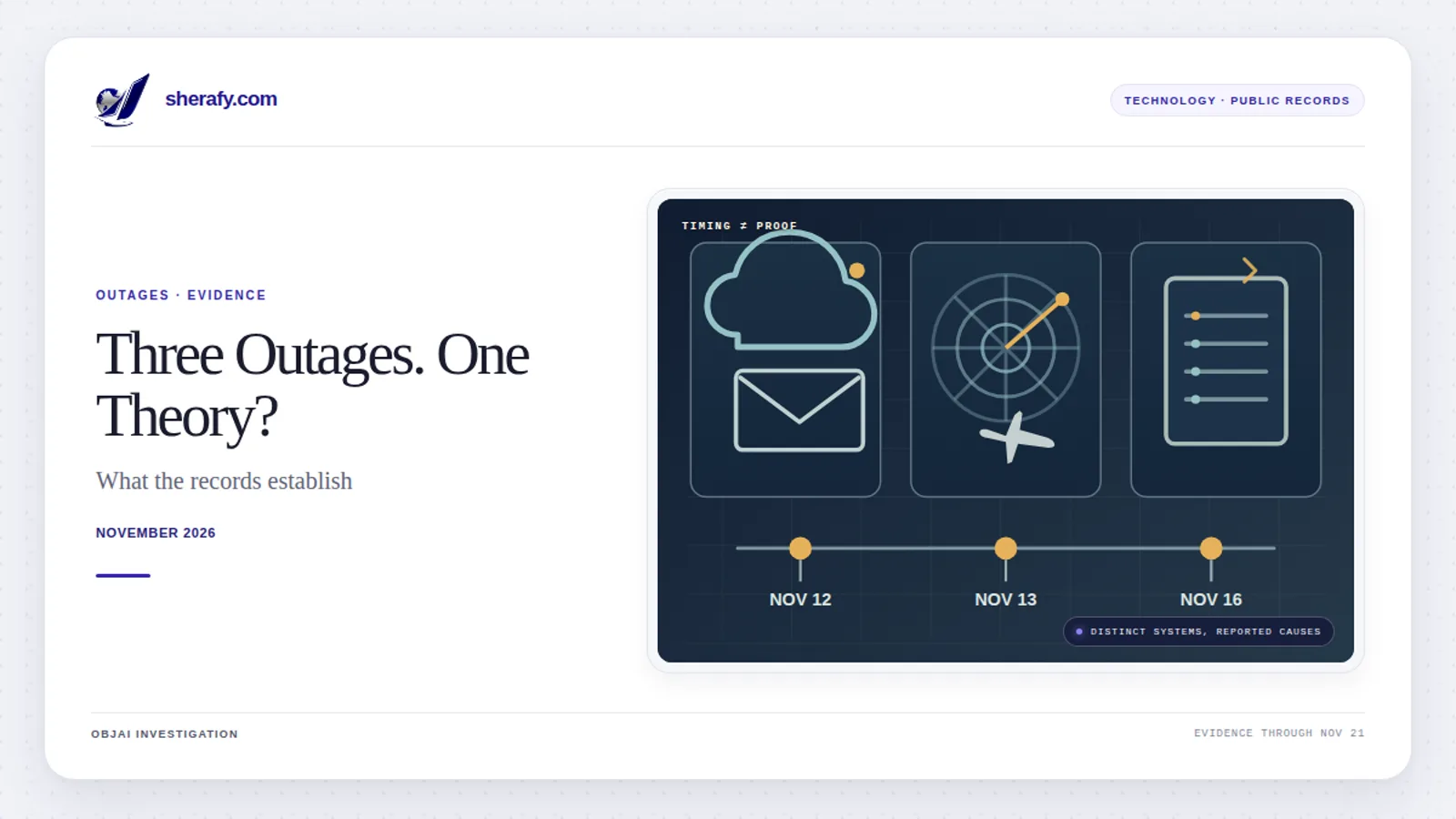
The Microsoft 365 disruption, nationwide FAA ground stop and JPMorgan Chase banking problems were real. There is no publicly established evidence, as of November 21, 2026, that they were coordinated or used to delete government records, conceal aircraft movements or transfer money without detection. The available technical accounts identify different failures, and the incidents did not occur at the same time.
That does not make every official explanation complete. Microsoft's newly released post-incident report identifies serious resilience and testing deficiencies. The FAA has disclosed a network-flooding failure during router replacement work, while senators are questioning why the equipment passed testing and why backup arrangements did not prevent the disruption. Chase has offered a more limited explanation of a software bug. Separately, congressional records demands and new White House rules governing access to information raise consequential oversight questions.
Those facts warrant scrutiny. They do not, by themselves, add up to a criminal cover-up.
This investigation compares the incidents against the primary documents, reconstructs the chronology and asks a more useful question than whether the timing looks suspicious: what evidence should exist if the alleged misconduct actually occurred?
Findings at a Glance
| Question | Finding as of November 21, 2026 |
|---|---|
| Did all three disruptions really happen? | Yes. The incidents are documented, although their viral descriptions often exaggerate their scope. |
| Did they happen simultaneously? | No. Microsoft's reported active customer impact ended before the FAA disruption began; the Chase problem followed on November 16. |
| Is there evidence of one coordinated cyberattack? | Not in the reviewed public record. The operators report distinct technical causes and have not disclosed a common malicious actor. |
| Were government records secretly erased? | Not established. Some Microsoft compliance and audit-search functions were impaired, but that is different from verified destruction of stored evidence. |
| Could the FAA ground stop hide flights? | No such operation has been established. Departures were restricted, while aircraft already airborne and certain essential operations continued. |
| Did the banking failure conceal money transfers? | Not established. Chase reported processing delays, not the elimination of bank ledgers or transaction records. |
| Are there legitimate federal oversight issues? | Yes. GAO documented FAA modernization weaknesses, and congressional records-preservation and information-access disputes are real. |
The distinction: An outage can be genuine, a government investigation can be genuine, and a technical system can have weaknesses without the outage having been engineered or exploited to defeat that investigation.
What Happened? A Verified November 2026 Outage Timeline
The sequence matters because the viral explanation often compresses several days into one supposed national shutdown. All times below are Eastern Standard Time (EST, UTC-5), unless indicated otherwise.
| Date | Event and documented scope | Primary evidence |
|---|---|---|
| May 6, 2025 | A Senate subcommittee minority letter directed World Liberty Financial to preserve records responsive to an inquiry into potential conflicts of interest. | Original Senate correspondence, enclosed with a November 2026 letter |
| Nov. 5, 2026 | Sen. Richard Blumenthal renewed the World Liberty Financial records request and alleged the company had not supplied responsive records. | November 5 Senate letter |
| Nov. 12, 11:20 a.m. | Microsoft's recorded Exchange Online incident began after a latent gateway-server defect was exposed under heavy load. Other connected Microsoft 365 functions were also affected. | Microsoft post-incident report, dated Nov. 20 |
| Nov. 13, 11:10 a.m. | Microsoft says customers were no longer experiencing active incident impact. Monitoring and delayed-mail recovery continued; formal closure followed later. | Microsoft final incident timeline |
| Nov. 13, approximately 3:30 p.m. | FAA telecommunications instability led to a nationwide ground stop restricting departures. | FAA questions and answers |
| Nov. 13, 8:15 p.m. | The FAA says the system had stabilized and the ground stop was lifted, although airlines continued recovering afterward. | FAA questions and answers |
| Nov. 16 | JPMorgan Chase reported transaction-processing delays resulting from an internal software problem, with downstream effects on some payments involving other banks. | Reuters' account of Chase's statement |
| Nov. 16 | The White House counsel's office required agencies to obtain White House approval before personnel agreed to congressional committee testimony, according to a memorandum reported by Axios. | Axios report on the memorandum |
| Nov. 17 | A public post by former Rep. Marjorie Taylor Greene closely matched the theory connecting deleting information, moving people or aircraft, and moving money. | Contemporaneous report reproducing the post |
| Nov. 18 | House Oversight Democrats released 12 document-preservation notices addressing prospective inquiries involving Trump associates, business interests, DHS and Epstein-related records. | House Oversight minority announcement and linked letters |
| Nov. 20 | Microsoft released its detailed technical report. President Trump separately signed Executive Order 14438 concerning federal contractors' responses to congressional requests. | Microsoft report; executive order |
A consequential timing detail: Microsoft says active customer impact ended at 11:10 a.m. on November 13. The FAA dates the onset of its problem to approximately 3:30 p.m., four hours and twenty minutes later. That does not exclude an unrelated action before or after either incident. It does contradict the impression that the two services were simultaneously switched off as part of one continuous blackout.
Likewise, Chase's reported problem occurred on November 16, three calendar days after the FAA disruption. The timing alone cannot establish an operational connection.
Readers looking for the full individual incident records can consult our separate investigations of the November Microsoft outage, FAA ground stop and Chase banking disruption.
Where Did the Cover-Up Theory Come From?
The claim circulated in a simple three-part form: an email and software outage could provide cover for deleting files; a nationwide aviation disruption could conceal movements; and a bank outage could conceal transfers. The viral retelling then added an explanation for why someone would want those things hidden: anticipated investigations of the Trump administration.
A November 17 post attributed to former Rep. Marjorie Taylor Greene used a close version of all three suggestions. The post supplied no specific deleted document, aircraft, passenger, bank account or suspicious transfer. It also did not establish a technical connection among the failures.
The origin of the formulation is not conclusively established. A speaker in the video supplied to sherafy.com described hearing it from another woman and wanted to credit her. Without that original post, recording or an independently established date, assigning the theory to a particular creator would be guesswork. Greene's identifiable public post documents circulation, not authorship of the idea.
The theory spread in a broader environment of real disruptions and rising anxiety. PolitiFact's November 20 review found no established coordination among the incidents and explained how recurring news about outages can encourage people to connect otherwise separate events. That is a useful caution, but psychology alone cannot settle a technical question. The way to test the allegation is to identify the proposed action and examine the records it would ordinarily leave.
Could the Microsoft Outage Have Been Used to Delete Government Files?
There is no public evidence here of a specific outage-related records deletion. Microsoft's report confirms real interruptions to compliance tools, but it does not establish that their stored evidence vanished.
This is the allegation with the most technical nuance, because the disruption affected more than Outlook inboxes.
What actually failed inside Microsoft 365?
In its November 20 post-incident report for incidents EX1550543 and MO1550821, Microsoft attributes the outage to a latent Windows connection-processing defect in a configuration used by Microsoft 365 gateway servers. The defect began deployment in July, remained unnoticed for months and became disruptive when several otherwise routine conditions converged.
Nearly 14% of the gateway's server capacity was temporarily out of service during ordinary operations. A routing problem had shifted Teams traffic onto infrastructure also serving Exchange Online. When North American business traffic approached its daily peak, the additional load exposed the defect, causing servers to become unresponsive.
Automatic traffic redirection then made the situation worse. As unhealthy servers stopped taking requests, traffic moved to other servers and increased their load. Microsoft says that at the worst point more than 80% of the affected North American gateway-server fleet was unresponsive. The company concluded that its pre-deployment testing had not adequately represented its newer, higher-core-count hardware and realistic traffic conditions.
That is a concrete account of how a software defect and ordinary recovery mechanisms can combine to cause a large failure. It is also a significant engineering-accountability finding. A resiliency feature intended to contain the outage helped spread it.
Microsoft says it found no malicious activity and that the incident was not a cyberattack. That is the company's forensic conclusion, not independent access to every system log. Nothing in the public technical record reviewed for this article contradicts it with affirmative evidence of a malicious actor.
What happened to Purview, eDiscovery and audit searches?
Microsoft says impacted users may have encountered problems opening the Microsoft Purview portal, delaying policy changes, processing and alerts. Affected capabilities included data-loss prevention, communication compliance, data lifecycle management, eDiscovery and audit searches. Elements of Microsoft Defender were also impaired.
Those details matter because organizations use these systems to monitor activity, find records and respond to litigation or investigations. But the functions must be distinguished:
| Function | What a disruption could mean | What it does not, by itself, prove |
|---|---|---|
| Mailbox or document access | A user cannot reliably reach information through an application. | That information was deleted from storage. |
| Audit search | An administrator cannot retrieve or search activity records normally. | That events stopped being recorded or that existing logs were erased. |
| eDiscovery search or export | Legal or compliance staff cannot promptly find or export responsive records. | That a preexisting preservation hold was removed. |
| Policy processing | Changes, matching or enforcement may be delayed. | That every control was disabled or that a malicious deletion occurred. |
| Permanent content loss | Records are actually missing from all applicable retained or recoverable locations. | This requires a different evidentiary showing from a failed search or login. |
Microsoft says customer data at rest was unaffected and that all queued enterprise messages were ultimately delivered, with no enterprise messages identified as permanently lost. Its detailed impact section adds a qualification: some messages sent to consumer mailboxes inactive for more than 30 days expired and generated nondelivery reports. That is a delivery exception, not evidence of government records destruction. Read the relevant Microsoft incident findings.
The published report does not provide a tenant-by-tenant audit-capture assessment for every organization. The honest conclusion is therefore limited: Microsoft reports no loss of stored customer data, and no evidence reviewed here identifies a particular destroyed government record. It would be premature to claim either that every possible audit event was preserved or that the outage created a window for undetectable deletion.
Does deleting a Microsoft 365 file erase the evidence?
Not necessarily. The result depends on the account, the service, the organization's settings, licensing, permissions, retention obligations and whether a hold was already in place.
Microsoft's Purview documentation describes overlapping mechanisms that can preserve content, including eDiscovery holds, litigation holds, retention policies and other recovery features. Material deleted from a normal user view may remain in a retained location. Microsoft also describes how authorized personnel can modify or remove holds, which means preservation controls are powerful but not invulnerable.
Microsoft's audit-retention documentation gives a standard default of 180 days for many audit events and longer default coverage for qualifying premium-licensed users and workloads. These are product defaults, not proof that any specific government organization had those settings or that all relevant activities were logged.
A credible deletion investigation would identify the custodian and specific document, determine the service and tenant where it was stored, examine relevant audit and retention-policy histories, and reconcile them against retained copies or other evidence. If the material was subject to a legal hold, changes affecting that hold would also matter.
Were the alleged government records even on the affected infrastructure?
This is a foundational question the viral theory skips.
Microsoft offers different U.S. government Microsoft 365 environments, including GCC, GCC High and DoD arrangements with separate compliance and content-handling commitments. These are not interchangeable with every commercial Microsoft 365 deployment. Some government institutions may use commercial services, government environments, other vendors or internal systems.
A disruption in a commercial service cannot simply be assumed to have disabled records preservation in a particular White House, Justice Department or congressional environment. We would first need to identify the actual system and show that its relevant functions were affected during the necessary time window.
Current finding: Microsoft's outage exposed documented resilience and compliance-tool vulnerabilities. It has not been connected in the reviewed evidence to a specific unauthorized deletion, destroyed legal hold or concealed government document.
Did the FAA Ground Stop Make Planes or People Untraceable?
No evidence reviewed identifies an aircraft or person whose movement was concealed by the November 13 ground stop. More fundamentally, a ground stop is a departure restriction, not a command that turns off every aircraft tracker, radar installation or flight record.
According to the FAA's November 15 account, its telecommunications network became unstable when legacy equipment was flooded with roughly 1,000 connection attempts every four to five seconds. The FAA identified two potential contributing locations: a radar site in Amarillo, Texas, and a radio-communications site in El Dorado, Arkansas. L3Harris, the network service provider, had been working at El Dorado, including deploying a new router.
The FAA says 17 of 22 Air Route Traffic Control Centers experienced instability, with effects extending to some terminal facilities. The disruption was consequential, but not total. Some radio frequencies and radar feeds remained usable. The agency says it blocked the two implicated sites, disabled a relevant feature on newly deployed routers and paused additional installations as an added precaution.
Approximately 3,500 aircraft already airborne continued to land, and critical military, law-enforcement and lifesaving operations were permitted to continue. The FAA reported 12,462 cancellations on November 13, including 9,082 by major airlines, while cautioning that not every cancellation was directly attributable to the ground stop. The Congressional Research Service's November 18 analysis also notes that inbound international flights continued to their destinations.
A public flight-tracking website is not an exhaustive legal register of every aircraft movement. Some flights, particularly sensitive government or military movements, are not displayed to the public in the same way as routine commercial traffic. But that limitation existed independently of the November 13 outage. An absence from public tracking data is not evidence that an aircraft used a network failure to travel secretly.
To test the allegation, investigators would need a specific tail number or aircraft, a time and location, an alleged passenger or cargo movement, and records that contradict its authorized flight or operational history. No such example has been substantiated in the material reviewed.
There is a genuine FAA accountability problem behind the failure
The November 16 letter from 13 senators to the Department of Transportation and FAA is much more specific than the viral claim. Citing information senators said L3Harris had provided, it describes a planned conversion of 3,648 routers to Juniper devices, with approximately 400 installed and 69 operational at that point. These are figures reported by the senators, not an independently audited inventory.
The letter says a sample of the devices passed pre-deployment testing. Senators question why those tests did not anticipate the operational failure, whether adequate redundancy existed and why public explanations initially emphasized old equipment when deployment of new devices appeared central to the triggering sequence. They requested a joint FAA-L3Harris-Juniper technical briefing and further information by November 23.
That is a genuine investigation into design, contractor oversight and operational testing. It also illustrates why two apparently conflicting accounts can both contain part of the explanation: new router behavior can trigger instability in an old network. The responsible question is which combinations of equipment, software, traffic and controls caused the actual failure, not whether the network was merely "old" or "new."
The available record supports examining operational accountability. It does not establish a hidden flight operation.
For the procurement and modernization background, see our separate FAA ground-stop and $50 billion funding investigation.
Could the Chase Banking Outage Have Concealed Money Transfers?
There is no identified transaction in the reviewed public evidence that was deliberately concealed using the November 16 Chase disruption. The fact that customers temporarily could not see or complete some banking actions does not establish that the underlying banking ledgers stopped recording money.
On November 16, Reuters reported JPMorgan Chase's statement attributing delays to a software bug affecting an on-premises hardware system. Chase said it had no evidence of a cyber cause, that customers retained access to their accounts and funds, and that other institutions could experience delays when they were counterparties to Chase transactions. The Associated Press also reported widespread customer complaints involving online banking and Zelle.
These reports are not evidence that every bank's processing core failed simultaneously. Some customers of other banks experienced downstream effects because financial transactions cross institutional boundaries. A problem at one institution can propagate to another bank's customers without the second bank suffering the same underlying defect.
A payment is not just a number displayed in an app
Several different stages matter:
- Instruction: A customer or authorized system initiates a payment.
- Processing: The bank or payment service validates and handles the instruction.
- Clearing and settlement: Depending on the payment rail, institutions exchange information and settle obligations.
- Posting and reconciliation: Records, balances and confirmations are updated and checked against other systems.
Different payment rails use different processes, so this is a simplified model rather than a description of one universal banking network.
A delayed posting, failed app session or pending transfer can occur without money having been secretly moved. Conversely, the existence of ordinary financial controls does not make unauthorized transactions impossible. Fraud investigators look for specific instructions, authorizations, transaction identifiers, ledger entries, counterparties, timestamps and reconciliation discrepancies.
U.S. financial rules also create recordkeeping obligations for qualifying transfers. FinCEN's funds-transfer guidance explains how required transaction records can help identify senders and recipients and generally must be kept for five years, subject to the scope and exceptions of the rules. Such records are not necessarily public, and the rules do not guarantee that every payment is fully traceable.
No public post-incident ledger audit reviewed here establishes a covert-transfer scheme tied to Chase's problem. That leaves a limit on what can be independently verified, not affirmative evidence of concealed activity.
There is also no documented link between the Chase incident and the separate congressional inquiry into World Liberty Financial. Both involve financial subjects, but that category overlap cannot substitute for a named account, payment rail or transaction.
For customer-facing effects and payment-system context, see our November 16 Chase outage investigation.
Could Separate Failures Still Be Exploited as Part of a Cover-Up?
In principle, yes. But coordinating outages, taking advantage of unrelated outages, and noticing a pattern after unrelated outages are three different hypotheses. They should not be treated as one accusation.
- Coordinated sabotage would require evidence that a common actor or group intentionally caused or directed the failures. A shared timeline alone does not identify that actor.
- Opportunistic concealment would require evidence that someone exploited an independently caused failure to carry out an unauthorized deletion, movement or transfer. The person need not have caused the outage, but the concealed act must still be established.
- Post-event pattern construction occurs when a memorable explanation is attached to events already in the news. It is a plausible account of how the claim circulated, but it should not replace technical investigation.
There is also a fourth explanation for the week's alarming headlines: complex services have shared dependencies and often fail in ways that affect thousands of people. That does not mean the Microsoft, FAA and Chase events shared a vendor, exploit or cause. It means each institution can contain a smaller failure poorly, creating disruption well beyond the original defect.
The distinction between possibility and evidence is fundamental. The fact that someone could theoretically misuse an administrator account, charter an aircraft or attempt to disguise a transfer is not evidence that anyone did so during these outages.
A strong investigation therefore asks what the alleged action would leave behind, what investigators can obtain, and what observed data contradict or corroborate the accusation. The answer may change with new records. Until then, the allegation remains unsubstantiated.
Were Government Investigations and Preservation Demands Already Underway?
Yes. Some important records-preservation demands began long before the November outages. This is one of the clearest ways to test the timeline suggested by the viral story.
A November 5, 2026 letter from Sen. Richard Blumenthal to World Liberty Financial says that the Senate Permanent Subcommittee on Investigations minority had been pursuing records about possible conflicts of interest connected to President Trump's cryptocurrency ventures. It also refers to, and includes, a May 6, 2025 letter directing preservation of responsive records.
Blumenthal alleged that the company had not adequately responded or produced responsive records and asked it to begin production by November 30, 2026. He warned that the subcommittee would consider additional measures if records were not voluntarily produced by January 4, 2027. These are statements and demands in a senator's correspondence. They are not a judicial finding that the company destroyed evidence, and they do not establish that any bank outage affected the requested material.
On November 18, House Oversight Democrats announced 12 preservation notices. The announcement identified proposed inquiries involving business interests of people associated with the president, Department of Homeland Security matters and the handling of Epstein-related records. The committee minority's press release contains allegations about those subjects; their inclusion in a notice is not proof that each allegation is true.
The sequence matters: a preservation demand is evidence that a requester wanted information retained. It does not reveal whether recipients complied, whether responsive material existed in the first place, or whether any later deletion was deliberate.
Preserving records, producing records and destroying records are different things
Federal information is not all governed by one rule:
| Record or dispute | Relevant distinction |
|---|---|
| Presidential records | The Presidential Records Act, 44 U.S.C. 2203, addresses documentation and preservation of records of the presidency, as defined by that law. |
| Federal agency records | Under 44 U.S.C. 3101, agency heads have duties to make and preserve adequate records of agency work. |
| Private-company records | Their obligations depend on the records, applicable law, litigation, instructions and other circumstances. They are not automatically presidential records because a politician has an ownership interest. |
| Congressional request or preservation notice | A request can identify material sought or demand that it be retained. Whether it has compulsory legal effect depends on its form, authority and context. |
| Withholding on a claimed privilege | A party may assert a legal basis not to disclose certain information. Whether that assertion is valid can be disputed. Withholding is not the same act as deleting. |
| Criminal record destruction | 18 U.S.C. 1519 addresses knowing destruction, concealment or falsification with intent to obstruct certain federal matters, including contemplated ones. Its elements must actually be met; a congressional dispute does not automatically establish a violation. |
The practical consequence is stark: neither a letter alleging nonproduction nor an IT outage proves destruction of evidence. An investigator needs the specific missing record, its custodian, the applicable preservation obligation, the act that caused its loss or concealment and evidence bearing on intent.
What Changed in the White House's Approach to Congressional Information?
The same week brought developments concerning access to government-related information. They are important, but they should not be mistaken for proof that the outages were deliberate.
On November 16, Axios reported a memorandum from White House counsel William O. Scharf directing executive agencies to secure approval from the White House Office of Legislative Affairs and Office of White House Counsel before agreeing to congressional testimony.
Then, on November 20, President Trump signed Executive Order 14438, Protecting the Executive's Privileges and Enhancing Efficiencies in Federal Contracting. It instructs federal contractors and subcontractors to notify the White House and contracting agencies of qualifying congressional requests involving their work or communications with the executive branch. It further directs coordination on responses and compliance with instructions concerning communications the administration determines are protected by executive privilege. Contracting consequences are contemplated for violations, subject to applicable law.
The White House argues that these steps protect confidential executive communications, preserve legitimate privileges and avoid uncoordinated disclosures. Congressional critics argue that they can restrict oversight and deter cooperation. Those are competing legal and institutional positions about the reach of executive privilege, not evidence that any specific document has been destroyed.
Existing law also matters. 5 U.S.C. 7211 protects federal employees' rights to petition or furnish information to Congress, while 41 U.S.C. 4712 provides anti-retaliation protections for qualifying contractor disclosures concerning specified wrongdoing. Those provisions operate alongside legal restrictions on certain information and disputes over legitimate privilege. The legality of a particular instruction or disclosure requires the facts of that case.
Because L3Harris provides telecommunications services to the FAA, a legitimate forward-looking question is whether the contractor order could affect a future congressional request for material concerning the November 13 failure. We have not established that L3Harris or another outage-related contractor has invoked the order to refuse a request. The order also came after all three major incidents, so it cannot be presented as their triggering cause.
For this investigation, the correct distinction is between an observable change in information-access procedures and an unproven allegation of evidence destruction. The former is documented; the latter requires additional proof.
What Did Federal Auditors Warn About Before the FAA Failure?
The strongest independently documented infrastructure-accountability finding predates November 13.
In its September 14, 2026 report on the FAA's Brand New Air Traffic Control System, the Government Accountability Office reported that the modernization program lacked a comprehensive, well-documented lifecycle cost estimate and an integrated master schedule. As of its review, the FAA had 11,389 individual project schedules that were not integrated or optimized across the initiative. That assessment largely reflects information available to GAO by May 2026.
GAO also reported that the FAA administrator had waived significant acquisition requirements in the interest of accelerating modernization. The agency warned that weak cost and schedule controls increased the risk of disruptive installations, overruns and continued reliance on obsolete systems. GAO did not conclude that these deficiencies caused the November 13 outage or established criminal corruption. Its findings matter because the risks were identified before the disruption occurred.
The financial figures require particular discipline. Congress had appropriated $12.5 billion in July 2025 to support modernization. That is not the same as money already spent. The November 16 Senate letter questioned why the administration had sought approximately $30 billion on November 12 and subsequently advocated $50 billion following the ground stop. These are requests or advocated funding amounts, not proof of expenditure or diversion.
The senators' question is a proper one: what changed in the assessment of need, and which specific vulnerabilities would the additional funds address? Answering it requires planning, engineering and budget documentation. It does not require inventing a covert financial transfer during the Chase outage.
The documented concern is that a high-stakes modernization program had known oversight weaknesses and then suffered a major operational failure. That finding stands on its own, even if the outage-conspiracy theory turns out to have no factual basis.
The Evidence Test: What Would Actually Change the Conclusion?
A useful investigation does not merely label allegations true or false. It specifies what records would make them testable.
| Allegation | Evidence needed to substantiate it | Current public-record position |
|---|---|---|
| Microsoft failure enabled records destruction | Identified custodian and system; affected tenant; deletion or hold-change events; retained copies or missing-record proof; relevant intent | No identified incident-linked act or destroyed record |
| FAA ground stop concealed a movement | Specific aircraft or person; contemporaneous operational or movement records; material discrepancy; evidence of concealment | No substantiated concealed movement |
| Chase disruption hid a transfer | Identified accounts or payment instructions; timestamps; ledger and settlement records; reconciliation discrepancy; evidence of deliberate concealment | No substantiated covert transaction |
| The three outages were orchestrated together | Communications, malicious technical artifacts, shared operational control or other reliable evidence linking the failures | Distinct reported mechanisms; no demonstrated common actor |
| Government investigations involved records wrongdoing | An actual missing or altered record, applicable duty, responsible actor, and evidence satisfying the relevant legal standard | Preservation requests and access disputes documented; destruction not established |
These standards also guard against selection bias. The three failures were chosen for the story because each could be paired rhetorically with an alleged purpose. Other technology problems occurred during the same period. Selecting three memorable events after the fact and assigning a motive to each is not the same as documenting that someone planned those events beforehand.
The appropriate investigative comparison asks what the evidence predicts under each explanation:
- If the incidents were separate operational failures, we would expect distinct technical sequences and no reliable record of a shared actor.
- If someone intentionally coordinated them, we would expect independent evidence of coordination, not only matching dates.
- If someone exploited a naturally occurring failure, we would expect a specific act tied to the affected service and time window, even if the outage itself was accidental.
- If the theory developed only after the headlines, we would expect its claimed purpose to be asserted without the specific logs, transactions, aircraft or documents that could verify it.
The available evidence currently fits separate operational failures more directly than the proposed covert operation. That is a comparative assessment of the reviewed record, not a statistical probability or a declaration that future evidence is impossible.
Frequently Asked Questions
Were the Microsoft, FAA and Chase outages connected?
No connection has been established in the publicly available evidence reviewed as of November 21, 2026. Microsoft describes a software and capacity interaction, the FAA describes network instability during router work, and Chase describes an internal transaction-processing bug. Sharing a news cycle is not proof of sharing a cause.
Was there a coordinated cyberattack against U.S. infrastructure?
None has been substantiated by the records examined here. Microsoft and the FAA reported no evidence of a malicious attack in their investigations to date, while Chase said it had no evidence of a cyber-related problem. These are attributed assessments, not a guarantee that every investigative question is closed.
Did the November 2026 Microsoft outage erase email or government documents?
Microsoft says stored customer data was unaffected and that queued enterprise email was delivered. The company acknowledged problems with audit searches and some compliance processing, but those failures do not independently establish that existing evidence was erased. The report does not identify government documents secretly destroyed during the incident.
Could deleted Microsoft 365 records still be recovered?
Often, depending on applicable retention policies, holds, account privileges and the particular service. A file's disappearance from a user interface is not necessarily permanent deletion. However, recovery is not guaranteed in every environment, and audit retention varies by configuration and license.
Did the FAA stop every airplane from flying?
No. The ground stop restricted departures. Approximately 3,500 aircraft already airborne continued to land, and essential flights could continue under safety procedures. Some radar and radio functions remained available.
Did the November 16 bank outage make customers' money disappear?
The public evidence chiefly describes customer-access complaints and transaction delays, with Chase saying customers retained access to accounts and funds. A temporary display or processing problem is not proof of permanent loss, but any individual unresolved transaction must be examined against that customer's actual bank records.
Were congressional investigations announced after the outages?
Some later preservation notices were announced on November 18, but congressional scrutiny of certain financial matters predated the outages. A Senate letter identifies a May 6, 2025 preservation request concerning World Liberty Financial.
Does Executive Order 14438 allow officials to destroy records?
The order addresses coordination and asserted privilege in responses to congressional requests by federal contractors and subcontractors. It does not, on its face, authorize destroying records. Whether a particular withholding decision is lawful is a separate question, and an unlawful destruction allegation requires independent evidence.
Methodology and Limits of This Investigation
This article compares the Microsoft post-incident report, FAA's incident explanation, congressional oversight letters, GAO audit findings, statutory text, White House executive-order text and independent reporting on the Chase failure and the spread of the viral theory.
Claims from Microsoft, the FAA, Chase, congressional offices and the White House are attributed to their respective sources. A published technical explanation is not the same as independent access to underlying logs. A congressional allegation is not a court finding. Where records are private, unproduced or not identified, the article says so rather than assuming their absence proves concealment.
No private Microsoft tenant logs, bank ledgers, nonpublic aircraft records or subpoenaed witness testimony were available for this review. This is a public-record investigation and technical evidence assessment, not a forensic examination of those systems or a criminal adjudication. The research cutoff is November 21, 2026. Material released afterward could alter individual findings.
The conclusion is neither that suspicious activity is impossible nor that coincidence proves a crime. The outages were real. The infrastructure weaknesses were real. The records-access disputes were real. The alleged criminal connection remains to be demonstrated.
References and Further Reading
Primary Technical and Government Records
- Microsoft 365 Post-Incident Report, EX1550543/MO1550821 (November 20, 2026) – Microsoft's detailed incident chronology, gateway defect, service impacts, restoration steps and engineering changes. This is a copy of the Microsoft-authored report hosted by an independent Microsoft 365 specialist, not a separate forensic audit.
- FAA: Nationwide Ground Stop, Questions and Answers (November 15, 2026) – Official account of the network flooding, affected facilities, continued flight operations and immediate mitigations.
- Senate Commerce Committee: Letter to DOT and FAA on the Ground Stop (November 16, 2026) – Congressional questions about the Juniper rollout, testing, redundancy, funding proposals and requested November 23 briefing. Contractor-supplied equipment figures are presented as senators' understanding.
- Government Accountability Office, GAO-26-107992: Air Traffic Control Systems (September 14, 2026) – Independent audit of FAA modernization cost and schedule planning, including 11,389 unintegrated project schedules.
- Microsoft Learn: Manage Audit Log Retention Policies – Explains default audit-retention periods and relevant licensing differences; not evidence of any particular customer's settings.
- Microsoft Learn: Manage Holds in eDiscovery – Explains mechanisms that can retain deleted or modified content and how holds may be administered.
- Microsoft Learn: Office 365 U.S. Government Service Description – Describes government cloud commitments and why commercial service impact cannot automatically be assigned to a particular government tenant.
- FinCEN: Funds Travel Regulations, Questions and Answers – Explains qualifying financial-transfer recordkeeping requirements and limitations.
Congressional Preservation and Federal Law
- Sen. Richard Blumenthal: November 5, 2026 Letter to World Liberty Financial, with May 6, 2025 Correspondence – Documents the earlier preservation request and later claims of inadequate production. The senator's allegations are not court findings.
- House Oversight Democrats: November 18, 2026 Preservation Notices – Official announcement linking to 12 notices and identifying proposed investigation subjects.
- Executive Order 14438: Protecting the Executive's Privileges and Enhancing Efficiencies in Federal Contracting – Primary text of the November 20 rules requiring notice and coordination about qualifying congressional requests.
- 44 U.S.C. 2203: Presidential Records – Presidential recordkeeping and custody provisions.
- 44 U.S.C. 3101: Federal Agency Records Management Duties – Agency heads' statutory record-preservation duties.
- 18 U.S.C. 1519: Destruction, Alteration or Falsification of Records – The statutory criminal rule and its intent requirement for covered federal matters.
- 5 U.S.C. 7211: Employees' Right to Petition Congress and 41 U.S.C. 4712: Contractor Whistleblower Protections – Relevant statutory protections for certain communications or disclosures, subject to their precise coverage.
Independent Reporting and Background
- Reuters: JPMorgan Says Software Bug Slows Its Transactions (November 16, 2026) – Reports Chase's explanation, downstream financial effects and statements from another affected bank; this is a Reuters story hosted by Investing.com.
- Associated Press: Technical Issue at JPMorgan Chase Triggers Banking Delays (November 16, 2026) – Independent reporting on customer-facing problems and affected payment services.
- Axios: White House Requires Signoff Before Agency Staffers Testify to Congress (November 16, 2026) – Original reporting on the White House counsel memorandum.
- PolitiFact: Why People Think Recent Tech Failures Must Be Connected (November 20, 2026) – Explains the viral connection narrative and limits of existing evidence.
- IBTimes UK: Marjorie Taylor Greene's November 17 Outage Claims – Preserves a near-exact public formulation of the viral theory; does not establish who first originated it.
Related sherafy.com Investigations
- Microsoft Outage, November 12-13, 2026: Cause, Status and Email Risks – Detailed incident-specific technical chronology. The newer November 20 Microsoft report should be used for the final root-cause account.
- FAA Nationwide Ground Stop, November 13, 2026: Cause, L3Harris and Funding Questions – Related reporting on aviation infrastructure, modernization and financing.
- Chase Bank Outage, November 16, 2026: Cause, Zelle and Other Banks – Customer effects and the distinction between Chase's fault and downstream problems at other institutions.
Editorial currency note: This investigation reflects records available through November 21, 2026. The Senate-requested FAA technical briefing was due November 23; World Liberty Financial records-production milestones were stated for November 30, 2026 and January 4, 2027. These are requested dates, not evidence that production or a briefing has occurred. Microsoft service guidance, executive-branch policies and legal rulings may change. Material updates should state what new document changed which finding.
—