A company can hire a remote software engineer, receive real work, and pay an ordinary salary without knowing that the person on its payroll is not the person doing the job. In documented North Korean IT-worker schemes, stolen or borrowed identities, U.S.-based laptop hosts, remote-access systems, and financial intermediaries make that possible. Some workers write the code themselves; others hire freelancers to do it. The wages can ultimately support North Korean state organizations, including organizations linked to its weapons programs.
This is not merely a theory about suspicious résumés. Americans have pleaded guilty to facilitating these operations, and federal court records show employer payments moving through domestic accounts to recipients overseas. But those records do not establish that every dollar from a particular paycheck can be followed all the way to the North Korean government, much less to a specific weapon.
The difference between what is documented and what is estimated is the key to understanding this operation. The FBI's October 13, 2026 advisory describes an expanding network of intermediaries, while Justice Department prosecutions reveal how the employment and financial arrangements work in individual cases.
How does the North Korean IT worker scam work?
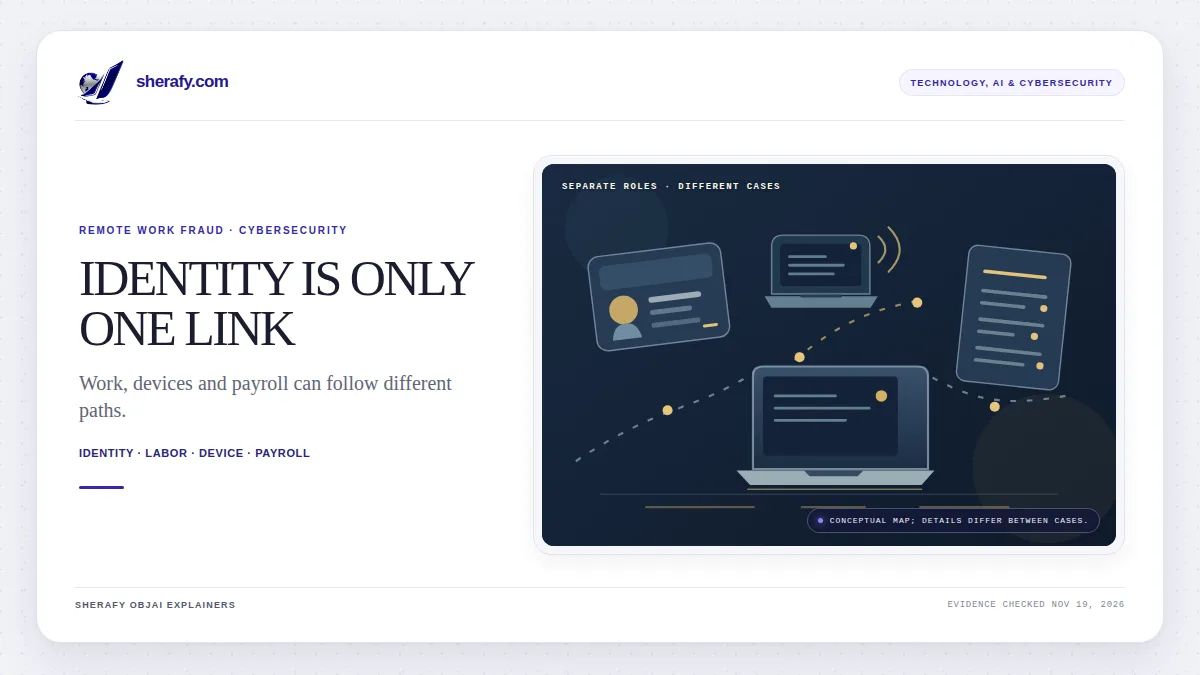
The basic operation has four parts: a claimed identity, a person doing the work, a computer that appears to be in an approved location, and a payment route. An employer may assume all four belong to the same employee. Investigations show they sometimes do not.
A fraudulent applicant may use a real American's stolen personal information or pay someone to lend a professional identity. Another person may attend an interview or verification appointment. Once hired, a remote worker may connect to an employer-issued computer being kept online at a U.S. residence. Meanwhile, salary payments may pass through accounts operated by facilitators before reaching recipients outside the United States.
These roles can be combined in different ways. No single case necessarily involves every intermediary described below.
| Part of the job | What a company may believe | What investigators have documented |
|---|---|---|
| Identity | The résumé, tax documents, and profile identify its employee | Identity information can be stolen, purchased, or willingly lent |
| Interview | The applicant speaking is the intended worker | A stand-in can attend, or an operative can interview under a false identity |
| Actual labor | The named employee is writing the code | A North Korean operative or a subcontracted freelancer may complete the work |
| Company laptop | A U.S.-located laptop means the employee is physically in the U.S. | A domestic host can maintain the laptop while someone abroad operates it |
| Payroll | Wages go to the person the employer hired | Salary may be received or redirected through a facilitator's account |
| Final proceeds | The named worker is the ultimate beneficiary | Foreign intermediaries and DPRK-affiliated organizations may receive a share |
The FBI reports that the system now includes paid Americans who lend identities, appear on camera, join interviews or meetings, complete identity checks, and keep employment devices connected. Its October 2026 warning also says some North Korean operators subcontract entire jobs to freelancers in other countries. Nisos, a corporate investigations firm, independently described three work arrangements: a U.S. intermediary as the public-facing employee while an operative works; an operative serving as both employee and worker; and an operative presenting as the employee while a separate subcontractor performs the work.
That last arrangement creates an uncomfortable possibility for employers: the submitted code may be good, the meetings may be productive, and the employee's claimed identity may still be fraudulent.
Why remote hiring creates an opening
Traditional hiring procedures usually answer separate questions: Does this résumé look credible? Does the applicant appear competent? Does the identification document pass a check? Does a company computer connect from an approved network?
None of those questions, by itself, proves that the same person is responsible for every stage of employment.
North Korean IT-worker networks exploit that separation. The June 2026 Nisos investigation describes purchased identity packages, manufactured employment histories, operatives verifying each other's references, and AI-assisted résumés and interviews. Nisos traced these practices to one network it assessed as DPRK-linked. Its attribution and counts are findings of a commercial investigator, not judicial determinations about every applicant.
The FBI has also seen operators pay to use established professional-networking accounts with years of authentic activity. An account's history can be genuine while its current operator is not the person who originally built it. The FBI specifically warns that verification of one document, a single video call, or a list of suspicious names is insufficient to identify the scheme reliably.
AI tools can help create convincing materials or generate interview responses, but AI use is not evidence of North Korean involvement. Neither is speaking with an accent, applying from abroad, or working legitimately as a contractor. The fraud is about misrepresentation, unauthorized access, concealed control, and payments, not a person's ethnicity or language.
What is a North Korean laptop farm?
A laptop farm is a location where a facilitator receives and operates, or simply keeps online, computers issued by employers to people hired under fraudulent identities. A remote operator can then access those computers from elsewhere, potentially making activity appear to originate from a familiar U.S. residential connection.
The term suggests a large room of machines, but a farm can also consist of a small number of devices in someone's home. According to the FBI, operators have increasingly distributed equipment across more locations with fewer devices at each, making a single seizure less disruptive. The FBI also describes the use of remote-desktop programs and hardware that relays keyboard, video, and mouse control over a network. Its October 2026 advisory emphasizes that the presence of these tools alone is not proof of wrongdoing; many have legitimate uses.
The Arizona case shows why the distinction matters
Christina Marie Chapman, an Arizona resident, pleaded guilty in February 2025 and was sentenced to 102 months in prison that July. According to the Justice Department's sentencing account, Chapman operated a laptop farm for workers posing as U.S. residents and helped obtain employment at 309 American companies and two companies abroad.
Federal agents seized more than 90 laptops from her residence. Prosecutors also said she shipped 49 employer-issued laptops and other devices overseas, including to a city in China near the North Korean border. The scheme compromised 68 U.S. identities and generated more than $17.1 million in revenue for Chapman and DPRK-linked participants.
Chapman's case is particularly revealing because the computers were only one layer. The Justice Department says she also received forged payroll checks and direct deposits, moved money to people overseas, and helped create false wage reporting under the names of Americans whose identities had been stolen or borrowed.
A victim's name could therefore appear on employment and tax records even though that person never took the job or received the wages. A company could have a genuine issued laptop, a functioning employee account, completed software tasks, and a fraudulent employee identity at the same time.
Following the paycheck: What the October 2026 indictment actually shows
The most useful public financial trail appears in a 58-page federal indictment filed in October 2026 in United States v. Sun Sheng Ming et al., in the Northern District of Ohio. The Justice Department announced the charges on October 13, describing a scheme affecting more than 70 U.S. employers and generating approximately $3 million in alleged IT-worker revenue.
Important legal distinction: An indictment is a grand jury's accusation, not a finding of guilt. The account figures below are what prosecutors allege the records show. They should not be confused with the separate schemes resolved through guilty pleas.
The underlying indictment, pages 50–51, paragraphs 366–372, lays out two instructive financial accounts:
| Indictment account | Money received | Money allegedly moved onward | What the figures prove and do not prove |
|---|---|---|---|
| Account attributed to a facilitator identified as Nolte, approximately March 2023–May 2025 | $158,675.54 in deposits from employer payroll and transfers from other accounts he controlled | $132,107.42 to money-transfer accounts outside the U.S., including $131,897.03 to accounts in China | An alleged domestic-to-overseas account trail. Not all incoming deposits were direct employer wages, and final government receipt is not shown for each transfer. |
| Account attributed to defendant Juan Cecilio Pena Carrillo, approximately February 2025–February 2026 | $190,510.39 in alleged fraudulent payroll from five victim companies | $155,204.80 through a separate transfer service for overseas co-conspirators | Alleged payments from identified victim employers followed by outward transfers. The filing does not establish that every outgoing dollar reached a named DPRK state account. |
One especially telling detail appears just before those amounts. Paragraph 363 says the facilitator identified as Nolte opened a business account for Dark Falls, LLC, describing the company to the bank as a remote service that received laptops and kept them operational and connected. The description was part of the account-opening record as recounted by prosecutors; it is not independent proof that the company's stated business was legitimate.
These records matter because they connect a domestic employment arrangement to specific payment accounts and overseas transfers. But the chain has an evidentiary stopping point. The indictment identifies overseas recipients and alleges a wider North Korea-linked conspiracy; it does not publish a complete, independently verified ledger from every employer's paycheck to a North Korean treasury account.
Nor is it valid to divide the outgoing transfers by the account deposits and call the result “the percentage North Korea received.” The account histories have different dates, mixed sources of funds, potential balances and fees, and incomplete downstream information. That ratio would give a false sense of precision.
Where does the money go after it leaves the United States?
Some payments move through conventional banks or online money-transfer providers; others are converted to cryptocurrency or passed through currency brokers and third-country representatives. Investigators have identified several arrangements, not one universal payment route.
The Financial Action Task Force's June 2025 report on proliferation financing, page 44, Box 26 illustrates a possible route: a worker sends digital assets to a DPRK manager in a third country; funds pass through local representatives and a currency broker; cash or balances in disguised accounts can then come under the control of other DPRK officials.
That FATF diagram is an illustrative typology, not the continuation of the specific Ohio indictment transfers. Joining those two sources into a single unbroken transaction would manufacture evidence that has not been published.
Treasury's sanctions actions show how the wider system operates through identifiable intermediaries:
- In March 2026, Treasury said a Vietnam-based intermediary converted approximately $2.5 million into cryptocurrency for North Koreans between mid-2023 and mid-2025, including proceeds associated with IT workers. The full $2.5 million was not attributed exclusively to IT salaries.
- In October 2026, Treasury attributed nearly $2 million in cryptocurrency conversions and at least $1.25 million in other currency transactions since January 2025 to a Russian intermediary acting for DPRK officials. A different intermediary was linked to about $3.5 million in cryptocurrency transaction conversions since 2024.
These are government attributions about separate networks. Transaction volume is not the same as net income, and repeatedly converting the same funds can generate more transaction volume without creating new earnings. Those amounts should not be added to the Ohio case, the Chapman case, or one another as if they were independent contributions to North Korea's national income.
What the financial evidence supports
| Financial question | Best-supported answer |
|---|---|
| Did American employers unknowingly pay workers operating under deceptive identities? | Yes. Guilty pleas, sentencing records, and investigative evidence establish that pattern. |
| Did domestic facilitators move some proceeds overseas? | Yes. Established in adjudicated cases; additional account-level transfers are alleged in the October 2026 indictment. |
| Do networks exist that convert and transfer proceeds for DPRK-linked organizations? | Yes, according to Treasury designations, multinational investigations, and financial-crime reporting. |
| Can every employer payment be followed through the same complete chain to Pyongyang? | No. The public evidence is fragmented across different cases and transaction networks. |
| Can a particular U.S. salary be shown to have purchased a particular missile? | Not from these records. Evidence of revenue supporting affiliated state organizations is not a transaction-level proof of a specific weapons purchase. |
That last distinction is essential. It is possible to establish a state-directed revenue operation without pretending investigators have published every intermediate payment or ultimate expenditure.
How much money does North Korea make from remote IT workers?
The most useful current IT-worker-specific worldwide estimate remains $350 million to $800 million for 2024. It appears on page 52 of the Multilateral Sanctions Monitoring Team's October 22, 2025 report. The team draws on information supplied by participating governments and other corroborating material. It calls the figure an estimate of what North Korea likely earned, not a full audited accounting of every worker's contract and remittance.
The U.S. Treasury's March 2026 statement that the activity generated nearly $800 million in 2024 is consistent with the high end of that range. It should not be presented as a second, independent measurement confirming an exact $800 million.
Do workers keep their earnings?
Not necessarily. The multilateral report describes workers being required to send substantial portions of income to managers and affiliated organizations. Depending on the arrangement, some may retain as little as 5–10% of gross earnings. The FBI's October 2026 advisory separately estimates that the North Korean government receives 85–90% of revenue generated by participating actors.
Those are attributed estimates with different scopes. They do not establish that every worker has the same salary split, that every intermediary takes a fixed fee, or that multiplying a specific American paycheck by 90% reveals its actual final beneficiary.
A further source of confusion is a different 2026 figure. The multilateral team's September 2026 report estimated $450 million to $800 million annually from North Korean overseas laborers broadly, including manufacturing, construction, and other occupations. As Japan's Foreign Ministry explained when releasing that report, it is not an updated IT-only total to be stacked on top of the 2024 figure.
What has actually been proved in court?
The public record is strongest when cases are kept separate and their legal status is made explicit.
| Case or investigation | Established or reported findings | Evidence status as of November 19, 2026 |
|---|---|---|
| Christina Marie Chapman, Arizona | Employment at 309 U.S. companies; 68 compromised identities; more than $17.1 million generated | Guilty plea and 2025 sentencing |
| Kejia Wang and Zhenxing Wang, New Jersey | More than 100 U.S. companies affected; at least 80 compromised identities; more than $5 million in revenue | Guilty pleas and April 2026 sentencings |
| John Allen Kurrle Jr., Virginia | Lent identities and hosted devices in a scheme in which applications produced nine job offers | Guilty plea, October 2026; sentencing scheduled January 28, 2027 |
| Sun Sheng Ming and co-defendants, Ohio | Approximately $3 million in alleged scheme revenue; account-level deposits and overseas transfers | October 2026 indictment; allegations, not a verdict |
The April 15, 2026 sentencing announcement for Kejia and Zhenxing Wang adds an important security dimension. DOJ says people employed through that scheme gained access to sensitive corporate information, including source code and data subject to U.S. defense export controls. That shows why unauthorized employment can become a serious information-security problem even when the entry point was a job application rather than a conventional network hack.
The October 28, 2026 guilty plea of John Allen Kurrle Jr. raises a different concern. DOJ says he worked for a defense contractor, held an active Top Secret clearance with access to sensitive compartmented information, lent his identity for applications, and hosted company laptops that could be accessed from abroad. The nine offers are documented in the government's announcement. That announcement does not establish that classified information was stolen.
These are distinct investigations. Their revenues cannot responsibly be added together into a single unduplicated national total, and the existence of a guilty plea in one case does not prove allegations in another.
How widespread is the North Korean IT worker operation?
There is no reliable public count of every North Korean remote worker, every fraudulent hire, or every compromised American employer. The available figures measure different things.
A Nisos investigation published June 16, 2026 attributes 166,893 job applications, more than 21,645 interviews, and at least 76 job offers to a network of approximately 22 suspected operatives between December 2024 and September 2025. Those are observations about one investigated network, not a census of North Korean hiring fraud.
Using Nisos's detailed published counts:
76 offers ÷ 166,893 applications = approximately 0.046%, or one offer per 2,196 applications.
This is an application-to-offer ratio, not the proportion of offers that became completed hires. There is also a small but important discrepancy in Nisos's presentation: its executive summary says “more than 170,000” applications, while its detailed public count says at least 166,893. A separate Nisos explanation calls 0.35% an application-to-offer conversion rate, but 0.35% is much closer to 76 offers divided by 21,645 interviews. We use the explicit counts and identify the denominator instead of repeating a mismatched percentage.
The volume helps explain the economics of the scheme. A network does not need to win most applications if it can submit extraordinary numbers of them and maintain several personas and jobs simultaneously.
More recent research illustrates a different measurement. On November 10, 2026, Material Security reported observing 2,429 suspected DPRK-linked applicant personas across its own visibility in one year. Of those, 27 reached some onboarding activity, a category that included offer letters, background checks, equipment requests, or first-day IT setup. It did not report 27 confirmed North Korean employees successfully placed in companies.
Meanwhile, the Justice Department's October 2026 coordinated operation involved law-enforcement action at more than 40 known or suspected laptop-farm residences in Texas and the seizure of approximately 187 laptops and keyboard-video-mouse devices. That is a count of devices, not 187 workers or 187 convictions.
A vendor's suspected personas, a law-enforcement seizure, an interview count, and a national revenue estimate are not interchangeable measures of prevalence. They show that the activity is persistent and organized, but not an exact worldwide worker population.
Is this espionage, employment fraud, or sanctions evasion?
Revenue generation is central. North Korea's state-directed IT-worker arrangements allow workers to earn foreign income while concealing affiliations that would prevent or complicate legitimate employment and payments. False identities, falsified employment forms, wire fraud, identity theft, and money laundering appear in criminal cases. Transactions involving sanctioned entities also create sanctions-compliance risks.
That does not mean the security threat ends at payroll. A hired developer may obtain legitimate credentials to source-code repositories, production systems, employee records, or customer data. The FBI warns that some operators record screens, remove data, extort former employers, and threaten disclosure of proprietary information. Its latest advisory describes extortion and threats, while the Wang case documents access to sensitive employer materials.
Still, three claims should not be collapsed into one:
- Employment fraud: The claimed employee identity or location is deceptive.
- Sanctions-related revenue: Funds are generated for, or transferred through, prohibited or state-affiliated arrangements.
- Espionage or data theft: A worker accesses or exfiltrates information for an unauthorized purpose.
An operation can involve all three, but evidence of the first does not automatically establish the third. Likewise, North Korean IT-worker employment fraud should not be casually equated with every separate North Korea-linked hacking campaign. The tactics, actors, victims, and available proof can differ.
Can an unwitting employer face sanctions consequences?
Potentially, but not automatically in the way alarming headlines sometimes imply. The Treasury's March 2026 sanctions notice explains that certain dealings with blocked persons are prohibited and that the Office of Foreign Assets Control may impose civil penalties under a strict-liability framework. Whether a particular company's conduct creates liability depends on the parties, transactions, applicable restrictions, authorizations, and circumstances.
An employer that was deceived is not thereby proven to have committed a crime. Companies discovering possible exposure should preserve records, involve legal and security teams, and consider notifying appropriate authorities rather than assuming either that nothing matters or that every payment was necessarily a criminal offense.
How can companies detect fraudulent remote IT workers without profiling innocent applicants?
The most useful principle in the FBI's October 2026 guidance is identity in depth: verify the continuity between the applicant, the person interviewed, the person onboarded, the person operating company equipment, and the recipient of employment payments. Use several corroborating checks throughout employment, not one dramatic “gotcha” question.
For employers, a defensible response has five components:
- Verify identity and continuity. Confirm that the applicant, interview participant, onboarding documents, and eventual employee form a consistent record. Escalate discrepancies for a fair, documented review rather than treating one mismatch as proof of foreign involvement.
- Control company-issued devices. Maintain an inventory of where equipment was shipped, who accepted it, who operates it, and whether access methods match authorized business needs. Review unexpected remote-control hardware or software with context.
- Limit unnecessary access. Apply least-privilege permissions, especially for source code, customer data, production credentials, and sensitive government-related information. Reassess permissions after unusual account or device changes.
- Connect HR, IT, security, finance, and legal findings. A plausible hiring record may look different when compared with equipment locations, account ownership, payment changes, or repeated anomalies across employees.
- Preserve evidence and report credible concerns. Keep relevant hiring communications, access logs, device records, and payment information. The FBI asks victims or potential victims to contact a local FBI field office and submit a report through the Internet Crime Complaint Center.
Do not use nationality, accent, surname, appearance, or lawful use of remote-work software as a stand-alone fraud detector. The FBI explicitly warns that aggressive filters can create false positives, harm innocent workers, and even exclude people whose identities have been stolen by the perpetrators.
What if your identity was used to get one of these jobs?
The harm is not confined to the employer. A person whose Social Security number was used in a fraudulent job application may later encounter wage records for work they never performed. The Chapman prosecution documented false tax liabilities attached to identity victims.
The IRS's employment-related identity theft guidance explains the appropriate response to notices involving wages you did not earn: follow the notice instructions, review earnings with the Social Security Administration when necessary, protect financial accounts, and consider an IRS Identity Protection PIN. The federal government's IdentityTheft.gov can guide victims through a recovery plan.
Not every notice requires filing IRS Form 14039. The IRS says most people do not need to file it, and some affected accounts have already been flagged. Follow the current instructions for the notice or tax problem you actually received.
Questions readers are asking
Are North Korean IT workers actually located in North Korea?
Some may be. Others operate from third countries or through remotely controlled computers in the United States. Nisos assessed that some people in its investigated network may have been in North Korea, while other members appeared dispersed internationally. The location of an employer's laptop does not establish the location or nationality of its operator.
Do the fake employees know how to code?
Often, yes. The scheme takes advantage of real demand for programmers, designers, and other technical workers. Some operatives perform legitimate deliverables under false employment identities. In other cases, they subcontract the actual work. The problem is not necessarily that the code fails; it is that the employer cannot reliably identify the person or organization controlling the work, system access, and payments.
Can E-Verify or a video interview stop the scam?
They can help, but neither is a complete solution. A genuine identity may be misused, verification steps may be performed by a paid facilitator, and an authorized-looking device may be operated remotely. The FBI recommends layered, repeated checks and proportionate investigation of multiple indicators.
Is every suspicious remote applicant connected to North Korea?
No. Identity fraud and deceptive hiring also occur without DPRK involvement. A strange interview, a mismatched address, or remote-desktop software cannot establish a person's nationality or state affiliation. Attribution requires corroborating evidence, and innocent people deserve meaningful review before adverse conclusions are reached.
Does every dollar from these jobs go to North Korea's weapons program?
No such universal transaction-by-transaction finding is publicly established. Governments have documented and attributed revenue flows to DPRK state organizations, some associated with weapons development, but worker pay, facilitator fees, other expenses, intermediary transfers, and final uses vary. A national estimate is not a receipt for an individual missile purchase.
The larger failure the cases expose
The cases are often described as North Korea fooling American companies with fake résumés. That description is incomplete. The more consequential weakness is the assumption that a convincing employment file links a single, verified human being to the interview, the work, the computer, the bank account, and the ultimate paycheck.
Court records establish that domestic facilitators helped break that link. The FBI documents how the process is adapting. International financial investigators show how proceeds can move through still more intermediaries. The publicly available evidence does not reveal every last recipient, but it reveals enough to establish the business model and its risks.
A résumé can be authentic-looking, a laptop can be real, and the work can be completed. None of that proves the company knows who it hired or who it is paying.
References and Further Reading
Primary court records and federal enforcement
- FBI, North Korean IT Workers Expanding Use of Facilitators, Broadening Recruitment (October 13, 2026). The most recent detailed public advisory on identity misuse, U.S. facilitators, outsourced labor, extortion, and layered employer defenses.
- U.S. Department of Justice, United States v. Sun Sheng Ming et al., federal indictment (October 2026). The underlying 58-page charging document. See printed pages 50–51, paragraphs 363–372, for the account-opening statement and alleged payroll and international-transfer figures. Charges are not convictions.
- U.S. Department of Justice, coordinated North Korean remote-worker enforcement actions (October 13, 2026). Provides the broader Ohio allegations, more than 70 alleged victim employers, and Texas laptop-farm seizures.
- U.S. Attorney's Office for the District of Columbia, Christina Marie Chapman sentencing (July 24, 2025). An adjudicated case documenting compromised identities, employment, payroll, laptops, overseas transfers, and harm to identity-theft victims.
- U.S. Department of Justice, Kejia Wang and Zhenxing Wang sentencings (April 15, 2026). A separate adjudicated scheme involving more than 100 companies, laptop farms, money transfers, and sensitive employer data.
- U.S. Attorney's Office for the Eastern District of Virginia, John Allen Kurrle Jr. guilty plea (October 28, 2026). Evidence of identity and device facilitation involving an employee with a security clearance; does not announce a classified-information theft finding.
State-linked revenue and international financial mechanisms
- Multilateral Sanctions Monitoring Team, The DPRK's Violation and Evasion of UN Sanctions through Cyber and Information Technology Worker Activities (October 22, 2025). Page 52 supplies the 2024 worldwide $350 million–$800 million IT-worker revenue estimate and discusses wage remittances to affiliated organizations.
- Financial Action Task Force, Complex Proliferation Financing and Sanctions Evasion Schemes (June 2025). Page 44, Box 26, is an illustrative DPRK IT-worker proceeds route through virtual assets, brokers, and cash. It is not a trace of the Ohio indictment payments.
- U.S. Treasury, sanctions targeting DPRK IT-worker facilitators (March 12, 2026). Describes a Vietnam-based cryptocurrency conversion intermediary and the legal implications of dealings with blocked persons.
- U.S. Treasury, sanctions targeting additional DPRK IT-worker networks (October 28, 2026). Identifies Russia-linked intermediaries and distinguishes currency-conversion transaction volume from underlying worker income.
- Japan Ministry of Foreign Affairs, release of the MSMT report on North Korean overseas labor (September 16, 2026). Clarifies that the newer $450 million–$800 million annual estimate covers overseas labor broadly, not IT workers alone.
Original technical research and victim guidance
- Nisos, People, Process, Personas: DPRK Employment Fraud Schemes (June 16, 2026). Commercial investigator's account of one suspected network's labor arrangements, identity tactics, and internal organization. Its reported totals should not be generalized to all cases.
- Nisos, announcement of its employment-fraud investigation (June 16, 2026). Source of the detailed 166,893 applications, 21,645 interviews, and 76-offer counts used for the article's calculation.
- Nisos, Inside a DPRK Employment Fraud Operation (June 18, 2026). Helpful additional operating details; its stated conversion-rate label does not match the published raw denominators.
- Material Security, A Thousand Masks: Where the DPRK IT-Worker Threat Meets Your Data (November 10, 2026). Vendor telemetry on suspected personas and onboarding activity, not a count of confirmed DPRK hires.
- IRS, Employment-Related Identity Theft. Official guidance for people whose Social Security number or wage record may have been misused to obtain a job.
Editorial currency note: Research and case statuses were checked against public sources available on November 19, 2026. Indictments, sentencing schedules, sanctions designations, and revenue estimates may change. The Ohio case is described as allegations unless and until a later court resolution establishes otherwise. Estimates and vendor findings are attributed to their respective sources.