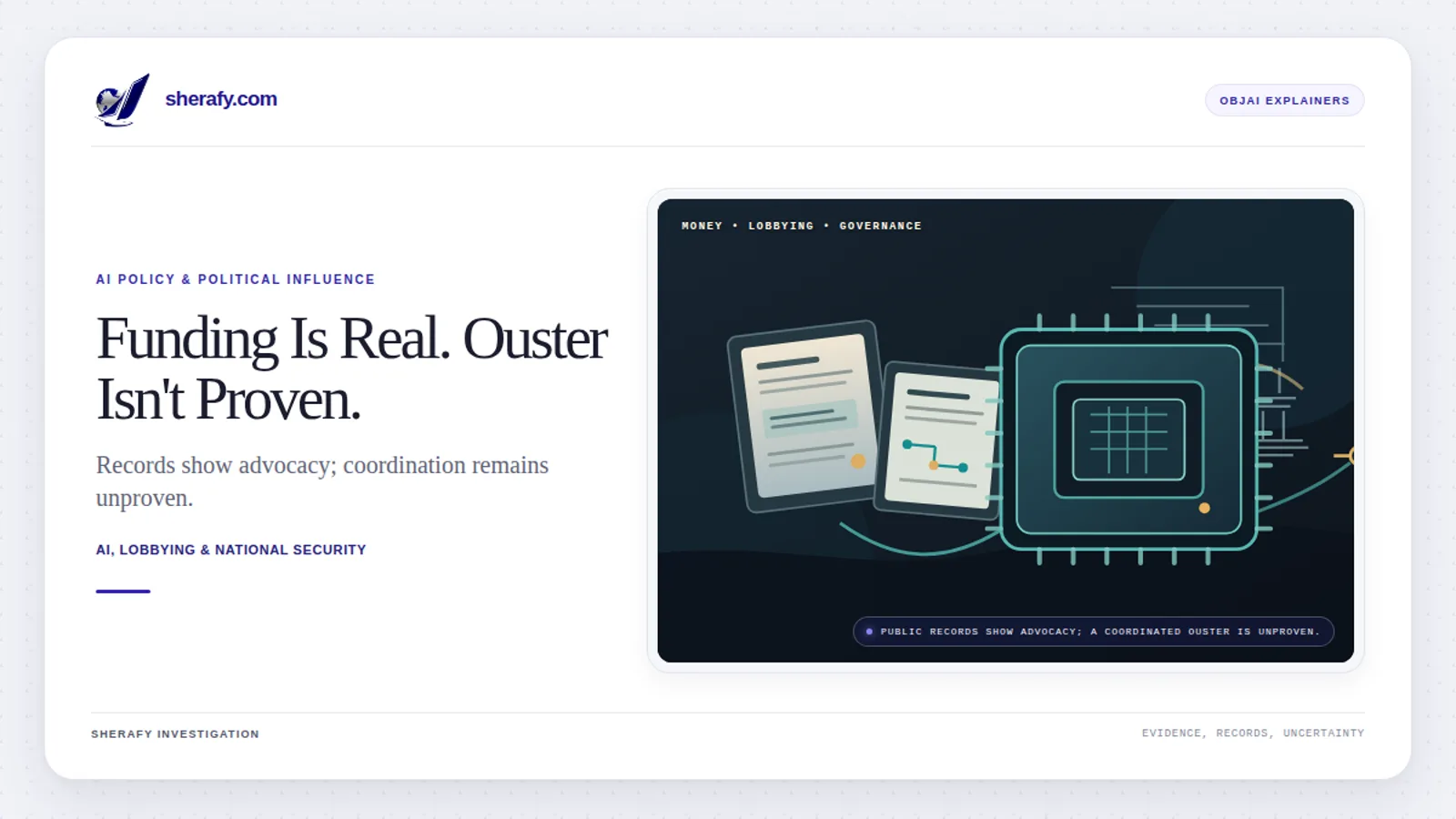
There is no public evidence that Anthropic organized Jensen Huang's removal from NVIDIA. But the political connections driving the suspicion are real, the money is substantial, and the policy consequences are already visible. Anthropic announced $40 million in donations to an AI-policy advocacy group. Its own lobbying disclosure names several chip-security bills. That advocacy group announced advertisements highlighting lawmakers who later scrutinized Huang. And after he left NVIDIA, congressional leaders explicitly invoked his scandal to push some of those same bills.
Those findings are documented in Anthropic's July 2026 funding announcement, its third-quarter federal lobbying disclosure, Public First Action's advertising announcement, and the November 12 congressional statement.
The strongest inference is not that Anthropic invented the scandal. It is that a preexisting, well-financed coalition had the means, motive and opportunity to use Huang's downfall to advance a policy agenda it had pursued for months. That does not tell us who leaked intelligence, who influenced NVIDIA's directors, or whether any organization coordinated a campaign against him. It tells us where to investigate.
Skepticism is warranted in both directions. It would be naive to dismiss a fight involving billions of dollars in AI business interests, political funding and semiconductor access as nothing but a CEO's private embarrassment. It would be equally unsound to turn overlapping interests into proof that every participant followed a secret set of instructions.
The distinction matters because a political influence operation can be real and consequential without a covert CEO-removal operation being proven. The public deserves an account of how both possibilities can be evaluated.
The short answer: What is established, and what is not?
| Question | Best-supported answer as of November 15, 2026 |
|---|---|
| Did Jensen Huang leave NVIDIA? | Yes. NVIDIA's board accepted his resignation effective November 11 and appointed longtime CFO Colette Kress interim CEO. |
| Did Anthropic give Public First Action $40 million? | Yes. Anthropic announced $20 million in February and another $20 million in July. |
| Did Anthropic-linked political groups spend money on elections? | Yes, through distinct entities. Public First Action transferred more than $24 million to affiliated super PACs by the period examined by Campaign Legal Center; AnthroPAC separately made candidate contributions. The sources of individual transfers must not be conflated. |
| Did associated advocacy highlight lawmakers who challenged Huang? | Yes. Public First Action announced advertisements highlighting Brian Mast and John Moolenaar. Their later letters demanded answers, not Huang's resignation. |
| Did Anthropic lobby on bills promoted after his departure? | Yes. Three specifically named bills overlap between the company's Q3 lobbying disclosure and the lawmakers' November 12 statement. |
| Did some politicians demand Huang resign? | Yes. Republican Senator Kevin Cramer publicly did. That is not the same as saying Mast, Moolenaar or Chris Coons demanded it. |
| Did U.S. intelligence definitively establish Alice Huang was a Chinese spy? | Not publicly. Major outlets reported intelligence suspicions; CNN subsequently reported disagreement among U.S. officials about whether the evidence proved espionage. |
| Did Anthropic direct the disclosures or NVIDIA's board? | Not established. No authenticated instructions, communications, payment trail or board record reviewed for this article proves such coordination. |
The NVIDIA SEC Form 8-K records the resignation, but does not state why Huang resigned. That missing explanation is important. Reporting can identify compelling pressures, but it should not be presented as a final board finding.
Why should an affair cost the founder of NVIDIA his job?
This is the objection much of the coverage fails to address seriously. Powerful executives have affairs. Some survive much worse personal scandals. Why would a CEO who helped build one of the world's most consequential companies suddenly lose control of it over infidelity?
An affair alone does not adequately explain this episode. It is not a securities-law violation merely to be unfaithful, and it is not an automatic disqualification from serving as a public-company CEO. NVIDIA's November 8 statement even said its board had confidence in Huang and then had no reason to believe national-security or company secrets had been compromised.
That is the starting point, not the end of the inquiry.
Four additional issues changed the stakes.
1. The relationship reportedly involved a major customer under scrutiny
Alice Huang was a former executive of Singapore-based Megaspeed International, a company involved in transactions for advanced AI computing equipment. U.S. authorities were already scrutinizing possible chip diversion through intermediaries. An intimate relationship between a supplier's CEO and a senior figure connected to a scrutinized customer can raise conflict-of-interest, preferential-treatment, due-diligence and executive-judgment questions even if neither person is a spy.
The questions are practical: Did the relationship overlap with purchasing decisions? Were customer risks escalated normally? Were approvals or exceptions made? Did relevant compliance staff know enough to assess potential conflicts? Those matters require records, not moral judgments about marriage.
For the underlying customer transactions, Singapore's investigation and the disputed hardware figures, see sherafy.com's separate examination of Jensen Huang, Alice Huang and the Megaspeed chip trail.
2. The intelligence allegation introduced possible leverage, but not proven blackmail
An undisclosed relationship can create a counterintelligence vulnerability if another actor can threaten exposure or exploit access to sensitive conversations. That is a reason for a company to investigate. It is not evidence that threats were made, secrets were transferred, or the person involved actually worked for an intelligence service.
This distinction has become more significant, not less. In a November 12 CNN investigation, multiple sources said intelligence gathered about Alice Huang had not proved that she spied for Beijing and that officials disagreed over the strength of the allegation. Attorney General Todd Blanche said no determination had been reached about who she was or was not. China denied the espionage claims.
Singapore's November 12 Ministry of Home Affairs statement also draws an important line. Its authorities investigated possible false declarations linked to servers and said Alice Huang was not investigated for espionage. They found insufficient evidence to establish her involvement in the suspected declaration offenses, but said she knowingly gave investigators inaccurate information about her role, issued a warning and barred her from re-entering. Their inquiry into Megaspeed and six other people continued.
Those findings do not resolve classified U.S. intelligence reporting. They do refute any attempt to portray the espionage allegation as a publicly adjudicated fact. Nationality is not evidence of espionage. The relevant question is what specific intelligence and conduct can be substantiated.
3. A separate reported workplace relationship raised a different governance problem
In addition to Alice Huang, The New York Times reported, as detailed by Axios that Huang had a relationship with an NVIDIA executive who reported to him. Other reporting described another employee relationship. The particulars remain attributed reporting rather than publicly released investigative findings.
A relationship involving someone in the CEO's reporting structure can create questions about favoritism, career decisions, consent, retaliation risks and whether a company's rules were applied consistently. The board must assess those issues whether the executive is brilliant, popular or exceptionally profitable.
That does not mean misconduct or coercion has been established. It explains why the issue cannot be dismissed as exclusively private.
4. Reuters uncovered a possible candor problem inside NVIDIA
On November 13, Reuters reported reviewing October correspondence in which Huang described interactions with Alice Huang and Megaspeed to senior NVIDIA officials, including general counsel Tim Teter, as ordinary customer dealings. According to Reuters' reporting and its sources, those descriptions were misleading in light of the affair.
This matters for reasons separate from infidelity. Directors and legal officers depend on accurate information from executives when assessing conflicts, litigation, public disclosures and national-security exposure. If a chief executive withheld material context while company officials were evaluating those risks, trust inside the organization could be damaged independently of any espionage allegation.
But there is an evidentiary limit: Reuters published this investigation after Huang's resignation. It does not prove which messages the board reviewed before its decision or establish that those messages caused the resignation.
What actually changed between November 8 and November 11?
The sequence is striking. On November 8, the board publicly expressed confidence. On November 10, independent directors identified outside legal counsel for the review. On November 11, reports about an additional relationship involving a company executive intensified; Reuters reported the board was weighing Huang's future. That day, the board accepted his resignation.
Reasonable inference: The crisis had expanded beyond public reaction to a marital affair into a wider set of governance, personnel and national-security questions. The board may have concluded that the cost of prolonged uncertainty was too high.
Unknown: Whether directors independently reached that conclusion, what private evidence they considered, or whether external pressure influenced the precise timing. The board has not published a definitive explanation, and no outside observer should invent one.
This is why the skepticism is reasonable. An affair was not necessarily enough; the combination of the relationship, its possible strategic context, additional reporting, and the company's internal response is a more credible explanation. It remains an explanation to test, not a sworn account of what happened in the boardroom.
Follow the money: What Anthropic paid, and what it did not directly pay
The money trail is more substantial than the viral videos describe, but the organizations must be kept separate. Otherwise, it is easy to double-count spending or turn legally different activities into one imaginary bank account.
The $40 million: Anthropic to Public First Action
Anthropic's February 12 announcement committed $20 million to Public First Action. Its July 21 announcement added another $20 million, bringing announced support to $40 million. Anthropic expressly supported tighter export controls on advanced chips and chipmaking equipment alongside model-safety and transparency policies.
Public First Action describes itself as a bipartisan 501(c)(4) social-welfare advocacy organization. Anthropic says its two corporate donations were restricted to public education and policy activities and could not be used to influence any candidate election.
That restriction is not a small footnote. A nonprofit's issue advocacy, its involvement in electoral activity and the financing of an affiliated super PAC operate under different legal and disclosure rules.
The other money: transfers to super PACs
The nonpartisan nonprofit Campaign Legal Center reported in September 2026 that Public First Action had transferred more than $24 million to affiliated super PACs. It identified the broader Public First network, including the Public First super PAC, Jobs and Democracy PAC and Defending Our Values PAC. It also reported significant election spending by those committees.
That does not mean Anthropic secretly paid an additional $24 million on top of its $40 million. Public First Action said it had raised around $100 million from a range of donors. Transfers between affiliated organizations can appear as receipts in one place and spending in another. Adding each headline amount as if it were newly created money is bad accounting.
The Public First super PAC's FEC-derived donor records identify a $1 million personal contribution from Anthropic CEO Dario Amodei on May 4 and a $1 million transfer from Public First Action Inc. dated February 24. Other Anthropic employees contributed personally. The personal contribution is not the same transaction as Anthropic's corporate gift.
The February 24 transfer occurred after Anthropic announced its first $20 million donation. Chronology raises a legitimate accounting question, but it does not trace the same dollars. Public documents reviewed here do not establish that restricted Anthropic donations were improperly used for electoral spending. Anyone alleging a violation needs the relevant fund accounting, donor restrictions, transaction records and applicable legal analysis.
AnthroPAC is a third, distinct channel
Anthropic also registered its own employee-funded political action committee, Anthropic PBC Political Action Committee, or AnthroPAC, FEC committee C00946111. The FEC's committee overview reports approximately $404,000 in receipts and $322,000 in disbursements for its available filing period through October 14, 2026, including about $321,000 in contributions to other committees.
FEC-derived candidate recipient records show contributions including $2,500 to Brian Mast, $2,500 to Chris Coons, $1,000 to Kevin Cramer and $1,000 to Rick Crawford. A reviewed recipient listing did not show a direct AnthroPAC contribution to John Moolenaar. Those amounts are not the value of Public First Action's advertisements featuring some of the same lawmakers.
It is legitimate to ask why an AI company helps finance political campaigns. It is not sound to say a $1,000 contribution itself proves that a senator was paid to force a resignation.
Money-flow ledger: Do not confuse the entities
| Money or activity | Who controlled or reported it | What the record actually shows |
|---|---|---|
| $40 million announced | Anthropic → Public First Action | Corporate donations described by Anthropic as restricted to policy and public education |
| More than $24 million transferred, September report | Public First Action → affiliated super PACs | Interorganizational transfers identified by Campaign Legal Center; not automatically traceable to Anthropic's restricted dollars |
| $1 million, May 4 | Dario Amodei personally → Public First super PAC | A separate, publicly disclosed individual political contribution |
| $1 million, February 24 | Public First Action → Public First super PAC | A reported organizational transfer; ultimate source of these specific dollars not established here |
| $15 million announced campaign | Public First Action | A proposed advocacy and advertising project, not a separate corporate donation to add to the $40 million |
| About $404,000 PAC receipts | AnthroPAC | Distinct committee finances, not the funding total of Public First Action |
| $2.11 million Q3 lobbying expenses | Anthropic's federal lobbying disclosure | Reported lobbying-related spending across many subjects, not a payment assigned solely to chip exports or Huang |
| $450,000 donation in August | Anthropic → CNAS | A disclosed research donation associated with a separate governance overlap discussed below |
Strong inference: Anthropic and people associated with it invested heavily in shaping the environment in which U.S. AI rules and export controls would be written. Unsupported leap: Those contributions establish payment for, or direction of, a secret operation against Huang.
The structure should nevertheless trouble anyone concerned about concentrated political influence. A company can support policy advocacy, individuals can fund electoral committees, allied organizations can elevate preferred politicians, and the same politicians can later help write industry rules. No bribery conviction is required for that arrangement to raise democratic accountability questions. Legal compliance is not the same as a level political playing field.
The overlooked match: Anthropic's lobbying record and Congress's response
This is the investigation's clearest policy connection.
Anthropic's official third-quarter 2026 lobbying disclosure, filed October 20, reports $2.11 million in lobbying expenses for the quarter. Its listed subjects include the AI OVERWATCH Act, Chip Security Act, MATCH Act, fiscal year 2027 National Defense Authorization Act, and matters involving export controls and model distillation.
Then, on November 12, after Huang's resignation, House committee chairs Brian Mast, John Moolenaar and Rick Crawford called for Congress to pass four chip-security measures. Their official statement explicitly cited the NVIDIA controversy as a reason for immediate action.
Three bills were named in both the lobbying disclosure and the congressional demand:
| Proposed measure | Practical effect if enacted as proposed | Explicitly in Anthropic Q3 filing? |
|---|---|---|
| AI OVERWATCH Act | Increase congressional oversight of certain advanced AI chip exports and related licensing decisions | Yes |
| Chip Security Act | Require security or tracking mechanisms aimed at identifying diverted advanced processors | Yes |
| MATCH Act | Strengthen alignment with allies on controls affecting semiconductor manufacturing equipment | Yes |
| Remote Access Security Act | Address access to restricted computing through overseas cloud or remote systems | Not specifically named in the reviewed filing |
This overlap matters. These were not vague calls to 'do something about AI.' They were identifiable legislative proposals mentioned in a company's lobbying record before the resignation and promoted by congressional leaders afterward.
A lobbying filing, however, lists subjects on which lobbying occurred. It does not necessarily state whether the client supported every provision of a bill, which lawmakers were persuaded, or whether those contacts affected its fate. The direct source establishes engagement. Anthropic's own policy statements separately establish its support for tighter export restrictions.
The overlap supports a strong inference of sustained policy alignment among Anthropic and some congressional chip-security hawks. The lawmakers' November 12 statement establishes that the scandal was used to argue for legislation. It does not establish that Anthropic directed those lawmakers to demand Huang's departure.
The chronology defeats a simplistic bribery explanation
The AI OVERWATCH Act was introduced in December 2025, before Anthropic's first announced $20 million donation in February 2026. Members of Congress were already fighting about chip exports. The political divide was not invented when a new donation appeared.
That chronology does not make subsequent funding inconsequential. It changes the likely mechanism. Instead of an AI company buying a position from previously indifferent lawmakers, the records are consistent with an AI company reinforcing, publicizing and organizing around existing allies.
This is how influence often works in Washington. Corporations rarely need to write lawmakers' opinions from scratch. They can support politicians who already share an agenda, finance public messaging that benefits them, help recruit allies, lobby on legislative text, and use major events to increase pressure for passage. All of those activities can matter even when no one orders a lawmaker to say a particular sentence.
What could actually change for ordinary people and businesses?
The dispute reaches well beyond one executive. Export restrictions could affect where advanced GPUs are sold, whether third-country data centers can serve Chinese customers, how processors are tracked and whether cloud providers face new screening obligations. They could slow some foreign AI development while also encouraging alternatives to U.S. hardware and increasing compliance costs.
A restriction on shipping a chip is not identical to a restriction on renting computing power from a chip sitting overseas. These are the kinds of gaps lawmakers are trying to address. The Commerce Department's January 2026 rules already allowed case-by-case review of certain H200 exports under conditions. An H200 is not a Blackwell processor, and a lawful licensed export is not a secret backdoor sale.
Whether tighter controls improve U.S. security, reduce Chinese access, damage American exporters or accelerate Chinese self-sufficiency depends on the final rules and how effectively they are enforced. Those are real, debatable outcomes. They should not be reduced to personalities.
The think-tank connections: Real conflicts to examine, false claims to reject
The videos move from politicians to think tanks as though they have uncovered an undisclosed command structure. There is a meaningful institutional overlap here, but some of the supposed evidence is simply wrong.
CNAS, Richard Fontaine and the $450,000 disclosure
Richard Fontaine, chief executive of the Center for a New American Security (CNAS), was appointed in 2025 as a trustee of Anthropic's Long-Term Benefit Trust. That is not the same as being a conventional member of Anthropic's corporate board. The distinction matters, but the relationship is not trivial: Anthropic says the trust has authority to appoint and remove a majority of its corporate board members.
Anthropic's November 10 SEC prospectus contains a particularly relevant related-party disclosure. It says Anthropic made a $450,000 charitable donation to CNAS in August 2026 to support research on AI, global competition, national security and related questions. The filing identifies Fontaine's role at CNAS.
This is a real, disclosed relationship: a major AI company funded a national-security think tank whose CEO also holds a position within that company's special governance structure.
Readers are justified in asking how CNAS protects editorial independence, whether the donation was tied to particular research deliverables, whether relevant authors disclose the relationship, and what safeguards separate institutional governance from policy advocacy. Disclosure reduces secrecy; it does not automatically answer those substantive questions.
On November 12, CNAS published The Nvidia Scandal Is a Wake-Up Call for Congress. It urged lawmakers to strengthen export controls and cited the controversy as a reason for legislative action. That is direct evidence that a connected policy institution used the crisis to advocate a policy response. The article appeared after Huang resigned, was written by Emily Kilcrease and Vivek Chilukuri, and is not proof that CNAS asked for or arranged his removal.
The strongest supportable criticism is about the convergence of funding, governance and public-policy advocacy, not an invented order from Fontaine to dismiss NVIDIA's CEO.
Georgetown's CSET was not founded by Anthropic
The viral claim that Anthropic established Georgetown University's Center for Security and Emerging Technology (CSET) fails a basic date check. Georgetown announced CSET in February 2019, supported by a $55 million founding grant associated with Open Philanthropy. Anthropic was incorporated in January 2021. Anthropic did not found an institution that existed before it did.
There is a genuine later connection worth naming: CSET's founding director, Jason Matheny, served on an early version of Anthropic's benefit trust and stepped down in December 2023, citing potential conflicts with his other policy work. This is a personnel overlap, not proof of Anthropic's role in CSET's creation.
The video's account of CSET's supposed position is also misleading. A November 11 CSET analysis emphasized the limits of the evidence and warned against strategic overreaction. It did not provide the alleged demand to remove Huang.
Treating every researcher, employer, former board member and grant recipient as part of a single covert hierarchy is not research. It replaces distinct institutions and individual actions with guilt by association. But pretending that disclosed funding and governance overlaps are irrelevant would be an equally poor standard.
Who started the scandal? The Rubio memo, intelligence reporting and the missing leaker
The videos imply that Anthropic used favorable journalists and contacts inside Washington to set the scandal in motion. That theory requires a critical missing link: evidence that Anthropic or someone acting for it provided the damaging information, directed its release or coordinated a campaign around it.
The more concrete reporting points toward a separate political struggle inside the U.S. government.
A November 13 Washington Post investigation reports that Secretary of State and National Security Adviser Marco Rubio drafted a warning to President Donald Trump using CIA reporting about Huang's relationship with a suspected Chinese intelligence asset. According to a person familiar with the matter, Rubio's presentation was more assertive than the underlying intelligence analysis. Other former officials described a longstanding clash between Huang and national-security officials who wanted stricter limits on chip sales to China.
CNN separately reported that intelligence intercepts led officials to unmask the identity of a U.S. person in reporting involving a Megaspeed executive; officials identified that person as Huang, and Rubio circulated a memo to a limited group of senior officials. That reporting helps explain a plausible government pathway for the information to reach senior decision-makers.
It does not identify who later disclosed information to reporters. Rubio preparing a memo is not equivalent to Rubio leaking it. A source describing a policy disagreement is not proof of an intelligence plot. And the fact that a story benefited particular lawmakers or businesses does not tell us which source gave a newspaper its information.
What if the intelligence itself was overstated?
This possibility deserves more attention than it has received in much of the public debate.
CNN's November 12 reporting described disagreement among intelligence officials about whether the evidence established that Alice Huang knowingly worked for Beijing. Some officials considered the spy label overconfident; others regarded her access and background as serious counterintelligence risks. The attorney general said no conclusion had been reached by the Justice Department.
Meanwhile, the Washington Post's account says Rubio's memo used more forceful language than the underlying CIA material, according to its source. Taken together, these reports support a meaningful question: Did a genuine but unresolved intelligence concern become a more categorical public claim as it passed through the political system?
That question is not the same as accusing Rubio or a particular agency of fabricating intelligence. Classified material has not been released. The public cannot independently compare the original assessment, subsequent memoranda and the information reported to journalists.
But there is an important lesson: an intelligence warning, a spy allegation and proof of espionage are different evidentiary categories. A political actor may use one as though it establishes the next. Readers should insist on the distinction even when the warning concerns a powerful person they dislike.
Did Jack Clark leak the story to The New York Times?
The first transcript specifically implicates Jack Clark, an Anthropic co-founder, as a confidential source for damaging reporting. It cites his political-policy experience and the claim that he owns more Anthropic shares than CEO Dario Amodei.
Anthropic's preliminary IPO prospectus does list 242,271,840 Class A shares beneficially owned by Clark before the offering, compared with 240,637,980 directly attributed to Dario Amodei in the relevant table. The difference is about 1.63 million shares. The filing also discusses voting proxies, special classes and founder governance, so raw share counts are not a simple measure of control.
More importantly, owning shares does not identify a journalist's anonymous source. Neither the stake nor Clark's background establishes that he supplied classified information, instructed reporters, or had anything to do with the timing of publication. No corroborated evidence reviewed here identifies him as the leaker.
The two transcripts confuse a possible motive, a possible opportunity and an actual documented act. Those cannot be merged into one conclusion.
Was everything deliberately held until after the midterms or before Anthropic's IPO?
The timing argument sounds persuasive only when earlier events are omitted.
The significant New York Times report about the intelligence concerns appeared on October 29, 2026, before the November 3 midterm election. Reuters' subsequent investigation says NVIDIA officials dealt with press questions about Huang's interactions with Alice Huang in 2025. The government's concerns and the chip-policy conflict also predated November 2026.
Anthropic's amended IPO registration is real and dated November 10. A high-profile scandal close to a proposed offering may create incentives for investors, competitors and policymakers. But closeness in time cannot prove the scandal was initiated for that offering, particularly when reporting and intelligence concerns can be traced much earlier.
What remains unknown is not whether the chronology is unusual. It is whether anyone deliberately chose a publication or disclosure date to influence a decision, and whether that choice can be tied to Anthropic or another identified actor.
The deeper commercial conflict: NVIDIA, Anthropic, Chinese models and open weights
The rivalry described in the videos is not imaginary, but it is exaggerated into an all-or-nothing war.
NVIDIA makes money from the infrastructure used to train and run AI. A proprietary model sold through an API and an open-weight model running on a company's own servers can both generate demand for NVIDIA processors. That gives NVIDIA an economic reason to encourage many kinds of AI development, including open models developed outside the United States when lawful and commercially feasible.
Anthropic sells access to proprietary frontier models and related services. Less expensive or customizable open-weight competitors can place pressure on that business model. It is therefore economically plausible that Anthropic and NVIDIA have different preferences about who can develop powerful AI systems, how those systems are distributed and what restrictions should apply to Chinese technology.
Plausible economic incentives, however, should be checked against what the companies have actually done.
Did NVIDIA acquire Hugging Face to compete with Anthropic?
NVIDIA's September 2026 SEC filing reports a signed agreement to acquire Hugging Face, a major platform for sharing AI models and datasets. The deal describes approximately $11.9 billion in purchase consideration plus up to $1 billion in employee retention arrangements. As of this article's cutoff, the acquisition had not closed; NVIDIA expected a possible closing in the first half of 2027, subject to regulatory approval.
NVIDIA's filing expressly recognizes that restrictions on open models, including models originating in China, could damage the platform's value and its business. NVIDIA has committed to keep Hugging Face open and continue supporting other silicon vendors, according to the filing.
These are concrete reasons for NVIDIA to resist broad model restrictions. They do not establish that the acquisition's secret purpose was to destroy Claude, that NVIDIA already owns Hugging Face, or that a pending deal was the trigger for a coordinated campaign to remove Huang.
Did Anthropic demand a ban on Chinese open-weight models?
No categorical ban is established by its public position. In a July 27 statement, Dario Amodei expressly said Anthropic had not advocated banning open-weight models as a category. He argued instead for stronger chip restrictions, efforts against large-scale model distillation and safety evaluations of highly capable models, open or closed.
A self-interested company statement should not be accepted as proof that commercial incentives do not exist. But it is evidence of what the company publicly proposed and directly contradicts the transcript's categorical claim that its only answer to competition is banning Chinese open models.
There is still a serious policy debate. Restrictions on high-end chips may slow foreign competitors, including Chinese developers, without outlawing their already-published model weights. Safety requirements can impose different burdens on large labs and smaller developers. Rules described as national-security safeguards can also affect competition. Those effects should be assessed on their merits, not simply accepted or rejected because of which company advocates them.
The inconvenient fact: NVIDIA and Anthropic are also partners
In November 2025, Anthropic, Microsoft and NVIDIA announced a major technology and computing partnership. NVIDIA committed to invest up to $10 billion in Anthropic, and the companies outlined engineering work to optimize their systems for each other. Anthropic also made large commitments to NVIDIA-powered computing capacity on Azure.
The November 2026 SEC prospectus describes NVIDIA's proposed $10 billion participation in a conditional private placement tied to Anthropic's IPO. The terms are contingent on the offering's completion, not proof that every prospective dollar was already paid.
This is a substantial counterweight to the idea that Anthropic simply wanted NVIDIA weakened. Anthropic depends on advanced chips. NVIDIA benefits when Anthropic grows. They also disagree about some policy issues and may compete in portions of the model ecosystem.
The relationship is simultaneously cooperative, competitive and political. That is normal for a highly concentrated industry. A conspiracy theory can seem coherent because it reduces a complicated set of incentives to one enemy and one command structure. Real corporate strategy is rarely so neat.
Are BlackRock, Vanguard and the big banks controlling both sides?
The second transcript argues that major asset managers and financial institutions direct Anthropic, OpenAI and NVIDIA as components of a unified plan to control the economy. It is a large allegation without a demonstrated operational mechanism.
Three concepts must be separated:
- Economic exposure: An investment fund owns shares or other interests because it expects financial returns.
- Governance rights: A shareholder or trust has defined powers to vote on directors or other corporate matters.
- Operational command: Someone can instruct a company to undertake a specific act, coordinate another company's behavior or direct an undisclosed campaign.
The first does not establish the third. Nor does overlapping ownership in major companies demonstrate that their executives cooperate on every dispute.
Anthropic's prospectus describes an unusual governance structure involving the Long-Term Benefit Trust, a founder-controlled voting structure and multiple classes of stock. NVIDIA is a strategic partner and prospective investor, not an entity described as a mere banking subsidiary operating under orders from BlackRock, Vanguard or State Street.
There is also observable competition among powerful AI interests. The Campaign Legal Center analysis describes rival political spending networks backing different candidates and approaches to AI regulation. Financial power is highly concentrated, but the record does not reveal a single obedient chain of command.
To support an allegation of operational control, researchers would need actual evidence: governing agreements, controlling voting arrangements tied to the alleged acts, communications directing participants, money transfers for that purpose, or credible testimony. The transcript supplies none of that.
The more defensible systemic criticism is also more important: a small number of companies, investors, executives and political organizations possess exceptional resources to shape the rules governing a technology on which much of the economy may depend. Rival power centers can compete aggressively while ordinary voters still have far less influence over the debate.
A chronology of the influence campaign and Huang's fall
Dates help distinguish a campaign that existed before the scandal from one supposedly created in response to it. They also show why the outcome cannot be assigned to a single donor or news story.
| Date | What happened | Why it matters |
|---|---|---|
| 2025 | NVIDIA faced press questions about Huang's contacts with Alice Huang, according to Reuters' later reporting. | Questions about the relationship did not begin after the 2026 election. |
| November 18, 2025 | NVIDIA, Anthropic and Microsoft announced a major strategic partnership. | Their interests were not purely adversarial. |
| December 2025 | The AI OVERWATCH Act was introduced. | The congressional policy struggle predates Anthropic's announced 2026 funding. |
| February 12, 2026 | Anthropic announced $20 million for Public First Action. | First publicly announced corporate funding installment. |
| February 24 | Public First Action transferred $1 million to the Public First super PAC, according to FEC-derived records. | Creates an accounting question, not automatic proof that restricted dollars were misused. |
| May 4 | Dario Amodei personally contributed $1 million to Public First super PAC. | Separate, directly disclosed electoral support. |
| Spring / May 2026 | Intelligence reporting and a Rubio memo concerning Huang were shared within government, according to CNN and the Washington Post. | Supports an internal-government pathway independent of any proved Anthropic operation. |
| July 17 | Public First Action announced a $15 million conservative AI-policy project, including planned ads highlighting Mast and Moolenaar. | Political advocacy existed before the scandal peaked. |
| July 21 | Anthropic increased its announced contribution to $40 million. | Confirms its scale and stated funding restrictions. |
| July 27 | Amodei publicly rejected a categorical ban on open-weight models. | Contradicts a central claim in the viral explanation of motive. |
| August | Anthropic donated $450,000 to CNAS, according to its SEC filing. | Documents a research-funding relationship with a think tank whose CEO is a trust member. |
| September 2 | NVIDIA signed a deal to acquire Hugging Face. | Strengthened its declared interest in an open-model ecosystem; acquisition still pending. |
| September 29 | Campaign Legal Center reported more than $24 million in Public First Action transfers to affiliated super PACs. | Documents an electoral network larger than direct candidate PAC contributions. |
| October 20 | Anthropic filed its Q3 lobbying disclosure. | Named chip-security bills before the resignation. |
| October 29 | The New York Times published major reporting about the alleged Chinese intelligence connection. | The public scandal predates the November 3 midterms. |
| November 5 | Mast, Moolenaar and Crawford sought a closed-door congressional briefing. | Their documented action was an oversight request, not a joint demand for resignation. |
| November 8 | Huang admitted infidelity; NVIDIA's board announced an inquiry and expressed confidence. | The board did not initially declare that secrets were compromised. |
| November 10 | Directors retained outside counsel; Cramer demanded Huang's resignation; Anthropic filed an amended IPO prospectus. | Separate developments occurred in a narrow window, but coincidence does not establish coordination. |
| November 11 | NVIDIA's board accepted Huang's resignation; new reporting described a relationship with an NVIDIA executive. | Leadership crisis intensified; the SEC filing stated no definitive cause. |
| November 12 | Congressional chairs invoked the scandal to demand chip legislation; CNN reported intelligence disagreements; Singapore clarified its investigation. | Political exploitation is documented, while the alleged espionage remains unresolved. |
| November 13 | Reuters reported the internal-candor issue; the Washington Post detailed the Rubio and Washington power struggle. | Provides more concrete alternative causal pathways than an asserted Anthropic takedown. |
| November 15 | The Associated Press reported Treasury Secretary Scott Bessent urged NVIDIA's board to seek an outside CEO. | Adds public official pressure for leadership change; does not establish Anthropic's involvement or the board's earlier reasoning. |
Reading the dates correctly changes the story. The funding and lobbying did not start because Huang resigned. The China-policy dispute did not start because Anthropic donated. And the intelligence questions did not suddenly appear after the midterms. The scandal intensified an already-running conflict.
Did anyone benefit from Huang's removal? Yes. That is not the same as causing it.
We should not be coy about the consequences. Huang was an unusually powerful advocate for preserving NVIDIA's access to Chinese customers and for keeping the American hardware ecosystem widely used. Removing him from the center of administration negotiations changes the balance of political leverage, even if his replacement ultimately adopts similar positions.
Reuters reported on November 13 that lawmakers had gained momentum for export restrictions after Huang's departure. The Washington Post described a longstanding internal struggle over Huang's access to Trump and reported national-security officials who opposed his influence. On November 15, the Associated Press reported that Treasury Secretary Scott Bessent urged NVIDIA's board to look outside the company for a new CEO and called for a dramatic shake-up, while questioning the company's compliance culture around U.S. export restrictions. This adds public official pressure for leadership change after Huang's exit; it does not establish what caused the board's earlier action or identify Anthropic as a participant.
| Actor or constituency | Potential advantage from the shift | Important complication |
|---|---|---|
| Congressional export-control advocates | More momentum for licensing oversight, chip tracking and cloud-access restrictions | Proposed bills still face negotiation and may change or fail |
| Anthropic and similar firms | Some restrictions could slow powerful foreign model competitors and align with stated policy preferences | These firms depend on NVIDIA hardware and the wider AI economy |
| Rubio-aligned China hawks | Less influence for an advocate of conditional chip exports to China | Their policy motives do not prove they leaked information |
| NVIDIA's board and new management | An opportunity to address governance risks and rebuild institutional confidence | Losing a founder also creates severe operational and reputational costs |
| Alternative chip suppliers | A chance to gain customers if buyers diversify | A broader AI slowdown could harm suppliers across the industry |
| Chinese AI firms | Political disruption among U.S. competitors could offer opportunities | Tightened chip access could hurt them directly |
| Ordinary users and businesses | Some safeguards might reduce security risks | More concentrated access, higher prices and fragmented global technology markets are possible |
This table describes possible benefits, not established responsibility. A beneficiary is a lead for further scrutiny, not a verdict.
The real pressure points are institutions, not just personalities
The controversy exposes several mechanisms by which power is exercised:
- Public-policy financing: Donations and advocacy organizations amplify some positions far more than ordinary citizens can afford.
- Selection of political allies: Campaign spending can support politicians who already favor a company's priorities.
- Government information control: Officials can decide when and how to brief leaders about unresolved intelligence concerns, subject to legal constraints.
- Congressional oversight: Committee chairs can demand briefings, subpoena records and connect controversies to legislative priorities.
- Corporate governance: A board may assess whether retaining an executive creates unacceptable legal, compliance or market risks even absent a criminal charge.
- Market dependence: Export licensing and access to computing infrastructure can shape which companies and countries can compete.
None of these mechanisms requires a single mastermind. They can reinforce one another through aligned incentives, independent decisions and opportunistic behavior. That is often how influence becomes powerful: people who want similar outcomes can move in the same direction without participating in an illegal agreement.
Conversely, if evidence later establishes coordination, it should be investigated rather than dismissed merely because every part of the operation looked individually plausible.
The causal test: Which explanation requires the fewest unsupported assumptions?
A serious investigation should compare hypotheses, not treat one viral account as a fact and reinterpret everything else to fit it.
| Explanation | What supports it | What remains missing | Assessment |
|---|---|---|---|
| An independent NVIDIA governance crisis | Multiple reported relationships, potential conflicts, board review, Reuters' correspondence reporting, resignation | The board's undisclosed deliberations and final findings | Strongly supported as a major pressure; exact cause unknown |
| A Washington struggle over China chip policy | Reporting on Rubio's memo, prior export disputes, congressional statements, Huang's political access | Full intelligence documents and private official communications | Strongly supported |
| An Anthropic-aligned influence campaign for stricter rules | $40 million donations, Public First advocacy, PAC records, lobbying subjects, related think-tank links | Evidence of who influenced each final policy decision | Strongly supported as organized policy advocacy |
| Political actors strategically amplified the scandal | Preexisting conflict, high policy stakes, subsequent legislative use, a reported internal-government information pathway | Identity and intent of any leaker, communications documenting a coordinated disclosure plan | Plausible but unproven |
| Anthropic engineered Huang's removal | Possible incentives and overlap with some beneficiaries | Direct coordination, operational records, credible witnesses, evidence connecting it to the board or leaks | Not established |
| Asset managers ordered a unified financial takeover | Large financial institutions hold influence across markets | Any demonstrated chain of command or relevant instructions | Unsupported |
Two counterfactual questions cut through the noise
Would Huang's board have faced serious problems even if Anthropic had given Public First Action nothing? Almost certainly yes. The relationships, possible compliance questions, press reporting, independent inquiry and internal-candor allegations are separate, observable issues. Whether the board would have made the same decision on the same date cannot be known from the public record.
Would congressional chip-export fights have existed even if Huang had never had an affair? Yes. The bills, national-security arguments and commercial conflicts preceded the public scandal. Huang's departure did not create the underlying agenda; it gave one side an unusually effective new argument.
That comparison explains why the strongest present conclusion is a convergence of an independent corporate crisis and an existing political struggle, followed by observable policy exploitation. It does not rule out deliberate acceleration by interested actors. It does mean the evidence does not require an Anthropic-orchestrated takedown to explain the outcome.
The difference between a reasonable inference and an invented certainty is whether the conclusion can survive competing explanations.
What would prove a coordinated takedown?
A demand for evidence is not a demand for an impossible signed confession. An operation can be established through circumstantial evidence if independent pieces form a specific, corroborated causal chain. But the chain must connect people, actions and consequences, not merely organizations that share opinions.
Evidence that could materially change the assessment includes:
- Authenticated communications directing political, corporate or media participants to disclose particular information about Huang for the purpose of removing him.
- Financial transactions or contracts paying intermediaries for obtaining or distributing confidential information, linked to the controversy rather than generic policy activity.
- Credible firsthand testimony corroborated by documents, messages, meeting records or other independent evidence.
- Board records establishing improper external pressure or information manipulation that materially changed directors' actions.
- Accounting evidence showing restricted donations were used contrary to their documented terms, rather than merely passing through an associated organization after another donation arrived.
- An independently verified disclosure chronology showing who possessed the critical intelligence, who transmitted it, and which decisions resulted.
None of those items has been established in the public records examined here. The absence of public proof does not resolve secret conduct that might later be revealed. It limits what can responsibly be alleged now.
There is also a different question worth investigating: Were export-license approvals or government warnings mishandled? Senators Elizabeth Warren and Chris Coons requested preservation of relevant records, and congressional oversight continues. If those records emerge, they may reveal decisions worth reporting even if they show nothing about Anthropic directing a leak.
Answers to the questions readers are asking
Did Anthropic pay lawmakers to fire Jensen Huang?
No such payment-for-removal arrangement is established. AnthroPAC made disclosed candidate contributions, while Public First Action and its associated committees supported policy advocacy and electoral activity. Some of the relevant lawmakers subsequently challenged Huang, but their documented actions and the timing must be examined individually. A contribution is evidence of political support, not automatic proof of a purchased act.
Did Brian Mast and John Moolenaar demand that Huang resign?
Their November 5 joint announcement sought a congressional briefing; their November 12 follow-up sought testimony and advanced legislation. Those statements did not directly order Huang to resign. Senator Kevin Cramer did publicly call for his departure.
Did Chris Coons demand his resignation?
The public record cited in the videos shows Coons and Warren requesting that federal officials preserve records and brief Congress. That is not a resignation demand.
Was Alice Huang proven to be a Chinese intelligence agent?
No public conviction, declassified finding or conclusive public evidentiary record was identified. Major news organizations reported intelligence suspicions, while CNN found disagreement among U.S. officials. Singapore says its inquiry into her concerned suspected declaration offenses, not espionage. A counterintelligence risk should be investigated, but it is not identical to proven spying.
Was Jensen Huang fired or did he resign voluntarily?
NVIDIA's SEC filing says the board accepted his resignation effective November 11. Reporting says the board was weighing his future. The precise private negotiations are undisclosed. It is inaccurate to claim the filing proves either a purely voluntary departure or an externally ordered firing.
Did NVIDIA buy Hugging Face, and was Nemotron the reason for the scandal?
NVIDIA signed an acquisition agreement for Hugging Face, but the transaction was not yet closed. NVIDIA's open-model investments and Nemotron business strategy create legitimate competitive and regulatory questions. No evidence examined establishes that those plans caused anyone to engineer Huang's resignation.
Is Anthropic trying to ban all Chinese AI models?
Its published position rejects a blanket open-weight-model ban but supports tighter advanced-chip controls and other security measures. Those policies may still affect competition. The economic implications deserve scrutiny without misrepresenting its stated proposal.
Why does Anthropic's upcoming IPO matter?
Anthropic's November 10 prospectus confirms a proposed IPO and major potential investment commitments, including from NVIDIA. The offering increases scrutiny of the company's incentives and financial relationships. It does not connect Anthropic to the intelligence disclosures or explain the decision to accept Huang's resignation. The major press story predates the November 3 election, and earlier concerns predate the IPO filing.
Did Colette Kress or Israel orchestrate the succession?
No public evidence reviewed here establishes that. Kress had been NVIDIA's CFO since 2013 before the board named her interim CEO. For the separate claims involving Kress, NVIDIA's Israeli business and intelligence-agency rumors, see sherafy.com's existing fact check.
What should readers watch next?
The most consequential developments would be NVIDIA's independent investigation findings, verified disclosures about the government intelligence and export-license decisions, any congressional testimony from Huang, further FEC or nonprofit accounting records, and the final legislative status of the proposed chip restrictions. These are developments that could actually change the evidence, rather than merely generating another round of speculative videos.
Conclusion: The influence operation is visible. A coordinated ouster is not.
There is no reason to pretend the timing and political consequences are ordinary. Anthropic committed $40 million to AI-policy advocacy. Its executive and employees financially supported an associated electoral network. Its own lobbyists worked on specific chip-security legislation. A think tank that received funding from Anthropic, whose CEO serves on Anthropic's special governance trust, used the NVIDIA scandal to call for stricter controls. Congressional leaders then made the same policy argument with the controversy front and center.
Those are documented facts, not an internet fantasy. They describe a powerful, sustained effort to influence the rules of the AI economy.
But the decisive question is different. Who engineered Huang's personal scandal, if anyone? The current public record does not show that Anthropic instructed anyone to leak intelligence, that Jack Clark served as a confidential source, that the financial industry ordered a corporate takedown, or that NVIDIA's board acted at a rival's direction.
We also cannot explain the resignation away as punishment for an affair. The issues included a scrutinized customer relationship, disputed intelligence concerns, additional reported workplace relationships and potentially misleading statements to corporate leadership. NVIDIA's board had concrete reasons to investigate. Its actual deliberations remain undisclosed.
The strongest current inference is that a real governance crisis collided with a long-running fight over Chinese access to advanced AI chips, and an established political coalition quickly used the resulting scandal to advance its agenda. Strategic amplification remains possible; a specific covert operation remains unproven.
The larger problem requires no secret mastermind: When a handful of companies can spend tens of millions of dollars shaping politics around technology that much of society will depend on, the public deserves to know who funds the argument, who writes the rules and who benefits when the balance of power changes.
We do not need to invent a conspiracy to see the power. And we should not stop investigating the power merely because the conspiracy has not been proved.
References and Further Reading
Corporate disclosures and original statements
- NVIDIA, Form 8-K reporting Jensen Huang's November 11 resignation — The definitive public corporate record of the leadership transition; it does not state why Huang resigned.
- NVIDIA, November 8 board statement — Announces the independent inquiry and the board's then-current assessment that it had no reason to believe secrets were compromised.
- NVIDIA, November 10 independent-director statement — Identifies outside lawyers conducting the review.
- Anthropic, first $20 million Public First Action donation (February 12) — Confirms the original funding announcement and policy rationale.
- Anthropic, second $20 million Public First Action donation (July 21) — Confirms the $40 million announced total, intended restrictions on use and support for tighter export controls.
- Anthropic, amended SEC registration statement dated November 10 — Governing document for ownership, the Long-Term Benefit Trust, NVIDIA's prospective IPO-linked investment and the disclosed CNAS donation.
- NVIDIA, September 2026 Hugging Face acquisition agreement filing — Establishes purchase terms, the planned closing period and the company's stated interest in open models.
- Anthropic, Microsoft and NVIDIA strategic partnership announcement — Documents direct commercial cooperation and prospective investments.
- Anthropic, Dario Amodei's position on open-weight AI (July 27) — Primary statement distinguishing opposition to blanket bans from support for chip and security restrictions.
Political money, lobbying and Congress
- Anthropic, Q3 2026 federal lobbying report — Primary filing disclosing $2.11 million in expenses and named chip-security bills.
- Public First Action, conservative AI-policy project announcement — Names lawmakers it planned to feature and details its advertised agenda. It is an interested-party statement, not independent validation of the campaign's claims.
- Campaign Legal Center, The AI Industry's Influence Operation (September 29) — Nonprofit analysis of political spending networks, transfers and the wider regulatory influence race.
- FEC, Anthropic PBC Political Action Committee — Official committee and finance information for AnthroPAC, separate from Public First Action and affiliated super PACs.
- FEC, Public First super PAC — Official federal committee record underlying reported donor and transfer data.
- House committee chairs, November 5 request for a Huang briefing — Original congressional action, which should not be misrepresented as a resignation demand.
- House committee chairs, November 12 follow-up and chip legislation demands — Direct documentary evidence linking the scandal to a call for legislation.
- Senators Warren and Coons, request to preserve NVIDIA-related records — Documents outstanding questions about the administration's intelligence warnings, export decisions and oversight.
- Commerce Department, January 2026 H200 export-license policy — Explains why regulated, case-by-case chip exports are not synonymous with illegal smuggling.
Academic and think-tank records
- Anthropic, Richard Fontaine's appointment to its Long-Term Benefit Trust — Establishes his role and identifies CNAS as his employer.
- CNAS, The Nvidia Scandal Is a Wake-Up Call for Congress — A post-resignation policy argument whose institutional context is relevant to the analysis.
- Georgetown University, CSET's 2019 founding announcement — Refutes the claim that the center was founded by Anthropic.
- Georgetown CSET, Espionage, AI, and the Risks of Strategic Overreaction — Illustrates why the video's characterization of CSET's position is misleading.
Independent investigations and additional context
- Axios, the reported relationship with a senior NVIDIA executive (November 11) — Summarizes the New York Times reporting about the separate alleged workplace relationship and the board’s resulting governance dilemma.
- Reuters, Huang's internal communications with NVIDIA leadership (November 13) — Original reporting based partly on correspondence the journalists reviewed; important to the corporate-candor question.
- The Washington Post, Rubio's memo and the struggle over Trump's China policy (November 13) — Original reporting on the administration's internal conflict; does not identify the leaker.
- CNN, disagreement among U.S. intelligence officials about Alice Huang (November 12) — Essential challenge to categorical assertions that espionage has been conclusively proved.
- CNN, the reported intelligence intercept and Rubio memorandum (November 13) — Describes how intelligence concerns reportedly circulated inside government.
- Singapore Ministry of Home Affairs, investigation of Alice Huang and Megaspeed (November 12) — Official statement separating suspected declaration offenses from espionage and identifying unresolved company investigations.
- Reuters, Congress considers tighter chip exports after Huang's exit (November 13) — Contemporary reporting on the measurable political consequences.
- Associated Press, Bessent comments and Megaspeed's announced inquiry (November 15) — Reports Megaspeed's statement about Alice Huang's departure and an internal investigation, and quotes Bessent urging an outside CEO; these are reported statements, not findings about the cause of Huang's resignation.
Editorial currency note (November 15, 2026): Corporate investigations, congressional proceedings, campaign-finance reports, IPO terms, export-control rules and the status of proposed legislation may change. Figures are identified by their disclosure periods, and new developments should be checked against the original records before this article is updated. Reporting about confidential intelligence is attributed rather than presented as an adjudicated finding.