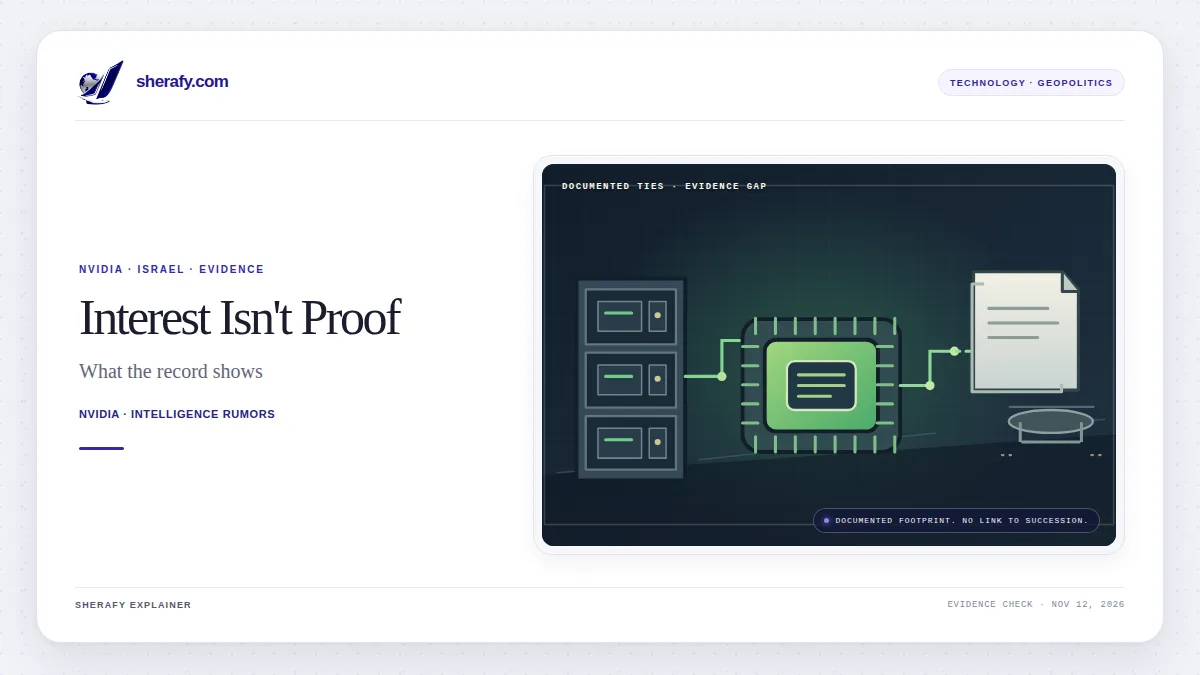
No credible evidence reviewed for this investigation establishes that Israeli intelligence removed Jensen Huang or installed an operative as NVIDIA's CEO. What is confirmed is that Huang resigned on November 11, 2026; NVIDIA appointed longtime chief financial officer Colette Kress as interim, not permanent, CEO; and the company's extensive Israeli operations have become the focus of a rapidly spreading takeover theory.
The allegation did not emerge from a classified document, a whistleblower disclosure, or a newly discovered intelligence connection. One of its main catalysts was a three-year-old interview in which Kress described starting her workday with NVIDIA colleagues in Israel. That statement is real. Its conversion into an allegation of a foreign intelligence operation is not supported by the interview itself.
But dismissing the entire subject as internet gossip would miss a larger and thoroughly documented story. Israel is a major center of NVIDIA's AI infrastructure development, its government openly wants Israeli firms to occupy an indispensable position in the global AI supply chain, and Huang's departure followed a genuinely serious, separately reported Chinese counterintelligence controversy. Those facts deserve scrutiny on their own terms.
The question is not whether Israel has a strategic interest in NVIDIA. It demonstrably does. The question is whether there is evidence connecting that interest to Huang's departure and the board's appointment of Kress.
What actually happened at NVIDIA?
The decisive record is NVIDIA's November 11 Form 8-K filed with the U.S. Securities and Exchange Commission. It states that the board accepted Huang's resignation as president, chief executive officer, and director, effective immediately. It also records two appointments:
- Colette M. Kress, NVIDIA's CFO since 2013, became interim CEO while retaining her finance position.
- Harvey C. Jones, an NVIDIA director since 1993, became chair of the board.
The company's November 12 announcement says the board will consider both internal and external candidates for a permanent CEO. It does not name an Israeli successor, state that Israel had any role in the decision, or identify intelligence activity behind the leadership change.
| Question | What the public record establishes |
|---|---|
| Did Jensen Huang leave NVIDIA? | Yes. He resigned as CEO, president, and director, effective November 11, 2026. |
| Who replaced him? | Colette Kress, on an interim basis. |
| Is an Israeli executive the confirmed permanent CEO? | No. NVIDIA has announced a search, not a permanent appointment. |
| Did the board reveal its full reasoning? | No. The filing documents the action, not every deliberation that produced it. |
| Has an Israeli intelligence operation been demonstrated? | Not by the reviewed corporate, government, or independent reporting records. |
That last distinction matters. A corporate filing cannot rule out every conceivable undisclosed influence. It can, however, establish who made the formal decision and prevent speculation from being presented as an appointment that never occurred.
Where did the claim about an Israeli takeover come from?
The clearest trail leads to an interview with Kress published by the Israeli business publication Globes on July 23, 2023, under the headline "Trillion dollar woman".
Discussing the value of NVIDIA's 2020 acquisition of Israeli networking company Mellanox, Kress said:
"My day starts with Israel meetings, and only then continues to California."
The context was corporate operations. The interview discussed Mellanox, data centers, networking technology, and the roughly 3,200 NVIDIA employees in Israel at that time. The statement described a work routine spanning important engineering teams in different time zones. It did not identify an intelligence agency, political loyalty, or covert reporting relationship.
After Huang's resignation, the excerpt began circulating with a different interpretation. An X post attributed to @Megatron_ron called it the "first signs of an Israeli coup inside Nvidia," a formulation reproduced in coverage of the viral claim by IndiaTimes. That establishes a visible route by which the claim spread, not proof that this account originated it.
The evidence was not a new discovery about Kress. It was an old, public interview reinterpreted after a dramatic new event.
Is Colette Kress Israeli? What is her actual background?
Kress is an American corporate finance executive. Forbes lists her citizenship as United States. Her official NVIDIA biography records previous finance positions at Texas Instruments, Microsoft, and Cisco. She holds a finance degree from the University of Arizona and an MBA from Southern Methodist University.
More importantly, there is a contemporaneous paper trail showing how she joined NVIDIA. A September 2013 NVIDIA announcement says Huang recruited her after an extensive executive search. A 2013 SEC filing independently confirms the board's appointment.
That is seven years before NVIDIA completed its Mellanox acquisition, and thirteen years before the current crisis. Kress was not introduced into NVIDIA's leadership in November 2026 by an Israeli entity. She was the company's established CFO and a senior executive familiar to its investors.
What about claims that she is a Mossad agent? The reviewed reporting, filings, and public biographical records provide no evidence of such an affiliation. A professional relationship with a major Israeli division, even a close and longstanding one, is not equivalent to a relationship with an intelligence service.
This does not mean executive conflicts of interest should never be investigated. It means accusations against a specific person require specific evidence.
Why did Jensen Huang resign? A timeline of the actual crisis
The Israeli takeover theory appeared against the backdrop of a separate national-security story: allegations that Huang had a relationship with Alice Huang, a businesswoman formerly associated with Singapore-based Megaspeed, whom U.S. intelligence reportedly assessed as having links to Chinese intelligence.
Those are reported intelligence findings, not publicly adjudicated facts. China denies the espionage claims. Alice Huang and Jensen Huang are not related despite sharing a surname. It is also important to distinguish Huang's acknowledged personal misconduct from any allegation that he knowingly disclosed corporate or national-security secrets.
| Date | Development | Evidentiary significance |
|---|---|---|
| September 2013 | NVIDIA appoints Kress CFO. | Establishes her long-standing corporate position. |
| April 27, 2020 | NVIDIA completes its approximately $7 billion acquisition of Mellanox. | Establishes a major, Huang-led expansion in Israel. |
| July 23, 2023 | Globes publishes Kress's Israel-meetings comment. | Original provenance of the quotation circulated in 2026. |
| October 29, 2026 | The New York Times reports U.S. intelligence suspicions involving Alice Huang. | Brings the alleged Chinese intelligence effort into public view. |
| November 4 | House committee chairs request a closed-door briefing from Huang. | Documents congressional national-security concern. |
| November 8 | NVIDIA announces a board-supervised independent inquiry and expresses confidence in Huang. | Shows the company's initial public position. |
| November 11 | Senators seek preservation of export-control and intelligence records; NVIDIA's board accepts Huang's resignation. | Shows overlapping oversight and governance pressures. |
| November 12 | NVIDIA announces Kress as interim CEO and Jones as chair. Reuters reports an additional alleged relationship involving another NVIDIA employee. | Confirms succession and continuing emergence of allegations. |
| November 12 | Kress's 2023 quotation circulates as an alleged sign of an Israeli takeover. | Documents the viral theory's emergence after the leadership decision. |
The major primary records are NVIDIA's November 8 board statement, the November 4 letter from three House committee chairs, the November 11 Senate preservation request, and the November 11 SEC filing.
What changed between November 8 and November 11?
On November 8, NVIDIA's independent directors said they were investigating reports that Huang had been targeted by a foreign intelligence effort. The board stated that it had no reason at that time to believe national security or NVIDIA secrets had been compromised, and expressed confidence in Huang.
That statement was not a completed-investigation finding. The board said its inquiry would examine available evidence.
Three days later, the board accepted Huang's resignation. In between, scrutiny broadened. Reuters reported that the board was considering Huang's removal as accounts of relationships involving company employees emerged. On November 12, Reuters reported a further alleged relationship with an additional employee, citing two people familiar with the matter; NVIDIA declined to comment.
The public chronology therefore supports several simultaneous sources of pressure: personal conduct, employee-reporting relationships, counterintelligence concerns, shareholder risk, and congressional oversight. It does not establish that Israeli intelligence triggered the reporting, controlled the board, or orchestrated the resignation.
A serious investigation should still ask who knew what, when disclosures were made, whether policies were applied consistently, and what the directors discussed. Those answers require records or corroborated reporting, not just the short interval between two press releases.
The Chinese intelligence allegation is a separate, substantive story
The alleged Chinese operation warrants its own scrutiny because advanced NVIDIA processors are subject to U.S. export controls, and Megaspeed's purchases and possible diversion of those chips have been the subject of reporting and government attention.
In their November 11 letter, Senators Elizabeth Warren and Chris Coons cited reporting that Megaspeed had purchased more than $4.8 billion in advanced NVIDIA AI chips since June 2024. They asked federal officials to preserve documents concerning possible export-control diversion, contacts with NVIDIA, decisions regarding investigations, and any defensive counterintelligence warnings.
That $4.8 billion is a figure the senators attributed to reporting. It is not a verified measure of chips illegally diverted to China, intelligence losses, or unlawful NVIDIA sales. Those are different claims requiring different evidence.
The House committee letter similarly sought information about NVIDIA's security protocols and Huang's interactions with Alice Huang. A request for a briefing records lawmakers' concern; it is not a judicial finding of espionage.
For further reporting on the espionage and export-control allegations themselves, see sherafy.com's existing investigation: Jensen Huang, Alice Huang, and the NVIDIA spy-affair controversy.
There is no logical reason to convert evidence concerning a reported Chinese intelligence effort into evidence of an Israeli operation merely because the company has significant ties to both countries. The two propositions must be proved independently.
How important is Israel to NVIDIA? More than most readers realize
The business relationship behind the viral Kress quotation is substantial. It did not begin with her promotion, and it is not limited to public relations or sales.
Mellanox made Israeli-developed networking central to NVIDIA's AI systems
On April 27, 2020, NVIDIA completed its $7 billion acquisition of Mellanox. Mellanox developed high-performance networking technology, including technologies used to connect computing nodes at high speed.
This matters because modern AI systems depend on more than fast individual GPUs. Large clusters must move enormous quantities of data between processors, memory, and storage. Network latency, bandwidth, and system orchestration influence how efficiently those clusters train and run AI models.
Mellanox helped NVIDIA expand from supplying powerful computing components to selling more integrated data-center infrastructure. The Israeli connection is therefore embedded in a commercially important technology stack, not simply in an overseas office.
A second acquisition extended that relationship into software
In December 2024, NVIDIA completed its acquisition of Israeli firm Run:ai, which develops software for scheduling workloads across GPU clusters. The European Commission's merger decision identifies the companies and the acquisition of control, while Reuters reported its completion.
The distinction between Mellanox and Run:ai is useful: one strengthens networking infrastructure; the other manages how shared compute capacity is used. Both relate to the practical functioning of large AI facilities.
NVIDIA's own filing quantifies the workforce
In its quarterly SEC filing for the period ended July 26, 2026, NVIDIA disclosed approximately 6,200 employees in its Israeli operations. The filing specifically identifies research and development, operations, and sales and marketing, and discusses potential effects of the Middle East conflict on product development, supply chains, and revenue.
Compare that with the approximately 3,200 workers cited in Kress's 2023 interview. These figures were reported at different dates and may not be perfectly like-for-like, but they show how much the local operation expanded as NVIDIA's AI business grew.
| Documented connection | Why it matters | Source |
|---|---|---|
| Mellanox acquisition, 2020, about $7 billion | High-speed networking and data-center integration | NVIDIA acquisition announcement |
| Kress's 2023 interview, roughly 3,200 Israeli employees | Original business context of the viral quote | Globes interview |
| Run:ai acquisition completed in 2024 | AI workload and GPU-cluster software | Reuters acquisition report |
| Approximately 6,200 employees in July 2026 | Significant operating and development footprint | NVIDIA quarterly SEC filing |
| Proposed Kiryat Tivon campus | Potential further expansion, not a completed workforce increase | Israel Innovation Authority strategy draft |
These relationships raise real questions about intellectual-property protection, cybersecurity, control over critical research, exposure to regional conflict, and the concentration of specialist expertise. A multinational can benefit from foreign research facilities while also needing safeguards against unauthorized access or improper government pressure.
That is an argument for examining systems and access controls. It is not evidence that the people who work in those facilities are intelligence operatives.
Israel's own AI strategy makes its national interest explicit
Perhaps the most significant primary document in this investigation is not about Huang's private life. It is the Israel Innovation Authority's April 2026 draft strategy, Strengthening the Global Leadership of Israeli High-Tech in the Age of AI.
On page 22, the draft describes a goal for Israel to become a critical supplier of technologies underlying the global AI industry, including semiconductor design, data-center networking, software infrastructure, and cybersecurity. It singles out NVIDIA's presence and expansion in Israel as an illustration of that opportunity.
The document describes NVIDIA's Israeli development center as its largest outside the United States and references plans for a Kiryat Tivon campus. Its approximately 5,000-worker figure reflects the draft's own reporting point, not the later 6,200 employees NVIDIA disclosed in July. The campus expansion was a plan, not proof that its projected jobs already existed.
The strategy also places technological capabilities in the context of international alliances and access to advanced computing resources. This is a government's stated economic and industrial policy: attract and develop companies capable of supplying important parts of the AI ecosystem.
The inference that follows is strong but limited. Israel has an identifiable strategic and economic interest in NVIDIA's continued investment and the success of its local engineering sector. That is demonstrated by a government document and the company's own disclosures.
The inference that does not follow is that the government ordered an intelligence service to change NVIDIA's CEO. An industrial strategy is not an operational plan for a corporate takeover.
Did Israeli intelligence have motive, means, or opportunity?
The intelligence allegation deserves a test rather than a shrug. Covert influence can exist without a published order, and an absence of public documentation is not proof that something could never have happened. But a serious assessment must distinguish capability, interest, opportunity, and evidence of actual conduct.
| Test | What is documented | What remains missing |
|---|---|---|
| Motive | Israel wants to strengthen its position in AI infrastructure; NVIDIA is commercially important to that ambition. | Evidence that removing Huang served that goal better than retaining him. |
| Means | Intelligence services can conduct influence and collection operations; documented precedents exist. | Any identified Israeli operative, intermediary, communication, payment, or tasking connected to NVIDIA's succession. |
| Opportunity | NVIDIA has extensive Israeli operations and professional relationships with executives there. | Evidence that those contacts were used to pressure the board or manipulate the CEO selection. |
| Trigger | The resignation followed an unusually fast escalation of personal-conduct and national-security reporting. | Evidence that Israeli actors generated, controlled, or strategically timed those disclosures. |
| Outcome | A longtime American CFO became interim CEO while a permanent search began. | An identified change in control, decision rights, intelligence access, or contractual benefit directed by an Israeli agency. |
This is not an attempt to calculate a numerical probability from insufficient data. It is a way to identify what the hypothesis predicts and whether the observed facts actually distinguish it from ordinary corporate crisis management.
One fact works against the simplistic theory
Huang himself was a major supporter of NVIDIA's expansion in Israel. Israeli technology publication Calcalist reported concern after his resignation that a successor might be less committed to the proposed campus and broader investment plans.
That does not make covert influence impossible. But it creates a problem for the most basic takeover story: why would an Israeli operation remove an unusually valuable advocate of Israeli investment, only to place an interim CEO with no demonstrated intelligence affiliation in charge?
A more specific theory might offer an answer. None supported by evidence has emerged in the material reviewed here.
Does historical Israeli espionage make this allegation credible?
History shows that Israeli espionage against the United States is not imaginary. The FBI's account of the 1985 Jonathan Pollard case documents a U.S. naval intelligence analyst who passed secrets to Israel.
There are also documented concerns about commercial surveillance technology. In 2021, the U.S. Commerce Department placed Israeli companies NSO Group and Candiru on its Entity List, citing spyware supplied to foreign governments and used against a range of targets. The government explicitly distinguished those company-specific actions from sanctions against Israel itself.
These examples establish that espionage and technology-enabled surveillance deserve scrutiny. They do not connect Pollard, NSO, Candiru, the Israeli government, or Mossad to Kress or the November 2026 NVIDIA board decision.
A precedent shows that a type of conduct can occur. It does not identify who committed a different alleged act.
What evidence could materially change the assessment?
The most valuable new evidence would concern a specific mechanism:
- Authenticated communications showing Israeli government or intelligence personnel attempting to influence NVIDIA's directors or executives about succession.
- Corroborated reporting about an intermediary who coordinated disclosures or exerted pressure at an agency's direction.
- Documentary evidence of an undisclosed conflict, security breach, unauthorized information access, or intelligence-related financial relationship involving a relevant decision-maker.
- Board records, investigative findings, or sworn testimony identifying improper outside involvement.
- A verifiable change in governance, sensitive access, or contractual arrangements that can be linked causally to such involvement, rather than merely occurring afterward.
None of those categories has been substantiated by the sources reviewed for this article as of November 12.
Who owns NVIDIA, and who actually chose its next CEO?
The rumor also exploits a common confusion between ownership, management, research operations, and government influence. They are not the same thing.
NVIDIA is a U.S.-incorporated, publicly traded company. Its May 2026 proxy statement filed with the SEC included the following reported beneficial ownership interests, using the filing's March 23 measurement date and underlying shareholder reports:
| Reported beneficial owner | Reported share |
|---|---|
| BlackRock | 7.43% |
| Vanguard Capital Management | 7.31% |
| Jensen Huang | 3.58% |
| Colette Kress | Less than 1% |
These figures are not a real-time November 12 ownership register. Beneficial ownership under SEC rules also does not necessarily mean one individual directly directs every vote of shares held through funds or other vehicles.
The relevant governance point is simpler: the board of directors appoints the CEO. NVIDIA's filing identifies the directors' action and Harvey Jones's appointment as chair. Jones has been on the board since 1993. The company has not disclosed a transfer of ownership to Israel or to an Israeli intelligence organization.
Operational dependence is different. A company may rely on engineers, supply chains, customers, and governments across several countries without those countries holding corporate voting control. That dependence is a legitimate subject for national-security and investor analysis, but it must not be mislabeled as a change in ownership.
Could an Israeli executive become the permanent CEO?
Yes, it is possible. It is not an announced outcome. NVIDIA says the permanent search will consider internal and external candidates.
Israeli and U.S. technology outlets have discussed several names, including these executives:
| Name | Confirmed current role | Status in succession coverage |
|---|---|---|
| Colette Kress | NVIDIA CFO and confirmed interim CEO | The only confirmed replacement so far; permanent appointment not announced. |
| Ian Buck | Senior NVIDIA computing executive associated with CUDA and AI infrastructure | Discussed as a possible internal candidate. |
| Michael Kagan | NVIDIA chief technology officer and Mellanox co-founder | Israeli executive discussed as a possible internal candidate. |
| Johny Srouji | Apple's chief hardware officer | Reportedly considered; no NVIDIA appointment announced. |
| Eyal Waldman | Mellanox founder and former chief executive | Mentioned in speculative Israeli successor coverage. |
| Rene Haas | Arm CEO | Discussed as a potential external candidate. |
| Lisa Su | AMD CEO | Discussed as a potential external candidate. |
See Calcalist's candidate overview, Ynet's discussion of Israeli executives, and Apple's April 2026 announcement of Srouji's role. These articles do not collectively constitute a verified NVIDIA shortlist.
A detail that illustrates why identity-based shortcuts fail: Bloomberg Businessweek reported that Srouji was born into an Arab Christian family in Haifa. Treating an Israeli birthplace as proof of Zionist politics, much less intelligence status, would erase relevant facts rather than uncover them.
The permanent successor should be evaluated through qualifications, board process, conflicts, disclosed relationships, strategic commitments, and actual decisions. Nationality alone does not answer those questions.
What matters next for NVIDIA, U.S. national security, and investors?
The most consequential questions extend beyond who occupies the CEO's office.
First, the independent investigation must establish the national-security facts. Was any proprietary or controlled information accessed? Were security rules breached? Did government officials receive warnings? NVIDIA's November 8 statement did not resolve those issues.
Second, the board must explain governance and continuity. Huang combined technical leadership, customer relationships, and corporate strategy in an unusually centralized role. An interim CFO can provide financial and operating continuity, but a permanent leadership structure may distribute those responsibilities differently. This is one reason a CEO appointment has consequences beyond headlines.
Third, export-control decisions remain a major financial and policy issue. NVIDIA's July 2026 SEC filing discusses restrictions on advanced chip exports to China, inventory effects, licensing conditions, and geopolitical risks. Those disclosures give investors a documented basis for examining the company's exposures without assuming that an unproven espionage allegation establishes wrongdoing.
Fourth, watch actual changes in Israel-related investment and engineering responsibility. Will the planned campus proceed? Will local networking and software work expand or contract? Will cybersecurity governance or access rules change? Those observable decisions are better indicators of evolving strategic dependence than the passports of rumored CEO candidates.
As of this article's publication date, NVIDIA has scheduled its fiscal third-quarter earnings release for November 17, 2026. The House request sought a closed-door briefing on November 18. The existence of a scheduled earnings call or requested briefing does not guarantee particular disclosures or findings.
Frequently asked questions
Did Israel replace Jensen Huang as NVIDIA CEO?
There is no substantiated evidence that the Israeli government or an Israeli intelligence service caused his resignation or selected his replacement. NVIDIA's SEC filing identifies a board decision and the interim appointment of Colette Kress.
Who is NVIDIA's CEO now?
As of November 12, 2026, Colette Kress is interim CEO while continuing as chief financial officer. NVIDIA has begun searching for a permanent chief executive.
Is Colette Kress Israeli?
Her publicly reported citizenship is United States, according to Forbes. Her longstanding contacts with NVIDIA's Israeli teams are business relationships documented in a 2023 interview.
Is Colette Kress a Mossad agent?
No credible evidence reviewed here supports that claim. The principal viral quotation concerns ordinary corporate meetings, not intelligence work. No specific intelligence affiliation has been established.
Why did Jensen Huang resign?
His resignation followed reports concerning personal relationships, one involving a woman U.S. intelligence reportedly suspected of acting for China, and allegations concerning NVIDIA employees. The board opened an inquiry, then accepted his resignation. The company has not publicly provided a complete account of its deliberations.
Does Israel own NVIDIA?
No evidence establishes Israeli state ownership or control of NVIDIA. It is a publicly traded U.S. corporation with significant Israeli engineering operations. Business dependence and ownership are different relationships.
How many NVIDIA employees work in Israel?
NVIDIA reported approximately 6,200 employees in Israeli operations in its July 2026 quarterly filing. An earlier 2023 interview referenced roughly 3,200.
Could Michael Kagan or Johny Srouji become CEO?
Both have been discussed in succession reporting, but NVIDIA has not announced either as its permanent CEO. Media speculation should not be mistaken for a company-confirmed shortlist.
Is there any evidence that U.S. intelligence investigated a Chinese espionage effort involving Huang?
There is substantial reporting about U.S. intelligence suspicions concerning Alice Huang, along with contemporaneous letters from members of Congress and a publicly announced NVIDIA investigation. The underlying intelligence evidence is not fully public, and the allegations should not be represented as proven criminal findings.
The distinction that matters
Three propositions can all be true at once: Israel has a powerful economic interest in NVIDIA; U.S. officials have treated alleged Chinese intelligence activity around Huang as a serious issue; and there is no demonstrated link between Israeli intelligence and NVIDIA's November 2026 CEO transition.
That does not end scrutiny of corporate access, government leverage, or the decision-making process. It gives the scrutiny a standard. Show the relevant decision, the responsible actor, the mechanism of influence, and the evidence connecting them.
A country can have a profound interest in a technology company without secretly controlling it. Influence is worth investigating. An intelligence operation still has to be proved.
References and Further Reading
Primary corporate filings and company records
- NVIDIA, Form 8-K reporting Huang's resignation and the Kress/Jones appointments (November 12, 2026). The decisive SEC record for the board action effective November 11.
- NVIDIA, CEO transition announcement (November 12, 2026). Confirms interim leadership and the open permanent search.
- NVIDIA, independent board statement (November 8, 2026). Documents the inquiry, initial confidence in Huang, and the board's preliminary security position.
- NVIDIA, appointment of Colette Kress as CFO (September 2013). Establishes the hiring history and Huang's role in recruiting her.
- NVIDIA, Form 8-K recording Kress's original CFO appointment (2013). Contemporaneous regulatory corroboration.
- NVIDIA, 2026 proxy statement. Board, governance, and beneficial ownership data with the dates specified in the filing.
- NVIDIA, quarterly Form 10-Q for July 26, 2026. Reports approximately 6,200 Israeli employees and discusses export-control and geopolitical exposures.
- NVIDIA, completion of the Mellanox acquisition (April 27, 2020). Documents the roughly $7 billion deal and its networking rationale.
Government documents and national-security context
- Israel Innovation Authority, Strengthening the Global Leadership of Israeli High-Tech in the Age of AI, April 2026 draft. See especially page 22 for the AI infrastructure strategy and NVIDIA reference. This is a draft for industry comment, not an intelligence directive.
- U.S. House committee chairs, request for a closed-door NVIDIA security briefing (November 4, 2026). Shows the questions lawmakers sought to pursue; not proof of an espionage offense.
- Senators Warren and Coons, federal records preservation letter (November 11, 2026). Primary record of questions about Megaspeed, export controls, and counterintelligence warnings.
- European Commission, NVIDIA/Run:ai merger decision (December 2024). Official description and competition assessment of the Israeli software acquisition.
- FBI, Year of the Spy (1985). Historical record of the Jonathan Pollard case, provided as context rather than evidence about NVIDIA.
- U.S. Commerce Department, NSO Group and Candiru Entity List announcement (2021). Documents action involving commercial spyware; does not implicate Kress or NVIDIA.
Original interview, independent reporting, and claim provenance
- Assaf Gilead and Nevo Trabelsy, "Trillion dollar woman," Globes (July 23, 2023). Original context of Kress's remark about Israeli meetings and Mellanox.
- Reuters, reporting on the additional alleged relationship (November 12, 2026). Adds sourced reporting to the leadership-crisis chronology while preserving uncertainty.
- Reuters, NVIDIA board weighing Huang's future (November 11-12, 2026). Documents the shift from an initial vote of confidence to a contested leadership decision.
- Calcalist, "Will Nvidia remain as committed to Israel without Jensen Huang?" (November 12, 2026). Relevant counterevidence to the simplistic claim that removing Huang necessarily benefited Israeli operations.
- Calcalist, "The race to replace Jensen Huang" (November 12, 2026). Identifies executives discussed by Israeli technology media; does not establish a confirmed shortlist.
- Ynet, "After Jensen Huang: The Israelis who could inherit Nvidia's AI empire" (November 2026). Additional context for the candidate speculation.
- Forbes, Colette Kress profile. Public biographical and U.S. citizenship information.
- IndiaTimes, coverage of the circulating "Israeli coup" claim. A source for how the allegation circulated, not independent corroboration that it occurred.