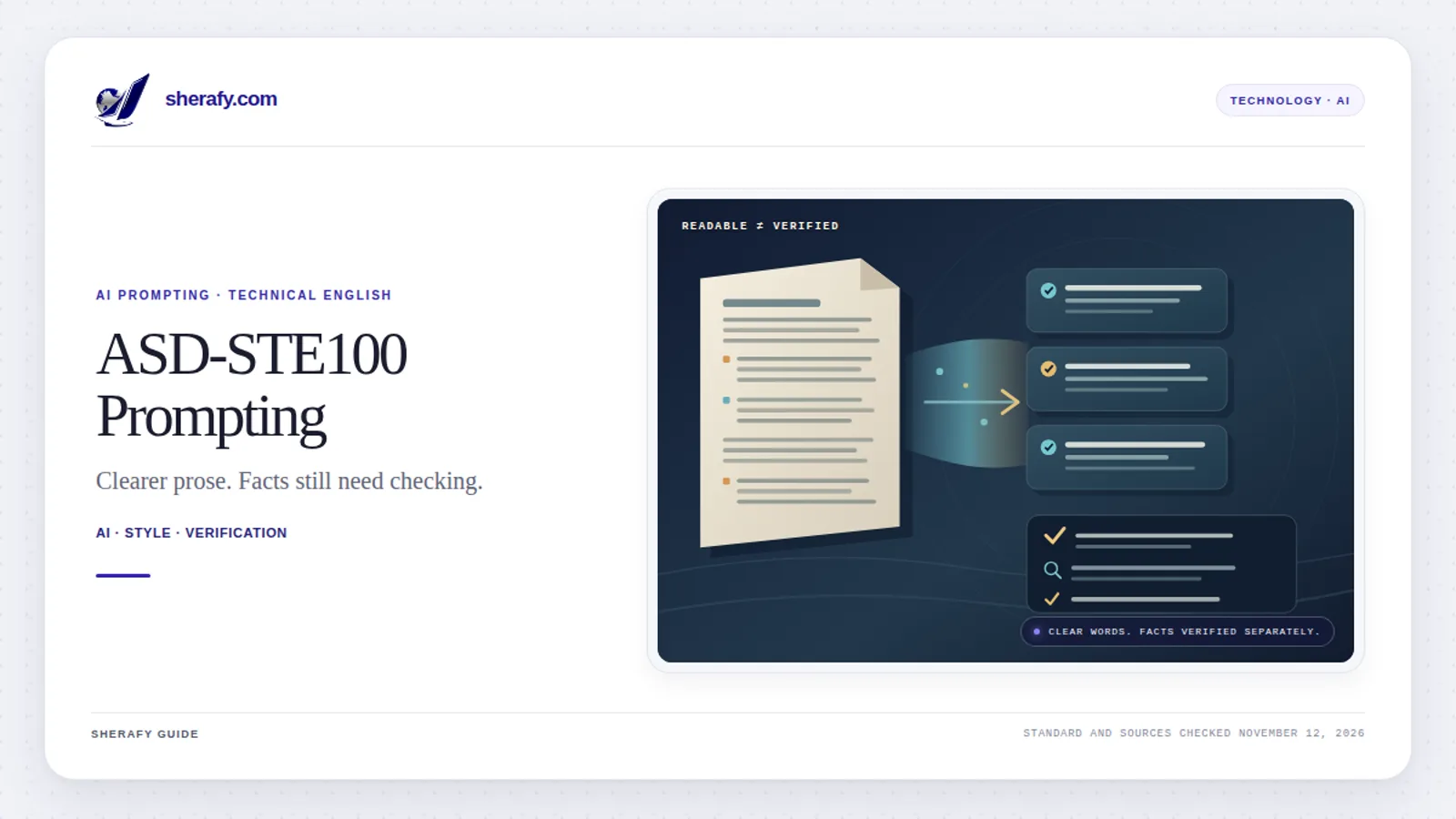
ASD-STE100 prompting is a way to ask ChatGPT, Claude, Gemini, or another AI assistant to explain information in clear, controlled English. The idea comes from an aerospace writing standard, not from a new AI algorithm. It favors short sentences, consistent terminology, and precise instructions. In October 2026, AI researcher Andrej Karpathy drew attention to the technique, including a looser request for writing "80% of the way to ASD-STE100."
It can make an answer easier to read. It does not guarantee that the answer is correct, complete, or compliant with the official standard. That distinction matters, especially when the subject involves science, law, medicine, finance, or technical instructions.
The ASD-STE100 prompt you can copy
If you want a quick way to try the method, start here:
Explain [TOPIC] in clear English inspired by ASD-STE100 Simplified Technical English. Use short sentences, active voice, consistent terms, and one main idea per sentence. Define necessary technical terms. Preserve important facts, conditions, exceptions, numbers, and uncertainty. Do not leave out information just to make the answer shorter.
This is a style instruction, not a request for official ASD-STE100 compliance. For most everyday questions, that is the useful distinction.
A more detailed prompt appears later in this guide, along with a method for checking what the model may have omitted.
What is ASD-STE100 Simplified Technical English?
ASD-STE100 is a controlled form of English developed for technical documentation. Its original purpose was practical: help aircraft maintenance personnel understand instructions clearly, including workers who do not speak English as their first language.
Aircraft maintenance can involve complicated equipment, strict procedures, and serious consequences when instructions are misunderstood. Ordinary English allows writers to express the same action in many different ways. It also allows words to carry several meanings. A controlled language limits that variation.
According to the ASD Simplified Technical English Maintenance Group's official history, European aerospace organizations began developing Simplified English in the late 1970s. The first AECMA Simplified English Guide appeared in 1986. The system later became ASD Simplified Technical English. Issue 9, published January 15, 2025, established its current name and status as an international standard for technical documentation.
The official title is ASD-STE100 Simplified Technical English. ASD stands for the Aerospace, Security and Defence Industries Association of Europe.
The standard has two main components:
- Writing rules: 53 rules in nine sections. They govern vocabulary, grammar, sentence structure, procedures, descriptions, punctuation, and writing practices.
- A controlled dictionary: Approximately 900 approved general words, plus about 1,200 entries for non-approved terms and suggested alternatives. Writers may also use relevant technical nouns and verbs under the standard's rules.
Those details come from the official ASD-STE100 explanation and Issue 9 standard.
The point is not to make language childish. It is to reduce the number of ways a reader can misunderstand a statement.
What are the actual ASD-STE100 writing rules?
Online summaries often reduce the standard to "use small words and short sentences." That misses its most important feature: consistent meaning.
The following are selected rules from Issue 9. They are not the complete standard.
| Feature | What ASD-STE100 requires or permits | Why it matters |
|---|---|---|
| Procedural sentences | A maximum of 20 words per sentence | Keeps individual work steps manageable |
| Descriptive sentences | A maximum of 25 words per sentence | Separates explanations into smaller units |
| Paragraphs | One topic per paragraph, with no more than six sentences | Keeps related information together |
| Instructions | Generally one instruction per sentence, with an exception for simultaneous actions | Helps readers identify each required action |
| Verbs | Controlled verb forms and an emphasis on active voice | Helps identify who performs an action |
| Word choice | Approved general vocabulary with controlled meanings | Reduces ambiguity and inconsistent synonyms |
| Technical terms | Appropriate subject-specific terms are allowed under defined rules | Preserves precision without forcing inaccurate substitutions |
| Terminology | Use selected terms consistently | Prevents readers from mistaking one item for several |
The distinction between procedures and descriptions is important. An instruction such as "Remove the cover" serves a different purpose from an explanation of how a system operates. The standard treats them differently.
It also requires more than mechanical word counting. For example, its rules tell writers to reorganize a sentence if a simple word substitution would change its meaning. See Issue 9, Part 1, Sections 5, 6, and 9.
Why consistent vocabulary can help
Consider a hypothetical instruction that calls the same object a switch, control, and selector in three different steps. A reader may reasonably wonder whether the writer means three components.
If the document means one switch, the writer should call it the switch throughout. The shorter vocabulary is not the main achievement. The achievement is removing unnecessary doubt.
The official ASD-STE100 FAQ gives another example. The controlled dictionary generally prefers start rather than interchangeable verbs such as begin, commence, or initiate. In ordinary writing, variety can make prose sound better. In maintenance instructions, variety may only create ambiguity.
That principle transfers naturally to AI explanations. Readers often need the same technical term repeated, not a new synonym in every paragraph.
Why did Andrej Karpathy recommend ASD-STE100 for AI?
On October 2, 2026, Andrej Karpathy described several ways to make AI-generated explanations easier to understand. He suggested asking a language model to explain a subject using ASD-STE100. He also described a softer version, "80% of the way to ASD-STE100," because the full specification is strict.
Karpathy's larger argument was about understanding the output of increasingly capable AI systems. He also suggested asking models for diagrams, interactive web pages, and custom explainer videos when text alone is insufficient.
The aerospace standard was one suggestion among several. Karpathy did not introduce a new language model, a scientific benchmark, or a special reasoning mode.
What does "80% ASD-STE100" mean?
It is an informal prompting shortcut. It means something like: borrow most of the standard's useful habits, but do not force every restriction onto ordinary conversation.
There is no official "80% ASD-STE100" certification or compliance setting. A model cannot establish formal compliance merely by claiming that it followed 80% of the rules.
For everyday explanations, a relaxed approach can make sense. The goal is readable prose that keeps technical meaning intact. For a regulated maintenance manual, however, "mostly compliant" is not an adequate substitute for the required review process.
Why might this prompt make AI explanations easier to understand?
The technique acts on the presentation of information. It does not directly upgrade a model's knowledge.
Three mechanisms help explain its appeal.
1. Short sentences reduce the amount a reader must track at once
Long sentences often combine an action, a condition, an exception, and an explanation. Breaking them apart can make each relationship easier to follow.
But the relationships must remain. A sentence that loses its exception may become shorter and less accurate.
2. Consistent terms make technical explanations easier to follow
AI models sometimes introduce new labels for concepts that already have names. A response may alternate between "model context," "working memory," and "input window" without explaining whether those expressions mean the same thing.
A controlled style encourages the model to define a term and use it consistently. This can reduce confusion, especially in code explanations and unfamiliar scientific subjects.
3. Active voice often clarifies responsibility
Compare "The setting was changed" with "The administrator changed the setting." The second sentence identifies the actor, provided the evidence supports that identification.
Active voice is not automatically better in every sentence. If the actor is unknown, the model must not invent one simply to satisfy a style rule.
The key distinction is between clearer language and better evidence. A prompt can improve the former without improving the latter.
Does the research show that Simplified Technical English works?
There is research on controlled English in aviation maintenance. Some studies found comprehension benefits. But those studies examined human readers and maintenance documents, not people asking ChatGPT to explain arbitrary topics.
1995: Better comprehension of complex maintenance procedures
A study by Serena K. Shubert and colleagues examined Simplified English and conventional English in aircraft maintenance procedures. The researchers reported better comprehension and easier information location for more complex documents. The tested versions took roughly the same time to read and complete.
The benefit was not identical for every passage or reader. The researchers also noted limits when comparing native and non-native English speakers. Their findings appear in The Comprehensibility of Simplified English in Procedures.
1996: Lower error rates in a test of 175 technicians
Steven Chervak, Colin Drury, and James Ouellette tested maintenance workcards with 175 practicing aircraft maintenance technicians. The workcards varied in difficulty, language, and layout.
In their reported evaluation, the comprehension error rate fell from 18% with conventional English to 14% with Simplified English. That is a four-percentage-point reduction, or about a 22% reduction relative to the original error rate.
The benefits were strongest for more difficult workcards and for technicians who were not native English speakers. The study did not find an effect from the tested layout changes. See Simplified English for Aircraft Workcards.
These numbers describe one study in a specific maintenance setting. They do not mean an ASD-STE100 prompt reduces ChatGPT errors by 22%.
2005: Simplification was not always the best intervention
Colin Drury and J. Ma studied language errors among 254 maintenance personnel at nine sites in Chinese-speaking countries. They tested approaches to making work documentation more usable.
In that study, a Chinese translation was the only tested document intervention with a statistically significant result. It produced approximately a 10% speed advantage. See Language Error in Aviation Maintenance: Data from Asia.
The lesson is not that controlled English has no value. It is that audience, task, language, and document design all matter. Sometimes translation is more useful than simplifying English.
What these studies do not establish
None of these studies demonstrates that a short ASD-STE100 prompt universally improves AI accuracy, reasoning, or factual completeness. They provide a reason to investigate the technique, not permission to claim more than the evidence supports.
The hidden risk: A clearer answer can leave out important facts
The largest problem with aggressive simplification is information loss. A model may remove conditions, exceptions, definitions, uncertainty, or entire steps while producing prose that looks polished.
A small developer experiment from August 2026 shows why this risk deserves attention.
Software developer Lucian Ghinda compared three explanation styles on four code examples: no added style instruction, an informal request for "Simple Technical English," and a request naming ASD-STE100. He tested Claude and Codex, repeated the exercise, and published the prompts and outputs.
For Claude, the average sentence length fell from 17.8 words without the style instruction to 9.2 words with the informal request and 10.1 words with ASD-STE100.
But Ghinda also checked whether the explanations retained selected facts about the code. Relative to facts present in the control explanations, his Claude results looked like this:
| Prompt condition | Average sentence length | Selected facts missing relative to control |
|---|---|---|
| No added style instruction | 17.8 words | Baseline |
| "Simple Technical English" | 9.2 words | 4 of 47 (8.5%) |
| "ASD-STE100" | 10.1 words | 22 of 47 (46.8%) |
These figures come from Ghinda's published test. They are not general omission rates for Claude, not findings from an independent peer-reviewed study, and not a test of the 80% prompt. Ghinda noted limitations in his setup, including a small sample and one case where he had seen a control answer before selecting the facts to evaluate.
The Codex results also differed from Claude's. Both added style clauses lost substantial selected information relative to Codex's control responses. That variation argues against assuming one instruction is equally useful for every model.
The plausible interpretation is that a model can optimize too strongly for a writing constraint. But this experiment does not prove exactly why omissions occurred, or that the same effect appears in other subjects.
A second observation: Shorter replies are not proof of better answers
In October 2026, developer Daniel Dewhurst examined his own coding-agent replies before and after adding STE-inspired writing rules. His median reply length fell from 72.5 words to 21 words, and sentences longer than 25 words became less common.
He also changed other instructions, including asking the agent to give the answer first and remove unnecessary text. His project mix changed during the comparison. The results therefore describe a useful personal workflow, not an isolated causal test of ASD-STE100.
Taken together, these reports support a limited conclusion: writing constraints can make AI responses shorter and more consistent, but factual completeness must be checked separately.
The difference between readable, complete, and correct
These qualities often overlap. They are still separate.
- Readable: Can the intended reader follow the explanation?
- Complete: Does the explanation retain the facts, conditions, and exceptions required for its purpose?
- Correct: Are the statements accurate and supported by evidence?
An answer can be readable but incomplete. It can be complete but difficult to understand. It can also be beautifully written and entirely wrong.
Example: A hypothetical medical study
The following example is invented to illustrate a writing problem. It does not describe a real treatment or clinical trial.
Original statement:
In a trial involving adults with mild symptoms, the treatment reduced symptom scores during the first six months, but researchers did not establish whether the benefit continued after treatment stopped.
Misleading simplification:
The treatment reduces symptoms.
Better simplification:
The trial involved adults with mild symptoms. Their symptom scores improved during the first six months. Researchers do not know whether the benefit continued after treatment stopped.
The bad version removes the studied population, observation period, and uncertainty. The better version uses more sentences, yet it preserves the meaning.
Example: A hypothetical risk reduction
Suppose an invented study reports that an event occurred in 2 of every 100 people in one group and 1 of every 100 in another group.
Calling that a 50% relative reduction is mathematically correct. But the absolute difference is one event per 100 people.
A useful explanation includes both numbers. It should also explain the time period, study design, and limits of the evidence. "The risk was cut in half" is not enough on its own.
Example: A software explanation
Harder to read:
The application's authentication subsystem initiates credential validation before propagating authorization state to dependent services.
Clearer:
The application checks the user's login details. It then tells the other services what that user is allowed to do.
The second version is easier to follow. But a developer must still verify that it describes the real system. Simplified prose cannot replace reading the code.
Example: A technical instruction
Unclear:
Prior to commencement of inspection activities, de-energization of the equipment should be performed and verification undertaken.
Clearer:
Disconnect the equipment from its power source. Confirm that it is safe to inspect before you continue.
This is an illustration of sentence structure, not a complete electrical safety procedure. Real safety instructions require equipment-specific steps and qualified review. The shorter version must not replace required lockout, testing, or other safeguards.
Which prompt style should you use?
The best choice depends on what you need the AI to do.
| Approach | Best use | Main limitation |
|---|---|---|
| "Explain simply" | Quick everyday questions | Too vague to control omissions or terminology |
| "Simple Technical English" | Informal technical explanations | The model may interpret it differently each time |
| "80% of the way to ASD-STE100" | Readable general explanations | The percentage has no defined compliance meaning |
| Explicit clarity and fact-preservation prompt | Research, science, technical explanations, and journalism | Still requires checking against sources |
| Formal ASD-STE100 writing workflow | Technical documentation that actually requires the standard | Requires the complete rules, controlled terminology, and specialist quality review |
For general AI use, explicit instructions are more defensible than relying on the standard's name alone. Tell the model what kind of clarity you want and which information it must preserve.
Three prompts for different levels of work
1. Quick explanation prompt
Use this when the stakes are low and you want less jargon:
Explain [TOPIC] in clear, concise English inspired by ASD-STE100. Use short sentences, active voice, and consistent terms. Define technical words when they first appear. Keep the important details.
2. Recommended prompt for everyday research and technical explanations
Use this when you need clarity and substance:
Explain [TOPIC] in clear English inspired by the principles of ASD-STE100 Simplified Technical English. Use short sentences, active voice where appropriate, and one main idea per sentence. Use the same term for the same concept. Define necessary technical vocabulary instead of replacing it with vague words.
>
Lead with the direct answer. Then explain how it works, the relevant evidence, important limitations, and practical implications.
>
Preserve material facts, numbers, dates, conditions, exceptions, uncertainty, and causal relationships. Do not omit necessary information to make the answer shorter. If a topic needs more detail to stay accurate, use more sentences.
>
Treat these as writing-style guidelines, not a claim of formal ASD-STE100 compliance.
3. Two-pass prompt for source-based work
For research papers, legal documents, or investigative material, work from the source text rather than asking the model to simplify its own unsupported summary.
Pass one: Extract the facts.
Read the supplied source. List its material claims, exact numbers, dates, conditions, exceptions, uncertainty, and limitations. Identify what the source does not establish. Do not add outside claims. Keep each item traceable to the source.
Pass two: Rewrite and compare.
Rewrite the source in clear, ASD-STE100-inspired English. Preserve the facts and qualifiers listed above. Then compare the rewrite with the original source. Flag anything omitted, added, strengthened, weakened, or given a different meaning. If a claim cannot be expressed simply without losing precision, explain it in more than one sentence.
This workflow makes omissions easier to identify. It does not replace independent verification, and a model can miss errors in its own work.
How to check that an AI explanation preserved the facts
A useful review has four steps.
- Identify the source. Use an actual paper, manual, court opinion, filing, or other record when possible. Do not ask the model to verify a claim against a source it has not seen.
- Create a fact checklist. Record the numbers, dates, named entities, population, conditions, exceptions, and uncertainty that matter.
- Compare the rewrite. Check whether each fact remains. Pay special attention to words such as may, only, unless, approximately, and not established.
- Verify the result independently. Follow the citations and inspect the original evidence. For consequential decisions, seek qualified review where appropriate.
A basic comparison table can help:
| Original-source element | What to check in the rewrite |
|---|---|
| Population | Did "some adults" become "everyone"? |
| Magnitude | Did a relative percentage hide the absolute difference? |
| Time | Did a six-month finding become an indefinite claim? |
| Condition | Did "if" or "unless" disappear? |
| Uncertainty | Did "may" become "does" or "proves"? |
| Attribution | Did a reported allegation become an established fact? |
The goal is meaning preservation, not the shortest possible output.
Can AI write officially compliant ASD-STE100?
Not simply because a user names the standard in a prompt.
Real compliance involves its dictionary, approved word meanings, technical-term rules, grammar, sentence limits, and specialist review. A model can produce fluent text that appears consistent with STE while violating requirements the reader cannot easily see.
The ASD Simplified Technical English Maintenance Group's AI guidance warns that plausible AI output should not be confused with verified compliance. Its software guidance also states that checking tools cannot replace trained writers or the standard itself. ASD and the maintenance group do not certify or endorse AI-based language-checking products.
For ordinary conversations, users may only want the benefits of concise technical writing. That is a reasonable style preference. For an aircraft manual, safety procedure, or regulated document, it is not enough.
When should you avoid strict simplification?
Avoid making brevity the primary objective when the reader needs the full reasoning or exact conditions.
- Medicine and scientific research: Preserve populations, study design, absolute risk, limitations, and uncertainty.
- Law and public policy: Preserve jurisdiction, definitions, exceptions, dates, and the difference between an allegation and a finding.
- Finance: Preserve time periods, assumptions, fees, and the difference between nominal and real values.
- Programming: Keep code, commands, error messages, file paths, and identifiers unchanged. Explain their role in simpler prose instead.
- Safety-critical instructions: Use the applicable official procedure and required professional review. Do not substitute a chatbot rewrite.
- Creative or persuasive writing: Strict controlled-language rules can remove rhythm, voice, humor, and deliberate ambiguity that serve the work.
If the task calls for a diagram, table, timeline, or worked example, ask for that format. Clear prose is only one tool for clear understanding.
Frequently asked questions
Is ASD-STE100 prompting a jailbreak or hidden ChatGPT feature?
No. It is an ordinary writing-style instruction. It does not bypass safeguards, unlock hidden knowledge, or create a new reasoning mode.
Does the 80% ASD-STE100 trick make ChatGPT smarter?
There is no established evidence that it directly improves a model's reasoning ability or factual accuracy. It may make the explanation easier for a person to follow. Those are different outcomes.
Does it work with ChatGPT, Claude, Gemini, and Codex?
You can request the style from any language model that accepts natural-language instructions. Results depend on the model, task, prompt, and supplied sources. Early developer experiments found meaningful variation between Claude and Codex. A universal performance claim would be premature.
Will shorter answers save tokens?
Sometimes, but not necessarily. Shorter sentences do not guarantee fewer words or tokens. A thorough explanation might use more sentences to preserve all required facts. Longer instructions and additional verification passes also use tokens.
Is ASD-STE100 the same as plain English?
No. Plain English is a broad approach to clear communication. ASD-STE100 is a particular controlled-language standard with formal vocabulary and writing rules. A relaxed AI prompt can borrow its principles without producing formally compliant text.
Is 80% ASD-STE100 an official version of the standard?
No. It is an informal phrase used in AI prompting. The current official standard is Issue 9, dated January 15, 2025.
Does writing in ASD-STE100 help an article rank on Google or appear in AI answers?
There is no published Google ranking bonus for ASD-STE100 wording. Google's guidance for AI features in Search says established SEO fundamentals still apply. Clear explanations can help readers, but search visibility depends on many other factors, including content quality, accessibility, and relevance.
What is the most reliable prompt to use?
Ask for short, direct explanations with consistent terminology and explicit fact preservation. For consequential subjects, provide the source material and require a comparison against it. Do not treat a style instruction as a fact-checking system.
The practical takeaway
ASD-STE100 is useful because it treats ambiguity as a problem to solve, not as a sign of sophistication. Its rules can teach both writers and AI systems to explain difficult subjects without needless verbal clutter.
The viral prompting shortcut has value. But the original standard was designed to prevent misunderstanding, not to make every answer as short as possible.
The test of a good explanation is not how little it says. It is how clearly it communicates everything the reader needs to know.
References and Further Reading
Official standards and guidance
- ASD-STE100 Simplified Technical English, Issue 9 (PDF). Aerospace, Security and Defence Industries Association of Europe, January 15, 2025. The authoritative text for the current writing rules, terminology, and dictionary.
- About Simplified Technical English. ASD Simplified Technical English Maintenance Group. Explains the standard's structure, controlled vocabulary, and history.
- ASD-STE100 Frequently Asked Questions. Official guidance on vocabulary restrictions, technical terms, and how to obtain the standard.
- Official downloads and white paper on AI. Official access point for the standard and the maintenance group's discussion of AI, professional accountability, and compliance.
- Tools for Simplified Technical English. The maintenance group's policy on software aids, including limits and non-endorsement of automated checkers.
Original research
- The Comprehensibility of Simplified English in Procedures. Shubert, Spyridakis, Holmback, and Coney, Journal of Technical Writing and Communication, 1995. Tests whether controlled English improves comprehension of aircraft maintenance procedures.
- Simplified English for Aircraft Workcards. Chervak, Drury, and Ouellette, Proceedings of the Human Factors and Ergonomics Society, 1996. Tests comprehension with 175 maintenance technicians.
- Language Error in Aviation Maintenance: Data from Asia. Drury and Ma, Proceedings of the Human Factors and Ergonomics Society, 2005. Evaluates language barriers and document interventions among maintenance personnel.
AI prompting and practical experiments
- Andrej Karpathy's October 2, 2026 post about understanding AI outputs. The original recommendation to ask for ASD-STE100 and, in some cases, to relax the request to roughly 80%.
- Explain to Me in Simple Technical English. Lucian Ghinda, August 14, 2026. Publishes a small comparison of prompt styles, average sentence lengths, and omitted facts.
- I Made My Coding Agents Talk Like an Aircraft Maintenance Manual. Daniel Dewhurst, October 20, 2026. Reports observational changes in coding-agent replies and important limits of the comparison.
- AI Features and Your Website. Google Search Central. Explains how ordinary search fundamentals apply to AI Overviews and AI Mode.
Editorial currency note: Standard editions, AI model behavior, and search guidance can change. This article reflects sources reviewed through November 12, 2026. The illustrated medical, risk, software, and equipment examples are hypothetical teaching examples, not results of tests conducted by sherafy.com.