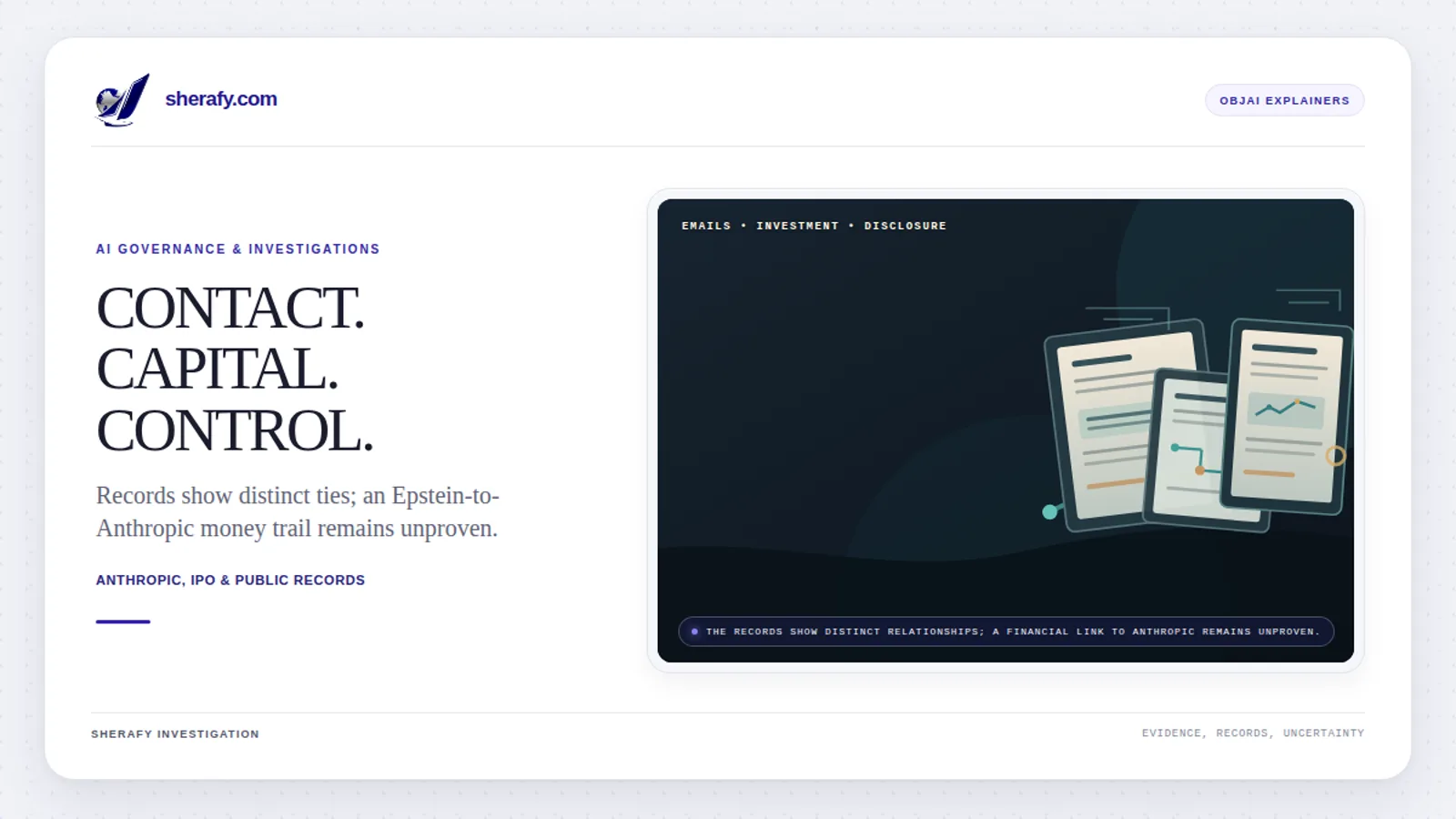
Camilla "Cami" Clark is the wife of Anthropic CEO Dario Amodei. Investigations published in August 2026 reported that she advises her husband informally and introduced him to former Google CEO Eric Schmidt, who became an early Anthropic investor. Separately, Justice Department-released emails document Clark and a business partner seeking Jeffrey Epstein's financial backing for an adult-media venture in 2011 and revisiting that possibility in 2012.
What the evidence does not establish is just as important: There is no documented investment by Epstein in Anthropic, no demonstrated financial path from his money to Schmidt's Anthropic shares, and no evidence in the reviewed records that Amodei participated in Clark's earlier correspondence. Epstein appears to have declined the adult-media proposal in 2012.
A new question became possible when Anthropic filed an amended IPO registration on November 10, 2026. The document details certain family employment arrangements, compensation, investments and voting rights, yet a search of the reviewed prospectus text does not find Cami Clark by name. That absence does not prove misconduct or an undisclosed transaction. It exposes a distinction worth understanding: someone can have reported personal access to a powerful executive without necessarily holding formal corporate authority or triggering a securities-disclosure requirement.
This article separates the historical emails, the actual investments, the reported private relationships and the legal disclosures. None can substitute for evidence of the others.
The short answer: What is verified and what remains unproven?
| Reader question | Best-supported answer | Evidence and limitation |
|---|---|---|
| Who is Dario Amodei's wife? | Camilla "Cami" Clark, whom independent reporting says married Amodei in 2022. | The Wall Street Journal's August investigation and The Information's profile. The marriage year comes from reporting, not a marriage record reviewed here. |
| Does Cami Clark work for Anthropic? | The Journal reported that she does not work there but serves as a private sounding board and strategic adviser. | Reported informal influence is not a verified employment contract, board seat or company office. |
| Did she exchange emails with Epstein? | Yes. Identified DOJ-released 2011-2012 correspondence documents fundraising-related contact. | The released records and independent reporting establish what was discussed, not every financial outcome. |
| Did Epstein invest in her adult-media company, Eddice? | No investment has been established. The 2012 response appears to decline the proposal. | A fundraising budget, introduction and request for money are not proof of payment. |
| Did she introduce Eric Schmidt to Amodei? | Yes, according to original reporting by the Journal and The Information. | A reported personal introduction is different from an investment agreement. |
| Did Schmidt invest in Anthropic? | Yes. Anthropic itself named Schmidt among participants in its May 2021 $124 million Series A. | Anthropic's original financing announcement does not say how much Schmidt personally contributed. |
| Did Epstein fund or control Anthropic? | No supporting evidence identified in the reviewed material. | Neither the existence of Epstein emails nor Schmidt's investment supplies the missing financial connection. |
| Why isn't Clark named in the IPO filing? | The reviewed November 10 prospectus does not name her. The reason cannot be determined from that fact alone. | SEC filings disclose defined roles, ownership and qualifying transactions, not everyone who privately advises an executive. |
How the relationships developed: A timeline from 2011 to 2026
Chronology is essential because the viral version combines events separated by nearly a decade.
| Date | What happened | Evidentiary status |
|---|---|---|
| June 2008 | Epstein pleaded guilty to Florida state charges; he was released from custody in July 2009. | Established in the Justice Department's review of the Epstein case. |
| February 2011 | Eddice's archived website advertised a $350,000 fundraising goal for its website and proposed films. | Documented historical website; not audited receipts. |
| March 3-7, 2011 | Literary agent John Brockman introduced Clark and Michelle Capocefalo to Epstein. A subsequent Eddice-linked message described a $2.5 million financing plan, and another referred to film treatments. | Identified DOJ-released correspondence; some sender details are redacted. |
| March 8-14, 2012 | Clark recontacted Epstein, discussed Eddice and a social-dieting application, and introduced lingerie entrepreneur Jennifer Zuccarini. | Documented in released email threads; funding outcomes not established. |
| 2013-2014 | According to The Information, Clark developed another women's-health venture, Eric Schmidt invested, Amodei was an adviser, and Clark and Amodei began their relationship. | Original reporting citing a fundraising document and people familiar with the events. |
| January-May 2021 | Anthropic was founded. Clark reportedly introduced Schmidt to Amodei; Schmidt participated in Anthropic's $124 million Series A. | Introduction reported; investment confirmed by Anthropic. |
| 2021 | Clark reportedly proposed a "Mother of AGI" investment fund, but other Anthropic co-founders opposed it and the proposal did not proceed. | Independent reporting; the underlying private proposal was not obtained for this review. |
| 2022 | Clark and Amodei reportedly married. | Independent reporting. |
| August 13-14, 2026 | The Journal, The Information and subsequent document-focused analyses published the relationships and correspondence. | These findings predate later social-media retellings. |
| November 10, 2026 | Anthropic filed Amendment No. 2 to its proposed IPO registration, including detailed related-person disclosures. | SEC Form S-1/A, preliminary as of this article's research date. |
The ordering matters. Clark's Epstein correspondence preceded her reported relationship with Amodei, and Anthropic did not exist at the time of the 2011-2012 exchanges. Those facts do not eliminate legitimate questions about the emails, but they prevent the chronology from being used as a substitute for a financial trail.
What did Cami Clark's emails with Jeffrey Epstein actually say?
The 2011 contact was a fundraising approach, not just a casual introduction
Clark and Michelle Capocefalo were developing Eddice, an adult-media concept marketed toward women. An Internet Archive capture of Eddice's February 2011 homepage shows a public $350,000 fundraising target for the website and a proposed set of four films. A displayed donation counter is a statement made by the website, not independent verification of money collected.
On March 3, 2011, literary agent John Brockman introduced the founders to Epstein in a fundraising context. The relevant correspondence appears in DOJ document EFTA01794534.
A March 4 message signed "C+M" and associated with Eddice refers to meeting Epstein and sending a breakdown of $2.5 million in financing requirements. The covering email is identified as EFTA02688552. A separately released, same-date Eddice financing document, EFTA00599134, breaks the proposed budget into $1 million for launch and $1.5 million for the remainder of the first year. Those amounts add up to $2.5 million; they are not three separate requests to add together.
The funding document closely matches the covering message in date and amount, although the released metadata does not conclusively join it to that email as the specific attachment. A further March 7 Eddice-linked email, EFTA00702664, refers to sending film treatments. That covering note does not prove the films were completed.
What this establishes: Eddice's principals approached Epstein about financing. What it does not establish: a signed investment, money received, or an ongoing financial partnership.
The distinction also matters because Epstein had already been convicted in 2008. The meetings and emails happened afterward. The correspondence reviewed does not establish what Clark knew about his criminal history at the time, and the chronology alone cannot answer that question.
The 2012 emails concerned three distinct business opportunities
The March 8-9, 2012 email thread, EFTA00718989, is more informative than summaries suggesting a single adult-entertainment pitch.
First, Clark proposed an introduction to Jennifer Zuccarini, a fashion and lingerie entrepreneur who was seeking backing for a new line. Clark also floated the idea of reconnecting with Epstein socially.
Second, Epstein asked about Clark's own venture. She described Eddice's continuing plans and asked whether he remained interested in financing another round. Epstein replied, "Can't do tv sex." In context, that reads as a refusal of the Eddice proposal, not an investment commitment.
Third, Clark described a separate proposed women's social-dieting and health application. The concept envisioned combining wearable-device information with user-entered nutrition, medication and supplement details, menstrual-cycle information, mood and GPS location to generate personal insights and optional social sharing. That description is evidence of a pitch. It is not evidence that an application launched, collected users' health data or obtained Epstein financing.
Clark followed through on the earlier introduction: a separate March 13-14 thread, EFTA01845548, records Zuccarini acknowledging the introduction and Epstein forwarding the exchange to an assistant. The introduction occurred in correspondence; a later business transaction has not been established by that exchange.
The contact did not necessarily end with the March exchange. The Information reported that Clark and Capocefalo subsequently invited Epstein to a 2012 housewarming party, which he did not attend. The Journal reported a later LinkedIn connection and a 2013 automated notice concerning Clark's new role at Female Algorithm Technologies. An invitation or automated network notification does not establish a personal friendship, another in-person meeting or financing.
Publicly searchable versions of these records contain OCR and redaction artifacts. A readable index of the March 2012 thread is useful for locating passages, but it is not a substitute for confirming exact wording against original document images before republishing long quotations.
Did Epstein ever invest in Eddice?
The available documents establish solicitation, not a completed payment. Both the August 2026 document analysis by Kingy AI and The Information's reporting distinguish the fundraising efforts from a confirmed investment. The Information reported that Epstein did not invest; the quoted 2012 refusal supports that account.
There are limits to any negative finding drawn from a large release. An absence of a payment record in reviewed documents is not proof that every bank account or archived file has been examined. But the current evidence does not justify describing Epstein as an Eddice investor, much less an Anthropic investor.
The phrase "flirting with Epstein" is also an interpretation of tone. The emails document business proposals and familiar language; they do not establish a romantic or sexual relationship or participation in Epstein's crimes.
The previously missing bridge: Schmidt, Clark and Amodei before Anthropic
The most relevant connection to Anthropic is not Epstein. It is Eric Schmidt.
According to The Information's August 13 investigation, Clark had previously dated Schmidt. The publication reported that in 2013, Clark developed a separate venture called Female Algorithm Technologies, envisioned as a women-focused health-clinic business. It reported, based on a fundraising document, that Schmidt invested in that venture and Dario Amodei was listed as an adviser.
This is an important reported intersection: Clark, Schmidt and Amodei appeared around the same proposed business years before Anthropic was formed. It does not establish that the 2012 app pitched to Epstein and the later health-clinic proposal were the same company, that Epstein was involved in Female Algorithm Technologies, or that the proposed clinics operated as described. The underlying private fundraising document has not been independently obtained by sherafy.com for this account.
The Information also reported that Clark and Amodei met in 2013 and began dating in 2014. Reporting confirms that Clark had previously had a relationship with Schmidt, but the circulating assertion that she was necessarily dating Schmidt during each specific March 2012 email has not been independently established here. A broad relationship history should not be treated as an exact day-by-day timeline.
How did Eric Schmidt become an investor in Anthropic?
In early 2021, as Amodei helped establish Anthropic, Clark introduced him to Schmidt, according to the Journal's original reporting and The Information.
The subsequent investment is not speculative. Anthropic's May 28, 2021 Series A announcement lists Schmidt among participants in a $124 million round led by Jaan Tallinn. The $124 million is the entire round, not Schmidt's contribution.
Bloomberg reported in October 2026 that Schmidt had invested tens of millions of dollars and held approximately 1% of Anthropic, citing people familiar with the matter. That ownership estimate is attributed reporting, not a company-confirmed stake established by the documents reviewed here. It should not be converted into a precise personal fortune using an assumed IPO valuation.
A reportedly influential introduction and an independently documented corporate investment belong in the same chronology. Neither requires, nor demonstrates, an Epstein financial intermediary.
What happened to the "Mother of AGI Fund"?
The Journal and The Information reported that Clark considered setting up an investment fund, known as the Mother of AGI Fund, that could invest in Anthropic and other AI companies. The proposal reportedly met resistance from Anthropic co-founders who objected to potential conflicts arising from her relationship with Amodei. It did not go forward, according to that reporting; Schmidt invested directly instead.
That is evidence of a reported proposal and an internal objection, not proof that the proposed fund operated, raised billions, held Anthropic shares or transferred money. The actual fund document has not been independently reviewed for this article.
The distinction is revealing in its own right: the proposal shows that people inside Anthropic reportedly saw potential conflicts worth addressing. It does not mean every informal personal introduction was improper.
Does Cami Clark have an official role at Anthropic?
No formal role is established in the sources reviewed. The Journal reported that Clark does not work at Anthropic, while describing her as a trusted adviser and sounding board to Amodei. The Information similarly described a behind-the-scenes role involving his personal security arrangements, public presentation and the couple's personal investment decisions.
Those descriptions concern reported private influence, not established powers to sign corporate contracts, direct company funds, cast board votes or set Anthropic's safety policies. Managing a family's private investments is also not the same as managing an AI company's investment portfolio.
On November 10, 2026, Anthropic filed Form S-1/A, Amendment No. 2, as part of its proposed initial public offering. A text search of the reviewed prospectus for "Cami Clark" and "Camilla Clark" found no matching name. That finding is limited to the searched filing text. It does not rule out every possible minority holding, personal arrangement, informal consultation or private agreement, and it does not indicate that a legally required disclosure is missing.
For a more meaningful comparison, the filing shows how Anthropic actually handles several financial relationships involving insiders and family members.
What Anthropic's IPO filing discloses about money, family and control
The November 10 SEC filing, under "Certain Relationships and Related Person Transactions," describes qualifying transactions since January 1, 2023, as well as currently proposed transactions meeting its stated criteria. The document was a preliminary registration statement as of this article's research cutoff, not a completed IPO prospectus.
A family member whose employment and compensation are disclosed
Holden Karnofsky, the husband of Anthropic president and board chair Daniela Amodei, has been employed by Anthropic since January 2025, according to the filing. Anthropic reports:
| Disclosed arrangement | Amount or quantity | What the figure means |
|---|---|---|
| 2025 compensation excluding equity | $430,213 | Salary and other non-equity compensation, not total economic pay. |
| January 1-October 31, 2026 compensation excluding equity | $428,801 | A ten-month period, not a full-year compensation figure. |
| Stock options granted during the disclosed period | 179,500 options | An option to purchase shares, not 179,500 shares already sold. |
| Restricted stock units granted | 761,700 RSUs | Equity awards subject to their own terms, not cash proceeds. |
Anthropic says Karnofsky's compensation and benefits were consistent with those of employees in comparable roles. The filing also identifies Karnofsky among individuals who sold shares in an April 2026 tender offer. The $4.661 billion reported for that offer is the aggregate paid across all sellers, not Karnofsky's personal sale proceeds.
These facts come from the filing's "Employment Arrangements with Immediate Family Members of Our Executive Officers" and "Tender Offers" subsections. The comparison with Clark is a difference between a documented employment and financial relationship and reported informal advice, not proof that an unnamed spouse is being hidden.
Another family-linked investment is disclosed
The same filing reports that Bodhi LLC, owned by Anthropic director Vas Narasimhan and his wife, bought 16,977 Series H-1 shares in 2026 for $9,999,614.
That is an identifiable related-person investment with a documented dollar amount. Unlike the older Eddice pitches, it is a disclosed securities purchase. It is also unrelated to the claim about Clark's correspondence with Epstein.
What if a spouse helps with security arrangements?
The Information reported that Clark had some involvement with Amodei's personal security arrangements. Separately, Anthropic's SEC filing reports $2,745,874 in 2025 personal security services associated with Dario Amodei and describes board-approved protective measures for executives and their families.
Those are two distinct facts. They do not establish that Clark approved company expenditures, controlled a security budget, received security payments or held a formal procurement role. The prospectus attributes the security program to company processes and board review. Any narrower claim about who made purchasing decisions would require reporting that is not contained in these records.
Who has actual voting power over Anthropic?
The IPO prospectus describes a corporate structure substantially more specific than informal access. It provides for a Founder LLC holding special Class F stock with 50.1% of general shareholder voting power, subject to detailed voting and sunset rules. A separate Long-Term Benefit Trust has substantial powers concerning the selection and removal of certain directors, with qualifications and exceptions.
Those arrangements concern defined legal rights. A personal adviser does not become a director, shareholder controller or trust fiduciary simply by being close to the CEO. The filing does not establish Clark as a participant in either governance structure.
For the fuller mechanics, readers should consult the prospectus sections "Our Governance Structure and Its Goals" and "Description of Capital Stock", which describe the exceptions and board-composition rules that a simplified "one person controls everything" summary would miss.
Does SEC law require Anthropic to disclose the CEO's spouse?
Not merely because the CEO is married. The relevant rule is SEC Regulation S-K, Item 404. A spouse falls within the definition of a covered immediate family member, but that is only part of the test.
For a related-person transaction to be covered by Item 404(a)'s general standard, the inquiry includes whether:
- The company participated in a transaction, arrangement or relationship.
- The amount involved exceeded $120,000, subject to the rule's applicable provisions and exceptions.
- A covered related person held a direct or indirect material interest in that transaction.
- The transaction occurred within the required disclosure period, or is currently proposed, with applicable form-specific rules determining the lookback.
The word "transaction" covers more than a bank transfer. Under the rule, it can include financial arrangements or relationships. But an executive's spouse giving informal, uncompensated personal advice does not automatically satisfy the financial and material-interest requirements.
That is why the disclosed Karnofsky employment arrangement matters as a comparison. Anthropic identified a concrete corporate employment and compensation relationship; the filing does not purport to identify every person whose judgment may affect an executive.
Another important distinction is time. Anthropic's November filing describes related-person transactions beginning January 1, 2023. Clark's reported 2021 Mother of AGI Fund proposal occurred earlier and reportedly was not implemented. Its omission from the later transaction disclosures is therefore not evidence, on its own, of a violation.
These are descriptions of the public rule and the filing, not a legal determination that any particular undisclosed arrangement exists or that the company has complied with every possible reporting obligation.
Evidence ledger: Contact, money and authority are separate findings
| Relationship or event | What the record establishes | What it does not establish |
|---|---|---|
| Brockman introduced Clark and Capocefalo to Epstein, 2011 | A fundraising-related route of contact. | Epstein's agreement to invest or knowledge of every participant's background. |
| Eddice submitted a $2.5 million financing plan | A proposed budget and request for financing. | A $2.5 million transfer. |
| Clark contacted Epstein in 2012 | Renewed discussion of Eddice, a health-app proposal and another founder's financing. | A sexual relationship, funded company or wrongdoing. |
| Clark introduced Zuccarini to Epstein | A documented business introduction. | That the introduction produced an investment. |
| Schmidt invested in Clark's subsequent health-clinic venture | Reported by The Information using a fundraising document. | That Epstein participated in that venture. |
| Clark introduced Schmidt to Amodei | A reported personal connection important to early fundraising. | Control over Anthropic's board or use of Epstein funds. |
| Schmidt invested in Anthropic's 2021 Series A | Anthropic's own announcement identifies the investment relationship. | That Schmidt personally supplied the entire $124 million round. |
| Mother of AGI Fund was proposed | A reported potential investment structure opposed by other founders. | A completed fund or actual fund-held shares. |
| Anthropic disclosed Karnofsky's compensation and Bodhi LLC investment | Specific employment, equity and financing relationships in an SEC filing. | Impropriety or an equivalent undisclosed Clark transaction. |
| Clark was not named in the reviewed amended prospectus | A narrow search result in a specified public document. | That she has no assets, gives no advice, or was unlawfully concealed. |
This is the central analytical test. An introduction is not a commitment. A commitment is not a payment. A payment is not ownership. Ownership is not necessarily voting control. None of those facts alone proves misconduct.
What about claims that Cami Clark's history was "scrubbed" from the internet?
The idea that "nobody knew" about Clark is overstated. The Journal's investigation reported a limited public profile and efforts to remove some references; The Information described inactive professional sites and the disappearance of some online profiles. Those reports make the question of online visibility legitimate.
But a deleted profile, an inactive site and a hard-to-find photograph are not, individually or collectively, proof of a coordinated cover-up of Epstein correspondence. The historical Eddice website and identified DOJ documents remain discoverable. Claims about who removed what, when and why require independent evidence, not inference from absence.
Nor did an August social-media narrator originate the underlying findings. The Journal and The Information published substantial original reporting on August 13, 2026, followed by document-focused analysis on August 14.
Questions that remain unanswered
The public record permits a clear chronology and a sharp separation of documented money from proposed money. It does not answer every question about informal involvement:
- Has Clark ever had an employment, consulting, advisory or other compensated corporate relationship with Anthropic, as distinct from privately advising her husband?
- Does Clark hold Anthropic securities, directly or through an entity, in a form that would be publicly reportable? No such specific holding was established by the reviewed prospectus search.
- What precise conflicts review was applied to the reported 2021 Mother of AGI Fund proposal, and is there a surviving document showing its proposed terms?
- Did any Eddice-related proposal result in a verified Epstein payment, financing commitment or business agreement? The reviewed materials have not established one.
- What are Anthropic's current rules for informal advisers' access to confidential company information and participation in formal decision-making?
These are specific, answerable reporting questions. Their existence does not establish that a questionable transaction occurred. An ethical investigation should seek records and direct responses rather than transform each unanswered question into an allegation.
Frequently asked questions
Was Cami Clark dating Eric Schmidt when she emailed Jeffrey Epstein?
The Journal and The Information reported that Clark previously dated Schmidt. The exact proposition that she was dating him on the dates of the March 2012 emails is not independently demonstrated by the public documents examined. Even an overlapping timeline would not, without further evidence, establish an Epstein connection to Schmidt's later Anthropic investment.
What was Eddice, and was it a real business?
Eddice was a women-focused adult-media and film venture developed by Clark and Michelle Capocefalo. A 2011 archived homepage confirms that the project publicly sought funding. Reporting in The Wall Street Journal says its name came from Clark's grandmother, but that background detail is not itself a financial record. Whether every proposed film or business line was completed is a separate question. The proposal and funding requests are not fictional, but their financial outcomes must not be assumed.
Did Jeffrey Epstein help start Anthropic?
No evidence reviewed supports that claim. The correspondence is from 2011-2012. Anthropic was founded in 2021, and its own first-round announcement names Schmidt and other investors without documenting an Epstein funding connection.
Did Eric Schmidt invest in Anthropic because of Cami Clark?
Original reporting identifies Clark as the person who introduced Schmidt and Amodei; Anthropic confirms Schmidt participated in the Series A. The introduction can reasonably be described as an important route of access, but the private decision-making behind Schmidt's investment is not completely documented. It is not evidence that Clark controlled the investment or held a formal position in return.
Did Anthropic hide Amodei's wife from its SEC filing?
That conclusion is not supported by the evidence. The reviewed amended prospectus does not name her, but SEC disclosure rules are not general registries of spouses or informal advisers. A claim of inadequate disclosure would require identifying a specific qualifying financial transaction, ownership interest or other reportable fact and applying the governing rule.
Does Anthropic's public-benefit structure mean outsiders control its AI models?
No such conclusion follows. The IPO filing sets out special voting and director-selection rights for named legal structures, subject to detailed qualifications. Informal influence, statutory board responsibilities, economic ownership and formal voting rights are different sources of power. No reviewed document gives Clark or Epstein authority over Anthropic's models or policies.
What this investigation ultimately shows
The Epstein documents raise legitimate questions about how a convicted sex offender retained access to people seeking money and introductions in elite business circles. They also establish a less sensational answer than the viral accounts suggest: Clark and her business partner pursued Epstein as a possible backer; the reviewed evidence does not demonstrate that he became one.
The Anthropic story is different. It concerns how personal relationships can lead to real capital, how founders respond to potential conflicts, and which arrangements appear in formal disclosures. Clark's reported introduction of Schmidt became relevant to a company that would later seek a public listing. The IPO documents make some family-linked financial relationships transparent while offering no comprehensive account of informal counsel.
The important unresolved issue is not whether proximity equals guilt. It does not. The issue is how to distinguish personal access from actual financial interests and decision-making power when a company helping shape the future of artificial intelligence enters public markets.
That distinction demands more evidence, not more insinuation.
Research methodology and limitations
This account cross-references identified DOJ Epstein-release document numbers, an archived first-party Eddice website, Anthropic's original Series A announcement, Anthropic's November 10, 2026 Form S-1/A, the text of SEC Item 404, and original reporting by the Journal and The Information. It makes narrower claims where evidence comes from a redacted email, OCR transcription or reporter-described private document.
The DOJ's official PDF links may require age confirmation, and some original images were not directly accessible for visual authentication in this research environment. Indexed transcripts and independent analyses were used to reconstruct those passages; long verbatim quotations were deliberately avoided. The existence of a document in a DOJ production does not independently establish that every statement made by its author is true. The DOJ itself warned that its large release could contain false submissions. The relevant emails have additional corroboration through surrounding correspondence, contemporaneous business pages and original reporting, but a final image-level check remains the standard for precise quotation or disputed authorship.
The November 10 prospectus is a dated preliminary registration statement. Its contents, proposed offering terms and ownership structure may change in later amendments. The legal analysis explains the disclosed rule rather than offering a finding of securities-law compliance or noncompliance. This article does not claim to have obtained private contracts, bank records, investment documents, or responses from Clark and Anthropic beyond statements already attributed to published reporting.
Research current through November 16, 2026. This article will be updated if authenticated records or official disclosures materially change any finding.
References and Further Reading
Primary documents: Epstein correspondence and business records
- DOJ EFTA01794534: John Brockman's March 3, 2011 introduction. Identified government-release record of the fundraising-context introduction. The official PDF may require age verification.
- DOJ EFTA02688552: March 4, 2011 Eddice follow-up. A "C+M"-signed message describing a meeting and a proposed $2.5 million financing requirement; a redacted sender field limits sole-author attribution.
- DOJ EFTA00599134: Eddice's $2.5 million financing plan. Separately released budget that appears to correspond to the March 4 follow-up. A plan is not proof of financing.
- DOJ EFTA00702664: March 7, 2011 proposed film treatment cover note. Refers to sending film material, without establishing that the films were subsequently produced.
- DOJ EFTA00718989: March 8-9, 2012 email exchange. The central correspondence about Eddice, Zuccarini and a proposed health application. A searchable transcription assists navigation but should be checked against the original images for precise quotations.
- DOJ EFTA01845548: March 13-14, 2012 Zuccarini introduction. Records a completed email introduction and subsequent administrative forward, not an established investment.
- Internet Archive: Eddice homepage, February 9, 2011. Contemporary public fundraising appeal showing the $350,000 target and proposed media project.
- DOJ Office of Professional Responsibility: Epstein case review, November 2020. Official chronology of the 2008 guilty plea and 2009 release, used only to establish timing.
Corporate records and securities law
- Anthropic: May 28, 2021 Series A financing announcement. Company confirmation that Schmidt participated in the $124 million financing round.
- SEC: Anthropic Form S-1/A, Amendment No. 2, November 10, 2026. The source for related-person transactions, Karnofsky's compensation, the Bodhi LLC investment, security expenditures and proposed voting structure. Particularly relevant are "Certain Relationships and Related Person Transactions" and "Our Governance Structure and Its Goals."
- SEC EDGAR filing index: November 10, 2026 amendment. Identifies the exact accession number and filing version; use the issuer's SEC filings page for any later amendments.
- 17 CFR § 229.404: SEC related-person transaction disclosures. Operative legal definitions, general threshold, timing rules, and specified exceptions.
Independent reporting and additional context
- The Wall Street Journal: Even Claude Is in the Dark About Dario Amodei's Wife, August 13, 2026. Original reporting on Clark's marriage, reported strategic influence, Schmidt introduction and the unsuccessful Mother of AGI fund proposal.
- The Information: Anthropic's "First Lady" Took a Winding Road to the Top, August 13, 2026. Original reporting that connects Clark's later health-clinic venture with Schmidt's investment and Amodei's advisory role, and provides additional context on personal access and professional history.
- Kingy AI: What the Records Show About Cami Clark, Eddice and Jeffrey Epstein, August 14, 2026. Document-based examination of the $350,000 public goal versus the $2.5 million private budget, released email identifiers, and limits of the investment claim.
- Bloomberg: Eric Schmidt's Reported Anthropic Stake, October 19, 2026. Source of the approximate 1% ownership estimate, which is attributed to unnamed people and not treated here as a verified filing figure.
- sherafy.com: Did Anthropic Help Oust Jensen Huang? The Money Trail. Related investigation into corporate advocacy, political spending and governance. It addresses a separate question and is not evidence of an Epstein connection.