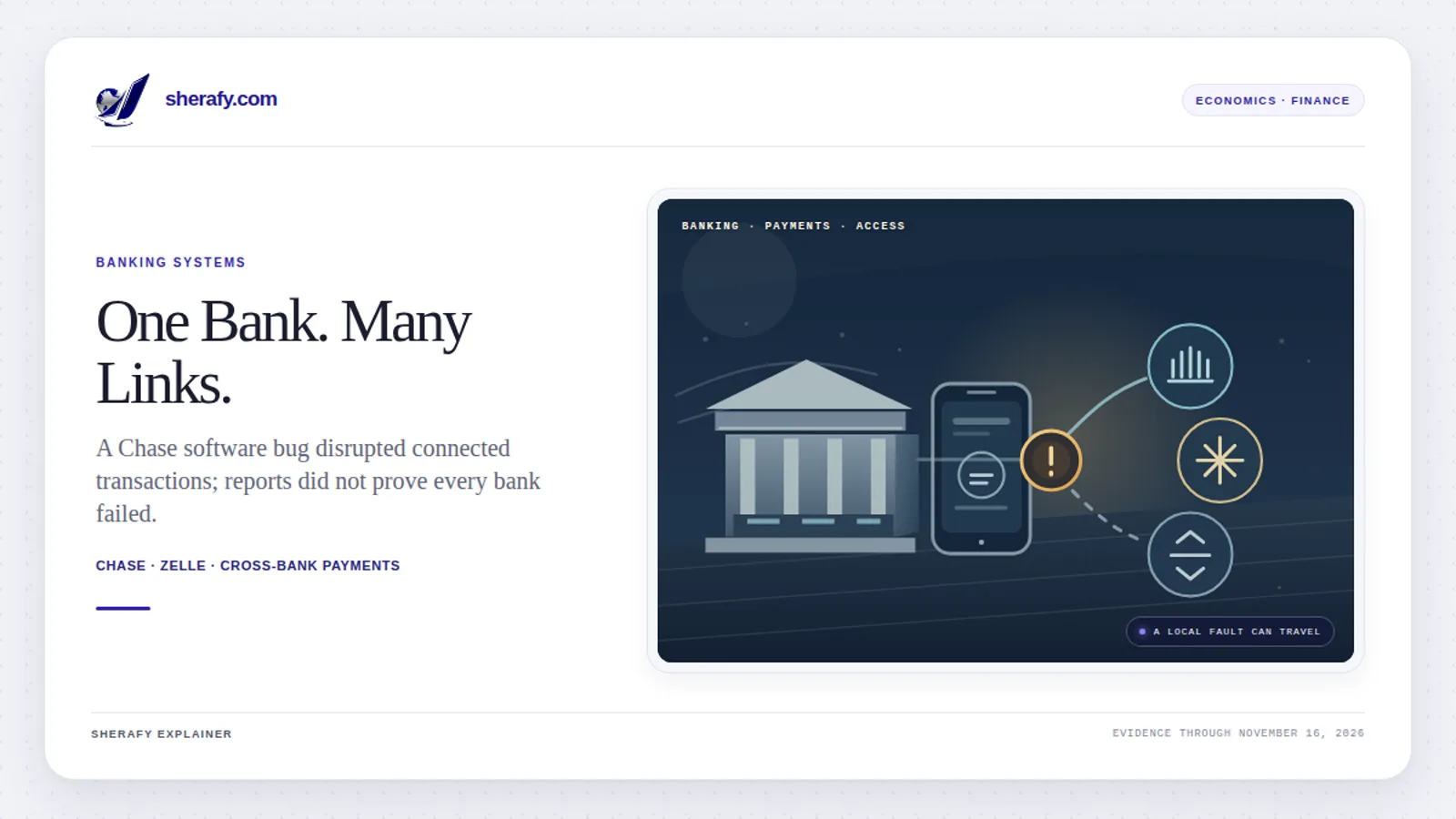
A software bug inside JPMorgan Chase disrupted banking services and delayed transactions on Monday, November 16, 2026. The bank said the problem involved an on-premises hardware system and was not cyber-related. Customers encountered unavailable online services, delayed transfers and, in some locations, problems using banking equipment or branch services. Some customers at other banks also encountered delays when their transactions involved Chase.
But the viral claim that all major U.S. banks went down is not supported by the available evidence. U.S. Bank said its own systems were not affected; Bank of America and Citigroup said their banking services were operating; and Zelle's operator said the Zelle network remained functional. Wells Fargo separately acknowledged an online-banking problem, although a shared cause with Chase was not established. Those distinctions appear in the Associated Press's updated account, Business Insider's reporting on Chase's later statement, and NBC Chicago's account of the Wells Fargo notice.
The larger issue is how one institution's technical failure can become another institution's customer's problem. A bank, a payment network and a third-party financial application can each be working as designed and still be unable to complete a task that depends on another participant. Understanding that difference is essential to knowing what failed, whether a payment actually moved, and whether a missing or outdated balance indicates lost money.
Incident reviewed: November 16, 2026. The bank's broad explanation is confirmed; the exact failed component, complete recovery timeline, total number of affected customers and financial losses, if any, were not established in the public evidence reviewed for this article. Live service conditions may change.
What happened to Chase, Zelle and other banks?
The first step is to separate confirmed outages, downstream transaction delays and customer reports. They are not interchangeable.
| Institution or service | What the evidence establishes | What it does not establish |
|---|---|---|
| JPMorgan Chase / Chase Bank | Chase acknowledged a software bug involving an on-premises hardware system, disrupted service and delayed transactions. It said customers retained access to accounts and funds. AP | Which specific component failed, how many customers were affected or that every access channel worked for every customer. |
| Wells Fargo | Its website displayed a notice that online banking was temporarily unavailable and directed customers toward ATMs, branches and customer service. NBC Chicago | That Wells Fargo's problem had the same technical cause as Chase's. |
| U.S. Bank | The bank said its own systems were not directly impacted, but some Zelle transfers involving another financial institution could be delayed. AP | An independent U.S. Bank platform outage. |
| Bank of America | Users filed outage reports, but the bank was identified as having no banking-service disruption in AP's later reporting. AP | That its core banking system failed nationwide. |
| Citigroup / Citi | Citigroup was reported as not experiencing banking-service problems. AP | That reports involving Citi proved a separate system failure. |
| Capital One | The bank said it was operating normally despite customer outage reports. Business Insider | A confirmed Capital One platform outage. |
| Truist and other listed institutions | Some users submitted outage reports. CBS News | The same root cause, or even an independent outage at each bank. |
| Zelle | Its operator, Early Warning Services, said the network remained operational, while payments involving troubled banks could be delayed. AP | That all Zelle transfers stopped or that the Zelle network itself failed. |
| Plaid connections to Chase | Plaid published an incident notice about disrupted Chase account connections and related API activity. Plaid's incident record | That Plaid caused the Chase bug or that all of Plaid was unavailable. |
The distinction matters because a customer at an otherwise functional bank can experience a failed or delayed payment when the other bank involved is having trouble. Likewise, an error appearing inside a budgeting app may originate at the bank providing the data, rather than the app itself.
Another small but consequential source of confusion: J.P. Morgan and Chase are not two unrelated banking companies. Chase is the consumer banking brand within JPMorgan Chase. Outage lists naming both separately can make the number of independently affected institutions look larger than it is.
How widespread were the problems?
Thousands of people submitted complaints to Downdetector, the website that aggregates public service-problem reports. CNN reported more than 4,700 Chase reports as of about 2 p.m. Eastern, with smaller reporting spikes involving other institutions. Reports described failed logins, unavailable balances and difficulties with transfers.
That is not a count of every person affected. One report does not necessarily equal one unique affected account; most affected customers may never submit a report; and the number rises or falls with public attention. Downdetector can help identify abnormal complaint activity. It cannot, by itself, determine what failed inside a bank, prove a common cause or quantify monetary losses.
The interruption was also not confined to phone screens. Fortune reported problems involving some Chase branches and connected financial apps, while AP photographs documented an out-of-service Chase ATM in Irving, Texas. These examples establish that some physical banking services were affected. They do not establish that every branch, ATM or card transaction stopped working.
What caused the November 16 Chase outage?
Chase moved beyond its initial description of a generic technical problem. Its spokesperson, Joe Evangelisti, attributed the disruption to a software bug in an on-premises hardware system, according to the Associated Press. A public Chase statement reproduced by Business Insider likewise identified the issue as software-related, said there was no evidence it was cyber-related, and explained that transactions involving Chase could affect counterparties at other banks.
That is an important technical disclosure, but it is not a complete root-cause report.
What does an on-premises hardware system mean?
On-premises generally describes computing infrastructure operated in an organization's own facilities or controlled environment rather than relying entirely on a public cloud provider. A bank can run business software on equipment that it owns, manages or operates through a private infrastructure arrangement.
Software runs on hardware, so a bug in software associated with a hardware system is not a contradiction. What remains unclear is which service or layer produced the disruption. Possibilities in banking technology include an application, a transaction-processing service, a connection between systems, configuration logic or an internal dependency. Those are examples of what investigators would test, not findings about this incident.
The disclosure does not establish that old hardware failed, that a mainframe crashed, that Chase was hacked, that a particular cloud provider was responsible or that the bank was in danger of insolvency. It also does not tell us whether an error originated in a recent software change, surfaced during routine processing or had existed in the system for some time.
Was Chase hacked?
Chase said the incident was not cyber-related. There was no substantiated public evidence in the reporting reviewed that a cyberattack caused this outage. That makes an internal technical problem the best-supported description of the known cause.
The bank's statement should not be misrepresented as an independently published forensic audit. The full technical record has not been released. Conversely, the absence of such a report is not evidence of a concealed cyberattack.
Why did a Chase problem affect people who bank somewhere else?
Because completing a financial transaction can require more than one institution or service to cooperate.
A simple example illustrates the principle. Suppose a customer of U.S. Bank attempts to send $500 through Zelle to someone who banks with Chase. The sender's bank might be functioning normally, and Zelle's network might be transmitting the payment instructions correctly. But if the recipient's bank is having trouble performing its part of the transaction, the sender or recipient may experience a delay or an error.
The exact processing and settlement path depends on the participating institutions and payment product. This is a conceptual example, not a reconstruction of an individual November 16 payment:
| Stage | What it contributes | Possible customer-facing symptom if this stage cannot complete its part |
|---|---|---|
| Sender's bank | Authenticates and initiates a payment | The transfer cannot be started or confirmed. |
| Payment service, such as Zelle | Helps the participating institutions coordinate the payment | A payment may not be initiated or its status may not be communicated as expected. |
| Recipient's bank | Processes the incoming side and makes information available to its customer | The recipient may not see the payment or may experience a delay. |
| Bank account and transaction-display systems | Show posted and pending account activity | The app's visible history may lag behind underlying processing. |
A failure in any necessary stage can disrupt the experience. The fact that the customer sees an error at the sender's bank does not identify the sender's bank as the source of the underlying fault.
Chase itself said other banks might experience slowness to the extent they were involved in transactions with Chase, while rejecting the characterization of a systemwide banking collapse. AP reported that statement directly. U.S. Bank's description of its own unaffected systems and possible interbank Zelle delays is consistent with that explanation.
This is the central concept of the incident: a disruption can spread through a network of business relationships without spreading as a common software failure.
Was Zelle down? Why could Zelle payments fail if the network was working?
Zelle said its network was operational. Its operator, Early Warning Services, explained that issues at participating financial institutions could still delay Zelle payments for their customers. That statement was reported by the Associated Press and CBS News.
Zelle is a payment service used through participating banks and credit unions. It is not a separate checking account that holds the money being sent. The money is associated with accounts at financial institutions, and those institutions have duties in executing and recording the transaction. Zelle's own customer documentation says payments between enrolled users generally become available within minutes, while instructing customers with unclear payment status to contact their bank.
A functioning coordination network cannot guarantee that every participating institution is available at the same moment. That is why the statements "Zelle is working" and "my Zelle payment is delayed" can both be true.
Zelle, ACH, RTP and FedNow are not interchangeable
The American payments system has several distinct layers and services:
- Zelle is a consumer-facing payment experience and network through which participating institutions coordinate transfers.
- ACH is an electronic bank-payment system often used for payroll, bill payments and transfers. Its processing and settlement arrangements differ from the customer-facing Zelle experience.
- RTP, operated by The Clearing House, is a real-time payment network used by participating financial institutions.
- FedNow, operated by Federal Reserve Banks, is another real-time interbank payment service.
- CHIPS is a major high-value payment clearing and settlement system for participating financial institutions.
These systems have different roles and should not be bundled into one undefined "banking network." On November 16, The Clearing House's network-status page displayed normal operations for CHIPS, its EPN ACH network and RTP during the status check. That is evidence about those specific networks at that time, not proof that every U.S. payment channel or individual bank system was functioning normally.
Nor does the fact that those networks were operational tell us which payment rail carried any particular delayed Zelle transfer. That would require transaction-level or operator evidence that has not been made public.
What about Wells Fargo, Bank of America, U.S. Bank and Capital One?
The reporting has to be interpreted bank by bank, not through a single viral list.
Wells Fargo: The bank posted an online-banking notice saying the service was temporarily unavailable and directed customers to alternatives such as ATMs, branches and customer support, according to NBC Chicago. This confirms a genuine Wells Fargo service disruption. It does not establish that Wells Fargo shared Chase's internal bug. That relationship remains unproven.
Bank of America and Citigroup: Both appeared in the larger public discussion, but AP's later reporting described their banking services as unaffected. A customer may still encounter a problem involving a transaction with another institution. An elevated complaint count alone does not overturn an institution's service-status statement.
U.S. Bank: Its statement was unusually specific. The bank said its systems were not directly impacted, while clients sending or receiving Zelle payments involving another financial institution could face delays. This is the clearest public illustration of the difference between an institution's own outage and a cross-bank transaction problem. The Washington Post reproduced the statement.
Capital One: A spokesperson told Business Insider that it had not been impacted and was operating normally at the time of the statement, despite its appearance in customer outage reports.
Truist and other banks: Some users submitted complaints, as CBS News reported. Those reports are leads for verification, not confirmation that each bank suffered an independent technical malfunction.
The available evidence therefore supports one identified Chase technical issue, a separately acknowledged Wells Fargo online-service problem, and downstream customer experiences at other banks, not a proven simultaneous failure of all major banks.
Why did financial apps connected through Plaid also have problems?
Plaid provides technology that lets people connect bank accounts to third-party products, including budgeting, lending, investment and other financial applications. Those connections depend on access to information or authorization services supplied by the bank.
At 15:11 UTC, or 10:11 a.m. Eastern on November 16, Plaid opened an incident titled "Service Disruption Impacting Chase connections". Its notice documented interrupted Chase connectivity affecting account-linking requests and API calls. This was corroborating technical evidence independent of consumer complaints and separate from the statements made by the banks. Plaid's status overview identifies which Plaid components are affected by reported incidents.
The consequence is straightforward: a person could be unable to refresh a Chase balance in an unrelated financial app because Chase's connection was impaired. That does not mean the app itself initiated the outage, nor does it mean the financial information in the underlying bank account vanished.
Plaid's notice does not identify the specific failed Chase component or the ultimate cause. The conclusion supported by the evidence is narrower: Chase's disruption reached outside Chase's own website and app into services that depend on Chase account connectivity.
Could customers really lose access to balances, branches or ATMs?
Yes, individual channels can become unavailable or unreliable during a bank service disruption. A customer may be unable to sign in, may see an incomplete transaction history, or may encounter an ATM or branch that cannot complete a particular service.
The AP's on-scene photographs show an out-of-service Chase ATM in Texas. Fortune documented reports involving branches and account-connected services. Chase nevertheless said its customers continued to have access to accounts and funds.
The difference between those statements is not necessarily dishonesty: one describes broad account and fund availability, while the other documents failures experienced by particular customers through particular channels. But the bank's broad assurance should not be treated as proof that every person could withdraw cash or complete every transaction on demand.
Does a missing balance mean the money is gone?
Not necessarily. Three situations can look similar on a phone but require different interpretations:
- Display or access failure: The account balance or recent transactions cannot be retrieved or shown correctly.
- Processing or posting delay: The bank has not yet completed or displayed a transaction, so a customer's available balance, posted balance and recent activity may temporarily differ.
- Actual account or transfer error: A debit, credit or other entry is wrong, duplicated, missing, unauthorized or not completed as required.
The first two do not by themselves establish that deposits were lost. The third can have real financial consequences and may require investigation under applicable consumer-protection rules.
The public evidence does not establish that Chase's core ledger was corrupted or that deposits disappeared during this incident. It also does not justify dismissing every customer's unexplained discrepancy as merely cosmetic. Preserve the details and ask the bank to investigate any balance or transaction error that remains unresolved.
Timeline: How the November 16 outage developed
The timeline below uses observable public evidence, not assumptions about when the original internal bug first occurred. Times are Eastern unless otherwise noted.
| When | What was documented | What the timestamp means |
|---|---|---|
| Monday morning | Complaints involving Chase login and transaction services began increasing. Fortune | Public reports; the precise internal failure time is unknown. |
| 10:11 a.m. | Plaid recorded the start of its incident affecting Chase connections. Plaid | A third-party incident record, not proof that Chase's bug began at this instant. |
| Early afternoon | Reports accumulated for Chase and several other bank brands; Chase acknowledged technical trouble. CBS News | Confirmed public escalation and response. |
| Around 2 p.m. | CNN reported more than 4,700 Downdetector complaints involving Chase. CNN report | Submitted reports, not verified unique customers. |
| Afternoon | U.S. Bank clarified it was not directly affected; Zelle said its network remained operational; Wells Fargo acknowledged an online-banking issue. AP; NBC Chicago | Important separation of institution failures from downstream effects. |
| Later Monday | Chase identified a software bug involving an on-premises hardware system and rejected a systemwide-failure or cyberattack explanation. AP; Business Insider | The most specific publicly attributable cause statement identified in the reporting reviewed. |
Not established: a definitive start time for the internal failure, a single verified all-services-restored time, a final count of affected payments, or an independent post-incident technical report. We will not substitute the disappearance of an error message or a decline in complaint volume for a verified restoration record.
Is this evidence of a banking-system crisis?
No evidence reviewed establishes a banking-system insolvency crisis, a nationwide settlement-network collapse or missing customer deposits. That does not make the disruption harmless. The problem created real access and payment difficulties, but operational availability and financial solvency are different questions.
Operational risk concerns whether systems and processes continue functioning. A transaction can be delayed because a necessary service is unavailable. Liquidity or solvency risk concerns whether a bank can meet its financial obligations and whether its assets cover its liabilities. An outage alone does not prove a bank lacks the money it owes depositors.
The size of Chase makes operational disruptions important. In the Federal Reserve's June 30, 2026 commercial-bank ranking, JPMorgan Chase Bank ranked first with approximately $4.09 trillion in consolidated assets. That figure illustrates institutional scale. It is not the amount of money placed at risk or affected by the November outage.
The structural issue: Financial services share dependencies
This incident exposes a genuine infrastructure question. Modern banking is not a collection of wholly independent apps. Banks exchange payment instructions with one another, rely on outside providers for some services, and connect customer accounts to many third-party tools. A service failing at one participant can disrupt an otherwise healthy participant's ability to complete a customer request.
Regulators have been examining such dependencies for years. The Financial Stability Board's third-party risk toolkit describes how concentrations of critical service providers and connected operational relationships can introduce wider financial-sector risks. U.S. banking regulators issued joint guidance on managing third-party relationships in 2023.
Those documents do not prove that an outside vendor caused the Chase outage. In fact, the reported origin was inside a Chase on-premises system. Their relevance is broader: the industry recognizes that dependency mapping, isolation, backup arrangements, recovery procedures and incident communication matter because services are interconnected.
The most useful lesson is therefore neither "the entire banking system failed" nor "nothing serious happened." It is that the customer-facing reach of a technical fault can exceed the institution where that fault originated. Quantifying that reach requires transaction records and recovery information that have not yet been disclosed.
What should you do if your Chase account or Zelle payment is still affected?
The correct response depends on the symptom. Avoid repeatedly submitting a payment simply because the app did not display confirmation. Before trying again, verify what the bank has actually recorded.
| What you are experiencing | Practical next step |
|---|---|
| Cannot sign in or see balances | Try the bank's official website, ATM, telephone service or branch if available. Use contact details from a bank card or official statement, not a link in an unsolicited message. |
| Zelle payment is pending or status is unclear | Check the payment activity in your bank's official app. Contact the participating bank before sending the payment again. |
| Sender says Zelle payment completed, recipient sees nothing | Keep the confirmation, recipient details, amount and time. Ask the sending bank to trace the transaction; the recipient can also contact their bank. |
| A payment or transfer appears twice | Do not assume both entries will settle or disappear. Preserve screenshots and transaction identifiers, then report a possible error to the bank. |
| Balance differs from your records | Compare available versus posted balances and pending activity. Document the discrepancy and request an investigation if it persists. |
| A bill or loan payment may be late | Contact the biller, determine whether the original instruction processed, ask about another payment method and document any late fee. |
| You incurred an overdraft, ATM or other fee because of the disruption | Request a reversal or credit and retain the bank's response. Reimbursement is not automatic in every case. |
| Someone calls or texts claiming to be the bank | Do not provide passwords, one-time codes or account credentials. Contact the institution through a verified number. |
These steps are consistent with the Consumer Financial Protection Bureau's guidance on bank outages, which recommends contacting the institution, considering alternative access methods, checking automatic payments, requesting reversals of outage-related fees and watching for impersonation scams.
Will a pending Zelle payment automatically be returned?
Do not assume so. Zelle's payment-status and cancellation guidance explains that a payment to a recipient who has not enrolled may be cancelable, while a payment to an already enrolled recipient generally cannot be canceled through the normal process. A service disruption adds uncertainty about processing status; it does not create a general right to cancel a completed payment.
If the bank cannot confirm the transaction's state, save the receipt or activity record and request an investigation. Do not send a second $500 simply because the first $500 has not appeared on the recipient's screen.
Are bank customers entitled to reimbursement?
Potentially, depending on the type of problem and the facts. The CFPB advises customers to request credits or reversals for fees caused by an outage, including late, overdraft and other applicable charges. That is sensible consumer guidance, not a guarantee that every expense or inconvenience will be reimbursed.
For qualifying errors involving a consumer electronic-fund transfer, Regulation E's error-resolution procedures establish notice and investigation requirements. In general, the consumer should notify the financial institution no later than 60 days after it sends the periodic statement on which the alleged error first appears. A covered institution ordinarily has 10 business days to investigate, with extensions and conditional provisional-credit obligations in certain situations. These provisions are fact-specific and do not apply identically to every business transfer, disputed charge or service outage.
If the bank does not address an unresolved problem, the CFPB's complaint process offers a formal channel to submit a consumer financial complaint.
Is your money safe when a bank's app is down?
A banking app becoming unavailable does not by itself mean the bank has lost your deposits. Chase said customers retained access to their accounts and funds, and the public record reviewed here does not establish deposit losses or a bank failure.
There is an important limit to the reassurance, however: money can remain legally owed to a customer even while that customer temporarily cannot use a particular access channel. That situation can cause immediate hardship when bills, wages, purchases or withdrawals are time-sensitive.
For insured deposits, the FDIC's official coverage guidance generally provides up to $250,000 per depositor, per insured bank, per ownership category, subject to the applicable rules. That coverage protects eligible deposits if an insured bank fails. It is not a promise of uninterrupted apps, ATMs, card authorizations or transfers, and it is not a blanket insurance policy against outage-related expenses.
A temporarily inaccurate-looking screen should be investigated if it does not reconcile. It should not be treated, without evidence, as proof that the underlying deposit has disappeared.
Was the banking outage connected to the FAA ground stop or Microsoft disruption?
The sequence was striking. A major Microsoft service interruption and a nationwide aviation disruption had already drawn attention to the fragility of critical technology systems when the bank complaints surged. But there is no substantiated evidence in the reporting reviewed that those events caused the Chase problem or shared a single technical trigger.
The distinctions matter:
- The November 16 banking issue was described by Chase as a software bug involving an on-premises hardware system.
- The November 13 FAA nationwide ground stop involved failures in the aviation communications and data environment; its particular causes and responsibilities have been the subject of separate investigation.
- The November 12-13 Microsoft service outage had its own technical account and affected a different set of services.
These events can be compared as examples of operational resilience, but proximity in a news cycle is not evidence of a common cyberattack, coordinated sabotage or a shared vendor failure. Any such claim would require direct technical or investigative evidence.
What remains unanswered about the Chase outage?
Chase's software-bug disclosure is meaningful. It is still several steps short of the public technical record needed to evaluate the event fully.
The most important unresolved questions are:
- Which exact service or system failed? The phrase "on-premises hardware system" does not identify a component, application or transaction-processing function.
- What triggered the software bug? No verified change history, fault sequence or reproduction has been released in the reviewed materials.
- Which functions actually stopped? The full breakdown among logins, balance retrieval, authorization, posting, transfers, branches, cards and ATM services is not public.
- How many customers and payments were affected? Complaint-report counts cannot answer this.
- When was each affected service restored? Partial recovery of an app does not prove all transaction processing and reconciliation is complete.
- Did delayed, duplicate or incorrectly displayed entries require correction? There is no public, audited incident-wide accounting in the sources reviewed.
- Was Wells Fargo's acknowledged online-banking problem independent? Its cause has not been established as the same as Chase's.
- What compensation and remediation will affected customers receive? The institutions' response to documented financial consequences remains material.
Those are not technicalities. They determine whether the bank's recovery was complete, whether delayed payments were reconciled, and whether the operational safeguards expected of a systemically important financial institution performed as intended.
Frequently asked questions
Why was Chase Bank down on November 16, 2026?
JPMorgan Chase attributed the disruption to a software bug in an on-premises hardware system. The bank said the problem was not cyber-related. The precise affected component and full technical failure sequence were not publicly established in the evidence reviewed.
Were all U.S. banks down?
No. Multiple institutions appeared in user-report trackers, but not all had confirmed internal failures. Chase acknowledged its problem, Wells Fargo acknowledged online-banking unavailability, and U.S. Bank, Bank of America, Citigroup and Capital One reported their systems were not directly affected or were operating normally at the times of their statements.
Was Zelle down on November 16?
Zelle's operator said its network was functioning, although payments involving financial institutions with technical problems could be delayed. A functioning network does not guarantee every participant can complete a transaction.
Did Chase customers lose their money?
No public evidence reviewed establishes that customer deposits were lost. Chase said customers retained access to accounts and funds. An inability to display a balance or complete a transaction is not, by itself, proof of lost deposits. Unexplained account errors should still be documented and investigated.
Were ATMs and branches affected?
Some were. AP documented an out-of-service Chase ATM in Texas, and other reporting described some branch-service difficulties. This does not mean every ATM or branch was unavailable.
Will my direct deposit or bill payment be delayed?
The publicly available statements do not establish an incident-wide failure of payroll direct deposits or automatic bill payments. A particular transfer could still be affected depending on the systems and institutions involved. Check its actual status with your bank and biller rather than assuming completion or failure.
Should I retry a missing Zelle payment?
Not until you verify the original transaction's status with the bank. Repeating a payment when the first one is merely delayed can create an additional transfer. Zelle's normal cancellation options are limited, especially when the recipient is already enrolled.
Was there a nationwide cyberattack on U.S. banking?
There is no substantiated evidence of that in the sources reviewed. Chase identified a software bug and said the incident was not cyber-related. Public reports of trouble at multiple brands are not evidence of a coordinated attack.
Has the outage been completely resolved?
A definitive, independently documented all-services-restored time was not established in the sources reviewed for this article. An individual user's app working again does not establish that every affected transfer, connected application or branch function has recovered. Consult your financial institution's current notices and confirm any outstanding transaction directly.
What the November 16 outage actually shows
The headline suggested a single mysterious event had taken down America's largest banks. The evidence supports a more precise and more revealing story.
Chase acknowledged a software bug inside its own infrastructure. Other institutions' customers experienced problems where their transactions depended on Chase, while several banks and Zelle said their own systems remained operational. Wells Fargo also acknowledged online-banking trouble, but the available evidence does not establish that its problem shared Chase's cause.
A banking network does not have to fail everywhere for a problem at one institution to be felt elsewhere. That is the operational vulnerability worth understanding. The remaining test of the system is not how quickly the outage vanished from headlines, but whether every affected payment was reconciled, every meaningful customer error was addressed, and the actual failure mechanism was documented well enough to prevent a repeat.
References and Further Reading
The sources below distinguish primary technical records and regulator guidance from contemporaneous reporting. Statements by banks and payment operators establish what those institutions said; they do not replace an independent incident audit.
Primary statements, technical records and payment documentation
- Chase's public November 16 statement, as linked by Business Insider – Chase's explanation of its software bug, on-premises system and cross-bank transaction effects. The statement is also reproduced in the independent reporting below.
- Plaid: Service Disruption Impacting Chase Connections – An independent technical incident record for third-party Chase account connectivity and affected API functions. The page may show later updates as the investigation continues.
- The Clearing House: Network Service Status – Live network-status information for CHIPS, EPN, RTP and other Clearing House services. It is not a historical audit of every U.S. payment system.
- Zelle: Payment Cancellation and Transfer-Status Guidance – Explains payment status, transfers to enrolled recipients, cancellation limits and when to contact a participating bank.
- Federal Reserve: Commercial Banks Ranked by Consolidated Assets, June 2026 – The primary source for JPMorgan Chase Bank's size and position among U.S. commercial banks. Asset size is not an estimate of outage losses.
Consumer rights and operational-risk guidance
- CFPB: What Happens If Your Bank Has an Outage? – Practical federal guidance on alternative access methods, automatic payments, fees and fraud prevention.
- CFPB: Regulation E, Section 1005.11, Procedures for Resolving Errors – The controlling regulation for notice and investigation of qualifying consumer electronic-fund-transfer errors, including applicable timing rules.
- FDIC: Deposit Insurance at a Glance – Authoritative explanation of insured deposits and ownership-category limits. Deposit insurance should not be confused with guaranteed uninterrupted banking service.
- OCC, Federal Reserve and FDIC: Interagency Third-Party Risk Guidance – Joint U.S. regulatory framework for identifying and managing risks in banking relationships with outside service providers.
- Financial Stability Board: Final Toolkit for Third-Party Risk Management and Oversight – International supervisory framework discussing operational dependencies, critical providers and possible wider financial-system consequences.
Independent incident reporting and verification
- Associated Press: A Technical Issue at JPMorgan Chase Triggers Online Banking Delays – Reports the more specific software-bug explanation, Chase's limited-system characterization and statements involving Zelle, Bank of America, Citigroup and U.S. Bank.
- Business Insider: Chase Software Bug Wreaks Havoc on Online Banking – Reproduces the later Chase statement and documents Capital One's denial of direct impact and U.S. Bank's cross-bank payment explanation.
- NBC Chicago: Multiple Banks Report Online Banking Issues – Records Wells Fargo's online-banking outage notice and the available alternative customer-service channels.
- Fortune: Chase and Wells Fargo Customers Report Access Problems – Adds reporting about branch impact, outside account-linked applications and the limitations of outage-report counts.
- CNN: Thousands of Customers Report Trouble With Online Banking – Contemporary reporting on Chase complaint volumes and the distinction between Chase's problem and delays at other banks.
Editorial currency note: This report reflects evidence publicly available on November 16, 2026. The bank's stated cause, any later formal root-cause report, service restoration, remediation practices and transaction counts should be reviewed for subsequent disclosures. Live operational pages are changeable snapshots. The conceptual payment-flow examples are explanatory models, not representations of confidential bank architecture or proof of the particular fault sequence.