
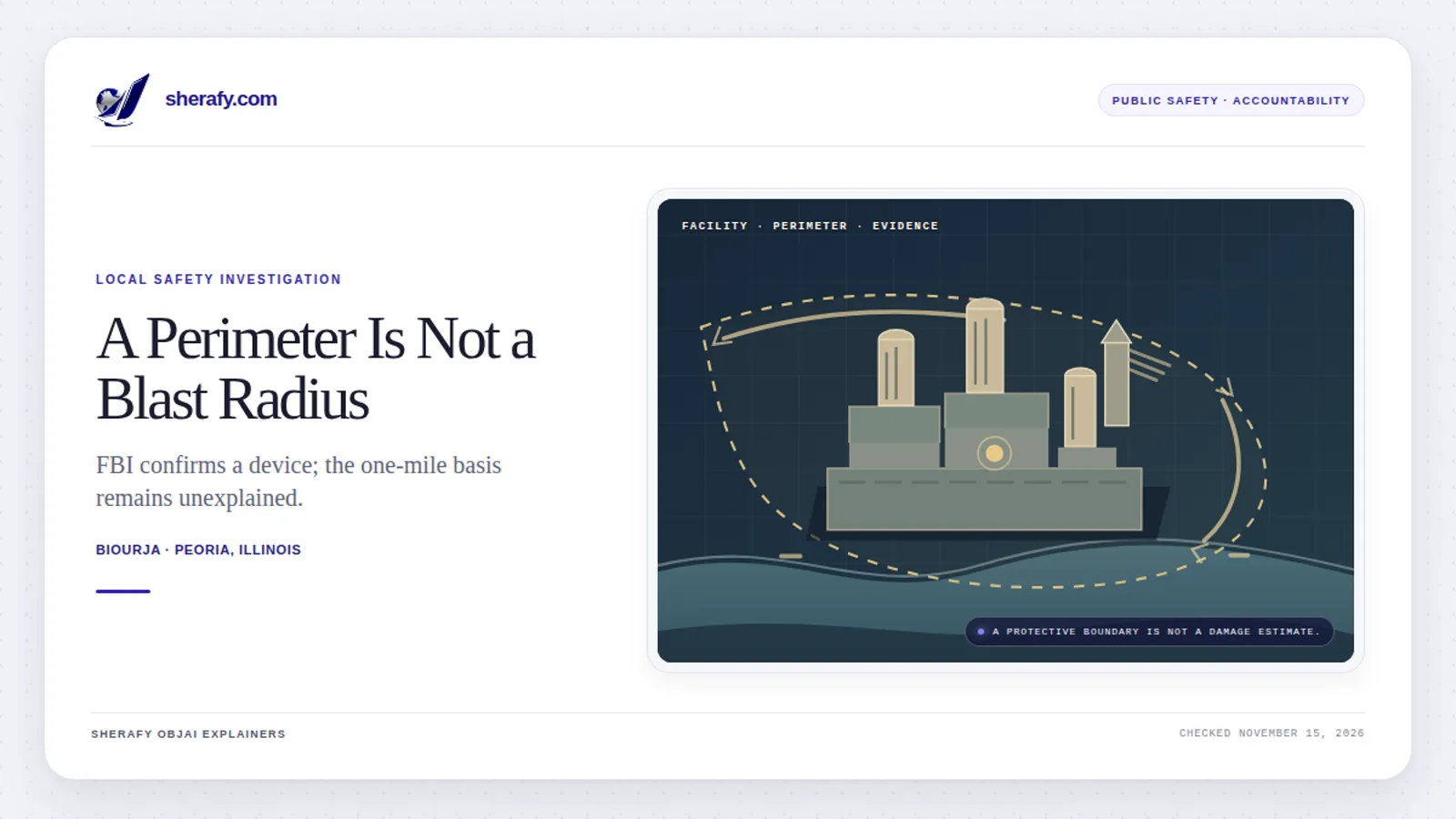
The one-mile evacuation around BioUrja Renewables in Peoria, Illinois, was a precautionary safety boundary, not a publicly verified measurement of how far the explosive device could cause damage. Officials said the ethanol plant’s combustible materials influenced the distance. As of the November 15, 2026, verification cutoff, the public sources reviewed had not supplied a site-specific technical assessment explaining how authorities selected exactly one mile.
A suspicious package was found on Friday, November 13, and bomb technicians rendered it safe that night. On Saturday night, the FBI confirmed that an explosive device had been found and said it was leading the investigation. After a search found no additional suspicious devices, Peoria police lifted the evacuation order at approximately 1 p.m. Saturday, November 14, and allowed residents and businesses to return. The Peoria Police Department’s official update said the investigation would continue.
The chronology explains an apparent contradiction in early coverage. Mayor Rita Ali initially called the object a bomb. At Saturday’s briefing, Police Chief Brad Dixon would not confirm its composition; Ali later told WCBU that bomb had been her interpretation at the time. Later Saturday, the FBI confirmed that an explosive device was found. WCBU documented the earlier statements, and WGLT reported the FBI’s subsequent confirmation.
The FBI has now answered the first question at a basic level: an explosive device was found. Why did the incident require protective measures across portions of two cities, and what supported the exact one-mile boundary? Those questions remain separate from the device’s confirmed classification.
Status: Updated with public information reviewed through 1:35 p.m. Central Standard Time on November 15, 2026. All incident times below are Central Standard Time. The November 13–14 evacuation is no longer in effect.
Why Did Authorities Order a One-Mile Evacuation Around BioUrja?
The immediate concern was not simply an unidentified package. It was an unidentified package at an industrial facility where authorities said combustible materials were present.
According to WCBU's reporting from the November 14 police briefing, the one-mile boundary was determined with the facility's materials in mind, rather than necessarily reflecting the size or destructive capability of the device itself. Mayor Ali had specifically expressed concern about ethanol and other combustible chemicals.
That explanation matters because three different concepts have been repeatedly blurred together:
| Term | What it actually tells us |
|---|---|
| Confirmed explosive device | The FBI confirmed an explosive device was found. Its public statement did not identify the device’s type, composition, quantity, or destructive capability. |
| Potential industrial consequences | Responders may need to consider whether a fire, equipment damage, or another event could involve materials already present at the site. The consequences depend on actual conditions. |
| One-mile evacuation boundary | Authorities identified an area where they wanted people away from potential danger while the threat was being assessed and the site searched. It is not proof that everything inside that circle could be destroyed. |
The word radius also describes geography, not the number of people who left. A one-mile circle centered on the plant reached into Peoria, across the Illinois River, and into part of East Peoria. Neither entire city was evacuated.
Was the bomb capable of destroying everything within one mile?
There is no publicly established basis for that claim.
Officials and news reports sometimes called the boundary a blast radius. In technical usage, however, the effects of an explosion depend on the explosive material, its amount, the surrounding environment, and the type of harm being measured. A protective boundary set before those facts are known is not the same as a calculated damage radius.
The FBI has confirmed an explosive device, but the public sources reviewed had not identified its type, composition, quantity, or destructive capability. Nor had officials released a site-specific risk assessment showing which potential industrial events, material quantities, or assumptions produced the one-mile figure.
A conservative evacuation can be appropriate under uncertainty. But that does not turn the perimeter into proof of a particular catastrophe waiting to happen. The public knows the distance officials selected. It does not yet know the complete calculation, if any, behind that selection.
Was an Actual Bomb Found at the Peoria Ethanol Plant?
Authorities found a suspicious device and considered it a credible threat. Bomb technicians rendered it safe at 9:12 p.m. Friday. On Saturday night, the FBI confirmed an explosive device had been found and said it was leading the investigation. The exact type, composition, and explosive quantity have not been disclosed in the public updates reviewed through the cutoff.
During the incident, Mayor Rita Ali described the object as a bomb. At Saturday’s briefing, Chief Brad Dixon declined to confirm that it was an explosive device and said examination was continuing. Ali later told WCBU that the word bomb was her interpretation at that time. The FBI subsequently confirmed an explosive device was found. The sequence is documented in WCBU’s November 14 report and WGLT’s November 15 report.
This is not a semantic technicality. The FBI’s statement confirms that the object was an explosive device, but does not disclose its design, contents, quantity, or likely effects. Those details are distinct findings and should not be inferred from the broader confirmation.
Here is where the evidence stood following the all-clear:
| Question | What was established by the November 15 verification cutoff |
|---|---|
| Was a bomb threat reported? | Yes. BioUrja notified Peoria police on November 13. |
| Was an object found? | Yes. Police located a suspicious package. |
| Was the threat considered credible? | Yes. Authorities reached that assessment Friday evening. |
| Was the object rendered safe? | Yes. Bomb technicians completed that action Friday night. |
| Did law enforcement confirm it was an explosive device? | Yes. The FBI said an explosive device was found. The precise type, composition, and quantity were not identified in the public updates reviewed. |
| Were additional suspicious devices found? | No. The subsequent plant-wide search found none. |
| Was a suspect or motive announced? | Not in the official updates reviewed. The investigation remained open. |
The FBI’s confirmation establishes the presence of an explosive device. It does not by itself establish the device’s power, the hazards it posed to neighboring properties, or why officials chose a one-mile protective boundary.
BioUrja Bomb Threat Timeline: November 13–14, 2026
The sequence shows why the crisis continued after technicians dealt with the initial package. It also identifies an important unanswered question about the timing of the public warning.
| Date and time (CST) | Confirmed development |
|---|---|
| Friday, Nov. 13, 1:08 p.m. | BioUrja contacted Peoria police about a bomb threat. |
| Around 2 p.m. | A suspicious package was found and additional resources were called. |
| 6:45 p.m. | Authorities classified the package as a credible threat. |
| Approximately 7:02 p.m. | Notifications directing people within one mile to evacuate were issued. |
| 9:12 p.m. | Bomb technicians rendered the identified package safe. |
| Saturday, Nov. 14, early morning | Specialist teams continued preparing for and conducting a search of the larger facility. |
| Approximately 1 p.m. | Authorities announced that the search had found no additional suspicious devices and lifted the evacuation order. |
| Saturday night | The FBI said it was leading the investigation and confirmed that an explosive device had been found. |
The chronology is drawn from WCBU’s initial reporting and police briefing, the Peoria Journal Star’s incident reconstruction, the official police all-clear, and WGLT’s report of the FBI’s later confirmation.
Why did the evacuation notice come nearly six hours after the threat?
The initial report to police and the public evacuation notification were approximately five hours and 54 minutes apart. That interval deserves an explanation, but it is not evidence that authorities simply ignored the warning for six hours.
Police were responding and investigating before the public notice. The package had been located around 2 p.m., and authorities said they did not classify it as a credible threat until 6:45 p.m. The broader public notification followed about 17 minutes later.
What is not publicly established is the complete decision-making record: what changed during the assessment, whether narrower protective measures had already been taken, and how officials weighed industrial risks before expanding the boundary. Those questions require the incident logs, additional official explanation, or a later after-action review. The known times alone cannot establish either negligence or flawless decision-making.
Why did people remain evacuated after the package was rendered safe?
Because making one item safe is not the same as clearing an entire facility.
Chief Dixon said responders still needed to search the extensive BioUrja site for other potential devices. Teams conducted that search Saturday, with the assistance of plant personnel. Police announced the all-clear after the search ended without finding additional suspicious objects. The official update authorized residents to return and said road barricades would be removed.
This is also why the status of the evacuation and the status of the criminal investigation should not be confused. The area could reopen while investigators were still working to establish what happened and who was responsible.
Could an Ethanol Plant Explosion Affect the Surrounding Community?
An ethanol facility can contain serious fire and explosion hazards, but there is no single standard blast radius for an ethanol plant. Different materials behave differently, and an industrial site is not one giant container that inevitably explodes as a unit.
The Occupational Safety and Health Administration's technical manual on ethanol processing identifies two particularly important categories of hazards: flammable liquids and vapors, and combustible dust from grain handling. They can both produce dangerous incidents, but through different mechanisms.
1. Ethanol vapors can ignite
Ethanol is a flammable liquid. When released, it can produce vapors that may ignite if they reach an ignitable concentration and encounter an ignition source. A spill, a leaking system, or damage to equipment can create conditions that differ considerably from normal, contained operations.
OSHA describes engineering safeguards, inspections, maintenance, fire protection, and other controls intended to prevent or limit these events. The presence of ethanol at a plant does not mean an explosion is occurring or inevitable; it means responders must understand the relevant hazards when something unusual happens.
2. Grain dust can present a separate explosion hazard
Ethanol production often begins with grain. Handling, transferring, or processing dry grain can create fine combustible dust. Under the wrong conditions, dust suspended in air can burn rapidly, and an initial incident may disturb additional accumulated dust.
This is a different process from a pool of ethanol burning or flammable vapor igniting. OSHA treats combustible dust as a distinct hazard and describes the importance of controlling dust accumulation, ignition sources, and conditions that could allow a fire to escalate.
3. The facility's actual conditions determine the consequences
A meaningful industrial risk assessment needs more than the name of a chemical. It must account for the materials present, their quantities and locations, the equipment involved, the type of initiating event, protective systems, and conditions at the time.
None of those plant-specific inputs has been publicly tied to a demonstrated one-mile damage calculation for the November 13 incident. It would therefore be misleading to claim either that a one-mile catastrophe was certain or that the perimeter was excessive based on a generic description of ethanol.
One widely used federal reference also needs careful handling. The U.S. Department of Transportation's 2024 Emergency Response Guidebook provides initial guidance primarily for hazardous-materials transportation incidents and expressly cautions that it may have limited value at fixed facilities. Distances listed for particular transport containers cannot, by themselves, prove the correct evacuation distance for a complex stationary plant.
The Same BioUrja Facility Had a Major Grain-Bin Explosion in 2022
The concern about industrial hazards has a documented local history, but it is important not to confuse two unrelated events.
On May 11, 2022, a grain-bin failure and explosion occurred at the BioUrja facility at 1 Edmund Street. The incident damaged multiple bins and injured two workers. WCBU's review of OSHA records described one worker receiving treatment for smoke inhalation and another sustaining a minor burn. Damage estimates reported at the time exceeded $2 million.
OSHA investigated. Its public inspection record, number 1595231.015, lists the case as closed in September 2022. WCBU obtained more detailed inspection documents and reported that OSHA recommended no citations after its review.
That finding should be stated accurately: it means the investigation did not produce the cited enforcement action. It is not a blanket certification that an industrial plant could never suffer another accident.
The financial aftermath is also documented. In Peoria City Council file 22-325, adopted September 27, 2022, the city recorded reimbursement received from BioUrja for emergency fire services and authorized a budget amendment of up to $101,000 associated with the response. The record specifically identifies the May 11 grain-bin explosion and the fire department's personnel and equipment costs.
These records establish a past industrial emergency and its public costs. They do not establish a connection to the November 2026 suspected device, a motive for the threat, or an unsafe condition that caused it.
Who Owns BioUrja Renewables, and What Does the Peoria Plant Produce?
BioUrja Renewables operates the former Archer Daniels Midland (ADM) ethanol complex in Peoria. In an October 21, 2021 announcement, ADM disclosed an agreement to sell the facility to Houston-based BioUrja Group.
The announcement described the plant's focus on ethanol and highly distilled industrial and beverage-grade alcohol. ADM said the sale would reduce its annual ethanol production capacity by 135 million gallons.
That number needs context. Annual production capacity is not the quantity stored on site at one moment. It cannot be used to calculate the size of a hypothetical November 2026 explosion or to infer how much ethanol was present during the threat.
The plant sits near the Illinois River at the address named in the Peoria Police Department's notice. Its position helps explain why a circle drawn around the property would intersect both Peoria and East Peoria, but location alone does not establish a particular physical hazard distance.
How Much of Peoria and East Peoria Was Affected?
The one-mile evacuation recommendation reached parts of Downtown Peoria, the South Side and Warehouse District, and crossed the Illinois River into portions of East Peoria. It did not require the evacuation of the entire population of either city.
The incident disrupted roads and bridges, regional employers, and scheduled events. Country singer Jon Pardi's Friday concert at the Peoria Civic Center was canceled, while other activities and businesses faced closures or changes. WCBU's original reporting documented the concert and bridges affected; 25News reported additional event and business disruptions.
The Coast Guard also established a temporary restriction on the Illinois River between mile markers 160 and 164, interrupting vessel traffic through that four-mile stretch. The restriction was lifted at approximately 1 p.m. Saturday, according to WMBD's report of the Coast Guard update.
Residents needing somewhere to stay were directed to Manual High School in Peoria and EastSide Centre in East Peoria. WCBU reported approximately 60 to 80 people at the Manual shelter midday Saturday. That was a shelter count, not a verified total of everyone who left homes, businesses, or workplaces. The American Red Cross and local volunteers assisted those displaced.
Was the evacuation legally mandatory?
The language was confusing. The initial police notice urged people within one mile to evacuate immediately and described the action as a precautionary recommendation. Subsequent headlines frequently referred to an evacuation order.
At Saturday's briefing, according to WCBU, Mayor Ali said the evacuation itself was not mandatory, while strongly encouraging residents to leave for safety. Authorities also restricted access to streets in the affected area.
Those points are not contradictory: a strong safety recommendation can coexist with road closures and access restrictions. But describing all residents as legally compelled to leave would overstate what local officials said.
How Do Officials Decide When an Industrial Area Should Be Evacuated?
There is no universal rule that every bomb threat at an ethanol plant requires everyone within exactly one mile to leave.
Public safety decisions depend on the credibility of the threat, what responders know and do not know, the people nearby, the facility involved, and whether remaining in place creates more risk than moving. The Cybersecurity and Infrastructure Security Agency's August 2025 Bomb Threat Guide describes threat assessment and protective responses as decisions adapted to circumstances rather than one automatic response to every report.
That national guidance explains a decision-making framework. It does not establish which particular plan or calculation Peoria officials used. A complete explanation of the one-mile selection would require a statement from incident command or an appropriately releasable assessment documenting the decision.
There is also a difference between issuing an early protective boundary and revisiting it as information improves. In Peoria, the response moved through several stages: investigation, credible-threat determination, evacuation, rendering the identified package safe, searching the remaining property, and lifting restrictions. An all-clear after a search should not be mistaken for proof that officials knew every relevant fact when the initial warning was issued.
Can Residents Find Out What Hazardous Materials Are at a Nearby Industrial Plant?
In many cases, yes, although the information is not necessarily current to the day of an incident or fully public.
The federal Emergency Planning and Community Right-to-Know Act (EPCRA) requires certain facilities to report covered hazardous chemicals to state and local emergency-planning authorities. The Environmental Protection Agency explains that members of the public can submit a written request for Tier II chemical inventory information for a specific facility to a state emergency response commission or local emergency planning committee. EPA's public-access guidance explains the process and its limitations.
In Illinois, Section 620.240 of the state's emergency-planning regulations states that the commission or local committee must respond to a Tier II information request within 45 days. Trade-secret and certain facility-specific location information may be protected. The underlying federal public-availability law, 42 U.S.C. § 11044, also provides for restrictions on disclosure of precise chemical locations.
For a request, identify the facility by its name and address and ask the relevant state or local emergency-planning authority for publicly releasable inventory records. A previous year's Tier II filing may help describe the site's reported materials; it is not a real-time inventory, proof that a particular chemical was involved, or evidence of why police chose a one-mile boundary.
The more consequential public-accountability question is whether officials will release an explanation of which hazards and uncertainties informed the November 13 evacuation decision, without exposing sensitive security information.
What Remains Unknown About the BioUrja Bomb Threat?
The evacuation has ended. The factual record is not yet complete.
WGLT reported that the FBI planned a Sunday morning briefing. We did not locate a published account of new investigative findings from that briefing in sources reviewed through 1:35 p.m. CST.
As of the November 15 verification cutoff, the following questions remained open in the public sources reviewed:
- What kind of explosive device was found, and how powerful was it? The FBI confirmed an explosive device, but the type, composition, quantity, and capability were not disclosed in the updates reviewed.
- Why exactly one mile? Officials linked the decision to materials at the plant, but had not publicly supplied the full technical or procedural basis.
- What determined the timing of the public warning? The chronology is known; the complete risk-assessment and notification record is not.
- Who was responsible, and why? The FBI and other agencies were investigating. The updates reviewed by the cutoff did not identify a suspect or motive.
- Will there be an after-action account? Such a document could clarify coordination, communication, and what officials learned about managing a cross-city industrial emergency.
Quick answers for readers
Is the BioUrja evacuation still in effect? No. Peoria police lifted it Saturday, November 14, around 1 p.m. and said residents could return. The statement is preserved in the department's official update.
Was a second bomb found? No additional suspicious devices were reported after the facility search. The FBI later confirmed that the first object was an explosive device.
Did the BioUrja plant explode in November 2026? No plant explosion was reported as part of the November 13 threat response. A separate grain-bin explosion occurred at the same site in May 2022.
Did the FBI announce terrorism or an arrest? Not in the official information reviewed for this article. Federal investigative involvement alone does not identify a motive.
Does an ethanol plant have a standard explosion radius? No. Potential consequences depend on the particular event and actual site conditions, not the general label ethanol plant.
The central distinction is straightforward. The FBI confirmed that an explosive device was found; the one-mile evacuation tells us how far officials extended a precaution. Neither fact, on its own, explains how officials calculated that boundary or how far the device could have caused damage. Explaining the difference is essential to understanding both the seriousness of the emergency and the limits of what authorities have disclosed.
References and Further Reading
Official Incident Records and Local Reporting
- Peoria Police Department, Bomb Threat Update, Incident 26-84403: Official original evacuation language and November 14 all-clear, including confirmation that the search found no additional items of concern.
- WCBU, "Peoria Evacuation Order Lifted After Bomb Search Finishes at BioUrja Plant" (November 14, 2026): Firsthand reporting from the police briefing; documents the industrial-materials explanation, mayor's clarification, search results, evacuation status, and river restrictions.
- WGLT, "FBI Now Leading Peoria Investigation After Confirming Explosive Device Was Found" (November 15, 2026): Reports the FBI’s Saturday-night statement confirming an explosive device was found and that it was leading the investigation. This later update resolves the classification question left open at the earlier police briefing.
- WCBU/NPR Illinois, "Peoria Police Order Evacuation After Bomb Threat at BioUrja Renewables" (November 13–14, 2026): Early incident chronology, official remarks, shelters, bridges, and event disruption.
- Peoria Journal Star, "Investigation Continues Into Bomb Threat at Peoria Plant" (syndicated copy, November 14, 2026): Detailed reconstruction of the incident, including the approximately 7:02 p.m. notification time and the chief’s comments at the earlier Saturday briefing, before the FBI’s later confirmation.
- WMBD Radio, "Downtown Peoria Evacuation Lifted" (November 14, 2026): Independent account of reopening, return transportation, and the Coast Guard's lifting of the river restriction.
Industrial Safety, Facility History, and Government Records
- OSHA Technical Manual, Section IV, Chapter 5: Ethanol Processing: Authoritative treatment of flammable ethanol, combustible grain dust, safety controls, and emergency planning at ethanol facilities.
- OSHA Inspection 1595231.015, BioUrja Renewables (2022): Federal inspection record following the May 2022 grain-bin event.
- WCBU, "OSHA Recommends No Citations After BioUrja Grain Bin Explosion" (October 12, 2022): Reporting based on OSHA documents obtained through a public-records request, including injuries and inspection findings.
- City of Peoria, Council File 22-325 (September 27, 2022): Municipal primary record of the 2022 explosion and budget authorization associated with up to $101,000 in emergency-response reimbursement.
- ADM, "ADM Reaches Agreement with BioUrja Group for Sale of Peoria Dry Mill" (October 21, 2021): Original statement on the facility's sale, business focus, and annual production-capacity figure.
Emergency Planning and Public Right-to-Know
- CISA, Bomb Threat Guide (August 2025): Federal guidance on evaluating threats and selecting context-dependent protective responses; not a record of Peoria's specific decision.
- U.S. DOT, 2024 Emergency Response Guidebook: Transportation-focused initial response reference, with an explicit warning about limited use at stationary facilities.
- EPA, "How Will Citizens Have Access to Tier I or Tier II Inventory Forms?": Explains public requests for hazardous-chemical inventory information and statutory qualifications.
- Illinois Administrative Code, 29 Ill. Adm. Code § 620.240: State Tier II request procedure, disclosure limits, and 45-day response requirement.
- U.S. Code, 42 U.S.C. § 11044: Federal public-access requirements and limits concerning specific chemical locations at covered facilities.
Editorial currency note: Incident findings, investigative status, public statements, and access procedures may change. This article reflects sources reviewed through 1:35 p.m. Central Standard Time on November 15, 2026. It does not infer device type, composition, quantity, capability, or the evacuation calculation beyond what the cited sources establish.