—
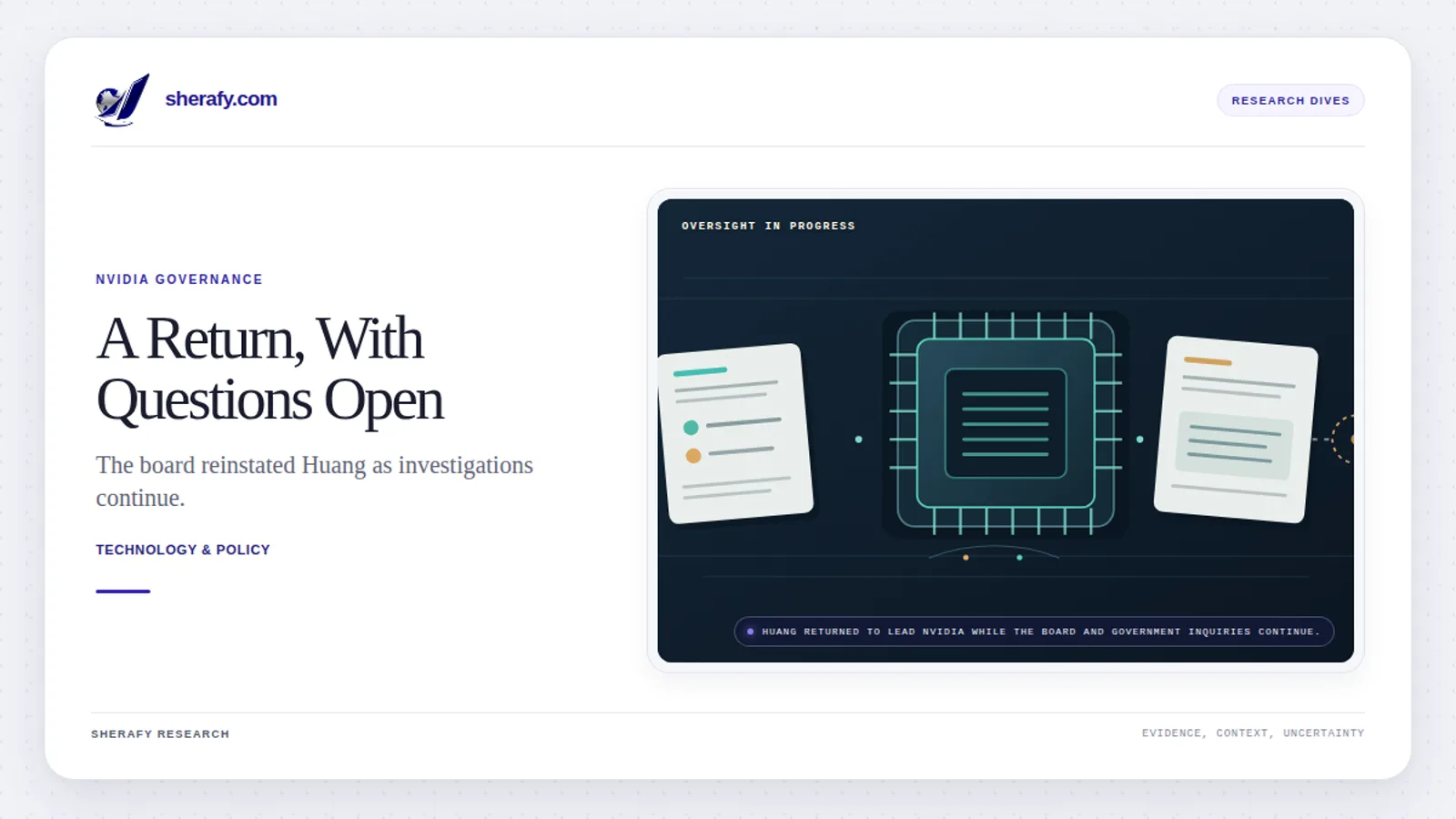
Jensen Huang is back because NVIDIA's board voted unanimously to reinstate him on November 22, 2026, following renewed discussions with Huang and input from senior U.S. government officials. President Donald Trump says he personally urged directors to bring him back and provided national security assurances. The board announced the decision November 23, reversing its public position only five days after chairman Harvey Jones said NVIDIA did not intend to reinstate its founder.
The company says restoring Huang as chief executive poses no national security risk. That is not the same as saying the underlying investigations are complete, that every allegation has been disproved, or that federal authorities have established what happened to any potentially restricted AI chips. NVIDIA says its independent investigation into reported foreign-intelligence targeting will continue. It also announced a new independent-director National Security and Export Control Committee and a search for a chief compliance officer who would report to the board's Nominating and Corporate Governance Committee. The United States is separately investigating the Singapore-based company Megaspeed over potential export-control violations, while congressional committees are probing the government's handling of the case.
This distinction is the key to the story. The affair involving Huang drew public attention, but the lasting questions concern what intelligence was collected, what government officials knew, whether enforcement decisions were independently made, and what corporate safeguards now exist at a company central to the global AI industry.
The evidence supports a clear, limited conclusion: an extraordinary combination of political advocacy, commercial pressure and government assurances accompanied Huang's return. It does not yet establish which factor was decisive inside the boardroom. Nor does it establish that Chinese intelligence succeeded in compromising him, that Israel orchestrated the leadership change, or that specific officials improperly intervened in an investigation.
What happened? The facts in brief
| Question | What the available evidence establishes |
|---|---|
| Is Jensen Huang CEO again? | Yes. NVIDIA's Form 8-K says the reinstatement took effect November 22, 2026. |
| Why did he step down? | He publicly acknowledged marital infidelity; the board described conduct inconsistent with its standards. Separate reporting raised a potential foreign-intelligence targeting concern. His resignation took effect November 11. |
| Did Trump intervene? | Yes, by his own public account. NVIDIA separately confirms receiving input from senior U.S. officials. The exact substance and timing of every communication have not been disclosed. |
| Was Huang cleared of espionage? | No completed public investigative finding establishes that. Trump says the government has no evidence Huang engaged in unlawful conduct, and NVIDIA says reinstatement presents no national security risk. The board investigation continues. |
| Is Alice Huang proven to be a Chinese spy? | No public adjudication or declassified evidence reviewed here establishes that. Major reporting describes intelligence concerns and alleged contact with China's Ministry of State Security. |
| Did Megaspeed illegally divert chips? | U.S. authorities are investigating potential violations. The relevant transactions, locations and ultimate users have not been conclusively established in the public record. |
| Did Israel install or restore a CEO? | No substantiating evidence identified. NVIDIA has substantial operations in Israel, but those corporate ties do not establish Israeli state involvement in its board's decisions. |
The strongest sources for the immediate corporate facts are the November 11 resignation filing, the November 22 reinstatement filing, and NVIDIA's November 23 announcement. Those are not interpretations of the news. They are the company's legal and public records.
The five-day reversal: a timeline that changes the meaning of the story
The sequence is important because it distinguishes a planned succession from a rapid reversal of a publicly stated board decision.
| Date | What happened | What it tells us |
|---|---|---|
| November 8 | In an email published by NVIDIA, Huang acknowledged infidelity, apologized to his family and employees, and promised to cooperate with an independent investigation concerning reported national security risks. | He acknowledged personal misconduct, not espionage or an export-control violation. |
| November 10 | Independent directors retained Joon H. Kim and Wachtell, Lipton, Rosen & Katz for an investigation. | The board had commissioned outside review before the resignation. |
| November 11–12 | The board accepted his resignation effective November 11, announced it November 12, named CFO Colette Kress interim CEO, and made Harvey Jones board chair. | The leadership change was formally reported to the SEC. |
| November 16–17 | The Commerce and Justice departments issued a joint Megaspeed investigation account. On November 17, Jones told investors the board did not intend to reinstate Huang. | The government's investigation and the board's public opposition were both active. |
| November 17 | NVIDIA reported quarterly revenue of $115.8 billion, with Kress as interim CEO. | The leadership crisis was not a collapse in operating revenue. |
| November 19 | A House committee published AI-chip export-license records, and new BIS remote-computing restrictions took effect. | The broader China-access policy was changing even as the CEO dispute continued. |
| November 22 | Directors voted unanimously to reinstate Huang, effective immediately. | The reversal happened a day before the public announcement. |
| November 23 | NVIDIA announced his return, cited government input and confirmed the independent investigation would continue. Trump said he had advocated the outcome. | The company had made a leadership decision, not announced the completion of all inquiries. |
The November 17 statement is especially significant. In the earnings-call transcript, Jones said: "The NVIDIA Board unanimously accepted his resignation and does not intend to reinstate Jensen as CEO."
Five days later, the same board reinstated him unanimously. Neither statement by itself proves misconduct. Together, they demand an explanation of what changed in the directors' assessment. NVIDIA names discussions with Huang and input from senior U.S. officials, but it has not released minutes, a written risk assessment, or a complete account of those contacts.
Did Donald Trump bring Jensen Huang back to NVIDIA?
Trump materially participated in the effort to return Huang to NVIDIA, according to his own statements and the company's acknowledgment of high-level federal input. That is stronger evidence than merely observing that Trump supported the result. It still does not establish that he possessed legal authority to order an independent public company's directors to appoint its CEO.
Trump publicly urged the board to rehire Huang. After reinstatement, he said the U.S. government had no reason to believe the return posed a national security threat and attributed to Attorney General Todd Blanche the view that officials possessed no evidence Huang had engaged in unlawful conduct. Reuters documented those statements.
In a CNBC interview reported by Fortune and Reuters, Trump said he spoke with directors and considered his intervention important. He also said he was represented in the board process. The White House publicly emphasized his involvement. Accounts differ in what they independently establish about whether Trump personally joined a particular board call.
There are three different propositions here:
- Trump advocated reinstatement. Established.
- Government officials gave the board national security assurances. Established by NVIDIA's announcement.
- The board reversed its position because Trump compelled it to do so. Not independently established by the available documents.
Directors could have been influenced by the president's preferences, the substance of security briefings, shareholder concerns, Huang's own explanations, or a combination. The public record does not reveal how each director weighed those factors.
That distinction matters for accountability. It would be inaccurate to describe the episode as ordinary private corporate governance with no government role. It would also be inaccurate to state, without more evidence, that a federal order forced the vote.
Was Jensen Huang officially cleared of spying or wrongdoing?
Not in the comprehensive sense implied by the phrase "cleared of everything." The public statements address different legal and institutional questions.
| Question | What the public record says | What it does not settle |
|---|---|---|
| Did the federal government identify criminal wrongdoing by Huang? | Trump said the attorney general confirmed the government did not possess evidence of unlawful conduct by Huang. | It does not publish the scope of the review or resolve every possible noncriminal security issue. |
| Does Huang's return pose an unacceptable national security risk? | NVIDIA says its board concluded that it does not, based in part on senior government input. | It does not disclose the underlying intelligence or the conditions, if any, of the assessment. |
| Was a foreign intelligence service targeting him? | NVIDIA says its independent investigation into reported targeting continues. | Targeting, access, successful intelligence collection and knowing cooperation are separate issues. |
| Did any customer violate export controls? | U.S. authorities say the Megaspeed investigation continues under DOJ leadership. | A finding about Huang's conduct would not automatically decide the customer's legal liability. |
| Did Huang violate NVIDIA's internal standards? | The board cited conduct inconsistent with company standards when he resigned, then later said it was satisfied with his candor and ability to lead. | The company has not published all of its underlying disciplinary or factual findings. |
A criminal prosecution typically asks whether provable conduct satisfies a particular law. A counterintelligence assessment may instead ask whether a foreign service can exploit access, vulnerabilities or information. A corporate board asks whether a person can lead the company within acceptable risk. Export-control investigators examine specific items, transactions, end users, knowledge and regulations.
An answer to one question cannot substitute for an answer to the other three. Nor should an unfinished investigation be portrayed as evidence of guilt. No public criminal finding reviewed for this article establishes that Jensen Huang knowingly cooperated with Chinese intelligence.
Who is Alice Huang, and what do the Chinese intelligence allegations actually say?
Alice Huang, also identified by Singapore as Huang Le, was a senior figure at Singapore-incorporated Megaspeed International. According to Singapore's Ministry of Home Affairs, she was the company's former chief executive, chairperson and one of its controllers, and she was a Hong Kong resident rather than a Singapore-based executive.
Huang's relationship with Jensen Huang became a national security story because of reporting about a possible Chinese intelligence effort to approach someone with access to the leader of a strategically important American technology firm.
The New York Times investigation, summarized by Reuters on November 22, reported that Alice Huang was in contact with an officer from China's Ministry of State Security between spring 2025 and fall 2026, according to people familiar with U.S. intelligence reports. The underlying intelligence documents, intercepts and assessments have not been publicly released for independent examination. China has denied the espionage characterization.
The allegations warrant scrutiny because the reported contact overlaps with a relationship involving a CEO who influences critical AI hardware, corporate strategy and sensitive policy discussions. But scrutiny is not proof of the strongest version of the allegation.
A useful intelligence analysis separates at least five possible stages:
- Approach or targeting: an intelligence service tries to gain access to someone.
- Access: an intermediary acquires a relationship or opportunity for contact.
- Collection: protected information is actually obtained.
- Influence: access changes decisions or behavior at the service's direction.
- Knowing participation: the target understands the operation and intentionally assists it.
Evidence of one stage does not automatically establish the next. A person may be targeted without recognizing the operation. An intelligence service may attempt collection without succeeding. A commercial relationship or affair can create a vulnerability without becoming an act of espionage.
It is also important not to infer espionage from Chinese nationality, ethnicity or a relationship with someone from China. The allegation rests on specific attributed intelligence reporting, not identity. Similarly, Alice Huang and Jensen Huang are not related merely because they share a surname.
For the initial sourcing, the timeline of the relationship and a detailed account of the reported chip purchases, see sherafy.com's earlier investigation, Jensen Huang, Alice Huang and NVIDIA's Espionage Allegations: The $4.8 Billion Chip Trail Explained. The evidence assessment in that article should be read with this November 23 leadership update.
What did Singapore actually investigate, and did it clear Alice Huang?
Singapore's findings are often misrepresented in two opposite directions. The country did not investigate Alice Huang for espionage, but that does not mean it adjudicated the separate U.S. intelligence allegations. It also did not establish that every Megaspeed server transaction was legitimate.
The November 12 statement from Singapore's Ministry of Home Affairs gives the most precise public account of the country's investigation:
- Singapore Police and Customs began their independent inquiry in February 2025. Their focus included suspected false declarations related to server purchases and other possible domestic offenses.
- Investigators examined whether equipment purchased by companies under investigation, then exported through Singapore to Malaysia, had subsequently gone somewhere else contrary to its declared destination. Singapore said the servers did not enter its domestic market.
- U.S. Bureau of Industry and Security personnel conducted a voluntary post-shipment verification at Megaspeed on June 24, 2025, with Alice Huang present. Singaporean police interviewed her the same day.
- Singapore sought information about U.S. server supplier Supermicro, saying the company provided limited cooperation. Singapore says it sought U.S. help on July 7 and made repeated requests to DOJ and the FBI from September 2025, receiving limited information or assistance concerning the supplier.
- In February 2026, Singapore concluded it lacked sufficient evidence to establish that Alice Huang committed the suspected false-declaration offenses being examined.
- Singapore nonetheless said it determined that she knowingly gave investigators inaccurate information to minimize her role in Megaspeed. Police issued a stern warning, barred her from returning and returned her passport before she departed on February 26.
- Investigations into Megaspeed and six other individuals remain ongoing, according to the ministry.
A stern warning is not a criminal conviction. Insufficient evidence for the particular Singapore offenses is not a finding about a U.S. foreign-intelligence assessment. And an open company investigation is not proof that a company committed a violation.
The distinction is more than legal caution. It prevents three separate stories from being collapsed into one allegation simply because the same people and hardware appear in them.
The U.S. Megaspeed investigation began before the scandal
In a joint statement dated November 16 and published by DOJ on November 17, the Commerce and Justice departments said Commerce began examining Megaspeed in 2024 after identifying suspicious activity suggesting possible diversion of sensitive semiconductors.
According to the agencies:
- Commerce asked NVIDIA in May 2025 for records on direct or indirect business with Megaspeed.
- NVIDIA placed Megaspeed on a corporate no-sell list in June 2025.
- Commerce investigators and Singaporean officials conducted an onsite end-use check that June and interviewed Alice Huang.
- DOJ later took the lead in the criminal investigation, with Commerce's Bureau of Industry and Security continuing to work with it.
That chronology establishes that the commercial investigation predates the November 2026 controversy. It also shows a company compliance action, NVIDIA's no-sell designation, that should not be omitted from accounts implying NVIDIA did nothing after regulators raised concerns.
But several questions remain. Did the no-sell status cover every intermediary and related entity? What transactions were already complete? Did subsequent services or remote computing access continue under a separate arrangement? What triggered the transfer to DOJ? Was the handoff routine, or did external pressure affect it?
Neither the government's description of a legitimate investigation nor lawmakers' concerns about interference resolves the evidentiary question by itself. Records of the actual communications, enforcement decisions and transaction trail are needed.
Did $4.8 billion in NVIDIA chips get smuggled to China?
That is not what the widely repeated $4.8 billion figure proves.
As detailed in sherafy.com's original Megaspeed evidence investigation, New York Times reporting based on trade records attributed at least $4.8 billion in imported advanced AI equipment containing NVIDIA technology to a Malaysian sister company of Megaspeed over a period spanning June 2024 to February 2026.
The phrase equipment containing NVIDIA technology matters. It does not mean Megaspeed purchased $4.8 billion in bare NVIDIA chips directly from NVIDIA; that NVIDIA booked the same amount as direct revenue; or that equipment of that value was illegally sent to mainland China. These are different propositions involving different records.
A typical supply chain can have several steps:
NVIDIA hardware → server manufacturer or distributor → overseas purchaser → data center → eventual cloud customer or remote user.
At each step, investigators need to identify ownership, the device, the transaction, the location, the declared and actual user, and the export rules applicable at the time. A data center in Malaysia, by itself, is not evidence of unlawful Chinese end use. A false destination declaration or access arrangement that violates an applicable restriction would be a different matter.
The public cannot determine a final diversion total by multiplying a guessed GPU count by an online list price. The relevant accounting would reconcile purchase orders, server serial numbers, logistics data, installation records, customer contracts, computing-access logs and applicable licenses. Those detailed findings have not been published.
The 879,000-chip revelation: what the House records actually show
On November 19, the House Foreign Affairs Committee released information on NVIDIA and AMD export-license applications. Its published summary reported applications involving approximately 3.4 million chips and more than 879,000 chips approved for Chinese customers.
Those figures are important evidence about licensing policy, but they are not an accounting of 879,000 physically delivered chips. The underlying four-page Bureau of Industry and Security table is specifically a status snapshot as of May 11, 2026, not a shipment ledger current through November. Many approved applications are labeled "Approved, not shipped." Other entries have different statuses, including rejected, submitted and "RWA," which should not be silently counted as approved deliveries.
The following examples come directly from that released status table:
| Listed applicant and consignee | Chip count | Status in the May 11 snapshot | What can be inferred |
|---|---|---|---|
| NVIDIA / Alibaba Group | 75,000 | Approved, not shipped | Authorization listed; no shipment shown by that snapshot |
| NVIDIA / Tencent Technology (Shenzhen) | 75,000 | Approved, not shipped | Authorization listed; no shipment shown by that snapshot |
| NVIDIA / Baidu | 43,000 | Approved, not shipped | Authorization listed; no shipment shown by that snapshot |
| NVIDIA / BYD | 4,000 | Approved, not shipped | Authorization listed; no shipment shown by that snapshot |
Some of these entries concern companies with diverse business activities, which is another reason not to treat every line as proof of Chinese military use. The committee's description of national security risk and the legal status of an individual transaction are separate matters.
Five quantities must not be mixed together: chips requested in applications, chips authorized, chips actually shipped, chips ultimately accessible to a restricted end user, and chips shown to have been diverted unlawfully. No one of those numbers is a reliable substitute for the others.
There is also no necessary inconsistency between those May entries and NVIDIA's later disclosure that it completed a fraction of allowed shipments under its H200 program. Different dates and product categories can produce different outcomes. NVIDIA's July 2026 quarterly filing says the limited H200 shipments represented less than 1% of its Data Center revenue in the most recent quarter at that time.
Why China can obtain AI computing power without the chips entering China
The strategic issue is not limited to where a server sits. Advanced AI chips can be installed in one country while their computing capacity is used from another. In some circumstances, a cloud customer may rent access to restricted capabilities without taking physical possession of the hardware.
That creates a regulatory problem: a border inspection may identify where hardware was shipped, but not necessarily who later controls or benefits from its computing capacity.
The United States addressed this more directly in a Bureau of Industry and Security interim final rule effective November 19, 2026, titled Addressing Remote Access to Advanced Semiconductors.
The rule establishes restrictions involving certain advanced computing items at overseas data centers that provide very large amounts of computing capacity to companies headquartered in specified destinations of concern, including China. It also creates additional licensing requirements for covered semiconductor shipments to Singapore, Malaysia, Indonesia, Thailand and Brazil, with defined exceptions and reporting arrangements for qualifying U.S.-headquartered companies.
The rule is technical. For one remote-access end-use control, its text refers to more than 12,000,000 aggregate total processing performance (TPP) across a data center or linked data centers, along with specified knowledge, customer and destination conditions. It is not a blanket declaration that every Chinese company's use of foreign cloud computing is illegal. Commercial recommender-system uses have a specific exception under the rule, and other licensing and regulatory provisions must also be examined.
The key features for an ordinary reader are:
- Where chips are installed can differ from where a customer is headquartered.
- Who ultimately owns or controls a customer can matter, not just the name on a contract.
- Linked data centers can matter where computing capacity is coordinated across facilities.
- Changes in ultimate use can trigger new obligations even after an otherwise lawful shipment.
- Licenses, exceptions, knowledge requirements and effective dates matter. A rule adopted in November 2026 cannot simply be applied retroactively as proof that a 2025 transaction was illegal.
This is why the Megaspeed inquiry potentially reaches beyond one company's shipping documents. It concerns whether U.S. national-security controls can follow strategically important computing capability through international suppliers, corporate structures and remote-service contracts.
Why NVIDIA still cares about China, even under export restrictions
NVIDIA has an obvious commercial interest in preserving lawful access to Chinese demand. China has an equally obvious interest in obtaining computing capacity and reducing dependence on restricted American products. Those interests explain an important policy conflict. They do not by themselves establish criminal wrongdoing or intelligence coordination.
The numbers also require careful interpretation. NVIDIA's supplemental financial information for the quarter ended October 25, 2026 attributes approximately $11.05 billion in quarterly revenue to direct customers headquartered in China, including Hong Kong. NVIDIA expressly explains that its geographic classification follows the headquarters of the direct customer, which can differ from the shipping location or ultimate end user.
Yet the company's November 17 earnings outlook assumes no Data Center compute revenue from China in the following quarter. There is no contradiction. The first number is a backward-looking total-revenue geographic classification; the second is a forward-looking assumption about a narrower product category.
A statement that NVIDIA earned $11.05 billion from China-headquartered direct customers does not prove $11.05 billion of prohibited AI-chip exports. A statement that its next-quarter forecast excludes China Data Center compute sales does not mean it has no other China-related revenue, and it does not erase earlier authorized shipments.
The real policy trade-off is difficult. Restricting advanced chips can constrain certain capabilities in China, but it may also encourage substitute hardware, local AI ecosystems and alternative suppliers. Allowing controlled sales may support American semiconductor companies and technical standards while increasing access to computing power. The precise national-security balance depends on what products, customers, end uses, monitoring arrangements and enforcement capabilities the policy actually covers.
Did NVIDIA interfere with the government's Megaspeed investigation?
There is a documented congressional inquiry into that possibility, but no public finding reviewed here establishes improper interference. The allegation deserves careful treatment because it is more specific than a general complaint about lobbying.
A November 19 letter from Representatives Gregory Meeks and Sydney Kamlager-Dove to Commerce Secretary Howard Lutnick cites New York Times reporting that NVIDIA general counsel Tim Teter contacted BIS investigators in August 2025, reportedly saying Under Secretary Jeffrey Kessler had authorized communication about the Megaspeed inquiry. The lawmakers ask whether investigators' work was halted, whether NVIDIA received nonpublic investigative information, what Kessler authorized and why DOJ took the lead.
The distinction between contact and interference is decisive. A company's lawyers may legitimately communicate with regulators, provide documents, clarify compliance questions and seek decisions. Improper interference would require evidence that officials distorted, obstructed or selectively compromised enforcement, or gave a company unauthorized access to protected investigative material.
The DOJ–Commerce joint statement says that DOJ assumed the lead after Commerce's enforcement actions. It does not, by itself, settle the specific questions about internal disagreements or political intervention raised in the lawmakers' letter. Conversely, the lawmakers' letter relies in part on reporting and asks questions; it is not a judgment establishing that the reported misconduct occurred.
This creates a concrete accountability test: what did investigators recommend, who made the subsequent decisions, on what grounds, and what records document the handoff? A transfer from Commerce to DOJ can be appropriate in a criminal matter. Whether this particular transfer was properly handled depends on its underlying record.
Singapore's complaint about limited U.S. assistance concerning Supermicro adds a second, independent question about investigative cooperation. It does not prove the U.S. deliberately withheld evidence to protect NVIDIA, but it is an official statement that deserves a specific answer from the relevant agencies.
Follow the money: Trump, Howard Lutnick and Cantor Fitzgerald
NVIDIA's political and economic importance makes financial conflicts a legitimate subject of scrutiny. But an investment position, lobbying relationship or correspondence with officials is not itself proof of corruption. The task is to identify actual economic exposure and any demonstrable relationship to official acts.
Trump's NVIDIA holdings and presidential intervention
A Washington Post review of Trump's financial disclosures estimated that his reported trades were consistent with a NVIDIA stake valued between $13 million and $62 million at the end of August 2026. The range comes from disclosure categories and does not establish his exact holdings on November 22 or 23. Reuters separately reported the disclosure-based estimate and its limitations.
The White House says independent financial managers make the president's portfolio decisions. No evidence reviewed here establishes that Trump directed particular NVIDIA trades because of nonpublic information or intervened in the board decision for personal profit.
The potential conflict question is narrower and more answerable: Did the president or relevant officials have financial interests affected by a company-specific decision, how were those interests managed, and what decision record exists? His public intervention is established. Improper financial motivation is not.
Lutnick, Cantor Fitzgerald and the danger of misreading 13F filings
House lawmakers also requested documents involving Commerce Secretary Howard Lutnick and Cantor Fitzgerald. Their questions concern NVIDIA positions, overseas data-center relationships, export-control decisions and any relevant communications. The requests are oversight actions, not findings of illegal conduct.
Cantor has offered a material counterexplanation. In a November 18 statement, the firm said it had no material proprietary NVIDIA position and that the substantial majority of its reported shares reflected hedges connected to clients' equity swaps. It said declines in those positions reflected the unwinding of client transactions, not speculative selling by Cantor on undisclosed information. Cantor also denied receiving compensation from NVIDIA or influencing export-control decisions.
That distinction is fundamental. A securities filing can report shares held to offset the economic exposure created by a customer derivative. A reduction in the share position can reflect a reduction in the paired obligation. Gross reported holdings do not necessarily equal a firm's unhedged bet on the stock. Cantor's explanation is an interested-party statement, not an independent audit, but it must be evaluated against transaction records rather than silently ignored.
The responsible conclusion is that the financial relationships justify specific disclosure and oversight questions. They do not establish a trading conspiracy or a quid pro quo.
What does Israel have to do with NVIDIA?
Israel is genuinely important to NVIDIA's technology operations. That fact should be neither minimized nor converted into an unsupported intelligence theory.
NVIDIA's July 2026 Form 10-Q describes approximately 6,200 employees in Israel supporting research, operations, sales and marketing, and identifies regional conflict as a possible risk to networking-product development and operations. The company completed its acquisition of Israeli networking company Mellanox in April 2020 for approximately $7 billion, making Israeli-developed interconnect technology part of NVIDIA's data-center capabilities.
These are substantial, documented strategic relationships. They raise legitimate questions about regional operational resilience, engineering concentration, cybersecurity, supply-chain continuity and corporate dependence on talent and infrastructure in Israel.
They do not establish Israeli government ownership of NVIDIA, that Israeli intelligence services ordered a leadership change, or that former interim CEO Colette Kress was installed as part of an intelligence operation. Kress was NVIDIA's longtime chief financial officer, appointed as an interim replacement after a formal board decision; the November 22 SEC filing confirms she returned to her CFO responsibilities after Huang's reinstatement.
The question worth asking is whether an identifiable Israeli government office, intelligence organization, contractor or intermediary actually participated in the November corporate or U.S. security decisions. The public documents reviewed here do not establish such participation. Corporate investment, nationality, religion, work location and an intelligence operation must not be conflated.
For the underlying viral claims, see sherafy.com's separate investigation, Did Israel Replace Jensen Huang at NVIDIA? Colette Kress, Intelligence Rumors, and the Evidence.
Did Anthropic or rival AI interests push Huang out?
Another set of allegations holds that lobbying groups or AI competitors used the China controversy to force NVIDIA's founder out. There is a legitimate underlying story about who funds AI policy, who favors tougher chip restrictions, and how commercial incentives intersect with legislation. It does not follow that those organizations engineered Huang's personal disclosures or the board's resignation decision.
Sherafy.com previously traced the lobbying and funding claims in Did Anthropic Help Oust Jensen Huang? The $40 Million, Lobbying Records and NVIDIA Power Struggle. That investigation separates public advocacy and campaign-finance records from allegations of coordinated sabotage.
There is also relevant counterevidence to a simple story of total commercial hostility. NVIDIA's November 17 results announcement says it expanded Anthropic's access to NVIDIA computing capacity through cloud providers and continued joint design and engineering work to optimize future architectures for Anthropic's workloads.
Competition, lobbying and commercial cooperation can all occur simultaneously. Evidence of political advocacy demonstrates advocacy, not a covert ouster operation. Proving the latter would require a specific communication, transaction, directive, corroborated testimony or other link between the actors and the leadership decision.
Why would NVIDIA take Huang back while investigations remain open?
The answer most consistent with the public record is that the directors assessed the benefits of restoring their founder against the risks of doing so, after receiving new representations from Huang and senior government officials. The documentary record supports the presence of several forces, but it does not tell us their exact relative weight.
1. Founder dependence and the economic cost of uncertainty
NVIDIA is not simply a company selling individual chips. Its products sit inside an ecosystem of AI accelerators, networking, software, infrastructure partnerships and development roadmaps. Huang has been central to how NVIDIA presents and coordinates that strategy. The market had reacted sharply to his resignation and rebounded around a third when his return was announced on November 23, according to Associated Press reporting.
That price reaction indicates investors reassessed the company and the broader AI outlook. It does not measure Huang's personal value with scientific precision. Equity prices respond simultaneously to leadership expectations, government signals, sentiment, positioning and other news. Nor does the rebound erase the governance problem: dependence on one individual can itself be a concentration risk.
2. Political assurance at the highest level
The president's intervention and NVIDIA's description of senior government input are unusually direct. They help explain why the board could regard the national security component differently after November 17. Yet a government assurance may be limited in scope, and the board has not disclosed the written findings, participating agencies or conditions underlying its risk judgment.
3. A decision to supervise ongoing risks rather than await final answers
NVIDIA announced several institutional measures: an independent-director investigation supported by outside counsel, a separate National Security and Export Control Committee, specialist advisers, and a search for a chief compliance officer. The announced compliance officer would report to the Nominating and Corporate Governance Committee, which is not identical to the new national security committee. The precise division of responsibility matters.
These measures suggest an attempt to strengthen oversight alongside the return of the CEO. They are not, by themselves, evidence of effective oversight. That will depend on independence, information access, escalation authority, auditability and whether adverse findings can be acted upon even when they concern the CEO.
Four plausible mechanisms, none established as the sole cause
| Possible explanation | Evidence consistent with it | Evidence still needed |
|---|---|---|
| Corporate continuity was considered economically essential | Founder dependence, investor response, strong AI infrastructure demand | Board minutes, succession analysis, investor communications |
| White House pressure influenced the outcome | Trump's acknowledged intervention and the company's admission of official input | Complete communication record and directors' account of its influence |
| Government intelligence or legal input changed the risk assessment | Public national security assurances | Agencies involved, scope and form of the assessment, conditions or caveats |
| Directors chose continued oversight rather than delay | Committees, outside counsel, announced compliance leadership role | Committee mandates, reporting arrangements and subsequent independent findings |
A fifth claim, that China, Israel or a private commercial rival secretly directed the reinstatement, requires a concrete evidentiary chain not identified in the documents reviewed for this article.
What does Huang's return mean for U.S. national security and AI policy?
The first consequence is continuity of leadership at a strategically important company. NVIDIA can return to its established public leadership while the government examines suspected semiconductor diversion and the board examines the intelligence-targeting reports.
The second is greater scrutiny of the relationship between corporate decision-making and federal security judgments. The question is not whether presidents may express opinions about major companies. It is what happens when a president provides security assurances relevant to a board decision while that administration also oversees export licenses, criminal investigations and national-security policy affecting the same company.
The third is an enforcement test for the new remote-compute rules. Regulations can specify customer screening, ownership review and licensing thresholds. Their practical value depends on whether enforcement agencies can identify the true beneficiary of computing capacity and obtain cooperation from suppliers and other countries.
The fourth is a corporate-governance test. If directors can independently investigate a founder, obtain government advice without surrendering judgment, and adopt enforceable controls, the outcome may demonstrate effective risk management. If the evidence later shows that uncomfortable questions were ignored, or that an inquiry was obstructed, the same reversal will look very different. Neither future finding should be presumed today.
Finally, the debate illustrates a policy conflict that cannot be resolved by a slogan. A company may be vital to U.S. technological leadership while also having powerful incentives to expand sales in markets U.S. security officials view as sensitive. Government can encourage domestic innovation, license certain exports and restrict others. The challenge is to make those decisions consistently and explainably, with enough independent oversight to distinguish national-interest reasoning from preferential treatment.
What evidence would change this assessment?
An investigation should be open to evidence that contradicts its initial interpretation. The most consequential missing records are specific:
| Unresolved issue | Most useful evidence | What it could establish |
|---|---|---|
| Why the board reversed itself | Board deliberations, dated government contacts and the scope of the security advice | Whether the decision was primarily economic, evidentiary, political or a combination |
| Whether intelligence collection succeeded | Declassified findings or an independent investigation summary with appropriate redactions | Whether there was targeting alone, information transfer, influence or knowing cooperation |
| Whether Megaspeed violated U.S. law | Transaction records, applicable licenses, end-use findings and criminal enforcement documents | Which hardware, entities and actions actually violated which rules, if any |
| Whether regulators were improperly influenced | BIS communications, internal recommendations and DOJ handoff records | Whether ordinary engagement crossed into preferential or obstructive intervention |
| Whether financial interests affected official decisions | Verified net exposures, management controls, communications and transaction timing | Whether an apparent conflict translated into improper conduct |
| Whether new NVIDIA oversight is meaningful | Committee charters, independent reporting rights and findings | Whether directors can monitor and act on national-security risks independently of management |
Congress has already scheduled additional scrutiny. A November 17 announcement from the House Intelligence Committee says Huang voluntarily agreed to a transcribed interview on December 1, 2026, with NVIDIA general counsel Tim Teter scheduled for December 2 before three House committees. As of this article's November 23 research cutoff, those interviews had not occurred. A House letter seeking documents from Commerce also requests answers by December 1.
The November 19 BIS interim final rule accepts comments through January 19, 2027. The law, compliance guidance and subsequent enforcement decisions may therefore change. Readers should distinguish rules already effective from later policy arguments, proposals and legal challenges.
Frequently asked questions
Why did Jensen Huang resign from NVIDIA?
He publicly admitted marital infidelity and agreed to cooperate with a board investigation following reports of potential foreign-intelligence targeting. The board accepted his resignation effective November 11, 2026, and subsequently described personal behavior inconsistent with company standards. That does not amount to a finding that he committed espionage.
Why did NVIDIA reinstate Jensen Huang?
The board says it was satisfied with his candor and leadership after additional discussions and that input from senior U.S. officials supported its judgment that his return posed no national security risk. Trump says he intervened to urge the decision. The precise weight of each factor inside the boardroom is not public.
Did Donald Trump force NVIDIA to rehire Huang?
Trump acknowledges advocating the result, and the company acknowledges federal input. The available public evidence does not establish a legal order compelling the board or a complete account of the directors' internal decision.
Was Jensen Huang cleared of Chinese espionage allegations?
No public completed investigation establishing that broad conclusion has been released. Trump says the government lacks evidence of unlawful conduct by Huang; NVIDIA says the risk of reinstatement is acceptable while the board investigation continues. No public finding reviewed here establishes that Huang knowingly helped Chinese intelligence.
Who is Alice Huang, and is she related to Jensen Huang?
Alice Huang, also known as Huang Le, was a senior executive and controller of Megaspeed. She and Jensen Huang are not related. She is the subject of intelligence-related reporting, but public proof of the strongest espionage allegations is not available.
Did Singapore find Alice Huang guilty of spying or chip smuggling?
No. Singapore says it did not investigate her for espionage and found insufficient evidence to establish her involvement in the suspected false-declaration offenses examined. It issued a stern warning over inaccurate information she gave police, barred her from returning and says the wider Megaspeed investigation continues.
Were 879,000 NVIDIA chips shipped to China?
That is not what the November 19 disclosure says. The House figure covers approved chips across NVIDIA and AMD license applications. The released BIS table includes many approvals marked "not shipped" as of May 11, 2026. A license approval is not a delivery record.
Can Chinese companies legally use NVIDIA GPUs at overseas data centers?
It depends on the product, ownership, end user, intended use, location, relevant export license and applicable date. The November 19, 2026 BIS rule establishes additional restrictions on defined forms of large-scale remote computing access and covered shipments. It is not a universal ban on every cloud service used by a Chinese business.
Did Israel or Israeli intelligence install Colette Kress as CEO?
No substantiated evidence reviewed here shows such a role. Kress was NVIDIA's longtime CFO and served temporarily after Huang resigned. NVIDIA does have important Israeli engineering operations, including the legacy of its Mellanox acquisition. Those facts do not establish intelligence-agency control of the company.
Is Colette Kress still NVIDIA's CEO?
No. Huang was reinstated effective November 22, 2026. The company's SEC filing says Kress continues as executive vice president and chief financial officer. Harvey Jones remains board chair.
Is the investigation over now that Huang is back?
No. NVIDIA says the independent investigation will continue, U.S. authorities say their Megaspeed inquiry remains active, and congressional oversight has further scheduled interviews and document requests. A CEO appointment does not close those processes.
The central accountability question
Jensen Huang's return can be explained in part by the importance of his leadership, a dramatic investor reaction and an administration that publicly wanted him back. The board's own account confirms that senior government input helped it reach its decision. These are meaningful facts, not a theory.
But the available record does not disclose the full security assessment, the detailed basis for the board's reversal, the results of its independent review, or the final disposition of suspected chip-diversion activity. Allegations about Chinese intelligence contact, regulatory interference, financial conflicts and Israeli influence must be examined at their actual evidentiary strength, not bundled into a single speculative account.
NVIDIA has answered who will lead the company. It has not yet answered every question about the information, influence and accountability surrounding that decision. The next decisive documents are not another CEO endorsement or a stock-price chart. They are the investigation findings, enforcement records and board-level explanation that would show why the national security concerns were judged manageable while the underlying inquiries remained open.
References and Further Reading
NVIDIA and SEC primary records
- NVIDIA Form 8-K, November 11 resignation and interim CEO appointment — SEC filing establishing the effective date of Huang's resignation and Kress's appointment.
- NVIDIA Form 8-K, November 22 reinstatement — SEC filing proving the board action occurred before the public announcement.
- NVIDIA Board Reinstates Jensen Huang, November 23 — Company's stated rationale, government input, continuing independent investigation and oversight changes.
- A Message to Our Company, November 8 — Huang's original apology and commitment to cooperate with the board review.
- Statement From the Independent Members of the NVIDIA Board, November 10 — Identifies the independent legal team appointed to investigate.
- NVIDIA Third-Quarter Fiscal 2027 Earnings-Call Transcript — Contains chairman Harvey Jones's November 17 declaration that the board did not intend to reinstate Huang.
- NVIDIA Third-Quarter Fiscal 2027 Financial Results — Establishes revenue, business outlook and disclosed collaboration with Anthropic.
- NVIDIA Fiscal 2027 Third-Quarter Supplemental Financial Information — Explains geographic revenue by direct-customer headquarters rather than final destination.
- NVIDIA July 2026 Form 10-Q — Export-control risk, limited H200 shipments, Israeli operations and related financial context.
U.S. and Singapore government evidence
- DOJ–Commerce Joint Statement on the Megaspeed Investigation — Official chronology of the 2024 inquiry, NVIDIA records request, no-sell designation, onsite check and DOJ leadership.
- Singapore Ministry of Home Affairs: Investigations Into Alice Huang and Megaspeed — Independent government account, including its limited-evidence conclusion, warning and request for U.S. assistance.
- House Foreign Affairs Committee: November 19 AI-Chip License Disclosure — Legislative release and summary of applications and approvals.
- BIS H200 License and Equivalent Application Status as of May 11, 2026 — Original released table showing application-level statuses, including approvals marked not shipped.
- Federal Register: Addressing Remote Access to Advanced Semiconductors — Text, thresholds, scope, exceptions and effective date of the November 19 rule.
- House Lawmakers' November 19 Letter to Commerce Secretary Lutnick — Precise oversight questions about alleged investigator contact and the handling of Megaspeed.
- House Intelligence Committee: Huang and NVIDIA Agree to December Interviews — Original announcement setting the December 1 and 2 interview dates.
- House Lawmakers' Inquiry Into Lutnick and Cantor Fitzgerald — Documents the lawmakers' financial-conflict questions, not a finding of wrongdoing.
Independent reporting and material responses
- Reuters: Trump Says NVIDIA Board Made the Right Call on Huang's Reinstatement — Records the president's public security and legal assurances as distinct claims.
- Reuters: Alice Huang's Alleged Contacts With a Chinese Spy Agency, Based on New York Times Reporting — Attribution for the nonpublic intelligence reporting; the underlying intelligence is not public.
- Fortune: Trump's Account of His Role in the NVIDIA Board Decision — Reports the president's CNBC statements and the White House's description of his participation.
- The Washington Post: Trump's NVIDIA Stake and Financial Disclosures — Disclosure-based estimate of holdings and the White House account of independent portfolio management.
- Cantor Fitzgerald: Statement on NVIDIA Positions and Equity-Swap Hedges — The firm's own rebuttal to claims that reported holdings necessarily represented speculative positions.
- NVIDIA Completes Acquisition of Mellanox — Corporate record establishing the size and strategic rationale of the Israeli networking acquisition.
Related sherafy.com investigations
- Jensen Huang, Alice Huang and NVIDIA's Espionage Allegations: The $4.8 Billion Chip Trail Explained — Earlier evidence audit of the relationship, reported intelligence concerns and transaction value.
- Did Israel Replace Jensen Huang at NVIDIA? Colette Kress, Intelligence Rumors, and the Evidence — Separates genuine Israeli corporate operations from unsupported claims of intelligence control.
- Did Anthropic Help Oust Jensen Huang? The $40 Million, Lobbying Records and NVIDIA Power Struggle — Prior money-trail analysis separating documented advocacy from unproven sabotage claims.
Editorial currency note: Research and disclosures reviewed through November 23, 2026. NVIDIA's independent investigation, the U.S. Megaspeed investigation, congressional oversight and regulatory implementation remain subject to change. Financial holdings and export-license statuses are dated snapshots, not necessarily current positions or shipments. An allegation, an inquiry, a risk assurance and a legal finding are not interchangeable.