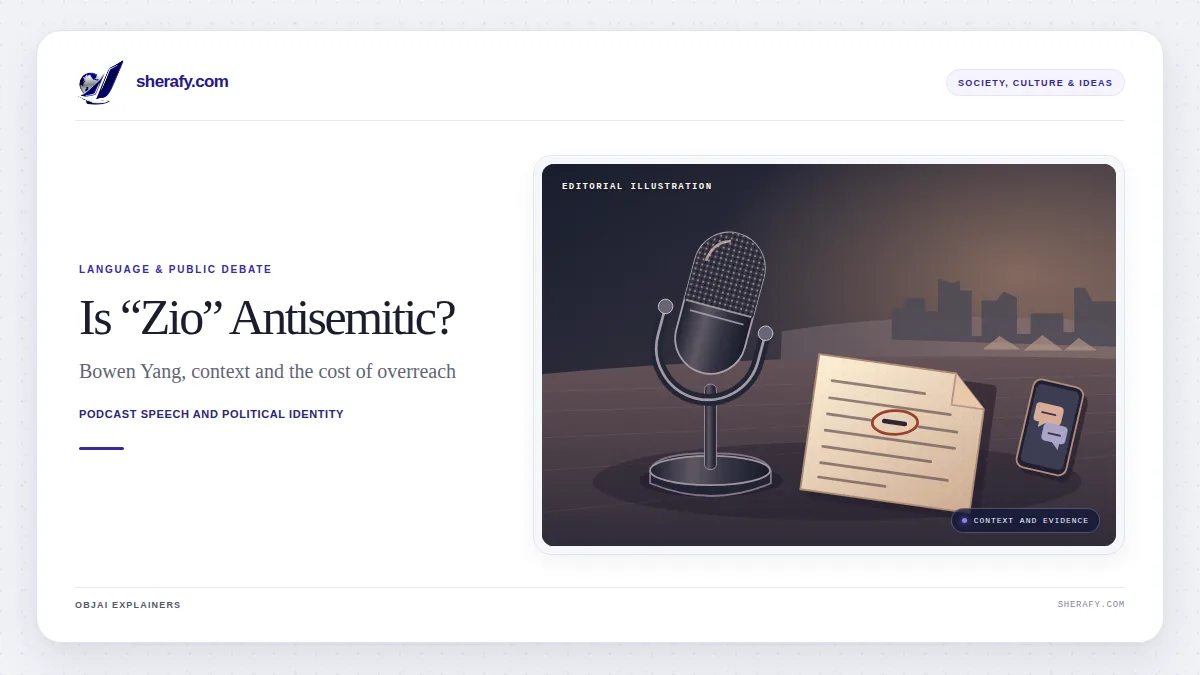
Using the word “Zio” does not automatically establish antisemitism. It is a contraction of “Zionist” with a documented history of use as an anti-Jewish slur, particularly among white supremacists. It can also be used as a derogatory political label or as a term of self-identification by Zionists themselves. Determining whether a particular statement is antisemitic requires evidence about what the speaker communicated, whom the statement targeted and the context in which it was made.
In November 2026, comedian Bowen Yang apologized after referring to singer Regina Spektor as a “Zio” on his podcast. The original conversation concerned Spektor's support for Israel. The controversy escalated into accusations of prejudice and demands for Yang's dismissal. One of the most vocal critics, actor Michael Rapaport, used the same word in the very post calling for Yang to be fired.
The issue extends beyond two celebrities. An August 2026 working paper by researchers associated with UCLA's Initiative to Study Hate reports that exposure to a contentious accusation of antisemitism can reduce confidence in subsequent allegations and lower perceptions of antisemitism's seriousness. The findings come from a randomized survey experiment involving 5,110 American adults.
A serious accusation deserves a serious evidentiary standard. A word's history is relevant evidence, but it cannot do all the work of proving what a person meant, much less what that person believes about an entire population.
What did Bowen Yang actually say about Regina Spektor?
The October 14, 2026 episode of Las Culturistas, featuring Edy Modica, provides the underlying context. The relevant exchange appears around 41 minutes into the searchable episode transcript.
The hosts and their guest were discussing artists associated with SUNY Purchase. They praised Spektor's musical talent before the conversation shifted to her political views. Modica described Spektor as particularly supportive of Israel. Yang responded by calling her “Zio.” The discussion then returned to her music and the disappointment of discovering that artists one admires hold objectionable views.
Spektor's politics were not invented for the purposes of this conversation. In a November 2023 interview with Ynet, she discussed her public support for Israel after October 7 and expressed opposition to calls for a ceasefire at that time. In July 2025, she also responded publicly to a pro-Palestinian protester at a concert. Neither event establishes that she endorses every action of the Israeli government.
The immediate political reference in the podcast is nonetheless clear. The discussion was about a particular artist's public position on Israel, not an unsolicited attack on her Jewish ancestry or religion.
That context does not make the choice of terminology immune from criticism. Nor does it establish every private belief Yang holds. It does, however, provide a plausible and directly evidenced political meaning for the word. An allegation that he was attacking Jewish people as such needs to account for that evidence, rather than simply disregard it.
Why did Bowen Yang apologize, and why did the controversy continue?
The October conversation resurfaced more than a month later. The timing coincided with the podcast becoming available on Disney+ and Hulu. There is no established evidence that the streaming launch and the criticism were coordinated.
The reporting on Yang's November 20 apology documents his acknowledgment that he had not understood the term's antisemitic history. He expressed regret at having adopted language popularized by far-right movements. In a subsequent message, he reaffirmed his support for Palestine: “At the same time, Free Palestine.”
He apologized for the terminology. He did not withdraw his political position or, on the available record, issue an apology to Jewish people collectively.
| Date | What happened |
|---|---|
| October 14, 2026 | The original podcast episode was released. |
| November 18 | The podcast became available through Disney+ and Hulu. |
| November 19 | A clip of the exchange circulated widely, including through Michael Rapaport's social media. |
| November 20 | Yang apologized for his word choice and reaffirmed his support for Palestine. ADL CEO Jonathan Greenblatt criticized his response. |
| November 21 | Rapaport posted a call for NBC to dismiss Yang, alongside his own self-referential use of “Zio.” |
| November 22–23 | Additional examples of pro-Israel advocates using the word circulated online. |
Sources: People's reporting on the apology and streaming launch, Entertainment Weekly's reporting on Rapaport and The Times of Israel's November 25 account.
Responses to the apology differed. Amy Spitalnick, CEO of the Jewish Council for Public Affairs, welcomed it and encouraged further discussion. Greenblatt was considerably less accepting. According to The Times of Israel, he objected both to Yang's failure to acknowledge an insult against Jews and to his subsequent pro-Palestinian statement. He inferred from the response that Yang did not accord Jewish people equal respect.
Comedian Eitan Levine, who helped publicize the clip, said in an interview with Israel Hayom that he wanted an on-air apology and offered the hosts a trip to Israel. He also indicated that he did not want them permanently canceled.
It is important not to collapse these distinct responses into a single campaign or attribute them to an entire ethnic or religious community. Criticism is not necessarily harassment, an apology under public pressure is not necessarily coerced, and demands made by particular personalities do not constitute a collective Jewish position.
But the transition from criticizing a word to making claims about the speaker's moral character deserves scrutiny. So does the suggestion that reaffirming support for Palestinians undermines an apology for anti-Jewish prejudice. Those two positions are not inherently incompatible.
Why are some Zionists calling themselves Zios?
On November 21, Rapaport posted a mock protest flyer calling for a boycott of NBC until Yang was fired. The Entertainment Weekly report, also syndicated by AOL, noted that Yang had already left Saturday Night Live in 2025 and was no longer employed by the network. Rapaport's post used exaggerated boycott and occupation language, in part mocking pro-Palestinian activism.
In the caption, Rapaport wrote:
ZIO’s don’t hide we MULTIPLY!!!!
The quotation is independently corroborated by TV Insider.
The significance is not that Rapaport must therefore be antisemitic. That would reproduce the very error under examination. The significance is that he used the term affirmatively while objecting to another person's use of it. His statement is a concrete example of a meaning other than hostility toward Jews.
Additional examples appeared in the days following the controversy:
| Person | Date and usage | Evidence and limitations |
|---|---|---|
| Bowen Yang | October 14, 2026: applied the word to Spektor during discussion of her politics. | Episode transcript and corroborating news reporting. |
| Michael Rapaport | November 21, 2026: used the word in a collective, self-referential sense while demanding Yang's dismissal. | Independently corroborated quotation. |
| Shai Davidai | December 9, 2025: identified himself as a proud Zio; reaffirmed that identification on November 22, 2026. | Indexed mirror of his X account; not independently authenticated against the original posts. |
| David Draiman | November 21, 2026: described the word as a badge of honor in reference to Zionism. | Indexed mirror of his X account; not independently authenticated against the original post. |
On November 23, the account DavidSaysStuff published a satirical poll highlighting these apparent inconsistencies, including additional alleged historical statements by Hen Mazzig and Eve Barlow. An indexed copy of the compilation preserves the claims. The original Mazzig and Barlow statements have not been independently authenticated and are not treated here as established evidence. The poll is satire, not a scientific survey or proof that its subjects are antisemitic.
Rapaport's independently corroborated statement is sufficient to establish the central point. The term is not used exclusively to express hostility toward Jewish people.
Does reclaiming a slur make it acceptable for everyone?
No. Self-identification and an insult directed at another person are not linguistically identical. Members of a targeted group sometimes reclaim derogatory words, using them affirmatively even when an outsider's use remains offensive. Claudia Bianchi's peer-reviewed research on slurs and appropriation examines this distinction.
The complication here is identifying the group to which the term refers. Zionism is a political affiliation, while Jewish identity is ethnic, religious, cultural or some combination of these. A speaker might use the abbreviation to target Jewish people, to criticize a political movement or to identify with that movement. These possibilities cannot be resolved simply by asking whether the speaker is Jewish.
Reclamation explains why some uses differ from others. It does not establish that every external use expresses ethnic hatred, or that every self-referential use makes an external use harmless. The point of contextual analysis is to distinguish these cases, not to manufacture a universal permission slip.
Did David Duke invent the word “Zio”?
Former Ku Klux Klan leader David Duke extensively used the abbreviation within explicitly antisemitic rhetoric. That history is well documented. The more specific assertion that he invented the standalone word is much harder to establish.
In 2017, The Forward investigated Duke's archives. It reported finding 359 instances in radio episode descriptions dating from January 2012 and 264 pages of website search results dating from 2002. Duke used the terminology within conspiracy theories about Jewish control of media and other institutions.
Those are the publication's historical archive counts, not independently reproduced measurements by sherafy.com. They establish substantial usage. They do not establish linguistic invention.
The Forward also traced related compound terminology to an incident in the late 1980s. Earlier evidence of a compound such as “Zionazi” is not, by itself, proof of the first standalone use of “Zio.” The first person to use the abbreviation remains unestablished.
The ADL's November 2026 explainer accurately distinguishes popularization from invention in its opening description, attributing the term's popularization as a slur to Duke. Its historical evidence should be evaluated on that basis.
| Claim | What the evidence establishes |
|---|---|
| The term is derived from “Zionist.” | Supported by its form and historical sources. |
| Duke used the term as coded anti-Jewish language. | Documented. |
| Duke popularized its use as an antisemitic slur. | Well supported. |
| Duke invented the abbreviation. | Not conclusively established. |
| Every modern use reflects Duke's ideology. | Not established; contemporary political self-use demonstrates variation. |
Rejecting an unsupported claim about the word's inventor does not erase its documented history. Equally, demonstrating its historical associations does not prove that everyone encountering or using it today learned it from Duke or shares his beliefs.
The 2016 report that said nobody identified as a Zio
The Shami Chakrabarti Inquiry into antisemitism and other forms of racism in the British Labour Party, published June 30, 2016, acknowledged that the word originated as an abbreviation of Zionist but recommended excluding it from Labour discourse. On printed page nine, Chakrabarti made a categorical assertion:
no one uses this word to describe their own political or cultural identity.
That assertion cannot be maintained as a universal description of contemporary usage. The examples above show why. This is not proof that the report was false in 2016; later usage may have changed.
The same page of the inquiry also describes an unrelated instance of historically racist terminology used without an understanding of its implications. Chakrabarti distinguished the offensive language from the individual's personal prejudice.
The House of Commons Home Affairs Committee's subsequent 2016 antisemitism inquiry likewise addressed the potential antisemitic meaning of accusatory or abusive uses of Zionist terminology. These are institutional recommendations rooted in a particular period and setting, not binding definitions applicable to every future statement.
When does political language become antisemitic?
Antisemitism is prejudice, hostility or discrimination directed against Jewish people as Jews. Political language can communicate that prejudice even when it avoids the word “Jew.” A person does not need to announce a racist intention for the content of a statement to be racist.
But a political label, an offensive expression and an accusation of personal prejudice are not interchangeable categories.
The British High Court addressed this precise problem in Professional Standards Authority for Health and Social Care v General Pharmaceutical Council, [2024] EWHC 577 (Admin). Paragraph 60 discusses the possibility that “Zionist” or “Zio” can function as a substitute for “Jew.” The court explained:
Deciding whether language is being used in this way requires a careful and contextual analysis of what is being said.
The surrounding paragraphs also recognize that accusations of antisemitism can discredit legitimate criticism of Israel. At the same time, the judgment warns that some rhetoric attacking Zionists can express prejudice even without explicitly equating them with Jews. The court distinguished statements considered offensive from statements considered both offensive and antisemitic, and did not treat the speaker's professed lack of racist intent as dispositive.
A later, separate case, Husain v Solicitors Regulation Authority, [2025] EWHC 1170 (Admin), cited that reasoning and upheld disciplinary consequences against a solicitor on the facts of his case. Contextual analysis can therefore support an accusation as well as rebut one. These are English professional disciplinary cases, not judgments about Yang or universal rules binding American employers.
A consistent approach asks what the language is doing in the particular circumstances:
| Type of use | What the evidence needs to establish |
|---|---|
| Political self-identification | Whether the speaker is affirming affiliation rather than targeting Jews. |
| Reference to a person's publicly expressed political position | Whether the referent is the position, the person's identity or both. |
| Political insult | Whether hostility is directed at beliefs or conduct, or extends to ethnicity or religion. |
| Coded anti-Jewish rhetoric | Whether the surrounding language substitutes a political label for Jews generally or invokes anti-Jewish stereotypes. |
| Threats and discriminatory conduct | Who is being targeted, why, and what the conduct communicates, irrespective of the chosen vocabulary. |
There are genuine examples of dangerous usage. In June 2025, The San Francisco Standard reported the vandalism of Manny's café, including threatening graffiti using the disputed word and personally targeting its Jewish owner. The owner described the messages as frightening threats. A death threat is not analogous to a political description in a podcast, and its antisemitic context warrants examination on its own facts.
The ADL reports nearly 100 vandalism and harassment incidents containing the term or variants since October 7, 2023. This figure is from its incident audit and classification system, not an independently verified count of criminal hate crimes. Its methodology covers categories beyond crimes. It demonstrates the organization's documentation of harmful uses; it does not establish the proportion of all uses that are antisemitic.
A serious analysis neither ignores such evidence nor applies it indiscriminately to unrelated statements. In Yang's case, the immediate political reference is directly evidenced. To conclude that the statement constituted an attack on Jewish people as such requires more than the word's appearance and historical association. To conclude that Yang personally harbors prejudice requires stronger evidence still.
What happens when antisemitism accusations lose credibility?
The consequences of contentious accusations are no longer solely a matter of speculation.
On August 18, 2026, E. Grant Baldwin, Clayton Becker, Josh Goetz, Ananya Hariharan, Emily Ortiz and Connor Warshauer circulated a manuscript titled Benefit or Backlash? Examining the Consequences of Expanding Definitions of Prejudice. The project received support from UCLA's Initiative to Study Hate. Baldwin's research page lists the paper as under review.
The investigators surveyed 5,110 US adults through an online panel designed to approximate national representativeness, July 16–24, 2025. Both randomly assigned groups learned about a pro-Palestinian rally. Only the treatment group saw a fictional nonprofit's social-media accusation condemning the rally as antisemitic. The researchers then measured responses to subsequent allegations and perceptions of antisemitism as a societal problem.
The experimental post drew upon three earlier X statements by Jonathan Greenblatt, dated November 7, 2023, April 22, 2024 and June 9, 2024 (manuscript footnote 7). It did not test his response to Yang.
How large was the observed backlash?
| Sample and model | Belief in unspecified future allegation (1–5 scale) | Perceived seriousness of antisemitism (0–10 scale) |
|---|---|---|
| Full adult sample | −0.074 | −0.152 |
| Likely skeptics, preregistered subgroup method | −0.143 | −0.192 |
| Skeptics, alternative statistical method | −0.280 | −0.497 |
| Supplemental undergraduate sample | −0.659 | −0.332 |
Source: Baldwin et al., Tables 1, 3 and 4. Values are estimated changes in scale points, not percentages. The alternative subgroup method was not preregistered and relies on additional assumptions. The student experiment enrolled 756 undergraduates from five US universities; its control condition differed from the main experiment.
The full-sample effects were modest but statistically significant. Larger estimates emerged among people predicted to distrust the initial allegation. The authors' exploratory analyses suggest that people may respond defensively when they feel an allegation implicates their own moral identity.
Crucially, the paper found no detectable increase in antisemitic attitudes among skeptical respondents. Effects on specific subsequent allegations, the ranking of antisemitism relative to other societal problems and willingness to donate were inconsistent across models. Long-term effects and hate-crime outcomes were not established.
This research does not prove the original experimental allegation was false. Its focus is what happens when an accusation is not accepted, rather than whether the accusation is objectively justified. Nor does it establish that expanding definitions of prejudice is always harmful. Such expansions can identify discrimination that was previously ignored.
The findings nevertheless support a genuine warning: a contentious accusation can produce skepticism that spills beyond the immediate dispute. The next person reporting discrimination may face greater doubt despite having nothing to do with the earlier controversy.
For a person fighting antisemitism, that is not a trivial cost. Nor is it a reason to let public skepticism decide whether documented prejudice exists. It is a reason to make accusations precise, substantiate them and correct them when the evidence demands it.
The Nexus White Paper and the Jerusalem Declaration on Antisemitism also address the risks of imprecise or politically misapplied accusations. Both acknowledge that opposition to Israel or Zionism can cross into anti-Jewish prejudice in particular circumstances, without treating such opposition as sufficient evidence in itself.
Can the conflation of political and religious identity cause additional harm?
Other research provides useful context, although it does not directly measure the effects of the Yang controversy.
A 2025 study of antisemitic hate crimes in New York City examined administrative data covering 3,255 reported hate crimes between 2019 and 2024. It found that anti-Jewish hate crimes were about twice as common during the first year of the Israel-Hamas war as during the previous five years, after adjusting for each borough's Jewish population (prevalence ratio 1.97; 95% confidence interval 1.64–2.35). That is an observational finding, not proof of what specifically motivated the increase.
A separate 2025 experimental study by Simon Ozer, Milan Obaidi and Robin Bergh involved two British samples of 354 and 490 participants. Exposure to Gaza-related material negatively affected attitudes toward Jews in one experiment, but did not establish an increase on the antisemitism measure; the effect was not replicated in the second experiment.
A November 2026 study published in PNAS Nexus, Nationalist Frames Erode Opposition to Violent Hate Crimes, found that reframing victims of hate crimes in nationalist rather than religious terms reduced opposition to violence across Jewish, Muslim and Hindu examples in US survey experiments.
Together, these studies illuminate distinct risks: actual increases in reported anti-Jewish crime, possible spillovers from international conflict into intergroup attitudes, and the effect of framing religious groups through nationalist categories. They do not establish that a particular celebrity, institution or accusation caused any subsequent hate crime.
The responsibility for expressing or committing antisemitism rests with the person who does so. Public criticism of an organization's conduct is not a justification for transferring that responsibility to Jewish people generally.
Jewish identity is not a political membership category
Treating a political movement and a religious or ethnic population as interchangeable is empirically unsound.
The Jewish Federations of North America's March 2025 survey, whose Zionism findings were released in February 2026, asked 889 Jewish respondents how they identified politically:
| Self-identification | Share |
|---|---|
| Zionist | 37% |
| Anti-Zionist | 7% |
| Non-Zionist | 8% |
| None of these | 30% |
| Unsure | 18% |
Yet 88% of a separately measured group of 1,499 Jewish respondents supported Israel's existence as a Jewish, democratic state. The same research also reported 71% emotional attachment to Israel and 69% agreement that actions by Israel or its government could sometimes be difficult to support. These questions have different respondent denominators and cannot be subtracted from one another to infer individual positions.
The July 2026 AP-NORC survey likewise found substantial differences among American Jews. Of those identifying as religiously Jewish, 48% considered supporting Israel very or extremely important to their Jewish identity, compared with 12% of secular Jewish respondents. On the justification of Israel's military operation in Gaza, the corresponding figures were 52% and 21%.
AP-NORC surveyed 3,040 US adults on June 11–17, 2026, including 1,022 Jewish respondents. The sampling margin for Jewish respondents overall was approximately five percentage points; subgroup estimates have additional uncertainty.
The takeaway is not that Jewish Zionists are less genuinely Jewish, or that Jewish anti-Zionists are uniquely representative. It is that political allegiance cannot be inferred from Jewish identity. Even support for Israel's existence, attachment to the country and support for its government's actions are distinct positions.
Our earlier analyses of Judaism, Zionism and collective blame and the contested meanings of Zionism examine these distinctions in greater depth.
Meanwhile, the humanitarian crisis in Gaza continued
The political disagreement that prompted the podcast exchange was not an abstraction.
According to the UN Office for the Coordination of Humanitarian Affairs report of November 26, 2026, Gaza's Ministry of Health recorded 29 fatalities from November 17–23, including deaths resulting from earlier injuries, and 129 injuries. By the end of the reporting period, the cumulative reported figures since the October 2025 ceasefire were 1,679 fatalities and 6,100 injuries.
On November 23, an UNRWA employee was killed and three others injured in an Israeli strike near a water well while carrying out community water-service duties. Approximately 1.36 million people, representing 65% of Gaza's population, remained in tents or improvised shelters. Just 35% of the $283 million required for the minimum winter shelter response had been funded.
These figures establish what was happening during the controversy. They do not establish that coverage of Yang displaced humanitarian coverage; that would require a separate measurement of media attention. Sherafy’s analysis of Gaza’s food insecurity explains how shelter shortages and barriers to aid affect access to food.
There is no contradiction between protecting Jewish people from antisemitism and taking Palestinian suffering seriously. A discussion about terminology should not become a substitute for addressing the political conduct that prompted the discussion in the first place. Nor should concerns about political conduct become an excuse for threatening or dehumanizing people on account of their identity.
The stakes of the underlying dispute deserve more than a contest over who can produce the most damaging label for a political opponent.
Frequently asked questions
What does Zio mean in politics?
“Zio” is a shortened form of “Zionist.” It has been used as a political epithet, as an antisemitic slur substituting for “Jew,” and as a self-description by some Zionists. Its interpretation depends on context and established usage.
Is Zio always an antisemitic slur?
No. Its antisemitic history is documented, and a person may reasonably find the word offensive because of that history. But the word alone does not establish that a particular statement targets Jewish people as Jews.
Did David Duke invent Zio?
Duke extensively used and popularized it as an antisemitic slur. Conclusive evidence that he invented the standalone abbreviation has not been established.
Why do Zionists use the term themselves?
Some use it as an affirmative political label or reclaim it from its derogatory uses. Self-reference is not automatically equivalent to an insult directed at someone else, but it demonstrates that the term has more than one possible communicative function.
What did Bowen Yang apologize for?
Yang apologized for using a word without understanding its antisemitic history. He separately reaffirmed his support for Palestine. The available record does not establish that his political views changed.
Does criticizing Zionism constitute antisemitism?
Not inherently. Criticism of political movements, government policies and publicly expressed beliefs must be distinguished from prejudice against Jewish people. Political terminology can nonetheless conceal or express antisemitism when its actual content targets Jews as a group. See our analysis of criticism of Israel and antisemitism accusations for more.
Can overbroad accusations of antisemitism make antisemitism worse?
The 2026 Baldwin et al. working paper provides experimental evidence that contentious accusations can reduce confidence in future allegations and concern about antisemitism. It did not find an increase in antisemitic attitudes among skeptics, nor establish an increase in discriminatory conduct or hate crimes. Those are different outcomes.
The standard cannot change with the speaker
A history of bigoted usage is evidence worth considering, not a verdict on every subsequent utterance. Self-identification is evidence of linguistic variation, not a defense of all possible uses. Public offense is relevant to understanding a statement's impact, not sufficient proof of a speaker's personal hatred.
An accusation of antisemitism should be assessed by what it establishes about the statement and its target, not by the prestige of the accuser, the number of people repeating it or the political convenience of accepting it. Where the evidence establishes prejudice, call it prejudice. Where it establishes a political disagreement, do not manufacture an ethnic conflict out of it.
That standard applies to Bowen Yang, Michael Rapaport, advocacy organizations and their critics alike.
If the accusation is serious, the evidence should be serious too.
References and Further Reading
Original statements, recordings and contemporaneous reporting
- Las Culturistas, “Hag and Protectress” (with Edy Modica), October 14, 2026: Original episode containing the exchange about Regina Spektor.
- Podscripts: Full transcript of the October 14 episode: Searchable transcript; relevant discussion around 41 minutes. Automated transcription may contain errors.
- People: Bowen Yang's apology and the Las Culturistas controversy: Reports the apology, streaming launch and public response.
- Entertainment Weekly: Michael Rapaport demands NBC fire Bowen Yang despite his departure from SNL: Documents Rapaport's post, Yang's employment status and the circumstances of the controversy. Syndicated copy preserves the relevant quotation.
- TV Insider: Rapaport's demand for Yang's dismissal: Additional corroboration of Rapaport's self-referential use of the word.
- TheWrap: Initial coverage of the Regina Spektor remark: Context for the early public criticism. Follow-up coverage of Yang's apology traces the subsequent reaction.
- The Times of Israel: Bowen Yang's Zio controversy and anti-Israel rhetoric in the US, November 25, 2026: Competing interpretation, Greenblatt's response, Spitalnick's acceptance of the apology and differing Jewish perspectives. Also reports antisemitic responses directed at people participating in the debate, including a Jewish anti-Zionist commentator.
- Israel Hayom: Interview with Eitan Levine, November 23, 2026: First-person account of his role in publicizing the clip and his requests for an on-air response.
- Ynet: Regina Spektor interview following October 7, 2023: Primary interview establishing her public position on Israel and ceasefire demands at that time.
- Jewish Telegraphic Agency: Regina Spektor responds to a pro-Palestinian protester, July 2025: Additional context for Spektor's public political engagement.
Historical records, institutional positions and judicial decisions
- The Shami Chakrabarti Inquiry, June 30, 2016: Original inquiry report, particularly printed page nine, containing the historical assertion about self-identification and recommendations on terminology.
- House of Commons Home Affairs Committee: Antisemitism in the UK, 2016: Historical parliamentary assessment of political terminology and antisemitism.
- The Forward: Historical investigation of David Duke's use of Zio, 2017: Archive counts and evidence of Duke's role in popularizing antisemitic usage; does not establish the first standalone use.
- American Jewish Committee: Translate Hate glossary entry on Zionist terminology: Institutional explanation distinguishing political definitions from antisemitic applications.
- ADL: Zio, What You Need to Know, November 2026: Advocacy organization's historical explanation, examples of harmful use and incident figures. ADL methodology for antisemitic incident data explains its classification system.
- Professional Standards Authority v General Pharmaceutical Council, [2024] EWHC 577 (Admin): Primary judgment, particularly paragraphs 57–62 and 68–73, on contextual interpretation, antisemitic rhetoric, legitimate political criticism and the relevance of intent.
- Husain v Solicitors Regulation Authority, [2025] EWHC 1170 (Admin): Separate subsequent judgment applying relevant reasoning in a professional disciplinary case.
- The San Francisco Standard: June 2025 protest coverage and vandalism of Manny's café: Independent reporting and first-person account of a threatening use of the abbreviation.
- Jerusalem Declaration on Antisemitism: Scholarly definitional framework that distinguishes anti-Jewish prejudice from political opposition to Zionism and Israel.
- The Nexus Document and Nexus White Paper: Frameworks examining political criticism, antisemitism and the risks of misapplied accusations.
Original academic research and survey data
- Baldwin, Becker, Goetz, Hariharan, Ortiz and Warshauer, Benefit or Backlash? Examining the Consequences of Expanding Definitions of Prejudice, August 18, 2026: Working paper reporting the randomized experiment with 5,110 adults and supplemental undergraduate survey. See methods, footnote 7 and Tables 1–5. Author's research page supplies the abstract and current publication status. UCLA Initiative to Study Hate project page provides institutional and funding context.
- Claudia Bianchi, Slurs and Appropriation: An Echoic Account, 2014: Peer-reviewed linguistic research explaining how derogatory language may acquire different meanings through appropriation.
- Simon Ozer, Milan Obaidi and Robin Bergh, The Impact of Globalized Conflicts, 2025: Two experiments examining attitudes toward Jews and other populations after exposure to Gaza-related material.
- Janet E. Rosenbaum, Antisemitic Hate Crimes in New York City: An Analysis of Administrative Data, 2019–2024: Peer-reviewed observational analysis of recorded hate-crime prevalence.
- Nationalist Frames Erode Opposition to Violent Hate Crimes, PNAS Nexus, November 2026: Experimental research on how framing victims through nationalist rather than religious affiliations affects reactions to violence.
- Jewish Federations of North America: 2025 Survey of Jewish Life since October 7, Zionism toplines: Primary survey tables with self-identification and attitudes toward Israel; the query parameters identify the underlying document and are required for retrieval.
- AP-NORC: Among American Jews, Views on Jewish Identity and Israel Vary by Religiosity, July 2026: Probability-based survey documenting variation in American Jewish identity and political attitudes.
Social-media leads and humanitarian evidence
- DavidSaysStuff's November 23 social-media compilation (indexed copy): Satirical poll and source lead, not a representative survey or independent authentication of every quoted statement.
- Indexed posts attributed to Shai Davidai and indexed posts attributed to David Draiman: Secondary mirrors documenting apparent self-identification; not equivalent to authenticated original posts.
- United Nations OCHA: Humanitarian Situation Report, November 26, 2026: Contemporaneous casualty, shelter, aid-worker and humanitarian funding information, with underlying figures attributed to the relevant reporting bodies.
Editorial Currency Note: This analysis reflects evidence available through November 27, 2026. The original podcast was located and its indexed transcript and independently reported quotations were examined; the audio was not directly listened to for this article. Yang's original Instagram apology and Rapaport's original caption were corroborated through contemporaneous reporting rather than directly authenticated. Certain social-media statements remain unverified, the first standalone use of “Zio” is unresolved, and no representative linguistic corpus establishes the frequency of its different contemporary meanings. The Baldwin et al. manuscript is a working paper under review; its results and conclusions may change following peer review. Some source PDFs were available as extracted text when individual page images could not be retrieved. No formal right-of-reply outreach or independent media-attention analysis was conducted. Humanitarian figures are dated estimates and reported counts, subject to revision. No causal link between the Yang controversy and subsequent antisemitic behavior has been established. For the governing methodology, see sherafy.com's Editorial Standards and Source Evaluation & Evidence.