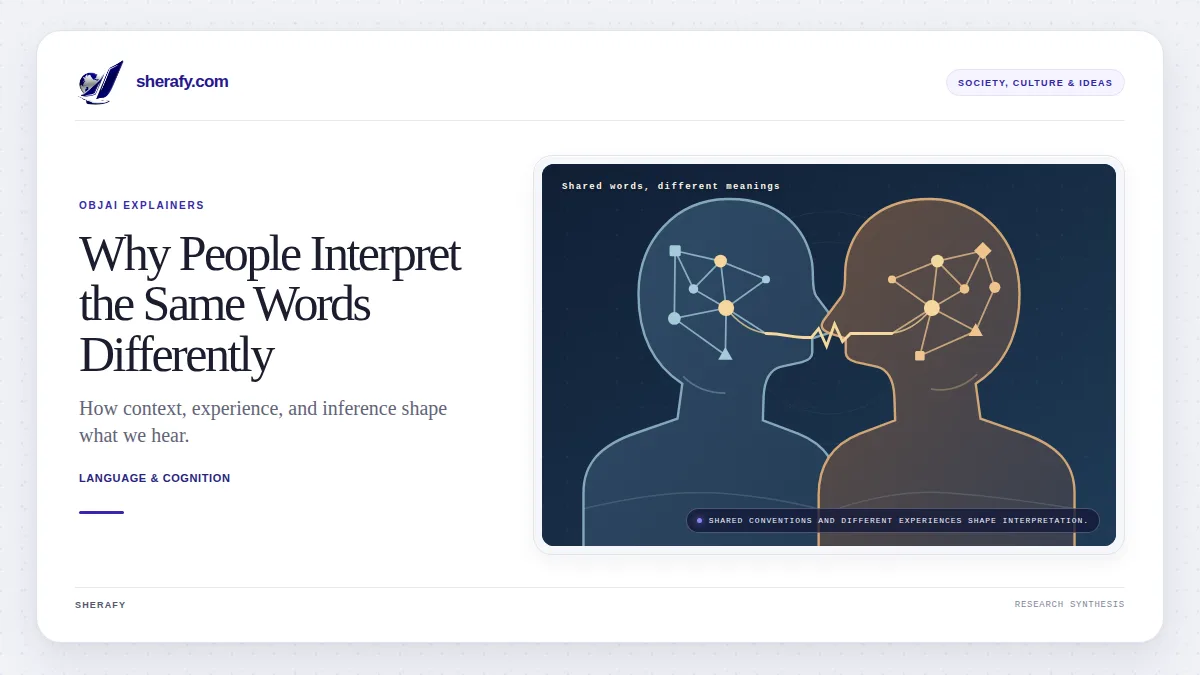
People interpret the same words differently because understanding language involves more than recognizing words and their definitions. We also draw on our knowledge, experiences, social conventions, expectations, and the circumstances in which something is said. Two people can speak the same language, know the same facts, and still construct different meanings from the same statement.
Research also shows that people tend to overestimate how much others share their interpretations. What seems obvious to a speaker may not be obvious to the listener, precisely because the speaker already knows what they intended to communicate.
But there is an important distinction: interpreting something differently is not necessarily the same as misunderstanding it, and misunderstanding someone is not the same as disagreeing with them. Human communication can succeed without two people having identical mental representations or experiences.
The science of how this happens spans cognitive psychology, linguistics, social psychology, and the philosophy of interpretation known as hermeneutics. Together, these fields help explain why people talk past one another, why misunderstandings can go unnoticed, and how people establish shared understanding in the first place.
Do the same words mean different things to different people?
Consider a penguin. Is it more similar to a chicken or a dolphin?
A chicken and a penguin are both birds. A dolphin and a penguin are both adapted to life in water and are proficient swimmers. Depending on which characteristics someone considers most important, either answer can make sense.
The two people need not disagree about any biological facts. They may simply organize the same knowledge differently.
This distinction matters because words are not just entries in a dictionary. They also connect to concepts, categories, associations, and knowledge stored in memory. People may share the conventional definition of a word without sharing every aspect of the mental representation associated with it.
There are also words with multiple established senses. The word head, for example, can refer to a body part or the leader of an organization. Linguists call the existence of multiple related senses of a word polysemy. But even when two people are using the same dictionary sense, differences in their conceptual knowledge can remain.
Measuring differences in people's concepts
In 2023, Louis Marti and colleagues at the University of California, Berkeley, published Latent Diversity in Human Concepts in the journal Open Mind.
The first experiment involved 1,799 participants making comparisons between familiar animals or American political figures. The second involved 1,000 participants rating conceptual features, following a preliminary exercise in which 16 participants supplied candidate features.
| Measurement in Experiment 1 | Result |
|---|---|
| Consistency when individuals repeated their own judgments | 88% |
| Average agreement between individuals on conceptual judgments | 50% |
The researchers used statistical models to distinguish relatively stable differences between people's responses from inconsistency within the same individual. They estimated that even familiar nouns can have at least 10 to 30 distinguishable conceptual variants in the population. Participants also tended to predict that roughly two-thirds of others would agree with them, even on judgments where actual agreement was much lower.
These are results from particular experimental tasks and selected concepts, not a count of dictionary definitions or an estimate of the proportion of conversations that fail. Nevertheless, they provide measurable evidence that people differ in their conceptual representations and are not necessarily aware of those differences.
Can conceptual differences actually interfere with communication?
In separate 2023 research presented at the Cognitive Science Society's annual meeting, Yuguang Duan and Gary Lupyan examined the penguin comparison described above and similar judgments. Some participants gave greater weight to biological classification, while others prioritized different kinds of similarity. Comparable differences appeared in judgments about manufactured objects.
When people with different patterns of semantic organization were paired in a communication task, they were less likely to identify the targets their partners intended. The study provides experimental evidence that differences in concepts can have communicative consequences, although it is conference research involving a specific task rather than a population-wide measure of everyday misunderstanding.
Why do people develop different concepts?
Part of the explanation lies in individual language experience. People encounter words in different settings, read different material, work in different professions, and participate in different communities.
In a 2021 study of language experience and semantic priming, Harinder Aujla examined how computational models derived from different news sources could help predict performance on word-recognition tasks. The findings support a relationship between people's linguistic environments and how they process words.
Brendan T. Johns's 2024 study of individualized semantic memory approached the question through a different method, constructing models of word relationships from the writing of 500 Reddit users. The models exhibited substantial variation, associated partly with characteristics of the words and their use.
These studies do not directly reveal a person's private thoughts or establish how much conceptual variation comes from any one life experience. They do support the broader conclusion that learning and using the same language does not necessarily produce identical semantic knowledge.
How the human mind interprets what someone says
A statement can be understood correctly at the level of its words and incorrectly at the level of what its speaker intends.
Imagine someone says, "It's cold in here."
The conventional meaning is straightforward: the speaker is describing the temperature. But the statement could also be an indirect request to close a window, an invitation to move somewhere warmer, or an explanation for why the speaker is uncomfortable.
Understanding the sentence and understanding why it was said are related but distinct tasks.
| Aspect of communication | What it involves | Example |
|---|---|---|
| Semantics | The conventional meaning of words and sentences | Understanding what cold means |
| Pragmatics | Inferring what a statement communicates in context | Recognizing a request to close the window |
| Prosody | Meaning conveyed through rhythm, stress, and intonation | Distinguishing genuine enthusiasm from sarcasm |
| Reference | Identifying the person, object, event, or idea being discussed | Knowing which window the speaker means |
| Common ground | Information the participants regard as shared | Knowing that the heating system is broken |
These processes work together. A listener who knows that a window was just opened has contextual information that an unfamiliar listener does not. The same sentence may therefore communicate more to one person than to the other.
Three components of pragmatic language understanding
A 2025 study published in the Proceedings of the National Academy of Sciences examined whether different kinds of nonliteral and context-dependent understanding rely on the same abilities.
Sammy Floyd and colleagues tested 376 participants in an initial experiment using an approximately eight-hour battery of tasks. A second, preregistered experiment involved another 400 participants.
After accounting for general cognitive ability, the researchers identified three clusters of performance that they interpreted as corresponding to:
- Social conventions: Recognizing indirect requests, conversational implications, and irony.
- Intonation: Interpreting vocal emphasis and emotional tone.
- World knowledge and causal reasoning: Using knowledge about how the world works to infer intended meanings.
The overall structure largely replicated in the second sample. These are patterns in behavioral performance, not three independently established brain systems or an exhaustive classification of language comprehension.
The research nevertheless helps explain why being good at understanding one aspect of communication does not guarantee equal proficiency in every other aspect.
How culture and social conventions affect interpretation
People also learn different expectations about what counts as direct, polite, enthusiastic, critical, or appropriately brief communication.
For example, British and American English speakers may interpret an intensifier such as quite differently depending on the expression and conversational setting. A 2025 conference study by Yuka Machino and colleagues examined these differences across three experiments and found support for both semantic differences and pragmatic factors involving the costs of expressing a message.
Culture is not a complete explanation for individual behavior, and national groups are not linguistically uniform. Professional expertise, family conventions, local dialects, and personal experiences can also affect how language is used and understood.
Why people don't realize they have been misunderstood
One of the most difficult communication problems is not being misunderstood. It is being misunderstood while believing that communication has succeeded.
A speaker knows which meaning they intended. When evaluating their own statement, that knowledge is difficult to set aside. A listener, however, may not possess the same information.
This is one reason an ambiguous message can seem completely unambiguous to the person who produced it.
The illusion of transparency
In 1998, Thomas Gilovich, Kenneth Savitsky, and Victoria Medvec published The Illusion of Transparency, a series of experiments examining how accurately people judge others' ability to detect their internal states.
Their research found that people can overestimate the extent to which their private experiences are visible to others. Subsequent research and a 2008 review by Jessica Cameron and Jacquie Vorauer explored how related biases affect interpersonal communication and relationships.
Consider someone who feels frustrated but says very little. Their frustration may be so apparent to them that they assume their partner must also recognize it. If the partner does not respond as expected, the silence may be interpreted as indifference rather than a lack of information.
The original research concerned the perceived visibility of internal states. It should not be confused with a general measurement of verbal communication accuracy.
Why speakers overestimate how clear they are
In a 2002 study by Boaz Keysar and Anne Henly, participants attempted to communicate particular meanings using ambiguous sentences. Speakers expected listeners to identify the intended meaning more often than listeners actually did.
The researchers also found that informed overhearers did not exhibit the same systematic overestimation. Knowing what a sentence is meant to communicate is not necessarily the same as having produced that sentence yourself.
Keysar's subsequent theoretical work on egocentric processes in communication explains how reliance on one's own perspective can create systematic errors in both producing and interpreting language.
Even listeners can overestimate their understanding
A particularly striking demonstration appeared in The Extreme Illusion of Understanding, published in 2022 by Becky Ka Ying Lau and colleagues.
Native Mandarin speakers overestimated how much English-speaking Americans understood of their Chinese utterances, even when told the Americans did not know Chinese. The listeners also overestimated their understanding of the speakers' intended meanings.
The experiment does not imply that people routinely believe they understand completely unfamiliar languages. It illustrates how strongly confidence in communicating or interpreting intentions can diverge from measured comprehension.
Why the people closest to you can still misunderstand you
Familiarity often makes communication easier. Friends, partners, and colleagues build shared knowledge, recognize each other's references, and develop conventions that allow them to communicate efficiently.
The same familiarity can also create a risk: assuming that someone understands a message because they already know you.
Kenneth Savitsky and colleagues examined this in The Closeness-Communication Bias, published in 2011. In one experiment, people following instructions from friends were more prone to certain perspective-related errors than people following instructions from strangers. Two other experiments found that participants communicating ambiguous meanings overestimated their success more with friends or spouses than with strangers.
The finding is not that strangers generally understand one another better than close friends. Rather, familiarity can reduce the perceived need to check assumptions, creating opportunities for specific kinds of misunderstanding even within otherwise effective relationships.
Someone may tell a partner, "I need some space," expecting them to understand that they need twenty minutes alone to decompress. The partner might interpret this as a desire to withdraw from the relationship. Their shared history may provide useful clues, but it can also provide reasons to assume an interpretation that has not actually been confirmed.
Feeling understood, accurately understanding another person's intentions, sharing their emotional experience, and agreeing with them are all different things.
Why do people misinterpret text messages and emails?
Written messages lack some of the information available in face-to-face conversation, including vocal intonation, facial expressions, and gestures. This can make particular kinds of ambiguity harder to resolve, especially when someone intends sarcasm or relies on an unstated assumption.
However, it is misleading to conclude that written communication is inherently unreliable.
| Research | What was studied | Main finding |
|---|---|---|
| Kruger et al., 2005 | Five experiments involving email and intended tone | Participants overestimated how effectively they communicated tone. |
| Pollmann and Roos, 2025 | Everyday informal texts and work or educational emails | Senders' and recipients' emotional-valence ratings aligned closely. |
| Poirier et al., 2025 | Three experiments involving punctuation and message segmentation | Text formatting can itself convey emotional information. |
The 2025 study by Monique Pollmann and Carla Roos is particularly important because it examined messages exchanged between people who knew one another. There were 347 recipients of informal messages and 361 recipients of work or educational emails, with corresponding sender ratings available for 171 and 61 recipients, respectively.
The researchers found little evidence of a systematic difference between intended and perceived emotional valence, meaning how positive or negative the messages were. That does not mean every individual message was understood accurately, nor does it establish accuracy for sarcasm, implied requests, factual content, or other aspects of meaning.
Rachel Poirier and colleagues separately demonstrated that dividing words with periods or sending them as individual messages can communicate emotions such as frustration. People develop ways to express meaning using the tools available in the medium.
Consider the difference between "Okay," "Okay!" and "Okay." A recipient may perceive different emotional tones, but none of these punctuation choices has a universally fixed interpersonal meaning. Context and familiarity still matter.
The research is not necessarily contradictory. Conveying deliberately ambiguous tone in a laboratory exercise is different from exchanging ordinary messages with someone who already knows your communication style.
When does a difference in interpretation become a misunderstanding?
Not every difference in conceptual representation changes the outcome of a conversation. This distinction becomes particularly important when words are used to collect data, establish obligations, or guide decisions.
In 2018, Michael Schober, Anna Suessbrick, and Frederick Conrad published When Do Misunderstandings Matter? Evidence From Survey Interviews About Smoking.
Across 131 interviews, the researchers examined how respondents interpreted ordinary survey expressions relating to tobacco use. One question concerned whether respondents had smoked at least 100 cigarettes in their lifetime.
When 130 respondents explained what counted as smoking, their interpretations were almost evenly divided:
| Respondent's interpretation | Number | Share |
|---|---|---|
| Only puffs that were inhaled | 60 | 46.2% |
| Any puffs, including those not inhaled | 70 | 53.8% |
| Total | 130 | 100% |
The study's standardized definition included puffs regardless of whether they were inhaled. In the second study, 12.3% of respondents changed their answer to the lifetime 100-cigarette question after receiving a standard definition during reinterview. Among 74 respondents with response-change data, 65 changed at least one survey answer after definitions were supplied.
The researchers did not independently verify every respondent's actual smoking history. A changed answer therefore establishes response instability, not proof that the revised answer was always correct.
The implications extend beyond smoking surveys. If one answer determines which questions someone is subsequently asked, an initial difference in interpretation can affect an entire sequence of measurements. The same problem arises when an ambiguous instruction determines what an employee does next or when a patient interprets medical advice differently from what was intended.
Different interpretations can be harmless
The same research identified cases in which differences in conceptualization had no effect on survey answers. A respondent who had smoked thousands of cigarettes, for instance, might exceed a 100-cigarette threshold regardless of whether they counted cigarettes that were only partially smoked.
Consider an everyday example involving the word soon:
| Situation | What happens |
|---|---|
| Shared interpretation | Both people understand soon to mean within an hour. |
| Harmless difference | One person considers soon an hour and the other considers it a day, but both complete the task in twenty minutes. |
| Consequential misunderstanding | The speaker expects the task within an hour, while the listener believes tomorrow is acceptable. |
| Genuine disagreement | Both understand that the deadline is an hour away, but one believes the deadline is unreasonable. |
The examples are illustrative, not results from an experiment. They demonstrate why the appropriate standard for judging communication depends on what the participants need to accomplish.
The survey researchers also identified cases in which clarification was needed but never occurred, and cases where attempted clarification appeared ineffective or even counterproductive. Explaining more is not always the same as explaining better.
Are you misunderstanding each other or actually disagreeing?
When two people appear to be talking past each other, it is tempting to assume that their disagreement would disappear if they simply understood one another better.
Sometimes it would. Sometimes it would not.
Consider two colleagues discussing whether a deadline is fair. One understands fair to mean that everyone receives the same amount of time. The other understands it to mean that the time allocated should reflect each person's workload.
They may initially misunderstand each other's use of the word. But once both definitions are established, the disagreement may persist because the colleagues have different views about how work should be distributed.
That is no longer merely a failure to understand a word. It is a dispute about how a principle should be applied.
Recognizing a meaning is not the same as adopting it
In a 2026 philosophical paper on verbal disputes, Michelle Liu distinguishes between failures to recognize an intended meaning and failures to adopt a meaning that has been recognized.
In the first case, a listener does not identify what the speaker intended. In the second, the listener identifies the intended meaning but does not accept its use within the conversation. This latter category can involve disagreements about language, competing conversational purposes, or substantive disagreements beyond language itself.
A related concept in philosophy of language is metalinguistic negotiation: people appear to disagree about a statement, but part of their dispute concerns how a particular expression should be used.
Liu's work is a theoretical account of verbal disputes, not an experiment measuring their prevalence. Its distinction nevertheless offers a useful way to analyze real arguments.
A framework for identifying why people talk past each other
The following table is a practical synthesis of research on semantic cognition, pragmatic inference, verbal disputes, and conversational repair. It is not a validated psychological assessment.
| Source of the problem | Question to investigate | Appropriate next step |
|---|---|---|
| Different definitions | Are we using the same word in the same sense? | Define it or give concrete examples. |
| Unclear reference | Are we talking about the same person, event, or object? | Identify the referent explicitly. |
| Inferred intention | Do I know what they intended, or am I assuming? | Ask and consider the surrounding evidence. |
| Different factual beliefs | Do we disagree about what happened or what is true? | Examine the relevant evidence. |
| Different goals or expectations | Do we agree on the intended outcome or obligation? | Specify the goal, deadline, or expectation. |
| Different values | Do we disagree about what should matter? | Identify the substantive disagreement. |
| Disputed language use | Do we understand each other's definitions but reject their use? | Explain why the chosen definition matters. |
| Deliberate misrepresentation | Is someone knowingly responding to a distorted version of the other's position? | Document the actual position and distinguish evidence from speculation about motives. |
There is no reason to assume that everyone engaged in a dispute is acting in good faith. Equally, an unsuccessful clarification or persistent disagreement is not sufficient evidence of deliberate dishonesty.
Understanding is not agreement. Someone can accurately explain your position, recognize the evidence you rely on, understand your reasons for holding it, and still conclude that you are wrong.
What is hermeneutics, and how does it relate to communication?
Hermeneutics is the study and philosophy of interpretation. As explained in the Stanford Encyclopedia of Philosophy's entry on hermeneutics, it has applications in theology, law, literature, history, and other fields concerned with understanding the significance of human expression and experience.
A central idea in the hermeneutic tradition is that interpretation involves a relationship between what is being interpreted and the larger context in which it appears. One version of the hermeneutical circle concerns how understanding a text as a whole helps us understand its individual parts, while understanding those parts helps us revise our understanding of the whole.
For example, an isolated statement in a conversation may seem hostile. Learning what happened earlier, or understanding how that statement relates to the rest of the discussion, may lead to a different interpretation.
Hermeneutics is not, however, the name of every scientific mechanism involved in misunderstanding. The empirical findings about concepts, cognitive biases, pragmatic inference, and conversational repair come primarily from psychology, linguistics, and cognitive science.
The expression interpretive gap can be a useful descriptive term for differences between intended and received meaning. It should not be confused with a single, standardized psychological diagnosis or a universally measurable phenomenon established by hermeneutics.
Nor does the philosophical recognition that interpretation is shaped by context imply that all interpretations are equally valid. Some interpretations are better supported by the words, circumstances, evidence, and stated intentions than others.
Can two people ever fully understand each other?
The answer depends on what is meant by fully understand.
| Type of understanding | What it requires |
|---|---|
| Linguistic | Accurately identifying the relevant words, meanings, and references. |
| Intentional | Accurately recognizing what the speaker wants to communicate. |
| Practical | Understanding enough to make an appropriate decision or carry out an action. |
| Experiential | Sharing or fully accessing another person's subjective experience. |
A person can understand instructions accurately without having the same internal experience as the person giving them. An engineer can explain how a device works to someone who has never built one. A friend can understand that someone is grieving without experiencing their grief in precisely the same way.
The inability to demonstrate complete access to another person's subjective consciousness is not evidence that every message is misunderstood.
In Grounding in Communication, published in 1991, Herbert Clark and Susan Brennan describe communication as a collaborative process in which participants seek evidence that they have achieved mutual understanding adequate for the purpose at hand. Their grounding criterion concerns the understanding needed for the present interaction, rather than requiring identical mental states.
Neuroscience also offers evidence that successful communication can involve shared patterns of processing. In a 2010 functional brain imaging study, Greg Stephens, Lauren Silbert, and Uri Hasson found associations between speaker-listener neural coupling and comprehension during a storytelling task. That finding does not establish that speakers and listeners experience identical thoughts or consciousness.
How humans establish and repair shared understanding
Communication is often described as a speaker sending a message and a listener receiving it. That description leaves out much of what makes ordinary conversation work: both participants can adapt to one another.
People adapt their language to what others know
In a 1987 experiment by Ellen Isaacs and Herbert Clark, people worked together to arrange photographs of New York City landmarks. Participants with different levels of familiarity with the city adjusted their descriptions as they learned what their partners knew.
A 1989 experiment by Michael Schober and Herbert Clark compared people who actively participated in a conversation with people who overheard the same words. Participants arranged complex figures more accurately than overhearers, despite initially having equivalent background information.
The distinction is revealing. Receiving the same words is not necessarily equivalent to participating in the process of establishing their meaning.
How meaning becomes shared understanding
A simplified, research-informed way of representing this process is:
- Intention: A person has something they want to communicate.
- Expression: They produce words, gestures, or other signals using their available knowledge and assumptions.
- Interpretation: The recipient constructs a meaning using the message, context, and their own knowledge.
- Verification and repair: Participants use responses, questions, corrections, and other feedback to assess or improve their understanding.
- Shared understanding: They establish a sufficiently accurate interpretation for the current purpose, or discover that further clarification is needed.
This is an explanatory synthesis rather than a validated sequence of discrete cognitive stages. Real conversations are reciprocal, with interpretation and feedback occurring throughout an exchange.
How often do people repair communication problems?
A 2015 study led by Mark Dingemanse examined naturally occurring conversation across 12 languages from eight language families. In 48.5 hours of exhaustively sampled conversation, the researchers identified 2,053 instances of a recipient initiating a repair of a communication problem.
That amounts to approximately one repair initiation every 1.4 minutes, or about 84 seconds, in the sampled conversations.
The researchers identified three recurring strategies:
| Repair strategy | What the recipient does | Illustrative example |
|---|---|---|
| Open request | Signals a problem without identifying its precise source. | "Sorry, what did you say?" |
| Restricted request | Identifies the particular information that needs clarification. | "Which meeting do you mean?" |
| Restricted offer | Proposes an interpretation for the speaker to confirm or correct. | "Do you mean tomorrow's meeting?" |
These strategies appeared across the sampled languages, with participants generally favoring more specific forms of clarification when available.
The 84-second figure is not an estimate of how often people misinterpret each other's emotional intentions, nor a rate of serious interpersonal conflict. Repair includes minor problems such as not hearing a word or identifying an unclear reference. It measures observable efforts to address communication problems, not every misunderstanding that occurs.
As Patrick Healey, Jan de Ruiter, and Gregory Mills discuss in their 2018 introduction to research on miscommunication, communication breakdowns and their resolution are important parts of how people maintain shared language.
Do people have to communicate alike to understand each other?
Conversation partners often adapt their language to one another, a phenomenon known as conversational alignment. But alignment can depend on the situation rather than reflecting a permanent characteristic of an individual or relationship.
A 2026 study by Yngwie Nielsen and colleagues examined 1,375 conversations across four datasets. Measures of lexical, structural, and semantic alignment were more consistent within conversations (correlations around 0.50) than across times, partners, and contexts (around 0.20 to 0.25). The researchers proposed that individual differences in alignment may be better understood as a skill than a stable trait. That remains a hypothesis, not proof that a particular communication-training program works.
Nor must people use identical words to coordinate successfully. A 2025 study by Polyphony Bruna and Christopher Kello found improved performance in a task involving shared categorization even as participants' word usage diverged. Effective coordination can emerge without simple verbal imitation.
How to tell whether someone actually understands you
The practical lesson from this research is not that every conversation needs an exhaustive discussion of definitions. Most everyday communication would become unnecessarily difficult if people attempted to eliminate every possible ambiguity.
Instead, the effort spent verifying understanding should reflect the consequences of getting it wrong.
1. Ask about the other person's perspective rather than relying entirely on your own inference
In a 2018 paper titled Perspective Mistaking, Tal Eyal, Mary Steffel, and Nicholas Epley reported 25 experiments examining whether deliberately imagining another person's perspective improved interpersonal accuracy. They found no consistent benefit from perspective-taking instructions alone. A final experiment found improved accuracy when participants obtained the other person's perspective directly through conversation.
Empathy and perspective-taking remain valuable, but imagining someone's experience is not a substitute for obtaining information about it.
Instead of assuming that someone interpreted a statement as criticism, ask what they understood it to mean. Instead of attributing a motive based on a brief message, determine whether there is additional information that supports or contradicts the inference.
2. Identify the ambiguity instead of repeating the same words
Repeating an instruction may solve a hearing problem. It may accomplish nothing if the listener is attaching a different meaning to a crucial word.
Consider these alternatives:
| Ambiguous expression | More specific clarification |
|---|---|
| Finish it soon. | Can you send me the completed version by 3 p.m. today? |
| I need some space. | I need twenty minutes alone, then we can continue talking. |
| Be respectful. | Please let me finish speaking before responding. |
| That's not what I meant. | I was questioning the conclusion, not your motives. |
| Take care of it. | Please cancel the appointment and confirm that it has been canceled. |
These are examples of making references, expectations, and intentions more explicit. They are not universal scripts. A more specific statement can still be ambiguous in context or conflict with someone's legitimate expectations.
3. Check understanding rather than asking whether someone understands
A simple yes-or-no question can conceal uncertainty or mistaken confidence. When accuracy matters, asking someone to explain the next step in their own words can reveal misunderstandings that would otherwise remain hidden.
Healthcare provides a practical example. The U.S. Agency for Healthcare Research and Quality's teach-back guidance recommends asking patients or caregivers to explain essential information or actions in their own words, allowing healthcare professionals to identify where explanations need improvement.
Adapting this principle to ordinary communication can be useful when the stakes warrant it. The objective is to check the quality of the explanation, not to test or embarrass the listener. It should be reciprocal where appropriate.
4. Separate intentions from consequences
The intention behind a statement and its effect on another person are two distinct pieces of information.
A person may intend a joke that causes genuine harm. The harm does not, by itself, establish malicious intent, and benign intent does not erase the harm. Understanding what someone meant can help explain a situation without automatically resolving responsibility for what happened.
5. Recognize when more communication will not resolve the problem
Sometimes people avoid constructive discussion because they expect it to go worse than it actually does. Research by James Dungan and Nicholas Epley published in 2024 found that people in the studied settings overestimated how negatively others would respond to constructive confrontation.
That does not establish that confrontation is advisable in unsafe circumstances. Clarification also cannot resolve every substantive disagreement, power imbalance, deceptive statement, or incompatible interest. When someone knowingly misrepresents your position or disregards an explicitly communicated boundary, the problem may not be a lack of understanding.
Frequently asked questions
What is it called when two people interpret the same words differently?
There is no single scientific term covering every instance. Semantic divergence describes differences in meaning or conceptual representation; pragmatic misunderstanding concerns context-dependent or intended meaning; and verbal disputes may involve differences in the interpretation or use of expressions. Hermeneutics examines interpretation more broadly. The appropriate term depends on what is actually different.
What percentage of human communication is misunderstood?
There is no defensible universal percentage established by the research discussed here. Studies measure different outcomes, including conceptual agreement, recognition of intended meanings, emotional tone, and observed clarification requests.
For example, a 2023 study by Thomas Holtgraves and colleagues found that about 95% of recalled digital miscommunication incidents involved references, intentions, or both. Participants reported that both parties recognized the miscommunication in 76.8% of those incidents. These findings describe a sample of recalled misunderstandings, not the proportion of all messages that people misunderstand.
Does having different experiences mean that everyone has their own definition of every word?
No. Language depends on shared conventions, and people often agree about the relevant meaning of words. Research indicates that meaningful individual differences coexist with this common foundation. The extent of variation depends on the concept, the context, and how understanding is measured.
Is it possible to misunderstand someone even when they are telling the truth?
Yes. Truthfulness concerns whether a speaker is honestly communicating information. Understanding concerns whether the recipient correctly interprets it. An honest statement can be ambiguous or misinterpreted, and an accurately understood statement can be false or dishonest.
Can someone understand you without agreeing with you?
Yes. A person can understand exactly which claim you are making and still disagree about its truth, relevance, implications, or moral justification. Understanding does not obligate someone to accept a conclusion.
Can miscommunication be completely eliminated?
There is no universal method that guarantees every message will be understood as intended. Many particular misunderstandings can be detected and resolved through shared context, explicit language, feedback, and clarification. Others require additional information or changes in circumstances. Some differences do not need to be resolved at all.
The bottom line
Human language works because people share enough conventions, knowledge, and context to communicate, and because they can adapt when those resources prove insufficient. The fact that individuals organize knowledge differently does not make understanding impossible. It makes communication a process of coordination rather than a simple transfer of thoughts.
The most useful distinction is between what someone said, what they meant, what another person understood, and whether any remaining difference actually matters. Sometimes the problem is ambiguous language. Sometimes it is an assumption about someone else's intentions. And sometimes there is no misunderstanding at all, only disagreement.
Understanding someone does not require becoming them. It requires knowing what they mean well enough to recognize where understanding ends and disagreement begins.
References and Further Reading
Semantic cognition and conceptual diversity
- Marti, L., Wu, S., Piantadosi, S. T., & Kidd, C. (2023). Latent Diversity in Human Concepts. Open Mind, 7, 79–92. Primary open-access research measuring individual conceptual differences and the extent to which people misjudge agreement with their own judgments.
- Duan, Y., & Lupyan, G. (2023). Divergence in Word Meanings and Its Consequence for Communication. Proceedings of the 45th Annual Meeting of the Cognitive Science Society. Conference research linking differences in semantic organization to performance in a communication task.
- Aujla, H. (2021). Language Experience Predicts Semantic Priming of Lexical Decision. Canadian Journal of Experimental Psychology, 75(3), 235–244. Examines how models of linguistic experience relate to word-processing behavior.
- Johns, B. T. (2024). Determining the Relativity of Word Meanings Through the Construction of Individualized Models of Semantic Memory. Cognitive Science, 48(2), e13413. Computational analysis of individual semantic representations derived from 500 Reddit users' language corpora.
- Floyd, S., Jouravlev, O., Poliak, M., Mineroff, Z., Gibson, E., & Fedorenko, E. (2025). Three Distinct Components of Pragmatic Language Use: Social Conventions, Intonation, and World Knowledge-Based Causal Reasoning. Proceedings of the National Academy of Sciences, 122(50), e2424400122. Two large behavioral studies of the cognitive structure of pragmatic comprehension.
- Machino, Y., et al. (2025). Minding the Politeness Gap in Cross-Cultural Communication. Proceedings of the Annual Meeting of the Cognitive Science Society. Experimental and computational conference research examining semantic and pragmatic differences in intensifier interpretation.
Consequential misunderstanding and interpersonal accuracy
- Schober, M. F., Suessbrick, A. L., & Conrad, F. G. (2018). When Do Misunderstandings Matter? Evidence From Survey Interviews About Smoking. Topics in Cognitive Science, 10(2), 452–484. Primary survey-interview research distinguishing conceptual differences that affect responses from those that do not, including the limits of clarification.
- Gilovich, T., Savitsky, K., & Medvec, V. H. (1998). The Illusion of Transparency: Biased Assessments of Others' Ability to Read One's Emotional States. Journal of Personality and Social Psychology, 75(2), 332–346. Foundational experimental investigation of perceived visibility of private emotional states.
- Keysar, B., & Henly, A. S. (2002). Speakers' Overestimation of Their Effectiveness. Psychological Science, 13(3), 207–212. Experiments comparing speakers' expectations of comprehension with listeners' actual understanding.
- Cameron, J. J., & Vorauer, J. D. (2008). Feeling Transparent: On Metaperceptions and Miscommunications. Social and Personality Psychology Compass, 2(2), 1093–1108. Review of transparency biases, perceived understanding, and interpersonal consequences.
- Savitsky, K., Keysar, B., Epley, N., Carter, T., & Swanson, A. (2011). The Closeness-Communication Bias: Increased Egocentrism Among Friends Versus Strangers. Journal of Experimental Social Psychology, 47(1), 269–273. Three experiments examining how familiarity can influence perspective-related errors and confidence.
- Lau, B. K. Y., Geipel, J., Wu, Y., & Keysar, B. (2022). The Extreme Illusion of Understanding. Journal of Experimental Psychology: General, 151(11), 2957–2962. Experimental study of communication overconfidence when participants lack a shared language.
- Keysar, B. (2007). Communication and Miscommunication: The Role of Egocentric Processes. Intercultural Pragmatics, 4(1), 71–84. Theoretical review explaining the contribution of egocentric processing to communication errors.
- Eyal, T., Steffel, M., & Epley, N. (2018). Perspective Mistaking: Accurately Understanding the Mind of Another Requires Getting Perspective, Not Taking Perspective. Journal of Personality and Social Psychology, 114(4), 547–571. Experimental comparison of imagining and directly obtaining information about another person's perspective.
- Dungan, J. A., & Epley, N. (2024). Surprisingly Good Talk: Misunderstanding Others Creates a Barrier to Constructive Confrontation. Journal of Experimental Psychology: General, 153(3), 779–797. Examines how anticipated negative responses can discourage constructive interpersonal discussions.
Written and digital communication
- Kruger, J., Epley, N., Parker, J., & Ng, Z.-W. (2005). Egocentrism Over E-Mail: Can We Communicate as Well as We Think?. Journal of Personality and Social Psychology, 89(6), 925–936. Five experiments investigating overconfidence in conveying tone through email.
- Pollmann, M. M. H., & Roos, C. A. (2025). “I Get U”. People Correctly Interpret the Tone of Text Messages and Emails. Computers in Human Behavior Reports, 18, 100689. Primary research comparing senders' and recipients' emotional-valence ratings in everyday written communication.
- Poirier, R. C., Cook, A. M., & Klin, C. M. (2025). Read. This. Slowly: Mimicking Spoken Pauses in Text Messages. Frontiers in Psychology, 16, 1410698. Three experiments examining how punctuation and message segmentation affect emotional interpretation.
- Holtgraves, T., Bray, K., & Britton, K. (2023). How People Perceive and Talk About Miscommunication. Journal of Pragmatics, 217, 140–152. Studies of recalled digital miscommunication and social-media discussion of communication breakdowns.
Common ground, conversational alignment, and repair
- Clark, H. H., & Brennan, S. E. (1991). Grounding in Communication. In Perspectives on Socially Shared Cognition. Foundational theoretical account of how conversation participants establish sufficient mutual understanding.
- Isaacs, E. A., & Clark, H. H. (1987). References in Conversation Between Experts and Novices. Journal of Experimental Psychology: General, 116(1), 26–37. Demonstrates adaptation to differences in conversational partners' expertise.
- Schober, M. F., & Clark, H. H. (1989). Understanding by Addressees and Overhearers. Cognitive Psychology, 21(2), 211–232. Experimental evidence of the comprehension advantage associated with active participation in conversation.
- Dingemanse, M., et al. (2015). Universal Principles in the Repair of Communication Problems. PLOS ONE, 10(9), e0136100. Cross-linguistic observational research quantifying communication repair and identifying common clarification strategies.
- Healey, P. G. T., de Ruiter, J. P., & Mills, G. J. (2018). Editors' Introduction: Miscommunication. Topics in Cognitive Science, 10(2), 264–278. Multidisciplinary research overview treating miscommunication as an important feature of language and interaction.
- Bruna, P., & Kello, C. (2025). Least Effort and Alignment in Task-Oriented Communication. Cognitive Science, 49(4), e70062. Experimental and computational research on efficient coordination without requiring identical word usage.
- Nielsen, Y. A., et al. (2026). Conversational Alignment as an Individual Difference. Proceedings of the Royal Society B, 293, 20252205. Analysis of repeated conversational measures across four datasets investigating the stability of alignment.
- Stephens, G. J., Silbert, L. J., & Hasson, U. (2010). Speaker-Listener Neural Coupling Underlies Successful Communication. Proceedings of the National Academy of Sciences, 107(32), 14425–14430. Functional neuroimaging research associating speaker-listener activity patterns with comprehension.
Philosophy of interpretation and practical application
- Stanford Encyclopedia of Philosophy. Hermeneutics. Substantively revised April 30, 2025. Authoritative philosophical reference covering interpretation, the hermeneutical circle, and the development of the hermeneutic tradition.
- Liu, M. (2026). Ad Hoc Concepts, Polysemy and Mechanisms of Verbal Disputes. Synthese, 208, Article 241. Original philosophical analysis distinguishing recognition of intended meanings from their adoption in verbal disputes.
- Agency for Healthcare Research and Quality. TeamSTEPPS: Teach-Back. Official practical guidance on checking understanding by asking patients or caregivers to explain information in their own words.
Editorial note: This article is a research synthesis, not a systematic review or meta-analysis. The numerical findings refer to their specific study populations, tasks, and measured outcomes. The illustrative examples and communication framework are editorial explanations, not validated psychological assessment instruments. Research reviewed through November 25, 2026.