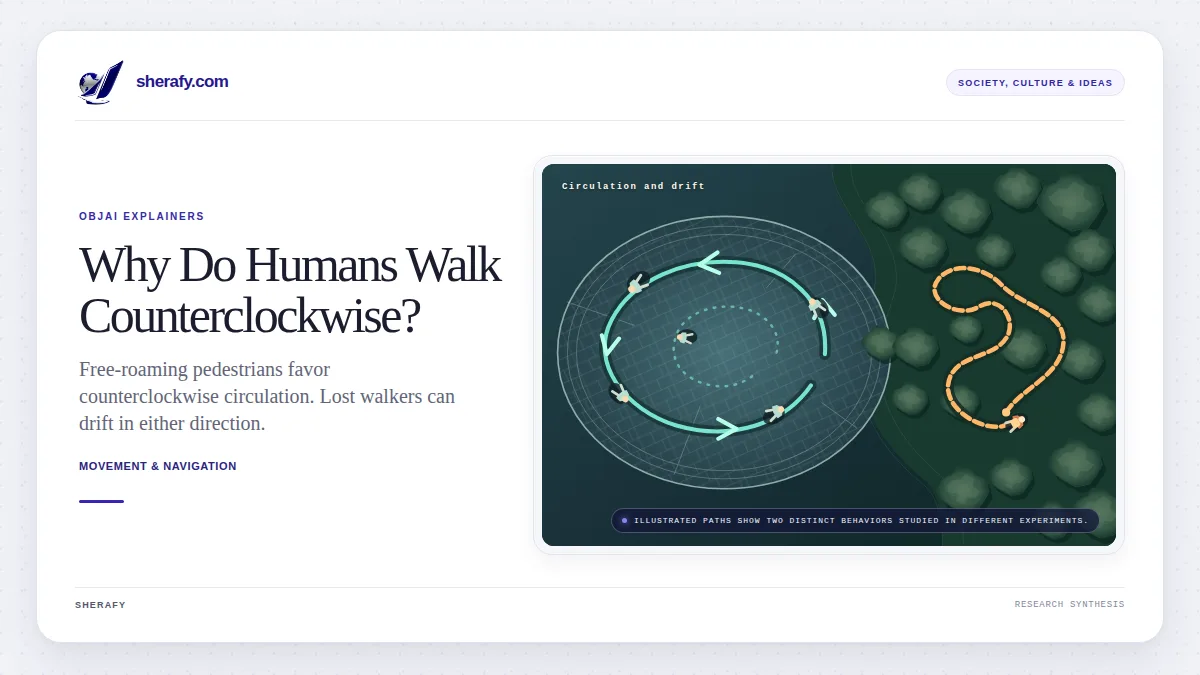
Humans exhibit a measurable preference for counterclockwise movement when walking freely without a specific destination. A 2026 study published in Nature Communications found the tendency in pedestrian experiments in Spain and Japan, including among individuals walking alone. Scientists have not established its biological cause, and handedness, foot dominance and eye dominance did not adequately explain it.
Humans also tend to lose their sense of a straight course when they lack reliable directional references. In a landmark 2009 study published in Current Biology, people instructed to walk straight through unfamiliar environments or while blindfolded sometimes unknowingly circled back toward where they started. Unlike the free-roaming pedestrians, however, they showed no consistent overall preference for circling clockwise or counterclockwise.
That distinction matters. Preferring to move in one direction is not the same thing as being unable to maintain a direction. The two behaviors may involve related systems in the brain, but a shared mechanism has not been demonstrated. Nor does the evidence support the popular suggestion that a lost hiker can recover the correct route simply by turning right.
The science reveals a more interesting problem than an unexplained preference for turning left: how an apparently symmetrical body, guided by an imperfect internal sense of direction, actually moves through the world.
Do humans naturally prefer walking counterclockwise?
The evidence is strongest for a specific kind of movement: spontaneous circulation around a space when people are free to roam. It does not establish that humans invariably turn left at intersections, prefer every leftward movement or walk in circles whenever they are lost.
Iñaki Echeverría-Huarte and colleagues published their investigation of individual locomotor bias on June 10, 2026. They examined movement in several settings, including adult pedestrian groups, schoolchildren and people walking alone.
| Experimental setting | Participants or sample | What it tested |
|---|---|---|
| Confined adult groups in Spain | 50 | Whether walls and individual turning preferences explain collective circulation |
| Spanish schoolyard | 107 students, aged 13–14 | Whether circulation occurs without nearby enclosing boundaries |
| Confined adult groups in Japan | 39 | Whether the pattern persists under different pedestrian conventions |
| Japanese nursery school | Four class groups, all under six years old | Whether similar movement occurs in young children |
| Individual walking in Spain | 209 adults recruited | Whether the effect requires other pedestrians |
| Social-convention questionnaire | 168 valid responses | Whether conscious preferences and expectations explain the observed pattern |
The individual experiment is especially important. Participants were instructed to move continuously for 60 seconds within a hexagonal space approximately 4.6 meters along each side. Each person walked alone, eliminating simultaneous interaction with other pedestrians.
Counterclockwise circulation remained observable. This supports an individual locomotor contribution to the collective pattern rather than an explanation that depends entirely on people following one another.
It is still a result from particular experimental settings and largely healthy, young populations, not a representative survey of all humanity.
How scientists discovered the counterclockwise bias
The discovery began with research into pedestrian movement during the COVID-19 pandemic. Scientists investigating social distancing noticed that freely moving groups spontaneously organized into counterclockwise circulation.
Their February 2022 Scientific Reports paper proposed that interactions with the surrounding walls, combined with a tendency among predominantly right-handed pedestrians to turn left when approaching a boundary, produced the observed rotation. Numerical simulations supported the plausibility of that mechanism.
The later experiments undermined its necessity. Groups composed of people classified as right-turners still circulated counterclockwise. A group of 107 teenagers roaming a schoolyard measuring approximately 50 by 60 meters also exhibited the bias without immediately encountering enclosing walls. Finally, the solitary-walker experiments showed that other pedestrians were not necessary for the tendency to emerge.
The 2026 investigation therefore changed the explanation: individual preferences can contribute to the collective rotation even in the absence of the particular interactions originally proposed.
That does not mean walls, other pedestrians or discrete turning choices are irrelevant to movement. They simply cannot account for all the observed results. The later study also shares authors with the 2022 research, so it is an extension and revision of the earlier work, not a wholly independent replication.
How strong is the counterclockwise preference?
The researchers quantified rotational movement using a measure called polarization. In this context, it describes how closely a person's direction of travel aligns with the counterclockwise tangent around a reference point.
Imagine standing at the eastern edge of a circular arena. Walking north is locally counterclockwise, walking south is clockwise, and walking directly toward the center is radial movement. The instantaneous polarization score ranges from −1 to +1.
| Polarization | Interpretation |
|---|---|
| −1 | Movement directly along the clockwise tangent |
| 0 | Radial movement at that instant; a time average near zero may also reflect opposing movements canceling |
| +1 | Movement directly along the counterclockwise tangent |
A person's average polarization summarizes the movement recorded over a trial. The researchers then compared those averages across participants.
In the principal individual-level analysis, reported with Figure 8, the results were:
| Statistic | Result |
|---|---|
| Participants recruited | 209 |
| Participants in the principal Wilcoxon signed-rank test | 156 |
| Standardized test statistic (z) | −5.63 |
| p-value | < 0.001 |
| Absolute effect size (r) | 0.45 |
| Bootstrap 95% confidence interval for median polarization | 0.12 to 0.27 |
The positive confidence interval and statistical test support an overall counterclockwise tendency in the analyzed sample. The negative sign of the reported test statistic follows the statistical implementation; it does not reverse the positive observed polarization.
The denominator matters. Although 209 people were recruited, the reported significance test used 156. The paper also reports a separate 49-person right-eye-patch condition and excludes participants without clear dominance classifications from analysis. These counts should not be treated as interchangeable.
Polarization is not a percentage. A score of +0.20 does not mean that 20% of people turn left, nor that a person will turn left 60% of the time. It is a measure of rotational movement around a chosen reference point, not a count of choices at a junction.
The authors observed substantial variation among people, including walkers who circulated clockwise, changed directions or moved along straighter paths. They also simulated collective polarization by combining measurements from separately recorded individuals. This synthetic result supports the idea that individual tendencies can help generate the group pattern, but it is not a new experiment involving a real crowd.
The publicly released experimental dataset and analysis code allow researchers to investigate these distributions further. The statistics presented here are those reported in the original paper, not independently reproduced participant-level estimates.
Why do humans prefer turning left? The competing biological explanations
Does handedness determine which way people turn?
The right-handedness explanation is appealing because most people favor their right hand, and functional differences between the brain's hemispheres can affect movement. Earlier research even provides some support for a relationship between handedness and certain turning behaviors.
A 2003 Behavioral Neuroscience study by Christine Mohr and colleagues examined 69 right-handed and 24 non-right-handed participants. The groups exhibited opposite preferences in spontaneous turning. A 2004 reanalysis of earlier turning data likewise found a leftward preference among right-handed participants and a rightward preference among non-right-handed participants. The researchers suggested that differences in dopamine-related activity between the brain's hemispheres might contribute to the pattern.
That proposed neurological mechanism was not directly established by the turning measurements.
A 2006 study of 107 adolescents also reported a left-turn preference of approximately 59% during unconstrained walking and 71% during running. The walking preference was sensitive to starting-position constraints. These results concern choices made during repeated turns, not the percentage of humanity that prefers counterclockwise circulation.
Other evidence is less supportive of a general handedness explanation. In a 2007 study, 60 participants divided equally among right-handed, mixed-handed and left-handed groups performed blindfolded straight-ahead walking tests four weeks apart. Neither handedness nor footedness significantly predicted the direction of veering.
The 2026 free-roaming research likewise failed to identify statistically significant differences in rotational polarization across several individual characteristics:
| Comparison | Group sizes | p-value | Estimated shift in polarization (95% CI) |
|---|---|---|---|
| Right-handed vs. left-handed | 142 / 14 | 0.554 | −0.05 (−0.34 to 0.18) |
| Right-footed vs. left-footed | 138 / 18 | 0.553 | −0.04 (−0.21 to 0.09) |
| Right-eye vs. left-eye dominance | 96 / 60 | 0.917 | 0.00 (−0.15 to 0.12) |
| Male vs. female | 62 / 94 | 0.178 | −0.08 (−0.24 to 0.03) |
| No eye patch vs. right-eye patch | 156 / 49 | 0.120 | +0.10 (−0.03 to 0.25) |
These are the study's Mann–Whitney comparisons and Hodges–Lehmann location-shift estimates. None reached conventional statistical significance.
However, only 14 analyzed participants were left-handed and 18 were left-footed. Some confidence intervals are wide enough to leave meaningful uncertainty. A nonsignificant result is not proof that the characteristic has no effect.
The defensible conclusion is that handedness alone cannot adequately explain the observed free-roaming bias. It is not that handedness can never influence a person's movements.
Does one stronger or longer leg make us turn left?
An uneven stride could, in principle, curve a person's path. Biomechanical asymmetry is a plausible mechanism for particular individuals, and mechanical modeling of circular walking illustrates how asymmetrical movement can produce curvature.
But the 2009 straight-walking experiments did not find a consistent relationship between leg-strength differences and directional error in the 11 participants who underwent strength measurements. Manipulating effective leg length with footwear adjustments of approximately 12 millimeters also failed to account for the general circular-walking pattern.
An individual's directional error could even change sides between experimental conditions. That is difficult to explain using a fixed physical difference between the legs alone.
Does the inner ear influence which way we veer?
The vestibular system, located in the inner ear, provides information about head rotation, acceleration and orientation relative to gravity. Asymmetries in how these signals are perceived or processed could influence a person's subjective sense of straight ahead.
In 2012, Emma Bestaven, Etienne Guillaud and Jean-René Cazalets investigated this possibility in a blindfolded walking and postural-balance study.
Fifteen people were scheduled for six walking trials each. Technical issues reduced the completed total to 88 trajectories, not 90.
| Direction of final deviation | Share of completed trajectories |
|---|---|
| Left | 50% |
| Right | 39% |
| Approximately straight | 11% |
A trajectory counted as approximately straight if the final deviation was less than 10% of its total length. These percentages describe trial outcomes, including repeated trials by the same individuals. They are not population prevalence estimates or counts of completed circular loops.
The investigators found relationships between postural balance, directional deviation and perceived verticality. They proposed a role for vestibular inputs in determining subjective straight ahead.
The small sample and correlational design limit the conclusion. Vestibular asymmetry may help explain some personal directional errors, but no experiment reviewed here establishes it as the cause of the population-level counterclockwise free-roaming preference.
How does your brain know which direction you are facing?
The brain does not need to consult a literal compass to orient the body. It continuously combines several sources of information about position, motion and heading.
| System | Contribution to navigation |
|---|---|
| Visual landmarks | Stable external reference points |
| Optic flow | Apparent movement of the visual environment as the observer travels |
| Vestibular system | Information about head movement and orientation |
| Proprioception | Sensory information about body position and movement |
| Motor signals | Information about intended and executed actions |
| Spatial memory | Previously learned locations and relationships between them |
One important process is path integration, the continuous estimation of one's location and orientation from one's own movements. If you walk a few steps in a dark room and turn around, you may retain a reasonable idea of where you started even without seeing it.
A 2017 review of the neuroscience of spatial navigation describes how navigation depends on interacting brain networks rather than a single isolated compass mechanism. These networks combine information about the body with representations of the surrounding environment.
Scientists have also identified neural activity related specifically to directional orientation. In 2024 research published in Nature Human Behaviour, investigators used motion tracking and electrical recordings from 52 healthy participants and 10 patients with intracranial electrodes to examine signals associated with actual head direction. Earlier recordings of human entorhinal neurons identified cells that responded differently during clockwise and counterclockwise virtual navigation.
These findings establish that the nervous system represents direction. They do not establish that the neural representations themselves cause a preference for counterclockwise movement.
When an external reference is available, it can help recalibrate an inaccurate heading estimate. Without one, small errors can accumulate. A forest may contain thousands of visible trees while offering few stable, distinctive points against which a walker can reliably check their direction.
Why do people walk in circles when they get lost?
In 2009, Jan Souman, Ilja Frissen, Manish Sreenivasa and Marc Ernst directly investigated the familiar claim that disoriented people walk in circles. Their study, Walking Straight into Circles, used GPS to record the trajectories of people instructed to maintain a straight course in unfamiliar surroundings and additional blindfolded walking experiments.
The researchers studied 24 people across three settings:
| Setting | Participants | Observed results |
|---|---|---|
| German forest | 6 | Four circled under overcast conditions; two with visible sun maintained relatively straight paths |
| Sahara Desert, Tunisia | 3 | Two daylight walkers deviated without circling; a night walker substantially changed direction after the moon disappeared |
| Controlled blindfolded walking | 15 | Irregular deviations and sometimes very small circles, with no consistent overall turning direction |
The forest and desert participants walked for several hours. Three of the four overcast-forest participants repeatedly crossed their own paths without realizing it. Some blindfolded walkers followed loops approximately 20 meters across or smaller. Despite their attempts to go straight, their displacement could level off while the distance they walked continued to increase. The average displacement in the blindfolded experiment approached approximately 100 meters under those particular conditions, not a universal limit on how far a lost person can travel.
The experiment did not reproduce every aspect of a real wilderness emergency. Participants had a defined task and experimental supervision. Real missing hikers may deliberately change course, follow terrain, search for familiar features, stop to rest or respond to injury and weather.
Nevertheless, it demonstrated a fundamental weakness of unaided navigation: a person may believe they are maintaining a steady heading while their actual course is changing.
How a small directional error becomes a large navigation problem
Two different kinds of error illustrate why walking farther does not necessarily solve disorientation.
Consider a person who intends to walk one kilometer north but consistently holds a heading five degrees east of north. Simple trigonometry gives a lateral displacement of 1,000 × sin(5°), or approximately 87.2 meters. The person still travels about 996.2 meters north.
Now consider a hypothetical walker whose heading gradually changes by 0.36 degrees for every meter traveled. After one kilometer, that person's direction has changed through a full 360 degrees. In an idealized constant-curvature model, the radius of the resulting circle is 1,000 ÷ (2π), or approximately 159.2 meters.
| Illustrative scenario | Distance walked | Final displacement from starting point |
|---|---|---|
| Accurate heading | 1,000 m | 1,000 m |
| Constant 5° heading error | 1,000 m | 1,000 m, but 87.2 m off the intended northward line |
| Constant heading change of 0.18° per meter | 1,000 m | Approximately 636.6 m |
| Constant heading change of 0.36° per meter | 1,000 m | 0 m in the idealized model |
Methodology: The curved paths are circular arcs with radius 1/|k|, where k is the assumed heading change per meter expressed in radians. Their straight-line displacement after distance s is 2 × |sin(ks/2)| ÷ |k|. These are original illustrative calculations, not measured human error rates. Real walking trajectories are considerably more irregular.
A fixed directional error can send a walker progressively farther off course. A changing directional error can instead cause the person to travel a long path while making little net progress. Both are navigation problems, but they are mathematically different.
Do lost people walk clockwise or counterclockwise?
Neither direction has been established as the general rule for lost people.
In the 2009 blindfolded experiment, only three of the 15 participants consistently veered toward one side. The average directional bias did not differ significantly from zero (t = 0.21, 14 degrees of freedom, p = 0.839). The researchers attributed the general tendency to circle primarily to the accumulation of errors in the systems used to estimate heading when external corrections are unavailable.
The 2012 postural study found somewhat more left-ending than right-ending trajectories, but its small sample and repeated-trial design cannot establish a universal directional rule either.
Some people may have a persistent personal navigation bias
The absence of a consistent population-wide direction does not mean that every individual's errors are random.
A 2016 study by Simon Jetzschke and colleagues identified personal biases in the perception and production of walking angles that persisted across experiments several weeks apart.
A more extensive April 2026 Scientific Reports study by Jonas Scherer and colleagues examined 275 participants across 12 studies, including a new desktop virtual-reality experiment involving 27 participants. The research separated two kinds of angular error during path-integration tasks:
| Component | Meaning | Average and 95% confidence interval |
|---|---|---|
| Symmetric error | Tendency to over- or undershoot the required turn regardless of side | +10.6° (6.1° to 14.9°) |
| Asymmetric error | Additional tendency favoring one rotational direction | +1.4° (−1.2° to 3.8°) |
The asymmetric population average was not significantly different from zero. Yet the individual data revealed biases toward both sides, some of which persisted between testing sessions separated by at least three weeks. The test-retest intraclass correlation for asymmetric angular error was 0.581 (95% CI: 0.27 to 0.78), indicating moderate consistency rather than perfect stability.
Two people can make different errors of comparable magnitude, giving a group an average close to zero even though neither person's estimate is accurate. Averages can conceal meaningful individual behavior.
The research used homing tasks, including virtual environments where participants attempted to return to the starting point after following two sides of a triangle. It did not directly test whether someone's directional error in that task predicts their tendency to circle counterclockwise while walking freely. That proposed connection remains untested in the studies discussed here.
Why apparently contradictory studies can all be correct
Much of the confusion comes from using the term turning bias to describe behaviors that are not equivalent. A useful way to organize the research is to distinguish four types of directional behavior:
| Type of behavior | What is being measured | Example |
|---|---|---|
| Rotational preference | Spontaneous circulation around a space or reference point | Free-roaming pedestrians |
| Discrete turning preference | A choice between leftward and rightward movement at a decision point | Turning at a wall |
| Navigational drift | Unintended departure from a desired heading | Disoriented walkers |
| Imposed circulation | Movement constrained by rules, architecture or convention | Athletes running around a standardized track |
This four-part framework is an explanatory synthesis, not a formal scientific classification. Its value is that it clarifies why findings from one kind of experiment cannot automatically answer questions about the others.
The research record illustrates the difference:
| Study | Sample or design | Behavior examined | Principal finding |
|---|---|---|---|
| Mohr et al., 2003 | 93 participants | Spontaneous turning | Turning preferences associated with handedness |
| Mohr & Bracha, 2004 | Reanalysis of earlier data | Spontaneous turning | Additional evidence for a handedness association |
| Lenoir et al., 2006 | 107 adolescents | Repeated walking and running turns | Leftward preferences affected by movement and physical constraints |
| Mohr & Lievesley, 2007 | 60 participants | Blindfolded straight walking | No significant handedness or footedness association |
| Souman et al., 2009 | 24 participants across three settings | Maintaining a heading | Circular walking without consistent overall lateral bias |
| Bestaven et al., 2012 | 15 participants, 88 recorded trajectories | Blindfolded veering | Variable outcomes and suggestive vestibular associations |
| Jetzschke et al., 2016 | Two angular-estimation experiments | Perception and production of walked angles | Persistent individual biases |
| Echeverría-Huarte et al., 2022 | Pedestrian groups | Free-roaming circulation | Counterclockwise collective motion |
| Scherer et al., April 2026 | 275 participants across 12 studies | Path integration and homing | Personal lateral errors that largely cancel at population level |
| Echeverría-Huarte et al., June 2026 | Multiple group settings; 209 individual recruits | Spontaneous free-roaming locomotion | Counterclockwise preference even without concurrent pedestrian interactions |
Choosing to turn left when encountering a wall, circulating counterclockwise around an arena and accidentally veering left while trying to maintain a straight heading are three distinct tasks. Differences in the studies' results are not necessarily contradictions; they may reveal different processes governing movement.
A common underlying biological mechanism remains possible. But demonstrating it would require measuring these different behaviors in the same people, testing their consistency and manipulating the candidate mechanisms directly.
Is the counterclockwise preference innate, cultural or evolutionary?
The 2026 findings make a purely social-convention explanation less satisfactory, but they do not establish that the preference is inborn.
The study compared pedestrian groups in Spain and Japan, where customary practices for passing approaching pedestrians differ. Its Japanese participants reported a preference for walking on the left in a corridor. Nevertheless, spontaneous counterclockwise circulation occurred in both countries' experiments.
The researchers also asked 168 university respondents in Spain about their own hypothetical circulation preferences and what they expected other people to do. Nearly 40% consistently indicated clockwise movement across all three questions. Another 15% expected others to favor clockwise movement despite personally choosing counterclockwise. About 20% expected counterclockwise movement, while the remaining approximately 25% provided conflicting answers.
Consciously reported conventions therefore did not straightforwardly explain the observed locomotor behavior. But surveys about hypothetical movements cannot rule out all learned influences.
Does the behavior appear in children?
The 2026 team reanalyzed data from earlier Japanese nursery-school movement research. Children under six ran freely to piano music during an activity in which the teacher did not prescribe the direction of movement. Counterclockwise circulation was observable.
Children of that age have already accumulated years of motor development, imitation and environmental experience. Running in a group to music also differs from solitary infant movement. The finding shows that the behavior can occur early in life, not that humans are born with it.
The evidence establishes neither worldwide universality nor genetic inheritance. Developmental studies beginning earlier in childhood and experiments across more societies would help distinguish learned and biological contributions.
Could evolution or animal behavior explain it?
Functional lateralization is familiar in biology: even seemingly symmetrical animals may use one side of their bodies or nervous systems differently from the other. A 2014 study of nest exploration in ants, for example, documented a left-turning bias in a particular species and task.
Cattle also exhibit individual lateral preferences. A 2001 study involving 70 dairy cows found variation in the consistency with which cows chose a side of a milking parlour. A 2007 study found no clear side preference in most of the 146 cows studied. These are choices within particular environments, not evidence that cattle inherently circulate counterclockwise.
The existence of lateralization in other species makes asymmetrical neural and motor mechanisms worth investigating. It does not establish that a specific human counterclockwise preference evolved to improve survival, that it is inherited or that animals and people share its cause. An evolutionary explanation would require evidence connecting the behavior to development, inheritance or an identifiable selective advantage.
Why do so many everyday activities go counterclockwise?
Running tracks, racecars, grocery shoppers and concert crowds can all appear to move in the same direction. The resemblance is interesting, but each case has different constraints.
Why do running tracks and racecars go counterclockwise?
World Athletics technical rules prescribe a running direction that places the inside of the track on the athlete's left in races that include at least one bend. On a conventional oval, this means counterclockwise running. Modern competitors follow that rule regardless of personal directional preference.
The convention has not always been universal. Track races at the 1896 Athens Olympics were run clockwise. International athletics rules were subsequently standardized, but the historical record reviewed here does not establish that a biological turning preference was the reason for choosing the modern direction.
The same distinction applies to motorsport. Oval racing commonly follows a prescribed counterclockwise circuit, but not every racecourse operates in that direction. Road courses, including NASCAR's Road America example, also require both left and right turns. Drivers following a racecourse are not independently choosing a direction of circulation.
The older experiments finding stronger left-turn preferences while running are relevant, but they do not prove the historical origin of either sporting convention.
Why do grocery stores encourage counterclockwise shopping?
Store architecture can exert a substantial influence on movement. In The Science of Shopping, commercial retail researcher Herb Sorensen reported observations from 100 stores linking entrance placement to shopping circulation. Entrances positioned on the right favored counterclockwise traffic, while left-side entrances favored clockwise traffic.
That is observational industry research, not a controlled test of human neurological preferences. The placement of entrances, aisles, checkouts and products changes what routes are available or convenient.
A 2017 study by Sorensen and colleagues, covering approximately 654,000 transactions in 40 stores across the United States, United Kingdom, China and Australia, also showed that many shopping trips are short and cover only a small portion of a store. The familiar picture of everyone making a full loop is itself an oversimplification.
A biological directional preference might influence shopping under some conditions. The available evidence does not establish that most supermarkets place their entrances on the right specifically to exploit an innate counterclockwise bias.
Why do mosh pits and circle pits move counterclockwise?
A 2013 Physical Review Letters study of concert crowds identified contrasting forms of collective movement. Conventional mosh pits were comparatively chaotic, while circle pits displayed organized rotation that could be modeled using principles of collective motion.
An individual counterclockwise preference could contribute to the emergence of some rotating crowds. Other factors, including imitation, group interactions and the physical environment, may also contribute. The concert research does not establish a common biological mechanism or a universal direction across all events.
These examples reinforce the same point: the direction a group travels may reflect individual choices, external constraints, or an interaction between the two. Observing a counterclockwise path is not sufficient to determine which explanation applies.
Could Earth's rotation or magnetic field explain why we turn left?
There is no established evidence that either produces the reported human locomotor preference.
The Coriolis effect is a real consequence of observing motion from a rotating frame of reference. But at an ordinary walking speed of 1.4 meters per second, using Earth's angular velocity of approximately 7.29 × 10⁻⁵ radians per second, the maximum horizontal Coriolis acceleration is only about 0.000204 m/s² (2 × angular velocity × speed). The horizontal effect is smaller at lower latitudes and changes sign between hemispheres.
This calculation illustrates the scale of the physical effect, not its measured influence on a human gait. Both Spain and Japan are in the Northern Hemisphere. Experiments in the Southern Hemisphere would be useful for testing geographical hypotheses, but the current evidence does not justify treating the Coriolis effect as an established cause.
Similarly, 2019 research on human neural responses to geomagnetic changes reported electrical brain activity in response to particular magnetic-field manipulations. It did not demonstrate a consciously usable magnetic compass or establish a causal relationship with counterclockwise walking.
Can knowledge of directional bias improve public spaces?
If directional preferences persist outside experimental environments, they could help architects, urban planners and pedestrian modelers understand how people move through museums, exhibitions, airports, stations and shopping centers. A circulation path that aligns with a spontaneous preference might improve comfort or reduce friction, for example.
The 2026 paper discusses such possibilities, but they remain applications to investigate rather than proven design interventions. Directed movement, congestion, obstacles, signs, accessibility needs and emergency conditions can substantially alter behavior. The experiments do not justify assuming that people will turn left during an evacuation or designing emergency routes around a supposed universal bias.
A useful next step would be controlled field comparisons of alternative layouts, measuring outcomes such as travel time, crowd density and pedestrian comfort rather than merely whether people move counterclockwise.
Are lost hikers usually found within a mile of a trail?
That specific claim is not established by the circular-walking experiments or the search-and-rescue research reviewed here.
A 2014 review of wilderness search strategy and tactics, drawing on prior lost-person case data, reports a median recovery distance of 1.9 miles (3.1 kilometers) from the initial planning point for missing hikers in temperate mountainous terrain. The initial planning point is a reference location used by search managers, not necessarily the nearest trail, the location where someone first became disoriented or the start of their hike.
The review also reports that trail junctions and obscured routes are common circumstances associated with becoming lost. But an end location cannot reconstruct the route a missing person followed. Someone recovered near a trail might have stayed nearby, followed a drainage, stopped moving or traveled a long and irregular path before returning.
A 2022 agent-based study of lost-person behavior used search-and-rescue data to evaluate simulated movement strategies. Such modeling is valuable for predicting where a person might be found, but it is not a GPS record of what every missing person actually did.
There is insufficient evidence to conclude that hikers missing for 24 hours are generally recovered within one mile of a trail because they unknowingly walked in counterclockwise circles.
Sherafy’s Darién Gap survival guide examines how terrain, limited communication and uncertain routes can complicate similar decisions.
What should you do if you realize you are walking in circles?
Do not assume that you have been turning left or that an overdue landmark must be to your right. The 2009 navigation study did not establish a reliable directional correction of that kind.
The National Park Service's outdoor emergency guidance recommends a different approach:
- Stop moving and assess your situation. Avoid continuing along an uncertain heading simply because you expected to reach a destination by now.
- Try to determine your location. Use your map, compass, GPS or reliably identifiable landmarks, and assess the terrain and available daylight.
- Retrace your route only if you can do so safely and confidently. Do not wander farther in an attempt to guess where the trail might be.
- Seek assistance if you cannot recover the route safely. Contact emergency services when possible, provide coordinates or other useful location details, and follow responders' instructions.
- Remain in a safe location when awaiting rescue, unless you face an immediate hazard or responders direct you elsewhere. Use available shelter, clothing, water and signaling equipment to protect yourself and aid detection.
Before entering unfamiliar terrain, carry appropriate navigation equipment, download offline maps where useful, learn how to use a map and compass, and leave your itinerary with a trusted person. Reliable external references and a sound emergency plan are more useful than trying to compensate for an assumed unconscious turning preference.
What scientists still do not know about human turning preferences
The strongest evidence now supports an individual contribution to counterclockwise free-roaming circulation. It also supports the tendency for directional errors to accumulate when navigation lacks reliable external references. What is missing is a demonstrated biological mechanism connecting those observations.
Several questions remain open:
- Does spontaneous rotational preference correlate with an individual's measured navigational drift or path-integration bias?
- Can vestibular or other sensory manipulations alter the free-roaming preference?
- Does the preference remain stable when the same individual is tested weeks or months later?
- Does it emerge in infancy, develop during childhood or depend on experience?
- Does it persist across more cultures, in the Southern Hemisphere, in older adults and among people with different sensory or mobility characteristics?
- Can accounting for the bias measurably improve pedestrian circulation in actual public spaces?
Answering those questions requires experiments that distinguish preferred movement from inaccurate movement, measure individual differences and test their proposed causes. Observing the same pattern in different settings is a useful beginning, not proof of a shared explanation.
The human brain has remarkably sophisticated systems for representing position and direction. But a sense of direction is still an estimate of reality. Under the wrong conditions, that estimate can lead us straight back to where we started.
References and Further Reading
Principal counterclockwise locomotion studies and research data
- Individual locomotor bias drives counterclockwise motion in pedestrian crowds, Echeverría-Huarte et al., Nature Communications (2026). The principal study of spontaneous circulation in Spain and Japan, including solitary walking, laterality comparisons and methodological limitations. Full text in PubMed Central; PubMed record.
- Individual locomotor bias: experimental data and analysis code, version 3, Zenodo (2026). Includes raw trajectories, a processed figure-data workbook, participant-level measurements and analysis scripts. The repository is licensed CC BY 4.0; the journal article has a separate CC BY-NC-ND 4.0 license. The underlying archive was not independently reanalyzed for this article.
- Spontaneous emergence of counterclockwise vortex motion in assemblies of pedestrians roaming within an enclosure, Echeverría-Huarte et al., Scientific Reports (2022). The earlier discovery and proposed wall-interaction and turning-preference mechanism.
- Quantitative analysis of spontaneous sociality in children's group behavior during nursery activity, Ichikawa et al., PLOS ONE (2021). Original source of the nursery-school movement data subsequently reanalyzed in the 2026 locomotion study.
Circular walking, turning preferences and navigation errors
- Walking Straight into Circles, Souman et al., Current Biology (2009). Foundational GPS-tracked forest, desert and blindfolded navigation experiments. Publisher full text; Max Planck Institute research overview.
- Is “Circling” Behavior in Humans Related to Postural Asymmetry?, Bestaven, Guillaud and Cazalets, PLOS ONE (2012). Reports 88 completed blindfolded trajectories and explores possible relationships between balance, perceived verticality and directional veering.
- Uncovering persistent biases in human path integration by separating left and right trials, Scherer et al., Scientific Reports (2026). Multi-study investigation separating symmetric and asymmetric navigational errors and testing personal directional consistency. Full text in PubMed Central.
- Going round the bend: Persistent personal biases in walked angles, Jetzschke et al., Neuroscience Letters (2016). Earlier experimental evidence that individual angular-estimation and production biases can persist over time.
- Biomechanical research on circular walking. Provides context for the mechanical plausibility of asymmetric gait producing curved trajectories, without demonstrating a universal cause of directional drift.
- Opposite turning behavior in right-handers and non-right-handers suggests a link between handedness and cerebral dopamine asymmetries, Mohr et al., Behavioral Neuroscience (2003). Important evidence of handedness-associated spontaneous turning behavior and a proposed neurochemical explanation.
- Compound measure of hand-foot-eye preference masked opposite turning behavior in healthy right-handers and non-right-handers, Mohr and Bracha, Behavioral Neuroscience (2004). A reanalysis of earlier spontaneous-turning data, rather than a new experimental sample.
- Intrinsic and extrinsic factors of turning preferences in humans, Lenoir et al., Neuroscience Letters (2006). Compares turning during walking and running under different constraints.
- Test-retest stability of an experimental measure of human turning behaviour in right-handers, mixed-handers, and left-handers, Mohr and Lievesley, Laterality (2007). Finds no significant handedness or footedness relationship in blindfolded straight-ahead veering, qualifying broader claims about lateral dominance.
Neuroscience and sensory orientation
- Interacting networks of brain regions underlie human spatial navigation: a review and novel synthesis of the literature, Ekstrom, Huffman and Starrett, Journal of Neurophysiology (2017). Reviews the multimodal and network-based nature of human navigation.
- Electrophysiological signatures of veridical head direction in humans, Griffiths et al., Nature Human Behaviour (2024). Experimental evidence of neural representations of physical head direction.
- A sense of direction in human entorhinal cortex, Jacobs et al., Proceedings of the National Academy of Sciences (2010). Identifies direction-sensitive neuronal activity during virtual navigation.
- Transduction of the geomagnetic field as evidenced from alpha-band activity in the human brain, Wang et al., eNeuro (2019). Reports electrophysiological responses to controlled magnetic-field changes, not a demonstrated navigational or turning mechanism.
Collective movement, sporting rules, retail and animal behavior
- Collective Motion of Humans in Mosh and Circle Pits at Heavy Metal Concerts, Silverberg et al., Physical Review Letters (2013). Examines chaotic and rotational patterns of concert-crowd motion.
- The Science of Shopping, Herb Sorensen. Commercial observational research on shopper circulation and store configuration, useful with appropriate attention to its design and industry context.
- Fundamental patterns of in-store shopper behavior, Sorensen et al., Journal of Retailing and Consumer Services (2017). Large-scale study of actual shopping trips across multiple store formats and countries.
- World Athletics competition and technical rules. Governing rules establishing track-running direction; see also World Athletics' historical overview for the development of international athletics standards.
- 1896 Olympic athletics, Olympedia. Historical context showing that early Olympic track-running direction differed from the modern convention.
- Road America turn-by-turn analysis, NASCAR (2021). Example of a racing course involving both leftward and rightward turns.
- Ants show a leftward turning bias when exploring unknown nest sites, Hunt et al., Biology Letters (2014). Species- and task-specific evidence of animal lateralization.
- Consistency of side choice in the milking parlour by Holstein-Friesian cows and its relationship with their reactivity and milk yield, Paranhos da Costa and Broom, Applied Animal Behaviour Science (2001). Documents individual differences in cattle's side choices.
- Entrance order and side preference of dairy cows in the milking parlour, Grasso et al., Italian Journal of Animal Science (2007). Shows why individual animal laterality should not be generalized to universal counterclockwise circulation.
Wilderness navigation and safety
- Wilderness Search Strategy and Tactics, Phillips et al., Wilderness & Environmental Medicine (2014). Explains search planning and recovery-distance statistics, including the distinction between the initial planning point and other geographic references.
- An agent-based model reveals lost person behavior, Scientific Reports (2022). Models plausible movement strategies using search-and-rescue incident information, with the limitations inherent to simulated trajectories.
- Outdoor Emergency Plan, U.S. National Park Service. Official guidance for preventing disorientation, responding to becoming lost and preparing for outdoor emergencies.
Additional explanatory coverage
- University of Tokyo research overview of counterclockwise pedestrian movement. Institutional context for the principal research, distinct from independent replication.
- The study authors' general-audience explanation of why people tend to turn left, The Conversation, republished by Medical Xpress (2026). A firsthand explanation of the research history, findings and unresolved questions.
- Humans prefer to walk anticlockwise, scientists find, though reason is unclear, The Guardian (2026). Independent reporting on the June 2026 discovery.
- Researchers accidentally discover that humans prefer to turn counterclockwise, Smithsonian Magazine (2026). Accessible reporting on the discovery and unresolved biological mechanism.
- Do lost people really go round in circles?, National Geographic (2009). General-audience explanation of the original circular-walking experiments.
- Walking in Circles, The Natural Navigator (2012). Supplementary practical context concerning external directional references.
Editorial currency note
Research and guidance reviewed as of November 26, 2026. The 2026 locomotor study acknowledges Spanish, European and Japanese research funding and support from the BBVA Foundation; its authors declared no competing interests. The April 2026 path-integration study acknowledges German Research Foundation funding and likewise reports no competing interests. The retail circulation evidence includes commercially oriented observational research, which is identified separately from controlled scientific experiments.
This article is an original comparative synthesis of published research, not a new human-subject experiment or independent replication of the 2026 dataset. Attempts to retrieve the underlying data archives for independent participant-level reanalysis were unsuccessful; reported experimental statistics are attributed to the respective researchers. The mathematical navigation examples are original hypothetical calculations. No precise historical cause of the modern track-running convention, universal developmental origin of counterclockwise preference, or direct verification of the specific one-mile-from-a-trail missing-hiker claim was established. Conclusions should be updated if new replication studies, developmental research, causal evidence or authoritative safety guidance materially change the answer.
The article follows the principles described in sherafy.com's Editorial Standards and Source Evaluation & Evidence.