The middle ground fallacy is the error of assuming that the truth must lie somewhere between two opposing positions simply because they disagree. A moderate conclusion can be correct, but being moderate is not evidence that it is correct. The merits of an argument depend on the evidence supporting it, not its location on a spectrum of opinions.
The distinction matters beyond philosophical debates. It affects how we interpret news, evaluate scientific research, negotiate disagreements and decide whom to trust. Even when every individual quotation in a news report is accurate, the way those quotations are selected and presented can create a misleading impression of the evidence.
In a 2025 Pew Research Center survey of 9,397 U.S. adults, 75% said all sides of a news story always deserved equal coverage. Yet 82% said journalists should report false statements made by public figures while identifying them as false. These separate survey findings are not necessarily contradictory. They reveal two public expectations: fairness to different perspectives and accuracy about the facts.
What happens when those expectations appear to conflict?
The answer begins with distinguishing a fair hearing from equal credibility. Objectivity requires consistent scrutiny of competing claims, not equal confidence in them.
What is the middle ground fallacy?
Also known as the argument to moderation, false compromise or golden mean fallacy, the middle ground fallacy is an informal error in reasoning. It occurs when an intermediate position is accepted without adequate justification beyond its relationship to other positions. The Latin name argumentum ad temperantiam and the term equidistance fallacy are also used, although terminology varies.
Imagine two employees disagreeing over the number of sealed packages in a warehouse. One has physically counted 1,000 packages and verified the count against inventory records. The other insists there are only 600 but cannot provide supporting evidence. A manager decides that 800 is the fairest answer.
Nothing about the compromise makes 800 a more accurate inventory count. The disagreement might justify checking the records again, but it does not independently establish that either count needs to be averaged.
Philosopher Grant Sterling's chapter on the middle ground fallacy explains why the error resembles reasonable thinking: the correct conclusion sometimes does fall between competing positions. The problem is assuming that it does without examining the arguments.
The same mistake can occur without calculating a literal midpoint. If two people disagree about whether a document is authentic, concluding that its authenticity must be doubtful solely because of their disagreement is similarly unjustified. A position does not become more credible merely by being less decisive.
Nor does exposing a fallacy automatically establish that its conclusion is false. The manager could accidentally guess the correct inventory count. The reasoning would still be inadequate.
When compromise becomes a risk-management mistake
Consider a hypothetical group of climbers deciding whether to continue toward a summit. Their guide warns of an approaching storm, while another climber insists on continuing because of the money already spent on the expedition. Climbing halfway before reconsidering might satisfy both parties temporarily, but it does not reduce the weather risk simply because it represents a compromise.
Unlike the inventory example, the forecast is uncertain and the group must make a decision under risk. The point is not that the guide must be infallible. It is that the decision should account for the reliability of the forecast, the consequences of being wrong and the available safety margins. The preferences of the climbers cannot change the probability of a storm.
Why does the middle ground feel so reasonable?
Compromise has genuine social value. It can help people cooperate despite differences in preferences, interests or beliefs. It is therefore understandable that an intermediate position may also feel intellectually responsible.
Psychological research offers several related explanations, although no single mechanism has been established as the universal cause of the middle ground fallacy.
In their landmark 1974 paper, Judgment Under Uncertainty: Heuristics and Biases, psychologists Amos Tversky and Daniel Kahneman described anchoring, the tendency for an initial reference value to influence subsequent estimates. An arbitrary or misleading starting point can affect a person's judgment even when it contains little useful information.
In 1992, Itamar Simonson and Tversky investigated extremeness aversion and the compromise effect. Their consumer-choice experiments showed that the attractiveness of an option can increase when it becomes an intermediate alternative rather than an extreme one.
Imagine a shopper comparing three laptop configurations priced at $600, $1,000 and $1,600. The $1,000 model may feel like the sensible choice because it falls between the cheapest and most expensive alternatives. But the addition of a more expensive model does not improve the middle laptop's specifications or make it better suited to the shopper's needs.
These findings are relevant to how alternatives influence judgment. They do not establish that choosing a mid-priced product is a logical fallacy, or that the same psychological mechanism explains every political or scientific disagreement. Consumer choices often involve genuine preferences and trade-offs rather than a uniquely correct answer.
Social pressures may also contribute. Avoiding confrontation, appearing reasonable and fearing accusations of bias can give people incentives to seek an intermediate position. Those are plausible explanations, not motives that can automatically be attributed to everyone who takes a moderate position.
How an extreme claim can move the middle
A decision rule that automatically splits the difference is vulnerable to manipulation. Someone can change the proposed compromise merely by changing their opening assertion, without introducing any new evidence.
Suppose an independently verified measurement is 100 units:
| Established measurement | Unsupported competing claim | Arithmetic midpoint | Error from established measurement |
|---|---|---|---|
| 100 | 80 | 90 | 10 |
| 100 | 60 | 80 | 20 |
| 100 | 20 | 60 | 40 |
| 100 | 0 | 50 | 50 |
Illustrative calculation by sherafy.com. These are hypothetical values, not experimental data. The midpoint is calculated as the sum of the two proposed values divided by two.
The verified measurement has not changed. The reliability of the evidence has not changed. Only the unsupported claim has moved.
Under this reasoning rule, the person making the unsupported assertion gains influence over the conclusion simply by advancing a more extreme position. The person whose position is constrained by reliable evidence has no equivalent freedom to move their endpoint without sacrificing accuracy.
The illustration identifies a mathematical weakness in the decision rule. It does not establish that real people always calculate midpoints or that every extreme assertion is deliberately dishonest. Negotiators can legitimately make opening offers, and opposing estimates can legitimately be combined. The nature of the disagreement determines whether such an approach is appropriate.
Middle ground fallacy vs. false balance vs. false equivalence
These terms are often used interchangeably, but they describe different aspects of a reasoning or communication problem.
| Concept | What it means |
|---|---|
| Middle ground fallacy | Accepting an intermediate conclusion because it is intermediate, rather than because evidence justifies it. |
| False compromise | Treating a negotiated or intermediate position as an established answer without sufficient justification. |
| False balance | Presenting competing positions as more equally supported or credible than the evidence warrants. |
| False equivalence | Treating materially different claims, events or actions as equivalent while overlooking relevant differences. |
| Bothsidesism | Treating the existence of disagreement as a sufficient reason for compromise, doubt or continued debate. |
| False dilemma | Restricting an issue to a limited set of alternatives when other possibilities exist. |
| Anchoring | Allowing an initial reference point to influence a subsequent judgment. |
| Compromise effect | Increased preference for an option because it occupies an intermediate position in a choice set. |
| False imbalance | Misrepresenting comparably supported positions as having substantially unequal credibility. |
These are working distinctions rather than universally standardized definitions. False balance can create conditions that encourage the middle ground fallacy, but it need not persuade anyone to adopt a middle position.
In their 2022 philosophy paper Bothsiderism, Scott F. Aikin and John P. Casey identify three possible responses to disagreement that can become unjustified: accepting a compromise, suspending judgment or continuing to debate a matter.
This is a particularly important insight. An unsupported objection can influence an audience without convincing anyone that the objection is correct. It may be enough to convince them that nobody knows the answer.
Can balanced reporting actually mislead people?
Yes. Controlled experiments demonstrate that exposure to opposing claims can change perceptions of expert agreement, even when audiences are also given accurate numerical information about that agreement.
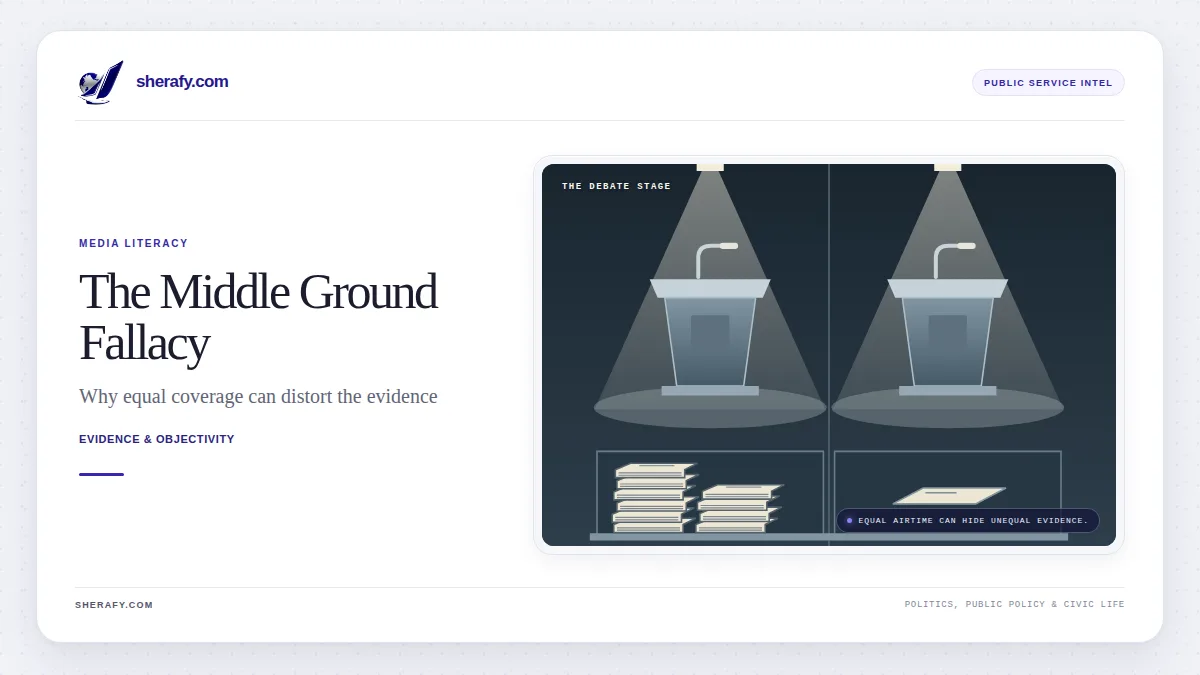
Imagine a panel of 20 relevant specialists. Nineteen support a conclusion, and one disagrees. A news program invites one person from each position to participate in a debate.
| Representation | Supports conclusion | Opposes conclusion |
|---|---|---|
| Full hypothetical expert panel | 19 of 20 (95%) | 1 of 20 (5%) |
| Selected television guests | 1 of 2 (50%) | 1 of 2 (50%) |
Hypothetical example, not data from a particular scientific field or experiment.
Both guests may be genuine specialists, and the program may quote both accurately. Nevertheless, its format can suggest a much more evenly divided field than actually exists.
The appropriate solution is not necessarily to invite nineteen guests from one side. It is to communicate the relevant distribution of knowledge and explain the merits of the underlying evidence.
Experimental evidence across multiple subjects
In a 2016 study of false balance, University of Waterloo psychologist Derek Koehler compared participants who received aggregate expert ratings with participants who received the same information plus opposing quotations from individual experts.
The experiments used genuine film-critic reviews and economic expert-panel responses, rather than directly testing climate change or vaccination beliefs. In the economics experiment, 393 of 402 participants were included in the final analysis. Exposure to opposing quotations reduced participants' ability to distinguish strong agreement from weaker agreement and reduced perceived agreement overall. It also made participants less likely to regard agreement on high-consensus economic questions as sufficient to inform policy. The selection method was disclosed, and numerical context remained available. Not every secondary outcome changed reliably, and the precise psychological mechanism was not fully established. See the original full paper.
Research in scientific communication provides direct evidence that the problem extends beyond film and economics:
| Study | Participants or design | Main finding |
|---|---|---|
| Dixon and Clarke (2013), Science Communication | 327 participants randomly assigned to different news articles | Balanced coverage of a purported vaccine-autism link increased perceived expert disagreement and reduced confidence in the established scientific conclusion. |
| Dixon and Clarke (2013), Health Education Research | 320 undergraduates | Falsely balanced reporting affected perceived vaccine safety and intended future vaccination. |
| Kortenkamp and Basten (2015) | 247 participants reading environmental-risk articles | Even identifying one expert viewpoint as discredited did not reliably remove its influence on risk and uncertainty judgments. |
| Han, Snook and Day (2025) | 360 participants randomly assigned to presentations of expert comments about an interrogation practice | Equal representation distorted consensus perceptions; a presentation weighted toward the actual consensus performed better. |
| Not Every Story Has Two Sides (2026 journal issue) | 254 participants; experimental variation of expert agreement and opposing comments | Balanced messages reduced perceived agreement, particularly when underlying consensus was high, and influenced support for expert testimony. |
The two Dixon and Clarke papers are reported separately. Their sample sizes should not be combined or treated as proof of independent replication without establishing the relationship between their datasets. The experiments generally measure perceptions, attitudes or intentions, not long-term behavior or broad political outcomes.
The underlying medical evidence in the vaccination example must also be established independently. A 2019 Danish nationwide cohort study by Hviid and colleagues followed 657,461 children, covering more than five million person-years and recording 6,517 autism diagnoses. The adjusted hazard ratio for autism among MMR-vaccinated versus unvaccinated children was 0.93, with a 95% confidence interval of 0.85 to 1.02. The researchers found no increased autism risk associated with MMR vaccination, including in the susceptible subgroups they examined. The study used registry data rather than individual medical-chart review and was funded by the Novo Nordisk Foundation and the Danish Ministry of Health. This is a separate line of evidence from the communication experiments.
Philosopher Giulia Terzian's 2025 analysis of journalistic balance helps explain why the presentation matters. Audiences infer information about the strength of competing positions from how those positions are represented. A format associated with fair treatment of genuine disagreements can convey a false implication when the disagreement is not between comparably credible positions.
Accurate quotations do not guarantee an accurate account of the state of knowledge. Selection, omission and context can be as consequential as the truth of individual sentences.
False balance in journalism: What the climate change research actually found
One of the best-documented historical examples is the coverage of human contributions to global warming. But the research also reveals that reporting improved substantially in later years. Both findings matter.
2004: Balance as bias in major American newspapers
In Balance as Bias: Global Warming and the US Prestige Press, published in 2004, Maxwell T. Boykoff and Jules M. Boykoff examined coverage from 1988 through 2002 in The New York Times, The Washington Post, Los Angeles Times and The Wall Street Journal.
The researchers identified 3,543 articles and selected a broader sample of 636 for analysis. The specific findings about human contributions to global warming were based on 340 relevant articles, not the entire sample.
| How human contributions to global warming were represented | Share of 340 relevant articles | Reconstructed count |
|---|---|---|
| Approximately equal treatment of human contribution and the exclusively natural explanation | 52.65% | 179 |
| Human contribution emphasized, with competing views included | 35.29% | 120 |
| Skepticism of human contribution emphasized | 6.18% | 21 |
| Human contribution discussed exclusively | 5.88% | 20 |
| Total | 100.00% | 340 |
Source: Boykoff and Boykoff (2004), Figure 1, journal page 129. Counts are reconstructed from the published percentages and denominator.
The problem was not that the newspapers mentioned dissenting views. It was that much of the sampled coverage suggested a degree of scientific disagreement that the researchers found inconsistent with contemporary scientific assessments.
This was a content analysis, not an experiment on readers. It established a discrepancy in representation; it did not directly measure the effect of those specific articles on public opinion.
2007 and 2021: Evidence that reporting improved
In a 2007 follow-up covering 2003 through 2006, Maxwell Boykoff found that U.S. newspaper representations diverged significantly from scientific agreement in 2003 and 2004, with the divergence declining in 2005 and 2006. The sampled British newspapers did not show a comparable major divergence during the period.
In 2021, Lucy McAllister and colleagues published Balance as Bias, Resolute on the Retreat?. They examined 4,856 articles from 17 newspaper sources across the United States, United Kingdom, Canada, Australia and New Zealand, covering 2005 through 2019.
After excluding 2,194 articles that did not directly address the relevant question, the researchers analyzed 2,662 articles concerning the causes of climate change. Their results were:
| Representation of climate change attribution | Articles | Share |
|---|---|---|
| Human contribution consistent with scientific understanding, alongside natural variation | 2,397 | 90.05% |
| Human and natural factors represented as contributing equally | 150 | 5.63% |
| Human contribution represented as negligible | 113 | 4.24% |
| Human contribution represented as the sole explanation, excluding natural variation | 2 | 0.08% |
| Total | 2,662 | 100% before rounding |
Source: McAllister et al. (2021), original paper. Percentages calculated from the published counts.
The authors' fitted trend suggested that accurate representations increased from approximately 87% to 92% over the 15-year period. There was considerable variation between years and outlets. The coding procedure reported 89.6% agreement and a Krippendorff's alpha of 0.81, a measure of agreement between coders accounting for chance. Some reported outlet-level differences reached only a 90% confidence threshold.
These percentages concern a specific question about the attribution of climate change. They are not estimates of the accuracy of every factual statement about climate in those newspapers. Nor are they directly comparable to the 2004 figures as a continuous statistical series, because the geographical scope, sources and coding categories differ.
Nevertheless, the later research establishes why the original study should not be cited as if it describes all journalism today. The historical problem was real, and important improvements were documented.
2026: Scientific facts and public policy require different benchmarks
A 2026 study by Ekaterina Landgren and colleagues examined climate policy coverage across seven major U.S. television networks using transcripts from April 2020 through April 2021. The main dataset included 2,022 transcripts. The authors found that, in aggregate, positive and negative views toward climate policies were represented roughly in proportion to public opinion, although individual outlets differed substantially. About two-thirds of climate-related segments did not discuss policy.
That study addressed a different question from the earlier newspaper research. Its benchmark was the distribution of public opinion on policy, not the scientific evidence for climate attribution.
The IPCC's Sixth Assessment Synthesis Report concludes that human activities, principally through greenhouse gas emissions, have unequivocally caused global warming. Its underlying assessment of human influence examines the physical evidence supporting that conclusion.
Accepting the evidence for human-caused warming does not determine which tax policies, energy technologies, infrastructure investments or regulatory approaches should be adopted. Those decisions involve empirical questions alongside values, costs, feasibility and competing interests. Genuine policy disagreements deserve serious consideration without implying that the underlying physical science is equally uncertain.
How disagreement can manufacture uncertainty
A misleading claim does not need to replace an established fact in someone's mind to influence their behavior. It may instead weaken confidence in the fact or delay a decision that depends on it.
In some historical cases, creating uncertainty has been an explicitly documented strategy. A 1969 Brown & Williamson tobacco-industry document titled Smoking and Health Proposal, preserved in the University of California, San Francisco's Industry Documents Library, contains the phrase:
Doubt is our product
The proposal describes public uncertainty as a way to establish controversy and compete with existing public knowledge about smoking and health. It offers direct evidence of that strategy in this particular case.
But the distinction between the effect of a claim and the intent of its author is essential. A person may be mistaken, sincerely skeptical, inadequately informed or responding to a real weakness in the evidence. An unsupported claim can create unwarranted doubt regardless of intent. Deliberate manipulation should be established through relevant documents, conduct, incentives and corroborating evidence, not assumed simply because someone disagrees.
What actually helps counter false balance?
Researchers have tested several ways to reduce the misleading effects of balanced presentations. Their findings suggest that explaining the evidence matters, but there is no universal numerical formula for representing every controversy.
A 2015 study by Clarke and colleagues involving 181 participants found that contextual information about the weight of scientific evidence was indirectly associated with more favorable vaccine attitudes through reduced uncertainty. Certainty also increased across the conditions generally, so the result should not be interpreted as proof that a particular message format eliminates doubt.
In six experiments published in 2019, Philipp Schmid and Cornelia Betsch found that factual rebuttals and explanations of misleading rhetorical techniques could mitigate the negative influence of science denialism on audiences' attitudes and behavioral intentions.
Their colleagues' three preregistered experiments published in 2020 tested advance warnings about false balance, the relative number of advocates and opponents, and whether opposing claims were rebutted. Forewarning helped on some measures; outnumbering opponents did not provide demonstrated protection under the conditions tested. The participants were students and the debates were simulated, limiting generalization. The researchers disclosed public funding and made research materials and data available.
The published paper also contains an unresolved sample-size inconsistency: the third experiment's methods section reports 369 participants, while its tables list 396. No combined sample-size estimate is relied on here.
The 2025 Han, Snook and Day experiment provides a useful qualification. Participants saw either an equal number of comments from each position (3:3), more consensus-supporting comments (5:1), more contrary comments (1:5), or no comments. The consensus-weighted presentation did the most to correct distorted perceptions of agreement. The authors reported no specific funding and provide their research data.
These results do not necessarily contradict the 2020 experiments. The topics, presentation formats and measured outcomes differ. The evidence supports explaining the relative strength of competing positions and recognizing misleading framing, while leaving open which approach works best for a particular audience and subject.
When finding the middle ground actually works
The opposite of a bad reasoning rule is not necessarily a good one. Automatically rejecting intermediate positions can be just as misguided as automatically accepting them.
Compromise resolves conflicts that facts alone cannot settle
Imagine two neighbors who agree on the cost of replacing a shared fence but disagree about how to divide the bill. They may choose a compromise because each values preserving the relationship more than winning the dispute. The settlement does not establish that their original opinions about fairness were equally correct. It establishes what they are willing to accept.
In Splitting a Difference of Opinion: The Shift to Negotiation, philosophers Jan Albert van Laar and Erik C. W. Krabbe distinguish settling a disagreement through negotiation from resolving it through argument. They also identify a related opposite error, the fallacy of no middle ground: rejecting a legitimate negotiated solution because it does not settle the original difference of opinion.
Compromise can be entirely rational when the objective is allocating resources, accommodating preferences or making a collective decision. It must still respect applicable rights, constraints and risks. Not every compromise is acceptable simply because it ends a conflict.
Averaging estimates can improve accuracy
Averages are not inherently fallacious. In their 2006 research, Richard Larrick and Jack Soll examined how people often underestimate the accuracy benefits of combining estimates, particularly when the estimates fall on different sides of the true value.
Assume that the true value of an unknown quantity is 100:
| Estimate A | Estimate B | Average | Absolute error of the average | Mean absolute error of the two estimates |
|---|---|---|---|---|
| 90 | 110 | 100 | 0 | 10 |
| 95 | 115 | 105 | 5 | 10 |
| 110 | 120 | 115 | 15 | 15 |
| 100 | 20 | 60 | 40 | 40 |
Hypothetical worked examples. Absolute error is the distance from the true value; mean absolute error is the average of the two individual errors.
The first pair illustrates how errors in opposite directions can cancel out. The second shows that averaging may improve on the typical estimate without necessarily beating the best one. The third shows the limits of averaging when both estimates err in the same direction. The fourth shows why giving an arbitrary estimate equal weight with an established measurement is unjustified.
For convex loss functions, including absolute or squared error, the loss of an arithmetic average cannot exceed the mean loss of its individual inputs. This does not guarantee that the average outperforms the best estimate or provides a reliably accurate answer. If the evidence differs in quality, weighting estimates according to their demonstrated reliability can be more appropriate than treating every input equally.
Independence also matters. In a 2011 laboratory study involving 144 participants, Jan Lorenz and colleagues found that exposure to other people's estimates could reduce the diversity of judgments and increase confidence without improving collective accuracy. This illustrates one limitation of the wisdom-of-crowds effect.
Three reports derived from the same original measurement are not three independent measurements. Repetition can increase the apparent size of the evidence base without increasing its actual informational value.
Different kinds of disagreement need different methods
| What is being disputed? | Appropriate response |
|---|---|
| An established fact or historical event | Examine primary evidence and corroboration. |
| An uncertain numerical estimate | Evaluate measurement quality, error and independence; combine estimates when justified. |
| Personal preferences | Negotiate or accommodate differences. |
| Distribution of resources | Consider fairness, rights, constraints and agreement. |
| Scientific interpretation | Compare methods, evidence quality and plausible alternative explanations. |
| Public policy | Separate factual premises from priorities, costs and trade-offs. |
| A question lacking sufficient evidence | Preserve uncertainty rather than manufacture an answer. |
The key is identifying what kind of problem is being solved before choosing a method for solving it.
Is scientific consensus always right?
No. Scientific consensus can be a valuable indicator of accumulated knowledge, but it is not an independent guarantee of correctness. Its value depends on the evidence, methods, relevant expertise and critical examination behind it.
The scholarly literature on epistemic disagreement addresses a legitimate challenge to simplistic anti-compromise arguments: learning that an equally capable, well-informed person reached a different conclusion can give us good reason to reconsider our own. Philosophers disagree about exactly how much weight such peer disagreement deserves. Some favor substantially equal weight in appropriate circumstances; others give greater consideration to the complete evidence available to each person.
The existence of a disagreement is therefore not always irrelevant. What matters is whether it supplies useful information about the reliability of our judgment.
Scientific agreement can also reflect shared methodological problems. For example, a 2016 modeling study by Nissen and colleagues examined how preferential publication of positive findings can cause erroneous claims to become accepted. It demonstrates a possible mechanism for scientific error under specified assumptions, not the real-world percentage of accepted findings that are false. The National Academies' 2025 report on misinformation about science provides a broader assessment of how scientific knowledge and misinformation are produced, communicated and evaluated.
Expert headcounts alone cannot replace examination of the evidence. A credible minority finding supported by stronger methods, newly available records or successful replication may justify revising an established conclusion. Conversely, a minority claim does not deserve greater credibility merely because it challenges powerful institutions or conventional wisdom.
An evidence-based approach is neither reflexively deferential nor reflexively contrarian. Both attitudes risk letting the identity of a source determine the answer before its evidence has been examined.
Can rejecting false balance become another form of bias?
Yes. The criticism of false balance can itself be misused when it becomes an excuse to dismiss credible opposition, exaggerate scientific agreement or protect a favored conclusion from scrutiny.
If genuine methodological disagreements remain, describing the issue as definitively settled can be misleading. If a primary document materially undermines a compelling narrative, withholding it can distort the evidence just as much as amplifying an unsupported claim.
The appropriate corrective is not to replace mandatory symmetry with mandatory asymmetry. It is to represent the evidence accurately, including the limitations of the strongest available explanation.
A claim supported by substantial evidence deserves substantial weight. A credible objection deserves serious examination. A weak objection should be described as weak, with the reasons made clear. Where the evidence genuinely cannot distinguish between explanations, uncertainty is an accurate conclusion.
The accusation of false balance is not itself evidence that a particular position is wrong. It must be demonstrated by examining the underlying claims and how they were represented.
How to avoid the middle ground fallacy: An evidence test
The following framework is an editorial synthesis by sherafy.com, not a scientifically validated psychological diagnostic or a numerical truth score. It applies the research discussed above to everyday disagreements.
- Identify the actual question. Are you establishing a fact, estimating an unknown quantity, expressing a preference or deciding what to do? Many disagreements contain more than one of these elements.
- Trace each claim to its evidence. Find the original study, measurement, document, testimony or record. Determine what it actually establishes, rather than relying on summaries or confident assertions.
- Examine the quality and independence of the sources. Consider relevant expertise, methodology, authenticity, potential conflicts of interest, missing context and whether multiple sources simply repeat the same underlying information.
- Separate the evidence from the positions people occupy. Ask whether changing an unsupported opening assertion would change your judgment. If it would, the endpoints may be influencing the answer more than the evidence.
- Test the strongest credible counterargument. Seek out information that might materially weaken your preferred conclusion. Do not substitute the weakest objection for the best available opposing case.
- Apply the same standards regardless of identity. Would you accept the same type of evidence if the people, institutions or political affiliations involved were reversed?
- Calibrate your confidence. Acknowledge what is established, what is reasonably inferred and what remains uncertain. Ask what new evidence would justify changing your conclusion.
The result is not limited to choosing one side or meeting in the middle. Four outcomes are possible:
| Evidentiary outcome | Appropriate conclusion |
|---|---|
| One explanation is substantially better supported | State the conclusion with appropriately calibrated confidence. |
| Several explanations remain credible | Explain why the evidence does not clearly distinguish between them. |
| All proposed explanations are contradicted by the evidence | Look for a different explanation rather than averaging incorrect answers. |
| Evidence is insufficient | State what is unknown and what information would help resolve it. |
Most importantly, apply this test to conclusions you already agree with. A method that only detects weak reasoning in other people's arguments is not a reliable method of self-correction.
What real objectivity looks like
Neutrality, impartiality and objectivity are related, but they are not interchangeable.
| Principle | Practical meaning |
|---|---|
| Neutrality | Refraining from taking a side, depending on the context. |
| Impartiality | Avoiding unjustified favoritism in how competing claims and people are treated. |
| Objectivity | Seeking conclusions grounded in evidence, rather than determining them by preference or allegiance. |
Neutrality can be valuable when evidence is incomplete or when a person's role requires facilitating a dispute. But remaining neutral about a well-supported factual proposition can be misleading if it suggests the evidence is evenly divided.
Public expectations make this difficult. In Pew Research Center's 2022 surveys, 76% of U.S. adults supported always striving for equal coverage, compared with 44% of journalists. The surveys involved 9,388 adults and 11,889 working journalists, using different recruitment and weighting methods. In the 2025 survey, support for equal coverage extended across political affiliations: 81% of Republicans and Republican-leaning independents and 68% of Democrats and Democratic-leaning independents favored it. At the same time, most respondents supported correcting public figures' false statements. Fifty-six percent also believed journalists often could not separate personal views from their reporting.
These results demonstrate the public relevance of fairness, not the prevalence of a logical fallacy. They do not tell us whether respondents interpreted equal coverage as equal credibility.
Professional standards recognize this distinction. The British communications regulator Ofcom's broadcasting rules on due impartiality and due accuracy clarify that appropriate impartiality does not require mechanically equal time for every view. These requirements depend on context and apply to the services covered by the UK code. Similarly, PBS's guidance on avoiding false equivalence distinguishes genuinely competing opinions from factual assertions with unequal support.
At sherafy.com, this principle informs our published Editorial Standards and Source Evaluation & Evidence policy. These commitments call for consistent scrutiny, traceable sources, openness to credible contrary evidence and conclusions proportionate to the available evidence. They are standards against which our work should be judged, not a reason to assume that our conclusions are correct. Readers should be able to follow the underlying sources, identify errors and challenge our interpretation, just as they would with any other publication.
Frequently asked questions
Is the truth always somewhere in the middle?
No. It may be between the proposed positions, at one endpoint, outside the proposed range or presently unknowable. Its location must be established through evidence and reasoning.
Is centrism a logical fallacy?
No. A politically centrist position may be well supported by empirical evidence, values or policy trade-offs. The middle ground fallacy concerns the justification for a conclusion, not the ideology of the person holding it.
Is listening to both sides a fallacy?
No. Considering credible objections and allowing relevant parties a fair hearing can improve understanding. The mistake is treating the presence of opposition as sufficient evidence that the claims deserve equal weight.
What is the opposite of the middle ground fallacy?
There is no single universally recognized opposite. The fallacy of no middle ground describes an unwarranted refusal to accept a legitimate negotiated settlement. False imbalance describes a different problem: portraying comparably supported positions as though one has substantially less credibility.
Is refusing to take a position always wrong?
No. Suspending judgment is reasonable when the evidence is inadequate or conflicting in material ways. It becomes unjustified when uncertainty is inferred solely from unsupported opposition despite a substantially stronger evidentiary record.
Can both sides of an argument be wrong?
Yes. Both positions may rely on incorrect assumptions, ignore relevant alternatives or frame the wrong question. An accurate answer may require rejecting both rather than combining them.
Can neutrality be a form of bias?
Yes. Apparent neutrality can become misleading when preserving it requires concealing material evidence or portraying unequal claims as equally credible. Neutrality itself is not inherently biased.
Does disagreement among experts mean the science is unsettled?
Not necessarily. Determine what the experts actually disagree about, whether their methods and evidence are comparable, and whether the disagreement affects the core conclusion or a narrower unresolved question.
Conclusion
Compromise is an essential tool for cooperation. Balanced reporting can illuminate real disagreements. Averaging estimates can improve accuracy. Intellectual humility can help us recognize our own mistakes.
None of these practices is a substitute for evidence.
Real objectivity is not the obligation to find a position that pleases opposing sides. It is the obligation to examine competing claims fairly, account for credible contrary evidence, acknowledge uncertainty and change our minds when the evidence warrants it.
Sometimes that leads to the middle. Sometimes it leads somewhere else entirely.
The truth is not obligated to meet us halfway.
References and Further Reading
Logic, philosophy and decision-making
- Grant Sterling, Middle Ground (2018), in Bad Arguments: 100 of the Most Important Fallacies in Western Philosophy. Philosophical treatment of the fallacy and the distinction between a correct intermediate conclusion and unjustified reasoning.
- Jan Albert van Laar and Erik C. W. Krabbe, Splitting a Difference of Opinion: The Shift to Negotiation (2018), Argumentation. Explains legitimate negotiation and the risks of both unwarranted compromise and unwarranted refusal to compromise.
- Scott F. Aikin and John P. Casey, Bothsiderism (2022), Argumentation. Conceptual analysis of unjustified compromise, suspension of judgment and continued debate.
- Disagreement, Stanford Encyclopedia of Philosophy. Scholarly overview of competing accounts of how credible peer disagreement should influence confidence.
- Amos Tversky and Daniel Kahneman, Judgment Under Uncertainty: Heuristics and Biases (1974), Science. Foundational research on anchoring and other judgment heuristics.
- Itamar Simonson and Amos Tversky, Choice in Context: Tradeoff Contrast and Extremeness Aversion (1992), Journal of Marketing Research. Consumer experiments demonstrating how the choice set can influence preferences for intermediate options.
- Richard P. Larrick and Jack B. Soll, Intuitions About Combining Opinions: Misappreciation of the Averaging Principle (2006), Management Science. Research into the benefits of combining estimates and common misconceptions about averaging.
- Jan Lorenz et al., How Social Influence Can Undermine the Wisdom of Crowd Effect (2011), Proceedings of the National Academy of Sciences. Experimental evidence showing how exposure to others' judgments can reduce diversity and create misplaced collective confidence.
False balance and communication research
- Graham N. Dixon and Christopher E. Clarke, Heightening Uncertainty Around Certain Science: Media Coverage, False Balance, and the Autism-Vaccine Controversy (2013), Science Communication. Randomized news-reading experiment examining perceived scientific disagreement and uncertainty.
- Graham N. Dixon and Christopher E. Clarke, The Effect of Falsely Balanced Reporting of the Autism-Vaccine Controversy on Vaccine Safety Perceptions and Behavioral Intentions (2013), Health Education Research. Examines vaccine safety perceptions and stated behavioral intentions.
- Katherine V. Kortenkamp and Bianca Basten, Environmental Science in the Media: Effects of Opposing Viewpoints on Risk and Uncertainty Perceptions (2015), Science Communication. Tests whether discrediting a competing expert viewpoint reduces its misleading influence.
- Christopher E. Clarke et al., The Influence of Weight-of-Evidence Messages on (Vaccine) Attitudes: A Sequential Mediation Model (2015), Journal of Health Communication. Evaluates the relationship between contextual evidence messages, uncertainty and vaccine attitudes.
- Derek J. Koehler, Can Journalistic False Balance Distort Public Perception of Consensus in Expert Opinion? (2016), Journal of Experimental Psychology: Applied. Controlled experiments using real film reviews and economic expert opinions. The university-hosted full paper provides detailed methods and results.
- Philipp Schmid and Cornelia Betsch, Effective Strategies for Rebutting Science Denialism in Public Discussions (2019), Nature Human Behaviour. Six experiments evaluating factual and rhetorical rebuttal strategies.
- Philipp Schmid, Marius Schwarzer and Cornelia Betsch, Weight-of-Evidence Strategies to Mitigate the Influence of Messages of Science Denialism in Public Discussions (2020), Journal of Cognition. Tests forewarning, numerical representation and rebuttals. The open research materials support further scrutiny of the study.
- Tianshuang Han, Brent Snook and Martin V. Day, The False Balance Effect: Exploring Partition Dependence as a Potential Explanation (2025), Applied Cognitive Psychology. Evaluates whether varying proportions of expert comments alter perceived consensus; data are publicly available.
- Giulia Terzian, The Epistemic Dangers of Journalistic Balance (2025), Episteme. Philosophical examination of the misleading implications audiences can draw from balanced journalistic formats.
- Not Every Story Has Two Sides: The Effect of False Balance on Perceived Scientific Consensus About Interrogation Practices (2026 issue), Journal of Criminal Psychology. Experimental research on the influence of opposing arguments under differing levels of expert agreement. The work was accepted in 2024 and appears in the 2026 journal volume.
Historical evidence and underlying scientific research
- Maxwell T. Boykoff and Jules M. Boykoff, Balance as Bias: Global Warming and the US Prestige Press (2004), Global Environmental Change. Historical newspaper content analysis; the original paper and Figure 1 provide the 340-article breakdown reproduced here.
- Maxwell T. Boykoff, Flogging a Dead Norm? Newspaper Coverage of Anthropogenic Climate Change in the United States and United Kingdom from 2003 to 2006 (2007), Area. Follow-up analysis documenting changes in American and British newspaper reporting.
- Lucy McAllister et al., Balance as Bias, Resolute on the Retreat? Updates and Analyses of Newspaper Coverage in the United States, United Kingdom, New Zealand, Australia and Canada over the Past 15 Years (2021), Environmental Research Letters. Multinational content analysis documenting changes between 2005 and 2019. The full paper supplies the counts, exclusions and coding criteria.
- Ekaterina Landgren et al., U.S. Television News Coverage of Climate Change Policy Is Aggregately Balanced but Polarized (2026), Environmental Research Communications. Distinguishes representation of public policy preferences from representation of scientific evidence. Journal DOI.
- Intergovernmental Panel on Climate Change, AR6 Synthesis Report: Summary for Policymakers (2023). Authoritative assessment of the physical causes and impacts of climate change; Working Group I, Chapter 3 assesses evidence of human influence on the climate system.
- Anders Hviid et al., Measles, Mumps, Rubella Vaccination and Autism: A Nationwide Cohort Study (2019), Annals of Internal Medicine. Large population-based study testing the factual claim underlying the vaccine-autism communication experiments.
- Silas Boye Nissen et al., Publication Bias and the Canonization of False Facts (2016), eLife. Theoretical modeling of how selective publication can contribute to erroneous scientific acceptance under specified assumptions.
- National Academies of Sciences, Engineering, and Medicine, Understanding and Addressing Misinformation About Science (2025). Comprehensive consensus study report on the nature, consequences and potential responses to misinformation about science.
- Brown & Williamson records, Smoking and Health Proposal (1969), UCSF Industry Documents Library. Original tobacco-industry archival document identifying the deliberate cultivation of doubt as a communication strategy.
Public opinion and professional editorial standards
- Pew Research Center, U.S. Journalists Differ From the Public in Their Views of Bothsidesism in Journalism (2022). Compares journalists' and the general public's attitudes toward equal coverage.
- Pew Research Center, How Do Americans Think Journalists Should Act? (2025). Primary survey findings on equal coverage, false statements and perceived impartiality.
- Pew Research Center, How Americans View Journalists in the Digital Age (2025). Overall report, survey sample, methodology and context for the 2025 findings.
- Ofcom, Broadcasting Code: Section Five, Due Impartiality and Due Accuracy. Official UK regulatory guidance distinguishing appropriate impartiality from obligatory equal airtime.
- Marcia Apperson, Fairness to 'Both Sides' Should Not Lead to False Equivalence, PBS Standards (2020). Professional guidance on distinguishing genuine differences of opinion from claims with unequal factual support.
- sherafy.com, Editorial Standards. Published commitments concerning accuracy, material context, uncertainty, source verification and corrections.
- sherafy.com, Source Evaluation & Evidence. Published approach to evaluating sources, evidence, competing explanations and reader-submitted challenges.
Editorial currency note: Research reviewed through November 27, 2026. Publication years and the periods covered by the studies are distinguished throughout. Historical media samples should not be interpreted as measurements of today's entire news ecosystem. Several journal articles were assessed through their original published abstracts where full text was unavailable; the methodological claims made about those articles are limited accordingly. The unresolved sample-size discrepancy in the 2020 Schmid study is disclosed above. The worked examples and Evidence Test are illustrative editorial synthesis, not original experimental data or a validated diagnostic instrument. New evidence may warrant revising individual findings or their interpretation.