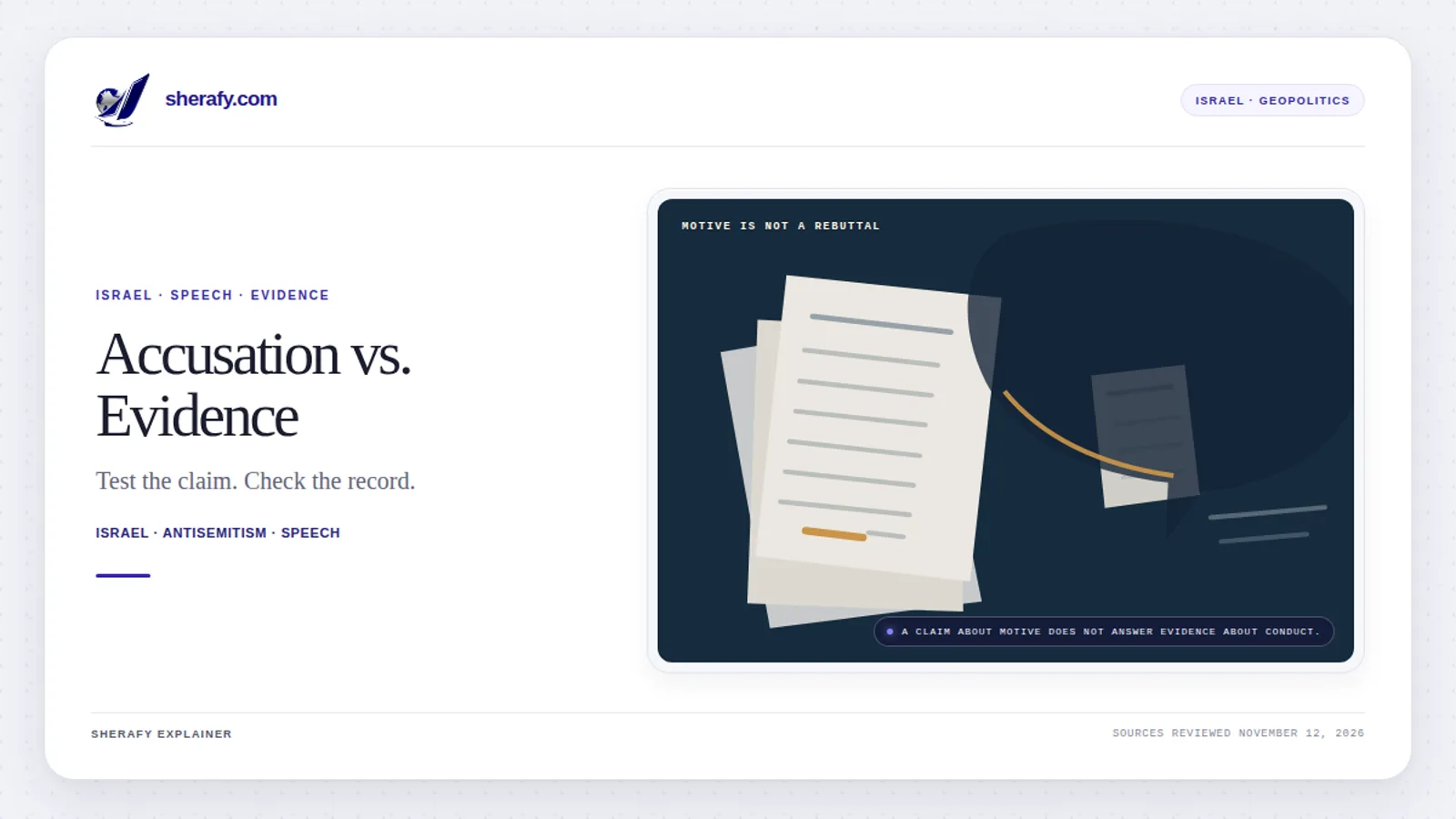
No, criticizing Israel is not inherently antisemitic. Condemning a government's policies, disputing a military operation, challenging a political ideology, or opposing American financial support for another state does not, by itself, establish hostility toward Jewish people. The problem begins when an allegation about the critic's supposed private beliefs is presented as a rebuttal to evidence about the state.
That is a remarkable change of subject. The original question might concern civilian deaths, the occupation of Palestinian territory, international law, or the use of American tax dollars. Suddenly, the person raising it is expected to defend a belief they may never have expressed. The government's conduct slips out of view. The critic's imagined motives take its place.
For a case-specific application of these distinctions, see Sherafy's analysis of the Rebellion PAC Israel ad.
In a November 9, 2026 post, writer Caitlin Johnstone proposed turning that method around: if someone is entitled to pronounce that she secretly hates Jews, she is equally entitled to pronounce that the accuser secretly disbelieves their own claims and is pretending otherwise to protect Israel. Her provocation exposes the absurdity of treating mind-reading as an argument.
But the deeper issue is not who can make the sharper accusation. It is who gets to turn an unsupported accusation into an accepted fact, and what happens when employers, universities, funders, or governments act on it.
The answer is no longer merely theoretical. A published political strategy, official policy documents, statements by the drafter of an influential definition, and federal court decisions reveal how this maneuver can move from ordinary argument into institutional power.
The accusation changes the subject, not the evidence
Imagine someone argues that Israel's restrictions on Palestinian movement violate international law. That is an identifiable claim. It can be tested against the legal standards, the restrictions actually imposed, official records, and the best available investigations.
The reply is: You only care because you hate Jews.
What has been refuted? Nothing. The respondent has introduced a second, separate proposition about the speaker's motivation. Even if that allegation could eventually be supported, it would not tell us whether the restrictions exist or whether they violate the law.
The same distinction applies to a demand that Congress suspend arms transfers. Whether such a policy is justified depends on evidence, law, costs, objectives, and consequences. Calling its advocate prejudiced is not a substitute for addressing those questions.
This is the essential logic:
| What is at issue | What a substantive answer requires | What an unsupported accusation substitutes |
|---|---|---|
| Alleged abuses by Israeli authorities | Evidence about conduct and applicable law | A theory about why the critic cares |
| U.S. military assistance to Israel | Funding records and an argument about policy | A theory about the critic's loyalties |
| A human rights report's conclusions | Engagement with its sources, methods, and findings | An attack on the motives of people citing it |
| An allegation of anti-Jewish prejudice | Specific words, conduct, context, and credible inference | The assumption that criticizing Israel proves the allegation |
The table does not mean motives are irrelevant. Historians, courts, and journalists regularly infer intention from documents, repeated conduct, contradictions, and other evidence. A person's words can also plainly express prejudice. The distinction is between drawing an inference from evidence and announcing a conclusion about someone's inner life without providing any.
There is a second trap. When the accused denies hatred, the denial can be dismissed as proof of concealment. When they provide additional evidence about Israel, that can be characterized as an elaborate cover story. An allegation structured this way cannot be meaningfully tested because every possible response is made to count against the accused.
That is not a stronger argument. It is an argument designed not to need one.
Why people are so confident about motives they cannot see
The tendency to assign hostile intentions to political opponents is not unique to this dispute. It has been studied experimentally.
In a 2014 paper published in Proceedings of the National Academy of Sciences, Adam Waytz, Liane Young, and Jeremy Ginges examined what they called motive attribution asymmetry across studies involving American partisans, Israelis, and Palestinians. Participants tended to interpret their own group's actions in terms of concern for their group, while interpreting opposing actions more in terms of hatred of the other group. The researchers also associated that pattern with resistance to compromise.
Earlier research on the "bias blind spot" found that people generally recognize the operation of cognitive biases more readily in others than in themselves.
These studies do not tell us whether a particular accuser is sincere, dishonest, correct, or wrong. They establish something more modest and useful: confidence about an opponent's motives is not reliable evidence that those motives have been correctly identified.
Psychology helps explain why an accusation can feel self-evident. It does not explain why some accusations result in a hostile comment while others can threaten a person's employment, education, residency, or funding. For that, we have to examine institutions and the people who seek to influence them.
Project Esther: when presumed motives become a political program
The clearest documentary example is not a social media exchange. It is the Heritage Foundation's October 2024 policy blueprint, Project Esther: A National Strategy to Combat Antisemitism.
The document argues that major components of the U.S. pro-Palestinian movement are part of what it calls a "Hamas Support Network." It places organizations such as Students for Justice in Palestine, American Muslims for Palestine, and Jewish Voice for Peace within that broad framework. That classification is Heritage's assertion, not a judicial finding that these organizations collectively form an unlawful terrorist-support network.
The blueprint does something revealing with motives. It says that people who have long maintained that criticism of Israeli policy is not equivalent to antisemitism are "at best insincere." It attributes a concealed objective to them, then uses its characterization of a broad movement as the premise for a campaign against organizations, resources, and political activity.
Its stated desired effects include removing or firing faculty and staff it categorizes as supporters, excluding targeted organizations from campuses, restricting protest permits, undermining fundraising and communications, and making potential demonstrators reluctant to associate with the targeted groups. The document also calls for legal and public-relations pressure, including what it describes as "lawfare."
These are not conclusions inferred from the mood of a political rally. They are objectives in a publicly available written plan.
Heritage presents the project as an effort to combat antisemitism and violence and says it intends to remain within the law. That stated purpose does not erase the need to examine its factual premises, the breadth of its organizational labels, or the proposed effects on lawful expression and association.
The evidentiary problem is straightforward. A movement's opposition to a government's policies does not, without additional proof, establish that its participants share a hidden terrorist objective. Nor does naming disparate organizations under a common label establish their criminal coordination. Actual crimes can be investigated and proved. Political opposition cannot simply be relabeled as criminality to avoid that work.
It would also be a mistake to claim, without evidence of operational coordination, that every subsequent federal action was directed by Project Esther. The blueprint and later policies can be compared on their merits. The existence of the blueprint itself, however, is enough to establish that a consequential political actor publicly proposed converting broad claims about critics' motives and affiliations into institutional pressure.
That is the transition worth examining: from "I know what you secretly believe" to "institutions should act against you because of what we say you believe."
How a monitoring definition became an enforcement controversy
The International Holocaust Remembrance Alliance's working definition of antisemitism, adopted in 2016, is expressly non-legally binding. Its own text says that criticism of Israel comparable to criticism of other countries cannot be regarded as antisemitic. Yet some of its illustrative examples address Israel and Zionism, making their interpretation consequential in political disputes.
Kenneth Stern, a lead drafter of the earlier definition from which the IHRA text developed, has repeatedly objected to its use as a campus speech code. In a September 2025 essay for Columbia University's Knight First Amendment Institute, he explained that the original project arose from a need to collect and compare data about incidents of antisemitism across Europe. It was not written to determine which university speakers, courses, or arguments should be punished.
That distinction is crucial. A tool intended to help researchers classify incidents can be applied very differently when it influences investigations, disciplinary decisions, or government demands.
Federal policy helped elevate its institutional role. Executive Order 13899, issued in December 2019, told agencies enforcing Title VI to consider the IHRA definition and examples, while recognizing applicable legal limits. Executive Order 14188, issued in January 2025, reaffirmed the earlier order and directed federal agencies to identify enforcement authorities and pending campus complaints.
Neither order makes every criticism of Israel illegal. A definition, an administrative policy, a finding of prohibited harassment, and a criminal conviction are four different things. Treating them as interchangeable is part of the confusion.
The concern is what occurs between those stages. If an institution treats a contested interpretation of political speech as proof of discrimination without adequate contextual analysis, it can transform a disputed allegation into an administrative consequence.
In October 2026, the American Historical Association published a white paper warning that misuse of the IHRA definition threatens open historical inquiry. The AHA traced the history and different purposes of the IHRA definition, the Jerusalem Declaration, and the Nexus Document. Its concern was not hypothetical sensitivity about disagreement. It was that an institutional rule could distort what historians feel able to research and teach.
The Nexus Document makes a particularly relevant observation: disproportionate attention to Israel is not, on its own, proof of antisemitism. It also explicitly warns that using accusations of antisemitism to suppress criticism of Israel can undermine free expression and distract from actual discrimination.
The point does not require a lengthy war over definitions. It requires precision about what a particular statement proves, what an institution is authorized to do, and whether political disagreement is being mistaken for evidence of discriminatory conduct.
What federal judges actually found
By 2025, the argument was no longer confined to scholarly warnings. Federal courts were considering cases in which the government had invoked concerns about antisemitism while pursuing actions with substantial consequences for speech and institutional independence.
Harvard: the allegation and the punishment did not match
In September 2025, U.S. District Judge Allison Burroughs ruled in litigation over the federal government's freeze and termination of approximately $2.2 billion in Harvard research grants. Her 84-page memorandum and order found serious legal defects in the government's funding actions, including First Amendment and administrative-law problems.
The judge did not declare Harvard free of antisemitism. Her opinion expressly acknowledged that the university had experienced serious problems and had fallen short in responding to them. The critical finding was that the sweeping funding measures bore little meaningful connection to the conduct the government purported to address. She described the government's invocation of antisemitism as a "smokescreen" for an ideologically motivated assault on universities.
That is a finding about the government's actions, not a claim that every complaint about Harvard was fabricated.
The distinction makes the case more revealing, not less. A real institutional problem can exist, and a government can still unlawfully use that problem as a justification for unrelated coercive demands. The merits of an accusation do not remove the obligation to use lawful procedures or impose a proportionate remedy.
The ruling was appealed. At an October 2026 appellate hearing, judges examined the federal government's authority and the district court's jurisdiction and remedies. The district court ruling should therefore be described as a significant judicial finding under appellate review, not as the last word from every court.
AAUP v. Rubio: pro-Palestinian expression and immigration enforcement
A separate case, American Association of University Professors v. Rubio, concerned federal efforts to arrest, detain, and deport certain noncitizen students and academics engaged in pro-Palestinian advocacy.
After trial, U.S. District Judge William Young ruled in September 2025 that officials had pursued an unconstitutional policy of targeting noncitizens for their political expression. In January 2026, the court entered a remedial judgment addressing the policy under the First Amendment and the Administrative Procedure Act. The litigation continued on appeal in 2026, with disputes over the scope of remedies.
The factual significance is substantial. The district court did not merely speculate that immigration consequences might discourage speech. It examined evidence concerning actual government actions and found unconstitutional viewpoint discrimination in the challenged policy.
A university student's political position should not become grounds for punishment merely because officials disapprove of that position. The First Amendment issues in this litigation concern government action, not a supposed constitutional right to be free from private criticism.
Together, the Harvard and AAUP cases demonstrate why the distinction between allegation and evidence becomes especially consequential when the accuser wields state power. Money, research, education, employment, and immigration status can all be implicated. Those are not simply feelings being hurt in an argument.
The evidence about Israel does not disappear when a critic is accused
The political rhetoric is particularly striking because the underlying criticism of Israeli state conduct is not an invention that disappears when someone challenges the critic's character.
In 2021, Human Rights Watch published a detailed investigation concluding that Israeli authorities were committing the crimes against humanity of apartheid and persecution. Its analysis examined laws, land records, restrictions on movement, residency policies, and other government practices.
In December 2024, Amnesty International published an investigation concluding that Israel had committed genocide against Palestinians in Gaza. In September 2025, a United Nations independent commission of inquiry concluded that Israeli authorities and security forces had committed genocide there. The Commission report published in October 2026 said Israeli authorities and forces continued to commit genocidal acts in Gaza, including after the October 2025 ceasefire; its October 26 release also reported findings of war crimes and crimes against humanity in the occupied Palestinian territory. These are Commission investigative conclusions, not merits judgments by the International Court of Justice. As of November 12, 2026, the ICJ case remained in written pleadings: Israel had filed its Counter-Memorial, and the Court order of May 21, 2026 set November 22, 2027 for the South Africa Reply and May 22, 2029 for the Israel Rejoinder. The Court had not yet decided the merits.
Separately, in November 2024, the International Criminal Court issued arrest warrants for Benjamin Netanyahu and Yoav Gallant concerning alleged war crimes and crimes against humanity. Arrest warrants are not convictions. Israel has rejected accusations of genocide and challenged the ICC's jurisdiction.
The findings, allegations, and legal stages differ, and readers should not be asked to confuse them. But none can be answered by merely declaring that someone who cites them must secretly hate Jews. A substantive rebuttal would have to engage the investigations' evidence, interpretation, jurisdiction, or legal reasoning.
There is also an obvious reason Americans may focus intensely on Israel: the United States is materially involved. The Congressional Research Service's May 2025 foreign-aid analysis reported U.S. foreign aid obligations to Israel totaling approximately $12.5 billion in fiscal 2024 and $3.8 billion in fiscal 2025, including military and missile-defense assistance. These are fiscal-year obligations, not a tally of every weapon delivered or every dollar spent in a particular month.
Americans have a direct civic interest in how that assistance is authorized and used. Asking what their government is financing is not evidence of an ethnic or religious prejudice. It is one of the ordinary functions of democratic accountability.
The same principle applies to other countries, and it does not require a critic to distribute their attention equally across every crisis in the world. People investigate particular abuses for particular reasons. Attention is not a confession of motive.
What would a substantiated accusation look like?
An accusation should be evaluated by what it can actually demonstrate. Blaming Jews collectively for Israeli government actions, trafficking in anti-Jewish conspiracy claims, or threatening a Jewish student because of their identity provides identifiable evidence of prejudice or harassment. Such conduct can be named and assessed without pretending to possess supernatural access to a person's mind.
The U.S. Department of Education's explanation of Title VI makes clear that federal civil-rights protections can apply to discrimination based on shared ancestry or ethnic characteristics. The law does not turn every objectionable political position into unlawful discrimination, and First Amendment protections place limits on public institutions. Protected expression and prohibited discriminatory conduct require contextual analysis, not slogans.
Even when evidence supports an accusation of prejudice, there are still two questions: what does the speaker's conduct show, and is their separate factual claim correct? Establishing the first does not automatically resolve the second.
The proper test is not whether an accusation sounds morally urgent. It is whether the person making it can identify the statement or conduct, explain the inference, and support the conclusion. When state power is involved, the further questions are what law authorizes intervention, what process is owed, and whether the response targets unlawful conduct or protected political expression.
Those requirements protect everyone. More importantly, they prevent an allegation from becoming its own evidence.
Johnstone's reversal makes a point. The documents make a stronger one.
Johnstone's response is intentionally provocative: if opponents are allowed to claim that she secretly hates Jews, she will claim they are secretly lying about their own beliefs. As a demonstration of the double standard, the reversal works. It makes visible how easily an accusation about inaccessible mental states can be manufactured and delivered with certainty.
Taken literally, however, the reverse accusation needs evidence too. Some people knowingly misrepresent what they believe. Others are sincere and mistaken. Others hold inconsistent positions or reason from assumptions they have never carefully examined. Their confidence does not settle the matter, and neither does ours.
There is no need to invent private motives when public evidence can establish so much more.
We can read Project Esther's proposed campaign in its authors' own words. We can read Stern's account of how a monitoring definition was repurposed. We can read government directives, a recent historical association's warning, and federal court rulings identifying unlawful executive conduct. We can examine the reports that critics of Israel are citing instead of treating their criticism as a psychological mystery.
This is not a demand for polite neutrality, and it is not an argument that competing claims deserve equal weight. The evidence is not always balanced. The power to impose consequences is certainly not balanced. The answer is to follow the stronger evidence wherever it leads and to describe abuses of power without exaggerating what remains unproved.
An accuser's sincerity, even when genuine, does not confer authority to define another person's beliefs. An accuser's political influence does not establish the truth of the accusation. And a government's ability to punish someone does not make the punishment legitimate.
The underlying question must survive the attempt to replace it.
Frequently asked questions
Is criticizing Israel or Zionism automatically antisemitic?
No. Criticism of Israeli policies, opposition to Zionism as a political ideology, and advocacy for different political arrangements are not inherently evidence of anti-Jewish prejudice. The content and context of a particular statement matter. The Nexus Document and Jerusalem Declaration both address these distinctions explicitly.
Does the IHRA definition make criticism of Israel illegal?
No. The IHRA working definition is non-legally binding and says that ordinary criticism of Israel is not automatically antisemitic. The controversy concerns how agencies and institutions incorporate its examples into investigations, disciplinary frameworks, or other decisions. A definition is not itself a criminal law or a finding that a particular person engaged in prohibited discrimination.
What is Project Esther?
Project Esther is a 2024 Heritage Foundation strategy that describes a broad set of pro-Palestinian organizations and activists as a Hamas support network and proposes coordinated political, institutional, financial, legal, and communications measures against groups it identifies. Its classifications and allegations must be distinguished from independently established facts and court findings.
Can an accusation of antisemitism violate the First Amendment?
A private individual making an accusation is generally exercising speech, not automatically violating someone else's First Amendment rights. The constitutional issue changes when government officials retaliate against protected viewpoints, impose unlawful conditions, or use state power to punish expression. The Harvard funding litigation and AAUP v. Rubio provide concrete examples of district courts finding constitutional violations in specific government actions, subject to ongoing appellate proceedings.
The argument they still have not answered
An allegation of prejudice can be investigated. A government can be criticized. A human rights finding can be challenged. A funding decision can be audited. A court's reasoning can be appealed. These are all matters for evidence.
What cannot be defended as serious analysis is the idea that an accusation about someone's hidden character answers a documented claim about a government's conduct.
The person raising the allegation may believe it passionately. They may enjoy the support of powerful institutions. They may even persuade others to impose consequences. None of those facts establishes that the allegation is true, much less that the original criticism was false.
Show where the evidence is wrong. If you cannot, you have not answered the argument. You have only tried to change who is on trial.
References and Further Reading
Original statement and political strategy
- Caitlin Johnstone, November 9, 2026 post. The rhetorical provocation that prompted this analysis. It is a statement of argument, not evidence for the institutional claims examined here.
- Heritage Foundation, Project Esther: A National Strategy to Combat Antisemitism (2024). The foundation's original strategy, including its descriptions of the alleged network and its recommended methods and desired effects. Cited as evidence of what Heritage proposed, not as proof of the accusations it makes.
Definitions, government policy, and academic freedom
- International Holocaust Remembrance Alliance, Working Definition of Antisemitism. Original text, illustrative examples, and the statement that the definition is non-legally binding.
- Kenneth S. Stern, A Bad Deal: By Adopting the IHRA Definition of Antisemitism, Universities Are Sacrificing Academic Freedom (2025). Firsthand account by a lead drafter of the earlier definition and his criticism of its use as an institutional speech code.
- American Historical Association, Definitions of Antisemitism and Their Impact on Historians (2026). Historical and professional analysis of competing definitions and the effects of institutional misuse on scholarship.
- Nexus Project, The Nexus Document. Guidance distinguishing criticism of Israel from anti-Jewish conduct and warning against the suppression of political criticism through unsubstantiated accusations.
- Jerusalem Declaration on Antisemitism. Alternative framework explaining why evidence-based state criticism and various political positions are not inherently antisemitic.
- Executive Order 13899, Combating Anti-Semitism (2019). The federal directive to consider IHRA in certain Title VI enforcement contexts.
- Executive Order 14188, Additional Measures to Combat Anti-Semitism (2025). The subsequent directive addressing federal enforcement activities and campus complaints.
- U.S. Department of Education, Education and Title VI. Official explanation of civil-rights protections involving ancestry and ethnic characteristics.
- U.S. Commission on Civil Rights, The Federal Response to Antisemitism on American College and University Campuses (2026). Bipartisan investigation of campus enforcement and the intersection with freedom of expression and academic freedom.
Court records and legal developments
- President and Fellows of Harvard College v. U.S. Department of Health and Human Services, Memorandum and Order (September 3, 2025). District court ruling regarding the freeze and termination of federal research funding and the government's stated justifications.
- AAUP v. Rubio, Litigation Record, Knight First Amendment Institute. Source collection including the trial findings, January 2026 judgment, appeal documents, and subsequent procedural developments.
- Associated Press, Harvard Funding Appeal Hearing (October 2026). Independent reporting on the ongoing appellate dispute, including jurisdiction and remedies.
Evidence concerning Israeli state conduct and U.S. involvement
- Human Rights Watch, A Threshold Crossed: Israeli Authorities and the Crimes of Apartheid and Persecution (2021). Documentary investigation and legal analysis of policies affecting Palestinians.
- Amnesty International, Israel's Genocide Against Palestinians in Gaza (2024). Primary investigation explaining Amnesty's factual record and genocide conclusion.
- United Nations Independent International Commission of Inquiry, Legal Analysis of the Conduct of Israel in Gaza (2025). Commission analysis and conclusions under the Genocide Convention, distinct from a final ICJ judgment.
- United Nations Independent International Commission of Inquiry, Report A/81/430 (October 2026). Its latest published report, including the Commission’s conclusion that Israeli authorities and forces continued to commit genocidal acts in Gaza after the October 2025 ceasefire.
- International Court of Justice, South Africa v. Israel, Case No. 192. Official procedural record; as of November 2026, the case was in written pleadings and no merits judgment had issued.
- International Criminal Court, Warrants for Benjamin Netanyahu and Yoav Gallant (2024). Official notice of arrest warrants concerning alleged crimes; warrants do not establish guilt.
- Congressional Research Service, U.S. Foreign Aid to Israel: Overview and Developments Since October 7, 2023 (May 28, 2025). Official fiscal-year aid data and description of the U.S.-Israel assistance relationship.
Relevant research on perceived motives
- Waytz, Young, and Ginges, Motive Attribution Asymmetry for Love vs. Hate Drives Intractable Conflict (PNAS, 2014). Five studies documenting how opponents perceive their own and rival groups' motives differently.
- Pronin, Lin, and Ross, The Bias Blind Spot: Perceptions of Bias in Self Versus Others (2002). Experimental evidence that people more readily perceive bias in others than in themselves.
Editorial currency note: Legal descriptions and appellate status reflect material located through November 12, 2026. The status of pending cases, executive policies, and international proceedings may change. Investigative bodies' conclusions, allegations in litigation, district court findings, and final judicial judgments are identified separately throughout.