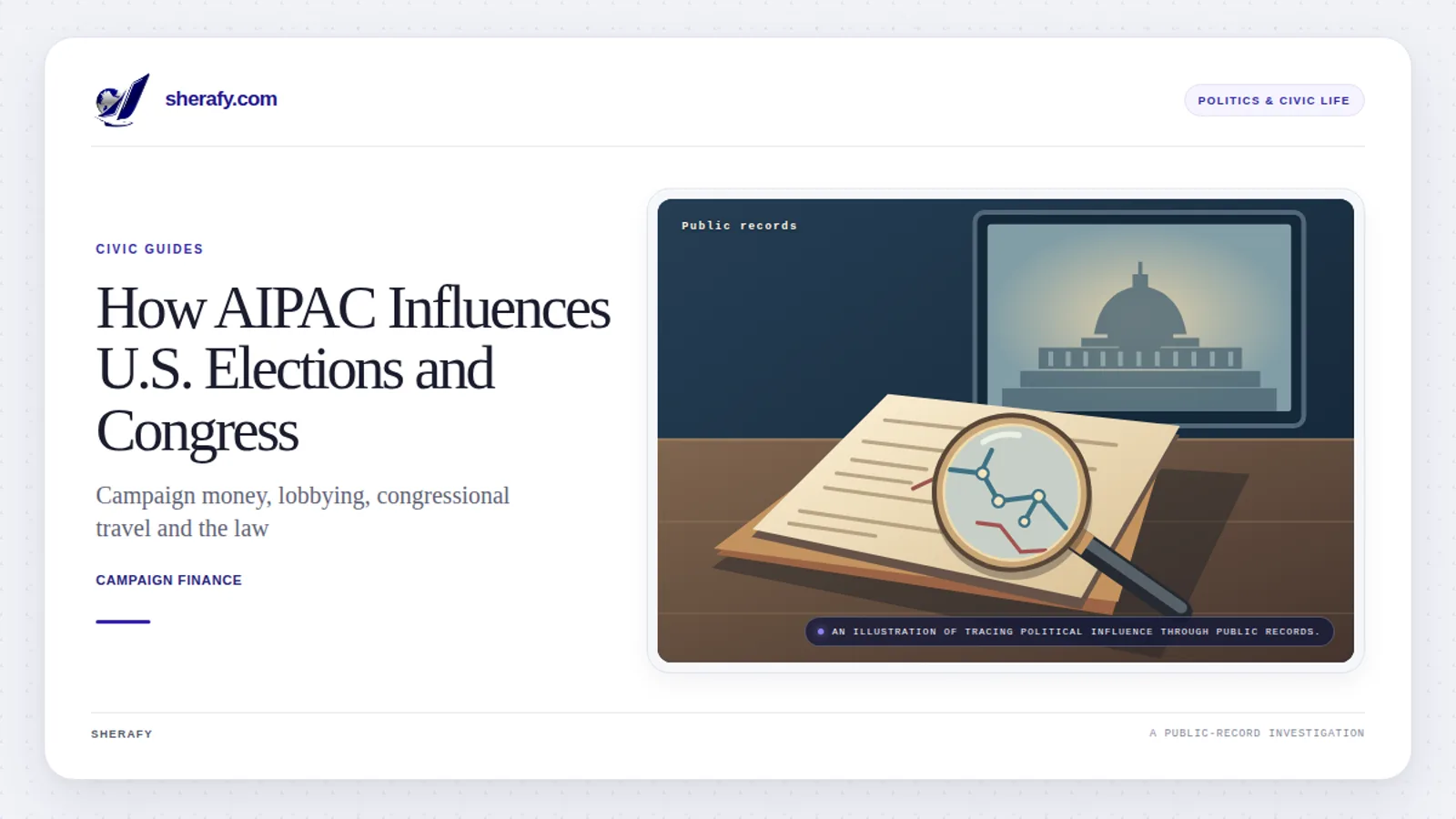
AIPAC influences American politics through organized campaign giving, a separate super PAC that buys election advertising, congressional lobbying, donor mobilization and an affiliated foundation that sponsors trips to Israel. These are different channels with different laws and disclosure rules. Taken together, they give an American organization focused on the U.S.-Israel relationship a substantial, documented presence in the country's elections and policymaking.
The money is not theoretical. Through October 14, 2026, AIPAC's affiliated super PAC, United Democracy Project (UDP), had reported $112.82 million in receipts and $85.06 million in disbursements for the 2025-2026 federal election cycle. Its independent expenditures, which include election advertising, totaled $53.60 million within that spending figure. AIPAC's separate traditional political action committee reported $57.77 million in receipts during the same period. The Federal Election Commission's UDP filings and AIPAC PAC filings show the accounting categories. These are not final election-cycle totals, and the two committees' figures cannot simply be added to produce a meaningful measure of influence.
An especially important connection is documented in AIPAC's own tax return. Its 501(c)(4) nonprofit reported that it contributed $25 million to UDP in 2025. This is not a rumor about a secret relationship. It appears in the organization's filed IRS Form 990, Schedule C. Additional FEC-derived records show another $5 million transfer later that calendar year, although that second transaction should be distinguished from the earlier nonprofit fiscal-year return.
The central issue is not whether a donor literally hands a lawmaker cash in exchange for a vote. A more consequential question is what happens when a politically organized network can finance favored candidates, spend heavily against others, introduce lawmakers to officials abroad and lobby for specific policy outcomes. Much of this activity is legal. Legality alone does not answer whether the resulting distribution of political influence is transparent or accountable to voters. At the same time, public records do not establish that AIPAC is secretly controlled by the Israeli government, that it bribes particular lawmakers, or that it engineered every state and local decision later attributed to it.
This investigation follows the records rather than either the organization's publicity or its critics' most dramatic allegations. Financial figures are identified by entity, accounting category and reporting period. Elections are treated as evidence of spending and outcomes, not automatic proof of causation. Where a claim depends on an unnamed witness or an unseen document, that limitation remains visible.
What is AIPAC, and why does its influence draw scrutiny?
The American Israel Public Affairs Committee (AIPAC) is a U.S.-based organization recognized under Internal Revenue Code section 501(c)(4). Its stated mission, set out in its IRS return, is to encourage the U.S. government to adopt policies strengthening the relationship with Israel. AIPAC is not the Israeli embassy, a federal agency or a political party. Nor is it synonymous with Jewish Americans, Israelis, or every organization that favors a close U.S.-Israel relationship.
The organization has an identifiable political objective: persuade American officials to adopt certain foreign-policy, security and legislative positions. It advocates for those policies through lobbying and public mobilization, and its connected electoral organizations have supported candidates seen as sympathetic and opposed others. That makes AIPAC a participant in American politics whose conduct can be evaluated against the same campaign-finance, ethics and transparency standards applicable to other powerful advocacy organizations.
The controversy is not exhausted by the fact that AIPAC advocates for Israel. It concerns the concentration of money, access and electoral leverage in a system where unlimited independent spending can be aimed at a primary contest, where donors can be mobilized as individuals, and where a voter may see an advertisement on healthcare or immigration without immediately recognizing the national political network financing it. The relevant question is what this structure can do, how much it has done, and which links the public can verify.
Three distinctions prevent the discussion from becoming misleading:
- Influence is not identical to control. Documented spending, lobbying and access can be significant even when an organization loses an election or policy fight.
- Domestic advocacy is not automatically foreign agency. The Foreign Agents Registration Act has a legal test tied to a foreign principal, not simply to the nationality of the country being discussed.
- A financial transaction is not automatically corruption. A lawful super PAC expenditure is still a political intervention worth scrutinizing, but proving bribery, prohibited coordination or foreign-national election funding requires specific evidence.
For a broader explanation of why these mechanisms matter well beyond one lobby, see sherafy.com's How Money Runs American Politics.
A brief history: From Washington lobbying to electoral super PACs
AIPAC's modern campaign-finance machinery is relatively new. Its roots in U.S. pro-Israel advocacy extend to the 1950s, but its traditional PAC and super PAC were registered only for the 2022 election cycle. The difference matters: claims about contemporary candidate donations should not be projected backward onto decades in which the organization principally operated through lobbying, relationships and political mobilization.
| Period | Development | Why it matters |
|---|---|---|
| 1950s-1960s | Pro-Israel advocacy institutions developed in Washington; the American Zionist Council became the subject of Justice Department scrutiny. | Historical organizations and their legal obligations must be identified separately. |
| 1962-1963 | The Justice Department examined the American Zionist Council's relationship with the Jewish Agency and sought foreign-agent registration. | A real historical dispute, but not proof of a modern AIPAC-specific exemption or violation. |
| 2010 onward | The post-Citizens United campaign-finance framework expanded the role of unlimited independent spending. | Candidate contribution limits did not disappear; a separate outside-spending channel became central. |
| 2015 | AIPAC opposed the Iran nuclear agreement; the agreement nevertheless proceeded. | A major case illustrating the difference between influence and ultimate control. |
| December 2021-January 2022 | AIPAC PAC and UDP registered as distinct federal committees. | The group acquired highly visible direct-contribution and outside-spending vehicles. |
| 2022-2024 | AIPAC-affiliated election spending became prominent in Democratic and some Republican primaries. | Voters could see a direct relationship between a foreign-policy lobby's priorities and domestic primary campaigns. |
| 2025-2026 | Large nonprofit-to-super-PAC funding, extensive outside spending and new intermediary committees appeared in public filings. | The money trail extends beyond a single PAC or a single ad. |
| October 21, 2026 | AIPAC announced it would discontinue candidate endorsements, direct PAC contributions and earmarked giving, while expanding organized individual contributions and continuing UDP. | The public-facing mechanics are changing; the underlying political activity is not ending. |
This chronology is documented by the FEC registration records, AIPAC's filed nonprofit return, and NPR's reporting on the October 2026 announcement. The 1960s foreign-registration history is examined in its own section below.
The organizational map: AIPAC, its PAC, UDP and AIEF are not the same entity
Confusion about AIPAC often begins with a single name being used for several organizations. That shorthand can conceal meaningful relationships and also produce erroneous financial totals.
| Organization | Legal identity | What it does | What its reports can establish |
|---|---|---|---|
| American Israel Public Affairs Committee | U.S. 501(c)(4), EIN 53-0217164 | Lobbying, advocacy, political organizing and nonprofit program activity | Revenue, expenditures, stated purposes and related-organization transactions on IRS Form 990 |
| AIPAC Political Action Committee | Federal PAC, FEC C00797670, registered December 15, 2021 | Historically made direct contributions and transmitted earmarked donations; announced strategic change in October 2026 | Individual receipts, candidate and committee disbursements, conduit reporting |
| United Democracy Project (UDP) | Independent expenditure-only federal committee, FEC C00799031, registered January 3, 2022 | Independent election advertising, campaign-related vendor payments and transfers to other committees | Donors reported to the FEC, independent expenditures and other spending |
| American Israel Education Foundation (AIEF) | 501(c)(3), EIN 52-1623781 | Education and officially connected congressional travel | Charitable revenue and expenses, separately disclosed travel and related-party records |
| Individual supporters and other committees | Separate donors and political entities | Make contributions, organize fundraising or buy ads through independently reportable entities | Some connections are disclosed; others require cross-checking filings or cannot be reconstructed from public records |
The AIPAC return's Schedule R also identifies other related entities and transactions, including AIPAC Impact LLC, AIPAC-AIEF Israel RA and various loans, services, reimbursements and shared personnel arrangements. Those entries establish financial and organizational relationships. They do not mean each related entity independently bought political advertisements, or that every reported internal transaction should be counted as a new expenditure.
AIEF deserves separate treatment. Its charitable status and travel role are not interchangeable with the super PAC's election activity. Conflating them obscures the precise ethics rules that govern trips, and adding their full budgets to election spending creates a false total.
How much money has AIPAC's political network raised and spent?
The most useful financial comparison is not a single spectacular number. It is a set of non-overlapping categories with explicit reporting dates.
| Entity | Reporting period | Money received | Money paid out | Important subcategory |
|---|---|---|---|---|
| UDP, FEC C00799031 | Jan. 1, 2025 to Oct. 14, 2026 | $112,820,861 receipts | $85,057,423 disbursements | $53,603,927 independent expenditures; $13,131,200 contributions to other committees; $18,310,296 operating expenditures |
| AIPAC PAC, FEC C00797670 | Jan. 1, 2025 to Oct. 14, 2026 | $57,771,931 receipts | $56,248,373 disbursements | $53,289,530 contributions to other committees, a category that includes the need to distinguish PAC resources from earmarked individual contributions |
| AIPAC 501(c)(4), IRS Form 990 | Fiscal year ended Sept. 30, 2025 | $122,539,124 revenue | $118,294,301 expenses | $41,222,425 political program services; $25 million identified as a contribution to UDP |
| AIEF 501(c)(3), IRS Form 990 | Fiscal year ended Sept. 30, 2025 | $61,115,404 revenue | $52,414,560 expenses | Educational activity and travel, not a super PAC election budget |
Figures are rounded to the nearest dollar. UDP's $53.60 million in independent expenditures is inside, not in addition to, its $85.06 million in disbursements. Transfers to other committees are also already inside disbursements. And the AIPAC nonprofit's fiscal year does not match the FEC election cycle.
An instructive comparison is the nonprofit's tax return. It reports approximately $41.22 million in political program-service expenses, approximately $16.10 million for information and member education, and approximately $7.32 million for its lobbying program. The categories describe different nonprofit activities; they are not interchangeable with the quarterly Lobbying Disclosure Act filings or the FEC's independent-expenditure totals. An organization can have an electoral operation far larger than its reported federal lobbying expense without that alone proving a disclosure violation.
The super PAC's FEC summary also reported $56.57 million in cash on hand as of October 14. Cash is not spending. Money available for future transactions should not be represented as money already used against a candidate.
Why the totals cannot be added together
Suppose a donor contributes to AIPAC's nonprofit, which then contributes to UDP, which subsequently transfers money to a separate committee that purchases advertising. The same underlying dollars may appear as a nonprofit receipt, a nonprofit expense, a UDP receipt, a UDP disbursement, a recipient committee receipt and eventually an ad purchase. Adding those entries produces a large but fictitious total of distinct money deployed.
The correct method traces origin, intermediary, final spender, recipient and actual purchase. For more on this type of financial opacity and branding, see sherafy.com's Mapping the Shadow: Small PACs, Dark Money and Brand-Laundered Political Influence.
The financial numbers above are the regular FEC summary available as of November 26, 2026. According to the FEC's post-general reporting reminder, the next reports covering October 15 through November 23 are due December 3, 2026. Therefore, October 14 totals are not definitive totals for the November election.
AIPAC itself reported giving $25 million to United Democracy Project
The nonprofit-to-super-PAC connection deserves a closer look because it answers a common question: Does AIPAC merely encourage donors, or has the nonprofit itself transferred money into election spending?
The answer is yes, the nonprofit reported a direct contribution. In the organization's 2024-tax-year Form 990, covering October 1, 2024 through September 30, 2025, Schedule C identifies United Democracy Project as a section 527 political organization and reports $25,000,000 contributed in 2025. The form's expenses schedule separately includes a line labeled contributions to UDP, and Schedule R records a $25 million related-organization gift. These references corroborate the same transfer, not three different $25 million gifts.
The political-activity portion of Schedule C reports $13,304,939 in the organization's own section 527 political activity and $25 million contributed to other organizations for section 527 activity, totaling $38,304,939 for that tax measure. That figure should not be added blindly to the $41.22 million political-program figure from the same return, because the categories can overlap. The return also contains a $1,276,500 expenses line labeled contributions to candidates, which requires distinction from the separate PAC's earmarked individual donations.
FEC-derived transaction trackers identify a second $5 million AIPAC-to-UDP contribution dated December 23, 2025, making approximately $30 million across those two reported 2025 calendar-year transfers. The December payment falls outside the nonprofit fiscal year ended September 2025, although it is within the FEC's 2025-2026 election cycle. The $25 million tax-return disclosure is independently corroborated by the nonprofit's own filing; the subsequent $5 million entry is based on FEC-derived itemization, with transaction-level verification required before treating the aggregate as independently audited.
This matters for donor transparency. UDP can report the AIPAC nonprofit as its contributor while the individual donors who originally funded the nonprofit may remain undisclosed. The transfer itself is reportable; the identity of every upstream contributor is not necessarily recoverable. Those are two different disclosure questions.
How PAC donations, earmarked contributions and super PAC advertisements work
AIPAC's electoral influence cannot be understood without separating three transactions that are often all called a donation.
A direct PAC contribution
A qualifying multicandidate PAC can give directly to a federal candidate within the applicable contribution limits. The recipient campaign must report the contribution. Before the October 2026 announcement, AIPAC PAC took part in direct candidate giving, and its FEC records remain the appropriate historical record. AIPAC PAC is not the same entity as UDP.
An earmarked individual contribution forwarded through a conduit
An individual may direct money to a particular candidate through an intermediary. Under the FEC's conduit reporting rules, the original individual remains the contributor and the intermediary is separately identified. The money cannot simply be reclassified as an unrestricted donation by the intermediary's treasury. This is crucial when interpreting the more than $53 million in AIPAC PAC's reported contributions to other committees.
An earmarked contribution does not abolish individual contribution limits. Nor does a conduit automatically have legal control over a candidate's campaign. The real influence issue is the ability of an organization to identify candidates, assemble donors and make a fundraising relationship politically meaningful even where formal contribution limits still apply.
Independent expenditure by a super PAC
A super PAC such as UDP may raise unlimited permissible contributions and pay for independent communications supporting or opposing candidates. Under the FEC's rules on independent expenditures, these payments are not donations to the candidate. The communications must not be made in prohibited consultation or cooperation with the candidate or campaign.
Unlimited independent spending can still affect the political environment: a district may see extensive television advertising, digital advertising, mailers and opposition messaging paid for by an entity entirely separate from the candidates' campaigns. Calling all such spending a bribe would be inaccurate; pretending it has no political purpose because it is legally classified as independent would be equally misleading.
Foreign nationals are subject to a separate prohibition. The FEC states that foreign nationals generally may not make or direct contributions, expenditures or election-related spending decisions in U.S. federal, state or local elections. This ban is not the same as FARA registration.
Who funds AIPAC-related election spending, and who remains hidden?
Two donor questions need different answers: Who is disclosed as having given to UDP? And who originally supplied every dollar that reaches AIPAC's nonprofit? The second question is harder because federal nonprofit reporting does not normally reveal the complete donor roster of a 501(c)(4).
The FEC's itemized UDP contribution records, together with an August 2026 FactCheck.org profile and transaction-based donor research, identify selected substantial 2025-2026 contributors:
| Publicly identified contributor | Approximate reported UDP giving, 2025-2026 cycle | What the amount does not prove |
|---|---|---|
| AIPAC's 501(c)(4) nonprofit | $30.0 million across two reported calendar-2025 transactions | The identities of all donors behind the nonprofit |
| Paul Singer | $2.6 million | Personal control over an individual advertisement or candidate |
| Haim Saban | $2.0 million | Agreement with every policy or candidate supported by UDP |
| Manzanita Action Fund | $1.6 million | Complete visibility into that organization's upstream funding |
| Blair Frank | $1.5 million | That the donation purchased a particular vote |
| Marc Rowan | $1.5 million | Direct control over the super PAC's day-to-day decisions |
These selected figures come from aggregations of FEC-reported receipts and should be read as cycle-specific, dated amounts, not lifetime totals or a complete ranking. Donors can make multiple contributions, different datasets can update on different days, and any full ranked table should be rebuilt directly from the latest original FEC transaction records. A donor's name and amount tell us something concrete about financial participation, not everything about motivation or decision-making.
The key blind spot is upstream attribution. A publicly filed $25 million payment from a social-welfare nonprofit to a super PAC is transparent at the recipient-committee level but does not necessarily reveal which individuals funded the originating nonprofit. That is the substantive distinction behind discussions of dark money. It does not mean no FEC report exists. For historical context on the 2024 cycle, see sherafy.com's Mapping the Money: Foreign-Connected Influencers in U.S. Politics.
What changed when AIPAC ended candidate endorsements and direct PAC giving in October 2026?
On October 21, 2026, AIPAC announced that it would cease candidate endorsements, direct contributions through its PAC and earmarking contributions for candidates. Its letter to members called for expanded organized individual giving, and the organization confirmed that UDP would continue. NPR reported the announcement and quoted AIPAC's response.
AIPAC said its members had contributed more than $90 million directly to candidates during the cycle and that this organized giving would increase. That amount is AIPAC's self-reported description of member giving, not an independently reconciled figure to be added to PAC receipts or UDP expenditures. Some contributions may already be represented within other reporting channels.
The shift changes what a voter may recognize. Before the change, a candidate could have an explicit AIPAC endorsement or an AIPAC PAC donation on the record. Under the announced model, individual contributors may continue making reportable donations, and UDP may continue independently spending, but the organizing organization's role can be less obvious from any one candidate's filing. Public disclosure of a donor's name is not always the same as public visibility into who assembled the donor network.
This is not evidence that all future donations will be hidden, that the PAC is dissolved, or that activity after October 21 automatically violated the new policy. It is an announced strategic change whose actual implementation must be assessed against subsequent filings. The 2026 reports covering the post-general period were not yet due on this article's research date.
How election money moves through other committees
The public may see one political committee's advertisement even when the money originated with another. That is not automatically illegal. Federal committees generally report contributions and spending. But it can make the funding trail much harder for an ordinary voter to reconstruct, especially when the spender has a local-sounding name and its advertisements never mention Israel.
The FEC's 2025-2026 UDP summary lists $13,131,200 in contributions to other committees through October 14. These are part of UDP's $85.06 million total disbursements. A recipient committee may then make its own expenditures, which must be traced separately. A receipt from UDP, a subsequent committee transfer and the final advertisement must not be counted as three different sets of dollars.
Illinois's 2026 Democratic congressional primaries illustrate the mechanism. The Washington Post investigated advertising from committees with names including Elect Chicago Women and Affordable Chicago Now. Their advertising addressed subjects such as immigration and healthcare. Its reporting examined donor overlap, committee activity and connections to operatives who had worked for AIPAC-related efforts. Later public-record examinations traced millions in UDP-related funding among committees active in Illinois, including Chicago Progressive Partnership.
The analytical sequence matters:
- Identify the committee named in the advertisement's disclaimer.
- Search its FEC filings for its committee ID, receipts and largest contributors.
- If it received money from UDP or another intermediary, find the precise transaction, date and amount.
- Identify what the recipient actually spent, including the advertiser, vendor, message and race.
- Separate a financial relationship from a legal allegation about coordination or an assumption that a candidate chose the advertisement.
The existence of a transaction can be proven through a filing. The proposition that a committee was created primarily to disguise the original political network requires more evidence about timing, organizing relationships, naming, funding and messaging. Some of that evidence can be assembled, but none of it should be inferred from a shared policy preference alone.
This is why an ad's named sponsor, its ultimate disclosed donor, the organization that mobilized the money, and the candidate who benefits are four different facts. Our related investigation, Who Funds Elect Democratic Women?, examines one financial pathway. Distinct committees with similar names, including PACs and hybrid PACs, should not be merged merely because they appear in the same political reporting.
Which candidates and elections have AIPAC-affiliated committees tried to influence?
Election case studies are more useful than claims about an all-powerful lobby because they establish a measurable record: which committee spent, in which contest, for or against whom, and what voters actually decided. The following are selected significant cases, not a complete universe from which to calculate a UDP success rate.
| Election | Documented intervention | Result | What can reasonably be concluded |
|---|---|---|---|
| Michigan House Democratic primary, 2022: Andy Levin vs. Haley Stevens | UDP reported about $3.88 million supporting Stevens and $342,000 opposing Levin. | Stevens defeated Levin after redistricting put two incumbents in the same primary. | A large pro-Israel outside-spending intervention targeted Levin, a Jewish congressman critical of certain Israeli policies. Redistricting, broader candidate appeal and other factors also mattered. |
| New York House Democratic primary, 2024: Jamaal Bowman vs. George Latimer | UDP reported approximately $9.87 million opposing Bowman and $4.68 million supporting Latimer, about $14.55 million combined. | Latimer won. | Heavy spending and a defeat are established; they do not by themselves prove a particular number of votes were purchased or changed. |
| Missouri House Democratic primary, 2024: Cori Bush vs. Wesley Bell | UDP's 2024 independent-expenditure totals were approximately $5.24 million opposing Bush and $3.36 million supporting Bell, about $8.60 million combined. | Bell won. | Another major intervention against an incumbent critic of Israeli policy, amid other campaign issues. |
| Oregon House Democratic primary, 2024: Susheela Jayapal vs. Maxine Dexter | Reporting tied approximately $1.3 million of UDP funding to an intermediary supporting Dexter; the broader independent-spending picture involved additional funds. | Dexter won. | Illustrates why committee transfers and the eventual spender need to be identified separately. |
| Virginia Republican primary, 2024: Bob Good vs. John McGuire | UDP and other interests intervened in a tightly contested Republican race. | McGuire won. | Opposition to particular politicians is not confined to the Democratic Party. Do not attribute all pro-Israel-group spending to UDP. |
| Kentucky Republican primary, 2026: Thomas Massie vs. Ed Gallrein | UDP's FEC-derived spending was roughly $4.15 million, primarily against Massie and in support of Gallrein; other organizations spent separately. | Gallrein defeated Massie. | One notable Republican intervention, with party endorsements and other campaign dynamics as alternative explanations. |
| Michigan Democratic Senate primary, August 4, 2026: Abdul El-Sayed vs. Haley Stevens | A date-filtered FEC-derived compilation records $30,638,639 in UDP independent expenditures benefiting Stevens, including $10,498,735 supporting Stevens and $20,139,904 opposing El-Sayed. | El-Sayed won, with 744,952 votes to Stevens's 731,160; withdrawn candidate Mallory McMorrow remained on the ballot and received 61,516. | Substantial spending did not produce UDP's preferred primary result. The vote totals are certified; the spending tally is a documented, specifically bounded reconstruction. |
| Michigan Senate general election, November 3, 2026: El-Sayed vs. Mike Rogers | New spending after the primary belongs to a separate general-election period. | El-Sayed won, with reported tabulations showing about 52.5% to 45.5%. Michigan certified the general election on November 23. | Primary and general results must not be merged, nor can one assume that UDP's August spending was all of its November activity. |
The 2022 and 2024 expenditures are detailed in FactCheck.org's 2022 UDP profile and 2024 profile, which draw on FEC disclosures. The 2026 UDP profile documents additional Republican and Democratic contests. Michigan's primary results and general results are separately reported. The exact primary-period UDP expenditures come from a transaction-level FEC-derived Michigan spending analysis, updated October 30. It must not be confused with broader spending on the general election.
The Michigan primary was close: 13,792 votes separated El-Sayed and Stevens, according to the cited certified totals. Yet UDP spent more than $30 million in outside support for Stevens's side and El-Sayed won. That is powerful evidence against a guarantee-of-victory narrative, not proof that advertising has no effect. Other committees also spent heavily in the race, so attributing the entire contest to one super PAC would produce the wrong causal story.
Sherafy also examined Haley Stevens’s endorsement of Mike Rogers in the Michigan general election.
The Massie example is examined further in sherafy.com's Thomas Massie Primary Defeat and Pro-Israel Spending. For the broader evidence on electoral effects, see Does Big Money Change Election Results?.
Why Democratic primaries are prominent targets
In a strongly Democratic district, the decisive contest may be the Democratic primary rather than the November general election. Spending that changes which candidate survives that primary can alter who represents the district even when the party's control of the seat is never seriously threatened. The same dynamic applies to Republican primaries in heavily Republican districts.
AIPAC and UDP have had especially visible conflicts with progressive Democrats who advocated conditioning aid to Israel, criticized Israeli government conduct or challenged established U.S.-Israel policy. In such contests, millions of dollars can help a preferred challenger buy recognition and advertising reach, even though the eventual electoral result depends on many additional factors. It is possible for a political group to change the incentives facing incumbents even when it does not defeat every opponent. A lawmaker assessing the next primary may notice an expensive campaign mounted against a colleague.
The specific claim that UDP spends more on Democratic primaries than every other super PAC has not been verified through an all-committee, same-period FEC comparison. The claim that UDP-supported candidates win most of the time also requires a complete, consistently defined universe of contests. Neither superlative should be stated as established without that accounting.
The historical record includes Republican interventions, notably Massie's 2026 primary and certain 2024 contests. AIPAC's relationships are bipartisan in that factual sense, but bipartisanship by itself says nothing about the fairness or democratic effect of concentrated political spending.
Why do some AIPAC-associated ads discuss other issues instead of Israel?
A political committee's organizational mission and its advertisement's immediate message need not be identical. If a group whose primary public-policy focus is U.S.-Israel relations enters a competitive primary, it can try to persuade voters using issues that are more salient to that district.
In the 2024 Bowman-Latimer primary, contemporary Punchbowl News analysis of AdImpact data found that one UDP advertisement highlighted Latimer's positions or record on infrastructure, gun policy and abortion rights. Other advertising stressed Bowman's domestic legislative decisions. Separately, messages about antisemitism and Israel-related controversies appeared in the broader campaign. It would be inaccurate to describe every spot as directly about Israel or to say no messaging about antisemitism existed.
The 2026 Illinois example is related but distinct. There, committees bearing local or issue-based names ran advertisements on immigration and healthcare while investigators traced relationships among donors, vendors and pro-Israel political networks. Some activity went beyond a UDP-branded television ad. That distinction matters because an ad's attribution requirements can identify the spending committee without making the entire upstream financing history obvious to the average viewer.
A reader should therefore ask four practical questions: Who bought the ad? Who supplied that committee's funds? What election outcome did the ad seek? And what reasons did the original funder publicly give for entering the race? A mismatch can be politically revealing. It does not, on its own, establish a violation of campaign-finance law or a secretly coordinated campaign.
The separate Michigan advertising controversy examined in sherafy.com's Rebellion PAC, Israel and Antisemitism Ad Investigation illustrates the need to identify the actual sponsor before assigning responsibility for a specific message to AIPAC.
Does AIPAC's spending change election outcomes or buy politicians' votes?
Money buys resources, not a mathematically guaranteed election result. It buys advertising time, voter targeting, research, campaign messaging and the opportunity to influence what voters hear. It can strengthen a favored candidate and increase the costs of taking a position opposed by a well-funded organization. But it does not let a super PAC count ballots or instruct individual voters to choose a particular candidate.
Three causal questions are often collapsed into one:
- Did the committee intervene? FEC disclosures can directly establish expenditures, recipients, dates and support or opposition.
- Did the intervention affect the campaign? Advertising purchases, reach, fundraising responses, candidate statements and changes in the debate can help answer this. A spending amount alone does not measure persuasion.
- Did the intervention determine the election or a later legislative vote? That is a much stronger claim, requiring credible comparisons and evidence capable of separating spending from candidate quality, incumbency, local issues, turnout, party endorsements and the wider political environment.
The wins over Levin, Bowman, Bush and Massie establish serious electoral intervention associated with victorious candidates. The 2026 Michigan primary loss establishes that a very large intervention may fail. Earlier UDP efforts also produced mixed results, including 2022 activity in a Michigan primary where the candidate it opposed, Shri Thanedar, won. FactCheck.org's 2022 breakdown supplies the distinction.
There is a historical policy counterexample, too. In 2015, AIPAC campaigned against the multilateral Iran nuclear agreement, but the agreement proceeded despite that opposition. The organization's contemporaneous opposition statement documents its position; the outcome demonstrates a limit on its ability to dictate U.S. policy.
None of these counterexamples makes large-scale spending harmless. A network may possess substantial agenda-setting power without winning every contest, and politicians may perceive the possibility of expensive opposition without ever receiving an explicit threat. But perception, incentive and actual private agreement are different evidentiary categories. A charge that a particular politician traded a vote for financial support needs evidence beyond the existence of a donation and a subsequent vote.
What does AIPAC do in Congress between elections?
AIPAC's electoral organizations are only one part of its operation. The nonprofit publicly advocates legislation, organizes constituents, communicates with lawmakers and encourages support for policy positions it identifies as favorable to the U.S.-Israel relationship. These activities connect money and elections to concrete congressional decisions, but they should be tracked through their own records rather than assumed from spending alone.
Federal lobbying is reported under the Lobbying Disclosure Act, which is not the same statute as FARA or federal campaign-finance law. AIPAC appears in the Senate's lobbying disclosure database. Its 2025 quarterly figures in the research record were approximately $963,135, $880,060, $940,000 and $973,910, adding to $3,757,105 in reported lobbying amounts for that calendar year. A further $2,367,400 was identified across the first three quarters of 2026. These are reported lobbying figures with a distinct statutory definition and period, not a comprehensive measurement of the organization's political spending. The underlying quarterly filing fields should be consulted for any narrower interpretation of exactly which expenses were included.
The nonprofit's roughly $7.32 million lobbying-program expenses for a different fiscal year need not match those federal filings. Different statutory definitions, staff allocation rules, organizational expenses and reporting dates can generate different numbers without proving concealment. sherafy.com's NAR vs. AIPAC Lobbying Comparison explains why a lobbying-spending ranking alone can miss the much larger electoral picture.
The first supplied transcript describes a private AIPAC scorecard and threats to punish disobedient lawmakers. The existence of public legislative priorities, actual campaign spending and primary challenges is demonstrable. A particular confidential scoring system, a specific threatening conversation or proof that an individual representative changed a position because of it requires its own document, recording or corroborated testimony. None should be invented to make the documented structure seem more ominous.
A defensible investigation of policy influence proceeds in sequence: identify AIPAC's stated legislative position, find the bill text, record lobbying activity and public communications, examine the vote and any associated election support, and then ask whether stronger evidence connects those actions causally.
Which congressional policies and votes does AIPAC seek to influence?
The clearest place to begin is AIPAC's own published bill summaries. They show the measures the organization chose to promote. That is first-party evidence of advocacy, not independent proof that its lobbying caused legislation to pass.
| Policy field | Examples documented in AIPAC's stated agenda or congressional record | What a proper influence claim requires |
|---|---|---|
| U.S.-Israel security and defense | The 2026 FUTURES Act, H.R. 7540/S. 3855, and the 2025 United States-Israel Defense Partnership Act, H.R. 1229/S. 554 | Bills, sponsors, status, registered lobbying and any material legislative changes |
| Iran sanctions and policy | The Enhanced Iran Sanctions Act of 2025, S. 556/H.R. 1422, and 2026 legislation on Iran internet freedom and human rights | Original bill language, related diplomacy and actual votes |
| International Criminal Court | The organization's promoted Illegitimate Court Counteraction Act and other sanctions proposals concerning ICC action | Precise bill number and Congress, official text, status and any actual implementation |
| Israel military assistance | Regular foreign military financing, missile-defense programs and debates over conditions on aid | Appropriations text, government accounting, roll calls, support/opposition by identified actors |
| Boycotts, campus policy and antisemitism legislation | A range of related federal initiatives | Distinguish the organization's published advocacy from a law's enacted content and effects |
The July 15, 2026 House vote provides an unusually clear public test case. Representative Thomas Massie proposed an amendment to H.R. 8595 that would prohibit funds made available by that bill from being used for Israel and reduce its Foreign Military Financing Program account by $3.3 billion. The House Clerk's official Roll Call 243 records its defeat: 104 ayes, 314 noes, 10 present and 9 not voting. Among Democrats, 103 voted yes, 98 no, and 10 present; one Republican voted yes.
That roll call demonstrates precisely what elected lawmakers did on an identified proposal. It does not identify why each lawmaker voted as they did. A causal accusation that a particular AIPAC donation bought one of those votes would need additional evidence. The amendment also concerned money available under that specific appropriations bill; it should not be described as a proposal to confiscate all funds previously appropriated for Israel or to end every future U.S.-Israel financial relationship.
Other important decisions include military assistance and its possible conditions, weapons transfers, sanctions, and the 2015 Iran nuclear agreement. Their outcomes reflect multiple actors: administrations, Congress, other domestic groups, foreign governments, defense and security institutions, voters and elected officials themselves. AIPAC's contribution is a serious subject of investigation, but the mere fact that its position matches an enacted policy cannot isolate its causal effect.
Does an AIPAC affiliate pay for members of Congress to visit Israel?
Yes. The American Israel Education Foundation (AIEF), a legally distinct 501(c)(3) organization affiliated with AIPAC, has sponsored substantial travel to Israel for members of Congress and congressional staff. This is not a speculation based on a viral anecdote. Private travel sponsors, approval forms, itineraries and post-trip disclosures create an official record.
In an original investigation published June 2, 2026, The Guardian examined congressional ethics filings and identified at least 78 House members, including 26 Democrats and 52 Republicans, who took part in AIEF-funded trips since October 7, 2023. The trips spanned at least 15 delegations, with more than $4.2 million in reported travel expenditures. Those are the Guardian's bounded totals for the period it reviewed, not figures for every trip in AIEF's history.
The reported itineraries included meetings with Israeli officials and figures in Israeli politics, visits to military or security locations, religious and historical stops and, on some itineraries, meetings in West Bank settlements. The range of viewpoints presented to participants matters: a trip that devotes extensive time to one government's security narrative while limiting independent Palestinian perspectives can shape what lawmakers learn. But determining precisely what was presented requires individual itineraries, and determining what effect it had requires evidence beyond the fact of attendance.
The trip program is an identifiable channel of non-cash access. It gives lawmakers and staff structured opportunities to meet officials, tour sites and form impressions in a setting paid for by a related American nonprofit. The sponsorship is distinct from both a campaign donation and an advertisement. No amount in the FEC tables above includes these trips.
How can a nonprofit sponsor trips if lobbyists face restrictions?
Congress has detailed rules governing officially connected travel paid for by private sources. The House Ethics Committee's travel regulations address the sponsoring entity, the purpose and length of travel, permissible lobbyist involvement, preapproval and post-trip disclosures. The Senate has separate travel rules. A 501(c)(3) educational sponsor can be eligible for arrangements that differ from travel paid directly by a lobbying organization, but charity status is not an unlimited exception to ethics requirements.
The practical checks are straightforward: who signed the sponsor certification, who selected the itinerary, who paid each expense, which lawmakers and companions traveled, which lobbyists participated, and what was disclosed afterward? AEIF's own characterization of trips as educational is an interested-party description; a claim that all participants were manipulated is likewise not established by a spending disclosure alone.
The AIEF tax filings report $61.12 million in revenue and $52.41 million in expenses for the fiscal year ended September 2025. This is the foundation's overall charitable financial statement, not a declaration that all $52.41 million paid for congressional travel.
For a comparison with a different branch of government, see Sherafy’s investigation of who sponsors U.S. judges’ trips to Israel.
What about John Kiriakou's account of an offered trip?
Former CIA officer and former Senate Foreign Relations Committee investigator John Kiriakou has described two visitors approaching him during his congressional work and offering a paid trip to Israel that would include meetings with Israeli officials. In a retelling, he describes a joking or startling reference to Mossad before the visitors identify themselves with AIPAC. He says he refused, while colleagues accepted. A later retelling of his claims can be located in a timecoded November 19, 2026 broadcast transcript; an interview transcript with Mehdi Hasan records other related assertions.
This is Kiriakou's reported account, not independent verification of the identity of those visitors or what they said. No contemporaneous invitation, witness list or record establishing the purported conversation was independently authenticated in the research reviewed here. The existence of AIEF-sponsored congressional travel corroborates the type of program described, but not that this particular meeting occurred or that colleagues were subsequently persuaded to change political beliefs.
That distinction is central. The independently documented trip program merits substantial scrutiny whether or not the anecdote is ever corroborated. Calling visiting officials 'brainwashed' is a personal judgment, not an empirical outcome established by ethics filings.
Why isn't AIPAC registered under the Foreign Agents Registration Act?
AIPAC is a domestic advocacy organization that reports lobbying under U.S. law. It is not, in the public record reviewed here, registered as an agent of the Israeli government under the Foreign Agents Registration Act (FARA). But the viral explanation that AIPAC discovered a special exemption and is the only organization allowed to evade registration is incorrect.
Under the Justice Department's FARA explanation, registration obligations concern activities performed as an agent of a foreign principal, subject to the statute's definitions and exceptions. Covered conduct can include political activity, public relations work, collecting or distributing money for a foreign principal, and representation before officials. A relevant relationship may involve an order, request, direction or control by a foreign principal. Registration depends on the actual relationship and conduct, not merely the foreign-policy outcome an organization favors.
A domestic group can lobby for greater military assistance to Israel without that policy position, by itself, proving that the Israeli government directs the group. Conversely, a U.S.-incorporated public-relations company or advocacy actor can acquire FARA obligations if its actual work is performed under a qualifying relationship with a foreign principal. A corporate address in Washington does not settle the issue either way.
| Question | What must be distinguished |
|---|---|
| Does AIPAC advocate policies preferred by Israel? | Yes, documented policy alignment and stated mission. This is not the complete FARA test. |
| Does AIPAC communicate with Israeli officials or support cooperation? | Communication and advocacy can be relevant facts, but are not automatically a statutory agency relationship. |
| Does a foreign principal direct, request or control covered political activities? | This is a central factual and legal question, requiring evidence of the relationship and acts at issue. |
| Does AIPAC have a unique FARA exemption written into law? | No such AIPAC-specific statutory exemption is established. Numerous domestic organizations are not FARA registrants. |
| Could foreign-government activity be regulated under other laws too? | Yes. Federal election law, lobbying rules, nonprofit tax law and ethics requirements operate independently. |
A critical question is therefore not 'Why is AIPAC allowed to violate FARA?' but 'What evidence would establish that its specific activities meet the statutory definition of work for a foreign principal, and has any regulator made that determination?' The historical dispute described next raises a legitimate provenance question. It does not substitute for modern proof.
The federal election prohibition is different again. The FEC's foreign-national guidance restricts foreign contributions and participation in U.S. election-spending decisions. Showing that someone favored an Israeli position is not evidence of prohibited foreign money. Proving that an ineligible foreign national financed or directed a covered U.S. election expenditure would require the actual funding or decision-making evidence.
What happened in the 1962-1963 foreign-agent registration dispute?
The historical issue is real, but the names matter. In the early 1960s, the Justice Department scrutinized the American Zionist Council (AZC) and its financial relationship with the Jewish Agency. Contemporaneous correspondence and a Senate Foreign Relations Committee investigation examined whether funds and political activities created a FARA registration obligation. The historical paper trail includes Justice Department requests for AZC registration and Senate hearings in 1963.
Those documents can be explored through reproduced Justice Department correspondence and Senate investigation materials. The documents are valuable historical sources, but these particular scans are hosted by an advocacy organization, not directly by the National Archives. Their origin, completeness and transcription should be evaluated accordingly.
The story is not one of completely unrelated organizations. AIPAC's development was connected to earlier pro-Israel lobbying institutions, including an AZC-linked lobbying function. But legal status, income streams, agents and organizational arrangements changed. A period report in the Jewish Telegraphic Agency's August 1963 archive records the distinctions that Isaiah L. Kenen and others asserted during the Senate inquiry. Those assertions are part of the historical record, not a definitive modern legal ruling.
The responsible conclusions are narrow and important:
- The federal government did investigate foreign funding and lobbying connections among AZC, the Jewish Agency and related institutions.
- Historical links to the development of AIPAC are relevant to understanding how domestic pro-Israel advocacy was organized.
- A FARA demand concerning AZC does not automatically establish that today's AIPAC is operating unlawfully.
- No permanent provision granting AIPAC an exclusive FARA exemption has been demonstrated.
A modern allegation of unregistered foreign agency still requires modern evidence of the legally relevant foreign-principal relationship and covered activities. Historical scrutiny is a reason to ask precise questions, not permission to skip them.
Is AIPAC the same as the Israeli government, Mossad or other pro-Israel organizations?
No. These terms refer to different institutions. AIPAC is an American advocacy nonprofit. The Israeli government is a foreign sovereign. Mossad is an Israeli intelligence service. The AIPAC PAC and UDP are U.S. federal political committees. AIEF is an American charitable organization. A direct line from one to another should appear in a factual graphic only when a documented organizational, financial or operational relationship supports it.
There are also other U.S. organizations active on related issues. Christians United for Israel, the Republican Jewish Coalition, Democratic Majority for Israel, J Street and other organizations have their own leadership, donors, political priorities and activities. Some may advocate overlapping positions; others strongly disagree. They should not be treated as AIPAC subsidiaries without proof.
Separately, Israeli-government-funded public-diplomacy contractors and influence efforts can have their own foreign-agent disclosures and financing arrangements. Such records are not evidence that AIPAC itself directed those projects. sherafy.com's Ted Cruz, Nick Fuentes and Israel Foreign Influence Investigation and AI Propaganda and Chatbot Verification Analysis explore separate claims about state-linked communications. Their relevance is the legal and evidentiary comparison, not an automatic organizational connection.
This distinction is not a favor to AIPAC. It is the difference between an accountable investigation of named institutions and a story that attributes every pro-Israel transaction, advertisement or state action to one presumed controller. The latter approach would bury demonstrable conduct beneath claims that are difficult or impossible to verify.
How much U.S. taxpayer money goes to Israel?
The frequently repeated figure of $3.6 billion per year is not the best description of the regular modern funding arrangement. Under the U.S.-Israel memorandum of understanding for fiscal years 2019-2028, the United States anticipated $38 billion in military-related support over ten years, ordinarily $3.3 billion annually in Foreign Military Financing plus $500 million annually for missile-defense cooperation, or a baseline $3.8 billion per year. The memorandum is not itself a binding congressional appropriation. Congress controls the actual funding.
The Congressional Research Service's U.S. Foreign Aid to Israel report shows why the baseline is not an all-inclusive number. In its table of aid obligations, the reported totals were $3.8 billion for FY2023, $12.5 billion for FY2024, and $3.8 billion for FY2025. The FY2024 figure includes $6.8 billion in military assistance and $5.7 billion in missile-defense-related support, reflecting supplemental measures during the war. These are defined federal assistance categories, not arbitrary estimates formed by adding every arms-sale announcement.
| Category | What the dollars describe | Can it simply be added to other rows? |
|---|---|---|
| Foreign Military Financing grants | Congressionally provided assistance for eligible defense purchases | Count with properly comparable assistance, period and accounting stage |
| Missile-defense funding | U.S.-Israel cooperative programs, including funding that may support research and production | Only once in the relevant CRS or appropriation total |
| Supplemental aid | Additional assistance authorized or appropriated in an unusual fiscal period | Yes within an accurately defined aid series, but not a new annual baseline |
| Arms sales and authorizations | Transfers, sales approvals or contracts, sometimes involving Israel's own payments | No. A sale authorization is not automatically a U.S. grant or cash outlay |
| State or county Israel Bonds | Public purchase of Israeli sovereign debt carrying an expectation of repayment | No. This is a financial asset, not a federal military grant |
| Private AIPAC/UDP political contributions | Domestic election or advocacy money | No. It is not U.S. government aid to Israel |
This distinction matters for two reasons. First, inflated totals can conceal rather than illuminate the real scale of government assistance. Second, much federal military financing is structured around purchases from defense suppliers, often in the United States, rather than as unrestricted cash sent to an Israeli welfare agency. That does not make assistance economically immaterial, but it changes where the money is formally authorized to go and who is paid.
Does American aid pay for Israeli universal healthcare?
The claim that U.S. taxpayers directly fund Israel's universal healthcare system was not established by the sources reviewed. The military-aid programs described above are not appropriations earmarked for Israeli health insurance. A different argument, known as budget fungibility, is that a country receiving external military support may have more domestic resources available for other needs than it would otherwise. That is a plausible economic mechanism in general, but its size and actual budgetary effect depend on fiscal choices and counterfactual assumptions.
The statement that American taxpayers literally pay Israeli healthcare bills, or that Israel is a 'socialist welfare state' wholly financed by the United States, leaps beyond the documented accounting. A credible evaluation would compare Israel's domestic tax receipts, healthcare expenditures, defense spending, U.S. financing restrictions and realistic scenarios without U.S. assistance.
For readers interested in how congressional appropriations and war powers work, sherafy.com's Can Congress Stop the Iran War? covers related institutional mechanisms, not evidence of a particular AIPAC decision.
Do U.S. states and counties give Israel money through Israel Bonds?
Some U.S. state and local governments invest public funds in bonds issued by the government of Israel. These purchases provide financing to Israel, while the American public entity acquires a contractual debt asset intended to pay interest and repay principal. That is materially different from gifting the same amount away. The arrangement can still raise difficult questions about public investment policy, credit risk and the role of political solidarity in fiduciary decisions.
Three documented cases show why the details matter:
| Public authority | Verified policy or transaction | What is actually known |
|---|---|---|
| Palm Beach County, Florida | On January 6, 2026, the county clerk announced a $350.5 million Israel Bonds purchase that brought its reported holdings to $1 billion. Commissioners had raised the permitted concentration cap from 15% to 18% in October 2025. | A county treasury investment, not a gift by the Town of Palm Beach. The clerk projected about $136 million in interest over three years from the new purchase; that is an official projection, not verified realized income. |
| State of Texas | On February 12, 2026, the comptroller announced a doubling of state Israel Bond investments from roughly $140 million to $280 million. | A state investment. The comptroller cited both investment and solidarity considerations in the official statement. |
| Miami-Dade County, Florida | Resolution R-761-26, adopted September 1, 2026, increased the allowed Israel Bonds share of the applicable portfolio from 3% to 5%, removed the prior A-or-higher credit-rating requirement, and shortened allowable maximum maturity from five to three years. | An investment-policy change, not evidence that the county immediately invested the full new 5% limit. Actual holdings require a separately dated investment report. |
The primary records are the Palm Beach County clerk's January 2026 announcement, Texas Comptroller's February 2026 announcement, and Miami-Dade County's adopted legislative record for Resolution R-761-26.
Why the Miami-Dade decision is more consequential than a headline about bond totals
Miami-Dade changed three risk-related settings at once. Raising the concentration limit allowed the county to allocate a larger share of eligible funds to the same foreign sovereign issuer. Removing the old rating threshold expanded the permitted securities beyond the prior A-or-higher screen, consistent with changes to Florida law. Shortening maturity constrained the maximum term of eligible instruments, which may reduce some duration exposure but does not eliminate issuer credit risk.
The adopted record lists no registered lobbyist for that item. That is a limited public-record observation, not proof that no informal conversations took place and not evidence that AIPAC directed the decision. The document identifies county officials' authority and policy changes; it does not supply a transaction trail from AIPAC to the vote.
To evaluate these decisions as investments, a taxpayer would need the purchase dates, issue terms, coupon or yield, comparable Treasury yields at purchase, credit assessment, portfolio concentration, maturity, liquidity provisions and actual holdings. An official claim that Israel Bonds will yield more than U.S. Treasuries is a proposition to test with comparable maturity and risk, not a self-proving conclusion.
Does every U.S. state, county and city provide Israel with money?
No universal claim of that kind was established. Documented investments by Palm Beach County, Texas or Miami-Dade do not prove that all 50 state governments or every municipality invests in Israel Bonds, much less provides direct grants. Nor can the regular $3.8 billion federal military-aid baseline be multiplied by 50 on the assumption that every state pays an additional identical amount.
The claim that AIPAC itself caused these particular public bond purchases also requires separate evidence: lobbying registrations, meeting records, correspondence, campaign-finance records linked to the decision, or testimony that can be independently corroborated. Public officials' expressed solidarity with Israel establishes the officials' stated motivation, not the identity of a hidden director.
The revealing financial question is not whether the money was 'given away'. It is whether treasury officials justified their actual exposure to a foreign sovereign using defensible risk-return standards, complied with law, and made any political considerations transparent to residents.
Antisemitism, criticism of Israel and political campaign messaging
AIPAC-related election disputes frequently involve allegations of antisemitism. These allegations deserve serious evaluation, and so does the possibility that a campaign message uses the accusation more broadly than the evidence supports. The relevant test is the specific statement or conduct, its context, and the evidence offered to substantiate the accusation.
In the 2024 Bowman primary, UDP released an advertisement featuring Elisha Wiesel, the son of Holocaust survivor Elie Wiesel. The advertisement criticized Bowman over statements concerning Hamas's October 7 attacks and Israel. It also invoked antisemitism and urged voters to oppose his purported lies and conspiracy theories. FactCheck.org's 2024 UDP profile documents the ad and the surrounding controversy. Bowman's own statements, corrections and relevant facts about sexual violence during the attacks must be evaluated on their merits. They should not be dismissed simply because an adversarial political committee used them.
At the same time, criticism of an Israeli government's conduct, opposition to unconditional military assistance, or scrutiny of AIPAC's financial arrangements is not intrinsically antisemitic. It is possible to challenge state policy, political financing or a named organization without attributing collective guilt to Jewish people. And it is possible to identify genuinely antisemitic rhetoric without treating every disagreement about the Israeli-Palestinian conflict as evidence of prejudice.
The relevant questions for any such advertisement are: Which exact statement is alleged to be false or hateful? Is the quotation complete and accurately dated? Does the evidence support the label? Is the candidate being held accountable for their own conduct, or is a wider claim about their political position being implied? Who purchased the advertisement, and what electoral outcome did it seek?
The same standards apply to criticism of AIPAC. A documented donor, recipient committee or lobbying contact can be investigated without implying that Jewish citizens collectively fund or control American institutions. Judaism, Zionism, Israeli state policy, American pro-Israel advocacy and specific AIPAC-affiliated legal entities are different categories. See sherafy.com's When Antisemitism Accusations Replace Evidence, Judaism, Zionism and Institutional Overlap, and Follow the Money, Not the Ethnicity for those distinctions.
Does AIPAC represent American public opinion or the views of Jewish Americans?
AIPAC represents its own advocacy agenda and the political coalition assembled around it. It does not speak for all Americans, all Jewish Americans, every supporter of Israel or every donor with some overlapping policy preferences.
In a Pew Research Center survey of 3,507 U.S. adults conducted March 23-29, 2026, 60% expressed an unfavorable view of Israel, up from 42% in spring 2022. The survey measures views of Israel, not whether respondents support AIPAC, favor a specific arms sale or approve of each congressional vote. Other survey questions concerning Israel's government, Israeli people or particular military policies cannot be substituted for one another.
Those public-opinion changes explain why the U.S.-Israel relationship and AIPAC's role have become more contested in some political constituencies. They do not, by themselves, establish that a member of Congress voted against the preferences of their own district, or that money rather than conviction caused a vote. A credible representative-versus-constituent comparison needs the relevant geographic population, a closely matched policy question and the vote's actual date.
AIPAC's historical endorsement decisions also reveal how the organization's stated single-issue priorities can intersect with wider concerns. In April 2022, the Jewish Telegraphic Agency reported that AIPAC PAC endorsed 109 of the 147 Republican members of Congress who had objected to certifying the 2020 presidential election results following the January 6, 2021 attack on the Capitol. AIPAC defended its endorsements as consistent with a single-issue commitment to U.S.-Israel relations. Critics, including other pro-Israel groups, questioned the implications of endorsing those lawmakers. That is a dated, verifiable institutional choice, not a claim about the political preferences of Jewish Americans.
The broader democratic issue extends to any organized interest whose financial leverage is substantial: can voters discover who financed a campaign, distinguish a candidate's own program from outside advertising, and assess whether a lawmaker's public positions are responsive to constituents, donors, personal convictions or some combination? Those questions cannot always be answered conclusively, but they can be made much more transparent.
Which viral allegations about AIPAC are verified, misleading or unresolved?
Two widely circulated forms of commentary recur in discussions of AIPAC. One is a satirical dialogue that personifies the organization as if it were admitting its own tactics. The other consists of John Kiriakou's firsthand recollections and broader claims about congressional trips, state politics and Israel financing. The first is not an authenticated interview with an AIPAC official. The second records what a former official has said, but a witness's account does not independently verify the actions of unnamed third parties.
The following table keeps the consequential claims separate from the broader records that can test them.
| Repeated claim | Evidence-based status | What the reader should know |
|---|---|---|
| AIPAC is an American nonprofit funded by donors. | Verified. | Its 501(c)(4) filings, stated mission and publicly reported expenses establish the organizational structure. |
| AIPAC never gives money to campaigns. | Historically false; policy changed. | AIPAC PAC conducted direct and earmarked giving during 2022-2026. In October 2026, AIPAC announced a new approach while keeping organized individual giving and UDP. |
| Its nonprofit directly helped finance its super PAC. | Verified for $25 million in 2025. | The IRS return names UDP and the amount. A further reported $5 million December transfer is supported by FEC-derived transaction data. |
| UDP intervenes against critics of Israeli government policy in primaries. | Documented in specific races. | Bowman, Bush, Levin, Massie and others can be traced through election filings; policy disagreements and other local factors vary. |
| UDP's candidate always, or almost always, wins. | Unsupported generalization. | Michigan's 2026 primary and earlier unsuccessful interventions demonstrate losses. A true win rate requires a defined full set of races. |
| AIPAC secretly scores every lawmaker and automatically threatens them. | Not established in that form. | Public policy positions and campaign targeting are real; a specific private scoring or threat mechanism needs documents or corroborated witnesses. |
| An AIPAC affiliate pays for congressional Israel trips. | Verified. | AIEF sponsorship and official disclosures are documented; spending on trips does not prove a particular legislative exchange. |
| Kiriakou was approached by two men who jokingly identified as Mossad before saying AIPAC. | Attributed, uncorroborated anecdote. | He has recounted the exchange, but visitors' identities, exact words and contemporaneous records remain unverified. |
| AIPAC is the only organization exempt from FARA. | False legal premise. | The statute contains no uniquely named AIPAC exemption; coverage depends on a foreign-principal relationship and covered activity. |
| AIPAC caused a proposed Texas 'John Kiriakou Day' proclamation to be blocked. | Unverified accusation. | Kiriakou says an unnamed Texas senator told him this. No authenticated draft, named sponsoring senator or AIPAC communication corroborating the alleged intervention was established. |
| AIPAC directly dictates all 50 states' decisions and the mayors of New York, Chicago and Los Angeles. | Not established. | National advocacy and spending in Chicago-area congressional primaries do not prove intervention in the Chicago mayor's race or every state legislature. Each claim needs a dated local finance or lobbying record. |
| Palm Beach gave Israel $100 million in taxpayer aid. | Misidentified jurisdiction and transaction. | Palm Beach County reported $1 billion in Israel bond investments in January 2026, not a grant by the Town of Palm Beach. |
| Every state gives Israel federal-style aid, on top of the U.S. military-aid figure. | Unsupported and financially confused. | Some state and local treasuries buy repayable debt securities. The regular federal military-aid baseline is separate, and there is no demonstrated all-50-state grant total. |
| U.S. military aid directly pays Israel's healthcare bills. | Not established. | No direct U.S. healthcare appropriation was identified; fiscal fungibility is a different, conditional argument. |
| AIPAC is a Mossad or Israeli-government command operation. | Not established by the cited accounts. | A legal or operational foreign-principal relationship requires specific evidence beyond political alignment, visits, historical ties or a dramatized exchange. |
What is known about the Texas proclamation story?
Kiriakou has said that a Texas state senator planned an honorary proclamation and later told him AIPAC had objected. A version of the story appears in a publicly available interview transcript. No authenticated proposed proclamation, communications between AIPAC and a sponsoring lawmaker, or independently identified senator was established in the material reviewed for this article.
That absence does not prove the encounter impossible. It limits what can responsibly be said: Kiriakou alleges an intervention; the allegation is not independently proven. It would be wrong to transform it into a verified example of AIPAC exercising power over the Texas governor. The separately documented Texas bond investment is a different subject and does not corroborate the proclamation claim.
Does AIPAC have a formal scorecard on members of Congress?
AIPAC publishes policy priorities, engages in lobbying and has historically endorsed candidates. That supports the basic observation that it takes legislative positions and evaluates politicians politically. But the specific private numerical scorecard described in the dramatized transcript was not authenticated. A claim about an internal list should identify the document, date, criteria, authorship and evidence of its use before being presented as fact.
What would change the assessment?
Authentic correspondence, recorded meetings, filed local lobbying disclosures, named and corroborated witnesses, internal instructions, transaction identifiers or a formal regulator's finding could establish more than the existing record. Until then, the findings above should remain categorized by their actual evidentiary strength, not by how frequently a clip is shared.
What does the evidence establish about political influence and accountability?
AIPAC-related influence is not mysterious in its most important measurable dimensions. The nonprofit reported substantial political program costs and a $25 million payment to a connected super PAC. The super PAC reported tens of millions in independent expenditures and transfers to other committees. A separate PAC historically handled candidate giving and earmarked contributions. A related charity funded congressional travel. The organization openly advocates legislative priorities. These findings do not require an allegation of clandestine intelligence direction to warrant serious public scrutiny.
The system has limits that matter. UDP-backed candidates have lost; AIPAC did not prevail in the 2015 Iran nuclear agreement dispute; election funding can be properly disclosed even when its origin is difficult to understand from an advertisement; and lawful independent spending cannot be equated automatically with a provable quid pro quo. Those points do not erase the advantages that large, organized pools of money can confer. They define the evidence needed to measure those advantages accurately.
The key transparency questions are practical: Can a voter follow money from its publicly reported source to the committee buying the advertisement? Can a reader identify what a lawmaker was asked to support, how they voted and whether the record establishes more than coincidence? Can residents scrutinize an overseas bond investment with the same risk standards applied to other public assets? And can a viral account of wrongdoing be traced past the original speaker to independent documents?
Different campaign-finance reform proposals attempt to address different parts of that system. Some focus on broader donor disclosure or faster electronic reporting; others address coordination standards, campaign financing, revolving-door relationships or ethics rules. Their constitutional and practical trade-offs should be evaluated separately. None is made unnecessary by the fact that a federal filing exists somewhere in a difficult-to-search database.
The most defensible conclusion is also the one most worth understanding: AIPAC's organized money, access and advocacy are substantial and documented. The law permits many of the mechanisms that make that influence possible. The public record does not prove every accusation made about the organization, but it provides enough evidence to examine how concentrated political financing can affect whose voices receive attention, which candidates face expensive opposition and how voters can hold decision-makers accountable.
How to verify the records yourself
Readers do not have to take either an advocacy group's explanation or a critic's viral video on faith. The main facts in this investigation can be reconstructed from public records:
- Start with the entity. Use the FEC UDP committee page or AIPAC PAC committee page to confirm its ID and legal reporting category. For the nonprofits, use AIPAC's EIN 53-0217164 filing history and AIEF's EIN 52-1623781 filing history.
- Choose the transaction type and period. Receipts, candidate contributions, earmarks, committee transfers and independent expenditures are not equivalent. Select the specific election, support/oppose designation and filing cutoff, and watch for later amended filings.
- Check the governing decision. Use the House Clerk's vote records, AIPAC's published legislative priorities, House ethics travel rules or the actual Miami-Dade resolution rather than a secondary description of what a law or vote supposedly meant.
- Test the claimed connection. A donor's transaction proves a payment, not direction of a particular ad. A trip form proves sponsorship, not a changed vote. A bond holding proves a repayable investment, not an unrestricted gift. A witness's report establishes that they made an allegation, not that another party's alleged action is independently confirmed.
The reporting periods in this article are stated so that future readers can update the results rather than inherit a frozen, misleading total.
Frequently asked questions about AIPAC
Does AIPAC give money directly to politicians?
Its traditional PAC made direct and earmarked candidate-related contributions during the 2022-2026 period. On October 21, 2026, AIPAC announced it would discontinue direct PAC contributions and earmarking while continuing organized individual giving and its affiliated super PAC. A payment to a candidate committee and a super PAC advertisement are not the same kind of transaction.
Is United Democracy Project owned or funded by AIPAC?
UDP is a separate federal super PAC affiliated with AIPAC. AIPAC's original nonprofit tax return explicitly reports a $25 million contribution to UDP in 2025, and related public FEC records show additional transactions. The organizational link is documented, but their finances must still be reported separately.
Is AIPAC a foreign agent of Israel?
No public evidence evaluated here establishes a formal determination that AIPAC is an agent of the Israeli government under FARA. There is no exclusive statutory AIPAC exemption. Whether registration is legally required depends on the facts of a qualifying relationship with a foreign principal and covered activity, not simply a pro-Israel policy position.
Is AIPAC funding members of Congress to travel to Israel?
AIEF, AIPAC's affiliated charitable foundation, pays for documented congressional travel subject to ethics rules. The Guardian counted at least 78 House members traveling on AIEF-funded delegations since October 7, 2023, during the period examined. The existence of travel is established; an allegation that any particular trip purchased a vote is not.
Does AIPAC only target Democratic candidates?
No. Democratic primaries are prominent in the documented record, including Bowman, Bush, Levin and the Michigan Senate contest. UDP and other pro-Israel organizations have also intervened in Republican contests, including Thomas Massie's 2026 primary.
How much did AIPAC spend in 2026?
There is no valid single figure combining AIPAC's nonprofit, its PAC, UDP and AIEF without eliminating overlaps and reconciling different periods. The UDP super PAC reported $85.06 million in disbursements, including $53.60 million in independent expenditures, from January 1, 2025 through October 14, 2026. The next regular FEC reporting period was not yet due at publication cutoff.
Are Israel Bonds the same as U.S. foreign aid?
No. Israel Bonds are debt securities. A state or county that purchases them lends money to Israel while acquiring a contractual asset. That transaction has risk and financial consequences, but its principal should not be reported as an unconditional aid grant or added to U.S. military-assistance totals.
Can politicians be pressured without an explicit bribe?
Yes. Political actors can face advertising campaigns, fundraising advantages for challengers, reputational pressure and changes in access without a provable illegal exchange. Establishing a specific motive or causal effect requires more than showing that money and a vote occurred near each other.
Does AIPAC speak for all Jewish Americans?
No. AIPAC is a specific American political organization. Jewish Americans have diverse political and religious views, including different positions on the Israeli government, Palestine, foreign aid and U.S. lobbying organizations. Criticism of an identified lobby or documented political conduct is not collective blame.
Methodology and evidence limits
This explainer synthesizes original FEC committee disclosures, IRS Form 990 filings, federal lobbying disclosures, congressional votes, ethics rules, federal legal guidance, county and state records, original polling and independently reported investigations. The supplied transcripts were treated as research leads, not as authenticated institutional admissions or independently verified testimony.
Financial method: Keep legal entities separate; state whether a figure is revenue, receipt, expense, disbursement, independent expenditure, transfer or invested principal; identify the relevant tax year or election period; and avoid adding the same dollars at successive stages. Where a race-level sum comes from a third-party compilation of official FEC rows, that provenance and the compiler's cutoff are stated.
Causal method: Treat documented transactions and votes as observable facts. Political influence, deterrence, donor preferences and changes in legislative incentives can be reasonable analytical inferences, but one event following another is not automatically proof of causation. Alternative explanations and contrary examples have been included where consequential.
Source method: Original filings and contemporaneous records receive priority. Government and advocacy statements are reliable evidence of what those institutions reported or claimed, but not automatically neutral proof of their interpretation. For allegations that cannot be verified independently, including the Texas proclamation and alleged private AIPAC scorecards, this article does not fill the gaps with speculation.
These methods follow sherafy.com's published Editorial Standards and Source Evaluation & Evidence policies. This article is a synthesis of public records and attributed reporting, not an assertion that private organizational communications were independently obtained.
References and Further Reading
The records below distinguish original government filings and legislative documents from independent reporting, derived datasets, historical reproductions and interested-party statements. A financial figure should always be read with the reporting period and accounting category identified in the article.
Federal election filings and campaign-finance rules
- Federal Election Commission: United Democracy Project, C00799031. The affiliated super PAC's official receipts, disbursements, independent expenditures, contributors and committee transfers. The figures quoted above are for January 1, 2025 through October 14, 2026, not the completed calendar year or final election cycle.
- Federal Election Commission: AIPAC political action committee, C00797670. Original filings for the separate traditional PAC. Contribution and conduit entries must be distinguished from independent advertising purchases.
- FEC: Contributions received through conduits. Explains why the original donor, recipient and intermediary can all appear in a contribution chain without representing three separate political donations.
- FEC: Making independent expenditures. Defines outside expenditures, independent-activity reporting and the separation from candidate-controlled spending.
- FEC: Foreign nationals. Establishes election-finance restrictions involving foreign nationals, which are legally distinct from FARA's registration standards.
- FEC: 2026 post-general reporting reminder. Sets the December 3, 2026 deadline for additional post-election disclosure, explaining the provisional nature of October 14 committee totals.
Nonprofit financial statements, related organizations and lobbying records
- AIPAC: Original IRS Form 990 for the fiscal year ending September 2025. Filed nonprofit return documenting approximately $122.54 million of revenue, $118.29 million of expenses, relevant political program costs, and a $25 million contribution to United Democracy Project disclosed in Schedule C. Its related-organization schedule provides additional organizational context.
- ProPublica Nonprofit Explorer: American Israel Public Affairs Committee, EIN 53-0217164. Searchable Form 990 history for the 501(c)(4) organization. Filing years must not be conflated with FEC election cycles.
- ProPublica Nonprofit Explorer: American Israel Education Foundation, EIN 52-1623781. Tax-return history for the separate 501(c)(3) educational affiliate, including reported revenue and expenses.
- U.S. Senate: Lobbying Disclosure Act public records. Original federal lobbying reports and registrations. These represent reportable lobbying activity, not the entire financial or electoral footprint of an organization.
- PaidForPolitics: FEC-derived UDP receipt records. Secondary searchable presentation of original FEC data, useful for locating itemized transfers including the additional $5 million attributed to AIPAC in December 2025. The transaction should be checked against the underlying FEC entry before using it as an independently audited figure.
Congressional decisions, travel rules and AIPAC's stated agenda
- Office of the Clerk, U.S. House: Roll Call 243, July 15, 2026. Official record of the 104-314 vote, with 10 voting present, rejecting the Massie amendment concerning $3.3 billion in Israel Foreign Military Financing within the appropriations legislation under consideration.
- House Committee on Rules: H.R. 8595 amendment materials. Identifies the amendment's legislative scope and text. A vote on one appropriations amendment should not be described as a vote on every form of U.S. support to Israel.
- Congressional Record: House proceedings, July 15, 2026. Contemporaneous congressional record for debate, statements and legislative procedure.
- House Committee on Ethics: Officially connected travel paid for by a private source. Governs approval, sponsorship and disclosure of privately financed official travel by House members and staff.
- Senate Select Committee on Ethics: Travel. Separate ethics guidance applicable to senators and Senate staff.
- AIPAC: Legislative bill summaries. The organization's own descriptions of bills it supports. These are primary evidence of stated priorities, not neutral proof of a bill's effects or of causation behind a legislator's vote.
- AIPAC: Political activities. Interested-party account of the organization's electoral strategy and rationale; use alongside official disclosures and independent reporting.
Foreign-agent law and historical registration disputes
- U.S. Department of Justice: FARA frequently asked questions. Explains foreign principals, qualifying agency relationships, political activities, exemptions and registration obligations. It does not establish a special statutory AIPAC exemption.
- Congressional Research Service: Foreign Agents Registration Act, R46435. Legal history and analytical treatment of FARA, including the standards that should be applied to specific contemporary claims.
- Archived 1962-1963 American Zionist Council and Justice Department correspondence. Reproductions of historical primary documents hosted by an advocacy site; provenance and context require caution. These materials concern a historical registration dispute and do not by themselves establish current foreign direction of AIPAC.
- 1963 Senate Foreign Relations Committee hearing record. Reproduced contemporaneous hearing materials relevant to the American Zionist Council and Jewish Agency debate, not an adjudication of today's organization.
- Jewish Telegraphic Agency: Historical reporting on Isaiah Kenen and the American Zionist Council. Period journalism that helps distinguish the sequence of historical events from later characterizations of them.
Congressional travel and independent election reporting
- The Guardian: Investigation of AIEF-funded congressional travel, June 2, 2026. Original newsroom compilation identifying at least 78 House members, at least 15 delegations and more than $4.2 million in travel spending over the period studied. Underlying disclosures remain essential for individual-trip verification.
- FactCheck.org: United Democracy Project profile, 2022. Investigates early super PAC spending and organizational mechanics in the 2022 primaries.
- FactCheck.org: United Democracy Project profile, 2024. A dated snapshot of the committee's prominent 2024 candidate contests and spending.
- FactCheck.org: United Democracy Project profile, August 7, 2026. Documents the 2026 political-finance operation and publicly disclosed donors, with a clear cutoff preceding November's general election.
- VoteLog: Michigan 2026 Democratic Senate primary spending ledger. FEC-derived transaction compilation separating approximately $10.50 million supporting Haley Stevens from $20.14 million opposing Abdul El-Sayed during the defined primary period. It is a derived dataset, not an original government filing.
- Ballotpedia: Michigan 2026 Senate election. Aggregates primary and general-election outcomes with references to state results; use official state certification when available, especially for the November general election.
- The Washington Post: AIPAC-related committee spending in Illinois, February 18, 2026. Original reporting connecting UDP transfers, separately named committees and advertisements centered on domestic issues. Individual transactions should be reconstructed from FEC filings.
- Jewish Telegraphic Agency: AIPAC's 2022 endorsements of election-certification objectors. Original account identifying 109 of the 147 Republican members who opposed certifying Biden's 2020 election victory among AIPAC's endorsed members.
- New Hampshire Public Radio/NPR: AIPAC stops direct contributions and candidate endorsements, October 21, 2026. Contemporary reporting on the announced change to PAC contributions, earmarking and candidate endorsements, alongside continuing individual giving and UDP activity.
Federal foreign aid, state and local investments, and public opinion
- Congressional Research Service: U.S. Foreign Aid to Israel, RL33222. Explains the fiscal years 2019-2028 $38 billion memorandum, regular $3.8 billion annual framework and supplementary assistance. A memorandum is not itself an unconditional appropriation.
- Palm Beach County Clerk and Comptroller: Israel Bonds holdings reach $1 billion, January 6, 2026. Official county announcement describing a $350.5 million bond purchase, reported cumulative holdings and the county's projected interest income. The holding is not a gift from the Town of Palm Beach.
- Texas Comptroller: Announcement of increased Israel Bonds investments, February 2026. State statement identifying a planned or implemented increase toward approximately $280 million and explaining the comptroller's stated rationale.
- Miami-Dade County: Resolution R-761-26, File 261175. Original county action increasing the portfolio concentration ceiling for Israel Bonds from 3% to 5%, changing a credit-rating condition, and shortening permitted maximum maturity from five years to three years. The ceiling is not proof of actual holdings at that amount.
- Miami-Dade County: Legislative action record for File 261175. Official case chronology and record for the investment-policy change, separate from claims about who influenced the vote.
- Pew Research Center: Americans' unfavorable views of Israel, April 7, 2026. Original survey reporting 60% unfavorable opinion among U.S. adults, compared with 42% in spring 2022. Attitudes toward Israel must not be equated automatically with attitudes toward AIPAC or any particular bill.
Video claims and the limits of testimonial evidence
- The Joe Rogan Experience, episode 2392: John Kiriakou transcript archive. A published transcript useful for tracing the witness's own account. A witness's repeated allegation is not independent confirmation that the reported incident occurred.
- The David Knight Show: November 19, 2026 rebroadcast transcript and Kiriakou excerpt. A secondary, timecoded transcript that assists in identifying the circulation of parts of the account; any exact quotation should be checked against original audio. No independently authenticated source was identified for the dramatized AIPAC-personification transcript supplied as a research lead.
Editorial currency note
Research and source-verification cutoff: November 26, 2026. AIPAC, UDP and AIEF are separate reporting entities, and their figures have different tax years or campaign-reporting windows. The FEC committee totals cited for the 2025-2026 election cycle cover filings through October 14, 2026 and are not final totals for the November 3 election. The next post-general report was due December 3, 2026. The October 21, 2026 AIPAC policy announcement may also change the composition of future candidate-related transactions. Election results, donor disclosures, lobbying reports, Israel Bond holdings, investment policies, legal interpretations and pending matters should be checked against updated original records before a subsequent revision. Unverified testimonial allegations are identified as such, and a later authenticated document may warrant correction or expansion. Readers should distinguish the date of an event from the date of a filing, announcement, compiled dataset or article update.