Eleven House Democrats missed a consequential November 10, 2026, vote on Pete Hegseth's impeachment resolution. Three were subsequently identified as attendees of a reception hosted by Elect Democratic Women (EDW), a political action committee chaired by Rep. Lois Frankel. The reception overlapped with the House voting window and drew a guest list that included major corporate and defense-industry lobbyists.
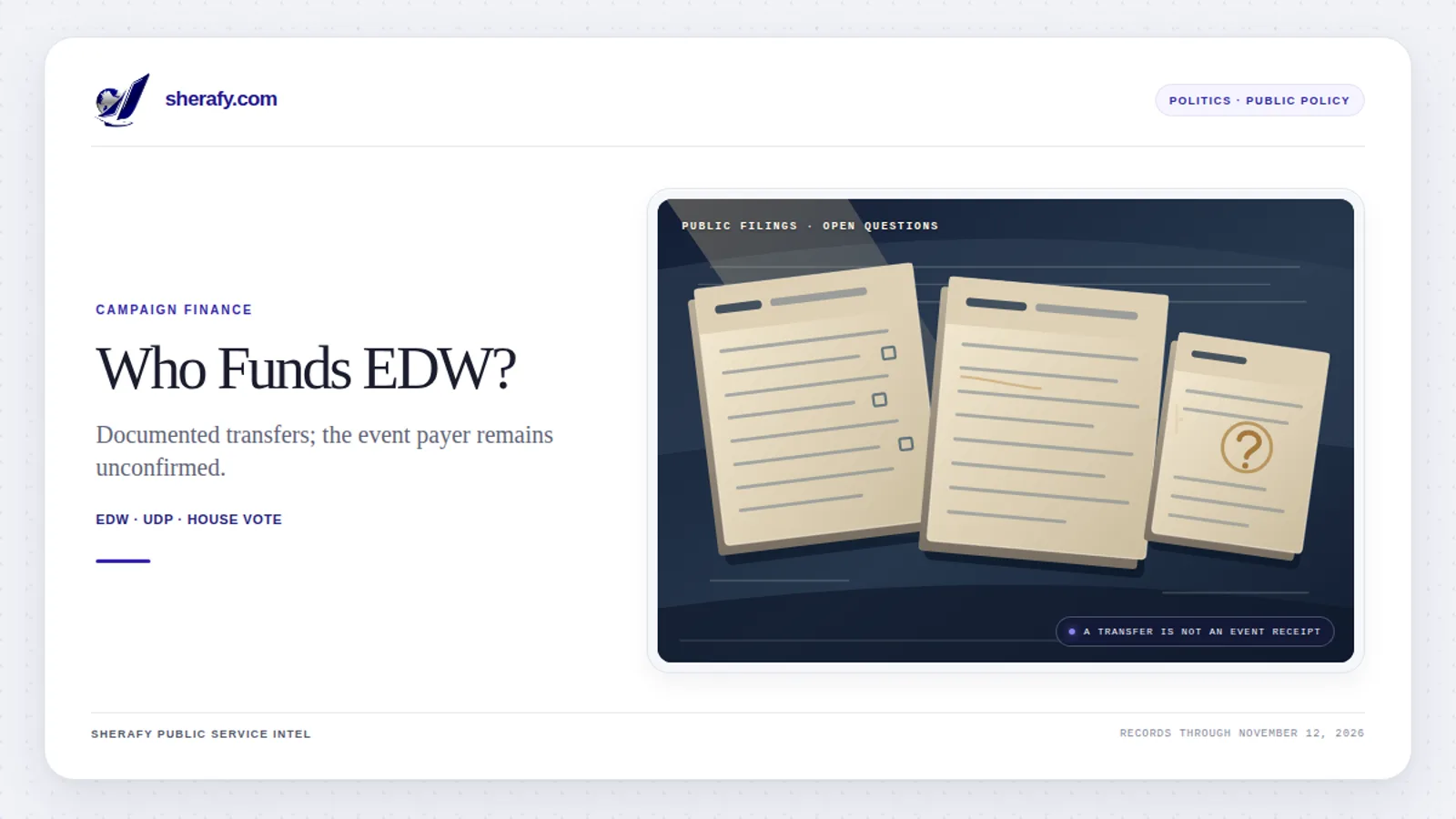
The financial connection is documented. United Democracy Project (UDP), the super PAC affiliated with the American Israel Public Affairs Committee (AIPAC), gave $2.35 million to the separately registered EDW Action Fund during the 2025–2026 election cycle. That represented approximately 24.1% of EDW Action Fund's $9.74 million in reported receipts through October 14, according to Federal Election Commission records and an FEC-derived transfer analysis.
But the available evidence does not establish that AIPAC paid for the November 10 reception, ordered it to coincide with the vote, or directed lawmakers to stay away from the House floor.
That distinction does not make the incident inconsequential. The official House roll call shows that a motion to refer the impeachment resolution to committee passed 211–204, with 11 Democrats and seven Republicans not voting. Seven additional votes against referral would have produced a 211–211 tie and defeated the motion, assuming every other recorded vote stayed the same. Six of the missing Democrats cast votes in the next roll call, recorded just eight minutes later.
So there are two separate questions: What happened to congressional accountability on November 10? And what does the political-money network surrounding EDW reveal about access and donor transparency? Both deserve answers based on records rather than slogans.
For the names, reported explanations and full roll-call reconstruction, see our separate record-based account of the 11 Democrats who missed the Hegseth vote.
What actually happened during the Hegseth impeachment vote?
Rep. Thomas Massie, a Kentucky Republican, introduced eight articles of impeachment against Defense Secretary Peter Brian Hegseth. They alleged wrongdoing involving war powers, military operations, civilian casualties, and other uses of departmental authority. The articles were allegations in a congressional resolution, not judicial findings.
The House did not vote directly on whether Hegseth should be impeached. Instead, it voted on a motion to refer H.Res. 1655 to the House Judiciary Committee. Referral stalled the immediate effort to bring the articles to a substantive floor vote.
The official House Clerk record for Roll Call 317 is unambiguous:
| November 10, 2026, vote | Members |
|---|---|
| Yes, refer the impeachment resolution to committee | 211 |
| No, reject the referral | 204 |
| Not voting | 18 |
| Democrats not voting | 11 |
| Republicans not voting | 7 |
Of the 211 members voting for referral, 210 were Republicans and one was an independent. Massie was the one Republican voting against referral, alongside 203 Democrats.
The House recorded the result at 6:02 p.m. Eastern. By 6:10 p.m., six previously absent Democrats were recorded voting on the next measure. That is not an allegation about their whereabouts: it is visible by comparing Roll Call 317 with Roll Call 318.
It also makes the underlying accountability question difficult to dismiss. Those six lawmakers were available for another House vote within minutes, but their votes were not counted on the Hegseth referral.
What is Elect Democratic Women, and who runs it?
Elect Democratic Women says it was founded in 2018 by Democratic members of Congress to elect more pro-choice Democratic women to federal office. Its founding members include Reps. Lois Frankel, Katherine Clark, Joyce Beatty, and Julia Brownley, along with former representatives Cheri Bustos, Annie Kuster, and Lucille Roybal-Allard.
Frankel chairs EDW. Brownley sits on its executive board, and Melanie Stansbury is listed on its board of directors. Katherine Clark, now the House Democratic whip, is a founder. These affiliations matter because Brownley and Stansbury were among the lawmakers reported at the reception and among those who missed the vote.
EDW is not one interchangeable pool of political money. At least two legally distinct committees carry the branding:
| Organization | FEC committee ID | Registered type |
|---|---|---|
| Elect Democratic Women | C00685297 | Traditional PAC |
| EDW Action Fund | C00863472 | Hybrid PAC with a non-contribution account |
| United Democracy Project | C00799031 | Independent-expenditure-only super PAC |
EDW Action Fund describes itself publicly as a super PAC, while its FEC registration gives the more specific classification of a hybrid PAC. That distinction matters: a hybrid committee can maintain separate accounts for certain limited contributions and unlimited independent-expenditure funds under FEC rules.
The reception was attributed to EDW. The multimillion-dollar UDP transfers were made to EDW Action Fund. Treating those entities as identical, or assuming a transfer to the latter paid for an event hosted by the former, would skip the very financial relationship that needs investigation.
How much money did AIPAC's super PAC give EDW Action Fund?
At least $2.35 million during the 2025–2026 cycle, according to the reported transfers reviewed. ChamberLight's FEC-derived compilation identifies six UDP transfers to EDW Action Fund beginning April 14, 2026. Drop Site News independently reported the same total and linked to the underlying FEC disbursement search.
The FEC's published committee summaries, covering January 1, 2025, through October 14, 2026, provide the denominator:
| Committee | Total reported receipts, 2025–2026 through Oct. 14 |
|---|---|
| Traditional Elect Democratic Women | $8,070,880.21 |
| EDW Action Fund | $9,742,502.33 |
| United Democracy Project | $112,820,861.12 |
The straightforward current-cycle calculation is:
$2,350,000 ÷ $9,742,502.33 × 100 = approximately 24.1%.
That means UDP accounted for roughly one-quarter of EDW Action Fund's gross reported receipts in that period. It does not mean UDP supplied one-quarter of the traditional EDW PAC's receipts, nor does it mean that UDP controlled one-quarter of every expenditure made by an affiliated organization.
There is a further accounting complication. The traditional EDW committee's FEC summary reports $1.6 million received as transfers from affiliated committees during the period. That is an inbound figure on the traditional PAC's books. It should not be reversed into a claim that traditional EDW sent $1.6 million to EDW Action Fund, and it should not be attributed to UDP without inspecting the underlying transactions.
Then where does the claim that AIPAC provided more than half the money come from?
It uses a different period and denominator.
In August, Sludge reported that UDP had given EDW Action Fund at least $2.45 million since May 2024, which amounted to more than half of the group's fundraising after excluding transfers from affiliated organizations. The cumulative figure includes an earlier period, and the percentage intentionally excludes a category included in ordinary gross receipts.
The two statements therefore should not be presented as competing calculations of the same quantity:
- 24.1% describes $2.35 million divided by EDW Action Fund's 2025–2026 gross receipts through October 14, 2026.
- More than half, as reported by Sludge, describes a longer historical period with affiliated transfers removed from the denominator.
Both can be useful, but only when readers know exactly what was counted.
Where did the political money go after EDW Action Fund received it?
This is where the story extends beyond one November reception.
An October investigation by The Lever traced approximately $13.1 million that UDP had sent to other political committees in the 2026 cycle. Some of those recipients advertised under names emphasizing women candidates, reproductive rights, or other issues rather than an explicit connection to AIPAC.
One of the clearest examples was Pro-Choice Majority Action. The Lever reported that Elect Democratic Women had transferred approximately $5.6 million to that committee, which then financed independent election advertising, including ads in the Colorado Democratic primary between Diana DeGette and Melat Kiros. A later review of FEC bulk filing data through October 14, 2026 lists 26 EDW Action Fund payments totaling $6.12 million to Pro-Choice Majority Action, with the latest dated October 5. The records support the larger cumulative figure for the reporting period; they do not, by themselves, explain why it differs from The Lever's published figure or identify the source of every dollar received by the recipient committee. Readers can inspect the FEC disbursement search and a filing-data summary that identifies its FEC source and coverage dates.
The financial path can be summarized as follows:
United Democracy Project → $2.35 million to EDW Action Fund → EDW Action Fund sends money to other committees, including Pro-Choice Majority Action → independent election advertising.
Important: That is a map of reported organizational transfers, not a claim that particular UDP dollars can be tagged and followed through every subsequent payment. EDW Action Fund received money from other sources. Money is fungible, so an intermediate recipient's spending cannot automatically be attributed dollar-for-dollar to one upstream funder.
Pro-Choice Majority Action consultant Lenny Young told The Lever that the organization supported pro-choice Democratic women and did not vet candidates on their positions toward Israel. There is evidence that the network sometimes supported candidates critical of Israel, including a case involving Tram Nguyen examined by Sludge.
Those facts complicate the notion that each downstream committee acts under a single donor's direct political instructions. They do not erase the disclosure problem. Voters seeing an ad from a reassuringly named committee may not know its major upstream funding relationships without searching through multiple FEC filings.
The question is not whether transferring money between registered committees automatically violates the law. It generally does not. The question is whether voters can understand who helped finance the political messages reaching them before they cast a ballot.
What happened at the November 10 EDW reception?
Drop Site News reporters Ryan Grim and Julian Andreone obtained event materials for an EDW New Member Reception scheduled from 4:30 to 6:30 p.m. Eastern. According to the reported run of show, Frankel was scheduled to give remarks at 5:00 p.m. The House voting series was scheduled to begin at 5:30 p.m.
The event was at Goldfinch Social, 1401 Pennsylvania Avenue SE, Washington, DC, a venue at The Roost complex. Goldfinch Social's own location page confirms the exact address. The SE designation is important: this is not a venue on Pennsylvania Avenue near the White House.
| Time, Eastern | Event |
|---|---|
| 4:30 p.m. | EDW reception scheduled to begin |
| 5:00 p.m. | Frankel's remarks scheduled |
| 5:30 p.m. | House voting series scheduled to begin |
| 6:02 p.m. | House Clerk records the 211–204 Hegseth referral vote |
| 6:10 p.m. | Roll Call 318 records votes from six Democrats absent on Roll Call 317 |
| 6:20 p.m. | Roll Call 319 records another vote, including Steven Horsford |
| 6:30 p.m. | Scheduled end of EDW reception |
Sources: Drop Site's reporting on the event schedule and House Clerk Roll Call 317, 318, and 319. The timeline gives scheduled event times and official recorded roll-call times, not independently verified arrival or departure timestamps for every attendee.
Who was invited to the reception?
The RSVP list obtained by Drop Site identified 132 lobbyists expected to attend. The reporters described representatives associated with Lockheed Martin, major defense lobbying firms, technology companies including Google and Anthropic, pharmaceutical and insurance interests, and other businesses.
That is politically relevant because those industries have substantial interests before Congress, and the reception provided an opportunity for contact with lawmakers and incoming members.
There is an essential evidentiary limit: an RSVP list does not prove that all 132 people physically attended. Nor does the presence of a lobbyist establish that a contribution was made, a favor was requested, or an official act was promised. The source establishes the composition of the intended gathering and the access it offered.
The event's timing is independently troubling. When lawmakers have been alerted to a voting series, attending a reception away from the Capitol introduces an obvious risk. Traffic may explain a delay, but it does not eliminate the scheduling responsibility.
Which 11 Democrats missed the Hegseth vote, and who attended EDW's event?
The full list comes from the House Clerk's November 10 roll call. The EDW attendance column reflects reporting by Drop Site, not the assumption that every absent member went to the party. The AIPAC PAC column uses ChamberLight's FEC-derived recipient dataset, which counts net direct PAC contributions plus individual donations earmarked through AIPAC PAC from December 2021 through October 14, 2026. It does not count UDP's independent expenditures or every possible other pro-Israel donor network.
| House Democrat who missed Roll Call 317 | EDW reception connection | Subsequent recorded House vote | AIPAC PAC-linked receipts since Dec. 2021* |
|---|---|---|---|
| Julia Brownley (CA) | Reported attendee; EDW executive board | 6:10 p.m. | About $63,000 |
| Lou Correa (CA) | Attendance not established; medical absence reported | No vote in next two roll calls | About $44,000 |
| Laura Gillen (NY) | Attendance not established; cited traffic | 6:10 p.m. | About $467,000 |
| Steven Horsford (NV) | Attendance not established; cited personal emergency | 6:20 p.m. | About $186,000 |
| Jonathan Jackson (IL) | Attendance not established; cited traffic delay | 6:10 p.m. | About $13,000 |
| Nancy Pelosi (CA) | In California for a veterans event, according to her office | No vote in next two roll calls | About $15,000 |
| Brittany Pettersen (CO) | Confirmed attendee; acknowledged EDW event | 6:10 p.m. | About $72,000 |
| Melanie Stansbury (NM) | Reported attendee; EDW board member | 6:10 p.m. | No matching entry in this dataset |
| Haley Stevens (MI) | Attendance not established | No vote in next two roll calls | About $1.17 million |
| Marilyn Strickland (WA) | Attendance not established; cited motorcade delay | 6:10 p.m. | About $291,000 |
| Frederica Wilson (FL) | Attendance not established | No vote in next two roll calls | About $33,000 |
Rounded, cumulative AIPAC PAC-linked receipts, not payments for attending the EDW event, not amounts received from UDP, and not evidence of why someone missed this vote. The presence or absence of an entry in this defined dataset cannot establish all forms of outside support. Attendance and explanations are drawn from Drop Site, ABC News, and The Washington Post. Later votes are confirmed by the House Clerk.
This record undercuts a simplistic version of the viral accusation that all eleven absentees received AIPAC money and all were at an AIPAC-linked party. Within the defined AIPAC PAC dataset, ten have identifiable historical receipts; Stansbury has no matching entry. Only three absentees are specifically identified in the reporting reviewed as EDW reception attendees: Brownley, Pettersen, and Stansbury.
Some of the other absences had unrelated explanations. Correa had announced a medical procedure; Pelosi's office confirmed she was at a veterans event in California; Horsford cited a personal emergency. Several lawmakers said a police escort or motorcade had contributed to a traffic delay. Their accounts should be evaluated individually, not treated as one invented explanation or one verified attendance group.
There is also a critical difference between contributions and independent expenditures. A campaign receiving an earmarked individual donation through AIPAC PAC is not equivalent to a super PAC spending money on advertisements without transferring that money to the campaign. Combining the two into a single personal “AIPAC money taken” number would mislead readers.
Could the missing Democrats actually have changed the result?
Yes, as a mathematical possibility. No, not as an established account of what would have happened if the vote had remained open.
The official vote was 211 for referral, 204 against. With the 211 yes votes held fixed:
| Additional hypothetical votes | Referral tally | Result |
|---|---|---|
| Three absent Democrats vote no | 211–207 | Referral passes |
| Six absent Democrats vote no | 211–210 | Referral passes |
| Seven absent Democrats vote no | 211–211 | Referral fails on a tie |
| All 11 absent Democrats vote no | 211–215 | Referral fails |
| All 11 absent Democrats vote no and all seven absent Republicans vote yes | 218–215 | Referral passes |
A tie defeats a motion that requires a majority. Seven, not eight, extra no votes were sufficient in the fixed-vote scenario. Importantly, the six Democrats who voted in the next roll call would not have been enough by themselves: their votes would have moved the tally to 211–210.
ABC News documented those six later arrivals: Brownley, Gillen, Jackson, Pettersen, Stansbury, and Strickland. Horsford also voted in the subsequent 6:20 p.m. roll call.
The counterfactual becomes less certain once the seven absent Republicans are included. The Washington Post examined later voting attendance and argued that Republican leaders had enough members nearby to prevail if the vote had remained open and those members voted with their party. That is a plausible scenario, not a record of a vote that actually happened.
And even a failed referral would not have meant Hegseth was impeached. The House still would have needed to adopt the articles of impeachment. Conviction and removal would then require a separate Senate process.
The defensible conclusion is therefore narrower, but still significant: the Democratic absences had the numerical potential to defeat the referral motion, while the complete attendance picture does not prove the EDW reception determined the outcome.
Were the traffic explanations credible?
Several lawmakers described congestion near the Capitol associated with a police escort or motorcade. Stansbury, Gillen, Jackson, and Strickland or their offices publicly described traffic-related delays. Pettersen acknowledged attending the EDW event and said a blockade on Independence Avenue delayed her return. ABC News reported that it had asked U.S. Capitol Police about the incident but had not received a response at publication time.
The available reporting does not justify claiming that the traffic problem was fabricated. Nor is there a verified public record here placing each affected member in the same vehicle, following the same route, or being blocked by precisely the same incident.
But there are two different accountability standards at issue. One asks whether the lawmakers' descriptions of traffic were truthful. The other asks why a reception was attended close enough to the voting window that an ordinary transportation problem could prevent participation.
A genuine traffic jam can explain how someone became late. It cannot, by itself, answer why that lawmaker was cutting the timing so close.
Was EDW a “shell PAC,” and was anything illegal?
Calling EDW a shell PAC as if it were a proven legal finding would be inaccurate. EDW, EDW Action Fund, and UDP are identifiable, federally registered political committees with reported receipts and expenditures. Their filings are public. A registered PAC can be used as an intermediary in a political funding network without being fictitious or automatically unlawful.
The FEC's hybrid PAC guidance describes how committees can operate separate accounts with different contribution rules. The FEC also says that federal candidates and officeholders may attend, speak at, or appear at super PAC fundraisers where unlimited contributions are solicited, provided their own solicitations comply with applicable limits and source restrictions.
That means a lobbyist attending a political reception, a member of Congress speaking there, and a super PAC contributing to a separate PAC are not sufficient facts to establish a campaign-finance violation.
There are still legitimate concerns about disclosure and access. A political committee's advertising may emphasize one issue while its major donors care about another. Transfers can make the upstream funding network difficult for ordinary voters to understand. Reporting dates can also mean that some information becomes public only after voters act.
But there are several different levels of evidence:
| Finding | What the evidence supports |
|---|---|
| Documented | UDP transferred $2.35 million to EDW Action Fund; EDW hosted a reception overlapping with House votes; several absent lawmakers attended |
| Reasonable accountability concern | The event schedule created a foreseeable conflict with legislative duties; political donors and lobbyists had access to lawmakers |
| Not established | UDP or AIPAC paid for this specific reception, deliberately scheduled it to disrupt the vote, or instructed members not to vote |
| Not established | Any particular lawmaker missed the vote in exchange for a contribution or other benefit |
The difference matters. Investigative reporting should not need to invent an illegal conspiracy to describe a real problem with political influence and legislative priorities.
Who paid for the November 10 reception? The key record is not public yet
The large UDP transfers to EDW Action Fund occurred before November. That alone cannot show who paid Goldfinch Social, a caterer, a transportation provider, or any other vendor for the November 10 reception.
The committee's publicly displayed FEC summary currently ends on October 14, 2026. The FEC's official reporting schedule says the post-general report, due December 3, 2026, will cover activity from October 15 through November 23 for PACs and party committees. Relevant spending may not become visible in the usual reporting cycle until then. Filing an expense, however, is not guaranteed to answer every question about the event's ultimate funding.
The outstanding questions are direct:
- Which legal committee or other entity contracted for and paid for the EDW reception?
- When did organizers learn the House voting series would start at 5:30 p.m., and what logistical guidance did they send attending members?
- Which lawmakers actually attended, and when did each leave?
- Which lobbyists actually attended, as distinct from appearing on the RSVP list?
- Do the post-general filings reveal venue, hospitality, transportation, or other event-related payments, and which account made them?
Until those records or credible first-hand evidence appear, the correct answer to “Did AIPAC pay for the party?” is not established. The financing relationship is real. Its connection to this particular event remains unproven.
Why this matters beyond one Hegseth vote
The November 10 incident brought together two normally separate parts of congressional politics.
One is the campaign-finance system, in which donors, traditional PACs, hybrid PACs, and super PACs can occupy different legal roles and move large sums among committees. Its records are public but frequently difficult for casual readers to interpret.
The other is congressional attendance and access, in which elected members balance votes, party obligations, donor gatherings, lobbyist contact, district events, and emergencies. Those commitments are not equally discretionary, and the House's roll-call record makes the outcome of a missed vote visible.
EDW's public mission of electing Democratic women is a legitimate political objective. AIPAC and its affiliated committees are free to support candidates and political organizations within the law. Those facts do not exempt the organizations or lawmakers from scrutiny over money, access, or timing. They also do not prove that two organizations agreeing on a candidate share the same views on every issue.
What is established is enough to demand a clear accounting. Millions of dollars moved through a politically connected network. An EDW reception overlapped with a consequential House vote. At least three lawmakers identified as attendees missed that vote. Six absent Democrats were back in recorded voting minutes later.
Political money does not, by itself, prove why someone skipped a vote. A traffic problem does not, by itself, prove a cover story. And a 211–204 result does not, by itself, prove what would have happened with perfect attendance.
But voters should not have to choose between believing a conspiracy and ignoring a documented failure of accountability. They are entitled to know who paid, who attended, who missed the vote, and what the public records can actually prove.
Frequently asked questions
Did AIPAC block Pete Hegseth's impeachment?
There is no established evidence that AIPAC orchestrated the missed votes or caused the referral motion to pass. An AIPAC-affiliated super PAC funded EDW Action Fund, which is associated with the committee that hosted the overlapping reception. Some attendees missed the vote, but the presence of seven absent Republicans and the procedural nature of the vote complicate the causal claim.
How much AIPAC-linked money did Elect Democratic Women receive?
UDP contributed $2.35 million to the separate EDW Action Fund during the 2025–2026 reporting cycle, equivalent to approximately 24.1% of its $9.74 million in gross receipts through October 14. That is not a direct claim about traditional EDW's receipts or the cost of its November reception.
Who founded and chairs Elect Democratic Women?
EDW lists seven founding members and identifies Rep. Lois Frankel as chair. Founders include Katherine Clark, Joyce Beatty, and Julia Brownley, alongside several former members of Congress.
Which Democrats were reported at the EDW reception?
Julia Brownley, Brittany Pettersen, and Melanie Stansbury were identified as attendees in Drop Site's reporting. Pettersen subsequently acknowledged attending. Their presence should not be extrapolated to all eleven Democrats who missed the vote.
How many votes were needed to stop the referral?
With the recorded 211–204 tally otherwise unchanged, seven additional no votes would have produced a 211–211 tie, defeating the referral motion. Six absent Democrats voted on the next House measure, and seven Republicans had also missed the original vote. The final result under a longer voting window cannot be known from the existing tally alone.
When will the missing reception spending records become available?
The FEC's next relevant post-general filing deadline is December 3, 2026, covering October 15 through November 23. The filings could identify event-related expenditures if reportable, but further confirmation may still be needed to determine who financed the reception.
References and Further Reading
Primary Congressional Records
- U.S. House Clerk, Roll Call 317, November 10, 2026: Official 211–204 vote on referring H.Res. 1655, including every recorded absence and party breakdown.
- U.S. House Clerk, Roll Call 318, November 10, 2026: Official 6:10 p.m. roll call, used to verify which previously absent members voted on the next measure.
- U.S. House Clerk, Roll Call 319, November 10, 2026: Official 6:20 p.m. roll call, relevant to additional member arrivals.
- Office of Rep. Thomas Massie, Hegseth Impeachment Announcement, November 9, 2026: The sponsor's contemporaneous description of the eight articles and their allegations. A sponsoring member's accusations are not independent legal findings.
Federal Campaign-Finance Records and Rules
- FEC: Elect Democratic Women, C00685297: Official registration and 2025–2026 financial summary for the traditional PAC, including inbound affiliated transfers.
- FEC: EDW Action Fund, C00863472: Official registration as a hybrid PAC and $9.74 million reported gross receipts through October 14.
- FEC: EDW Action Fund disbursement search: Official search for reported payments to Pro-Choice Majority Action (C00949248); filings can be amended and FEC processing may affect totals.
- WhereTheyStand: EDW Action Fund filing analysis: FEC bulk filing data through October 14, 2026; lists 26 payments totaling $6.12 million to Pro-Choice Majority Action, latest October 5.
- FEC: United Democracy Project, C00799031: Official records for the AIPAC-affiliated independent-expenditure-only committee.
- FEC: UDP Disbursements to EDW-Related Committees: Pre-filtered official transaction search; confirm transaction-level details and amendments when using it.
- FEC: Registering as a Hybrid PAC: Explains the separation of contribution and non-contribution accounts.
- FEC: Federal Candidates Fundraising for Super PACs: Explains permitted appearances and restrictions on officeholders' solicitations.
- FEC: November 2026 Post-General Reporting Reminder: Establishes the December 3 deadline and the period covering the reception.
Organizational and Venue Disclosures
- Elect Democratic Women: About the Organization: EDW's description of its purpose, founders, leadership, and boards.
- EDW Action Fund: About the Organization: The affiliate's own description of its mission and advisers.
- Goldfinch Social: Washington, DC Location: Confirms the reception venue at 1401 Pennsylvania Avenue SE, adjacent to The Roost.
Original Reporting and Independent Data Analysis
- Drop Site News: Democrats Missed Hegseth Impeachment Vote While at a Fundraiser with Defense Lobbyists: Ryan Grim and Julian Andreone's original reporting on the reception, run of show, identified attendees, and lobbyist RSVP list.
- ABC News: Several Democrats Missed the Crucial Hegseth Impeachment Vote. Many Blamed Traffic: Original reporting on explanations, statements, and the six members who returned by the next roll call.
- The Washington Post: Democratic Lawmakers Apologize After Absences on Hegseth Vote: Reporting on party leadership, individual explanations, and how Republican absences affect the counterfactual.
- The Lever: AIPAC Is Spending Millions, Just Not Under Its Own Name: Luke Goldstein and Katya Schwenk's investigation of UDP transfers and downstream political advertising networks.
- Sludge: AIPAC-Linked PAC Boosts Nguyen Despite Her Gaza Stance: Donald Shaw's analysis of historical EDW Action funding and an example complicating assumptions about the political positions of downstream candidates.
- ChamberLight: AIPAC Money in Congress: FEC-derived transfer and spending summaries, including UDP's six 2026 EDW Action transfers.
- ChamberLight: Every AIPAC PAC Recipient Since 2021: Clearly defined dataset of net direct PAC checks and earmarked individual donations, used for the eleven-member comparison.
Editorial currency note: This investigation reflects publicly available reporting and FEC filings reviewed on November 12, 2026. The referenced FEC totals and the downstream transfer analysis cover activity only through October 14. Information on November 10 event payments, attendance, or additional statements may change after the December 3 post-general filing deadline or with further original reporting. Contributions, transfers, and independent expenditures have different legal meanings and should not be added together as though they were direct payments to individual lawmakers.