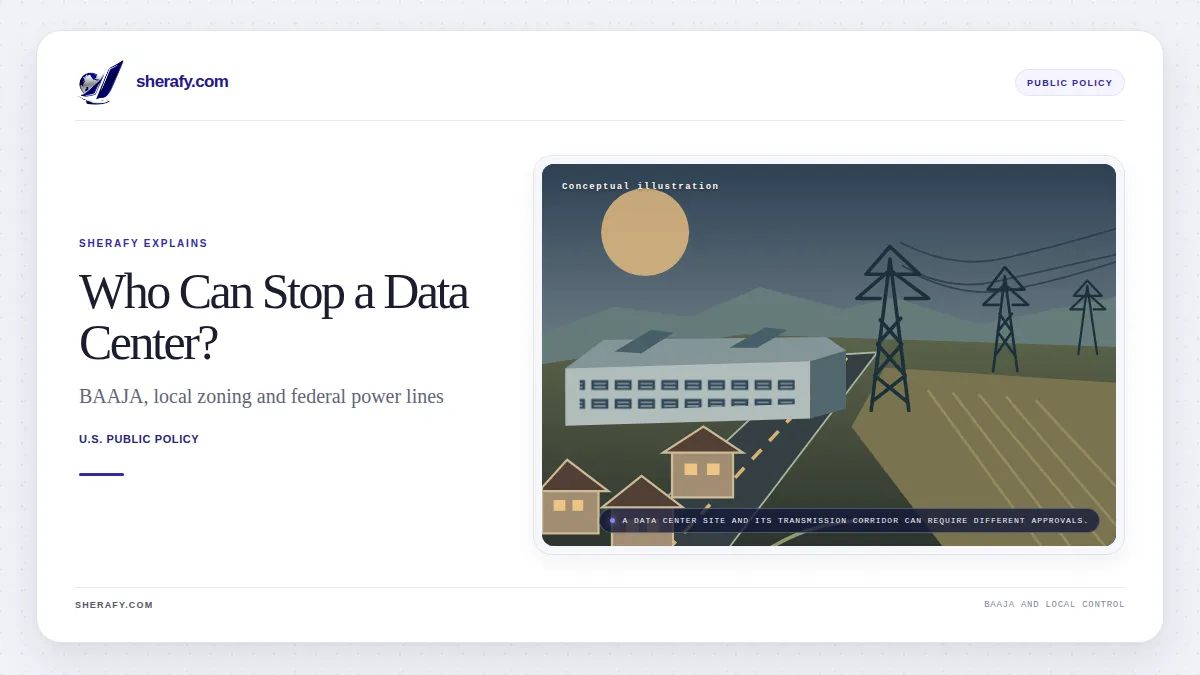
Yes. Cities and counties can generally reject new data center developments where state law gives them the necessary land-use authority. The Bipartisan American Affordability and Jobs Act of 2026 (BAAJA), which passed the U.S. Senate on November 19, would not impose a nationwide override of local data center zoning or prohibit local governments from adopting data center moratoria.
But that is only part of the answer.
The Senate-passed legislation would substantially expand federal authority over qualifying electricity transmission projects, restrict certain environmental challenges and strengthen legal protections for federally authorized developments. It would also impose new protections against shifting certain data center electricity costs onto other customers.
Meanwhile, some states have already taken away significant local regulatory powers. West Virginia expressly preempts numerous local regulations for certified high-impact data centers. Florida has expressly preserved local planning authority.
The distinction is important: the government that decides whether a data center can be built is not necessarily the government that decides whether its power lines, generating facilities or other supporting infrastructure can be built. Nor does the right to challenge an approval necessarily include the right to stop construction while that challenge is resolved.
As of November 26, 2026, BAAJA has passed the Senate but has not become law. Its proposed changes are discussed here conditionally.
What is the BAAJA bill, and has it become law?
BAAJA is a broad federal permitting and energy infrastructure package, not a law exclusively about artificial intelligence. It covers environmental review, water regulation, endangered species, federal permit protections, nuclear licensing, electricity transmission, energy development and historic preservation, among other subjects.
Senators Shelley Moore Capito, Sheldon Whitehouse, Mike Lee and Martin Heinrich introduced the original legislation as S. 5653 on September 30, 2026. The Senate ultimately used H.R. 2347 as its legislative vehicle, replacing the text of an earlier House bill concerning the tax treatment of certain legal damages.
On November 19, the Senate passed the amended bill. The official roll-call record records 62 votes in favor, 33 against and five senators not voting. Both the support and opposition crossed party lines.
| Date | Legislative development |
|---|---|
| September 30, 2026 | S. 5653 introduced. |
| Early November 2026 | Proposed revisions and Congressional Research Service analyses published. |
| November 19, 2026 | Senate passed H.R. 2347, as amended to incorporate BAAJA, by 62–33. |
| November 24, 2026 | CRS updated its Clean Water Act analysis to address the Senate-passed legislation. |
| November 26, 2026 | Senate-passed bill awaiting further House action; not enacted. |
The different bill numbers explain why some searches for H.R. 2347 still return its original, seemingly unrelated title. The controlling document for this analysis is the November 19 engrossed Senate amendment, not the September version or an unadopted proposed amendment. The Administrative Conference of the United States also records the Senate's passage of the amended measure.
The House must agree to the Senate's changes or the chambers must otherwise resolve their differences before the legislation can proceed to enactment. None of the proposed new powers or restrictions discussed here should be mistaken for law already in effect.
Who actually has the power to approve or stop a data center?
A large data center does not receive one universal permit. It may need a collection of approvals from institutions with different jurisdictions. Some are discretionary decisions about whether a development should occur. Others concern whether the design meets specific technical standards or whether it may use particular public resources.
A developer might own land but lack the zoning necessary to build on it. A county might approve the site while the utility lacks sufficient electrical capacity. A federal agency might authorize a transmission line while a municipality refuses to approve a data center that would use its electricity.
Data center regulatory authority matrix
The following comparison identifies the principal decision-maker for each regulatory mechanism and the effect of the Senate-passed BAAJA text. It is a jurisdictional guide, not a universal permit checklist. Actual requirements depend on state law, existing development rights, the project design and federal involvement.
| Decision or approval | Principal authority | What BAAJA would change |
|---|---|---|
| Buying land for the data center | Private parties, subject to applicable law | No general compulsory acquisition power for data center sites identified. |
| Rezoning or conditional-use approval | Authorized city or county | No blanket federal override identified. |
| Development permitted by existing zoning | Applicable state and local rules | No general new federal zoning entitlement. |
| Local data center moratorium | State or authorized local government | No blanket prohibition on moratoria identified. |
| Preemption of municipal zoning | State legislature | Existing state-specific laws remain relevant. |
| Building permits, noise limits and setbacks | Applicable state or local authorities | Generally not directly changed; state preemption may independently apply. |
| Municipal water service | Water utility and applicable regulators | No blanket override of water-service agreements identified. |
| Water withdrawals | State or regional authorities, as applicable | Distinct from federal water-quality certification. |
| Water-quality certification for federal permits | Authorized state or Tribal authority | Section 1202 would narrow specified certification powers. |
| Wastewater discharge permits | EPA or authorized state authorities | Section 1203 would extend the maximum NPDES permit term. |
| Wetlands and dredge-and-fill permits | Army Corps of Engineers or authorized state programs | Sections 1204–1205 would change permitting and judicial review. |
| Air-pollution permits | Applicable federal, state or local air regulators | Separate Clean Air Act requirements remain relevant. |
| Federal environmental review | Relevant federal agencies | Sections 1101–1110 would modify review and judicial remedies. |
| Interstate transmission siting | State siting authorities and FERC | Section 2101 would expand conditional federal jurisdiction. |
| Transmission rights-of-way | Landowners, qualified permit holders and courts | Section 2101 would modify existing condemnation law. |
| Onsite electricity generation and natural gas infrastructure | Applicable state and federal authorities | Project-specific permitting reforms could facilitate development. |
| Retail electricity rates and service | State regulators and other authorized entities | Section 2107 would establish new cost protections while recognizing retained state authority. |
| Interstate transmission rates | FERC | Section 2107 would require new pricing rules. |
| Historic preservation and Tribal consultation | Federal agencies, Tribal governments and other consulting parties | Several provisions would modify federal procedures. |
| Withdrawal of federal authorizations | Federal agencies and courts | Sections 1401–1403 would strengthen qualifying project protections. |
| Federal land leases and rights-of-way | Applicable federal land-management agencies | General permitting and project-certainty reforms could affect qualifying developments. |
Sources: sherafy.com comparative analysis of the Senate-passed bill, Federal Power Act Section 216, FERC's existing transmission siting framework, and the state and local records discussed below.
Zoning is not the same as permitting
Zoning determines what kinds of development are allowed on particular land. A project that is permitted by right under existing zoning may not require a new discretionary rezoning vote. It must still comply with the other applicable development and permit requirements.
A conditional-use permit is different. It may allow a particular land use subject to a separate approval process and specified conditions. A moratorium can temporarily pause certain new applications while a jurisdiction develops or revises its regulations.
Local governments cannot necessarily reject an already entitled project simply because political opinion has changed. State preemption, vested development rights, procedural requirements and judicial review can all limit local discretion. Whether a particular prohibition is lawful depends on the applicable law and circumstances.
Why the electricity infrastructure matters so much
The 2024 United States Data Center Energy Usage Report, produced by Lawrence Berkeley National Laboratory, estimates that data centers consumed 176 terawatt-hours (TWh) of electricity in 2023, about 4.4% of total U.S. electricity consumption. The laboratory's summary of its research gives a 2014 estimate of 58 TWh, meaning consumption roughly tripled over that period.
The report projected a range of 325–580 TWh for 2028, equivalent to approximately 6.7–12% of projected national electricity consumption. Those are scenarios, not measured 2028 consumption or a certainty about future demand.
Megawatts measure power demand or capacity at a given time. Megawatt-hours measure energy consumed over time. For example, a hypothetical facility drawing 100 MW continuously for a full non-leap year would consume 876,000 MWh, or 0.876 TWh. Actual facilities operate at varying loads.
Serving a large new customer may require substations, regional transmission upgrades, additional generation or onsite power systems. A transmission line might serve many customers, including homes, industrial facilities and data centers. It is not inherently an AI project.
This is why a permitting bill that never expressly overrides municipal data center zoning can still have major consequences for data center construction.
Does BAAJA override local data center bans?
Our review of the Senate-passed text found no general provision that invalidates municipal data center zoning, prohibits local moratoria or requires cities and counties to approve data center campuses. That conclusion is consistent with the legal distinction identified in Heatmap's November 25 analysis of BAAJA.
The issue is not hypothetical. Communities around the country are already using their existing regulatory powers. The Urban Institute's October 2026 policy guide cites tracking that identified 313 enacted moratoria affecting 44 states and more than 200 local jurisdictions as of September. That is not a count of 313 currently active statewide bans. Some restrictions are temporary, local or limited to particular applications.
Separately, the National Conference of State Legislatures identified lawmakers in 16 states considering bans or moratoria in September 2026. Consideration is not enactment.
Heatmap reported that its polling found 71% of Americans opposed a data center near their home, up from 42% the previous year. Its proprietary project tracker also identified more than 100 projects canceled during 2026 following significant local opposition, representing more than $260 billion in proposed investment. The latter figure measures planned projects, not realized economic losses, and is the publication's tracking estimate rather than an official census.
Two municipal examples illustrate what communities are actually doing.
Monterey Park, California: Voters approve a citywide prohibition
On June 2, 2026, residents of Monterey Park approved Measure NDC, amending the city's land-use framework to prohibit data centers meeting the measure's definition.
According to the city's official election records, the results were:
| Vote | Total | Share of valid votes on Measure NDC |
|---|---|---|
| Yes | 10,388 | 88.33% |
| No | 1,372 | 11.67% |
| Total | 11,760 | 100% |
There were 12,381 ballots cast overall in the municipal election; the percentages above use votes actually cast on the measure as their denominator.
The city's ordinance records document the progression from a temporary moratorium adopted on January 21 to the council's March ballot referral, May implementing action and eventual voter-approved prohibition. The definition of the facilities covered matters, including the measure's reference to structures on one or more acres. The prohibition should not be understood as a ban on every ordinary business server room.
Nothing in the reviewed Senate-passed BAAJA language appears to establish a blanket override of this type of local land-use prohibition. That is a statutory interpretation, not a court ruling on every possible challenge to the Monterey Park ordinance.
Linn County, Iowa: An 18-month pause on new rezoning applications
The Linn County Board of Supervisors' data center records describe a different approach. The county stopped accepting new applications to rezone property into its EU-3 Large-Scale Data Center Zoning District for 18 months, effective July 1, 2026. Unless modified, the pause runs into January 2028.
The county had adopted a data center ordinance in February requiring qualifying projects to conduct water availability studies, enter water-use agreements with tracking and reporting requirements, and execute economic development agreements addressing community benefits.
The moratorium applies to unincorporated Linn County, not independently governed cities within the county. It concerns specified new rezoning applications and should not be confused with a blanket ban on all previously authorized construction.
BAAJA contains no identified general federal prohibition on this type of local moratorium either.
Can state governments take away local control over data centers?
Yes. Municipal and county land-use powers derive from state constitutions and laws. Their scope varies substantially among states, including states with different forms of municipal home rule. A state legislature may expressly reserve certain regulatory decisions to state authorities or preempt local restrictions, subject to applicable constitutional and legal limits.
This is where the most direct removal of local data center zoning authority can already be found.
West Virginia has already restricted local authority
West Virginia's current statutory code, §5B-2-21b, reflects the framework created by HB 2014 in 2025 and amended by HB 5168 in 2026.
The law reserves extensive regulatory control over certified high-impact data centers and certified microgrid districts to the state. It prohibits counties and municipalities from enforcing many regulations that would limit the development or operation of qualifying certified projects, notwithstanding specified local home-rule powers.
That is actual, explicit state preemption. The exemptions encompass numerous local zoning, land-use, noise and permitting requirements. Certification is essential: the statute does not exempt every computing facility in West Virginia. Applicable state building standards, specified taxes and fees, and relevant federal environmental obligations remain.
The distinction between the proposed federal bill and the enacted state law is particularly revealing. If one wants to see what a law directly restricting local data center zoning looks like, West Virginia provides a much clearer example than BAAJA.
Florida has expressly preserved local land-use authority
Florida took a different approach in SB 484, enacted as Chapter 2026-65.
The enrolled text expressly preserves local comprehensive planning and land-development regulatory authority relating to large-load customers. It also prevents those customers from being classified as electrical substations for purposes of a specified land-use statute.
Additional provisions address electricity tariffs, financial security and certain large-scale data center water-use permits. Most provisions took effect on July 1, 2026; the provision preserving local planning authority took effect upon becoming law.
Florida's law does not guarantee that every local prohibition will survive every legal challenge. It does make clear that the state has not chosen West Virginia's broad approach to preempting local regulation of qualifying facilities.
| Jurisdiction | Regulatory approach | Practical distinction |
|---|---|---|
| Monterey Park, California | Voter-approved local prohibition | Qualifying data centers prohibited under local land-use rules. |
| Linn County, Iowa | Limited temporary moratorium | Specified new rezoning applications paused. |
| West Virginia | State preemption for certified projects | Many traditional local restrictions cannot be enforced against qualifying facilities. |
| Florida | Express preservation of existing local planning authority | Local governments retain land-use powers available under state law. |
| Proposed BAAJA | Federal permitting and infrastructure reform | No general local data center zoning override, but significant changes to other approval mechanisms. |
These are selected comparative cases, not an exhaustive survey of all 50 states. They demonstrate why the answer to whether a city can stop a data center depends first on the state's laws and the project's existing rights.
How BAAJA would expand federal control over electricity transmission
Section 2101 is the clearest example of how BAAJA could reduce state control over infrastructure without directly overriding ordinary data center zoning.
FERC already possesses limited backstop authority
Under Section 216 of the Federal Power Act, 16 U.S.C. §824p, the Federal Energy Regulatory Commission (FERC) can issue certain interstate transmission construction permits in designated National Interest Electric Transmission Corridors.
The existing mechanism is conditional. It can become available when a state lacks the required siting authority or ability to consider interstate benefits, when an applicant cannot qualify under state rules in specified circumstances, or when a state fails to act, denies a qualifying application or imposes conditions meeting the statutory criteria.
The 2021 Infrastructure Investment and Jobs Act amended the backstop framework, expressly addressing state denials. FERC subsequently issued Order 1977 in May 2024 and its rehearing order, 1977-A, in October 2024. These measures also established or clarified landowner and Tribal engagement requirements.
Federal transmission override authority is therefore not new. BAAJA would substantially broaden and modify it.
What Section 2101 would change
The Senate-passed Section 2101 would remove the requirement that eligible transmission facilities lie within a designated national-interest corridor. It would also replace the current discretionary permit language with a requirement to issue permits when the amended statutory conditions are satisfied.
| Transmission issue | Existing law and framework | Senate-passed BAAJA |
|---|---|---|
| Geographic eligibility | Designated national-interest corridors | Corridor prerequisite removed; statutory exclusions remain. |
| Federal permit issuance | FERC may issue a qualifying permit | FERC must issue it when the amended statutory conditions are satisfied. |
| Technical eligibility | Existing transmission criteria | Generally at least 230 kV, with qualifying interconnection and advanced-conductor exceptions. |
| State decision period | One-year framework linked to the state application or corridor designation, whichever is later | Revised calculation from state application filing. |
| State siting power | Preserved subject to limited federal backstop | Expressly preserved except in the qualifying federal circumstances. |
| Federal pre-filing | Generally follows the existing state-process framework | May begin before the state application and must begin no later than that application. |
| Public participation | Existing FERC requirements | At least 45 days for public comments in specified proceedings. |
| Landowner input | Existing consultation and engagement rules | Express requirement for FERC to consider landowner input. |
| State record | Existing administrative process | State may submit relevant portions of its record for FERC consideration. |
The amended mechanism would still require findings concerning interstate or foreign electricity transmission, public interest, consumer protection or benefits, reliability and just and reasonable rates. Where applicable, modifications must make reasonable and economical use of existing infrastructure. The proposed voltage threshold is not a requirement that a data center itself consume 230 MW: kilovolts (kV) measure voltage, not power demand.
The bill would expressly exclude the Electric Reliability Council of Texas (ERCOT) area and qualifying ERCOT utilities. Certain exempt transmitting utilities that do not voluntarily accept FERC jurisdiction would also remain excluded.
Section 2101 therefore does not give FERC unconditional authority to build any power line anywhere. It considerably expands the circumstances in which federal backstop jurisdiction can be used.
Approving a power line does not approve a data center
Consider a hypothetical county that lawfully prohibits new large-scale data centers. A utility proposes a regional high-voltage transmission line crossing the county, and the state rejects its siting application.
Under BAAJA, the utility could potentially pursue a federal permit if the transmission project satisfies the amended Section 216 requirements. If granted, that permit could allow the transmission development to proceed despite the qualifying state siting denial.
It would not automatically give a technology company permission to build a prohibited data center in that county. The new transmission capacity might instead serve facilities in neighboring jurisdictions, along with other residential and industrial customers.
This is the distinction between the legal authority over the facility and the authority over the infrastructure serving it.
Other energy infrastructure provisions
Section 2102 would create special treatment for qualifying transmission upgrades and natural gas infrastructure work within existing rights-of-way or specified adjacent areas. Sections 2103–2106 address transmission planning, development, competition and generator interconnection planning. Sections 2108–2110 address qualifying behind-the-meter energy resources, advanced transmission technologies and generator interconnection queues.
These reforms can facilitate data center development, but they also have uses unrelated to AI, including grid reliability, renewable electricity integration and other industrial demand. Their practical effects depend on which projects are proposed, approved and financed.
Can BAAJA make it easier to take private farmland through eminent domain?
Potentially, for qualifying transmission infrastructure. Not generally for the data center buildings themselves.
Eminent domain is the legal power to acquire property for an authorized public use without the owner's voluntary agreement, subject to legal requirements and just compensation. Congress already provides a mechanism for holders of certain FERC transmission permits to seek necessary rights-of-way through condemnation when voluntary acquisition fails.
Under existing Section 216(e), permit holders must satisfy the applicable requirements, including good-faith efforts to engage landowners and stakeholders. The acquired right-of-way is restricted to transmission-related purposes. It cannot simply be repurposed for an unrelated commercial facility.
The compensation provision deserves particular scrutiny
A side-by-side comparison of existing federal law and BAAJA reveals changes beyond the widely reported expansion of siting jurisdiction.
| Issue | Existing Federal Power Act | Proposed change in BAAJA |
|---|---|---|
| Eligibility for condemnation | Tied to existing qualifying federal transmission permits | Broader potential permit eligibility could extend the practical reach of condemnation. |
| State-owned property | Excluded alongside federal property under Section 216(e)(1) | Section 2101(d) would remove the state-property exclusion, while retaining the federal-property exclusion. |
| Federal court condemnation procedure | Generally follows comparable state court procedures as nearly as practicable | Section 2101(d) would substitute Federal Rule of Civil Procedure 71.1. |
| Compensation formula | Section 216(f) expressly requires just compensation based on fair market value, including applicable severance damages | Section 2101(e) would replace the entire compensation subsection with transmission cost-allocation provisions. |
That fourth change is especially consequential. The existing subsection explicitly specifies the valuation date and recognizes applicable severance damages, which concern loss of value to remaining property when only part of it is taken. The proposed new subsection concerns how transmission costs are allocated among customers who benefit from the infrastructure, not how landowners are compensated.
The statutory replacement is directly observable in the Senate-passed text of Section 2101(d)–(e). It does not, however, repeal the Fifth Amendment's just-compensation protection. Nor does the change establish that owners would necessarily receive less compensation. The valuation implications would depend on the remaining legal framework and future judicial interpretation.
Removal of the state-property exclusion could similarly expand the statutory reach of condemnation, but that does not settle every possible constitutional or sovereign-immunity question concerning a particular parcel.
The strongest evidence-supported conclusion is that BAAJA would modify both the availability and procedural framework of transmission-related condemnation. It does not establish a general power for a data center company to confiscate a farm in order to build a server campus.
Would BAAJA make data centers harder to challenge in court?
In certain circumstances, yes. The bill would change both the ability to bring particular federal environmental challenges and the remedies available when those challenges succeed.
When federal environmental review applies
The National Environmental Policy Act (NEPA) governs environmental review for qualifying federal actions. It is primarily a procedural law, requiring environmental consequences to be considered rather than automatically requiring the rejection of a project with adverse effects.
A privately financed data center does not necessarily undergo federal NEPA review simply because it is large. Federal involvement may arise from a federal land lease, a qualifying federal permit, certain federal funding or associated infrastructure decisions. State environmental laws may impose separate requirements.
BAAJA Sections 1101–1109 would revise NEPA's purpose, scope, agency procedures, review coordination, categorical exclusions and use of existing environmental documents. Section 1107 would extend the specified period for reusing programmatic environmental analysis from five to ten years. Sections 1121 and 1131–1134 concern review systems and federal permitting improvement, including shorter specified FAST-41 litigation deadlines. The Congressional Research Service's NEPA analysis provides useful background on the earlier version; the Senate-passed text controls the final comparison.
The new 150-day deadline and participation requirements
Section 1110 would generally require covered NEPA challenges to be filed within 150 days, unless another federal law imposes a shorter deadline. The starting event depends on the type of authorization, including specified Federal Register notices or public release of the authorization.
For certain cases involving qualifying public-comment opportunities after enactment, the challenging party would need to have submitted substantive comments addressing the issue later raised. A party, or an individual member of an organization, must allege actual or imminent injury amounting to direct harm.
Covered claims would generally go directly to the appropriate federal court of appeals, subject to statutory exceptions. For residents, early identification of the relevant agency, comment period and administrative record could therefore become even more important.
Winning an environmental lawsuit might not stop construction
Under the existing framework, courts may set aside an unlawful authorization or grant an injunction when legally warranted, although neither remedy is automatic.
Under BAAJA Section 1110, the ordinary remedy for a covered NEPA violation would instead be remand without vacatur or injunction. Remand sends the matter back to the agency for correction; vacatur sets the defective decision aside; an injunction orders a party to take or refrain from specified actions.
| If a court identifies a covered NEPA violation | Effect under BAAJA |
|---|---|
| Agency's review is found legally deficient | Court sends the authorization back with corrective instructions. |
| Deadline to correct the review | Court-established schedule, not exceeding 180 days after its order. |
| Status of authorization during correction | Remains effective under the remand provision. |
| Authorized construction or activity | May continue during remand, subject to other applicable requirements. |
| Preliminary injunction | Limited exception requiring additional statutory findings. |
A preliminary injunction could be issued under specified conditions, including a substantial likelihood of a violation of another qualifying federal law (not NEPA or the specified historic-preservation law), irreparable harm, a favorable balance of equities and consistency with the public interest.
Separate claims under other applicable laws and challenges involving violations of authorization conditions are not universally eliminated by the proposal. The particular cause of action and available remedies matter.
Still, the practical consequence is significant: a community could establish that a federal agency's environmental review was legally deficient while the project continues. A right to judicial review is not equivalent to a right to halt construction.
Could federal agencies revoke a data center's permits after approval?
Sections 1401–1403 of BAAJA would create or expand distinct mechanisms protecting qualifying projects against federal interference, discriminatory permitting and delays. These provisions deserve separate treatment because their coverage and remedies are different.
Section 1401: Protection of existing federal authorizations
Section 1401 concerns projects with nonfederal sponsors that have secured all necessary federal authorizations for construction or operation. It would restrict new federal actions that withdraw, suspend, materially alter or otherwise interfere with qualifying authorizations in effect on or after November 6, 2026, or with the construction or normal operation of qualifying projects.
Federal agencies would retain specified grounds for intervention, including court orders, material violations of law or permit conditions, fraud or material misrepresentation, newly identified sufficiently serious and immediate threats to health, property, the environment or national security, requests from authorization holders and actions permitted under applicable law or regulation. Actions in response to the newly identified threat exception must be narrowly tailored to address the danger.
Agencies would generally have to provide a written explanation, identify their statutory authority and supply supporting evidence. In judicial review, the agency would bear the burden of showing that an applicable exception permits its action.
Successful qualifying challenges could produce injunctions, reasonable legal costs and specified economic or delay-related damages. Where bad faith is demonstrated, an additional award could amount to 25–50% of qualifying development and construction expenditures already incurred and not otherwise recovered under the specified provisions. The court would determine the amount according to statutory factors.
This is a federal project-protection provision. It would not itself convert a city's refusal to rezone farmland into a claim for federal developer compensation.
Section 1402: Discriminatory federal permitting
Section 1402 establishes a separate framework for specified types of energy and related projects, including electricity generation and transmission, pipelines, mining, energy storage and other enumerated facilities.
Data centers are not listed as a standalone project category. An associated power plant or transmission project may qualify, and the bill provides a court-certification mechanism for additional types of energy-related projects. Whether a particular data center campus would qualify through that mechanism remains unresolved.
The provision concerns qualifying bad-faith denials or unreasonable delays forming part of a pattern of disparate federal treatment. For the relevant delay claims, the text addresses applications pending more than 60 days beyond the applicable deadline. The applicant must meet the specified statutory conditions; the mere existence of a delayed permit does not establish liability.
The evidentiary provisions are unusually important. Once the applicant establishes the specified prima facie case, the government would have to rebut it or demonstrate a lawful basis for the treatment. Under specified circumstances, the government would also be required to provide approval, denial and delay statistics for the calendar year of the action and the preceding ten calendar years. Failure to produce those data would result in an adverse inference.
A successful qualifying claimant could obtain injunctive relief, legal costs and economic damages, plus an additional award of 50–100% of the reasonably expected construction cost as determined by the court under statutory criteria.
That is a different calculation from Section 1401, which is based on specified costs already incurred.
Section 1403: Deadlines for certain federal permits
Section 1403 would generally require agencies to decide covered federal authorizations that do not require an environmental assessment or environmental impact statement within one year after the latest complete covered application was submitted. Exceptions include specified applicant misconduct or withheld information, emergencies, disasters and qualifying lapses in appropriations.
Courts could order compliance-related injunctive relief through an expedited process. This section does not establish the same percentage-based damages remedy as Sections 1401 and 1402.
| Provision | Project stage | Principal protection | Percentage-based remedy |
|---|---|---|---|
| Section 1401 | Necessary federal permits secured | Protection against qualifying interference with authorizations or the project | 25–50% of specified unrecovered incurred expenditures, upon showing bad faith. |
| Section 1402 | Qualifying applications denied or delayed | Protection against specified patterns of discriminatory federal treatment | 50–100% of reasonably expected construction costs for successful qualifying claims. |
| Section 1403 | Complete covered application pending | Federal decision deadline | No equivalent percentage-based remedy in this section. |
Sources: Senate-passed BAAJA, Title IV and the November 6 CRS project-certainty report, the latter concerning the earlier legislative version.
The effect could be to make federal reversals and certain permitting delays more legally and financially consequential for the government. It would not establish automatic liability for every unfavorable regulatory decision, nor make every approved project immune from enforcement.
What happens to water, pollution and other environmental protections?
Data center water use raises several different legal questions. Who supplies the water? Who has the right to withdraw it? What can the facility discharge? Does construction disturb federally regulated wetlands? These are not interchangeable regulatory mechanisms.
| Mechanism | What it governs |
|---|---|
| Municipal water-service agreement | Contractual access to water supplied by a utility. |
| Water withdrawal authorization | Legal authority to withdraw water from a specified source. |
| Clean Water Act Section 401 certification | Water-quality compliance associated with qualifying federal licenses or permits. |
| Clean Water Act Section 402 (NPDES) permit | Specified pollutant discharges. |
| Clean Water Act Section 404 permit | Dredged or fill material discharged into jurisdictional waters. |
| Clean Air Act permit | Applicable emissions from onsite generators and other pollution sources. |
According to the November 24 Congressional Research Service comparison of BAAJA's Clean Water Act provisions, the Senate-passed legislation would modify several water-related regulatory powers.
- Section 1201: Revises procedures for developing federal water-quality criteria.
- Section 1202: Narrows specified state and Tribal water-quality certification review and conditioning authority. It establishes revised timelines, including a nine-month maximum certification period for certain applications.
- Section 1203: Extends the specified maximum NPDES wastewater discharge permit term from five to ten years.
- Section 1204: Changes federal dredge-and-fill permitting, including the window for certain EPA Section 404(c) interventions, maximum terms for general permits and prescribed treatment of certain discharges affecting less than two acres of navigable waters. The latter is not a universal exemption from wetland law.
- Section 1205: Establishes 150-day deadlines for specified challenges, subject to shorter applicable deadlines; imposes prior comment requirements in qualifying cases; and restricts available judicial remedies for specified Section 404 actions, with limited exceptions.
For applicable future permit applications, the EPA's Section 404(c) intervention window would generally be limited to the period between a complete application and issuance of the permit. Specified general permits could last up to ten years rather than five.
The practical effect could be to reduce regulatory leverage over projects that depend on these federal approvals. It does not follow that a data center would gain unrestricted access to municipal drinking water or that every state water-withdrawal rule would disappear. Our separate examination of data center water priority during droughts explains why utility contracts and local water allocation deserve independent scrutiny.
Similarly, applicable air-pollution requirements for onsite generators remain a distinct issue. See our examination of whether data centers can receive air-pollution permits without public notice.
BAAJA also proposes changes to the Endangered Species Act under Sections 1301–1306 and historic-preservation procedures under Section 2301. Section 2102 provides special treatment under NEPA and historic-preservation law for specified activities in existing or narrowly expanded infrastructure corridors. Section 2212 addresses certain Tribal leases and rights-of-way. Tribal sovereignty and federal obligations cannot be reduced to ordinary municipal zoning.
The November 19 Congressional Record includes objections from the Affiliated Tribes of Northwest Indians regarding Tribal interests, waters and cultural resources. Such objections are important evidence of the affected organization's position; the actual legal effects depend on the operative provisions.
Would BAAJA finally require data centers to pay their own electricity infrastructure costs?
The bill contains significant proposed protections for electricity customers, including measures intended to prevent ordinary households and businesses from being left with costs attributable to new computational facilities.
This is not incidental to the legislation. Section 2107 addresses transmission pricing and retail electricity service through separate mechanisms.
Embedded costs versus incremental costs
Embedded costs are existing costs reflected in applicable electricity rates. Incremental costs are the additional costs reasonably attributable to providing service to the new customer. A data center might require new grid connections, substations, generating capacity or other investments that would not otherwise have been necessary.
Section 2107(a) would require FERC to initiate rulemaking within 90 days of enactment and finalize the specified transmission-pricing rule within one year of its proposed rulemaking notice. The framework addresses embedded and incremental transmission costs, prevention of double recovery, standardized cost assessment, potential cost-reducing service arrangements and eligible computational load customer classifications.
Section 2107(b) would add a new Section 229 to the Federal Power Act, establishing a retail ratepayer-protection floor. In general, specified incremental retail service costs could not be allocated to or recovered from customers other than the relevant computational load owners or operators.
Preventing stranded infrastructure costs
Suppose a utility builds $100 million in additional infrastructure specifically to serve a new data center. The developer subsequently cancels the project or ends its service before the costs have been recovered.
If those costs are attributable to the computational customer under the applicable rules, the proposed retail framework would require arrangements protecting other customers from being left to pay the unrecovered incremental costs. Financial assurances and continuing cost-recovery obligations would help address the possibility that the anticipated electricity customer does not remain in service long enough to pay for the investment.
The $100 million is illustrative, not an actual contract or an estimate of nationwide savings. Real cost attribution, shared infrastructure benefits and the allocation of embedded costs would depend on applicable utility rules and contracts.
Would state regulators still have the power to impose tougher conditions?
Yes. The proposed Section 229 expressly recognizes existing state authority over retail electricity service, rate design and resource planning. It permits states, within their jurisdiction, to differentiate computational facilities from other large industrial or commercial users, including imposing less favorable rates, terms or interconnection priorities.
States could also impose additional conditions relating to scarce capacity, cost recovery, financial commitments, generation procurement or other service requirements where authorized. The provision recognizes that states already possess important powers rather than claiming to create all of them.
This directly contradicts the notion that BAAJA would eliminate all meaningful state control over data centers.
Would existing data centers have to renegotiate their electricity contracts?
Not automatically. The proposed retail protections in Section 229(b) and (c) apply prospectively to computational load sites interconnecting on or after enactment. Previously state-approved arrangements would generally remain in effect unless revised where state law permits.
The transmission-pricing provisions follow a separate FERC rulemaking framework, including potential changes affecting existing customers. Applying the retail grandfathering rule to the entire bill would therefore be inaccurate.
The definitions also extend beyond AI facilities to qualifying cloud or other computing infrastructure and cryptocurrency mining. Computing equipment ancillary to a business whose main activity is unrelated to these computational activities is treated differently under relevant provisions.
Would BAAJA reduce household electricity bills?
The legislation could reduce some forms of cost shifting if enacted and effectively implemented. It cannot establish that household bills will fall. Overall prices depend on electricity demand, generation costs, grid investments, market conditions, how benefits and costs are attributed, and regulatory implementation.
The Bipartisan Policy Center's analysis of the affordability provisions provides policy context. The controlling legal evidence remains Section 2107 of the Senate-passed text.
A bill can simultaneously facilitate infrastructure development and require developers to bear more of the costs associated with their electricity demand. Both features matter when evaluating its effects.
Can data centers be built on federal land without ordinary local approval?
Federal land presents a separate jurisdictional issue. Depending on ownership, the federal government's authority, the project sponsor, the lease and applicable laws, ordinary municipal land-use controls may operate differently from those governing private developments on locally regulated land. Federal ownership alone does not answer every question about a project's obligations.
On July 23, 2025, the White House issued the executive order on accelerating federal permitting of data center infrastructure. The order defines qualifying data center projects using, among other criteria, more than 100 MW of new load for specified AI activities.
On July 24, 2025, the Department of Energy announced four selected sites for further AI data center and energy infrastructure development initiatives:
- Idaho National Laboratory
- Oak Ridge Reservation
- Paducah Gaseous Diffusion Plant
- Savannah River Site
Selection for a development initiative did not itself constitute completed construction, a final permit or an operating data center. The executive order and its eligibility threshold are also distinct from the provisions and definitions in BAAJA.
The bill's general federal permitting reforms and project-certainty protections could affect qualifying projects on federal land. Their applicability would depend on the nature of the project, the required authorizations and statutory exceptions. Nothing identified in the Senate-passed bill establishes a general power to transfer any public or private land to an AI company regardless of other governing law.
Is BAAJA connected to the Iowa lead-contamination incident?
There is no substantiated evidence in the records reviewed for this article establishing such a connection. The documented hazardous-material disposal operation at the Iowa Army Ammunition Plant near Middletown and the congressional permitting legislation are separate matters unless evidence demonstrates otherwise.
The EPA's September emergency storage permit became effective September 29, one day before BAAJA was introduced. Its November emergency treatment and storage permit became effective November 13. Those records identify a documented hazard involving deteriorating stored material and provide an independently traceable explanation for the Army's disposal operation on November 25.
The EPA's November 26 update reported 1,591 environmental samples collected beforehand, more than 1,000 afterward, more than 130 structures resampled, and no airborne lead detections reported by its real-time monitors at the time of the update. Initial laboratory results from post-operation sampling were still expected.
Those agency-reported results do not independently establish that all soil, water or long-term exposure concerns have been resolved. Nor do the temporal proximity of the events, bipartisan support for energy infrastructure or the bill's transmission-related condemnation provisions establish intentional contamination, coordinated property acquisition or a deliberate media distraction. Such allegations would require their own evidence, including relevant property transactions, communications, development records and environmental results.
The public-health investigation deserves scrutiny on its own evidence. It is not necessary to establish the substantial, documented jurisdictional changes BAAJA proposes.
What can communities still do to influence data center development?
The most practical first step is to determine what decision is actually pending. A county zoning hearing will not resolve an interstate transmission rate dispute. A FERC proceeding will not necessarily resolve a municipal water-supply contract.
| Concern | Records or proceedings to identify |
|---|---|
| Whether the data center is permitted on the site | Zoning maps, use definitions, planning commission records and development applications. |
| Whether the project already has development rights | Entitlements, development agreements, prior approvals and permit history. |
| Electricity prices and infrastructure costs | State utility commission dockets, tariffs, service contracts and cost studies. |
| Transmission lines and substations | State siting proceedings, FERC dockets and relevant utility plans. |
| Private property impacts | Easement proposals, right-of-way maps, siting records and condemnation filings. |
| Water availability and drought resilience | Water availability studies, withdrawal permits, utility agreements and drought plans. |
| Air emissions and noise | Applicable air permits, generator specifications, noise studies and public notices. |
| Public subsidies and promised benefits | Tax abatement agreements, development agreements, fiscal estimates and employment commitments. |
| Environmental impacts | Federal and state review documents, agency notices, administrative records and applicable comment deadlines. |
Residents and local officials should establish whether the municipality has authority over the issue, whether state law preempts it, whether an approval is discretionary, and whether the proposed development requires a qualifying federal authorization. Notice, participation, standing and review deadlines vary significantly. Where property rights or litigation are involved, project-specific legal advice may be necessary.
Public access to the underlying records is also consequential. Our research into the data center water records lawsuit in The Dalles, Oregon illustrates why transparency is part of the regulatory question rather than an afterthought.
Proposed reporting and technical assistance for communities
BAAJA contains two relatively overlooked provisions that could reduce information gaps.
Section 2114 would require the Energy Information Administration to revise Form 861 or its successor to collect information separately from computational load sites, with the statutory deadline set at 90 days before the first April 1 following enactment. This could improve the visibility of data center electricity consumption, although it does not guarantee disclosure of every facility's commercially sensitive information.
Section 2117 would require the Department of Energy to establish a Data Center Community Assistance Program within 180 days of enactment. State, local and Tribal governments could request technical assistance concerning electricity demand, water use, cooling technologies, infrastructure costs, public incentives, employment, tax revenue and other community effects. A publicly accessible toolkit would help officials identify the questions they need to ask developers and utilities.
These measures could help smaller communities negotiate and evaluate complex proposals. They would not themselves confer a regulatory veto.
Frequently asked questions
Has BAAJA passed Congress?
The Senate passed H.R. 2347 incorporating BAAJA on November 19, 2026, by 62–33. As of November 26, the amended legislation still required further House action and had not become law.
Does BAAJA prevent cities or counties from banning AI data centers?
No general provision doing so was identified in the Senate-passed text. Existing municipal powers depend on state law, the form of restriction and the project's prior approvals. BAAJA would substantially change other federal permitting and infrastructure mechanisms.
Can a governor still oppose or stop a data center?
A governor can oppose a project, but whether that opposition can legally stop it depends on the governor's powers under state law and which approval is at issue. BAAJA does not abolish state regulatory authority; it does propose a broader conditional federal backstop for transmission projects.
Can the federal government use eminent domain to acquire land for an AI data center?
BAAJA contains no identified general condemnation power for private commercial data center sites. It would expand and modify existing federal transmission-related condemnation mechanisms. Just compensation remains constitutionally required, even though the proposal would replace the existing express statutory valuation provision in Federal Power Act Section 216(f).
Can residents still sue to stop a data center?
Potentially, depending on applicable law, standing and the specific authorization. BAAJA would limit certain federal environmental challenges and their remedies, including allowing activities to continue during specified NEPA remands. It does not eliminate every federal, state or local legal challenge.
Does BAAJA apply only to artificial intelligence?
No. BAAJA is a broad infrastructure and permitting package. Its computational-load provisions can include qualifying non-AI data centers and cryptocurrency mining, while other provisions concern energy, environmental review and infrastructure generally.
Would every existing data center immediately have to pay more for electricity?
No. The bill's principal retail protections apply prospectively, with existing state-approved arrangements generally remaining effective unless permissibly revised. Separate FERC transmission-pricing changes would follow rulemaking.
What BAAJA would change, what it would leave intact and what remains uncertain
The Senate-passed bill supports several conclusions with different degrees of certainty.
Established by the text: BAAJA would broaden conditional federal transmission siting authority, modify existing condemnation provisions, restrict specified environmental remedies, create stronger federal project protections and establish new electricity cost-allocation requirements. No general override of ordinary municipal data center zoning was identified.
Reasonable inference: Easier approvals for supporting infrastructure and more limited remedies against federal authorizations could make some data center developments easier to complete. This is an inference about the operation of the proposed framework, not proof that any particular project would be approved.
Not yet established: The final legislation, court interpretations of the changed compensation and permitting provisions, the applicability of Section 1402's additional-project mechanism to particular data centers, and the actual effect on electricity prices. Further House action, implementation rules, judicial decisions or applicable state-law changes could materially alter the analysis. The Senate vote does not independently establish improper corporate influence or the motives of individual legislators.
The policy debate should not be reduced to a choice between building AI infrastructure and abolishing local government. The legislation distributes regulatory powers in more specific and sometimes contradictory ways, and those details determine who can actually influence a development.
A community can retain the right to say no to a data center while having less power over the infrastructure that serves it. It can retain the right to challenge an environmental authorization while losing an important means of stopping construction. And in a state that has already preempted municipal zoning, it may have lost the first power before Congress acts at all.
The question is not merely whether a community has a voice. It is whether the decision that matters still belongs to the community.
References and Further Reading
Federal legislation and official records
- H.R. 2347: Bipartisan American Affordability and Jobs Act of 2026, Senate engrossed amendment, November 19, 2026. Controlling legislative text for the proposed changes, including Sections 1110, 1201–1205, 1401–1403, 2101, 2107, 2114 and 2117. Earlier drafts and proposed amendments should not supersede this version.
- U.S. Senate Roll Call Vote 270, November 19, 2026. Official record of the 62–33 passage vote and five senators not voting.
- Senate Daily Press: November 19, 2026. Official Senate proceedings, including the passage vote and amendment activity.
- Congressional Record, November 19, 2026. Legislative debate and recorded positions; statements by participants establish their arguments, not the truth of every assertion.
- Senate Committee on Energy and Natural Resources: Introduction of BAAJA. Establishes the original introduction, bipartisan sponsors and stated policy objectives.
- Administrative Conference of the United States: Legislative Updates. Independent official legislative-status corroboration for the Senate-passed vehicle.
Existing federal law, regulation and executive actions
- Federal Power Act Section 216, 16 U.S.C. §824p. Existing federal transmission siting, state-denial backstop, condemnation, right-of-way and compensation provisions. Especially important for comparison with BAAJA Section 2101.
- U.S. Constitution: Fifth Amendment. Constitutional protection requiring just compensation when private property is taken for public use.
- Federal Energy Regulatory Commission: Electric Transmission Siting. Explains the existing conditional backstop jurisdiction, state process and federal public-participation requirements.
- FERC: Explainer on Siting Interstate Electric Transmission Facilities, Order 1977. Existing regulatory framework and guidance concerning federal transmission permits.
- FERC: Final Action on Transmission Siting Rule, Order 1977-A. Rehearing order and explanation of landowner and Tribal engagement requirements.
- White House: Accelerating Federal Permitting of Data Center Infrastructure, July 23, 2025. Separate executive action concerning AI data center infrastructure, federal lands and qualifying projects.
- Department of Energy: Site Selection for AI Data Center and Energy Infrastructure Development on Federal Lands, July 24, 2025. Official announcement identifying the four selected sites; not evidence that development has been completed.
Congressional Research Service analyses
- BAAJA: Analysis of Clean Water Act Provisions, R49492, updated November 24, 2026. Updated statutory comparison reflecting Senate passage; particularly useful for water certification, NPDES, wetlands and judicial remedies.
- BAAJA: Analysis of Project Certainty Provisions, R49511, November 6, 2026. Technical context for Sections 1401–1403, including potential damages and legal considerations. Analyzes an earlier version; the November 19 text controls.
- BAAJA: Analysis of Division A, Title I, Including NEPA Provisions, R49510, November 6, 2026. Background on federal environmental review and earlier proposed changes; compare with Senate-passed provisions.
- BAAJA: Section-by-section legislative analysis, R49506. Earlier legislative structure and statutory cross-references; useful for orientation rather than establishing final Senate language.
- BAAJA and FERC's Backstop Siting Authority, IN12746, November 9, 2026. Technical comparison of the existing federal siting mechanism and earlier proposed revisions. The analysis predates Senate passage.
State and municipal primary records
- West Virginia Code §5B-2-21b: Certified Microgrid District and Certified High Impact Data Center Projects. Current state preemption framework, reflecting 2025 HB 2014 and 2026 HB 5168. Establishes the significance of certification and remaining state requirements.
- Florida Senate: SB 484 legislative history. Enactment record and effective-date information for Chapter 2026-65.
- Florida SB 484: Enrolled legislative text. Direct statutory evidence for preservation of local land-use authority and electricity and water-related provisions.
- Florida Senate: SB 484 bill summary. Concise official overview of the enacted regulatory changes.
- Linn County, Iowa: Data Centers in Unincorporated Linn County. Official moratorium scope, effective date, water-study requirements and development agreements.
- City of Monterey Park: Data Center Information. Local ordinance and land-use history, including the city's development restrictions.
- City of Monterey Park: June 2, 2026 Special Municipal Election. Official source for Measure NDC, its ballot materials and election results.
Original research, data and local policy resources
- Lawrence Berkeley National Laboratory: 2024 United States Data Center Energy Usage Report. Original DOE-funded research on historical and projected electricity consumption. The report's 2028 estimates are scenarios, not observed outcomes.
- Berkeley Lab: Report Evaluates Increase in Electricity Demand from Data Centers. Official research summary identifying the 58 TWh estimate for 2014, 176 TWh for 2023 and the 2028 scenario range.
- Urban Institute: 25 Questions for States and Cities to Ask During a Moratorium and Before a Data Center Breaks Ground. Practical local-government checklist and third-party moratorium tracking figures. Useful for distinguishing temporary restrictions from permanent bans.
- National Conference of State Legislatures: Which States Are Banning Data Centers?. Tracks state legislative proposals and their status; proposed restrictions should not be conflated with enacted statewide bans.
- Federation of American Scientists: Before Breaking Ground, A Guide to Better Data Center Policy for Local Governments. Community planning and policy considerations before development approvals.
Independent reporting and additional legal or policy analysis
- Heatmap News: What the Permitting Bill Says About Data Centers. November 25 reporting and analysis of zoning, transmission, federal permitting and ratepayer protections, including the publication's own polling and proprietary project tracking. The reported investment figures are proposed investment, not realized losses.
- Inside Climate News: Data Center Impact Hotly Contested in Federal Permitting Fight. Independent reporting on environmental and political disputes surrounding the Senate bill.
- Bipartisan Policy Center: Explaining the Affordability in the Bipartisan American Affordability and Jobs Act. Policy analysis of ratepayer protections and transmission reform; not proof of future consumer savings.
- Columbia Climate Law Blog: Local Moratoria Considerations. Legal background on local land-use restrictions and limitations, prior to BAAJA's introduction.
- Foley Hoag: BAAJA Blast, Part 3, Data Centers and Large Loads Under the Senate Permitting Bill. Specialist law-firm analysis of earlier large-load provisions. Read alongside the final legislative text.
- Natural Resources Defense Council: BAAJA Will Make It Easier and Faster to Build Data Centers. Environmental advocacy organization's interpretation and concerns about infrastructure acceleration; evaluated against the operative legislation.
- NRDC: Assessment of the Senate-Passed BAAJA Permitting and Transmission Bill. Advocacy perspective on the Senate version and potential environmental effects.
- Institute for Progress: Data Centers on Public Lands and BAAJA. Policy analysis offering a competing interpretation of federal land and project-certainty issues; an interested interpretation rather than binding legal authority.
Iowa environmental records
- EPA: Iowa Army Ammunition Plant, Emergency Storage Permit. September 29 effective date and documented storage hazard.
- EPA: Iowa Army Ammunition Plant, Emergency Treatment and Storage Permit. November 13 effective date and underlying authorization for the hazardous-material response.
- EPA: Initial Air Monitoring Following the Iowa Disposal Operation, November 25, 2026. Initial agency-reported air monitoring, not a comprehensive assessment of long-term exposure.
- EPA: Updated Sampling Information, November 26, 2026. Updated baseline and post-operation sample counts, monitoring results and pending laboratory analysis.
- EPA: Iowa Environmental Monitoring Data. Ongoing access to agency monitoring information; subsequent data may change the environmental assessment.
Related sherafy.com research
- Do Data Centers Get Water Priority During Droughts?. Examines contracts and resource allocation rather than conflating water supply with federal discharge permits.
- Can Data Centers Get Air-Pollution Permits Without Public Notice?. Examines air-permitting transparency and public participation.
- Did Google Really Pay an Oregon City to Sue a Newspaper Over Its Data-Center Water Use?. Related investigation into public records and local accountability.
- Does 38,000 ChatGPT Queries Really Use the Water of One California Almond?. Related technical examination of data center resource-consumption claims.
Editorial currency note: Research cutoff: November 26, 2026. This article analyzes the Senate-passed November 19 engrossed amendment to H.R. 2347 and compares it with existing federal law and selected enacted state and local measures. BAAJA had not been enacted at the cutoff. The analysis is a statutory comparison and public-policy explainer, not a judicial determination or individualized legal advice. It is not an exhaustive 50-state survey, an analysis of every provision of the entire bill or an independent environmental or lobbying investigation. Congress.gov direct retrieval was restricted; the official Government Publishing Office text, Senate vote and legislative updates establish the controlling version and Senate action. The West Virginia statute was reviewed through indexed official text because direct retrieval timed out. Several supplementary earlier analyses are retained for their context, not as substitutes for the operative text. Historical electricity estimates use Berkeley Lab's original research and its official summary rather than treating differing rounded summaries as interchangeable. Later legislative amendments, enactment, regulatory implementation, court rulings, state-law changes or new evidence may require updates. See our editorial standards and source evaluation policy.