
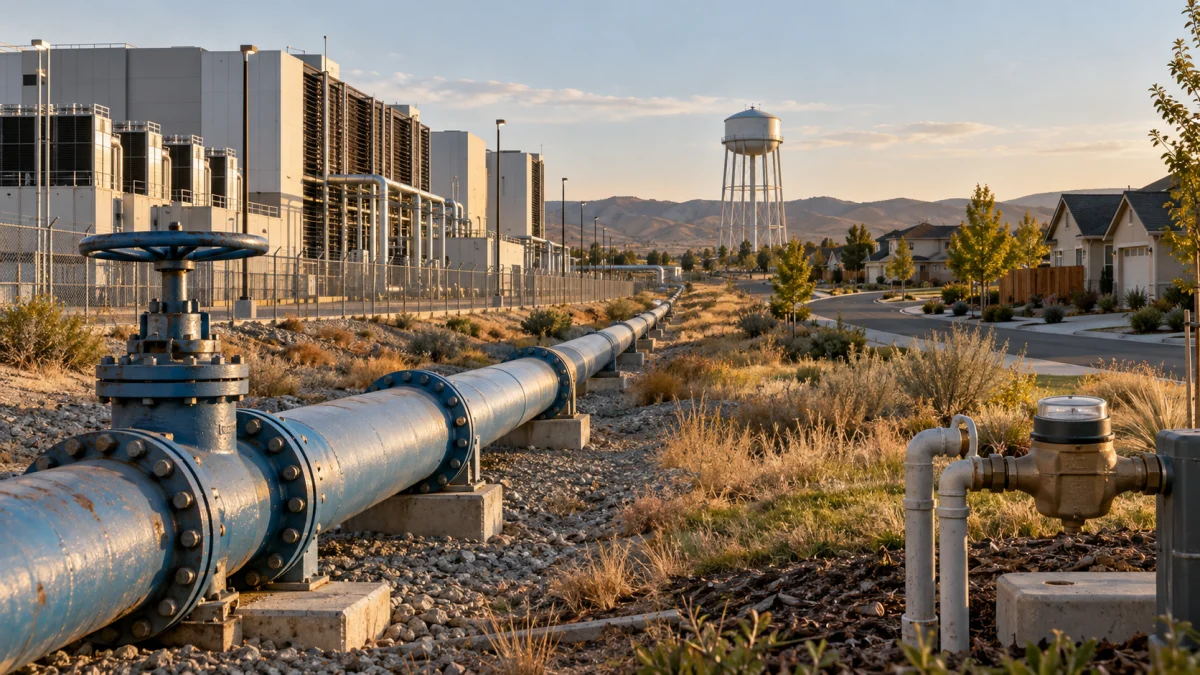
There is no established evidence that most data centers have contracts forcing cities to shut off residents’ drinking water first during a drought. But some municipalities have signed agreements that give data centers unusually explicit protections against water-service interruptions, including during shortages. Those protections raise legitimate questions about how much water is reserved, what a city can still restrict, and who bears the financial risk.
The distinction is visible in the contracts themselves. In Piqua, Ohio, a January 2026 agreement places a planned data center at no lower priority than indoor residential water use, while also giving public health, drinking water and essential services precedence. In Chesterfield County, Virginia, a 2020 agreement promises efforts to maintain service but permits reductions for legal and public-health reasons. A proposed agreement in Hermantown, Minnesota, explicitly puts residential areas and essential public services first. Piqua agreement, §5(a), p. 5; Chesterfield agreement, §7(a), pp. 4–5; Hermantown draft, §4.18, p. 8.
The question worth investigating is not simply whether data centers get water before people. It is what local governments promise industrial customers before a shortage, how those promises operate during one, and whether the public can examine the terms.
Is the claim that residents’ water must be shut off first true?
A social-media claim circulating in 2026 alleges that most data-center contracts require a municipality to disconnect residents before reducing water service to a data center. The claim also suggests that households lack comparable protections because they have no contract with the city.
That broader allegation is unsubstantiated. We found signed agreements containing preferential or protective industrial-service provisions, but no representative national survey establishing that most data centers have such clauses, and no evidence in the agreements examined that cities are categorically required to disconnect household drinking water before protecting the facilities.
The supposed absence of contracts for residents is also misleading. Household utility service is governed by municipal ordinances, utility tariffs, state law and applicable customer protections. An individually negotiated industrial agreement does not erase those obligations.
Three situations are frequently confused:
- Outdoor water restrictions come first. A city may prohibit lawn watering and other discretionary uses while continuing to supply households and businesses. That is not the same as cutting off residential drinking water.
- An industrial customer receives a service commitment. A contract may promise a specific allocation, reasonable efforts to avoid interruption, notice before a restriction or treatment comparable to a named customer class.
- A genuine emergency threatens essential supply. Public-health protections and emergency powers may permit or require restrictions that ordinary operating agreements do not anticipate.
Whether a particular agreement is appropriately protective of the public is a separate question from whether the viral claim is literally true.
What signed data-center water agreements actually promise
The relevant evidence is in the service-priority clauses, not in promotional claims about an industry’s economic value or in generalized estimates of AI water use.
| Location and customer | Document status | What the water-priority language provides | What it does not establish |
|---|---|---|---|
| Piqua, Ohio — J5 LLC, doing business as Shaytura LLC | Signed January 23, 2026 | No lower drought classification than indoor residential use, subject to specified public-health protections; residential and commercial irrigation restrictions anticipated first. | That household drinking water must be shut off before the project. |
| Chesterfield County, Virginia — Peanut LLC | Executed 2020 | Best efforts to preserve continuous service, with legal and essential public-health exceptions; no lower priority than other customers in its class. | That the project outranks every residential customer. |
| Hermantown, Minnesota — Harmony Group LLC / proposed Google project | Draft, not established as signed as of October 14, 2026 | Healthcare facilities, public services and residential areas would be prioritized during water shortages. | That the proposed terms are already binding or identical to higher-water-demand projects. |
| Ridgeland, Mississippi — Amazon | Signed agreement described in independent reporting | Large potential daily allocation; Amazon says it remains subject to commercial curtailment rules and that residential service takes priority. | That Amazon holds a superior legal drought priority over homes. |
Sources: Piqua’s signed agreement, Chesterfield’s agreement, Hermantown’s published draft and the Mississippi Free Press investigation of Ridgeland’s agreement. These examples are not a statistically representative sample of American data centers.
Piqua, Ohio: The project receives protection comparable to indoor residential use
On January 23, 2026, the City of Piqua executed a Water and Wastewater Agreement with J5 LLC, doing business as Shaytura LLC. The city’s current project information page identifies the development as a Meta project, although the contractual customer named in the agreement is J5/Shaytura.
Section 5(a), printed page 5, matters for three reasons.
First, the agreement explicitly says that when a shortage is declared, the city will prioritize public health and safety, including residential users, public services and healthcare facilities. It reserves an exception allowing the city to reduce the project’s supply when needed to provide sufficient drinking water for the imminent protection of residents’ health and safety.
Second, if Piqua creates water-shortage customer classifications, the project must receive no lower priority than indoor residential uses, apart from specified essential public-health and safety services. Section 3(a), printed page 4, also restricts how deeply the city may cut the project’s industrial allocation relative to percentage reductions imposed on indoor residential water use.
Third, the city anticipates restrictions on residential and commercial irrigation before restrictions on industrial users such as the customer. All three commitments appear in the executed Piqua water agreement, §§3(a) and 5(a).
What follows from those terms? The customer has negotiated more specific protections than a routine utility-service description would convey. Outdoor water restrictions can precede industrial restrictions, and the project has a contractual basis to challenge a drought classification below indoor residential use.
What does not follow? The document does not say the city must discontinue drinking water to households to keep the servers running. In fact, it expressly preserves essential protections for residents.
That distinction does not settle whether the allocation is wise or fair. It identifies the policy choice actually made: the city committed to keeping the industrial project relatively high in its shortage classifications while carving out essential public needs.
Chesterfield County, Virginia: Continuous service, but with exceptions
A 2020 agreement between Chesterfield County and Peanut LLC addresses continuous process-water service. Section 7(a), printed pages 4–5, commits the county to using its best efforts to avoid interruption during a shortage and says the monthly allocation should not ordinarily be reduced.
It also states that the county may restrict service when necessary to comply with local, state or federal requirements, or to meet essential public-health, safety and welfare needs, including sufficient potable drinking water to protect residents. Any shortage classification must treat the project at least as favorably as other customers in the customer’s class.
That final phrase is important. Being protected within an industrial class is not equivalent to having priority over households. The document creates a meaningful continuity commitment, but its exceptions substantially narrow the interpretation that the facility has an absolute claim on water.
Hermantown, Minnesota: A proposed agreement says residents come first
Hermantown provides a contrasting approach. Section 4.18(a), printed page 8, of its published development-agreement draft with Harmony Group LLC says the city would prioritize water and wastewater service to healthcare facilities, public services and residential areas in a shortage. Only without impairing those users would the city use reasonable efforts to minimize disruption to the data-center project.
The comparison requires two qualifications. The document was a draft, with blank execution and approval information. On October 14, 2026, Hermantown announced an October 26 City Council meeting to consider the proposed Google project’s permit and associated agreements. The provision should not be described as a signed promise unless a final version is obtained.
The draft also identifies up to 50,000 gallons per day of potable-water demand under its described domestic-water requirements, with separate fire-flow and temporary commissioning considerations. Those needs differ from other projects’ allocations and may change through subsequent agreements. Hermantown is a useful example of alternative wording, not proof that the projects have identical water requirements. Draft agreement, §§3.2, 4.18–4.19.
Can a city restrict a data center’s water during a drought?
Yes, depending on the governing law and the particular agreement. A promise to provide industrial water is not, by itself, an unconditional exemption from emergency restrictions. But a carefully negotiated service clause can affect what actions a utility may take without risking a contractual dispute.
The distinction between ordinary drought conservation and a public-health emergency is fundamental:
| Type of use or restriction | Why it matters during a shortage |
|---|---|
| Drinking, cooking, basic sanitation and essential household needs | Direct public-health consequences; many plans and agreements afford these uses special protection. |
| Hospitals, firefighting and other critical public services | Interruptions may threaten life and safety even if total usage is relatively small. |
| Lawn watering, ornamental landscaping and other discretionary irrigation | Often restricted early because these uses can be reduced without shutting off household drinking water. |
| Industrial processing and data-center cooling | Consequences depend on the system, available alternatives, curtailment classification and contractual terms. |
| Emergency service interruptions | May invoke statutory powers, utility rules, emergency declarations and express contractual exceptions. |
In Piqua, Municipal Code §53.42 authorizes designated city officials to order limitations or discontinuance of water use during an emergency. The executed project agreement separately sets out its water-service commitments and exceptions.
The ordinance and contract must be read together. The existence of an emergency power does not automatically tell us how every contractual dispute would be resolved; equally, the contract does not establish that officials have surrendered all emergency authority. A definitive answer would depend on the circumstances, governing law and potentially a court’s interpretation.
Reasonable inference: Strong continuity provisions create an incentive for a city to plan around a large customer’s allocated capacity and avoid restrictions that could trigger disputes. That is a real form of negotiated leverage. It is not evidence that an essential household water cutoff has occurred or would necessarily be lawful.
There is also a timing issue. A municipality may face its most consequential choice before a drought, when it decides how much capacity to reserve, which conservation measures to require and what shortage classifications to promise.
Reserved water is not the same as water actually used
Data-center reporting often moves between maximum allocations, projected demand, withdrawals and consumption as if they were interchangeable. They are not.
According to the U.S. Geological Survey’s water-use definitions, a withdrawal is water taken from a surface-water or groundwater source; consumptive use is the portion removed from the immediate water environment, including by evaporation. Water withdrawn may later return through a wastewater system or other return flows.
| Figure in a contract or report | What it tells readers | What it does not tell them |
|---|---|---|
| Reserved or allocated capacity | Amount the utility has committed to make available under defined conditions. | How much was withdrawn yesterday or will be consumed annually. |
| Maximum daily allocation | A daily quantity specified by the agreement. | A prediction that the facility uses that amount every day. |
| Annual allocation | The quantity listed for a year under that agreement’s terms. | Metered annual consumption or the same quantity as a daily peak multiplied by 365. |
| Projected water use | What the developer expects under stated assumptions. | A binding limit unless the agreement or law makes it one. |
| Measured withdrawals or delivered water | Volume taken from a source or supplied through a utility meter. | How much evaporated rather than returning to the local system. |
| Consumptive use | Water not promptly returned to the relevant water environment. | The entire gross amount of water delivered to the site. |
Piqua’s allocation table: Two tiers, not figures to be added together
Exhibit B, printed page 18, of Piqua’s executed contract gives the following cumulative water-capacity allocations:
| Stage | Daily water allocation | Annual water allocation | Stated development stage |
|---|---|---|---|
| Tier I | 500,000 gallons | 50 million gallons | Construction and startup |
| Tier II | 2 million gallons | 500 million gallons | Domestic, industrial and fire-suppression-related stage, with separately specified fire figures |
Source: Piqua Water and Wastewater Agreement, Exhibit B, Capacity Allocations. Tier II values are cumulative; the correct comparison is not 500,000 plus 2 million gallons per day. Exhibit B also distinguishes peak flow rates measured in gallons per minute from the daily allocations.
The numbers expose another common error. Two million gallons per day, sustained for 365 days, would equal 730 million gallons per year. But the same Tier II schedule lists a 500-million-gallon annual allocation, equivalent to approximately 1.37 million gallons per day averaged over a full year.
Those figures must be understood together under the contract’s terms. Neither the daily nor the annual allocation proves that the project currently withdraws, or will actually consume, that volume.
Ridgeland, Mississippi: Amazon’s reported estimate versus its peak allowance
The Mississippi Free Press obtained and examined Amazon’s Ridgeland water-service agreement in September 2026. The reporting found two very different figures: 93 million gallons of estimated annual use and a contractual peak withdrawal allowance of 3.67 million gallons per day.
The estimated annual figure averages to approximately 255,000 gallons per day. By comparison, using the maximum daily allowance on all 365 days would produce roughly 1.34 billion gallons annually, about 14.4 times the projected annual figure.
That is a comparison of theoretical capacity with a forecast, not evidence that Amazon will use 1.34 billion gallons. The company’s statement to the publication described the peak as an extreme-condition allowance, said the facilities could reduce withdrawals using on-site storage and recycling, and maintained that residential service takes priority under the city’s commercial-curtailment framework.
The legitimate reporting question is whether measured usage eventually matches the forecast, and whether the contract or utility rules require public notice if it does not.
Does closed-loop cooling mean a data center uses almost no water?
Not necessarily. A closed loop describes the circulation of coolant within part of a system. The heat carried by that coolant still has to go somewhere.
A facility may reject heat through dry air cooling, which can greatly reduce direct cooling-water consumption, or through an evaporative cooling tower. As the U.S. Department of Energy explains, some data centers circulate chilled water in one loop while transferring heat to another loop that ultimately relies on evaporation. A closed internal loop therefore does not, by itself, identify the water requirements of the complete installation.
This distinction makes Piqua’s disclosures worth examining. The city’s October 2026 project description describes a sealed water-and-glycol cooling loop that needs an initial fill and occasional top-offs, with daily use primarily for domestic needs. Yet §6(f), printed page 7, of the executed agreement anticipates that a significant portion of metered water will be consumed or evaporated, and requires separate wastewater metering. Piqua executed agreement.
These statements do not prove the city is misrepresenting actual water use. The contract may accommodate a wider range of cooling configurations, a previous design, future operating conditions or conservative capacity planning. The publicly reviewed evidence does not resolve which explanation is correct.
Reasonable inference: A general claim that cooling is closed-loop cannot settle projected site consumption without the full heat-rejection design, assumptions about operating hours, supplemental cooling, metered withdrawals and wastewater discharge. Those records, not the label alone, would answer the question.
Who pays for water-system expansion and long-term maintenance?
Data centers can finance pipes, pumps and treatment upgrades that also benefit other customers. They can also create long-lived obligations for public utilities. Whether a particular deal benefits or burdens ratepayers depends on the complete allocation of costs, not merely on who pays the initial construction invoice.
Piqua: Project funding and negotiated fee treatment can coexist
Piqua’s official project disclosures state that the developer is responsible for the utility improvements needed for the facility, with funding secured through an escrow mechanism, and that the project will pay the applicable utility rates. The city says local ratepayers will not face increases as a result of the project.
At the same time, §6(e) of the signed water agreement limits additional charges to those disclosed in its fee exhibit and waives specified other application, tap, connection and system-development fees. Section 6 also protects against charges imposed solely because the customer is a data center.
These facts are not necessarily contradictory. A developer may pay directly for new infrastructure while receiving negotiated treatment on standard fees. Whether the arrangement fully recovers future costs requires the underlying cost estimates, utility rate studies and maintenance obligations. The presence of a waived fee is not, by itself, proof of an unrecovered public subsidy; a city’s prediction that no costs will be passed through is not a substitute for an audited cost allocation either.
Ridgeland: Private construction spending, public contributions and municipal upkeep
The Mississippi Free Press reports that Amazon is spending approximately $37 million to expand Ridgeland’s water system, while related work also draws on a $3.6 million federal American Rescue Plan Act grant and $1.2 million in city funding. The agreement makes the city responsible for maintenance and repairs after improvements are completed. Read the publication’s contract-based investigation.
Ridgeland’s public works director told the publication that the upgraded system would benefit residents and could be maintained through ordinary budgets without substantial new costs. Specialists interviewed by the publication raised a different risk: if a major customer stops operating, an expanded utility system could remain while anticipated payments disappear.
Both are testable propositions. The relevant questions are how much of the expanded infrastructure serves existing demand, what ongoing maintenance costs are forecast, and whether the city has minimum-revenue guarantees or other protection against stranded capacity. The published record does not establish that Amazon has already caused a household water-rate increase.
Can residents find out how much water a data center uses?
Not always easily. Water-use data may exist in utility records while contracts and public-records exemptions complicate access.
In Piqua, §12(l), printed pages 11–12, treats the customer’s actual and projected consumption or usage data as confidential business information. It calls for the city to notify the customer promptly about relevant public-records requests and allow time to contest disclosure. The clause also expressly states that nothing in the agreement should conflict with Ohio public-records law. Read the original provision.
The proper conclusion is narrower than either extreme. The contract demonstrates a negotiated confidentiality process; it does not conclusively determine which requested records a court would require the city to release. Public access depends on state law, the nature of the record and any applicable exemption.
The issue has a documented history. In Oregon, a dispute involving Google, the city of The Dalles and a newspaper’s request for water-use records exposed how confidentiality claims and a litigation-cost arrangement can affect public access. Our earlier investigation, Did Google Pay The Dalles to Sue The Oregonian Over Water Use?, examines the original records and explains why the facts are more specific than the viral shorthand.
The importance of reliable metering is also illustrated by a separate incident in Georgia. In May 2026, E&E News reported that Fayette County discovered two improperly accounted-for connections serving a QTS data-center campus after residents complained about low pressure. More than 29 million gallons had not initially been billed, and the utility issued approximately $147,474 in retroactive charges. QTS said it paid; utility officials described metering and administrative problems that were subsequently corrected.
That incident does not establish a contractual right to take water ahead of residents, nor does it by itself prove what caused every pressure complaint. It does show why industrial connections, accurate meters and independently reviewable usage figures matter.
What can municipalities do before approving a data center?
Different jurisdictions have taken different approaches. On April 22, 2026, the Ypsilanti Community Utilities Authority approved a 12-month moratorium on new water and sewer commitments to covered data-center and computing projects while it undertakes further due diligence. That decision did not require a finding that data centers had already displaced residential customers. It allowed time to examine the effects before making new commitments.
Hermantown’s draft reflects another approach: write an explicit residential-first shortage rule into the proposed agreement. But the choice has to be evaluated alongside demand estimates, the sources of water, the utility’s existing commitments and state law.
The practical questions are whether enough reliable water exists under dry-year conditions, not merely whether a treatment plant can process the requested volume on a normal day; whether the developer can reduce cooling demand; whether recycled or nonpotable water is available; and whether the public utility can afford its long-term obligations.
California enacted two new water-related data-center laws in 2026
On September 21, 2026, California signed a package of data-center legislation, including two laws directly relevant to water use:
- AB 2469, Chapter 436 adds requirements for specified new data-center construction and expansions that increase peak demand. These include a water-supply assessment, projected usage and efficiency information, responsibility for the full cost of necessary water-system improvements as determined by the supplier, and a water-scarcity plan requirement beginning January 1, 2028.
- AB 2619, Chapter 437 requires specified water-use estimates with initial business-license or comparable applications, annual usage reporting on license renewal, and consideration of data-center demand in urban water-shortage planning.
Both were enacted in September 2026, with the usual effective date of January 1, 2027, subject to their particular provisions and future implementation. Neither creates a universal statewide rule that every data center must be the first customer disconnected during every shortage.
At the federal level, H.R. 10139, the proposed Ratepayer Bill of Rights Act of 2026, introduced on August 24, proposes restrictions on priority water access for covered data centers during emergencies and additional cost and supply protections. It was a proposal, not federal law, as of October 14, 2026. Its provisions should not be described as existing national protections.
The direction of these measures is significant: regulators are increasingly asking data-center applicants to document water availability and costs rather than relying solely on projected economic benefits. How much protection those measures ultimately provide will depend on implementation and enforcement.
How to check whether your city has promised a data center priority water service
A resident does not need a leaked agreement to begin. Municipalities, water districts and economic-development authorities may maintain public agendas, signed agreements, utility studies and drought plans. Disclosure rules differ by state, and some records may be withheld or redacted under applicable law.
Start with these records:
- Executed water and wastewater service agreements, including all amendments, exhibits and side letters. Do not confuse a staff presentation or draft with a signed agreement.
- Water-shortage contingency and emergency-response plans, including customer classes, stages of restrictions and public-health exceptions.
- Capacity-allocation schedules showing gallons per minute, maximum daily supply, annual volumes, phased increases and any expiration or reassessment conditions.
- Water-supply assessments identifying source reliability, dry-year projections, treatment capacity and competing existing commitments.
- Project cooling plans that distinguish sealed internal coolant loops from dry cooling, evaporative heat rejection, makeup water and discharge.
- Cost and rate documents covering construction, maintenance, connection fees, minimum payments, escrow security and who owns new infrastructure after completion.
- Available meter records and annual water reports, distinguishing delivered or withdrawn water from consumptive use and wastewater returned.
- Meeting minutes and approvals showing what the governing body actually authorized and whether proposed protections changed before signing.
A focused public-records request can begin with:
Please provide the fully executed water and wastewater service agreements, amendments, exhibits and capacity-allocation schedules for the proposed or operating data-center project; the water-shortage classifications and contingency plans applicable to that customer; the supporting water-supply and infrastructure-cost assessments; and any releasable monthly metered usage and discharge records. Please identify the legal basis for any withheld or redacted material.
If records are denied, ask for the particular statutory exemption rather than assuming that a company’s confidentiality designation is legally conclusive.
Frequently asked questions
Can data centers receive priority over residential lawn watering?
Yes. Piqua’s executed agreement expressly anticipates irrigation restrictions before industrial curtailment. That is not equivalent to granting industrial water priority over essential household drinking water. Piqua agreement, §5(a).
Does a signed water agreement prevent a city from declaring an emergency?
Not necessarily. Signed agreements can include public-health and legal-compliance exceptions; municipal emergency powers may also apply. The result depends on the exact provisions and governing law. Chesterfield’s agreement explicitly recognizes these exceptions. Chesterfield agreement, §7(a).
Is a two-million-gallon allocation proof that a data center consumes two million gallons every day?
No. It is a contractual capacity figure. Actual withdrawals require metering, and consumptive use requires accounting for what returns to the relevant water system. Piqua’s own allocation schedule contains a separate annual figure. Piqua Exhibit B; U.S. Geological Survey definitions.
Have we established that a U.S. city disconnected households’ drinking water to fulfill a data-center contract?
No. The agreements and incidents examined here do not document that sequence of events. That does not mean water-supply conflicts cannot occur; it means this particular allegation requires direct proof rather than inference from general contract language.
The conclusion the documents support
The viral allegation makes a sweeping claim about most data centers and residential shutoffs. The documents reviewed here do not support that generalization.
They establish a different, narrower concern. Some cities have promised large technology projects explicit protection against water curtailment, substantial reserved capacity and negotiated treatment of water-use information. Other cities have written residential priority into proposed agreements or paused new utility commitments to conduct further review. Those differences are documented, not hypothetical.
The reasonable inference is that the public’s leverage is greatest before a municipality commits scarce capacity and sets the rules for an emergency. That does not establish bad faith by officials or operators, and a developer-financed infrastructure expansion can provide genuine public benefits. It does mean that a promise of uninterrupted industrial water service is a consequential public decision, even if an emergency never occurs.
Residents should not have to choose between accepting an unsupported viral claim and accepting a city’s assurances on trust. The relevant questions are answerable: What exactly was signed? Who retains priority during a shortage? How much water has been allocated and actually used? Who pays if the assumptions fail?
The answers belong in the public record.
For the broader technology and environmental context, see our companion analysis of AI data centers and water use.
References and Further Reading
Executed Agreements and Municipal Records
- City of Piqua, Ohio — Water and Wastewater Agreement with J5 LLC d/b/a Shaytura LLC (executed January 23, 2026). Primary source for §§3(a), 5(a), 6(e)–(f), 12(l) and Exhibit B’s cumulative daily and annual allocations.
- City of Piqua — Data Center Project Information (updated October 6, 2026). City’s identification of the Meta project, account of cooling design, infrastructure-funding representations and approval timeline.
- Piqua Code of Ordinances, §53.42 — Emergency Limitations. Local authority for emergency water-use restrictions; legal interpretation must account for the contract and other applicable law.
- Chesterfield County, Virginia — Peanut LLC Tax, Rate and Water/Wastewater Service Agreement (2020). Primary text of continuous-service commitments, legal exceptions and same-class treatment.
- Hermantown, Minnesota — Draft Development Agreement with Harmony Group LLC (April 2026). Proposed, not established as executed; §§3.2 and 4.18–4.19 specify service needs and draft residential priority.
- City of Hermantown — October 26 Council Meeting Announcement (October 14, 2026). Establishes the pending consideration of permits and associated agreements at the article’s review date.
Legislation, Water Science and Technical Guidance
- California AB 2469 — Chaptered Text, Chapter 436 (2026). Enacted requirements concerning water-supply information, infrastructure costs and future drought planning.
- California AB 2619 — Chaptered Text, Chapter 437 (2026). Enacted water-use reporting and planning provisions.
- U.S. Congress — H.R. 10139, Ratepayer Bill of Rights Act of 2026 (introduced text). Federal proposal concerning utility priorities and customer safeguards; not enacted at the review date.
- U.S. Geological Survey — Water Use Across the Conterminous United States, Water Years 2010–20. Original water-use reference distinguishing withdrawals, consumptive use and return flows.
- U.S. Department of Energy — Cooling Water Efficiency Opportunities for Federal Data Centers. Technical explanation of chilled-water loops, evaporative heat rejection and efficiency options.
- UC Berkeley Law — Regulating Data Center Water Use in California. Analysis of regulatory issues and information gaps; predates California’s September 2026 legislation.
Independent Reporting and Further Context
- Mississippi Free Press — Inside the Private Deal Between Amazon and Ridgeland’s Water System (September 17, 2026). Original contract-based reporting on peak allowances, projections, public and private financing, and responses from Amazon and city officials.
- E&E News / POLITICO — A Data Center Drained 30M Gallons of Water Unnoticed (May 7, 2026). Original reporting on QTS, Fayette County’s metering failure, retroactive billing and residents’ concerns.
- WEMU — Ypsilanti Utilities Authority Approves Data Center Moratorium (April 23, 2026). Direct reporting on the 12-month pause and its purpose.
- Piqua Watch — The Water Agreement: What a Concerned Citizen Would Like to Know (August 13, 2026). Local document-based analysis of Piqua’s rate, priority, transparency and continuity provisions.
Editorial currency note (reviewed October 14, 2026): Draft agreements may change before execution. The Hermantown proposal, implementation of California’s 2026 laws, pending federal legislation and actual metered usage should be checked again before publication or a substantive update. This article interprets public documents; it does not present an attorney’s opinion on the enforceability of any specific contract.