Last verified: November 5, 2026 (Pacific time). This is a developing labor dispute. An extension, settlement or work stoppage after this date may supersede the status described below.
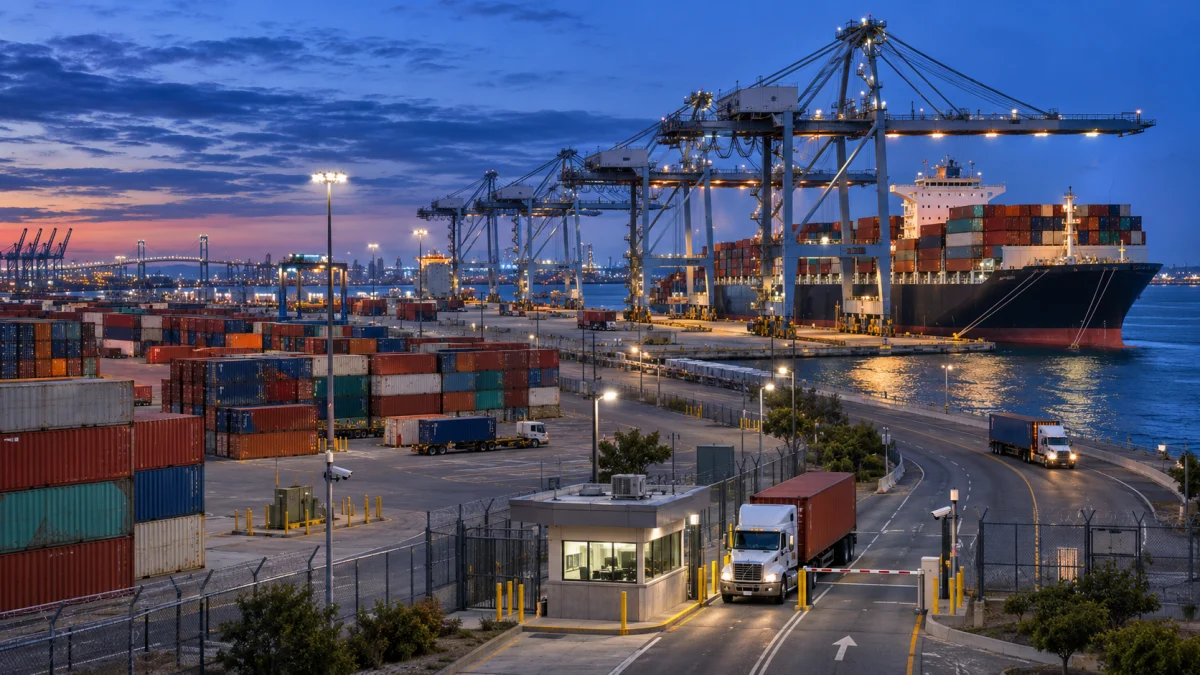
The ports of Los Angeles and Long Beach are facing a credible strike threat, but there is no verified port-wide shutdown. The immediate dispute involves approximately 250 terminal security workers, known as watchmen, represented by International Longshore and Warehouse Union (ILWU) Local 26. The Pacific Maritime Association (PMA), which bargains on behalf of participating employers, says the parties have extended their arrangement through midnight Friday night, November 6, 2026, while negotiations continue with federal mediators. The union has authorized a strike but an authorization is not the same as a walkout in progress. FreightWaves reported the November 5 status and extension; Bloomberg’s November 5 account reproduces the PMA’s updated deadline announcement.
The watchmen are not the full longshore workforce. Their separate bargaining agreement expired in July 2025, and other ILWU groups remain covered by coastwise contracts running through 2028. Nevertheless, a Local 26 walkout could disrupt container handling at major terminals if other waterfront employees honor qualifying picket lines. That is a serious operational possibility, not a guaranteed result.
The numbers circulating in headlines also need careful interpretation. PMA estimates that terminals employing the affected watchmen handle approximately 85% of the Port of Long Beach’s cargo and 33% of the Port of Los Angeles’s cargo. Those percentages describe cargo passing through potentially exposed facilities. They are not estimates that 85% and 33% of cargo will definitely stop, and they are not measured economic losses. The percentages are an interested employer association’s estimates, not independently audited disruption forecasts. PMA’s October 27 statement gives its position.
This dispute raises three different questions: What are the workers actually bargaining over? How could a small group affect so many other jobs? And who must keep working, who might be unable to work, and who pays if cargo stops moving? Answering them requires the actual agreements, not a reflexive assumption that either labor or management is right.
Is the Port of Long Beach on strike? The November 6 status
As of the latest publicly confirmed update reviewed on November 5:
| Question | Verified answer |
|---|---|
| Is a strike underway at both ports? | No port-wide walkout has been confirmed. The latest public reporting describes ongoing negotiations and a short extension. |
| Which workers authorized a strike? | Approximately 250 ILWU Local 26 terminal watchmen. |
| When does the extension expire? | PMA describes it as running through midnight Friday night, November 6, Pacific time, at the transition into Saturday, November 7. |
| Who is negotiating? | Local 26 and participating employers represented by PMA, with assistance from the Federal Mediation and Conciliation Service. |
| Does the main longshore contract expire? | No. The separate 2022–2028 coastwise agreement remains in effect. |
| Is every terminal at both ports affected? | No. The identified exposure concerns particular terminals and locations, not a confirmed closure of the entire port complex. |
What to watch next: a new union or PMA announcement, verified picket activity, an employer or terminal operating notice, and any formal labor-relations determination concerning a picket line. The expiration of an extension does not independently establish that a strike has begun. The PMA statements archive and actual terminal notices are more reliable than social posts repeating an earlier deadline.
How the dispute reached this point
The last published Local 26 Watchmen’s Agreement covers July 1, 2019, through July 1, 2025. Negotiations for a replacement continued after that period, and employers and the union agreed to extensions while bargaining proceeded.
In an October 23, 2026 letter to other maritime unions, Local 26 President Luisa Gratz said the union had participated in prolonged, unsuccessful negotiations and had not obtained a satisfactory result even with federal mediation. gCaptain reported the contents and context of that letter. PMA disputed the characterization of its conduct, saying it had offered wage and pension improvements and that substantial differences remained. The union initially contemplated action after November 1; a subsequent extension ran to November 4, followed by the current Friday-night extension.
The parties’ full current economic proposals, outstanding nonwage demands and exact settlement gap have not been established in the public documents reviewed. That limitation matters. It prevents a responsible conclusion that either side rejected a demonstrably fair offer.
Who are ILWU Local 26 watchmen, and what do they actually do?
Calling watchmen merely security guards obscures why their absence could matter to a major marine terminal.
The 2019–2025 watchmen’s agreement, Articles 1–3, recognizes several distinct types of work: gate and vehicle access control; cargo and dock watch; vessel gangway control; security monitoring and screening; rail-security assignments; patrols; vehicle and pedestrian traffic management; transporting authorized personnel within facilities; security logs; and certain assignments involving detained individuals. Required training includes first aid, safety, security and hazardous-material subjects. Duties vary by employer and terminal. These are documented functions, not an assumption that every watchman performs every task on every shift. Read the actual Local 26 agreement.
Two contractual details are especially important:
- Job jurisdiction is explicit. The agreement reserves recognized watchmen work, including specified gate-security functions, to the bargaining unit. Article 1 also addresses technological screening and says private security or governmental personnel are not to substitute for covered watchmen in their traditional assignments. These are provisions of the published agreement; their enforceability during or after a particular strike would depend on the legal and contractual circumstances.
- Terminal security has an independent regulatory dimension. Under 33 CFR §105.255, regulated facilities must maintain access control, credential checks, screening and other measures in their approved security plans. The rules do not say that only Local 26 can perform every legally required task. They do mean an operator cannot responsibly ignore security obligations simply because its normal security workforce is unavailable.
That distinction explains the possible disruption without exaggeration: watchmen work is both contractually protected and operationally embedded in terminal access. A terminal might face labor, security, staffing and legal constraints at the same time. Exactly what it can continue doing depends on its facilities, agreements, security plan and the actual picket situation.
Why job security and automation matter to these workers
The worker perspective cannot be reduced to a debate over one salary figure.
The ILWU’s own October 2022 issue of The Dispatcher reported that Local 26 ratified its prior agreement after lengthy negotiations and a near-unanimous strike vote. The union described gains involving not only wages and pensions, but the distribution of steady work, training and preservation of jobs at mechanized terminals. Those are the union’s account of the 2022 settlement, not an independent finding that every allegation it made about past negotiations was correct.
The union’s June 2024 convention record included a resolution supporting Local 26’s work and jurisdiction. In the same issue, Gratz argued that automation and new technology can displace workers and weaken the employment base supporting pensions and local communities. That establishes a documented, longstanding concern about preserving work. It does not prove automation or jurisdiction is an outstanding item in the November 2026 talks.
The economic logic is understandable. In a capital-intensive industry, a change in technology can affect future jobs, dispatch opportunities, the distribution of hours and retirement-plan contributions long after the immediate contract’s wage rates have changed. Employers, on the other hand, may seek productivity improvements, modern equipment and more flexible staffing. Whether a proposed change is efficient, harmful, fairly compensated or prohibited is a question about its actual terms and consequences, not a slogan about robots or unions.
How much do Long Beach port watchmen make? Checking the $170,000 claim
PMA says full-time watchmen currently average more than $170,000 annually, plus employer-funded healthcare and pension benefits. The number is relevant, but PMA’s public statement does not provide the payroll distribution, hours worked, overtime shares or methodology needed to assess what it means for a typical employee.
The expired, publicly available agreement gives us a more concrete baseline:
| Effective date under 2019–2025 agreement | Straight-time hourly rate | Listed 1.5× overtime rate |
|---|---|---|
| July 1, 2019 | $37.28 | $55.92 |
| July 2, 2022 | $44.64 | $66.96 |
| July 1, 2023 | $46.64 | $69.96 |
| June 29, 2024 | $48.64 | $72.96 |
Source: Local 26 Watchmen’s Agreement, Article 5. These are historical contractual rates, not independently verified November 2026 pay rates. The last agreement was ratified in 2022 with retroactive provisions.
At $48.64 per hour, a purely illustrative 40 hours per week for 52 weeks produces $101,171.20 in straight-time gross wages. That is not a claim that a watchman actually worked that schedule or received that annual amount.
The contract separately provides for weekend and holiday overtime, a $2-per-hour night differential, and differentials for designated sergeant roles. Under a simplified model using 40 straight-time hours weekly and overtime at $72.96 per hour, the difference between $101,171 and $170,000 equates to roughly 18 additional overtime hours per week over a full year. The model ignores paid leave, holidays, irregular assignments, differentials, and potentially different rates after 2025. It is a mathematical illustration, not evidence of actual schedules.
An average also is not a median. High-earning workers with extensive overtime can lift the average above what many others earn. Conversely, it would be wrong to dismiss a verified high average simply because it is politically inconvenient. The unanswered questions are the average hours worked, the distribution of gross earnings, how many workers qualify as full-time, and what proposed compensation changes would cost.
Most fundamentally, whether $170,000 is high is not the same question as whether a proposed labor contract is fair. A negotiation may also involve retirement security, job assignments, staffing, technology, benefits or work jurisdiction. The public record does not yet establish which of those issues are actually preventing this agreement.
How could 250 workers affect most of Long Beach’s cargo?
A port is a network of connected activities, not a single employer with a single workforce.
A container vessel can reach its berth with licensed officers and crew ready, a crane physically available, truckers waiting and rail service scheduled. Yet the cargo still cannot move normally if the required terminal labor, access controls, supervision or safe operating arrangements are unavailable. Bottlenecks are determined by essential dependencies, not by the headcount of the smallest group.
A possible disruption sequence is:
- Local 26 watchmen begin a strike at one or more covered employers’ facilities.
- Picket lines appear at specific locations; their status under other ILWU agreements becomes important.
- Longshore workers, marine clerks or foremen may decline work in circumstances their contracts recognize.
- Affected vessel shifts, yard movements, gate transactions and rail transfers may be suspended or constrained.
- Trucks and marine contractors lose access to work, while vessel calls and inland deliveries may have to be rescheduled.
Every step after the first is conditional. It is possible for an individual terminal, berth or shift to be affected without all facilities at both ports closing. It is also possible for some shipboard and public-safety activities to continue while commercial cargo handling stops.
Why the 85% and 33% figures do not mean an 85% or 33% shutdown
The employer’s figures concern the normal cargo throughput of terminals where Local 26 members work. They are not a calculated fraction of total traffic that would be halted by an actual strike. Affected facilities could continue certain operations, unaffected facilities could remain open, and some cargo could be delayed rather than permanently lost. The combined share cannot be obtained simply by averaging 85% and 33%, because the two ports have different cargo volumes.
There are at least four distinct quantities that headlines often blur:
| Measure | What it means |
|---|---|
| Cargo at potentially affected facilities | Exposure to an operational risk |
| Cargo movements actually canceled or deferred | Observable immediate disruption |
| Cargo moved later or rerouted | Delay and added cost, not necessarily a permanent trade loss |
| Permanently lost economic output | A much harder figure requiring evidence about downstream production and alternatives |
No reliable public measurement of the final three exists yet for a strike that has not been confirmed. Neither a daily cargo value nor an annual port-trade value can simply be relabeled a daily economic loss.
Which port terminals could be affected?
Reporting based on Local 26’s strike notice identifies eight locations. PMA refers to six container terminals. That apparent disagreement is mostly a counting issue: the longer list includes two non-container facilities. The list identifies exposure, not a live closure notice for each location. gCaptain and SupplyChainBrain provide the detailed breakdown.
| Identified location | Facility type in published reporting | What is established |
|---|---|---|
| APM Terminals, Pier 400 | Container terminal | Named among potentially affected facilities |
| Long Beach Container Terminal (LBCT) | Container terminal | Named among potentially affected facilities |
| Total Terminals International (TTI) | Container terminal | Named among potentially affected facilities |
| SSA Marine, Berth C-60 | Container-terminal operation | Named among potentially affected facilities |
| SSA Marine, Berth A-90 | Container-terminal operation | Named among potentially affected facilities |
| Pacific Container Terminal (PCT) | Container terminal | Named among potentially affected facilities |
| SSA Marine, LB 206 | Non-container facility | Included in the wider union-notice location list |
| Outer Harbor, Berth 55 | Non-container facility | Included in the wider union-notice location list |
A vessel’s carrier name does not, by itself, establish the operating status of its assigned berth. Nor should readers assume all eight locations are container terminals. Before acting on a shipment, verify the specific terminal, berth, vessel and gate advisory.
Can ILWU longshoremen, marine clerks and foremen refuse to cross the picket lines?
Some contracts expressly recognize refusals to cross qualifying picket lines. They do not grant every worker an unconditional right to stop working whenever anyone is picketing.
This distinction is established in three separate published agreements:
| Workforce | Agreement | Relevant rule |
|---|---|---|
| Local 13 longshore workers, including many crane, vessel and yard occupations | Pacific Coast Longshore Contract, 2022–2028 | Section 11.51 says refusing to cross a legitimate and bona fide picket line, as specifically defined, does not violate the agreement. |
| Local 63 marine clerks | Pacific Coast Clerks’ Contract, 2022–2028 | Section 11.51 contains a parallel qualified protection. |
| Local 94 walking bosses and foremen | Walking Bosses and Foremen’s Agreement, 2022–2028 | Sections 11.2–11.5 define qualifying lines and distinguish pay before and after an arbitrator’s determination. |
The longshore and clerks’ agreements exclude certain categories of picketing, including collusive, jurisdictional, hot-cargo, secondary-boycott and demonstration lines, from their contractual definition. Their 2014 picket-line letter also says that, where a party requests an immediate Joint Port Labor Relations Committee meeting concerning an ILWU affiliate’s proposed line, that meeting must occur within 24 hours, and an affiliate line cannot qualify under that letter without the meeting. See the Picket Lines addenda to the longshore agreement.
This makes it incorrect to say the wider longshore workforce must stop work, just as it is incorrect to assume the broader contract automatically forbids honoring Local 26. The status of a particular line, any required process, and the instructions applicable to that worker matter. A contractual exception to a no-strike clause is not interchangeable with a universal rule of federal labor law.
There is also a financial dimension. Under relevant contract provisions, observing a picket line does not automatically mean a worker receives ordinary wages for the missed time. The Local 94 foremen’s agreement, for example, provides for actual time worked before the specified arbitration determination and contractual minimums for workers ordered and reporting after a qualifying determination. A worker’s financial exposure cannot be inferred solely from union solidarity.
For union members facing an actual assignment, the correct sources for individual instructions are their union’s official guidance, the applicable bargaining agreement and documented labor-relations decisions. Neither an employer press release nor a general news article can substitute for a case-specific determination.
Which other union jobs and port workers could be affected?
The word longshoremen is frequently applied to everyone who works around a seaport. Legally and operationally, that is wrong. Several people may work on the same container, vessel or berth while being employed under completely different agreements.
| Workers or services | Direct Local 26 strike participants? | Realistic consequence if a terminal stops cargo work |
|---|---|---|
| Local 26 watchmen | Yes | Direct strike participation, potential lost wages, and the eventual terms of the new agreement |
| Local 13 longshore workers | No | Vessel loading/discharge, lashing, crane work and yard operations may pause at affected facilities where qualifying lines are observed |
| Local 63 marine clerks | No | Vessel planning, container-movement coordination and documentation work may be delayed under their own agreement |
| Local 94 foremen/walking bosses | No | Supervision and work allocation may be disrupted; their distinct picket-line and pay rules apply |
| Mechanics and maintenance/repair employees | Generally no | Equipment service and repair assignments may be delayed; representation depends on the particular job and employer |
| Local 63 Office Clerical Unit employees | No | Some dispatch, administrative, documentation and customer-support work may continue remotely or be constrained by unavailable terminal operations; the OCU is not the marine clerks’ bargaining unit |
| Other unionized service and construction workers | No | Individual terminal assignments may be canceled or inaccessible; their own agreements govern any right to decline work |
| Rail crews and on-dock intermodal staff | No | Trains may run while particular containers cannot be released, loaded or transferred within a terminal |
| Truck drivers and drayage employees | No | Missed turns, unpaid time, canceled appointments, equipment-return problems and reduced load opportunities |
| Warehouse and distribution workers | No | Work may decline or shift when inbound cargo is delayed, with different effects depending on inventory and employer policies |
The ILWU Local 63 Office Clerical Unit lists separate agreements with numerous shipping and terminal companies. Its own description of the unit distinguishes office clerical work from the coastwise marine clerks. Membership in the same larger union family does not make all contracts interchangeable.
Does a shutdown mean everyone loses their paycheck?
No single answer applies. A casual worker who receives fewer dispatch opportunities, an employee on a guaranteed schedule, a salaried public worker, a crew member signed aboard a vessel and an independent owner-operator have very different arrangements. Some are paid for time actually worked; others may be paid during an interruption; some may lose expected overtime rather than regular wages; independent contractors may carry the cost of being unable to perform a scheduled job.
An interrupted shift also differs from a canceled future assignment. The employment effect is the interaction of the job’s contract, employer, status, dispatch method and what actually happens at the facility.
What happens to vessel crews, captains and licensed marine officers during a port strike?
A ship that cannot load or discharge cargo is not automatically a ship whose crew has stopped working.
A vessel alongside still needs appropriate navigation or harbor watches, machinery supervision, mooring safety, fire and emergency readiness, and compliance with its flag-state and applicable port requirements. The master retains command and safety responsibilities. Licensed deck and engineering officers and unlicensed crew may therefore continue performing shipboard duties even if the terminal’s commercial cargo operation is suspended.
The practical effects depend on what the ship needs next:
- Cargo operations: crane, lashing, yard and clerk work may not proceed at a picketed terminal. Shipboard tasks supporting safe operations can continue, but that does not replace terminal labor.
- Berth and sailing plans: a carrier might keep a ship alongside, delay arrival, wait at anchorage, change the port rotation, or reschedule a departure. A ship cannot simply decide to maneuver in restricted waters without required services and authorizations.
- Crew changes and shore leave: a seafarer may be able to work aboard while shore-side gate access, transport and relief arrangements are delayed. A valid crew document or TWIC does not override every facility-access restriction.
- Provisioning, repair, inspection and bunkering: each operation depends on its location, access route, contractor, security arrangements, safety requirements and whether relevant staff are available. Some services may still proceed.
A ship may have licensed officers represented by the Masters, Mates & Pilots, Marine Engineers’ Beneficial Association, American Maritime Officers or another organization; it may also be a foreign-flagged vessel with different employment contracts. No single seafarers’ union rule can be assumed for all ships at Los Angeles and Long Beach. Public evidence reviewed did not establish a blanket instruction requiring all vessel officers to join a Local 26 action.
A legitimate question for officers is whether a particular order involves essential ship safety, ordinary shipboard work or entry into an active picketed facility. Those are distinct cases, and the answer may depend on the seafarer’s collective agreement, flag, assignment and instructions from authorized maritime and union representatives. General commentary should not be used as individual legal or disciplinary guidance.
Will harbor pilots, tugboat crews, line handlers and surveyors keep working?
Harbor pilots
The Port of Los Angeles operates a city-staffed pilot service, with its own dispatch and navigational responsibilities. The port’s pilot-service page describes a 24-hour operation and requires advance notice for movements. Pilotage arrangements at Long Beach are separately organized. Neither group is part of Local 26 bargaining merely because both support cargo vessels.
If a vessel stays at berth because cargo work is delayed, that vessel may not need a planned departure pilot when originally scheduled. If operators reorder berthing or departures, pilots may instead face changed demand. A delay in pilotage assignments does not mean harbor pilots are themselves on strike. The same general distinction applies to tugboats, launches and line-handling services.
Marine surveyors, classification inspectors and other boarding contractors
For a surveyor, the first useful question is often more specific than “Is the port closed?” It is “Can I enter the assigned terminal and board the relevant vessel for the scheduled work?”
Under 33 CFR §105.255, facility access must be controlled. The regulation recognizes work orders, pilot orders and surveyor orders as examples of documents used when verifying an authorized visitor’s purpose, alongside other applicable credentialing and escort requirements. It does not guarantee admission during a strike or permit someone to bypass a picket or facility security procedure.
Cargo surveyors, damage surveyors, draft surveyors, class inspectors, bunker surveyors, ship repair contractors and chandlers should verify the terminal and gate, berth and vessel, authorized appointment, escort and TWIC requirements, and agent or facility confirmation before traveling. A terminal-side inspection and a shipboard inspection may have entirely different access constraints.
Vessel agents, marine service providers and public officials
Vessel agents can continue coordinating schedules, documentation and services, but their ability to execute a boarding or delivery depends on the actual terminal conditions. Customs and other government officers retain their public responsibilities; whether a specific inspection or physical access is possible is a separate operational matter. Crew change transport, chandlery and waste collection may be delayed even when the corresponding businesses remain fully staffed.
Are Port of Long Beach and Port of Los Angeles employees going on strike?
Not by virtue of this Local 26 dispute. The municipal harbor departments and their employees are different from the private marine-terminal employers bargaining through PMA.
The Port of Los Angeles explains its employment structure: many jobs at terminals, railroads, shipping lines and logistics companies are supplied by separate port tenants and contractors. The port’s own functions include public safety, planning, engineering, real estate, finance and operations oversight. These employees do not automatically lose their right to work because a tenant’s security employees strike.
The Long Beach Post’s October reporting quoted Port of Long Beach leadership explaining that the harbor department is not a party to the negotiations and that port-wide Harbor Patrol and Long Beach Police Department security services continue. This is not the same as saying individual private-terminal security posts can operate normally without their assigned workforce.
Public staff may still face a heavier workload, altered inspections, traffic management or postponed projects. A port authority’s ability to remain open and a terminal’s ability to process cargo are separate questions.
What happens to truckers, containers, rail and warehouses?
When a terminal cannot move boxes through its gates or yard, the consequences can spread rapidly beyond the waterfront:
- A container may be discharged but not released for pickup, or a vessel may not be discharged at all.
- A truck driver may lose a pickup or empty-return appointment, potentially losing paid work time.
- Containers needed for export may miss a receiving window. Imports may miss rail connections or distribution appointments.
- Chassis, empties, warehouse labor and distribution equipment may become unavailable at the intended place or time.
- Even after work resumes, the system may require additional shifts or revised vessel, truck and train schedules to clear accumulated work.
None of this is inevitable for every shipment. Cargo already outside a facility may move normally. Some terminals may remain open. An importer with inventory on hand may have little immediate effect; a manufacturer relying on one time-sensitive part can face a severe interruption. A work stoppage’s economic impact depends on duration, specific facilities, available alternatives and how quickly operations recover.
For an independent drayage owner-operator, disruption can be particularly asymmetric: the driver may not be a party to the dispute but can still incur fuel, equipment, appointment and lost-revenue costs. That effect deserves reporting without turning the trucker into an argument that watchmen should forfeit bargaining power.
If cargo is delayed, who pays demurrage, detention and other charges?
A labor-related delay does not automatically cancel shipping charges, but neither is every charge during a closure necessarily lawful or reasonable.
The first distinction is technical:
- Container demurrage generally concerns a container remaining at a marine terminal beyond applicable free time.
- Container detention generally concerns keeping carrier equipment outside the terminal beyond applicable free time, such as a late empty return.
- Vessel charterparty demurrage is a different contractual concept relating to a ship’s time under certain charter arrangements. It should not be conflated with container invoices.
The Federal Maritime Commission (FMC) has stated that detention and demurrage practices must serve legitimate freight-fluidity purposes and that it can scrutinize charges arising during terminal closures. In a 2026 appellate decision summarized by the FMC, the court upheld a fact-specific finding that detention charges were unreasonable when a trucker had no practical opportunity to return equipment during a three-day closure. That is not a blanket nationwide waiver for any labor action.
There is also a significant recent change often missing from older guides. In September 2025, the D.C. Circuit set aside 46 CFR §541.4, which had restricted who could be billed for detention and demurrage. The FMC explains that other provisions of Part 541 remain effective, including invoice-content and timing requirements. See the FMC’s explanation of the appellate decision and 46 CFR §541.7.
A practical dispute turns on evidence: the specific container or equipment number; the published and actual gate hours; an appointment rejection; when the equipment became available; the last free day; any customer or carrier notice; the invoice date and required details; and the actual legal and contractual terms. Keep screenshots, appointment records and timestamped terminal advisories. The FMC describes complaint and assistance procedures for contested charges. Because the agency’s rules and court decisions have changed, avoid relying on an old blanket assertion about who can or cannot be billed.
Separate commercial contracts may allocate delay risk differently. A vessel owner, charterer, carrier, cargo owner, freight forwarder, trucker and terminal can face different obligations. An otherwise substantial gross cargo value says nothing by itself about who is contractually liable for a particular hour of delay.
The Vincent Thomas Bridge closes November 7. Is that connected to the strike?
The timing overlaps; the projects are not the same event.
Caltrans has announced that the Vincent Thomas Bridge (State Route 47) will close at 12:01 a.m. Saturday, November 7, 2026, for an approximately 16-month deck-replacement project, with reopening targeted for early 2028. The project is planned independently of Local 26 negotiations. Caltrans’ October 22 closure announcement supplies the schedule and rationale.
The bridge closure will redirect motorists and trucks through alternative routes. The Port of Los Angeles’ bridge-project information addresses traffic management, and Maersk’s November 4 advisory anticipates traffic delays while stating the road closure itself is not expected to interrupt vessel navigation or terminal operations.
If labor disruption also occurs, the combination could complicate driving routes, appointments, staff commuting and recovery scheduling. But a missed truck appointment due to a bridge detour is not automatically evidence of a union work stoppage. The causes, and potentially the contractual consequences, differ.
What would a strike actually look like? Four defensible scenarios
| Scenario | What follows | What does not follow automatically |
|---|---|---|
| Negotiated agreement or another extension | Normal operations may continue while bargaining is resolved or prolonged | No guaranteed long-term settlement from a short extension |
| Local 26 strike with limited operational effects | Individual security posts, access arrangements or shifts may be affected | No automatic shutdown of every terminal |
| Picket lines recognized and honored more widely | Vessel, yard, gate or rail-transfer work may stop at particular facilities | No proof that every other union, vessel officer or municipal worker is on strike |
| Extended stoppage followed by restart | Backlogs and irregular vessel, trucking and rail schedules may persist | No sound basis for treating the entire cargo value as permanently lost |
There is no sufficiently grounded public evidence to assign probabilities to these outcomes. Both sides may have powerful incentives to reach a settlement before work stops: employers want operating certainty and workers may want enforceable improvements without a prolonged interruption of wages. Incentives explain possible behavior; they do not predict the outcome.
The labor dispute, evaluated from both sides without inventing a verdict
What the workers have a substantial basis to argue
Local 26 represents workers performing defined work that is tied to the security and functioning of large marine terminals. Their published agreement documents wages but also safety training, work jurisdiction, dispatch, retirement benefits and technological change. The union’s historical publications show that protecting the availability and character of these jobs has been a continuing priority.
A high wage does not erase a worker’s interest in safe staffing, future employment, retirement security or fair contractual terms. The ability to bargain collectively is part of how these jobs acquired their current terms. Watchmen also bear direct economic risk if they strike. An analysis that treats them as an expensive obstacle to cargo flow, rather than as working participants in that flow, fails to explain the industrial system.
What employers have a substantial basis to argue
Marine-terminal operators need reliable security, staffing and vessel schedules. An interruption can impose costs on carriers, contractors, cargo customers and workers not represented by Local 26. Compensation, productivity, cost predictability and operational flexibility are legitimate negotiating subjects. PMA’s statement that it has offered wage and pension improvements is a fact about its public position and should be reported as such.
But a press-release characterization of an offer as generous is not enough to establish its value. Without the full offer, we cannot know whether increases are offset by changes to staffing, retirement terms, work assignments or other conditions. Nor can we assume that all such offsets exist. The evidence works in both directions.
What the public and unrelated workers are entitled to know
The strongest unresolved question is not “Are the watchmen paid too much?” It is: What exactly separates the union’s last proposal from the employer’s last proposal, in money and in enforceable employment conditions?
That requires, at minimum, a clear list of open articles and the actual proposed economic terms. Neither side’s public statements currently supplies that complete comparison. The claim that bargaining has stalled cannot, on this evidence alone, be converted into a reliable finding about which side is responsible.
The same discipline should apply to downstream costs. Truckers, importers, seafarers, terminal contractors and ordinary consumers may face genuine consequences, but a disruption’s costs should be documented and allocated, not used as an automatic argument against collective bargaining. The economic consequences of a strike are evidence about its reach, not proof that the workers lack a legitimate grievance.
What should workers, crew, surveyors and shippers check right now?
For anyone whose job or shipment may be affected, the most practical response is verification at the actual workplace or cargo location, rather than a general claim that “the port is closed.”
- Confirm your location. Identify the port, terminal, berth, vessel and shift or appointment. A carrier’s general advisory does not necessarily establish that every facility it uses is affected.
- Check the right authority. Union workers should obtain dispatch and picket-line guidance from their own union and governing agreement. Vessel crews should check with the master, company and relevant seafarer representative. Outside contractors should confirm access with the terminal and vessel agent.
- Separate access from employment. A site may deny entry even when a person remains employed and available for work. A ship may remain safely crewed while commercial cargo work is suspended.
- Preserve documents. Save gate advisories, canceled appointments, emails, shipment milestones, equipment-availability records and invoices, especially when financial charges or missed assignments may later be contested.
- Recheck both weekend developments. The labor extension is currently scheduled through Friday night, while the separately planned bridge closure begins at 12:01 a.m. Saturday. Terminal disruptions and road detours must not be confused.
This is not an instruction to cross or disregard any picket line. Personal rights and obligations depend on the worker’s actual agreement and circumstances. For urgent safety and access questions, use the appropriate employer, union, vessel-command or public authority channel.
Frequently asked questions
Are all Long Beach longshoremen going on strike November 6?
Not according to the latest confirmed information. ILWU Local 26 watchmen have authorized a possible strike. The broader longshore workforce has a separate agreement through 2028, and whether individual longshore workers would honor a qualifying Local 26 picket line is a separate contractual and operational question.
What time could a port strike begin?
The latest announcement extends the Local 26 agreement through midnight Friday night, November 6, Pacific time. That is a negotiating deadline, not confirmation of an actual walkout at that hour. Check for an updated union, PMA or terminal notice before treating the date as a strike start.
Will the entire Port of Los Angeles or Port of Long Beach shut down?
That has not been established. PMA’s cargo-exposure percentages concern facilities employing Local 26 watchmen, not a verified total-port closure. Activity can vary by terminal, berth, job and shift. Public harbor services are separately operated.
Can longshore workers cross a Local 26 picket line?
Their contract recognizes refusals to cross qualifying legitimate and bona fide picket lines, subject to defined conditions and procedures. A worker’s applicable contract, the actual picket line and official guidance matter; neither an unconditional duty to cross nor an unconditional right to refuse can be assumed.
Do ship captains, officers and crews have to stop working?
No general rule establishes that. The vessel must still meet its applicable safety and manning obligations. Cargo handling may stop while shipboard watches and engineering duties continue. Shoreside access, vessel scheduling and the individual’s employment agreement require separate consideration.
Will pilots, tugboats and surveyors still work?
Those services are not automatically parties to the Local 26 strike. However, vessel moves may be delayed and access to a specific terminal or ship may be unavailable. Confirm the actual assignment with the pilot service, vessel agent or terminal.
Can a terminal use other security workers?
A terminal must maintain security measures required by its facility plan, but the published Local 26 agreement also contains significant job-jurisdiction and substitution restrictions. What alternatives would be lawful and workable during a particular dispute cannot be determined without current agreements, labor law, staffing arrangements and security obligations.
Do importers automatically receive demurrage or detention waivers?
No. Charges may be disputed under applicable federal rules, contracts and fact-specific reasonableness standards. An inability to pick up or return equipment may be important evidence, but a blanket waiver is not established merely by the word strike.
Is the Vincent Thomas Bridge closure part of the strike?
No. It is an unrelated Caltrans construction closure scheduled to start early Saturday, November 7. It may compound road-access problems if labor disruption also occurs, but it is not caused by the collective bargaining dispute.
What the evidence supports, and what it still cannot tell us
Established: Local 26 watchmen have a distinct bargaining agreement; a strike has been authorized; the most recently confirmed extension runs through Friday night, November 6; the union’s work is embedded in terminal security; other ILWU contracts contain qualified protections for honoring certain picket lines; and identified terminals handle a large proportion of the two ports’ cargo.
Attributed claims, not independently audited findings: PMA’s 85% and 33% cargo shares; its reported full-time average pay above $170,000; its description of the current economic offer; and each side’s assessment of bargaining progress.
Conditional consequences: a halt to specific vessel, yard, gate or intermodal work; foremen, clerks and longshore workers declining certain assignments; ship rescheduling; trucking delays; and additional cargo-related costs.
Still unknown: the exact remaining contract disputes, a reliable comparison of last offers, actual terminal-by-terminal strike plans, any final determination about a particular picket line, and the size and duration of a disruption that has not occurred as of this verification.
The broader significance is clear even while those questions remain unanswered. Modern ports rely on workers whose occupations, pay systems, legal obligations and bargaining agreements differ sharply, yet whose work is tightly connected. A relatively small group can have substantial leverage because its work is part of an essential operational chain. That reality does not prove every union demand is justified. It also does not make workers responsible for every downstream cost of a dispute they are trying to settle.
The real issue is not whether 250 workers are capable of disrupting billions of dollars in trade. It is what their work is worth, what each side is actually asking for, and how a system that depends on them distributes both its rewards and its risks.
References and Further Reading
Primary contracts and union records
- ILWU Local 26 Watchmen’s Agreement, 2019–2025 — PMA’s full published contract. Articles 1–3 define covered security work and job jurisdiction; Articles 5–7 contain wages, premiums and daily guarantees; later provisions address dispatch, benefits, safety and technology.
- Pacific Coast Longshore Contract, 2022–2028 — Governs the relevant coastwise longshore work and the qualified picket-line exception in Section 11.51; see also the 2014 picket-line letter.
- Pacific Coast Clerks’ Contract, 2022–2028 — Separate agreement governing marine clerks, including its own Section 11.51.
- Pacific Coast Walking Bosses and Foremen’s Agreement, 2022–2028 — Sections 11.2–11.5 govern qualifying lines and certain pay consequences for foremen.
- The Dispatcher, October 2022, page 3 — ILWU’s own account of the previous Local 26 negotiations, ratification, wages, work-preservation measures and retirement provisions.
- The Dispatcher, June 2024, convention resolutions and candidate statements — Primary evidence of the union’s historically stated concerns about Local 26 job jurisdiction and automation; not evidence of an outstanding 2026 bargaining proposal.
- ILWU Local 63 Office Clerical Unit: Employers Under Contract — Establishes the separate office-clerical bargaining structure used by shipping and terminal companies.
Current negotiations and independently reported details
- Pacific Maritime Association, October 27 statement on Local 26 negotiations — Employer’s negotiating position, compensation claims and estimated cargo exposure; should be read as an interested party’s statement.
- Pacific Maritime Association: Statements and Press Releases — Official employer updates; check for subsequent agreements or extensions.
- FreightWaves, November 5: Port Strike Delayed Again — Documents the November 6 extension and continued mediation.
- Bloomberg News via Transport Topics, November 5: Strike Deadline Pushed to November 6 — Independent reporting reproducing the employer’s updated deadline statement.
- gCaptain: Strike Threat Looms at Eight Terminals — Reports Local 26 President Luisa Gratz’s October 23 letter, employers’ response and the location list.
- SupplyChainBrain: Ports Face Loading Delays, Looming Strike — Distinguishes six container terminals from two other locations.
- Long Beach Post: Security Workers’ Strike Vote and Port Response — Local reporting on the vote, harbor administration and continued port-wide public safety services.
Security, marine operations and shipping charges
- 33 CFR §105.255: Maritime Facility Access Control — Federal rules governing access, credentials and screening, including verification of surveyor and pilot orders.
- Port of Los Angeles: Pilot Service — Describes the city-run pilotage function and vessel-movement procedures.
- Port of Los Angeles: Employment and Port-Tenant Jobs — Distinguishes city harbor employees from separately employed terminal and logistics workers.
- Federal Maritime Commission: Appellate Decision on Detention Fees and Freight Fluidity — Explains the fact-specific 2026 detention-fee case involving a period when equipment could not be returned.
- Federal Maritime Commission: Court Decision on Demurrage and Detention Billing — Explains the 2025 invalidation of 46 CFR §541.4 and the provisions that remain in effect.
- 46 CFR §541.7: Invoice Timing — Current federal issuance requirements for demurrage and detention invoices.
- Caltrans: Vincent Thomas Bridge November 7 Closure — Primary announcement of the unrelated 16-month roadway project.
- Maersk: November 4 Bridge Closure Port Advisory — Operational expectations regarding detours and continuing vessel navigation.
Editorial currency note: This article reflects records and reporting checked on November 5, 2026. Bargaining status, terminal operations, port advisories, rates and regulatory interpretations can change. The 2019–2025 watchmen agreement is the last complete agreement located and is used for historical contract analysis; it should not be mistaken for a newly ratified 2026 agreement. The article is explanatory reporting, not individualized labor or legal advice.