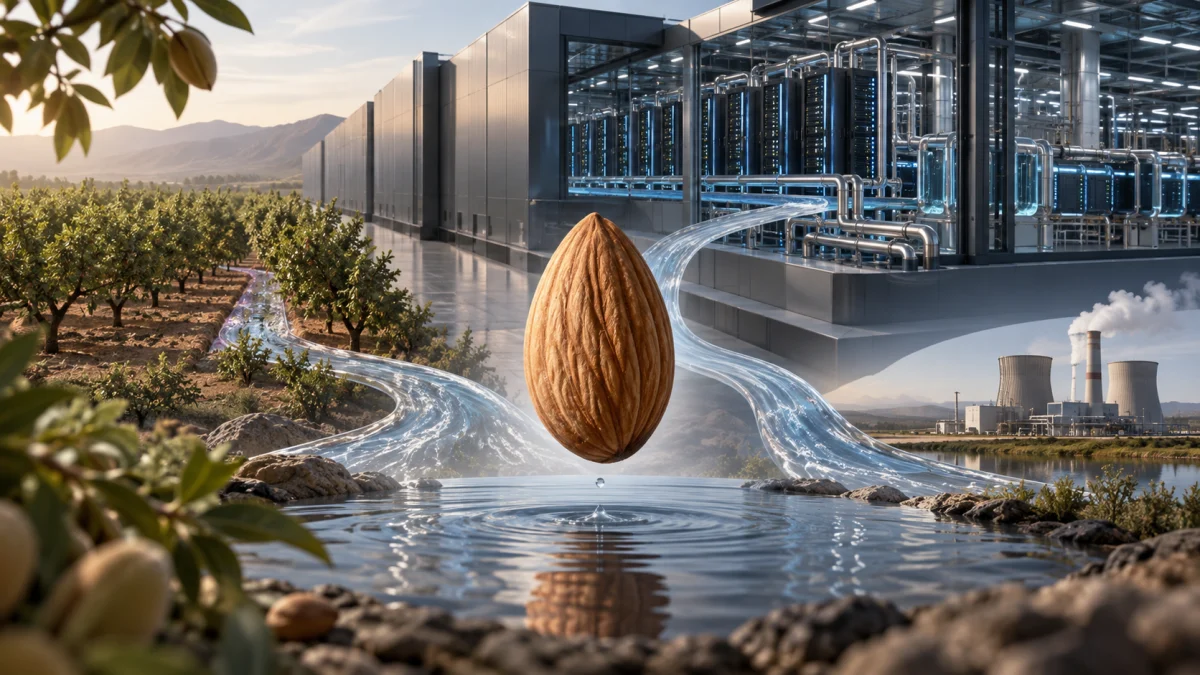
Sam Altman’s 38,000-query comparison is not obviously bogus. In fact, the arithmetic can be reconstructed almost exactly. But that does not establish what Altman said it establishes.
OpenAI’s CEO previously said an average ChatGPT query uses about 0.000085 gallons of water, or 0.322 milliliters. A peer-reviewed study of California almonds calculated a total water footprint of 10,240 liters per kilogram, using a 1.2-gram almond kernel. Those numbers produce approximately 12.288 liters per almond. Divide that by Altman’s ChatGPT figure and the result is approximately 38,190 queries. (Sam Altman)
That is remarkably close to the 38,000 figure Altman recalled from memory during a September 2026 interview with Alex Heath. The numerical match strongly suggests—though does not prove—that this is where the figure came from. (AI Podcast · AI 播客)
The problem is what happens next.
The almond number is a broad water-footprint calculation that includes irrigation water, rainfall and a theoretical measure of water required to assimilate pollution. OpenAI has not published a comparable methodology explaining what its 0.322-milliliter ChatGPT number includes. Google researchers reviewing Altman’s disclosure made the same point: without a measurement boundary or methodology, it cannot be meaningfully compared with other estimates. (ResearchGate)
Altman described his comparison as “total true water accounting.” The public evidence does not currently establish that.
The fairest verdict is therefore more nuanced than either side of the viral argument:
The 38,000-query arithmetic checks out remarkably well. Sub-milliliter operational water use for modern AI inference is also technically plausible. But OpenAI has not demonstrated that its ChatGPT number measures water on the same broad accounting basis as the almond number. Altman’s separate office-building comparison has real supporting evidence, while his suggestion that modern data centers stopped using evaporative cooling is too broad and contradicted by current operating data.
What Sam Altman actually claimed
During the launch episode of Sources with Alex Heath, Altman pushed back on increasingly common claims about AI’s environmental footprint.
He cautioned that he was recalling the number from memory, but said approximately 38,000 ChatGPT queries consume as much water as producing one California almond. He went further, describing that as the “total true” accounting rather than merely the water consumed inside one data center. He also said evaporative cooling was something data centers used in the past and that a modern large data center uses roughly the amount of water associated with an office building’s sinks, toilets and other routine uses. (AI Podcast · AI 播客)
Those are really three separate claims:
| Claim | Best-supported verdict |
|---|---|
| 38,000 ChatGPT queries ≈ one almond | The arithmetic strongly checks out |
| The comparison represents equivalent total water accounting | Not established |
| Modern data centers can use office-building levels of water | Yes, in some cases—and surprisingly often in Virginia data |
| Modern data centers stopped using evaporative cooling long ago | False or materially overbroad as an industry-wide statement |
Understanding why requires looking at what each number actually measures.
Where the 38,000 figure appears to come from
Altman published his ChatGPT resource estimate in June 2025.
He wrote that an average query consumed:
- 0.34 watt-hours of electricity
- 0.000085 gallons of water
The water figure converts to approximately:
0.000085 U.S. gallons × 3,785.41 mL/gallon = 0.32176 mL per query. (Sam Altman)
Now consider the 2019 study Water-indexed benefits and impacts of California almonds, published in Ecological Indicators.
Researchers Julian Fulton, Michael Norton and Fraser Shilling calculated an average California almond water footprint of:
10,240 liters per kilogram of kernels.
They used an average kernel weight of:
1.2 grams.
That gives:
10,240 L/kg × 0.0012 kg = 12.288 liters per almond. (ScienceDirect)
Then:
12,288 mL ÷ 0.32176 mL/query = about 38,190 queries.
Altman said 38,000.
The difference is roughly half of one percent.
There is no published OpenAI document we found saying, “This is the almond study we used.” So it would be inappropriate to present that provenance as a verified fact.
But as an inference, it is strong. An unrelated calculation independently landing within about 0.5% of Altman’s remembered number would require a substantial coincidence.
The most probable explanation is that Altman’s 38,000 figure combines his own previously published ChatGPT estimate with the Fulton study’s approximately 12-liter almond footprint.
That explains the number.
It does not yet validate the comparison.
The “12 liters per almond” number does not mean what most people think
The almond study did not conclude that farmers literally pump 12 liters of irrigation water onto an orchard for each almond produced.
It used a formal water-footprint framework containing three categories:
| Water-footprint component | Liters per kg of almonds | Approx. per 1.2 g almond |
|---|---|---|
| Blue water | 5,290 L | 6.35 L |
| Green water | 570 L | 0.68 L |
| Grey water | 4,380 L | 5.26 L |
| Total | 10,240 L | 12.29 L |
The researchers define blue water as water from managed sources, green water as effective rainfall and grey water as the water-footprint component associated with pollution impacts to surface and groundwater. (ResearchGate)
That last category matters enormously.
Approximately 43% of the headline 12-liter figure is grey water.
Grey water in this methodology is not necessarily 5.26 liters that physically disappeared while growing one almond. It is an environmental accounting construct representing freshwater associated with assimilating pollution to a specified water-quality standard.
That does not make the almond study misleading. It makes its measurement boundary broader than ordinary physical water withdrawal.
And once Altman compares that number with ChatGPT, the obvious question becomes:
Does OpenAI’s 0.322-milliliter number include an equivalently broad environmental footprint?
There is currently no public evidence showing that it does.
Another peer-reviewed almond calculation gives 3.56 liters—not 12
This is a useful demonstration of why environmental comparisons can produce different answers without either study necessarily being wrong.
A separate peer-reviewed study used Landsat satellite observations to estimate crop evapotranspiration in California’s Central Valley. Dividing the measured crop-water use by almond production produced an estimate of approximately 3.56 liters per almond. (MDPI)
Using exactly the same ChatGPT figure:
3,560 mL ÷ 0.32176 mL ≈ 11,064 ChatGPT queries.
So a defensible scientific comparison can yield either roughly:
11,000 queries per almond
or
38,000 queries per almond
depending on what “water used to produce an almond” is intended to mean.
The 3.56-liter study is closer to a field-scale physical crop-water calculation based on evapotranspiration.
The roughly 12-liter figure is a broader water-footprint calculation that additionally incorporates green and grey water.
Those are different questions.
This distinction is central because Altman did not merely say that 38,000 was a fun comparison under one particular water-footprint methodology. He characterized it as a comprehensive accounting of the water involved.
That stronger claim requires evidence about the ChatGPT side of the equation.
What does OpenAI’s 0.322 mL per query actually include?
We know where the number was published.
We do not know its full methodology.
Altman’s June 2025 post provides the final figures—0.34 Wh and 0.000085 gallons—but does not explain:
- what models were averaged;
- what constitutes one “query”;
- whether input and output length are weighted;
- whether reasoning workloads are included;
- which data centers or cloud providers are represented;
- whether idle hardware is allocated to queries;
- whether data-center power overhead is included;
- whether the water number measures withdrawal or consumption;
- whether electricity-generation water is included;
- whether hardware manufacturing is included;
- whether training is allocated across inference;
- or how geographic differences were weighted. (Sam Altman)
Google researchers explicitly identified this problem in their 2025 paper on Gemini’s environmental footprint.
Discussing Altman’s figure, they wrote that his disclosure contained no explanation of the measurement boundary or methodology, making comparisons with other estimates impossible. (arXiv)
That does not prove OpenAI’s number is wrong.
It establishes that outsiders cannot presently verify what the number means.
The numbers themselves provide a clue about how OpenAI may have calculated it
This is where recursive analysis becomes useful.
Altman published two numbers together:
0.34 Wh of electricity per query
and
0.32176 mL of water per query.
Divide one by the other:
0.32176 mL ÷ 0.34 Wh ≈ 0.946 L/kWh.
That is interesting because data-center operational water intensity is commonly measured using Water Usage Effectiveness, or WUE, expressed in liters per kilowatt-hour.
Google has disclosed exactly this kind of methodology for Gemini.
Its researchers measured a median Gemini Apps text prompt at 0.24 Wh and 0.26 mL of water. Google calculates prompt-level water consumption from prompt energy and the fleet-average WUE of the data centers supporting its models. Its disclosed 2023 and 2024 WUE value was 1.15 L/kWh. (Google Cloud)
Google’s precise formula applies WUE to the relevant IT-energy component rather than simply dividing total prompt energy by water, so the two coefficients should not be treated as mathematically identical.
But the resemblance is notable:
- OpenAI figures imply roughly 0.95 L/kWh when simply divided
- Google reports a formal operational WUE of 1.15 L/kWh
Reasonable inference
The numerical relationship makes it plausible that OpenAI’s 0.322-mL estimate is fundamentally an operational data-center cooling calculation tied to inference energy—something conceptually similar to an energy-times-WUE calculation.
That would make the number entirely legitimate for measuring operational cooling water.
But it would not automatically make it a comprehensive lifecycle water footprint comparable with the almond study’s blue + green + grey accounting.
We cannot prove this is OpenAI’s methodology without OpenAI publishing it. It remains an inference.
But it explains the available numbers more economically than assuming that an undisclosed comprehensive water-footprint calculation merely happens to produce a coefficient resembling ordinary operational WUE.
Independent evidence says sub-milliliter AI water use is plausible
There is also a strong reason not to swing too far in the other direction.
Google’s production measurement found 0.26 mL of water for a median Gemini text prompt. Its methodology includes accelerator energy, host CPU and memory, idle capacity and data-center energy overhead before applying operational water-consumption metrics. (Google Cloud)
Microsoft published an even lower 2026 estimate. It says a typical query on large production models consumes somewhere from 0 to 0.067 mL of cooling water under its assumptions as the company rolls out data centers designed to eliminate evaporative cooling. (Microsoft)
Microsoft and Google are interested parties in the broader AI industry, so their claims should not be treated as independent environmental audits of OpenAI.
But Google’s disclosure is unusually useful because it publishes its measurement boundary and methodology in detail.
The evidence therefore supports a meaningful conclusion:
A normal text prompt using a fraction of a milliliter of onsite cooling water is technically plausible on modern, efficient AI infrastructure.
The old mental image that every ordinary AI question must directly consume a bottle or glass of water is not a reliable description of modern inference.
The harder question is what happens when the accounting boundary expands.
Electricity can carry a much larger water footprint
Lawrence Berkeley National Laboratory estimated that U.S. data centers directly consumed approximately 66 billion liters of water in 2023.
But the electricity supplying those data centers was associated with an estimated nearly 800 billion liters of indirect water consumption, based on regional electricity-grid mixes.
The report calculated a national-average indirect water-consumption intensity of 4.52 L/kWh for data-center electricity. (LBL ETA Publications)
This provides an illuminating stress test of Altman’s number.
If—purely as a counterfactual—we applied LBNL’s national-average electricity-water factor to Altman’s 0.34 Wh query:
0.00034 kWh × 4.52 L/kWh ≈ 0.00154 L
or:
about 1.54 mL per query.
That is nearly five times Altman’s entire 0.322-mL figure before adding any onsite cooling water.
This is not an estimate of ChatGPT’s actual indirect water use
It would be wrong to present 1.54 mL as the “real ChatGPT number.”
LBNL explicitly warns that its grid-based methodology does not incorporate every individual facility’s power-purchase agreements or behind-the-meter generation. OpenAI workloads may operate in regions with much lower electricity-water intensity or use contractual energy arrangements that materially change attribution. (LBL ETA Publications)
But the calculation does establish something narrower and important:
The public 0.322-mL ChatGPT number cannot simply be assumed to contain comprehensive electricity-related water consumption.
If it does, OpenAI needs to show how.
There may be no meaningful universal “water per ChatGPT query”
Even with perfect disclosure, one universal number would still be an average rather than a physical constant.
A 2025 peer-reviewed study by researchers including Lawrence Berkeley National Laboratory’s Arman Shehabi found more than a 10,000-fold difference in workload-level water consumption under different combinations of operating conditions.
The main determinants included:
- server efficiency;
- electricity-grid water intensity;
- server utilization;
- cooling system;
- infrastructure efficiency;
- climate;
- inactive-server share;
- and hardware refresh cycles. (ScienceDirect)
The same principle applies within an AI assistant.
A short factual prompt routed efficiently through production hardware is not equivalent to a long reasoning task, image generation, video generation or an autonomous agent performing many model calls.
A fleet average can still be useful.
But “one ChatGPT query” needs a methodology before it becomes a scientifically comparable unit.
Altman’s office-building comparison is more defensible than it sounds
Altman’s claim that modern data centers can use roughly the water of an office building sounds extraordinary.
Virginia’s government data shows that there is real evidence behind it.
The Virginia Joint Legislative Audit and Review Commission analyzed utility records covering the large majority of data-center buildings for which data were available. It compared them with an average large office building using 6.7 million gallons per year.
Its finding:
Most individual data-center buildings consumed approximately the same amount of water as the average large office building—or less.
That deserves to be stated plainly.
Critics should not dismiss the office comparison simply because it sounds implausible.
But the same government report contains the qualification that changes its meaning.
In 2023:
- 11 data-center buildings each exceeded 50 million gallons
- one building consumed 243 million gallons
- that single building represented 10% of the industry’s measured water use
And JLARC explicitly states that its comparison is per building, not per campus.
That 243-million-gallon building used more than 36 times Virginia’s large-office benchmark.
So the accurate conclusion is:
Many data-center buildings really can use office-building quantities of water. Some use dramatically more. And comparing one building with one office does not tell us the water demand of a multi-building hyperscale campus.
OpenAI’s newest campuses help explain what Altman probably meant
There is another important chronological clue.
Months before Altman’s podcast comments, OpenAI itself began using almost exactly the same office-building analogy when describing its newest infrastructure.
In April 2026, OpenAI said its Stargate site in Abilene, Texas uses closed-loop cooling rather than traditional evaporative cooling towers. The company says the initial fill is recirculated through sealed pipes and that, at full buildout, annual cooling-system water use should be comparable with a medium-sized office building or about four average households. (OpenAI)
Then, in June, OpenAI described its planned 1-gigawatt “The Barn” campus in Saline, Michigan as using a closed-loop cooling system designed to consume approximately the water of a typical office building. (OpenAI)
Then, in September, Altman described modern large data centers generally using office-building levels of water.
Strong inference
The chronology makes a straightforward explanation plausible:
Altman may have been generalizing from the newest generation of OpenAI’s own Stargate infrastructure.
If so, the underlying point is stronger than critics sometimes acknowledge.
New hyperscale AI infrastructure can apparently be designed to consume remarkably little onsite cooling water.
But this also exposes the problem with his wording.
“OpenAI’s newest closed-loop data centers” is not synonymous with “modern data centers.”
The latter includes a much broader installed fleet.
OpenAI’s claims about Abilene and Michigan are also company projections and descriptions, not independently audited measurements of completed full-buildout operations.
Data centers absolutely still use evaporative cooling
This is the weakest part of Altman’s argument.
Virginia’s JLARC report states directly that some data-center cooling systems use water evaporation and require continual replenishment. It contrasts evaporative systems with dry cooling and discusses the use of reclaimed water specifically for data-center evaporative cooling.
Microsoft’s own disclosures make the point even harder to dispute.
In June 2026, Microsoft described existing cooling technologies that include:
- cooling towers that evaporate water year-round;
- hybrid fluid coolers that evaporate water during hot conditions;
- direct-air systems that use evaporative assistance above certain temperatures.
Microsoft says about 90% of its 2025 owned fleet operates with highly efficient low- or zero-water cooling systems—which itself means the transition is not universal. (The Official Microsoft Blog)
Microsoft separately says its existing Arizona facilities use direct evaporative cooling, with water required when temperatures exceed 29.4°C. (Microsoft Local)
So if Altman’s statement is interpreted literally as saying large modern data centers have not used evaporative cooling “in a long time,” the evidence contradicts it.
A defensible version would be:
New data centers can increasingly be designed without evaporative cooling.
That is true.
The broader claim is not.
“Liquid cooled” does not automatically mean “no water consumed”
This distinction is also routinely lost in discussions of AI infrastructure.
There are two different stages:
- getting heat away from the chips;
- rejecting that heat from the facility into the outside environment.
Direct-to-chip liquid cooling can be excellent at the first job.
But the warmed coolant still has to dump its heat somewhere.
The U.S. Department of Energy describes direct liquid cooling systems in which a closed water loop carries heat away from IT equipment before transferring it through a heat exchanger to another loop and ultimately to a cooling tower, where evaporation rejects the heat.
Other systems instead use dry coolers and may require essentially no evaporative water. (The Department of Energy’s Energy.gov)
So:
closed-loop liquid cooling at the server does not, by itself, tell you whether the entire facility consumes water.
The heat-rejection architecture determines that.
This is why OpenAI’s specific statements about eliminating conventional evaporative towers at its new campuses matter more than simply saying the servers are liquid cooled.
Lower water use can also mean higher electricity use
There is another systems-level tradeoff.
Evaporating water is an extremely effective way to remove heat. Replacing evaporation with mechanical or dry cooling can reduce onsite water consumption but sometimes increases electricity requirements.
Microsoft acknowledges this tradeoff in discussing its zero-water cooling designs, while the Virginia report similarly contrasts the water requirements and other characteristics of evaporative and dry cooling. (The Official Microsoft Blog)
That creates an important recursive effect:
A facility can reduce its onsite water footprint while potentially increasing the water footprint associated with electricity generation.
Whether total water consumption rises or falls then depends partly on how that electricity is produced.
A solar- or wind-heavy electricity supply has a very different operational water profile from some thermoelectric generation.
This is why “our data center uses almost no water” and “our computing has almost no water footprint” are not necessarily equivalent statements.
Tiny per-query water use and large data-center water demand can both be true
This is probably the single most important conceptual point.
There is no contradiction between saying:
An individual AI query uses very little water
and:
The AI infrastructure boom can create substantial water demand.
Efficiency is a ratio.
Total consumption is scale multiplied by that ratio.
Virginia’s data illustrates the geographic problem especially well.
JLARC estimated the entire data-center industry accounted for less than 0.5% of statewide water withdrawals in 2023.
That sounds negligible.
But among the six water utilities JLARC examined, data centers represented approximately 2% to 21% of water use after reclaimed water was excluded. The report warned that because data centers cluster geographically, local water demand can grow suddenly even when statewide totals appear modest.
Both statistics are true.
The denominator changes the story.
The same thing happens with ChatGPT.
A third of a milliliter per query sounds trivial because per query is the denominator.
A multi-building campus serving enormous aggregate demand raises a different question entirely.
The real water question is local, not moral
The almond comparison encourages people to ask:
Should I feel guilty every time I use ChatGPT?
On the available evidence, ordinary text queries are probably not where the most meaningful water-policy question lies.
Modern inference appears capable of operating with very little onsite cooling water per prompt.
The infrastructure question is much more concrete:
How much water will this particular data-center campus require, from which source, during which season, at what peak rate, and what infrastructure must the local water utility build to supply it?
Those questions cannot be answered by multiplying a global fleet average by the number of prompts.
A data center using reclaimed water in a water-abundant region is not equivalent to one drawing treated drinking water from a constrained municipal system during summer.
Likewise, annual consumption can conceal peak demand, which matters because water systems must be sized to meet demand when it is highest, not merely averaged across the year.
That is why disclosure at the facility and campus level remains useful even if Altman’s per-query number proves completely accurate.
The timing of Altman’s claim matters—but does not prove motive
The comments also arrived during an active California debate over data-center water transparency.
As of publication, two bills authored by Assemblymember Diane Papan are awaiting Gov. Gavin Newsom’s signature. One would require additional disclosure of water sources and usage when operators seek permits; another would require developers to disclose water plans before local governments approve new data centers and address infrastructure costs. Newsom vetoed an earlier transparency measure in 2025. (CalMatters)
Technology and business groups have opposed the latest measures. (CalMatters)
That gives the industry an obvious incentive to argue that public perceptions of data-center water consumption are outdated.
But incentive is not proof of motive.
There is no evidence establishing that Altman selected the almond comparison specifically to influence those California bills.
The defensible observation is narrower:
Altman’s comments entered the public debate at a moment when policymakers are deciding whether data-center operators should be required to disclose more of the very information needed to independently verify claims like his.
What probably happened: the plausible scenarios
Because OpenAI has not published the missing methodology, several explanations remain possible. They should not be weighted equally.
Scenario 1: The 38,000 figure came from the 12-liter almond study and Altman’s 2025 ChatGPT estimate
Assessment: Highly likely.
The exact inputs produce roughly 38,190.
The numerical fingerprint is too close to ignore.
There is still no documentary confirmation, so this remains inference rather than verified provenance.
Scenario 2: OpenAI’s 0.322-mL number is primarily an operational cooling/WUE calculation
Assessment: Plausible to likely.
The paired energy and water figures imply approximately 0.95 L/kWh, closely resembling the scale of operational data-center WUE values.
Google’s independently disclosed methodology uses essentially this framework and reports 1.15 L/kWh for its relevant fleet. (arXiv)
This explanation fits the available evidence well.
Scenario 3: Altman used “total true water accounting” to mean fleet-wide operational water rather than lifecycle water
Assessment: Plausible.
He may have meant that the calculation averages all infrastructure serving ChatGPT rather than measuring one specific data center.
If so, “total” referred to the operational fleet boundary rather than agriculture-style lifecycle water accounting.
That would substantially reconcile his wording with the published number.
But it would still make the almond comparison methodologically uneven.
Scenario 4: OpenAI has an unpublished comprehensive water model that really does support 0.322 mL
Assessment: Possible, but currently unsupported.
OpenAI could possess detailed information about:
- geographic workload routing;
- very low-WUE facilities;
- electricity contracts;
- low-water energy generation;
- infrastructure allocation;
- and other factors unavailable publicly.
A comprehensive calculation could therefore differ dramatically from LBNL’s national averages.
Nothing we found rules that out.
But evidence that exists only inside OpenAI cannot independently establish a public factual claim.
Publishing the methodology would resolve the issue.
Scenario 5: Altman generalized from OpenAI’s new Stargate designs when discussing the industry
Assessment: Strongly plausible.
The sequence is notable:
April 2026: OpenAI says Abilene cooling should use about as much annual water as a medium office building.
June 2026: OpenAI says its 1-GW Michigan campus is designed for office-building-level water use.
September 2026: Altman says modern large data centers use about as much water as office buildings. (OpenAI)
That does not prove his thought process.
It does provide a straightforward explanation for why the office analogy appears in his argument.
Claim-by-claim verdict
| Claim | Evidence | Verdict |
|---|---|---|
| One almond ≈ 38,000 ChatGPT queries | Published inputs reproduce ~38,190 | Arithmetic strongly supported |
| A California almond has a ~12 L water footprint | Peer-reviewed study | True under that methodology |
| Growing one almond literally consumes 12 L of irrigation water | Much of the 12 L is green and grey water | Misleading |
| ChatGPT uses ~0.322 mL/query | Altman’s published figure; methodology undisclosed | Plausible but not independently reproducible |
| Modern AI inference can consume sub-mL cooling water | Google measured 0.26 mL; Microsoft estimates ≤0.067 mL for some systems | Supported |
| 0.322 mL represents comparable “total true” water accounting | No public OpenAI methodology establishes this | Not established |
| Many data centers use office-building levels of water | Virginia utility data says most measured buildings did | Supported, with qualifications |
| Modern large data centers generally use only office-level water | Significant outliers and campus aggregation complicate this | Too broad |
| Evaporative cooling disappeared from modern data centers | Current government and industry records document its use | False as a general claim |
| New AI campuses can operate with almost no cooling-water consumption | Current closed-loop/dry designs make this technically credible | Supported for appropriate designs |
| Tiny water use per query makes data-center water concerns irrelevant | Local concentration, peak demand and indirect water remain separate issues | False |
What OpenAI could publish to settle the debate
The controversy does not require another analogy.
It requires a methodology.
OpenAI could make the 0.000085-gallon figure independently interpretable by publishing:
- its definition of an average ChatGPT query;
- the model and workload distribution included;
- input and output token assumptions;
- treatment of reasoning and multimodal workloads;
- active-compute energy;
- idle and supporting infrastructure allocations;
- facility PUE and WUE methodology;
- water withdrawal versus consumption;
- geographic weighting;
- electricity-generation water;
- treatment of training;
- treatment of hardware manufacturing and other lifecycle effects;
- the source used for the almond comparison;
- and what Altman meant by “total true water accounting.”
Until then, outsiders can reproduce the 38,000 result.
They cannot reproduce what OpenAI says that result represents.
Bottom line
Sam Altman’s almond comparison is more credible than a superficial fact-check might suggest.
The arithmetic works almost perfectly.
His underlying argument that modern AI inference can use extraordinarily little onsite cooling water is also supported by measurements and disclosures from other major AI operators.
And his office-building analogy is not invented: Virginia’s utility data genuinely shows that most measured individual data-center buildings used about as much water as, or less than, the state’s benchmark for a large office building.
But those facts do not validate the whole argument.
The approximately 12-liter almond figure is a broad environmental water footprint containing rainfall and pollution-assimilation accounting. OpenAI’s 0.322-milliliter ChatGPT figure comes with no published measurement boundary and numerically resembles an operational data-center cooling metric. OpenAI has therefore not shown that the two sides of the comparison measure the same thing.
Altman also overreached when suggesting evaporative cooling belongs to the data-center industry’s past. Current government records and Microsoft’s own disclosures show it remains in operation.
The most defensible conclusion is therefore neither “Altman lied” nor “AI water concerns have been debunked.”
It is this:
38,000 ChatGPT queries per almond is a remarkably reproducible piece of arithmetic. But identical arithmetic does not make unlike accounting systems equivalent. Modern AI can use very little water per query while large, geographically concentrated data-center development can still create meaningful local water demands. Both things can be true at once.
That is the distinction the almond comparison obscures.
References and Further Reading
Original claims and OpenAI infrastructure
Sam Altman — “The Gentle Singularity” — Original June 2025 disclosure stating approximately 0.34 Wh and 0.000085 gallons of water per average ChatGPT query.
Sources with Alex Heath — Sam Altman interview archive — Original program in which Altman discussed ChatGPT water consumption, almonds and modern data-center cooling.
OpenAI — Building the Compute Infrastructure for the Intelligence Age — OpenAI’s description of closed-loop cooling at its Abilene Stargate site and projected office-building-scale annual cooling water use.
OpenAI — Building the Infrastructure for the Intelligence Age in Michigan — OpenAI’s description of the 1-GW “The Barn” campus and its planned closed-loop cooling system.
Almond water research
Fulton, Norton & Shilling — Water-indexed benefits and impacts of California almonds — Peer-reviewed source for the approximately 12-liter total water footprint, including blue, green and grey water.
Characterizing Crop Water Use Dynamics in California’s Central Valley Using Landsat-Derived Evapotranspiration — Peer-reviewed remote-sensing study producing the narrower approximately 3.56-liter-per-almond crop-water estimate.
AI inference methodology
Google — Measuring the Environmental Impact of Delivering AI at Google Scale — Detailed production methodology for Gemini prompt energy, emissions and operational water consumption; also identifies the missing methodology behind Altman’s ChatGPT disclosure.
Google Cloud — How Much Energy Does Google’s AI Use? We Did the Math — Plain-language summary of Google’s 0.24 Wh and 0.26 mL median Gemini text-prompt measurement.
Microsoft — Scaling AI With 8 to 20x Energy Efficiency — Microsoft’s 2026 estimate of 0–0.067 mL cooling-water consumption for typical queries on large production models.
Data-center water evidence
Virginia JLARC — Data Center Natural and Historic Resource Impacts — Utility-based evidence showing most measured Virginia data-center buildings at or below large-office water use, alongside major high-use outliers and continuing evaporative cooling.
Lawrence Berkeley National Laboratory — 2024 United States Data Center Energy Usage Report — Federal laboratory analysis estimating direct and electricity-related water consumption for U.S. data centers.
Lawrence Berkeley National Laboratory — The Water Use of Data Center Workloads — Peer-reviewed analysis finding more than 10,000-fold variability in workload-level water consumption.
U.S. Department of Energy — Cooling Water Efficiency Opportunities for Federal Data Centers — Technical explanation of cooling towers, direct liquid cooling and the distinction between chip cooling and final heat rejection.
Microsoft — Inside Microsoft’s Two-Decade Push to Cut Water Intensity — Current description of Microsoft’s evaporative, hybrid, air-cooled and zero-water data-center technologies.
Current reporting and policy context
CalMatters — Fact Check: Is Sam Altman Right That Almonds Use More Water Than ChatGPT Queries? — Independent reporting on the claim, California disclosure legislation and the lack of publicly available facility data.
Editorial currency note: Data-center designs, AI model efficiency, OpenAI’s infrastructure mix and California’s pending legislation are changing rapidly. The per-query and policy sections should be reviewed when OpenAI publishes new methodology, new facility-level measurements become available, or Gov. Gavin Newsom acts on the pending 2026 disclosure bills.