A follow-up to “Mapping the Money”
In the original Mapping the Money analysis, the question was relatively simple: which U.S.-registered, non-FARA, foreign-connected organizations exerted the most measurable influence in American politics during the 2024 cycle?
The answer was not subtle. The data showed a striking concentration of money in one ecosystem: pro-Israel advocacy, with AIPAC, United Democracy Project, J Street, Democratic Majority for Israel, and related entities accounting for the overwhelming majority of measurable non-FARA foreign-connected political finance in that category. The point of that article was not to accuse every donor, activist, or organization of wrongdoing. It was to map scale. It showed where the money was concentrated, how legally domestic organizations could still shape foreign-policy politics, and why the line between diaspora advocacy and de facto foreign-interest influence deserves serious public scrutiny.
This follow-up looks at the next layer.
Because once the major names become publicly recognizable, the influence game changes.
Money does not disappear. It adapts.
It moves through smaller committees. It appears under local-sounding names. It backs candidates through groups that do not mention the underlying issue. It uses generic civic language: affordability, progress, women, democracy, responsive government, the future. It enters the race as a mailer, a television ad, a voter guide, a digital campaign, or an independent expenditure whose public-facing message may have very little to do with the donor network’s real policy interest.
That is the phenomenon this article examines.
Not merely dark money, although dark money is part of it.
Not merely Super PAC spending, although Super PACs are central to it.
Not necessarily criminal money laundering, because that is a specific legal offense requiring criminal proceeds and statutory elements.
The more precise term is something like political brand laundering: the separation of political money from the name, reputation, and policy agenda that would allow voters to understand who is really trying to shape their choices.
See: How Money Runs American Politics: The Corruption Blocking Real Reform in the U.S.
Introduction: Following the Influence, Not the Label
Political influence no longer has to announce itself.
It does not always arrive with the name of the national organization that built the donor network. It does not always say “AIPAC,” “crypto,” “AI,” “Big Tech,” “oil,” “labor,” “real estate,” or “foreign policy advocacy” on the mailer. It may arrive as Elect Chicago Women, Affordable Chicago Now, Chicago Progressive Partnership, Voters for Responsive Government, Think Big, Protect Progress, or any number of benign, civic, local, patriotic, scientific, or progressive-sounding names.
The names are often not false. That is the point. They are usually legally registered entities. They file paperwork. They often leave a paper trail. They may comply with the letter of campaign-finance law.
But the public-facing name can still function as a mask.
Recent reporting has made this problem unusually visible. In the 2026 Illinois primaries, Washington Post reporting described AIPAC-linked or AIPAC-aligned influence moving through groups such as Elect Chicago Women, Affordable Chicago Now, and Chicago Progressive Partnership, with the ads reportedly avoiding mention of Israel while supporting candidates favored by AIPAC donors or AIPAC-aligned interests. (The Washington Post)
The Guardian, citing WBEZ and FEC-related analysis, reported that AIPAC and affiliated PACs spent at least $13.7 million across four Illinois races through Super PACs such as Elect Chicago Women and Affordable Chicago Now, and that donor patterns showed significant overlap with prior AIPAC and United Democracy Project donors. (The Guardian)
The Associated Press later reported that outside groups, including AIPAC, poured roughly $70 million into six open U.S. House and Senate races in Illinois, making the state a proving ground for some of the biggest issues inside Democratic politics: Israel, crypto, AI, and the role of billionaire and special-interest money in primaries. (AP News)
That is the new map.
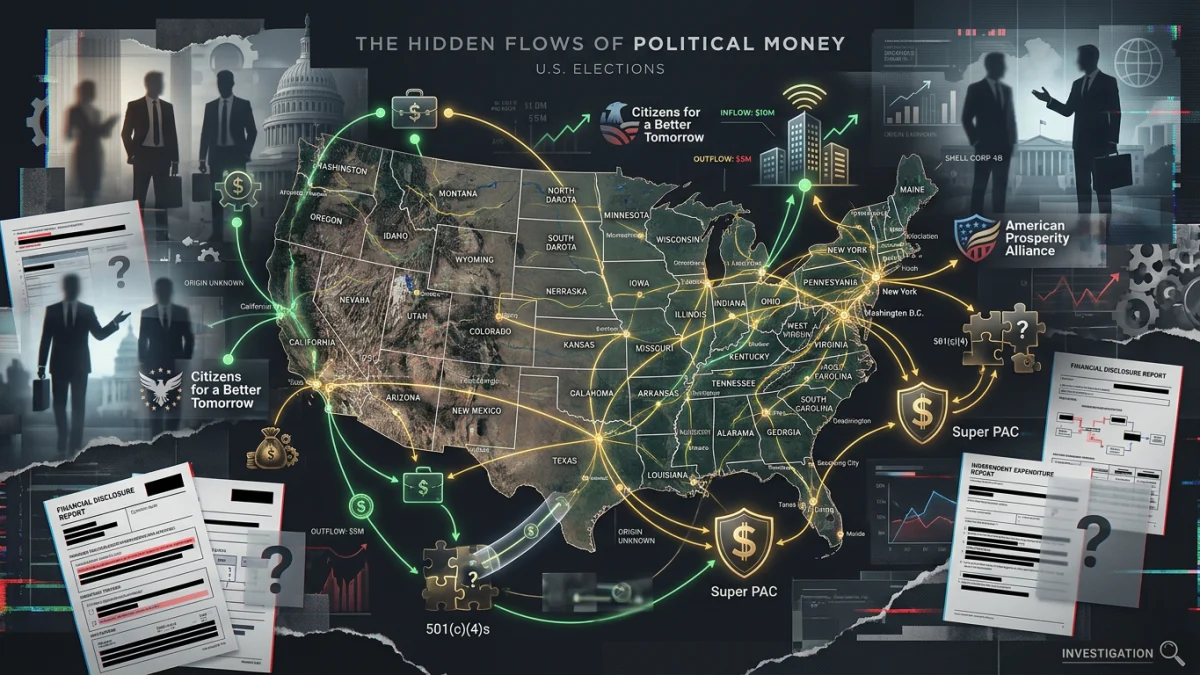
The first layer is the visible organization.
The second layer is the funding network.
The third layer is the smaller political vehicle.
The fourth layer is the message the voter actually sees.
And by the time the voter sees it, the real policy interest may have disappeared.
The Core Problem: The Public Sees the Ad, Not the Network
The average voter does not have time to read FEC filings.
That is the practical reality on which this system depends.
A voter sees a television ad saying a candidate is too extreme, too risky, too weak, too corporate, too anti-worker, too anti-safety, too aligned with Trump, too aligned with the left, too soft on crime, too hostile to innovation, or too unreliable on democracy.
What the voter often does not see is the full donor network behind the message.
They do not see whether the group was created weeks before the primary.
They do not see whether the donors are clustered around a major national advocacy organization.
They do not see whether the same consultants, vendors, treasurers, or digital firms appear across multiple committees.
They do not see whether the group’s name is local while its money is national.
They do not see whether disclosure will arrive only after the election is already over.
That last point matters. In several recent examples, the most politically meaningful disclosure came too late for voters to use it. Reporting on the Illinois races described funding and donor disclosures that either arrived late in the campaign or after Election Day, meaning the legal paper trail existed, but not necessarily at the moment when it could inform the vote. (The Washington Post)
This is why the phrase “it is disclosed” can be technically true and democratically inadequate at the same time.
A receipt after the election is not the same thing as transparency before the vote.
Methodology: What This Article Is Mapping
This article does not claim that every organization listed or discussed is corrupt, illegal, foreign-controlled, or acting as a formal agent of a foreign principal.
That distinction matters.
Instead, this article maps transparency risk and influence architecture using the following indicators:
- Entity structure — PAC, Super PAC, 501(c)(4), LLC, nonprofit, donor network, fiscal sponsor, or affiliated political committee.
- Timing — whether the group formed shortly before a competitive primary or began spending late in the cycle.
- Naming strategy — whether the public-facing name obscures the policy interest or donor ecosystem.
- Donor overlap — whether donors previously gave to a larger, better-known organization or aligned Super PAC.
- Vendor overlap — whether consultants, media buyers, treasurers, compliance firms, or ad vendors recur across related groups.
- Disclosure timing — whether donor information becomes public before or after voters cast ballots.
- Message-content mismatch — whether ads avoid the underlying issue that appears to motivate the donor network.
- Scale distortion — whether a small race receives spending far beyond normal local political scale.
- Legal category — whether the structure is legal, prohibited, gray-area, or dependent on facts not yet public.
The goal is not to label every opaque structure as criminal.
The goal is to show how a legally compliant system can still deceive the public in practical terms.
The Money-Laundering Analogy: Useful, But Legally Limited
The user-level instinct here is understandable: this can feel like money laundering.
That does not mean it is criminal money laundering under federal law.
But the analogy is useful because the structure can resemble the classic three-stage logic of laundering:
| Money-Laundering Concept | Political-Finance Parallel |
|---|---|
| Placement | Money enters the political system through a PAC, Super PAC, 501(c)(4), LLC, donor-advised fund, or aligned donor network. |
| Layering | Money moves through intermediate entities, generically named committees, affiliated groups, grants, vendors, or delayed-disclosure structures. |
| Integration | The final output appears as ordinary political speech: ads, mailers, digital content, influencer posts, voter guides, and independent expenditures. |
The similarity is not that the money is necessarily illegal.
The similarity is that the route can obscure origin, purpose, control, or reputational association.
Federal money-laundering law is much narrower. Under 18 U.S.C. § 1956, the government generally must prove a financial transaction involving proceeds of specified unlawful activity, knowledge that the property represents unlawful proceeds, and intent to promote unlawful activity, conceal the source or ownership, or avoid reporting requirements. (Legal Information Institute)
That means lawful political money routed through multiple committees is usually not money laundering.
But it can still be laundering-like in the public-information sense.
It can launder the brand.
It can launder the political motive.
It can launder the identity of the network.
It can launder the reputational cost that would come from saying openly: this candidate is being helped or attacked because a national donor network cares deeply about Israel policy, crypto regulation, AI oversight, taxation, labor power, energy regulation, or another high-stakes issue.
That is the honest distinction.
Not criminal laundering by default.
But reputational laundering? Often, yes.
Democratic laundering? In effect, yes.
What Is Legal, What Is Illegal, and What Lives in the Gray Zone
The legal structure matters because the most disturbing parts of the system are often not illegal.
Legal: Super PACs and Independent Expenditures
Super PACs and hybrid PACs can accept unlimited contributions from individuals, corporations, labor organizations, and other political committees, so long as they do not contribute directly to candidates. The FEC explains that nonconnected PACs may make contributions subject to limits, while Super PACs and hybrid PACs may solicit and accept unlimited contributions but do not make contributions to candidates. (FEC.gov)
This is the central legal pathway.
A donor cannot simply give unlimited money directly to a federal candidate. But a donor can give enormous sums to an independent-expenditure-only committee that spends to support or oppose that candidate, provided the spending is not coordinated with the campaign.
That distinction is where much of modern campaign finance lives.
Legally independent.
Politically aligned.
Formally separate.
Functionally powerful.
Legal, But Opaque: 501(c)(4) Social-Welfare Organizations
A 501(c)(4) organization is supposed to operate primarily to promote social welfare. The IRS allows such groups to engage in lobbying as a primary activity, and it also allows some political activity so long as political campaign intervention is not the organization’s primary activity. (IRS)
This creates one of the major dark-money channels in American politics.
A 501(c)(4) can receive donor money without publicly disclosing all underlying donors in the way a candidate committee or PAC would. It can then spend on issue advocacy, election-related activity within limits, or give money to a Super PAC. When it gives to a Super PAC, the Super PAC may disclose the nonprofit as the donor, but the public may still not see the original donor behind the nonprofit.
That is not a bug in the system.
That is the system.
Legal, But Often Confusing: LLCs
LLCs can be treated differently depending on whether they are classified as corporations or partnerships. The FEC notes that LLCs treated as corporations are prohibited from making contributions to candidate committees, but may give money to independent-expenditure-only PACs; LLCs treated as partnerships are subject to partnership contribution rules. (FEC.gov)
This matters because LLCs can sometimes function as opacity vehicles.
A donor may appear as an LLC rather than a natural person. The public then has to ask: Who owns the LLC? Is it an operating business? Was it created recently? Is it funded by someone else? Is it a pass-through?
Sometimes the answers are innocent.
Sometimes they are not.
The problem is that voters usually do not know in time.
Illegal: Foreign-National Contributions
Federal law prohibits foreign nationals from making contributions, donations, expenditures, independent expenditures, and certain disbursements in connection with federal, state, or local elections, whether directly or indirectly. (FEC.gov)
This is the hard legal line.
A U.S.-based advocacy organization can be passionate about a foreign country.
A U.S. citizen can care deeply about Israel, Palestine, Armenia, India, China, Turkey, Pakistan, Ukraine, or any other country.
Diaspora advocacy is not illegal.
Foreign-national election spending is different.
The key legal question is not whether a group’s policy preferences align with a foreign country. The key legal question is whether money, direction, control, or decision-making comes from a prohibited foreign source.
Illegal: Contributions in the Name of Another
Federal law also prohibits contributions made in the name of another person. The FEC gives simple examples: a donor who has maxed out cannot give money to someone else to contribute on their behalf, and a corporation cannot reimburse employees for contributions. (FEC.gov)
This is where “funneling” can become legally serious.
If money is merely routed through a legally permitted committee with proper disclosure, that may be lawful.
If money is secretly passed through straw donors, reimbursed donors, false entities, foreign nationals, or sham intermediaries, the analysis changes.
That is the difference between opaque legal influence and potential campaign-finance violation.
Why Non-FARA Still Matters
FARA is often misunderstood.
The Foreign Agents Registration Act does not automatically apply just because an organization advocates a position favorable to another country. FARA turns on agency: whether a person or entity acts at the order, request, direction, or control of a foreign principal, and engages in covered political, public-relations, fundraising, or representation activities in the United States. (Legal Information Institute)
That is why the original article focused on non-FARA foreign-connected influence.
The question was not: who is legally a foreign agent?
The question was: which legally domestic organizations have foreign-policy or diaspora connections and enough money to materially shape American politics?
That question remains valid because FARA and campaign-finance disclosure solve different problems.
FARA asks: are you acting for a foreign principal?
Campaign-finance disclosure asks: who paid for the political activity?
The modern influence problem often sits between those questions.
A group may not be a FARA registrant.
A donor may be an American citizen.
The PAC may be legally registered.
The spending may be reported.
And yet the practical result may still be that voters are being targeted by a national foreign-policy donor network under a local-sounding or unrelated political brand.
That is the gray zone.
Not invisible.
Not fully transparent.
Not necessarily illegal.
Still deeply consequential.
Case Study One: Illinois 2026 and the New Shadow-Primary Model
The 2026 Illinois primaries are the clearest recent case study because several high-pressure factors converged at once:
- Multiple open congressional seats.
- Competitive Democratic primaries.
- Deep national interest in Israel policy.
- Rising progressive criticism of unconditional U.S. support for Israel.
- Massive outside spending.
- AIPAC’s increasingly controversial brand among Democratic voters.
- Crypto and AI spending entering the same battlefield.
Washington Post reporting described AIPAC as facing accusations of covert campaigning in Illinois, with groups such as Elect Chicago Women and Affordable Chicago Now supporting AIPAC-favored candidates without publicly branding themselves as AIPAC entities and without making Israel the subject of the ads. (The Washington Post)
A later Washington Post report stated that AIPAC’s political arm had funneled more than $5 million to other groups, including Chicago Progressive Partnership, Affordable Chicago Now, and Elect Chicago Women, with some disclosures arriving after the primary. The report also quoted a United Democracy Project spokesman defending the strategy as legal political activity and saying the group would use available tools to help elect pro-Israel Democrats. (The Washington Post)
The Guardian reported that AIPAC and affiliated PACs spent at least $13.7 million across four Illinois races through Super PACs including Elect Chicago Women and Affordable Chicago Now. The same reporting noted donor-pattern evidence: hundreds of donors who had previously given to AIPAC or United Democracy Project also contributed to candidates such as Donna Miller, Melissa Bean, and Laura Fine, with some donors giving to all three. (The Guardian)
Axios later placed the spending in a broader 2026 context: eight of the top twelve outside spenders in House primaries were affiliated with crypto, AI, or pro-Israel groups. Axios reported that United Democracy Project had spent $11.6 million, Elect Chicago Women had spent $9.8 million supporting two Illinois House candidates, Protect Progress had spent $15.8 million, and Think Big, the Democratic arm of the pro-AI Leading the Future network, had spent $8.2 million. (Axios)
That is the new model.
The issue is not only how much money is spent.
The issue is how the money is named.
A voter may think they are seeing a local women’s PAC, an affordability group, a progressive partnership, or a technology-forward coalition.
But the funding network may be national.
The policy objective may be specific.
The donor base may be narrow.
The real issue may never appear in the ad.
That is not just spending.
That is narrative engineering.
Case Study Two: Oregon 2024 and the Delayed-Disclosure Problem
The Oregon 2024 Democratic primary involving Susheela Jayapal and Maxine Dexter has become another important reference point.
Washington Post reporting noted that Voters for Responsive Government spent more than $3.2 million in attacks against Jayapal, and that after the election, FEC filings showed AIPAC’s United Democracy Project had contributed $1.3 million to Voters for Responsive Government. The same reporting also described 314 Action receiving more than $1 million from AIPAC’s Super PAC in the 2024 race, while later reporting emphasized that 314 Action said it had not received AIPAC money in two years and that its support in other races was unrelated to Israel policy. (The Washington Post)
This is exactly why the analysis has to be disciplined.
A group receiving money from a major donor network in one cycle does not automatically make every future action a proxy operation.
But the Oregon case still shows the central problem: voters may not learn the true funding architecture until after the political damage has already been done.
The democratic harm is not only whether a candidate wins or loses.
The harm is that voters are asked to interpret political messages without knowing the real sponsor ecology behind them.
Case Study Three: Crypto, AI, and the Generalization of the Model
This phenomenon is not limited to Israel policy.
Crypto and AI spending show that the same playbook is now becoming a general model for high-stakes regulatory politics.
The Guardian reported that crypto and AI companies spent heavily in Illinois Democratic primaries, often using Super PAC advertising and campaign materials that only occasionally referenced their industries. Instead, the messaging leaned on broader liberal or anti-Trump themes, a strategy the Guardian compared to other groups such as AIPAC. (The Guardian)
The same report stated that Fairshake spent more than $10 million against Juliana Stratton, while Protect Progress and other crypto-linked spending targeted races involving candidates seen as more favorable or unfavorable to digital-asset regulation. It also described AI-backed PACs spending on opposing sides in some races, including Think Big PAC and Jobs and Democracy PAC. (The Guardian)
Business Insider reported in June 2026 that OpenAI publicly distanced itself from political donations made by its cofounder Greg Brockman and his wife to Leading the Future, a pro-AI political network, while OpenAI said it does not direct LTF, has no visibility into its operations, and does not donate to Super PACs or political campaigns. The company also warned that AI advocacy groups should be clear about policy views, honest about whom they represent, and avoid tactics that obscure the real choices facing policymakers and the public. (Business Insider)
That statement is revealing because it acknowledges the core issue.
Not just spending.
Not just legality.
Representation.
Clarity.
Astroturfing.
Obscured choices.
The same problem now exists across multiple sectors: foreign policy, crypto, AI, technology regulation, taxes, labor, energy, real estate, and healthcare.
The modern political battlefield is increasingly shaped by concentrated money entering low-information races under names that sound broader, softer, and more local than the donor agenda behind them.
The Top 50 Shadow-Funding Watchlist
This is not a blacklist. It is not a finding that every entity below is corrupt, illegal, foreign-controlled, or deceptive.
It is a research map.
Some entries are specific recent case-study entities. Some are larger hubs. Some are repeatable entity types that should be investigated whenever they appear in a race. The ranking is based on transparency risk, not a legal finding.
| Rank | Entity / Channel | Why It Matters |
|---|---|---|
| 1 | Elect Chicago Women | Recent Illinois example of a local-sounding Super PAC tied in reporting to AIPAC-aligned spending. |
| 2 | Affordable Chicago Now | Recent Illinois example of issue-branded spending in races where the underlying donor interest was broader than affordability messaging. |
| 3 | Chicago Progressive Partnership | Recent Illinois example cited in reporting on delayed disclosure and AIPAC-linked spending. |
| 4 | Voters for Responsive Government | Oregon 2024 example where post-election filings revealed major AIPAC/UDP funding. |
| 5 | 314 Action / 314 Action Fund | Science-branded political spending became controversial after prior AIPAC-linked funding in Oregon; later statements show why cycle-specific caution is necessary. |
| 6 | United Democracy Project | AIPAC-affiliated Super PAC and central hub in pro-Israel outside spending. |
| 7 | AIPAC PAC | Direct candidate-contribution arm of the broader AIPAC ecosystem. |
| 8 | AIPAC donor networks | Individual donor clusters can matter as much as formal PAC structures. |
| 9 | Democratic Majority for Israel PAC | Major pro-Israel Democratic-aligned political vehicle. |
| 10 | J Street PAC | Countervailing pro-Israel/pro-diplomacy donor network within the same broad foreign-policy space. |
| 11 | Republican Jewish Coalition PAC / Victory Fund | Republican-side pro-Israel political infrastructure. |
| 12 | Christians United for Israel Action Fund | Evangelical pro-Israel advocacy and political mobilization channel. |
| 13 | American Israel Education Foundation | Not an election PAC, but an important example of non-campaign influence infrastructure through educational travel and relationship-building. |
| 14 | PAL PAC | Emerging pro-Palestinian counter-PAC; important because influence ecosystems create counter-ecosystems. |
| 15 | Fairshake | Major crypto-aligned Super PAC network. |
| 16 | Protect Progress | Democratic-side crypto-aligned outside-spending arm identified as a major 2026 House-primary spender. |
| 17 | Defend American Jobs | Republican-side crypto-aligned spending vehicle associated with the broader Fairshake model. |
| 18 | Think Big PAC | AI-aligned spending vehicle connected to the Leading the Future network. |
| 19 | Leading the Future | Pro-AI political network that became a flashpoint in 2026 political-spending debates. |
| 20 | Jobs and Democracy PAC | AI-related political vehicle reported in Illinois spending, associated with a different AI-policy posture than Think Big. |
| 21 | Public First Action-style AI safety groups | Represents the counter-network model: industry or industry-adjacent money supporting regulation rather than deregulation. |
| 22 | Deliver for California | Example of tech-backed state-level Super PAC spending in California politics. |
| 23 | Grow California | Example of tech/crypto-linked state-level spending designed to reshape legislative outcomes. |
| 24 | California Leads | Example of corporate tech-backed state legislative influence. |
| 25 | Golden State Promise | Example of state ballot-measure spending tied to wealthy tech/crypto donors. |
| 26 | Californians for an Affordable Future | Example of local/state race spending under broad affordability language. |
| 27 | Newly created one-race Super PACs | High-risk when formed shortly before a primary. |
| 28 | Local-sounding PACs with national donors | High-risk when the name implies local roots but funding is national. |
| 29 | “Women,” “families,” or “community” PACs with narrow donor clusters | Identity language can be legitimate, but also useful as reputational cover. |
| 30 | “Affordable” or “cost-of-living” PACs funded by unrelated policy interests | Voters may infer housing or inflation motives where another issue is driving spending. |
| 31 | “Progressive” PACs backing anti-progressive outcomes | Worth investigating when branding and candidate support conflict. |
| 32 | “Common sense” PACs | Often ideologically flexible language that hides donor specificity. |
| 33 | “Responsive government” PACs | Generic accountability language can obscure specific national agendas. |
| 34 | Science-branded PACs | Legitimate in many cases, but high-risk when used in races actually driven by unrelated foreign-policy or industry interests. |
| 35 | Technology-innovation PACs | Can obscure whether the real issue is AI liability, data centers, crypto regulation, antitrust, or labor automation. |
| 36 | Public-safety PACs | Can mask law-enforcement, real-estate, surveillance, or industry interests. |
| 37 | Small-business PACs funded by large corporate donors | Common representational mismatch. |
| 38 | Labor-sounding groups without labor funding | A classic voter-confusion risk. |
| 39 | Environmental-sounding groups funded by energy or utility interests | Important in state and local races. |
| 40 | LLC donors to Super PACs | Requires beneficial-ownership scrutiny. |
| 41 | Shell LLCs formed near an election | Especially important if no clear operating business exists. |
| 42 | 501(c)(4) donors to Super PACs | May disclose the nonprofit but not the underlying donors. |
| 43 | Donor-advised-fund routes | Can obscure original donors when funds move through charitable intermediaries. |
| 44 | Fiscal sponsorship projects | Can incubate political projects while blurring institutional identity. |
| 45 | Vendor-linked PAC clusters | Shared treasurers, consultants, mail vendors, or media buyers can reveal hidden coordination ecosystems. |
| 46 | Same-day, same-amount donor clusters | Suggests donor coordination, though not necessarily illegality. |
| 47 | Post-election disclosure committees | Legal deadlines can make transparency arrive after it matters. |
| 48 | Influencer-payment operations | Political persuasion increasingly moves through creator networks, not just ads. |
| 49 | Voter-guide nonprofits | Can shape low-information elections with limited donor transparency. |
| 50 | Educational, travel, and relationship-building nonprofits | Not campaign spending, but central to long-term influence architecture. |
The point of this list is not that all 50 are equivalent.
They are not.
The point is that modern influence is modular.
A major donor network does not need one giant organization to do everything. It can use a visible advocacy group, a Super PAC, a nonprofit, a donor cluster, a local-sounding committee, a vendor network, a travel program, an influencer campaign, and a delayed-disclosure timeline.
Each piece may be legal.
The total structure may still defeat meaningful public understanding.
The Counterargument: “Money Does Not Cause Corruption”
The standard counterargument is that political money does not necessarily cause corruption.
In a narrow sense, that is true.
A donation does not prove a bribe.
A Super PAC ad does not prove coordination.
A donor supporting a candidate does not prove the candidate changed positions because of the donor.
A wealthy person may sincerely believe in a cause.
An advocacy group may reflect genuine civic participation.
A diaspora community has every right to organize around foreign policy.
All of that is true.
But it does not answer the real question.
The real question is not whether every dollar buys a vote.
The real question is whether concentrated money changes the political environment before voters ever get a meaningful choice.
Does it decide which candidates can survive a primary?
Does it punish dissent?
Does it warn other politicians what will happen if they cross a donor network?
Does it flood low-information races with ads before local voters have time to understand the sponsor?
Does it make certain policy positions electorally dangerous even when those positions are popular with the party’s base?
Does it make elected officials more responsive to concentrated donors than ordinary constituents?
Political science does not produce one simple answer, but the broad evidence does not support the fantasy that money is irrelevant. Gilens and Page’s widely discussed study found that economic elites and organized business interests had substantial independent impact on U.S. policy outcomes, while average citizens and mass-based groups had little or no independent influence in their model. The interpretation of that study has been debated, but the underlying concern remains: policy responsiveness is not evenly distributed across the population. (The New Yorker)
Network research also shows that campaign donations are not random civic acts spread evenly across the population. One study of more than 50,000 elites found that campaign donations diffuse through elite social networks and that most contributions come from a tiny wealthy elite. (arXiv)
So the honest answer is this:
Money does not have to buy a politician in the cartoon sense to distort democracy.
It only has to shape incentives.
It only has to make some positions expensive and others safe.
It only has to make candidates ask, consciously or unconsciously: if I say this, who will spend $5 million against me?
That is influence.
Not always bribery.
Not always corruption under criminal law.
But influence.
Real influence.
Why This Is Especially Powerful in Primaries
Outside spending is most potent in primaries because primaries are lower-turnout, lower-information, and often more ideologically concentrated than general elections.
A few million dollars in a presidential race may barely register.
A few million dollars in a House primary can define the entire race.
A late wave of ads can introduce a candidate to voters in the most negative possible way.
A local newspaper may not have the staff to unpack the donor network.
The candidate being attacked may not have enough money to respond.
The disclosure deadline may arrive after the votes are counted.
By the time reporters reconstruct the architecture, the candidate is already gone.
This is why primary spending is not just persuasion.
It is candidate selection.
And candidate selection is upstream from democracy.
The public votes among the choices that survive the money filter.
The Real Function of Smaller Political Entities
The smaller entity performs several useful functions for a donor network.
1. Reputational Separation
If the main organization is unpopular with a party’s base, a smaller entity can support the same outcome without attaching the controversial brand.
This is especially important when the major donor network has become politically toxic among the voters it needs to persuade. Recent reporting has repeatedly emphasized that AIPAC’s brand has become a liability in parts of the Democratic electorate, particularly as Democratic sympathy has shifted toward Palestinians in public polling. (The Washington Post)
2. Message Flexibility
The smaller entity can run ads about anything.
It does not have to mention Israel.
It does not have to mention crypto.
It does not have to mention AI.
It does not have to mention taxes, labor law, weapons policy, antitrust, or data-center regulation.
It can attack a candidate on temperament, electability, crime, experience, extremism, Trump, socialism, corruption, or “values.”
This is how a foreign-policy race becomes a public-safety race.
A crypto-regulation race becomes a jobs race.
An AI-liability race becomes an innovation race.
A billionaire-tax race becomes an affordability race.
3. Disclosure Delay
If the structure is timed correctly, the public may not see the donor list until after the election.
This is legal in many circumstances.
It is also the opposite of meaningful transparency.
4. Plausible Deniability
Candidates can say they did not coordinate.
Major organizations can say the spending was independent.
Donors can say they supported a general cause.
The smaller committee can say it followed the law.
All of those statements may be true.
But the voter still may not know the real network behind the message.
5. Narrative Laundering
The final ad presents the race on terms chosen by the spender.
The true motive may be policy enforcement.
The public message may be moral branding.
That is narrative laundering.
The Difference Between Disclosure and Comprehension
A common defense of the current system is that filings are public.
That is partially true.
But raw disclosure is not the same as comprehension.
A voter would need to know:
- the committee name;
- the filing deadline;
- the FEC database;
- the donor list;
- the donor history;
- the related committees;
- the vendors;
- the candidate’s policy positions;
- the ad content;
- the timing of the spending;
- and the donor network’s prior activity.
That is not realistic for ordinary citizens.
A system that requires forensic accounting from voters is not meaningfully transparent.
It is technically transparent and practically opaque.
That is the democratic problem.
What Would Real Transparency Look Like?
A serious reform agenda would not ban diaspora advocacy, issue advocacy, or independent political speech.
It would make the source and purpose of major spending understandable before voters cast ballots.
The most practical reforms would include:
1. Real-Time Disclosure in Primaries
Large independent expenditures should trigger rapid donor disclosure before Election Day, especially in the final weeks of a primary.
The voter should know who is funding the ad while the ad is still influencing them.
2. True-Source Disclosure
If a nonprofit gives $1 million to a Super PAC, and that nonprofit received the money from a small set of donors for election-related purposes, the public should not stop at the nonprofit’s name.
The meaningful source is the original funder.
3. Beneficial Ownership for LLC Political Donors
If an LLC gives major money to a Super PAC, the public should know who owns or controls the LLC.
Otherwise, the donor is effectively a legal wrapper.
4. Stronger Straw-Donor Enforcement
Contributions in the name of another are already prohibited. The question is enforcement capacity, speed, and deterrence.
5. Clearer 501(c)(4) Political-Activity Standards
The IRS rule that political activity cannot be a 501(c)(4)’s primary activity leaves enormous room for interpretation. Clearer standards would reduce abuse.
6. Ad Disclaimers That Name Major Donors
“Paid for by Americans for a Better Tomorrow” tells the voter almost nothing.
A useful disclaimer would identify the top donors funding the communication.
7. Vendor and Consultant Transparency
Shared vendors do not automatically prove coordination. But they can reveal ecosystems. Disclosure systems should make those links easier to detect.
8. Foreign-Source Firewalling
Any entity involved in election spending should maintain strict controls to ensure that prohibited foreign-national money or direction is not entering the election system directly or indirectly.
The Moral Issue: Legal Does Not Mean Honest
The most important distinction in this entire debate is the gap between legality and honesty.
A practice can be legal and still deceptive.
A structure can comply with filing rules and still mislead voters.
A PAC name can be technically accurate and still designed to conceal the real political interest.
A donor can have every legal right to spend money and still be using that money to distort public understanding.
This matters because democracy depends on informed consent.
If voters are being persuaded by messages whose true sponsor, motive, and policy agenda are hidden until after the election, then the election is not fully transparent in any meaningful civic sense.
The ballot is public.
The persuasion machine is not.
About the Bias Question
Any article about AIPAC, Israel policy, foreign-connected advocacy, or diaspora influence has to be careful.
There is a real danger of sliding from institutional analysis into ethnic or religious scapegoating.
That is not what this article is doing.
Jewish Americans are not AIPAC.
Israeli government policy is not Judaism.
Criticism of a lobbying organization is not criticism of a people.
The same standard applies across the board.
A Pakistani-American PAC, Armenian advocacy group, Indian business forum, Chinese trade council, Turkish political committee, Ukrainian advocacy network, Gulf-funded policy shop, crypto Super PAC, AI industry group, fossil-fuel nonprofit, labor federation, or billionaire-funded state PAC should all be subject to the same analytical standard.
Who is funding the message?
What do they want?
What does the voter see?
What does the voter not see?
That is the standard.
The point is not to single out identity.
The point is to map power.
The Practical Conclusion: This Is Not a Coincidence
The argument that money in politics does not influence politics has become increasingly difficult to take seriously at the system level.
Again, that does not mean every donation is a bribe.
It does not mean every donor gets exactly what they want.
It does not mean every candidate is bought.
But sophisticated donors do not spend tens of millions of dollars because it has no effect.
They spend because it changes incentives.
They spend because it changes risks.
They spend because it changes who runs, who drops out, who moderates, who stays silent, who gets attacked, who gets protected, and which issues become politically survivable.
At some point, pretending this is all coincidence becomes its own form of propaganda.
Money does not need to corrupt every individual politician to corrupt the field in which politics happens.
That is the deeper issue.
The field is being shaped before the public enters the room.
Influence Without Invisibility, Part Two
The original Mapping the Money article ended with a simple idea: this is not a moral verdict; it is a map.
That remains true here.
But the map has changed.
The first article mapped visible financial influence.
This one maps the shadow architecture that emerges once visibility becomes a liability.
The old model was direct power:
Here is the organization.
Here is the spending.
Here is the policy agenda.
The new model is layered power:
Here is the donor network.
Here is the affiliated Super PAC.
Here is the smaller local-sounding entity.
Here is the ad that never mentions the real issue.
Here is the disclosure after the vote.
That is the future of political influence unless disclosure law catches up.
The money is not invisible.
It is worse than invisible.
It is visible in fragments.
The public sees the final message, but not the machinery.
And in modern politics, that may be enough to decide who gets power.
FAQ: Shadow Funding, PACs, Dark Money, and Political Influence
Is this the same as money laundering?
Not legally, in most cases. Criminal money laundering requires specific statutory elements, including unlawful proceeds and knowledge or intent tied to concealment, promotion of unlawful activity, or avoiding reporting requirements. But the analogy is useful because political money can be layered through entities in ways that obscure its source, purpose, or reputational association. (Legal Information Institute)
Are Super PACs allowed to take unlimited money?
Yes. Super PACs and hybrid PACs can solicit and accept unlimited contributions from individuals, corporations, labor organizations, and other political committees, but they do not contribute directly to candidates. Their spending is supposed to be independent. (FEC.gov)
What is dark money?
Dark money generally refers to political spending where the original source of the money is not fully disclosed to voters. This often involves nonprofits such as 501(c)(4) social-welfare organizations, which may engage in some political activity so long as it is not their primary activity. (IRS)
Is AIPAC required to register under FARA?
Not simply because it advocates pro-Israel policies. FARA depends on whether a person or organization acts at the order, request, direction, or control of a foreign principal while engaging in covered activities. A domestic U.S. organization can strongly support a foreign country’s interests without automatically being a FARA registrant. (Legal Information Institute)
Is diaspora advocacy illegal?
No. Diaspora advocacy is protected political participation when conducted by U.S. citizens or lawful domestic entities using lawful funds. The issue is not whether people care about foreign policy. The issue is whether the scale, source, coordination, and disclosure of political money allow voters to understand who is influencing their elections.
When does this become illegal?
It can become illegal if prohibited foreign-national money enters the election system, if donors use straw contributors, if committees file false reports, if independent expenditures are unlawfully coordinated with campaigns, or if other fraud or campaign-finance violations occur. Foreign-national contributions and contributions in the name of another are specifically prohibited. (FEC.gov)
Why do groups use generic names?
Generic names reduce reputational risk. A local-sounding PAC can run ads without forcing voters to evaluate the national donor network, foreign-policy agenda, industry interest, or billionaire funding source behind the campaign.
Does money in politics actually influence policy?
The strongest answer is that money shapes the political environment. It may not buy every vote directly, but it affects access, candidate viability, agenda-setting, risk calculation, and which positions become politically expensive. Research on elite influence and donor networks supports the concern that political responsiveness is not evenly distributed across ordinary citizens and concentrated donors. (The New Yorker)
Author’s Note
This article is a structural analysis of public influence systems, not a criminal accusation against every donor, PAC, nonprofit, or advocacy organization mentioned.
The central question is not whether Americans have the right to organize around foreign policy, technology, business, labor, or ideology. They do.
The central question is whether voters have a right to understand who is trying to influence them before they vote.
A democracy can survive persuasion.
It cannot survive permanent misdirection.