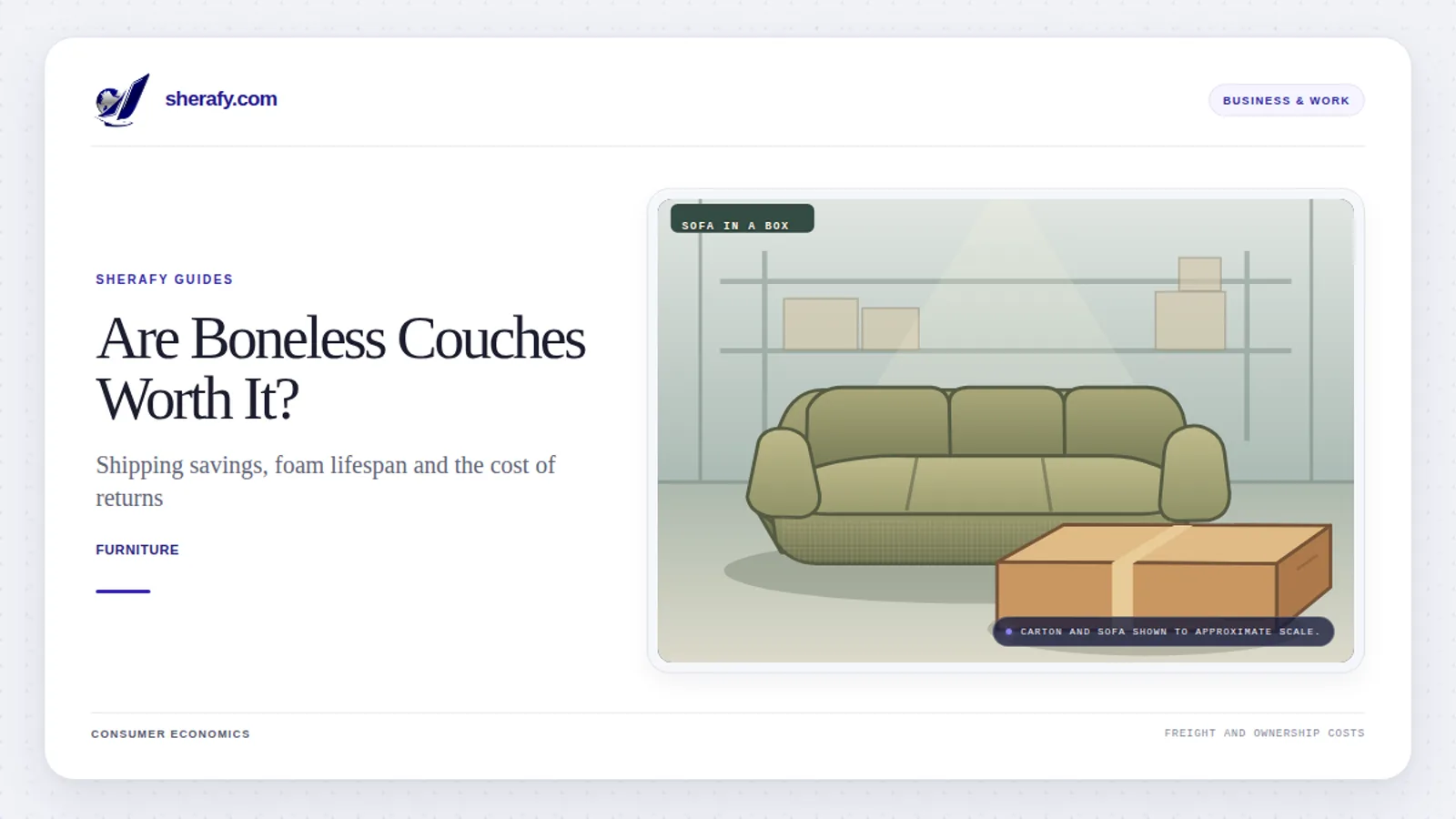
Boneless couches can be worth buying, particularly if you need affordable furniture delivered through a narrow doorway, want a casual lounge-style sofa or expect to use it for a relatively short period. But they are not automatically cheaper, less durable or better value than traditional couches. The answer depends on the particular sofa, how it supports your body, how long it remains comfortable and what happens if you need to return it.
The most important innovation is not necessarily the couch itself. It is the ability to compress upholstered furniture into a much smaller shipping package. In a comparison of two actual three-seat sofas, sherafy.com calculated that a vacuum-compressed model occupied approximately 69% less shipping carton volume than a conventional IKEA flat-pack sofa. Under an illustrative $4,000-per-container freight scenario, that translated into roughly $49 less allocated transportation cost per couch.
That is a meaningful saving. It does not explain every difference in retail price, and it does not tell us how long the foam will last.
| Question | What the evidence shows |
|---|---|
| Why are boneless couches cheap? | Compression can reduce freight, storage and handling costs. Eliminating some structural components can also change manufacturing costs. |
| How long do they last? | There is no reliable category-wide lifespan established by representative long-term testing. |
| Do they sag? | They can. Foam can lose firmness or thickness over time, and the risk depends on its formulation, construction and use. |
| Are they all made of foam? | No. Some compressed sofas also contain springs or metal supports. |
| Can you return one after opening? | Some sellers arrange collection; others charge for expanded returns or exclude ordinary opened-product returns entirely. |
| Are they cheaper over time? | Only if the useful lifespan and other ownership costs justify the purchase price. |
The distinction between a cheaper way to ship a couch and a cheaper way to own one is the key to understanding this market.
What is a boneless couch?
A boneless couch is generally an upholstered sofa that lacks a conventional rigid internal frame and is often designed to be delivered in vacuum-compressed packaging. Flexible foam provides much of the cushioning and, in many designs, the structural support that a wooden or metal frame would ordinarily provide.
The term is a commercial description, not a standardized furniture construction or quality classification.
| Construction | How it supports the sitter |
|---|---|
| Frameless foam sofa | Foam layers or blocks provide both support and cushioning. |
| Compressed hybrid sofa | Foam is combined with springs or other supporting components. |
| Conventional framed sofa | A rigid frame supports cushions and a suspension system, such as springs or webbing. |
| Conventional flat-pack sofa | The rigid components are disassembled for transportation and assembled at the destination. |
Modularity is a separate characteristic. A sofa can be modular with or without a rigid frame. Likewise, a cloud couch describes a style of soft, deep seating, while couch-in-a-box describes a delivery format. Neither term necessarily means frameless.
For example, the OVIOS 81-inch modular sleeper's specifications list foam and pocket springs among its materials. A Good Housekeeping review of a Mercer41 convertible boneless sofa also describes metal supporting components. By contrast, the Rove Lab M1 three-seater uses a foam-based frameless design.
Two sofas advertised as boneless can therefore have substantially different mechanical properties. The label alone is not enough to evaluate quality.
Why are boneless couches so cheap?
A conventional couch can be expensive to distribute because it occupies substantial space relative to its value. Even when a manufacturer disassembles the frame, the finished upholstery, cushions and rigid parts require room in shipping containers, warehouses and delivery trucks.
A compressible sofa changes that cost structure. Removing a conventional frame may reduce the need for certain structural materials and assembly operations. Compressing the finished furniture can allow more units to travel in the same container, reduce warehouse space requirements and make some products eligible for parcel delivery rather than specialized furniture transportation.
These savings can also make direct-to-consumer sales more practical. A retailer does not necessarily need to maintain a showroom or provide room-of-choice delivery for every order. However, industrial compression equipment, engineered foam, packaging, tariffs, domestic freight, customer acquisition and returns still cost money.
Retail Brew's November 2025 interviews with furniture industry executives illustrate the motivation. Lifestyle Solutions CEO Ana Arun reported that container costs for her company had increased from $2,500 to $20,000 during an earlier period and described compressed designs capable of increasing the load from roughly 20–30 pieces to 60–80. These are an executive's account of company experience, not audited industry averages or current freight quotes.
The market also has premium offerings. On November 27, 2026, Rove Lab advertised its M1 three-seater at a promotional $897 against a stated regular price of $1,397, while the IKEA KIVIK sofa examined here was listed at $799. These are different products and service arrangements, but the comparison demonstrates that compressed construction does not guarantee a lower retail price.
We can calculate the distribution advantage. We cannot determine the exact factory cost, merchant margin or proportion of savings passed to customers without the relevant financial records.
How much shipping space does a boneless couch actually save?
To quantify the difference, sherafy.com compared the published dimensions of the Boneless Couch Living Bubble three-seat sofa and IKEA's KIVIK three-seat sofa with its Tibbleby cover.
The KIVIK is an especially useful comparison because it is already disassembled for shipping. This is not a comparison against a fully assembled conventional couch deliberately packaged inefficiently.
Actual sofa and carton specifications
| Specification | Bubble three-seat | IKEA KIVIK |
|---|---|---|
| Assembled width | 98.43 in | 89.75 in |
| Assembled depth | 45.28 in | 37.375 in |
| Assembled height | 30.31 in | 32.625 in |
| Number of shipping cartons | 1 | 3 |
| Gross shipping weight | 104.7 lb | 179.56 lb |
| Combined carton volume | 12.618 ft³ | 40.623 ft³ |
| Combined carton volume | 0.3573 m³ | 1.1503 m³ |
For reproducibility, these are the raw carton dimensions used in the calculation:
| Carton | Length (in) | Width (in) | Height (in) |
|---|---|---|---|
| Bubble three-seat | 55.12 | 20.08 | 19.70 |
| KIVIK frame package 1 | 72.50 | 37.50 | 19.75 |
| KIVIK frame package 2 | 38.50 | 36.25 | 11.00 |
| KIVIK cover package | 22.25 | 14.75 | 3.50 |
Method: Multiply each carton's length, width and height, sum the volumes and divide cubic inches by 1,728 to obtain cubic feet. The comparative reduction is calculated as 1 minus the Bubble volume divided by the KIVIK volume.
The result is 68.94% less carton volume, or approximately 3.22 times as many complete sofas per unit of shipping space before practical packing restrictions.
The Bubble's own expanded rectangular bounding volume is about 6.20 times its shipping carton volume, an approximately 83.9% reduction. That is a different measurement. It includes the empty space around an assembled sofa and is not a measurement of the foam's compression ratio.
Both results are calculated from published product specifications rather than measurements taken by sherafy.com. The products have nominally comparable seating capacity but differ in construction, dimensions and intended use. This is a reproducible case study, not a controlled experiment or a representative industry average.
How many sofas fit in a shipping container?
Maersk's dry-container specifications give an internal capacity of 33.2 cubic meters for a standard 20-foot container, 67.7 cubic meters for a standard 40-foot container and 76.4 cubic meters for a 40-foot high-cube container. Their listed maximum payloads are 28,300, 28,870 and 28,690 kilograms respectively, subject to equipment and local restrictions.
Dividing available volume by the combined carton volume per sofa gives a theoretical upper bound. A second scenario assumes that 85% of the internal container volume is occupied by cartons.
| Container and scenario | Bubble | KIVIK |
|---|---|---|
| 20-foot standard, volume only | 92 | 28 |
| 20-foot standard, 85% utilization | 78 | 24 |
| 40-foot standard, volume only | 189 | 58 |
| 40-foot standard, 85% utilization | 161 | 50 |
| 40-foot high cube, volume only | 213 | 66 |
| 40-foot high cube, 85% utilization | 181 | 56 |
All counts are rounded down to complete sofas. The 85% assumption is illustrative, not an established utilization rate or a demonstrated packing arrangement. Carton geometry, stacking limits, loading access, securing requirements and weight distribution can reduce the number actually loaded. Although the estimated gross cargo weights in this example are below Maersk's nominal payload limits, that does not establish operational feasibility.
There is no universal answer such as 80 traditional couches or 300 compressed couches per container. The carton size and configuration determine the answer.
How much money does that save per couch?
Using the illustrative high-cube scenario of 181 Bubble sofas versus 56 KIVIK sofas, we can divide a hypothetical container transportation charge by the number of units loaded.
| Assumed container charge | Bubble per sofa | KIVIK per sofa | Difference per sofa |
|---|---|---|---|
| $2,500 | $13.81 | $44.64 | $30.83 |
| $4,000 | $22.10 | $71.43 | $49.33 |
| $8,000 | $44.20 | $142.86 | $98.66 |
| $10,000 | $55.25 | $178.57 | $123.32 |
| $20,000 | $110.50 | $357.14 | $246.65 |
Source: Original sherafy.com calculations using manufacturer-published packaging dimensions and Maersk's container capacity. The transport charges are scenarios, not current freight rates, invoices or complete landed-cost estimates.
At $4,000 per container, the compressed sofa's modeled freight allocation is approximately 69% lower. But the dollar difference is about $49 per unit. During a period of exceptionally high freight costs, the incentive to redesign furniture around transportation becomes much stronger.
The key point is that a substantial percentage saving on one cost component does not imply an equally substantial reduction in retail price. International freight is only one part of the economic equation. For more on why freight rates can diverge from shipping costs, see Sherafy's Red Sea and Cape route cost comparison.
What manufacturers report about compression
Boneless Couch Living's August 2026 compression statistics provide additional commercial evidence. Its production records reportedly cover 60 configurations across 37 models, with a median assembled-to-carton bounding-volume ratio of 5.6:1, a range of 2.5:1 to 11:1 and a reported median container load of 234 units. Its separate retail dataset covers 100 configurations across 56 models, with a median gross shipping weight of 95 pounds. The 22 three-seat configurations weighed 71–215 pounds, with a median of 124 pounds and a median of two cartons (range: one to five).
Those figures describe the seller's own catalog, including different seating capacities. The underlying records have not been independently audited. They support substantial variation in package size and weight, not an industry-wide average.
The hidden cost of shipping a couch in a box
Parcel delivery is one of the biggest commercial advantages of compressed furniture. It can also be one of its least understood costs.
UPS's U.S. package rules generally limit parcels to 150 pounds of actual weight, 108 inches in length and 165 inches in combined length and girth. Specific services can impose other restrictions.
But fitting within those limits does not make a package inexpensive to deliver. Carriers also charge for the space a package occupies, through dimensional weight, and impose additional fees for large or difficult-to-handle packages.
What a 105-pound couch can actually weigh for billing purposes
Consider the same Bubble carton, measuring 55.12 × 20.08 × 19.70 inches and weighing 104.7 pounds. Under the 2026 UPS Daily Rate and Service Guide, updated September 7, 2026 (printed page 19), each fractional dimension is rounded upward before the daily-rate dimensional-weight calculation.
| UPS calculation | Result |
|---|---|
| Rounded dimensions | 56 × 21 × 20 in |
| Actual weight, rounded up | 105 lb |
| Length plus girth: 56 + 2(21 + 20) | 138 in |
| Rounded volume | 23,520 in³ |
| Dimensional weight: 23,520 ÷ 139, rounded up | 170 lb |
The resulting dimensional weight is 170 pounds, despite the carton physically weighing about 105 pounds. That billing weight is not a violation of the 150-pound actual-weight limit.
Under the UPS large-package criteria, the carton also qualifies as a large domestic package because its length plus girth exceeds 130 inches and its cubic volume exceeds 17,280 cubic inches. The other qualifying thresholds are length over 96 inches or weight over 110 pounds.
The published residential large-package surcharges in the September 2026 guide (printed page 181) are:
| Shipping zone | Residential large-package surcharge |
|---|---|
| Zone 2 | $254.50 |
| Zones 3–4 | $274.50 |
| Zones 5–6 | $320.50 |
| Zones 7 and higher | $331.00 |
Only one such charge applies even when several criteria are met; the guide excludes a separate additional-handling fee when the large-package surcharge applies. Base transportation and applicable other fees are separate. FedEx's rate-change documentation likewise illustrates the importance of cubic size and actual weight in oversized-package pricing.
These are published list surcharges, not evidence of what the sofa retailer pays. Volume contracts, negotiated discounts, alternative carriers, warehouse locations and other fulfillment arrangements can produce very different actual costs. The seller’s shipping policy advertises free UPS or FedEx ground delivery within the contiguous United States. Free shipping means the consumer is not separately charged at checkout; it does not mean the transportation itself is free.
Compression can make furniture parcel-compatible without eliminating expensive oversized-package handling. Splitting a sofa into modules may help avoid particular thresholds, although it can increase the number of packages and associated handling costs.
A small box is not necessarily a light box
The Bubble three-seater weighs more than 100 pounds in its carton; even the two-seater's package weighs 85.1 pounds. Boneless Couch Living's own three-seat data also include much heavier configurations. These are gross shipment weights, not necessarily the weight of each individual carton in a multi-box shipment.
Check the smallest doorway, elevator dimensions, stairs, turns and the weight of the largest package. Arrange help or suitable handling equipment where necessary. OSHA's discussion of manual lifting explains why safe lifting depends on more than a single weight number.
A parcel carrier may deliver to your door rather than carry the furniture upstairs, unpack it or remove the packaging. Compare doorstep delivery against the services included in a conventional furniture purchase.
Who invented the boneless couch?
Frameless furniture is much older than the current social-media trend. Ligne Roset's history of designer Michel Ducaroy documents the modular all-foam Adria design from 1968 and the Togo seating collection from 1973.
Compressed and rolled foam mattresses also predate today's mass-market boneless sofas. A European patent application with October 2020 priority describes the challenge of dimensional recovery in compressed polyurethane foam articles. A furniture vacuum-packing application with July 2024 priority describes mechanical packaging of furniture using a hydraulic press. Patent records document particular technical developments, not proof of the first invention of an entire product category or proof that a proposed method works as advertised.
Chinese manufacturers have helped commercialize compressed furniture. Zhejiang's government portal describes Anji's furniture manufacturing cluster, while Boneless Couch Living identifies itself as a brand of Foshan Fangye Furniture Co., Ltd., in Guangdong, with a fulfillment warehouse in Georgia. Neither establishes China's share of worldwide boneless couch production or a particular city's claim to invention.
Retail Brew dates Rove Lab's business launch to September 2024 and reported growing searches and social-media attention in November 2025. It identified about 13,200 relevant TikTok videos at that time, including examples exceeding 10 million views. MarketWatch's November 2026 reporting subsequently reported roughly 300% year-over-year growth in Google search interest and noted that the five bestselling couches on Amazon were boneless models at the time of its reporting. These are dated reported indicators, not independently extracted search-volume data or continuing bestseller rankings.
The modern commercial development combines established foam furniture technology with industrial compression, warehouse fulfillment, parcel delivery and direct online retail. It is as much an innovation in distribution as it is in furniture design.
How does a vacuum-packed couch expand?
Flexible polyurethane foam contains a network of cells, many of which communicate with one another. Under mechanical pressure, its cellular structure deforms and air is displaced. Industrial compression machines and sealed packaging hold the furniture in a compact configuration until the customer opens it.
Once the seal is released, the foam's elastic structure attempts to recover its shape and air reenters the cells. Recovery is not necessarily instantaneous or complete. It depends on the material formulation, degree of compression, time in storage, temperature and product construction.
The same concept explains why a foam mattress can be shipped in a roll. But a couch must also accommodate seating geometry, upholstery, arms, backrests and sometimes springs or connectors.
How long does a boneless couch take to expand?
The answer is product-specific. Boneless Couch Living specifies about 72 hours for the Bubble sofa to finish expanding. Rove Lab's M1 faux-leather instructions allow up to 48 hours for complete expansion of the modules.
Follow the instructions supplied with your particular sofa. Open it in the room where it will be used, photograph its condition and avoid improvised heating or other treatments not approved by the manufacturer. If it appears defective, notify the seller promptly rather than waiting until a reporting deadline expires.
The fact that a couch expands to its advertised shape is evidence of initial recovery. It is not evidence that the seating will retain its firmness for years.
How long do boneless couches last?
No reliable representative study establishing an average lifespan for modern boneless couches was identified in the research for this article. Estimates such as five years appear in consumer coverage, but they should not be confused with a measured category-wide average.
A particular sofa could remain suitable for years or become uncomfortable much sooner. Laboratory tests can explain the mechanisms behind those outcomes, but they cannot automatically predict the lifespan of an individual household's couch.
Short-term product reviews are useful for evaluating dimensions, initial expansion and subjective comfort. Owner accounts, including consumer discussions on Reddit, illustrate both concerns about deterioration and satisfactory experiences. Neither constitutes a representative longitudinal sample. Warranty duration is also a contractual term, not a scientific measure of how long furniture lasts.
Why do some boneless couches sag?
There are three related but distinct mechanisms of deterioration:
| Mechanism | What it means |
|---|---|
| Compression-related deformation | Foam may fail to recover fully after being tightly packed for an extended period. |
| Dynamic fatigue | Repeated sitting and unloading can reduce firmness or thickness. |
| Natural aging | Time-dependent material changes may alter elasticity, stiffness or resilience even without repeated seating. |
In a frameless sofa, the foam may be responsible for both comfort and structural support. Losing firmness in a supporting layer can therefore affect the entire seating experience, not just the softness of a removable cushion.
A conventional couch also contains materials that deteriorate. Its cushions can soften, its suspension can fail and its frame joints can loosen. Neither construction is immune to wear.
Does higher-density foam last longer?
Density is useful, but it is not synonymous with firmness or durability. The Polyurethane Foam Association's technical guidance distinguishes material density from the force required to indent it. This is an industry association's technical resource, not independent testing of a particular sofa.
| Foam property | What it measures |
|---|---|
| Density | Mass per unit of foam volume. |
| Polymer density | Density attributable to the polymer rather than the contribution of added fillers or reinforcement. |
| Indentation force deflection (IFD or ILD) | Force needed to compress the material by a specified amount; an indicator of firmness. |
| Support factor | Relative resistance to deeper versus shallower compression; relevant to bottoming out. |
| Compression set | Residual dimensional loss following prescribed compression and recovery. |
| Dynamic fatigue | Changes in material performance after repeated loading. |
| Resilience | How readily the material rebounds. |
| Hysteresis | Energy dissipated during a loading and unloading cycle. |
| Tensile and tear strength | Resistance to stretching and tearing. |
A dense foam can feel soft. A firm foam need not be especially dense. Fillers can increase apparent density without proportionally improving polymer performance, but the presence of a filler does not by itself establish poor quality. A buyer needs information about the material's actual performance.
Common density conversions help when comparing metric and U.S. specifications:
| lb/ft³ | kg/m³ |
|---|---|
| 1.0 | 16.0 |
| 1.5 | 24.0 |
| 1.8 | 28.8 |
| 2.0 | 32.0 |
| 2.5 | 40.0 |
| 3.0 | 48.1 |
One pound per cubic foot is approximately 16.0185 kilograms per cubic meter. These values are conversions, not universal minimum grades for boneless furniture. Different layers may require different characteristics.
What laboratory research actually establishes
A 2019 study by Samet Demirel and Busra Ergun Tuna in Polymer Testing examined six polyether polyurethane foam formulations, with measurements before and after fatigue-loading stages of 8,000 and 80,000 cycles.
For the normal-foam category, increasing density from 14 to 28 kg/m³ corresponded to a reduction in measured 25% indentation-force loss from 30.7% to 21.5%. In the soft-foam category, increasing density from 24 to 32 kg/m³ was associated with a change from 20% to 23.6% loss, described as insignificant. Support factors increased with density in both categories, and measurable performance loss could occur without obvious visible deformation.
The study demonstrates why higher density alone is not a complete predictor. It was material testing, not a household couch trial. The loading cycles cannot responsibly be converted into a particular number of years of furniture use without a validated equivalence.
Smardzewski and Matwiej's 2013 natural-aging study examined seven furniture foam types over 730 days under residential-like climatic conditions. It documents time-dependent changes in foam stiffness, providing another reason why initial unboxing performance is an incomplete quality measure.
Research by Vlaović and colleagues published in Polymers in June 2026 investigated six three-layer combinations of conventional polyurethane, high-resilience polyurethane, low-resilience polyurethane and latex foam. The work shows how layer selection and arrangement can influence elastic response and support. Its small sample, limited replication, lack of human loading and absence of complete upholstered seating systems limit generalization. The authors declared no external funding or conflicts of interest and acknowledged commercially supplied samples.
These findings support evaluating the complete foam system rather than treating a single advertised density number as a quality guarantee.
What should manufacturers test?
ASTM D3574-25 provides standardized test methods for flexible polyurethane foam. ASTM's public description cautions that measurements under prescribed laboratory conditions need not match other real-world environments. The complete proprietary standard was not accessed for this article.
For a sofa designed to remain compressed in storage, a useful technical specification would identify the foam used in each structural layer, compression conditions, maximum validated storage duration, recovery measurements and retained thickness and firmness after repeated loading. A finished-product load test is valuable because the interaction between the layers, upholstery, springs and connectors also matters.
In one November 2026 listing audit by MeltFlex Solutions, the publisher examined 59 product listings across two sellers and reported that 13 of 21 OVIOS sofa listings disclosed springs while none of those 21 disclosed numerical foam density. This was the publisher's listing review, not physical testing; sherafy.com did not reproduce all 59 observations. A missing specification is a reason to ask for more information, not proof of defective foam.
Boneless couch vs. traditional couch: Which is better?
| Factor | Boneless or compressed couch | Conventional couch |
|---|---|---|
| Purchase price | Often marketed as affordable, but premium models exist. | Ranges from inexpensive used or flat-pack furniture to luxury models. |
| Delivery | Compact cartons can ease access; some are heavy or oversized. | Often bulkier, although disassembled models can be space-efficient. |
| Seating | May favor low, deep lounge-style seating; varies by model. | Wide range of seat heights, depths and support styles. |
| Durability | Depends on foam, springs, construction and use. | Depends on frame, suspension, cushions, construction and use. |
| Repairability | Replaceable foam modules or covers may be available. | Replaceable cushions, covers and repairable frames may be available. |
| Moving | Easier if modules separate; otherwise expanded furniture must fit through exits. | Depends on assembled size, disassembly options and weight. |
| Returns | Can be difficult or expensive after expansion. | Also retailer-dependent, without the same factory-compression constraint in many cases. |
Comfort, support and suitability for daily use
Softness is not the same as support. A couch can feel comfortable at first but compress too far during prolonged sitting. Seat height, depth, backrest height and support under the occupant's weight all matter.
The published unloaded seat heights of three examples are 15 inches for Rove Lab's M1, 17 inches for the OVIOS 81-inch sleeper and 17.75 inches for the IKEA KIVIK. The effective occupied height may be lower as cushions compress.
Deep, low seating can be appealing for lounging. It may also be harder to rise from, particularly for someone with mobility limitations. A heavier occupant should check the manufacturer's stated load rating and whether it applies to an individual seat or the complete sofa. The OVIOS sleeper, for example, lists a 650-pound weight limit; its listing should not be interpreted as guaranteeing that capacity at every individual seating position.
A boneless couch may be a reasonable secondary sofa, apartment sofa or casual seating option. For a main family couch used intensively every day, inspect the actual support system, published durability evidence and repair options. A well-made conventional sofa, including a suitable secondhand one, may offer better value than a poorly specified new model. The reverse can also be true.
Can you return a boneless couch after opening it?
Sometimes, but the return policy is especially important for compressed furniture. The manufacturer has equipment for compressing the product into its original packaging. Most customers do not. A sofa that traveled to the buyer as a relatively compact parcel may require a much larger package, special collection or freight transportation on its way back.
The following comparison examines published direct-purchase terms as of November 27, 2026. It does not measure how often claims are approved or how consistently the policies are honored.
| Seller | Ordinary return after expansion | Published conditions |
|---|---|---|
| Rove Lab | Allowed if eligible | 100 days, $99 fee; collection carrier handles repackaging. |
| Boneless Couch Living | Allowed if eligible | 30 days; unused, undamaged and complete; buyer pays freight plus 10% restocking for expanded items. |
| Boneless Labs | Not allowed for ordinary preference returns | Unopened returns within 30 days; defects or wrong items have separate terms. |
| Boneless Couch Global | Not allowed for ordinary preference returns | Unopened returns within 30 days; separate defect and incorrect-item terms. |
| BOCO | Not allowed for preference returns | Qualifying damage, defects or wrong items may be returned within 30 days. |
| OVIOS | Unclear for expanded sofas | Requires packing according to the original method; preference-based returns involve buyer-paid shipping. Obtain clarification before buying. |
| IKEA | Allowed if eligible | Open products within 180 days; unopened products within 365 days, subject to conditions. |
Eligibility varies with condition, order type and seller. Rove Lab, for example, excludes final-sale items and purchases made from third-party sellers; its collection is from the original shipping address. Boneless Couch Living offers discretionary partial-refund or local-donation arrangements for some purchases. It also specifies a 48-hour visible shipping damage reporting period and seven days for hidden or functional defects, in addition to a separate quality guarantee.
An important issue is the relationship between recovery and reporting deadlines. Boneless Labs and Boneless Couch Global require reporting manufacturing defects or incorrect items within three days of delivery. If an ordered product needs several days to reach its full shape, waiting for complete expansion could leave a buyer little time to report a suspected problem. Check the actual seller's instructions, preserve photographs and communicate in writing.
This does not prove that any retailer deliberately designed its product to obstruct legitimate returns. It establishes an asymmetry in the economics of delivery and collection. In particular, the retailer that allows an opened return and arranges collection offers a materially different consumer proposition from one that excludes ordinary returns once the vacuum seal is broken.
What does a lifetime warranty actually cover?
A prominently advertised warranty does not necessarily mean free replacement for the entire time you own the furniture.
Rove Lab's limited lifetime warranty provides three years of initial coverage for specified manufacturing and structural defects in its foam and fabric. Ordinary softening, compression and loss of resilience are excluded as normal wear. After the first three years, qualifying SmartFoam issues may be addressed by a replacement priced at 50% of the then-current undiscounted retail price. The discounted replacement price includes shipping and handling. Coverage is nontransferable and replacement does not reset the original warranty period.
Boneless Couch Living's warranty page states that its final extended coverage duration and complete terms are still being finalized. Its separately published 90-day manufacturing-defect guarantee applies under its specified conditions, including refund or replacement remedies.
Before ordering, determine whether sagging, incomplete recovery, loss of firmness, torn covers and failed connectors are covered. Ask how a defect is defined and measured, who pays transportation and whether a replacement restarts coverage. Normal wear exclusions are especially relevant when purchasing foam-dependent furniture.
What consumer rights apply in the United States?
The Federal Trade Commission's Cooling-Off Rule guidance expressly excludes sales made entirely online. There is no universal three-day cancellation right for an internet furniture purchase under that rule.
A voluntary return policy is not the entire legal picture. The FTC's consumer warranty guidance explains the role of written and state-law implied warranties, and 15 U.S.C. § 2308 restricts certain implied-warranty disclaimers where written warranties or qualifying service contracts are provided. Rights and remedies vary by jurisdiction and circumstance. A product that is defective or materially misdescribed is not necessarily subject to the same limitations as an ordinary change-of-mind return.
Are boneless couches safe?
A couch's safety cannot be established by its marketing category. Evaluate the actual materials, chemical-emissions documentation, flammability compliance and structural performance.
CertiPUR-US is a certification program for flexible polyurethane foam. It addresses specified emissions, content and durability criteria. It is not a certification of the entire sofa, and low volatile organic compound (VOC) emissions are not the same as zero emissions. Nor does the certification establish an exact product lifespan. Verify a seller's participation through the program's directory rather than relying solely on a logo in an advertisement.
U.S. upholstered furniture within the scope of 16 CFR Part 1640 must comply with federal flammability requirements incorporating California Technical Bulletin 117-2013's smolder-resistance test standard. The Consumer Product Safety Commission's upholstered furniture guidance explains the applicable requirements, including the permanent compliance label. Compliance does not mean that a sofa is fireproof.
A missing certification reference in an online listing is not by itself evidence of a regulatory violation. Conversely, a statement that a sofa is laboratory-tested is uninformative unless the seller identifies the material, test and applicable performance criteria.
Are boneless couches better for the environment?
Compressed furniture can reduce the volume transported per unit. That can reduce the number of containers and storage space required for a given quantity, potentially lowering emissions associated with distribution. The actual transportation benefit depends on how loads are organized, the routes traveled and the mode of transport.
The complete environmental footprint also includes raw materials, foam production, upholstery, packaging, repair and the eventual disposal of the product. If a couch must be replaced more often, its initial freight advantage could be reduced or offset. Alternatively, a modular design with available replacement parts could prolong useful life and avoid disposal of an entire sofa.
The EPA's furniture and furnishings waste estimates indicate that the United States generated 12.08 million tons of furniture and furnishings waste in 2018, about 9.68 million tons of which (80.1%) was landfilled. These are historical estimates for a broad category, not current sofa-only or boneless furniture statistics.
No representative comparative lifecycle analysis establishing an overall environmental advantage for contemporary boneless couches was identified. Less space in a shipping container is a real potential benefit. It is not a complete environmental assessment.
Which couch is actually cheaper over time?
The most useful comparison is cost per year of satisfactory use. A less expensive couch does not need to last as long as a more expensive couch to offer equal value. It only needs to last long enough relative to the difference in net cost.
Boneless couch lifetime value calculator
Use these formulas to compare two prospective purchases:
Net ownership cost = purchase price + delivery and setup + maintenance and repairs + disposal cost − resale value
Annualized ownership cost = net ownership cost ÷ usable lifespan in years
Break-even boneless couch lifespan = (boneless net cost ÷ conventional net cost) × conventional lifespan
Use the same currency, comparable delivery and tax assumptions and the same definition of useful life for both products. The break-even formula assumes positive conventional net cost. This is a simple annualized comparison, not a discounted cash-flow model or an empirical lifespan prediction.
Suppose a boneless couch costs $350 and a conventional one costs $800. Assume the conventional sofa remains satisfactory for eight years, with no other costs in this simplified example.
| Boneless couch usable lifespan | Boneless purchase cost per year | Conventional purchase cost per year |
|---|---|---|
| 1 year | $350.00 | $100.00 |
| 2 years | $175.00 | $100.00 |
| 3 years | $116.67 | $100.00 |
| 3.5 years | $100.00 | $100.00 |
| 4 years | $87.50 | $100.00 |
| 5 years | $70.00 | $100.00 |
Under these assumptions, the $350 couch needs to last at least 3.5 years to match the more expensive sofa's annualized purchase cost. Those are deliberately chosen scenarios, not category-average lifespans.
The following quick-reference table works as a manual break-even calculator for other prices, assuming an eight-year conventional couch lifespan and no additional costs:
| Boneless price | $600 conventional | $800 conventional | $1,000 conventional |
|---|---|---|---|
| $250 | 3.33 years | 2.50 years | 2.00 years |
| $350 | 4.67 years | 3.50 years | 2.80 years |
| $500 | 6.67 years | 5.00 years | 4.00 years |
| $750 | 10.00 years | 7.50 years | 6.00 years |
Substitute your actual net costs and expected period of use for a more relevant comparison. If you only need furniture for a two-year rental, consider that shorter ownership horizon and any likely resale value. Longevity beyond your expected period of use has a different economic value to you than it does to someone furnishing a permanent home.
The cost of getting the purchase wrong
The above calculation assumes the product is suitable enough to keep. Return fees introduce another cost.
A hypothetical $350 purchase subject to a 10% restocking fee costs $35 to return before transportation. If a seller arranges collection for a fixed $99 fee, the buyer can know the approximate downside in advance. If ordinary opened returns are excluded, discovering that the couch is unsuitable can expose the buyer to most or all of the purchase price, less what can be recovered by resale.
These are illustrative outcomes, not estimates of return frequency. When the couch cannot be tested before purchase, the ability to reverse the decision is itself worth something.
What to check before buying a boneless couch
Before ordering, obtain answers to the following questions. Important assurances should be documented in writing, particularly if they do not appear in the seller's specifications or terms.
- Construction: Is the sofa completely frameless, or does it use springs, braces or other supports?
- Materials: What are the numerical foam densities and support properties of the seat, base and backrest? Are there finished-product or fatigue-test results?
- Comfort: What are the actual seat height, depth and backrest dimensions? Can you test it before buying?
- Weight limits: Does the advertised capacity apply to one seat, the entire couch or a particular loading condition?
- Access: How many cartons will arrive, what are their dimensions and individual weights, and what delivery service is included?
- Expansion: How long should recovery take? How long may the sofa remain sealed before opening?
- Maintenance and repair: Are covers removable? Can a damaged or worn-out section be replaced independently, and are those replacements actually sold?
- Returns: Can you return an expanded couch because you dislike it? Who packages and collects it, and what fees apply?
- Warranty: Are structural collapse, excessive sagging or incomplete expansion covered? What counts as excluded normal wear?
- Total cost: Compare the delivered price, realistic period of use and financial consequences of an unsuccessful purchase against conventional and used furniture alternatives.
For a primary household sofa, durability and support evidence deserve particular weight. For temporary or secondary seating, price and delivery convenience may matter more. In either case, do not buy solely on the basis of an impressive unboxing demonstration.
Frequently asked questions
Can you vacuum-pack a boneless couch again after opening it?
Industrial recompression is possible for appropriate products, but a household vacuum and ordinary storage bag should not be assumed capable of reproducing the factory package. Improvised compression can also damage the furniture. Check manufacturer instructions and plan to move or return the couch at its expanded dimensions unless the seller confirms another arrangement.
How long can a boneless couch remain in its box?
There is no established universal safe storage period. Foam formulation, compression conditions and temperature affect recovery. Obtain the model's maximum validated compressed storage time, preferably measured from the date it was packed rather than the date you received it.
Why is my boneless couch not expanding properly?
Some products require two or three days to reach their intended shape. Uneven recovery may also reflect storage conditions, material deformation or a manufacturing defect. Follow the model's instructions, photograph the issue and notify the seller within the applicable claim period. Do not assume every wrinkle or irregularity indicates permanent damage.
Can you move a boneless couch after it expands?
Yes, if the expanded dimensions and weight permit safe handling. A modular sofa that separates into smaller pieces can be easier to move. A large one-piece sofa may have the same doorway and stairway limitations as other furniture after expansion.
Can you sleep on a boneless couch every night?
Some compressed couches are marketed as convertible sleeper sofas. Whether a particular model is suitable for regular sleeping depends on its support, dimensions and the person's needs. A plush seat or occasional guest bed is not necessarily designed for nightly use.
Can you wash a boneless couch or replace its foam?
Only according to the model's care instructions. A removable cover may be washable while its foam core is not. Independent replacement modules or cushions can improve repairability, but verify actual parts availability before buying. Some models require spot cleaning only.
Are all boneless couches manufactured in China?
No reliable global manufacturing breakdown was identified. Chinese factories are documented participants in this market, but neither the boneless label nor the delivery method establishes country of manufacture. Check the individual product's origin information.
Are boneless couches a good investment?
They are consumer goods, not investments in the financial sense. A reasonably priced compressed sofa can be an economical purchase if it provides adequate support, lasts long enough for your needs and comes with acceptable return terms. Without those conditions, the lower initial price can be misleading.
The bottom line
The boneless couch solves a real problem: moving a large upholstered product through a supply chain designed around limited space. That can deliver genuine savings and make furniture more accessible to people who cannot easily receive or transport a conventional sofa.
But the logistics innovation does not establish the quality of the seating. A product's foam performance, actual support, repairability, useful lifespan and return protections are what determine its value to the buyer. Until representative long-term performance data are available, the best decision is model-specific, based on verifiable specifications and a realistic ownership-cost comparison.
The furniture industry has found a cheaper way to move a couch. Whether it has found a cheaper way to own one depends on what happens after you open the box.
References and Further Reading
Product specifications and primary commercial documentation
- Boneless Couch Living: Bubble two- and three-seat couch. Primary listing for the assembled and shipping dimensions, gross weights and recovery instructions used in the original calculations.
- IKEA: KIVIK sofa, Tibbleby beige/gray. Conventional comparison product, including individual carton specifications, materials and seat dimensions.
- Boneless Couch Living: 2026 compression, weight and shipping statistics. Manufacturer-reported production and catalog data with sample sizes and measurement methodology. The underlying records have not been independently audited.
- Boneless Couch Living: Company and manufacturing information. The seller identifies its Chinese manufacturer and Georgia warehouse.
- Rove Lab: M1 three-seat boneless sofa. Manufacturer description, advertised retail price, design and seating measurements.
- Rove Lab: M1 faux-leather three-seat sofa. Model-specific unpacking and recovery instructions.
- OVIOS: 81-inch boneless modular sleeper. Published construction, pocket-spring disclosure, load rating and seating dimensions.
Transportation, packaging and original calculation inputs
- Maersk: Cargo weight limits and container capacity. Official dry-container capacity and nominal maximum payload specifications.
- UPS: Package dimensions and weight limits. General package eligibility, measurements and dimensional-weight guidance.
- UPS: Additional shipping charges. Size-based fees and additional handling criteria.
- UPS: 2026 Daily Rate and Service Guide, September 7, 2026 edition. Printed pages 19, 179 and 181 establish dimensional-weight calculations, rounding and standard surcharge amounts.
- FedEx: Rate and surcharge changes. Carrier pricing and oversized-package criteria.
- OSHA: Interpretation concerning manual lifting. Explains the contextual nature of lifting risk rather than a universal safe weight.
Materials science, technical standards and engineering records
- Polyurethane Foam Association: Foam performance. Industry technical resource distinguishing foam density, firmness, support, resilience and fatigue.
- ASTM International: D3574-25, Standard Test Methods for Flexible Cellular Materials. Public description of the active standardized flexible polyurethane foam testing reference and limits on generalization to actual use.
- Demirel and Tuna, Evaluation of the cyclic fatigue performance of polyurethane foam in different density and category, Polymer Testing (2019). Original experimental research, volume 76, pages 146–153. DOI: 10.1016/j.polymertesting.2019.03.019. The national research repository record provides an additional route to the abstract and bibliographic details.
- Smardzewski and Matwiej, Effects of Aging of Polyurethane Foams in the Context of Furniture Design, Drvna industrija (2013). Seven furniture foam types studied under residential-like conditions for 730 days; DOI: 10.5552/drind.2013.1241.
- Vlaović, Domljan, Gržan and Mihulja, Mechanical Properties of PUR and Latex Foams as Predictors for Seating or Lying Comfort, Polymers (2026). Experimental multilayer foam research with stated limitations, volume 18, article 1549; DOI: 10.3390/polym18121549.
- European patent application EP3981816A1. Technical documentation of the challenges of dimensional recovery in compressed flexible polyurethane foam articles. Patent assertions are not independent product-performance validation.
- International patent application WO2026020237A1. Documents a furniture vacuum-packing method using mechanical compression; does not establish first invention of the product category.
Direct retailer returns and warranty terms
- Rove Lab: Return policy. Eligibility, trial period, collection, return fee and exclusions.
- Rove Lab: Limited lifetime warranty for modular sofas. Initial three-year structural coverage, normal-wear exclusions and subsequent discounted replacement provisions.
- Boneless Couch Living: Shipping and returns. Delivery arrangements and consumer return information.
- Boneless Couch Living: Formal refund policy. Expanded-item return eligibility, restocking fees, shipping obligations, reporting periods and quality guarantee.
- Boneless Couch Living: Warranty and coverage. Distinguishes the published 90-day quality guarantee from extended warranty terms still being finalized.
- Boneless Labs: Refund policy. Unopened return restrictions and separate defect provisions.
- Boneless Couch Global: Refund policy. Conditions concerning expanded products, incorrect items and claims.
- BOCO: Refund policy. Exclusion of change-of-mind returns and eligible damage or defect claims.
- OVIOS: Warranty and return terms. Original-method packaging requirement and preference-based return conditions.
- IKEA: Returns and claims. Comparison retailer's opened and unopened return periods and conditions.
Government records, safety and consumer protection
- Code of Federal Regulations: 16 CFR Part 1640, Standard for the Flammability of Upholstered Furniture. Underlying federal regulatory text.
- U.S. Consumer Product Safety Commission: Upholstered furniture FAQ. Explains scope, applicable smolder-resistance testing and compliance labeling.
- CertiPUR-US: Frequently asked questions. Certification program's own explanation of its foam-specific scope, emissions and durability criteria.
- FTC: Cooling-Off Rule guidance. Establishes the exclusion of entirely online transactions from the particular federal cancellation rule.
- FTC: Warranties. Explains written and implied warranties for U.S. consumers.
- FTC: Businessperson's Guide to Federal Warranty Law. Additional guidance on the obligations and disclosures associated with written consumer warranties.
- 15 U.S.C. § 2308: Implied warranties. Statutory restrictions on certain implied-warranty disclaimers.
- U.S. EPA: Durable goods product-specific waste data. Historical 2018 furniture and furnishings generation and disposal estimates; not boneless couch-specific data.
History, original reporting and additional context
- Ligne Roset: Michel Ducaroy. Manufacturer's historical account documenting all-foam seating designs from the late 1960s and early 1970s.
- Zhejiang government portal: Anji's furniture industry. Government-hosted account of the manufacturing cluster, useful for regional industrial context rather than invention or global market-share claims.
- Andrew Adam Newman, Retail Brew: Why boneless couches went viral, and how brands are capitalizing on the trend (November 7, 2025). Original industry interviews, historical freight-cost accounts and early search and social-media signals.
- MarketWatch: Boneless couches are the new futons (November 2026). Consumer trend and reported search growth; quoted lifespan expectations are not representative durability measurements.
- Good Housekeeping: Mercer41 boneless couch review. Hands-on observations of an individual product rather than category-wide longevity evidence.
- Angi: Are boneless couches worth it?. General consumer guidance and practical trade-offs.
- Boneless Couch Finder: Is a boneless couch worth it?. Specialist consumer guidance and policy comparison; affiliate-supported, so direct seller terms take precedence for contractual details.
- MeltFlex Solutions: Boneless couch reviews and specification audit. Listing-based analysis of material and construction disclosures; not laboratory or long-term furniture testing.
- Reddit: Boneless couch consumer discussion. Illustrates consumer concerns and individual experiences; not representative performance data.
- Eric Cracks China: The Sofa in a Box. The commercial sourcing commentary that prompted this investigation. Its specific capacity, invention and durability assertions are not treated as independently established facts.
Editorial Currency Note
Product specifications, advertised prices, direct-purchase policies, applicable U.S. regulations and carrier-rate documentation were researched on November 27, 2026. Commercial terms, promotions, rates and product configurations can change. Historical research and waste data retain their original dates. The shipping and ownership-cost examples are original calculations using disclosed specifications and explicitly stated assumptions; they are not shipment manifests, retailer invoices, laboratory tests or measured category-wide lifespans. No sofas were purchased or physically tested for this article. The original product comparison is intentionally model-specific rather than a representative sample. The full proprietary ASTM standard and underlying manufacturer datasets were not available for independent examination. The 2019 study's DOI redirect was inaccessible during research; its abstract and bibliographic record are available through the linked publisher and repository. The ownership-cost calculation is provided as a portable formula and scenario table rather than a script-dependent widget. Representative long-term product performance data, actual return rates, comparative lifecycle assessments and audited manufacturing costs were not identified. Those findings could materially refine the conclusions in a future update.