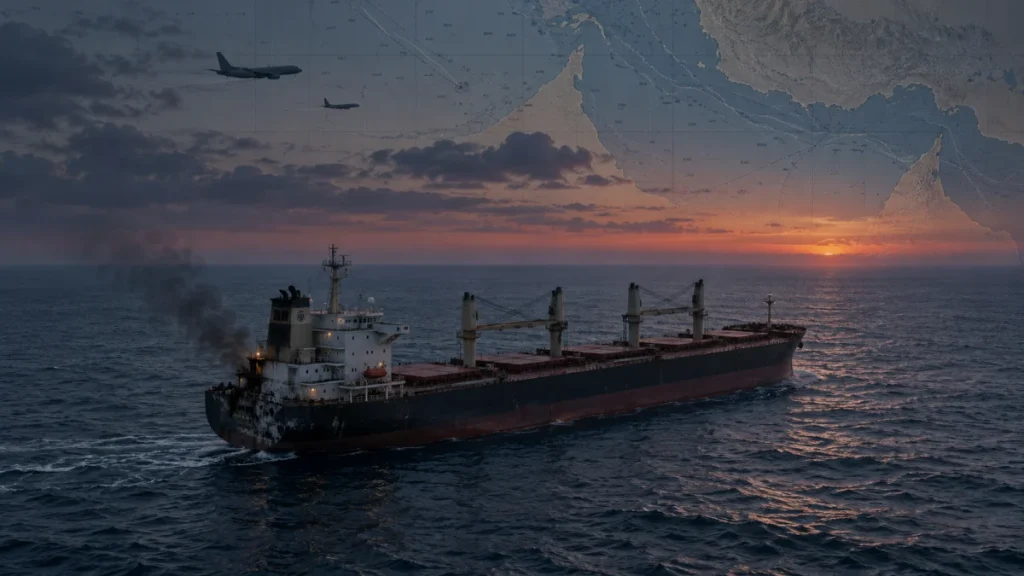
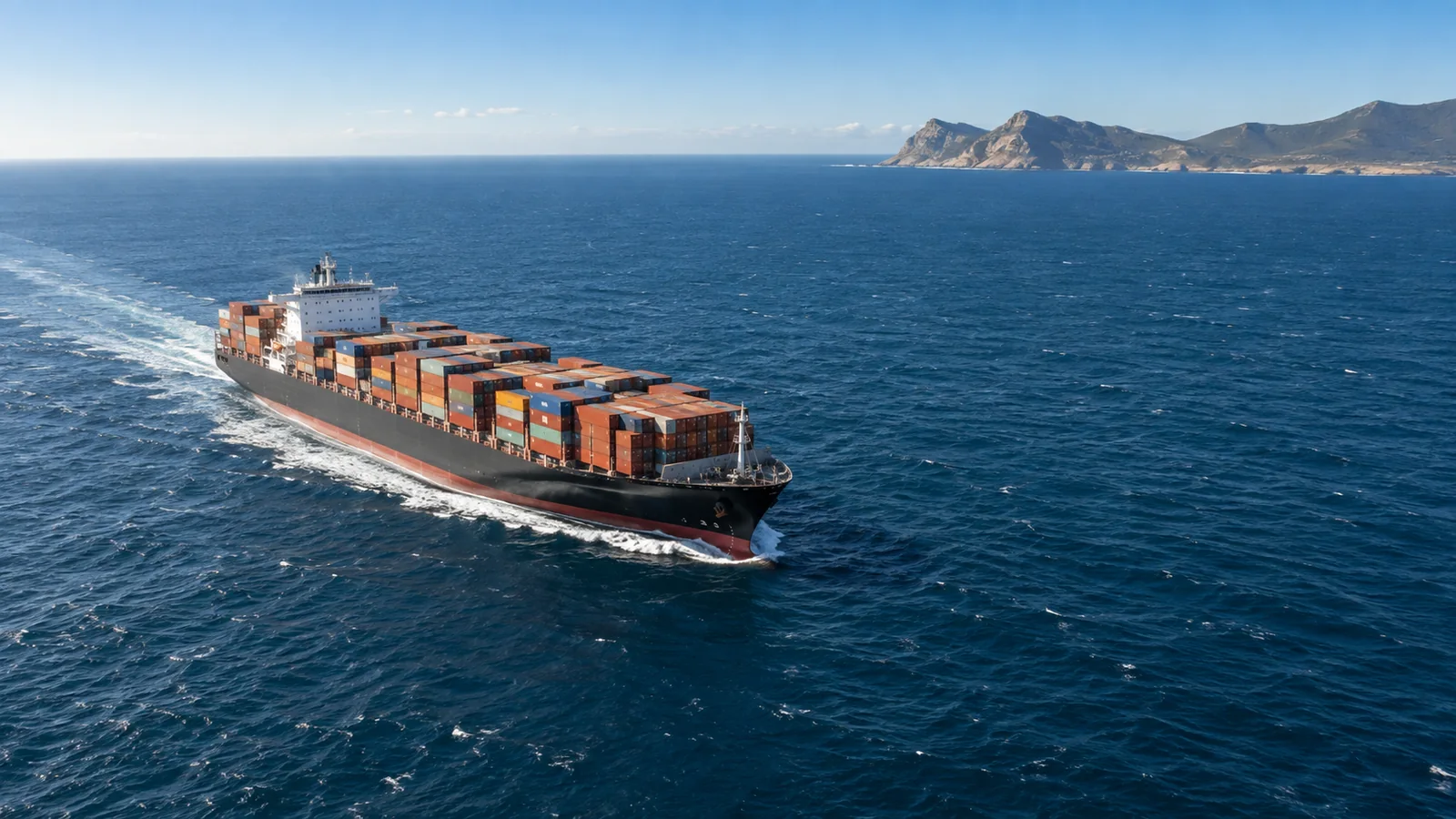
The Cape of Good Hope route becomes cheaper when its extra fuel, vessel time, and other costs are less than the Suez toll and Red Sea-specific costs it avoids. The added war-risk insurance premium is often the variable people focus on, but it is only one part of the decision. For a particular voyage, the useful number is the break-even premium: the most the operator could pay for added Red Sea cover before the shorter route loses its monetary advantage.
There is no universal answer in dollars or percent of ship value. Ship type, speed, ports, canal dues, charter contract, fuel price, insurance terms, and who bears delay costs all change the calculation. A financially cheaper passage can still be unacceptable on safety grounds.
What actually changes between the two routes?
On many Asia–Europe voyages, using Suez and the Red Sea saves distance and time. In one concrete comparison, UN Trade and Development (UNCTAD) describes a Shenzhen–Rotterdam voyage of about 10,000 nautical miles and 31 days via Suez, against about 13,000 nautical miles and 41 days around the Cape. That is one route example, not a ten-day rule for every ship.
The longer Cape voyage usually brings more fuel consumption and more days of vessel use. It may also affect emissions costs, cargo arrival, crew scheduling, port windows, and the number of ships needed to maintain a weekly liner service. UNCTAD’s 2024 review describes those system effects and the surge in Cape arrivals during the disruption.
The Red Sea route incurs a Suez Canal bill and can entail voyage-specific war-risk insurance and security expenses. The Suez Canal Authority provides a vessel toll calculator and toll schedule, while its navigation circulars document changes and concessions. A quoted generic toll cannot be carried into every comparison; the bill depends on the actual vessel and applicable rules.
These are marginal costs. Ordinary port charges, baseline insurance, and other expenses common to both routes cancel in the route comparison. The contractual payer matters too: a shipowner, charterer, carrier, cargo owner, and insurer may experience the same delay differently.
The break-even calculation
Start with the Cape route’s extra cost before additional war-risk insurance:
Extra Cape days × (daily vessel cost + daily fuel use × fuel price) + other extra Cape costs − avoided Suez bill − other avoided Red Sea costs.
If that result is positive, it is the maximum additional Red Sea war-risk premium before the two options reach financial parity. If it is zero or negative, the Cape route is already no more expensive under those inputs, even before adding a war premium. The companion calculation notes define each input and expose the arithmetic.
Use actual route-specific fuel totals when the ship would sail at different speeds. Do not count fuel twice inside a time-charter-equivalent figure and a separate bunker line. Add cargo-delay value only if it is a real cost borne by the decision-maker under the contract. The aim is an apples-to-apples voyage comparison, not a dramatic headline number.
A worked example, with hypothetical inputs
Suppose a ship would spend 10 additional days around the Cape. Assume $50,000 per day in vessel opportunity cost excluding fuel; 45 extra tonnes of fuel per day at $600 per tonne; $50,000 in other Cape-related costs; a $550,000 Suez bill that Cape avoids; and no other Red Sea-specific charge. All dollar inputs are illustrative assumptions, not current market quotations.
| Cost difference | Calculation | Amount |
|---|---|---|
| Extra vessel days | 10 × $50,000 | $500,000 |
| Extra fuel | 10 × 45 tonnes × $600 | $270,000 |
| Other Cape costs | Assumed | $50,000 |
| Suez bill avoided | Assumed | −$550,000 |
| Cape’s extra cost before added war premium | $270,000 |
In this example, an added Red Sea war-risk premium of $270,000 makes the routes equal on the listed monetary costs. On a hypothetical $100 million hull value, that is 0.27%. A $300,000 premium would put the Red Sea route $30,000 above the Cape in this model. It would say nothing about whether either passage is operationally safe.
The result is highly sensitive to sailing time. Holding the other sample inputs constant, five extra Cape days make the Cape $115,000 cheaper even with no added war premium; 15 extra days raise the premium break-even point to $655,000. That $77,000 swing per extra day is the sum of the sample vessel cost and fuel cost. The pattern explains why copying someone else’s “war-risk premium threshold” is unreliable.
Why an insurance percentage alone is misleading
A war-risk rate quoted as a fraction of hull value needs a coverage basis and a current voyage quote. A 0.3% rate on a $100 million hull is $300,000, but that multiplication does not tell us whether the Cape is cheaper. The comparison still needs the toll saving, fuel, time, and any other route-specific charges. The marine insurance and security picture can change rapidly, and coverage can be subject to conditions and exclusions. This article does not claim a current Red Sea market premium.
More fundamentally, insurance transfers specified financial losses; it does not remove the physical hazard. The U.S. Maritime Administration’s September 2026 Red Sea advisory says attacks on commercial shipping have resumed, identifies particular affiliation risks, and calls for a pre-voyage risk assessment for U.S.-flagged vessels. It supersedes the earlier 2026-006 advisory. The route decision therefore needs a current security assessment in addition to its cost calculation.
Nor does one vessel’s calculated cost equal the freight rate a customer pays. Rates also reflect available fleet capacity, service reliability, demand, congestion, and competition. UNCTAD’s 2025 maritime review describes how rerouting affects distance-adjusted vessel demand and the wider market. A shipper may pay more even when a particular sailing has a relatively low incremental cost.
What a useful real-voyage estimate requires
An operator should use the actual port pair and route plan; expected speed and fuel curve on each leg; the current bunker quotation; the relevant vessel’s charter or internal time cost; its SCA toll estimate and applicable circulars; and a current insurance quotation stating limits, exclusions, and conditions. Carbon charges, cargo-delay exposure, and port-slot effects should be assigned to the party that actually bears them. The security assessment remains a separate decision gate.
The broader question of what a prolonged Bab el-Mandeb disruption would mean for trade is covered in sherafy.com’s existing chokepoint analysis. For an individual ship, the honest answer is narrower: calculate the marginal costs for that voyage, find the premium at parity, and then decide whether the route is safe and permissible at all.
Key takeaways
- The added Cape distance creates fuel and time costs; avoiding Suez removes a vessel-specific toll.
- The break-even premium is the Cape’s extra cost after subtracting the charges Cape avoids.
- A premium expressed as a percentage of hull value does not answer the route question by itself.
- Contract terms decide who actually bears fuel, time, delay, and insurance costs.
- Financial parity is not a safety recommendation.
References and Further Reading
Route distances and market effects
- Review of Maritime Transport 2024: Navigating Maritime Chokepoints, UN Trade and Development. Provides the Shenzhen–Rotterdam route illustration and explains how rerouting affects capacity, emissions, and costs.
- Review of Maritime Transport 2025: Staying the Course in Turbulent Waters, UN Trade and Development. Documents continuing rerouting and wider market effects through the first half of 2025.
Canal charges and voyage planning
- Navigation Tolls, Suez Canal Authority. Official entry point for vessel-specific dues and the calculator.
- Navigation Circulars, Suez Canal Authority. Current notices governing toll changes and concessions.
- 2026-013 Red Sea and Bab el-Mandeb maritime advisory, U.S. Maritime Administration, September 2026. Current U.S. guidance on threat and voyage risk assessment; not an insurance quotation.
Editorial currency note (28 September 2026): Suez dues, rebates, bunker prices, insurance terms, and threat assessments change. The worked example is a transparent hypothetical and must not be republished as a current quotation. Recheck source pages and obtain voyage-specific inputs before using the method for an actual sailing.