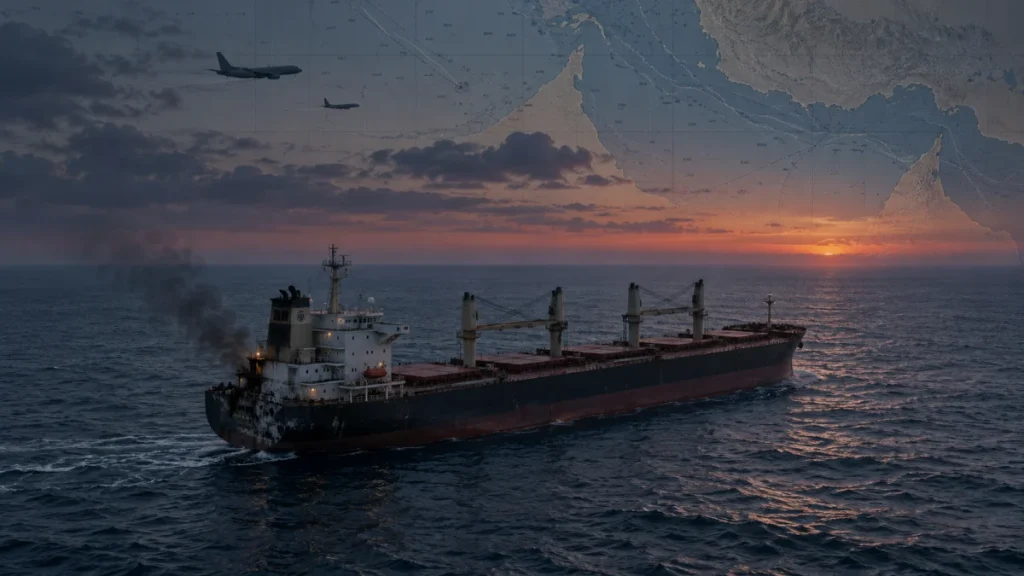

The public answer has three parts. A ship can be identified through its transmitted identity and permanent registration records. A purported connection can be inferred from port calls, owners, managers or other ships in the same fleet. Its location may be estimated from ship-tracking data and other information. But public evidence does not disclose a complete, verified Houthi targeting process for each attack. Turning off a ship’s Automatic Identification System (AIS) can make tracking harder; it does not make a vessel invisible or guarantee its safety.
That distinction matters because a vessel can be correctly identified yet wrongly classified as an acceptable target. A political claim about whom the Houthis intend to attack is not proof that every ship they actually attacked fit that claim.
Identity, affiliation and location are different questions
| Question | What the public record can show | What it cannot establish by itself |
|---|---|---|
| Which vessel is this? | An IMO number, name, flag and ship particulars | Whether an attacker’s identification was correct |
| Who is it connected to? | Registered owner, company, manager and documented port-call history | A simple national identity or a justified military target |
| Where is it now? | AIS position when transmitted and received, plus other observations | Continuous, certain location when transmissions stop |
The International Maritime Organization’s AIS explanation says AIS transmits a ship’s identity, type, position, course and speed to equipped receivers. The IMO ship identification scheme gives a ship a number that stays with it even if its name, flag or ownership changes. Those records make a ship and its corporate history more traceable than a name painted on a hull suggests.
The distinction also explains why “Israeli-linked ship” can mean radically different things. A vessel may be Israeli flagged, directly owned by an Israeli entity, managed by a company with another vessel that visited Israel, or simply have made a historical port call. Those are not interchangeable relationships. Nor do any of them make an attack on civilian seafarers lawful.
What evidence connects public data to the Red Sea campaign?
The Joint Maritime Information Centre’s July 2025 advisory urged companies to examine Israeli port calls across their fleets and their public digital footprint, including AIS logs, tracking platforms and maritime databases. Its assessment was that the attacks on Magic Seas and Eternity C related to past port calls or ownership and management ties involving ships that had called in Israel. This is an assessment by a maritime security center, not a recovered Houthi target file.
The later U.S. Maritime Administration advisory 2026-013 describes elevated risk for vessels with Israeli, U.S., UK or Saudi associations, as well as certain company or fleet relationships. Its categories reflect the threat picture at the time of that advisory. They should not be read backward as one fixed rule governing every attack since 2023.
Meanwhile, the UN Panel of Experts on Yemen’s 2024 report concluded that attacks were indiscriminate despite Houthi claims to target Israeli-linked vessels. The Panel also observed that many attacked vessels in the Gulf of Aden turned AIS off before entering. It suggested that outside assistance helped identify or locate vessels, and said it was continuing to investigate. That is a serious finding, but suggested assistance is not public proof of who supplied it, which data they supplied, or how a particular attack was directed.
Does switching off AIS prevent targeting?
No. AIS is one source of location information, not a cloak. The current MARAD Red Sea advisory says vessels have been attacked with AIS on and off, while describing transmission as a potential targeting risk. Whether to operate AIS is a safety and legal decision for a ship’s master and operator under applicable rules, not a simple public tip.
The IMO’s AIS page also warns that publishing AIS data on the web can harm ship security. The converse is equally important: a gap in a public AIS feed does not prove that a ship vanished from all observation. Other electronic emissions, observers and outside information may exist; the publicly available case record seldom lets us determine their role in a particular strike.
Can a fleet connection be mistaken for a ship’s own connection?
Yes. A company may operate ships under different flags, owners, charters and routes. A past port call by one vessel does not mean its sister ship is headed to the same port, carrying the same cargo or controlled by the same state. The JMIC advisory’s focus on fleet and management ties helps explain perceived risk, but it also shows how broad the claimed association can become.
For readers examining a particular case, the key questions are therefore narrower than “Was it linked?”: What exact link was claimed? At what date? Which vessel or company did it concern? Which original record supports it? The same IMO number should anchor the search, because names and flags can change.
What remains unknown?
No public, incident-by-incident dataset proves the identity source, affiliation test and location source used in every Houthi strike. An observed hit does not reveal whether AIS, a historical database, visual observation, outside intelligence or some combination produced the cue. Nor does a missed strike show that identification failed; many things can cause a miss.
The strongest supported conclusion is more modest and more useful: commercial shipping leaves a substantial public data trail, maritime security authorities assess that affiliations across fleets can affect perceived risk, and AIS alone does not explain all attacks. The human consequence is that broad or erroneous classifications expose international crews to danger. The IMO has condemned attacks on commercial ships and seafarers regardless of the claimed connection.
For the wider economic effect of danger at the southern gateway to the Red Sea, see sherafy.com‘s Bab el-Mandeb explainer.
Key takeaways
- AIS, permanent ship identifiers and corporate records answer different parts of the identification problem.
- An affiliation may be direct, indirect or historical; the precise relationship matters.
- The UN Panel documented attacks inconsistent with the narrow public targeting claim and noted AIS-off cases.
- Public records do not establish a single universal Houthi targeting method for all incidents.
References and Further Reading
Maritime systems and current risk
- IMO: AIS transponders. Explains the data AIS broadcasts and the security concern around public redistribution.
- IMO: Ship and company identification number schemes. Explains persistent vessel identity despite changes in name or flag.
- MARAD: 2026-013 Red Sea and Gulf of Aden advisory. Current U.S. risk description and AIS caution as checked September 28, 2026.
Incident assessments and limits
- JMIC: Maritime threat update, July 8, 2025. Gives the center’s assessment of two attacks and its concern about public digital footprints.
- UN Panel of Experts on Yemen: S/2024/731. Evaluates the targeting claim, AIS-off attacks and possible external assistance; the report explicitly leaves investigation open.
- IMO Maritime Safety Committee resolution MSC.564(108). Documents the organization’s condemnation of attacks on merchant ships and seafarers.
Editorial currency note: Threat criteria, advisories and incident assessments change. This draft reflects sources checked September 28, 2026; recheck the latest MARAD, JMIC, IMO and UN publications before publication.