
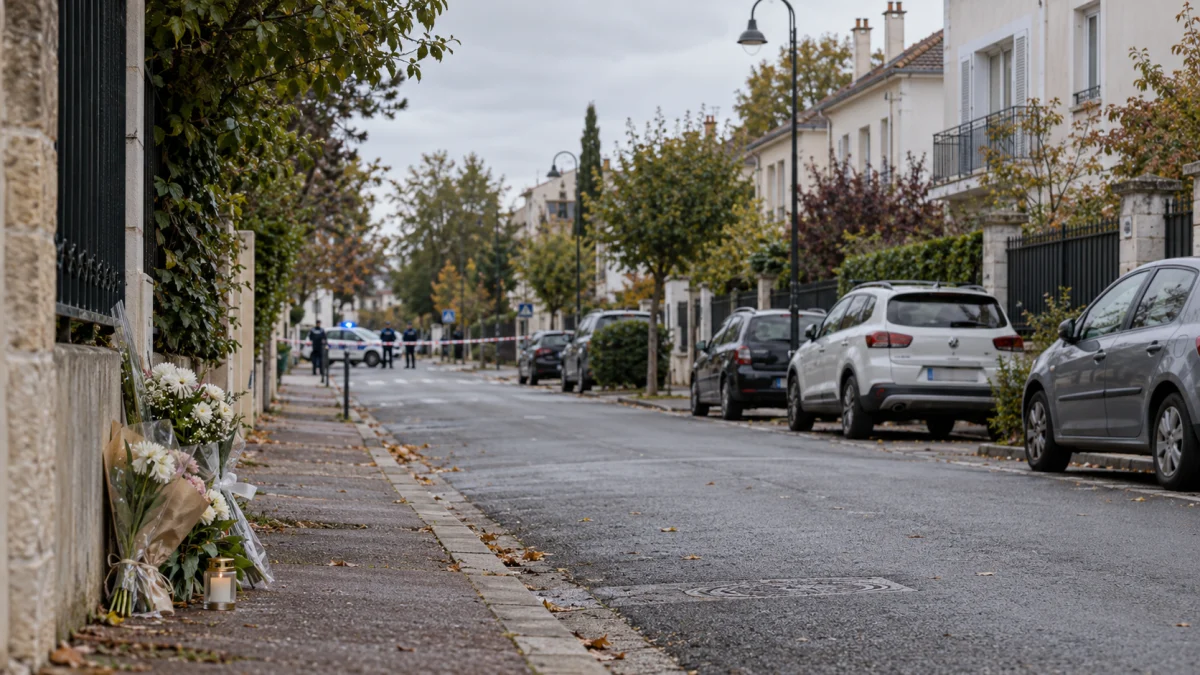
On October 23, 2026, a gunman opened fire at multiple locations in Trappes and La Verrière, west of Paris, killing 26-year-old Pengo Bossio Wangi and injuring five other people, including a 12-year-old girl. French anti-terrorism prosecutors opened an investigation into suspected terrorist murder and attempted murder involving the victims’ actual or perceived race, ethnicity, nationality or religion. The 39-year-old suspect, identified publicly as Kévin T., was arrested within approximately 20 minutes.
The central question is why the victims were targeted. According to original reporting by Le Monde based on multiple sources, the suspect told the first police officers who detained him that he wanted to avenge shopkeepers affected by the October 17 riots and had deliberately targeted Black and Arab people. That reported statement, together with the pattern of attacks, is significant evidence of a racist motive. It is not yet a final judicial finding.
The broader context matters, too. In the days between the riots and the shooting, prominent political figures and social-media accounts blamed immigrants or Muslims collectively for the unrest, despite the lack of evidence for that sweeping claim. But the existence of inflammatory rhetoric, followed by a seemingly related act of violence, does not by itself prove that any particular politician, broadcaster or post caused the shooting.
Nor is the widely shared assertion that English-language news organizations buried the attack supported as stated. The Associated Press, The Guardian, CNN and other English-language outlets reported it. Whether the attack received less attention than comparable events is a separate question that requires comparative data.
This explainer separates confirmed events, well-sourced allegations, numerical evidence and unresolved questions. It reflects information available as of October 25, 2026.
What happened in the Trappes and La Verrière shooting?
The attacks began around 10 a.m. local time on Friday, October 23. The suspect allegedly drove a gray Renault Clio through Trappes and neighboring La Verrière in the Yvelines department, firing a Sten-type submachine gun at people and locations along his route. Police arrested him in nearby Coignières at about 10:20 a.m.
The Associated Press’s initial account, drawing on statements from the National Anti-Terrorism Prosecutor’s Office (PNAT) and French officials, confirmed one death and five injuries. A more detailed location-by-location reconstruction by Le Monde describes the following sequence:
- Avenue Hector-Berlioz, Trappes: Shots were fired at a car carrying a mother and daughter. They survived.
- A local health center: The gunman reportedly fired at the building’s exterior. No injuries were reported at that site.
- Square Louis-Pergaud: Pengo Bossio Wangi, 26, was fatally shot.
- A service station on Route Nationale 10: Two adults were injured, one seriously.
- The Bois de l’Étang area of La Verrière: Two more adults were injured near a pharmacy.
- Another residential location in La Verrière: A 12-year-old girl was seriously wounded.
These are locations reconstructed in subsequent French reporting, not six separate officially designated crime scenes. Initial breaking-news accounts grouped the shootings differently and sometimes reported four injured people. The PNAT’s later official count was one person killed and five injured.
Several reports say the girl sustained eight gunshot wounds. Her condition was grave. Reporting on October 25 indicated some improvement, but she remained seriously injured. A temporary improvement should not be confused with a complete recovery.
The PNAT said investigators recovered a submachine gun and other items from the suspect’s vehicle. A search of his home in Plaisir also found what prosecutors described as a booby-trap arrangement involving three gas cylinders, electrical wiring and a timer. This is important evidence regarding preparation and potential danger; it does not, on its own, establish a particular ideology or affiliation.
Who was Pengo Bossio Wangi?
Pengo Bossio Wangi was 26 and trained in mixed martial arts. His club, Atch Academy in Aubervilliers, identified him publicly and commemorated him as a generous, respected member of its community. The Associated Press verified the identification through the club’s tribute.
A viral account describes him as an MMA instructor. The reporting verified for this article establishes that he was an amateur MMA fighter and club member; it does not independently establish an instructor position. He should not be assigned an unverified occupation simply because it appears in a widely shared post.
Accounts from people at the scene also help convey the impact beyond the police chronology. In reporting from Trappes, Le Monde interviewed a nurse who attempted to resuscitate Wangi and residents who described their fear after the attack. Their experiences deserve attention independent of the political argument that subsequently developed around his death.
What evidence points to a racist motive?
There are three separate evidentiary strands: what the suspect reportedly said, whom he appeared to target, and what investigators recovered. They should not be treated as interchangeable.
1. The suspect’s reported statement about revenge
The most direct evidence comes from Le Monde‘s October 24 investigation. Journalists Soren Seelow and Jérémie Pham-Lê reported, citing corroborating sources, that Kévin T. spoke to responding officers about avenging businesses damaged during the October 17 riots. He allegedly said he had targeted Black people and Arabs.
That is substantially stronger than an anonymous allegation online. Nevertheless, readers should understand its provenance: these were statements attributed to the suspect by investigative sources, not a publicly released interrogation transcript or a court’s determination of motive. Later accounts, including Le Parisien‘s October 25 reporting, provided further corroboration of the alleged statements.
An apparent attempt to punish strangers for violence committed by other people is central to the suspected racist motive. No publicly reported evidence links Wangi or any of the other shooting victims to the looting or vandalism on October 17.
2. The apparent selection of victims
French investigators, as described by Le Monde, believed the gunman appeared to select people who were not White. President Emmanuel Macron stated after visiting Trappes that people had been targeted because of their appearance or perceived religion. Those statements reflect the investigative theory and official assessment at the time, rather than a completed forensic reconstruction of every encounter.
Some shots were fired near a mosque, and local officials discussed a possible Islamophobic dimension. Being near a mosque does not establish that the mosque building itself was deliberately targeted. Whether the suspect selected certain people because he assumed they were Muslim is a separate question from whether he selected them because he perceived them as Black or Arab. The investigation may ultimately clarify how those categories figured in his decisions.
3. Material found at his home
Le Monde reported that investigators found a copy of Adolf Hitler’s Mein Kampf in the suspect’s home. The discovery may be relevant to investigators examining extremist beliefs. It cannot alone prove that he accepted the book’s ideas, belonged to a far-right organization or acted at anyone’s direction.
Investigators were also examining digital material and possible extremist connections. As of this article’s cutoff, no publicly verified record established that Kévin T. belonged to a particular political movement or had been instructed to attack by a named organization.
Evidence ledger: What is known and what remains unproven
| Question | Status as of October 25 | Why that status matters |
|---|---|---|
| Did the shooting happen, killing one and injuring five? | Confirmed by prosecutors | The core event and casualty count are established. |
| Did the suspect reportedly describe racialized revenge? | Strongly supported by original reporting | Multiple investigative sources reported statements to first responders. |
| Did he appear to select victims by perceived identity? | Strongly supported, still under investigation | Investigators’ assessment and the apparent pattern point in that direction. |
| Was the mosque itself an intended target? | Not established | Proximity is not evidence of an intended attack on the building. |
| Was he affiliated with an extremist group? | Not publicly established | Possessing a book or expressing prejudice is not proof of membership. |
| Did specific politicians or media posts influence him? | Unknown | The public record has not shown that he encountered particular messages. |
| Did a particular public figure cause the killing? | Not established | This would require a much stronger individual causal showing. |
What happened during the October 17 riots in France?
The unrest did not begin as an immigration protest or a religious conflict. High school students had been demonstrating over educational conditions and underfunding, and a broader October 17 national day of action drew people concerned about living costs, public services and the government’s response. Unions and other protest movements participated.
According to Le Monde‘s reporting on the demonstrations, estimates placed nationwide participation in the hundreds of thousands. Large peaceful marches took place, but the day also saw serious disorder. Some groups looted stores, vandalized buildings, attacked police or set fires. These were real incidents with real victims, including businesses and their employees.
The distinction is not semantic. A peaceful protester, a person engaged in property destruction, a looter taking advantage of confusion and a person accused of organizing violence are not automatically the same kind of participant. Neither is any of them representative of an entire ethnic or religious population.
There is evidence that some radical political activists participated in violence, alongside opportunistic offenders. But an assertion that all the disturbances had a single political or demographic cause outruns the available evidence. The Associated Press examined these competing explanations before the Trappes shooting took place.
Were immigrants and Muslims responsible for the riots?
There is no sound evidentiary basis for blaming immigrants or Muslims collectively for the October 17 violence. There is also no basis for claiming that no foreign nationals were involved. The best available early figures answer a narrower question than either slogan suggests.
On October 23, French fact-checking publication Les Surligneurs analyzed provisional Justice Ministry statistics about 186 people incarcerated in connection with the unrest. This was a selected sample of people detained in the criminal-justice process, not a census of marchers, rioters, arrestees, or people convicted after a trial.
| Measure in the provisional 186-person sample | Reported share |
|---|---|
| French nationals | 70% |
| Foreign nationals | 30% |
| Men | 95% |
| Age 25 or younger | 68% |
Source: Les Surligneurs, reporting provisional Justice Ministry figures provided to AFP. Percentages are rounded.
Three limitations are essential.
First, nationality is not ethnicity or religion. A French national can have immigrant parents or grandparents, and a foreign national can come from any racial or religious background. These figures say nothing directly about the share of Muslims, Arabs or Black people. The source also found that the justice case-management data did not systematically record dual nationality.
Second, this is not a representative sample of everyone involved. The 186 people were incarcerated, either following a conviction or while awaiting proceedings. Decisions about arrest, prosecution and detention select for factors that are not evenly distributed among all demonstrators or all offenses. This data cannot be used to construct the demographic profile of the whole protest movement.
Third, a comparison needs a proper denominator. Foreign nationals accounted for about 9% of France’s resident population in 2024, a lower share than the 30% in this particular incarceration sample. That difference should not be concealed. But neither does it establish that immigrants caused the unrest, or that foreign nationals were unusually represented in these types of offenses compared with ordinary criminal-justice patterns. Les Surligneurs compared the preliminary figures with earlier offense-specific statistics and found no demonstrated exceptional surge. Those comparisons are informative, not perfectly matched studies: the populations, offense categories and years differ.
The responsible conclusion is narrower than either political camp might want: the available criminal-justice data do not establish that the riots were an immigrant or Muslim uprising. They do show that some foreign nationals were among people incarcerated for related offenses. They do not establish who, if anyone, inspired the Trappes suspect.
How did the narrative blaming immigrants spread before the shooting?
One reason the October 17 events matter is that their interpretation became a political fight almost immediately. Real footage of looting and fires circulated beside misleading captions, selective generalizations and outright fabrications. By October 23, some of those claims had been publicly fact-checked.
What Donald Trump and other politicians said
During comments on October 19, U.S. President Donald Trump attributed France’s turmoil to immigration rather than the problems that had prompted students and other demonstrators to mobilize. A recording and transcript of his comments includes the phrase "not schools, not anything, it’s immigration." At a Kansas campaign event, the published speech transcript likewise contains claims about migrants who supposedly did not respect their host countries.
French politician Eric Zemmour, appearing on LCI, described purported participants in the disorder as a "horde of North African and African barbarians". The remarks were subsequently reported and challenged, including in Les Surligneurs‘ examination. These are specific, attributable statements. They should be evaluated as claims about the riots, not treated as evidence of the rioters’ actual identities.
The Associated Press fact-check published on October 20 found no support for blaming Muslim migrants for the violence as a whole. It also challenged claims linking supposed attacks on houses of worship to the disorder.
What Elon Musk amplified
In its October 19 analysis of viral videos, Le Monde reported that Elon Musk reposted images of an incursion into Marseille’s city hall and a message portraying the city as having fallen to an "invasion." The same report identified a video of police vehicles under attack that attracted more than 45 million views on X in less than 24 hours.
The 45-million-view figure concerns that circulated video, not a measured audience for one particular statement by Musk. Nor does a repost establish that a particular suspect saw the material. The point that can be documented is that an immigration-centered interpretation of the unrest was being amplified to large audiences before the shooting.
False images were circulating alongside genuine destruction
The problem was not limited to biased interpretations of authentic photographs. Full Fact documented fabricated or miscaptioned material, including a false image said to show an elderly couple stripped during the riots and older police footage misleadingly presented as new. It also investigated images purporting to show dramatic protest scenes at the Eiffel Tower.
This does not mean the actual looting and arson were invented. They occurred. The misinformation consisted of assigning false identities, causes, religious symbolism or new incidents to an already real crisis. That distinction helps explain why highly visible footage of real violence can coexist with unsupported stories about who committed it.
The chronology: Verified developments and public narratives
| Date | Events and evidence | Public narrative or investigation |
|---|---|---|
| October 17 | Large demonstrations across France; serious violence and looting occurred alongside peaceful marches. | Videos of property destruction began circulating widely. |
| October 18-19 | Authorities investigated offenses and damage from the weekend. | Anti-immigration interpretations spread online; Trump and Zemmour made broad claims about immigrant responsibility. |
| October 20 | AP published a fact-check challenging the collective-blame narrative. | Competing explanations for the unrest remained prominent. |
| October 22 | Full Fact published verification of false and miscaptioned protest imagery. | Some widely shared visuals were demonstrably unreliable. |
| October 23 | Shooting in Trappes and La Verrière: one dead, five injured; suspect arrested; PNAT investigation opened. | Macron described the attack as racist terrorism; the suspect’s reported statements became central to the inquiry. |
| October 24 | Le Monde reported the alleged revenge statement and details from the searches. | Investigators continued examining possible extremist connections; false online identification of another man was documented. |
| October 25 | PNAT announced a temporary interruption of questioning for psychiatric observation and reported toxicology results. | Motive, mental responsibility and media influence remained distinct and unresolved legal questions. |
This is a chronology, not proof that the suspect consumed the public statements listed beside his reported motive.
Is the Trappes attack an example of stochastic terrorism?
It is a case that raises the question; it is not a proven instance of a causal chain from a particular public speaker to a particular attacker.
Stochastic terrorism is a proposed framework for studying how repeated public demonization of a person or group may contribute to a risk of violence committed by individuals who are not acting under direct orders. The idea is that the general danger may be increased even when the identity, time and location of any eventual attacker cannot be predicted precisely.
In the peer-reviewed paper "Stochastic terrorism: critical reflections on an emerging concept", researcher James Angove explains that the term has competing definitions. He argues that the truthfulness of the rhetoric, its dehumanizing content and its broader political context matter, while warning against an overly broad definition that would sweep ordinary criticism or advocacy into the same category.
For Trappes, the evidence can be separated into five steps:
- Public messages existed: Politicians and social-media accounts demonstrably blamed migrants or Muslims for the unrest.
- Important collective claims lacked evidence: AP and French fact-checking challenged the claims as they were circulated.
- The suspect allegedly expressed a related grievance: Multiple sources say he spoke of avenging businesses by targeting Black and Arab people.
- A personal exposure link is missing: There is no publicly established evidence that he saw the identified posts, watched particular programs or was in contact with their authors.
- Individual causal responsibility remains unproven: Even verified exposure would be one part of the inquiry, not automatic proof that a speaker caused the attack.
The first three steps justify investigation of the potential relationship between public demonization and violence. The missing fourth and fifth steps make categorical claims that named politicians or technology executives bear direct responsibility for Wangi’s killing unsupported by the evidence currently public.
That distinction is not an argument that political speech has no consequences. It is the difference between a plausible social mechanism and a proven causal account of one person’s actions. Both are legitimate subjects for research, but they require different evidence.
Why is France investigating the attack as terrorism?
France’s terrorism framework does not require proof of membership in an organized group. Article 421-1 of the French Penal Code covers qualifying crimes intentionally connected with an individual or collective undertaking aimed at seriously disturbing public order through intimidation or terror.
French prosecutors opened an investigation into terrorist murder and attempted murder with an alleged discriminatory basis. They also examined possible terrorist criminal conspiracy. An investigation under these legal headings does not mean the suspect has already been convicted of terrorism, that every suspected offense will lead to charges, or that another participant has been proven to exist.
Macron called the shooting a racist terrorist attack during a visit to Trappes. It is appropriate to report that characterization alongside the criminal investigation, but a president’s description does not replace the legal process.
Was this France’s first racist terrorist attack?
No unqualified claim of that kind is defensible. Macron’s initial remark suggesting an unprecedented attack because of victims’ skin color or perceived religion prompted objections, including reminders of earlier antisemitic terrorism. The Élysée later clarified the intended scope of his remarks, according to contemporaneous coverage in Le Monde.
There is also a more recent comparison: in June 2025, a suspect in the killing of Tunisian national Hichem Miraoui in Puget-sur-Argens was charged in an investigation involving both a terrorist undertaking and an alleged racist motive. That case is not identical to Trappes and should not be conflated with it. It does demonstrate why claims about historical firsts need exact definitions.
The importance of the Trappes attack does not depend on presenting it as something France had never experienced in any form.
Why was the suspect transferred for psychiatric observation?
On October 25, the PNAT announced that Kévin T.’s police custody had been temporarily suspended after a psychiatric examination. He was transferred to a police-prefecture psychiatric facility for observation potentially lasting 48 hours, to assess whether his condition allowed investigators to continue questioning him. Four people from his family or social circle were also reportedly still in custody for questioning. That status does not imply they were involved in the attack.
Prosecutors also reported that toxicology detected cannabis and cocaine in the suspect’s blood. RTL reproduced the PNAT’s announcement. Separately, Le Parisien reported that the suspect told investigators he was being treated for schizophrenia. That is a reported self-description, not a diagnosis independently verified in this article.
These developments answer different questions:
- Fitness for questioning: Can investigators presently interview the suspect under lawful conditions?
- Motive: Did he intentionally choose victims because of their perceived identity?
- Criminal responsibility: What was his mental capacity at the time of the alleged acts, under the applicable law?
- Substance use: What, if anything, can be demonstrated about the timing and effects of detected substances?
They cannot be collapsed into one answer. Under Article 122-1 of the French Penal Code, a distinction exists between a disorder that abolished discernment or control at the time and one that merely impaired it. Related provisions address circumstances involving psychoactive substances. A short-term observation order cannot decide those legal questions by itself.
A psychiatric condition would not automatically erase a racist motive, just as evidence of prejudice would not prevent an expert from finding a psychiatric disorder. Both claims require their own proof. The family of the deceased has questioned how psychiatric issues are being handled, concerns that deserve accurate reporting without pre-judging the expert evaluation or the court.
Did English-language news media ignore the Trappes shooting?
No broad English-language media blackout is demonstrated. Several major outlets carried coverage on the day of the shooting or immediately afterward:
- The Associated Press reported the attack on October 23 and identified the victim through his MMA club on October 24.
- The Guardian published a substantial report on October 23.
- CNN’s October 23 broadcast transcript records an on-air report about the shooting, injuries and anti-terror investigation.
- The Financial Times also covered the attack, while Le Monde published English-language reporting about the suspect and victims.
A different question is whether these reports received less prominence than comparable attacks involving other perpetrators or victims. That cannot be answered responsibly by counting a few search results or relying on someone’s news feed. It would require a defined comparison set, the same publication window, comparable casualty and event characteristics, and actual metrics such as homepage placement, television airtime, headline positioning or publication counts.
It is reasonable to ask whether race affects media attention. It is not reasonable to label a verified body of coverage a deliberate suppression campaign without evidence that such suppression occurred.
A second misinformation problem: An innocent man was falsely identified as the suspect
After the shooting, users on social platforms spread the name, photographs and personal profile of a different man who shared the suspect’s first name and surname initial. A judicial source confirmed to Le Monde that the circulating identity was wrong.
The false identification then became the basis for speculation about the real suspect’s ideology and mental health. Some of the misleading posts were widely viewed before being corrected or removed.
For that reason, this article uses the officially reported form Kévin T. and does not reproduce an unverified surname or a photograph taken from an unrelated social-media account. An investigation into misinformation should not introduce new misinformation of its own.
Which claims in the viral account are supported?
The post circulating after the attack contains important facts, but it also makes claims that demand more evidence.
| Viral claim | What the evidence supports |
|---|---|
| A man shot people west of Paris, killing one and injuring several, including a child. | Confirmed. One person was killed and five injured. |
| The suspect claimed he was avenging shopkeepers and targeted Black and Arab people. | Strongly supported by original reporting, pending formal judicial findings. |
| The victim was a 26-year-old MMA instructor. | Partly confirmed. He was 26 and an amateur MMA fighter; instructor status was not independently established. |
| The shooting occurred in the area of a mosque. | Supported as a location detail. Proximity does not establish that the mosque itself was an intended target. |
| Immigrants and Muslims were responsible for the October 17 unrest. | Unsupported as a collective claim. The provisional data cannot substantiate it. |
| Specific political figures or platforms caused the killing. | Not established. Relevant public rhetoric is documented; the suspect’s personal exposure and causal chain are not. |
| English-language news organizations buried the attack. | Contradicted as a blanket assertion by readily verifiable contemporaneous coverage. Relative prominence has not been measured. |
What remains unknown?
The public record remains incomplete on several consequential questions:
- Whether formal questioning produces a fuller or different account of the suspect’s alleged revenge motive.
- Whether digital-device analysis reveals his media consumption, communications, ideological associations or planning history.
- Whether prosecutors identify further suspects, charges or evidence of coordination.
- Whether the psychiatric assessment and later expert reports affect his fitness for questioning or the legal assessment of responsibility.
- How the injured victims recover, especially the seriously wounded child.
- Whether a systematic comparison of news coverage reveals a meaningful, measurable imbalance in prominence.
The strongest currently supported conclusion is that a suspect reportedly framed a deadly attack on innocent people as racialized revenge for riots, while politically prominent but unsubstantiated claims about those riots were circulating publicly. The chronology merits serious investigation. It does not yet prove which messages, if any, shaped the suspect’s choices.
A useful public account must preserve both facts: the gravity of the alleged racist targeting and the limits of the evidence attributing an individual crime to particular public figures.
References and Further Reading
Prosecutorial statements and legal framework
- Associated Press, Paris-area shooting kills one and wounds several in a suspected racist attack (October 23, 2026). Reports the initial PNAT statements, casualties, arrest, weapon and residence search. The underlying PNAT press release was not located as a standalone public document during this review.
- RTL, Attentat à Trappes : la garde à vue du suspect suspendue après un examen psychiatrique (October 25, 2026). Reproduces the prosecutor’s update regarding psychiatric observation, blood toxicology and continued questioning of associates.
- Légifrance, French Penal Code, Article 421-1. The legal text defining qualifying terrorist offenses and individual or collective undertakings.
- Légifrance, French Penal Code, Article 122-1. The legal distinction between abolition and impairment of discernment or control.
Original reporting on the attack and its victims
- Le Monde, Suspect in racist Trappes shooting said he wanted to avenge robbed shopkeepers (October 24, 2026). Reporting based on multiple investigative sources concerning the suspect’s alleged statements and the racial-targeting theory.
- Le Monde, After deadly attack in Trappes, questions remain over suspected gunman’s motives (October 24, 2026). Detailed reconstruction of the route, shooting locations, early evidence and investigative status.
- Associated Press, Man killed in suspected racist attack near Paris identified as martial arts fighter (October 24, 2026). Confirms the victim’s identity through his MMA club’s public tribute.
- Le Monde, After deadly Trappes shooting, residents express anger and resignation (October 24, 2026). On-the-ground interviews with residents and a person who attempted to assist the victim.
- Le Parisien, Suspect said he was being treated for schizophrenia (October 25, 2026). Source-attributed account of an alleged self-report, not medical verification.
- Le Monde, An innocent man falsely accused online after the Trappes attack (October 24, 2026). Documents the false identification and its spread.
October 17 protests, statistics and public claims
- Les Surligneurs, Was immigration the cause of violence during the October 17 mobilization? (October 23, 2026). Analyzes provisional Justice Ministry data and explains why nationality and dual-nationality claims require caution.
- Associated Press, FACT FOCUS: Trump and Republicans blame France’s immigrants for riots without evidence (October 20, 2026). Checks claims about immigrant responsibility and attacks on religious sites.
- Roll Call Factba.se, Donald Trump speech at Park City, Kansas (October 19, 2026). Transcript documenting public statements about migrants and European unrest.
- Le Monde, Violent images from French protests go viral on social media (October 19, 2026). Documents viral footage and the role of influential accounts in amplifying narratives.
- Full Fact, France protests: fact checked (October 22, 2026). Checks viral images and footage falsely presented as documentation of the recent unrest.
Terrorism research and media coverage
- James Angove, Stochastic terrorism: critical reflections on an emerging concept, Critical Studies on Terrorism (2024). Peer-reviewed discussion of the definition, limits and potential utility of the concept.
- The Guardian, Macron condemns racism after one killed in terrorist shooting near Paris (October 23, 2026). Example of substantial contemporaneous English-language coverage.
- CNN, World News broadcast transcript (October 23, 2026). Broadcast record contradicting a categorical claim that the incident was ignored on English-language television.
- Le Monde, Tunisian national’s killing investigated as racist terrorism in 2025 (June 6, 2025). Historical context for evaluating claims that Trappes was France’s first such case.
Editorial currency note: This is a developing criminal investigation. Descriptions of the suspect’s statements, the victims’ medical status, psychiatric evaluations, criminal proceedings and potential extremist connections may change. All suspect-related allegations are reported as such unless and until established in court. Information is current through October 25, 2026.