
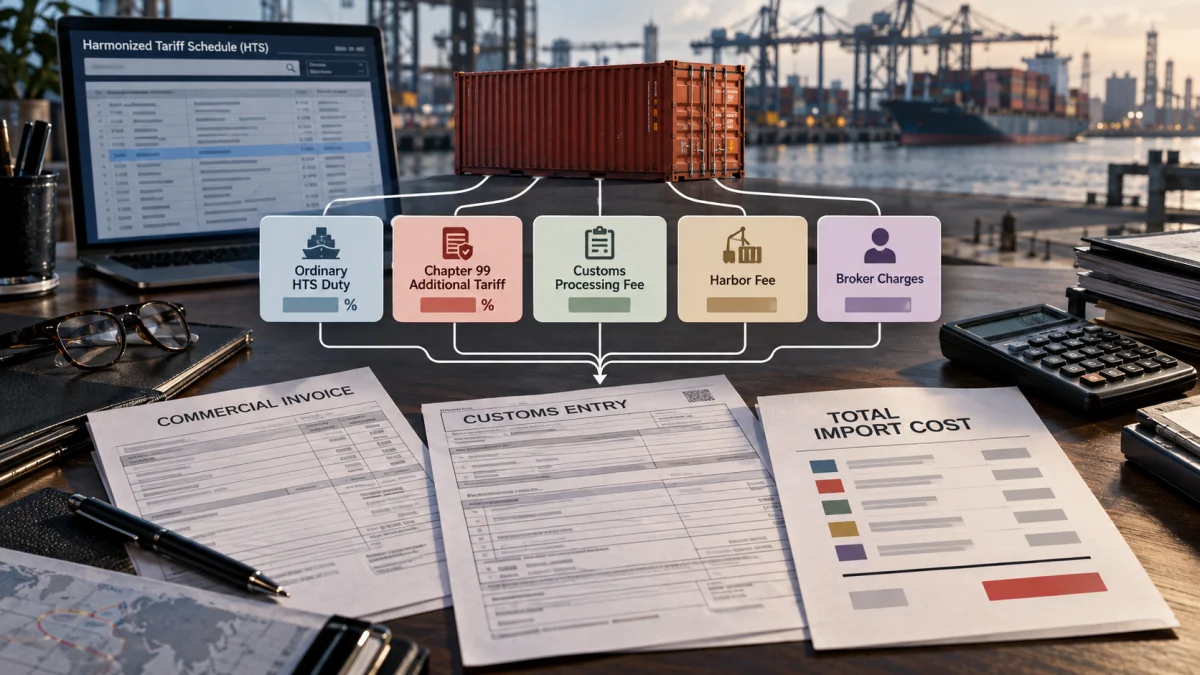
If the Harmonized Tariff Schedule says your product has a 2.5% duty rate but your customs or broker bill works out to 10%, 25%, 50% or something else entirely, that does not automatically mean the HTS lookup was wrong.
The percentage beside your product’s ordinary HTS classification may be only one part of what you owe.
Depending on the shipment, the final amount can also include:
- additional duties imposed through Chapter 99;
- Section 301, Section 232 or other trade-remedy measures;
- a different customs value than the number you used;
- Merchandise Processing Fee;
- Harbor Maintenance Fee;
- antidumping or countervailing duty deposits;
- and charges imposed by your customs broker, carrier or surety rather than by the U.S. government.
The important distinction is this:
Your ordinary HTS duty rate is not necessarily your total import charge.
And if you have already received a bill, running the product through another tariff calculator may not be the best way to figure out what happened.
The better method is to reconstruct the customs entry line by line, then compare the government’s charges with the invoice from your broker or carrier.
What Does the Duty Rate Beside Your HTS Code Actually Tell You?
Most importers begin with the Harmonized Tariff Schedule maintained by the U.S. International Trade Commission.
That is the right place to start.
A product’s ordinary classification in Chapters 1 through 97 identifies the merchandise and gives the normal tariff treatment associated with that classification.
Suppose the applicable rate says:
2.5%
That answers an important question:
What is the ordinary duty rate associated with this classification?
It does not necessarily answer:
What is the total amount I will owe when this merchandise enters the United States?
The USITC specifically warns that imported merchandise may also be subject to additional duties under measures such as Sections 201, 232 and 301.
Those additional measures frequently appear in Chapter 99 of the HTS.
That is how a product can be correctly classified at 2.5% while the actual duty collected is substantially higher.
Why Can the Same Product Have More Than One HTS Number?
This is one of the most confusing parts of a customs entry.
An importer may look at the paperwork and find what appear to be two different tariff classifications for the same merchandise.
Often, they are doing two different jobs.
The ordinary Chapter 1–97 number generally identifies what the product is.
A Chapter 99 provision can identify additional or modified tariff treatment that applies to that product in that particular situation.
For example, CBP rulings have instructed importers to report an applicable Chapter 99 provision along with the product’s ordinary classification when Section 301 duties apply.
So a customs entry can effectively look like:
ordinary HTS classification
plus
Chapter 99 provision
plus, where legally applicable,
another special tariff or trade-remedy provision
The number printed beside the ordinary product classification is therefore not always the end of the calculation.
Chapter 99 Is Where Many Importers Lose the Plot
Chapter 99 is not simply a list of obscure exceptions.
It is where many temporary, special and additional tariff measures are implemented.
That matters enormously in the current tariff environment.
For example, on July 23, 2026, the Office of the U.S. Trade Representative announced new Section 301 action involving 60 trading partners, with additional duties generally set at 10% or 12.5% and subject to country- and product-specific treatment and exemptions.
Existing Section 301 measures affecting goods from China also remain relevant to many products. USTR maintains a Section 301 tariff search tool that starts with the product’s HTS subheading.
Section 232 measures can separately affect certain steel, aluminum, copper and derivative products.
The practical consequence is simple:
Looking up the ordinary HTS rate alone may no longer reconstruct the actual duty calculation.
But Do Not Just Add Every Tariff Percentage You Find
This is the opposite mistake.
Once importers realize additional tariffs exist, it is tempting to search for every percentage associated with a product or country and simply add them together.
That can also produce the wrong answer.
Some tariff programs stack.
Others contain:
- exemptions;
- exclusions;
- reduced rates;
- country-specific rules;
- product-specific rules;
- ceilings;
- alternative calculations;
- or provisions preventing one additional tariff from being imposed alongside another.
The July 2026 Section 301 action is a good example. It contains different treatment depending on the trading partner and product and does not simply instruct importers to take every other tariff percentage they can find and add another number on top.
So this:
2.5% + 10% + 25% + 7.5% = 45%
is not a valid customs calculation merely because all four percentages appeared somewhere during your research.
You must determine which provisions actually apply to that specific merchandise, origin and entry date, and how those provisions interact.
That is why a current customs entry is usually more useful than a pile of tariff search results.
If You Have Already Been Billed, Start With the Entry
There is a major difference between estimating the cost of a future import and diagnosing a shipment that has already entered the country.
Before shipment, a tariff calculator can be useful.
After shipment, you have something better:
the actual customs entry.
For a formal entry, the key document is generally the CBP Form 7501 Entry Summary or its electronic equivalent.
You are trying to identify:
- country of origin;
- ordinary HTS classification;
- every Chapter 99 provision reported;
- customs or entered value;
- duty amounts;
- Merchandise Processing Fee;
- Harbor Maintenance Fee, if applicable;
- and any antidumping or countervailing duty treatment.
Only after reconstructing those government charges should you compare them with the final invoice from your customs broker, freight forwarder or carrier.
That distinction can resolve a surprising number of apparent tariff mysteries.
A Simple Example: How a 2.5% HTS Rate Can Become More Than 10%
Consider a fictional ocean import with a $100,000 customs value.
Assume, strictly for illustration, that:
- the ordinary HTS duty rate is 2.5%;
- an applicable Chapter 99 provision imposes an additional 7.5%;
- the entry is subject to the normal Merchandise Processing Fee;
- Harbor Maintenance Fee applies;
- no trade-agreement MPF exemption applies;
- no AD/CVD order applies;
- and there are no other special tariff provisions.
The calculation would look approximately like this:
| Component | Calculation | Amount |
|---|---|---|
| Ordinary HTS duty | $100,000 × 2.5% | $2,500.00 |
| Additional Chapter 99 duty | $100,000 × 7.5% | $7,500.00 |
| Merchandise Processing Fee | $100,000 × 0.3464% | $346.40 |
| Harbor Maintenance Fee | $100,000 × 0.125% | $125.00 |
| Total government charges | $10,471.40 |
Someone who looked only at the ordinary HTS rate might expect a $2,500 duty bill.
The actual government charges in this example are more than four times that amount.
Nothing in the arithmetic requires the original 2.5% classification to have been wrong.
The missing information was everything that applied in addition to it.
And this example still does not include customs brokerage, a bond, freight, storage, advancement fees or other private charges.
The Tariff Percentage Can Be Right While the Customs Value Is Wrong
There is another way to get the wrong answer even when you identify every applicable tariff correctly.
You may be multiplying the rate by the wrong number.
Under the normal U.S. transaction-value framework, CBP explains that international freight and insurance generally are not part of the value on which customs duty is assessed.
That surprises importers accustomed to markets that use a CIF-style customs base.
Suppose a commercial invoice shows:
Goods: $100,000
Ocean freight: $8,000
Insurance: $500
Total invoice: $108,500
It would generally be wrong under ordinary U.S. transaction-value treatment to automatically calculate:
tariff rate × $108,500
just because $108,500 appears at the bottom of the invoice.
But that does not mean customs value is always just the merchandise line
This is the other important nuance.
Certain costs may have to be added to transaction value even when they are not included in the seller’s unit price.
Depending on the facts, statutory valuation additions can include certain:
- packing costs;
- selling commissions;
- assists;
- royalties or license fees;
- and proceeds accruing back to the seller.
CBP rulings interpreting the transaction-value rules illustrate how these additions can affect the declared customs value.
So the seemingly contradictory rule is actually:
International freight can be excluded while another cost that was never included in the merchandise price can still be dutiable.
That is one reason black-box tariff calculators can disagree with the real entry.
Is U.S. Import Duty Charged on Shipping Costs?
Usually, not on international freight and insurance under the ordinary transaction-value method.
CBP’s guidance is explicit that the CIF amount, which includes freight and insurance, is generally not the value that should be declared for this purpose.
But be careful with the shorthand.
“Shipping is not dutiable” does not mean every logistics-related or seller-related cost can automatically be removed from customs value.
The legal question is what forms part of the customs value under the applicable valuation method.
For an ordinary transaction-value import, the basic distinction is:
international freight and insurance: generally excluded
certain packing, assists, royalties, selling commissions and seller proceeds: potentially included
That distinction matters far more than whatever total happens to appear on a commercial invoice.
Merchandise Processing Fee Is Not the Tariff Rate Either
Even if no additional trade-remedy tariff applies, an importer’s total government charges may still exceed:
HTS rate × customs value
because CBP collects user fees separately.
For formal entries, the Merchandise Processing Fee is generally 0.3464% of the value of the imported goods, subject to a minimum and maximum that are adjusted periodically.
The MPF calculation excludes duty, freight and insurance.
Some preference programs and trade agreements can also provide an MPF exemption.
The minimum and maximum matter.
A tiny formal entry may hit the minimum.
A very large entry may hit the maximum.
So even the formula:
customs value × 0.3464%
does not necessarily equal the MPF actually collected on every entry.
The worked example above uses $100,000 because the straightforward $346.40 percentage calculation falls within the applicable cap structure.
Ocean Cargo Can Also Be Subject to Harbor Maintenance Fee
Qualifying cargo moved through U.S. ports can also incur the Harbor Maintenance Fee, generally calculated at 0.125% of the value of commercial cargo.
On $100,000:
$100,000 × 0.125% = $125
That is not an additional tariff.
It is a separate federal user fee associated with harbor maintenance.
HMF is particularly useful when diagnosing invoices because it depends on the transportation context. Cargo imported by air is not treated the same way as qualifying vessel cargo.
So if you are trying to reconstruct a bill, identify the mode of transportation rather than simply assuming every CBP fee applies to every shipment.
Your Broker’s Invoice Is Not the Same Thing as Your Customs Bill
This distinction deserves more attention than it usually gets.
An invoice from a customs broker, carrier or freight forwarder can contain both:
money collected for the government
and
money charged by the private company providing the service.
Government-related lines may include:
- ordinary customs duty;
- Chapter 99 additional duties;
- MPF;
- HMF;
- AD/CVD cash deposits;
- and other applicable government assessments.
Private charges can include items such as:
- customs brokerage;
- entry preparation;
- bond charges;
- advancement or disbursement fees;
- documentation fees;
- storage;
- examination handling;
- delivery;
- and transportation charges.
Those private charges can be perfectly legitimate while still having nothing to do with the tariff percentage you found in the HTS.
That means this comparison is often meaningless:
HTS says 2.5%, but my broker charged me $12,000.
The useful comparison is:
Step 1
Calculate the government charges appearing on the customs entry.
Step 2
Calculate the broker/carrier’s private charges.
Step 3
Add them together.
Step 4
Compare that result with the amount actually invoiced.
The unexplained remainder, if there is one, is the number worth investigating.
Think of It Like Reconstructing a Medical Bill
The easiest mental model is not “find my tariff.”
It is:
reconstruct the bill.
One charge came from the ordinary HTS classification.
Another may have come from Chapter 99.
Another may be MPF.
Another may be HMF.
Another may be a customs bond.
Another may be the broker’s own service fee.
Each line has a different reason for existing.
Once those lines are separated, the mysterious “effective tariff” often stops being mysterious.
Antidumping and Countervailing Duties Are a Separate High-Risk Category
AD/CVD deserves special caution because it does not behave like a simple ordinary tariff lookup.
Antidumping duties are intended to address merchandise sold in the United States at less than fair value under the applicable trade law. Countervailing duties address certain foreign-government subsidies.
Importers can be required to make cash deposits of estimated AD/CVD duties, and U.S. antidumping and countervailing duty administration can involve later assessment through the review and liquidation process.
That distinction matters.
A cash-deposit rate appearing when merchandise enters is not necessarily the same conceptual thing as a permanent ordinary HTS rate.
And AD/CVD exposure can be enormous.
Whether an order applies can depend on:
- the exact product scope;
- physical characteristics;
- producer;
- exporter;
- country;
- order;
- and Commerce scope determinations.
If an unexpected customs bill involves AD/CVD, this is generally where a simple online tariff calculator stops being enough.
Why Can My Classification Be Correct but My Duty Cost Still Change?
CBP’s Binding Ruling Program makes an unusually important distinction:
“Tariff Classifications are binding, however duty rates are not.”
That is worth understanding.
A business might determine the correct classification of a product and use that classification successfully for years.
The classification might remain exactly the same while:
- a new Chapter 99 duty is imposed;
- an exclusion expires;
- a country becomes subject to an additional measure;
- a product becomes exempt;
- a trade agreement changes the treatment;
- a tariff interaction rule changes;
- or a government fee changes.
In other words:
A correct HTS code does not permanently lock in your landed cost.
That matters for purchasing departments, inventory models, supplier negotiations and long-term contracts.
If your landed-cost spreadsheet stores only an HTS number and a permanent percentage beside it, the model can become wrong even when the HTS classification itself remains correct.
How to Audit a Customs Bill That Looks Too High
If your numbers do not reconcile, check these in order.
1. Confirm the HTS classification actually used on the entry
Do not assume the broker used the classification you previously researched.
2. Identify every Chapter 99 provision
A second tariff number may explain most of the difference immediately.
3. Confirm the country of origin
Country of shipment and country of origin are not always the same thing, and origin can determine whether particular trade measures or preferences apply.
4. Check the entry date
Tariff treatment can change.
The correct answer today may not be the treatment that applied when merchandise entered months earlier.
5. Check exclusions, exemptions and interaction rules
Do not assume every applicable-looking tariff stacks with every other one.
6. Reconstruct the customs value
Make sure you are not simply multiplying the tariff by the bottom line of the commercial invoice.
7. Check for valuation additions
Assists, royalties, packing and other additions can change the dutiable value.
8. Add MPF
If applicable, calculate it separately and account for the minimum or maximum.
9. Add HMF where applicable
This is especially relevant to vessel cargo.
10. Determine whether AD/CVD applies
If it does, treat the issue separately rather than as an ordinary tariff calculation.
11. Separate government charges from broker charges
Brokerage is not customs duty.
Neither are many bond, advancement, storage, documentation or transportation charges.
12. Calculate the unexplained remainder
After everything identifiable has been accounted for:
invoice total − reconstructed charges = unexplained amount
That is the number to take back to the broker.
What an Import Duty Bill Decoder Should Actually Do
Most tariff calculators answer a question that occurs before importation:
What might this shipment cost?
A more useful tool for someone who has already been billed would answer:
Where did this amount actually come from?
A proper Import Duty Bill Decoder would accept:
- customs value;
- ordinary HTS duty;
- Chapter 99 lines;
- additional-duty amounts;
- MPF;
- HMF;
- AD/CVD deposits;
- broker’s government-charge total;
- brokerage charges;
- bond charges;
- and other invoice fees.
It would then reconstruct:
ordinary duty
-
additional tariff layers
-
AD/CVD deposits
-
CBP and port-related fees
= total government charges
Then separately:
brokerage
-
bond/disbursement/document fees
-
other private charges
= total private charges
Finally:
government charges + private charges = reconstructed invoice total
And the most useful result would be:
Unreconciled amount: $___
That tells an importer whether there is actually something left to investigate.
When Should You Stop Self-Auditing and Get a Binding Answer?
Arithmetic is one thing.
Customs law is another.
A spreadsheet can reconstruct a calculation once the correct inputs are known. It cannot necessarily tell you what those inputs legally should have been.
Consider a customs broker, trade attorney or CBP ruling when the dispute turns on questions such as:
- which HTS classification legally applies;
- whether manufacturing in multiple countries changed origin;
- whether substantial transformation occurred;
- whether a particular Chapter 99 provision applies;
- whether a Section 301 or Section 232 exclusion covers the merchandise;
- whether an assist or royalty belongs in customs value;
- whether a trade-agreement preference is available;
- or whether merchandise falls within an AD/CVD order.
CBP’s Binding Ruling Program exists specifically because classification, origin, valuation and other customs questions can depend on detailed facts.
The Bottom Line
If the HTS says 2.5% and your import bill looks nothing like 2.5%, do not assume either number is necessarily wrong.
The percentage beside the ordinary HTS classification may be only the beginning of the calculation.
Your shipment may also involve Chapter 99 duties, trade-remedy measures, customs-value adjustments, Merchandise Processing Fee, Harbor Maintenance Fee or AD/CVD deposits. And the invoice you ultimately receive may add private brokerage, bond, advancement, freight and other service charges that are not customs duties at all.
So the useful question is not simply:
What is my tariff rate?
It is:
How was this particular import bill constructed?
Start with the customs entry.
Identify the ordinary HTS line.
Identify every Chapter 99 provision.
Verify the customs value.
Reconstruct the government charges.
Then compare them with the broker or carrier invoice.
That is how a seemingly impossible customs bill turns back into arithmetic.
References and Further Reading
Harmonized Tariff Schedule and Additional Duties
Harmonized Tariff Schedule of the United States — U.S. International Trade Commission
The official current U.S. tariff schedule used to identify HTS classifications, ordinary duty treatment and Chapter 99 provisions.
How Do I Know if My Import Will Have Additional Duties? — U.S. International Trade Commission
USITC guidance explaining that merchandise can be subject to additional measures including Sections 201, 232 and 301 and directing users to relevant Chapter 99 provisions.
Section 301 Product Search — Office of the U.S. Trade Representative
USTR’s lookup resource for determining whether HTS subheadings are covered by relevant China Section 301 actions.
USTR Takes Action in Forced Labor Section 301 Investigations — July 23, 2026
Primary USTR announcement documenting the 2026 Section 301 action involving 60 economies and illustrating why the ordinary HTS rate alone may not describe current tariff treatment.
Customs Value and Fees
Duty, Cost, Insurance and Freight — U.S. Customs and Border Protection
CBP guidance explaining that ordinary U.S. customs duty is generally not assessed on international freight and insurance under the transaction-value framework.
Customs User Fee: Merchandise Processing Fee — U.S. Customs and Border Protection
CBP guidance covering the MPF percentage, formal and informal entries, applicable minimums and maximums, and exemptions available under some preference programs.
CBP Customs Valuation Ruling 547880
A CBP ruling discussing transaction value and statutory additions that can affect customs valuation, including costs that may have to be added to the price paid or payable.
Importing Into the United States — U.S. Customs and Border Protection
CBP’s broader importer reference covering entry procedures, valuation, classification, fees and other customs concepts.
Binding Customs Guidance
Binding Ruling Program — U.S. Customs and Border Protection
Explains CBP’s binding-ruling process and the important distinction between a binding tariff classification and duty rates that may change.
Editorial Currency Note
Tariff programs, Chapter 99 provisions, exclusions, trade agreements, user-fee limits and other import rules can change quickly. This article explains the structure of a U.S. import bill rather than providing a permanent tariff rate for any particular product. Importers should verify the HTS revision and applicable measures for the actual country of origin, merchandise and entry date.