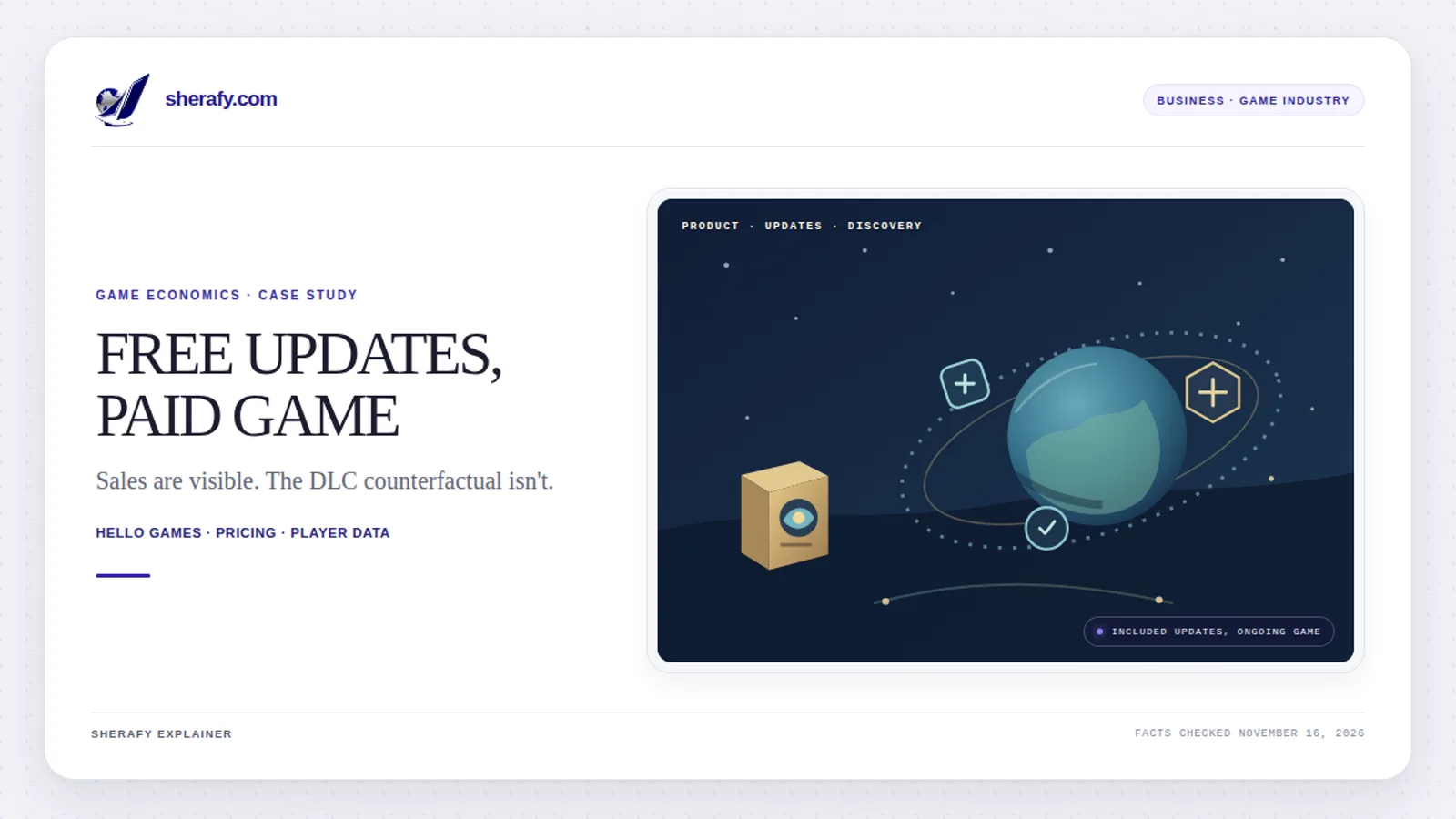
No Man's Sky still makes money by being a game people buy. Hello Games has continued selling its space-exploration game to new customers across PC, consoles, and now iPhone and iPad, while giving existing owners more than a decade of major gameplay updates without separate expansion charges. The game is also available through Xbox Game Pass, although the financial terms of that arrangement have not been disclosed.
That distinction answers the question behind Sean Murray's much-shared remark about refusing to look at a PowerPoint estimating the money Hello Games might have earned from paid DLC. Free updates do not mean the studio has stopped selling its product. They mean new content is included with the purchase rather than sold as a separate product.
Whether that strategy generates more or less lifetime profit than paid expansions is a different question. No public breakdown establishes exactly how much revenue individual updates bring in, what they cost to develop, or how much the studio would have earned under another model.
Where does No Man's Sky's money come from?
The clearest confirmed source is the original product: No Man's Sky remains a paid game on Steam, and it is available through numerous other platforms. Each major update can make that existing product more attractive to someone who has not bought it yet. A customer who paid in 2016 receives the newer content without buying an expansion; a new customer in 2026 still needs an entitlement to play the game.
The publicly visible commercial arrangements are not all the same:
| Mechanism | What is confirmed | What remains unknown |
|---|---|---|
| New game purchases | No Man's Sky is still sold as a premium game on Steam and other storefronts. | Unit sales and net revenue by platform, year, or update. |
| New platform launches | The game has expanded beyond its original release platforms, creating opportunities to reach new buyers. | How much incremental revenue each launch produced. |
| Xbox Game Pass | Hello Games lists Game Pass among supported ways to access the game. | The specific licensing or compensation terms agreed with Microsoft. |
| iPhone and iPad | The iOS version offers a free trial followed by a $19.99 one-time full-game unlock in the US App Store. | Mobile sales volume and resulting net revenue. |
| Merchandise and other studio projects | Hello Games operates an official merchandise store and develops other games. | Their contribution to company revenue, and how much can be attributed to No Man's Sky. |
The key point is that a free update and a free game are not the same thing. Hello Games has largely rejected charging existing customers for successive content expansions, not charging anyone to access the game in the first place.
The 2018 Xbox launch shows how the model works
This is not a theory invented after the game's success. In May 2018, Hello Games announced that its NEXT update would be free for existing PC and PlayStation 4 players while No Man's Sky would launch on Xbox One.
One group received a substantial new experience without a DLC bill. Another group gained a new opportunity to buy the expanded game. The same release could serve both purposes.
It does not prove how many Xbox copies were sold, but it demonstrates why a developer can continue giving away updates without giving away its entire business.
What Hello Games' financial records actually show
There is enough public financial information to reject the assumption that a decade of free updates necessarily means a decade without revenue. There is not enough to produce a trustworthy No Man's Sky-only profit-and-loss statement.
According to financial-data services extracting figures from the company's filed accounts, Hello Games Ltd reported the following for its financial year ended October 31, 2024:
| Financial measure | Reported figure |
|---|---|
| Turnover (company revenue) | £55.971 million |
| Operating result | £2.396 million loss |
| Profit or loss before tax | £2.367 million loss |
| Cash at the reporting date | £32.192 million |
| Average employees during the year | 55 |
These amounts are reproduced by The Accounts' company-data summary and, for the principal revenue, pretax result, cash, and employee figures, by 192.com's Companies House-derived financial record. The official Companies House filing history identifies the full accounts for the year ended October 31, 2024, filed on January 9, 2026.
Three qualifications matter.
First, turnover is not profit. The operating company reported a pretax loss for that particular financial year, despite substantial revenue. Describing the £55.971 million as profit would be wrong.
Second, these are company figures, not an audited breakdown of one game. Hello Games is associated with other games and projects, including The Last Campfire and the forthcoming Light No Fire. The accounts do not establish precisely what share of company turnover came from No Man's Sky, nor how much was earned from any individual update.
Third, reporting entities and dates matter. Hello Games Holdings Ltd filed separate group accounts for the year ended October 31, 2024. A comparison that mixes standalone figures from one year with consolidated group figures from another can be misleading. The financial snapshot above is for Hello Games Ltd in a specified period, not a stitched-together group revenue trend.
As of November 16, 2026, Companies House lists Hello Games Ltd's accounts for the year ended October 31, 2025 as overdue. This limits what the available filings can tell us about the studio's most recent performance. The overdue filing status, by itself, does not establish financial distress.
What can we conclude? Hello Games has demonstrated a substantial commercial operation and reported significant cash holdings as of its 2024 accounts. But a cash balance is not the same as annual profit, and these statements cannot tell us whether charging for DLC would have produced a better result.
Can free updates really help sell more copies?
They can, in principle. A paid game does not stop being a product once its launch window closes. If improvements make it more appealing, a developer can keep selling it to people who were not ready to buy earlier.
The potential business cycle is straightforward: a major free update gives previous players a reason to return, renewed activity creates discussion and publicity, and that visibility can introduce the game to prospective buyers. Some of those people may purchase it. The update costs money to make, but it may also extend the commercial life of the original purchase.
That is an economic explanation, not proof that every update pays for itself. Player activity is observable. The resulting sales and net profits generally are not.
What the September 2026 Steam numbers tell us
On September 9, 2026, Hello Games released Cosmos, a major free update that expanded space-station ownership, construction, and exploration. The change in Steam player activity around that release was substantial:
| Month | Average concurrent Steam players | Monthly change |
|---|---|---|
| August 2026 | 8,244.41 | -10.63% |
| September 2026 | 23,597.63 | +186.23% |
| October 2026 | 14,947.09 | -36.66% |
Source: Steam Charts, No Man's Sky monthly history. These are average simultaneous players on Steam, not monthly unique users, total players across platforms, or copies sold.
September's average was approximately 2.86 times August's. October's figure then declined, although it remained above August's level. That pattern is consistent with a major content release renewing interest, followed by some cooling as the initial attention fades.
It is not a controlled experiment. Promotions, other events, existing-player behavior, and the timing of releases can also affect the numbers. The data establishes an increase in Steam activity around Cosmos, not a specific increase in revenue caused by Cosmos.
Even so, this helps explain why a decade-old game can remain commercially relevant: Hello Games continues creating reasons for people to pay attention to it.
Why Sean Murray refuses to charge for major DLC
Murray's stated reasoning is not primarily about maximizing the number of copies sold. It is about keeping the game's development coherent.
In an August 2026 interview with GamesRadar+, the Hello Games founder acknowledged that someone might calculate how much extra revenue paid expansions or in-game purchases could have brought in. His response to that hypothetical presentation was simple: "I never want to see that PowerPoint."
The reason matters more than the joke. Murray explained that developers can design an update knowing the existing player base has access to the previous major content. New systems can build on old systems without requiring the studio to maintain a complicated set of paid expansion entitlements.
Imagine an update that introduces a new kind of starship and a later one that adds features specifically for those ships. If the first update were paid, the second would need to account for players who had never bought it. By keeping both available to owners, Hello Games avoids that particular divide.
This does not mean every platform receives identical technical features or every patch arrives simultaneously. It means major gameplay content is not routinely locked behind separate DLC purchases.
Murray also emphasized the team's desire to keep working on the game. In a separate GamesRadar+ interview, he tied continued updates to the fact that people were still playing and developers remained motivated. Neither statement is an unconditional guarantee that updates will continue forever.
How a small team sustains a huge game
The studio's scale is an important part of the explanation, though it is easy to misuse the numbers.
Murray told GamesRadar+ that approximately 12 to 20 developers work on No Man's Sky at a given time. That refers to the development team assigned to the game, not the company's entire staff. The separate financial record showing 55 average Hello Games Ltd employees in 2024 measures something different and covers an earlier reporting period.
The studio is also developing Light No Fire, so No Man's Sky is not the only project drawing on its resources. A relatively small dedicated team can make long-running updates easier to sustain than an operation requiring hundreds of full-time developers, but staff size alone does not reveal the full cost of technology, infrastructure, external services, or development.
In other words, Hello Games appears to have an operating structure compatible with this strategy. Its precise update-by-update economics are not public.
From the 2016 backlash to more than 40 free updates
No Man's Sky launched on PlayStation in August 2016 amid extraordinary expectations. The early response was contentious, with criticism of the gap between what some players expected and what was available at launch. In its November 2016 announcement of the Foundation update, Hello Games acknowledged the intense discussion and said it was listening to feedback.
What followed was not a single rescue patch. It was a sustained redesign and expansion of the game:
| Milestone | Why it matters |
|---|---|
| 2016: Foundation | Added foundational systems including base building and different game modes, establishing the long-term free-update approach. |
| 2018: NEXT | Expanded multiplayer and arrived free for existing PC/PS4 owners alongside the first Xbox release. |
| 2025: Voyagers | Introduced modular, customizable ships with walkable interiors and crew-oriented play. |
| September 2026: Cosmos | Expanded space-based activities and coincided with renewed Steam engagement. |
| October 2026: Forsaken | Added another major content release and brought the game to iPhone and iPad. |
The dates and features are documented in Hello Games' Foundation release notes, NEXT announcement, Voyagers announcement, Cosmos announcement, and Forsaken announcement.
With Forsaken on October 28, 2026, Hello Games said the mobile edition included more than 40 updates and described Forsaken as its fifth major update of 2026. The company also said it was planning further content for 2027.
There is one historical qualification worth preserving. In August 2016, Murray softened an absolute no-paid-DLC statement, leaving open the possibility that charging might become necessary for a feature the studio otherwise could not afford. The subsequent decade of free updates is an established record; an irreversible promise about every future development decision is not.
Does No Man's Sky have microtransactions?
Not as a recurring paid gameplay-expansion model, but the iOS version technically contains an in-app purchase. These are different things.
The US App Store listing describes No Man's Sky as free to try, with a $19.99 one-time purchase to unlock the full game, including a decade of updates. Apple therefore labels it as an app with in-app purchases.
That transaction buys access to the game; it is not a paid season pass or a charge for the Forsaken, Cosmos, or other major updates. Saying the game has "no in-app purchases of any kind" would be inaccurate. Saying existing owners receive major content updates without separate paid DLC remains accurate.
Could other studios follow the same model?
Possibly, but not automatically. The strategy depends on economics that are different for every game.
A studio needs enough continuing revenue or financial reserves to support development between sales cycles. It needs a game that can keep attracting new buyers after launch, a manageable cost structure, and players who value continued improvements. Control over product and pricing decisions also matters.
The model becomes much harder when a game has a limited market, an extremely expensive update pipeline, high recurring infrastructure costs, or little realistic opportunity to reach new customers. Nor should No Man's Sky's results be generalized to every online multiplayer or free-to-play game; those products can have very different costs and funding needs.
There is another trade-off. Paid DLC offers a clearer revenue event whenever new content launches. Free DLC avoids that immediate purchase barrier, but relies on a less direct return through sales, renewed interest, goodwill, and longevity. Neither structure guarantees higher lifetime profit.
The central financial question is not whether Hello Games could have charged more people. It is whether charging them would actually have left the studio better off after accounting for the effect on its audience and future sales. The necessary counterfactual data does not exist publicly.
Frequently asked questions
How many copies of No Man's Sky have been sold?
Hello Games described tens of millions of Travellers in its 2026 anniversary message on PlayStation Blog. That is a player-audience statement, not a verified lifetime count of paid copies. Subscription access, different platforms, and multiple purchases complicate the distinction. Steam player counts cannot be converted into worldwide sales totals.
Is No Man's Sky free with Xbox Game Pass?
It is available through eligible Game Pass access, according to Hello Games' official 2026 platform list. That means subscribers can access it under the service's terms; it does not mean the game is permanently free to own. The financial terms between the platform and Hello Games have not been publicly established in the sources reviewed here.
Will all future No Man's Sky updates be free?
Hello Games' demonstrated policy is to provide major updates to existing owners without separate paid expansion charges. Murray has expressed an intention to continue while players remain engaged and the developers want to keep making the game. That is a strong statement of direction, not a contract guaranteeing every update indefinitely.
Is Hello Games profitable?
Not every reported year. The 2024 Hello Games Ltd accounts show a pretax loss, alongside £55.971 million in turnover and £32.192 million in cash at year-end. Those figures cannot be treated as No Man's Sky's standalone profit or as a complete picture of the wider group in 2026.
The bottom line
Sean Murray is entitled to prefer a game in which every owner can experience each major new feature. The record shows that Hello Games has maintained that approach for a decade. It also shows that the studio continues to sell a commercial product and has operated at a substantial scale.
What it does not show is the amount of money the studio supposedly left on the table. Paid DLC might have generated additional purchases. It might also have reduced the appeal of the full game, split its audience, or weakened the cycle that keeps attracting new players. Without the underlying financial data, neither counterfactual can be declared a fact.
Free updates are not the absence of a business model. For No Man's Sky, they are part of the product people are still willing to buy.
References and Further Reading
Primary developer announcements and storefronts
- Hello Games: No Man's Sky NEXT multiplayer and release-date announcement (May 18, 2018). Confirms the free NEXT update for existing PC and PlayStation players and the simultaneous Xbox launch.
- Hello Games: No Man's Sky Cosmos (September 9, 2026). Documents a major free update and lists supported platforms, including Xbox Game Pass.
- Hello Games: No Man's Sky Forsaken (October 28, 2026). Confirms the latest major expansion, iOS launch, and inclusion of more than 40 updates.
- Hello Games: Foundation Update Incoming (November 25, 2016). Provides the studio's contemporary account of its response to launch criticism and its early update strategy.
- Steam: No Man's Sky storefront. Establishes that the game remains a paid product, separate from its free major content updates.
- Apple App Store: No Man's Sky. Documents the free-trial model and US $19.99 one-time full-game unlock.
Financial statements and player data
- Companies House: Hello Games Ltd filing history. Official register identifying the operating company's annual accounts and their filing dates.
- Companies House: Hello Games Holdings Ltd filing history. Official record of separately filed consolidated group accounts; essential for avoiding comparisons across different reporting scopes.
- The Accounts: Hello Games Ltd financial summary. Extracted 2024 turnover, operating result, pretax result, cash, and employment figures; cross-check against the underlying filing where available.
- 192.com: Hello Games Ltd financial information. Independent presentation of Companies House-derived financial totals, including 2024 turnover, pretax loss, cash, and employee figures.
- Steam Charts: No Man's Sky. Source for August, September, and October 2026 average concurrent Steam-player data. These figures do not measure sales.
Original interviews and historical context
- GamesRadar+: Sean Murray on free updates and the DLC PowerPoint (August 2026). The original interview behind the widely circulated quotation, including Murray's reasoning about keeping all players eligible for each update and his team's size.
- GamesRadar+: Murray on what keeps No Man's Sky updates going (2026). Explains how continued player engagement affects the developers' motivation.
- PC Gamer: No Man's Sky creator walks back no-paid-DLC statement (August 17, 2016). Records Murray's early qualification that future funding needs might alter an absolute commitment.
- Sean Murray on PlayStation Blog: No Man's Sky's tenth anniversary (August 10, 2026). Primary first-person account of the game's evolution and audience; its player language is not equivalent to a paid-copy sales total.
Editorial currency note: This article was fact-checked on November 16, 2026. Storefront prices, Game Pass availability, future updates, Steam activity, and Companies House filing status may change. Financial figures refer to the entity and reporting period explicitly identified; they are not a No Man's Sky-only revenue or profit statement.