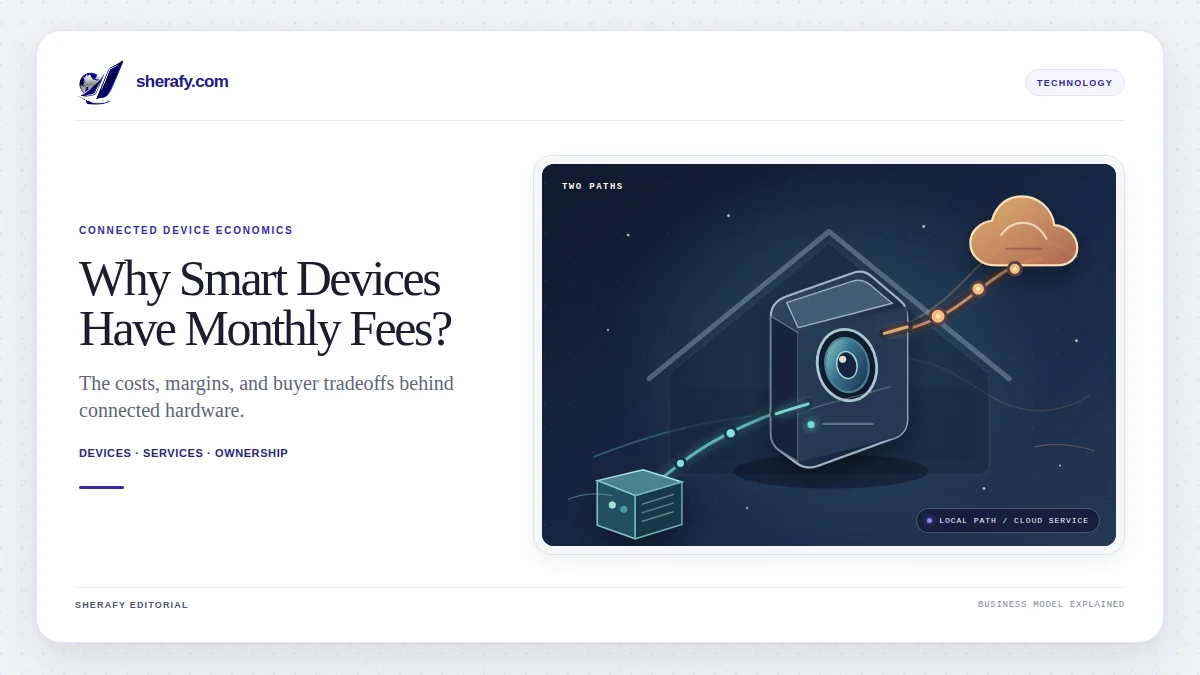
Smart devices charge monthly fees for different reasons. A fee may pay for an ongoing service such as cloud video storage, remote monitoring, or AI processing. It may also be the price a company sets for extra software features, even when some basic functions work without it. And many connected products do not require a subscription at all.
The business model is real, but the simple version—“cheap hardware is always a loss leader, then the company makes it all back through subscriptions”—does not fit every product. Public filings from Arlo and Roku show how some companies accept losses or lower margins on hardware while building higher-margin services or platform revenue. Those segment results do not prove that every device is sold below cost or that every customer becomes profitable. For buyers, the key questions are what the fee includes, how much it adds over time, and what still works when it ends.
What does a smart-device subscription pay for?
A recurring fee can support real work that continues after the sale. A connected camera may upload video, store it, and make it available in an app. A security system may pay for professional monitoring. A device that runs cloud-based AI may send data to servers for analysis. Remote connectivity, software maintenance, support, and security updates can also carry ongoing costs.
But a monthly charge does not automatically mean the company must pay that amount to keep the device operating. A vendor can reserve selected features for a paid tier, even when a local or less convenient version is technically possible. One plan can combine both: a real cloud service and a business decision about which functions are free.
The money can come from several distinct models:
| Model | Where the revenue comes from | What to ask as a buyer |
|---|---|---|
| One-time hardware sale | The device purchase price | Which functions work without an account or ongoing service? |
| Service or software subscription | Cloud storage, remote access, monitoring, AI, support, or premium features | What exactly stops when the plan ends? |
| Platform or advertising | Ads, distribution fees, transactions, or subscriptions sold through a device ecosystem | Is the device itself the product, or does it bring users into a wider platform? |
| Usage or consumables | Charges per use, replacement supplies, or proprietary accessories | Is this genuinely a subscription, or a recurring purchase? |
| Hardware-as-a-service or lease | A continuing fee for use of a device, often bundled with maintenance or replacement | Do you own the hardware, or are you paying to use it? |
These models can overlap, but they are not interchangeable. Buying a camera and paying for cloud recording is different from leasing a camera with installation and monitoring included. Buying printer filament or replacement filters repeatedly is also not the same thing as a monthly software subscription.
Do companies actually sell devices at a loss?
Sometimes, at least at the level of an entire reported product segment. The strongest public examples show why hardware and services have to be considered together—and why the numbers need careful limits.
| Company and period | Hardware result | Service or platform result | What the filing says |
|---|---|---|---|
| Arlo, 2025 Form 10-K | Products: −14.6% gross margin and a $31.2 million gross loss | Subscriptions and services: 83.5% gross margin | Arlo said it used lower retail prices and promotions to stimulate household acquisition and subscriber growth. It also said tariff costs rose $13.5 million and explained 6.3 percentage points of the product-margin decline. |
| Arlo, Q2 2026 Form 10-Q | Products: −0.4% gross margin | Subscriptions and services: 81.1% gross margin | The product margin had improved substantially from −15.4% in Q2 2025, showing that one year’s hardware loss is not a permanent rule. |
| Roku, 2025 Form 10-K | Devices: $82.0 million gross loss | Platform: $2.16 billion gross profit | Roku said it manages device prices to grow its audience, expecting that to support platform revenue and gross profit over time. |
Arlo’s 2025 Form 10-K reports its product and service results separately. The filing also describes the mix of lower prices, acquisition promotions, freight, and tariffs affecting product margins. In its second-quarter 2026 filing, Arlo reported that product gross margin had improved to −0.4%, while services remained above 80%.
Roku’s 2025 Form 10-K shows a different model. Its platform earns money from digital advertising, distribution and transaction revenue shares, premium subscriptions, and other services. A low-priced streaming device can help bring a household into that platform; revenue can then come from ads or transactions even if that household does not buy a Roku-billed subscription.
These are gross-margin figures, not net profit or customer lifetime value. Gross profit is what remains after the costs assigned to that segment, before broader company expenses such as research, marketing, and administration. Company-wide segment totals also cannot tell us whether one particular camera, TV, or customer relationship paid back its acquisition cost.
The pattern is not unique to U.S. companies, but neither does a company’s nationality tell you its business model. In Xiaomi’s Q2 2026 report, IoT and lifestyle products had a 20.1% gross margin, while internet services had a 76.8% margin. Xiaomi’s report says internet services include advertising and gaming. That high-margin category is not the same as a subscription attached to each smart device.
How long would it take to recover a hardware subsidy?
Here is a hypothetical example—not a reported result for Arlo, Roku, or any other company:
| Assumption or result | Amount |
|---|---|
| Hardware subsidy per device sold | $25 |
| Monthly subscription price | $6 |
| Share of buyers who subscribe | 25% |
| Contribution margin on subscription revenue | 70% |
| Contribution per device sold each month | $1.05 |
| Simple payback period | About 23.8 months |
The calculation is $6 × 70% × 25% = $1.05 per device sold per month. Then $25 ÷ $1.05 = 23.8 months. Only one quarter of buyers subscribe in this illustration, so the $6 payment does not return $6 per device sold. At 12 months, the company has recovered just $12.60 of the assumed $25 subsidy per device sold. At 24 months, it has recovered about $25.20.
That payback assumes every initial subscriber keeps paying for two years. Churn reduces the return; late sign-ups could increase it. The calculation also excludes customer-acquisition costs, warranty expense, fixed engineering and support, financing, and other operating costs. Even if the direct service contribution covers the hardware subsidy, that does not establish that the company made a net profit.
What does a subscription add to the buyer’s cost?
A $99 device plus a $6 monthly plan costs $459 over five years: $99 + ($6 × 60 months). The subscription accounts for $360 of that total. This is a simple illustration, not a current product quote; it assumes the fee never changes and excludes taxes, replacement hardware, and any local-storage equipment.
The comparison is useful only if the services are comparable. A local memory card may avoid a cloud fee but may not provide off-site backup if a camera is stolen, remote access, professional monitoring, or cloud-based AI. On the other hand, a buyer who does not need those features should not count them as savings merely because a subscription includes them.
What happens when you stop paying?
It depends on the device, plan, and storage method. TP-Link says Tapo cameras work without a Tapo Care subscription; its paid plans add cloud history and premium or AI features. If a Tapo Care plan expires, TP-Link says its cloud videos remain available for a 14-day grace period and are then permanently deleted. Some models also support local recording to a compatible microSD card or hub; TP-Link’s instructions explain which configurations support it, so buyers should check the exact device.
Google’s current Nest feature comparison shows that Google Home Premium features depend on the camera, plan, and region. The Standard and Advanced plans offer 30 or 60 days of event history, and Advanced adds 10 days of continuous recording on eligible wired devices. When a plan ends, subscription features such as event history and some alerts go away, while the basic functions available without a plan vary by device. It is not accurate to assume every camera becomes unusable—or that every camera keeps the same recording features.
A subscription ending is also different from software support ending. If a company stops issuing security updates or maintaining an app or cloud service, a device can lose functions or become less secure even when the owner has no unpaid subscription. In a 2024 staff review, the Federal Trade Commission examined 184 connected products. It found that 161 product pages did not disclose how long updates would be provided, and basic internet searches failed to find that information for 124 products. That sample documents a support-disclosure gap; it does not mean those products immediately stopped working.
What should you check before buying?
- List the functions you need. Separate live use, local recording, cloud history, AI, monitoring, and remote access.
- Check the exact model’s no-plan behavior. Find the manufacturer’s feature table and cancellation terms, not just a generic product-family page.
- Find out what happens to your data. Check the retention period, export tools, grace period, and deletion rules if you cancel.
- Calculate the full cost. Add the device, monthly or annual plan, likely price changes, required hubs or storage, and replacements over the time you expect to use it.
- Check support and independence. Look for a published software-update period, local operation, standards-based access, and whether the device still has useful functions if the vendor’s cloud service changes.
If local storage is a realistic fit for your needs, sherafy.com’s guide explains how to build a local system with Frigate. That approach trades a recurring cloud service for hardware, storage, setup, and maintenance of your own.
References and Further Reading
Company filings and financial results
- Arlo Technologies 2025 Form 10-K — Reports product and subscriptions/services revenue, costs, and gross margins for 2025, including management’s discussion of promotional pricing, tariffs, and acquisition goals.
- Arlo Technologies Q2 2026 Form 10-Q — Shows how Arlo’s product and services margins changed by the quarter ended June 28, 2026.
- Roku 2025 Form 10-K — Documents the device segment gross loss, platform gross profit, and the company’s stated pricing and platform strategy.
- Xiaomi Q2 2026 interim results — Separates IoT/lifestyle-product economics from internet services, which include advertising and gaming.
Product features and support
- TP-Link Tapo Care plans, features, and cancellation — Current U.S. plan details, optional subscription terms, local-storage qualifications, and the 14-day cloud-video grace period after cancellation.
- TP-Link Tapo Care overview — States that Tapo cameras work without a subscription and describes optional cloud and AI tiers.
- TP-Link Tapo SD-card and local-storage instructions — Shows how supported cameras and hubs record to local microSD storage.
- Google Home Premium feature comparison — Compares subscription features by Nest device and plan.
- FTC staff review of software-update disclosures — Explains the 184-product sample, findings, and limits of the 2024 staff review.
Further reading
- An introduction to smart home business models — Distinguishes one-time sales, subscriptions, freemium plans, and device-as-a-service, and explains churn risk.
- The 4 Core Business Models of IoT — A subscription-billing provider’s overview of connected services, usage-based pricing, hardware-as-a-service, and outcome-based pricing.
- How to Replace Google Nest Cameras Without a Subscription — Sherafy’s practical guide to local video recording and a self-hosted Nest alternative.
Currency note: Company figures above cover the specified 2025 and Q2 2026 periods. Product features and cancellation rules were checked on October 23, 2026; availability varies by model, plan, and region. Recheck them before purchase. The worked cost and payback calculations are explicitly hypothetical.