Evidence reviewed October 26, 2026. National figures below come from different years and methodologies; they are not interchangeable.
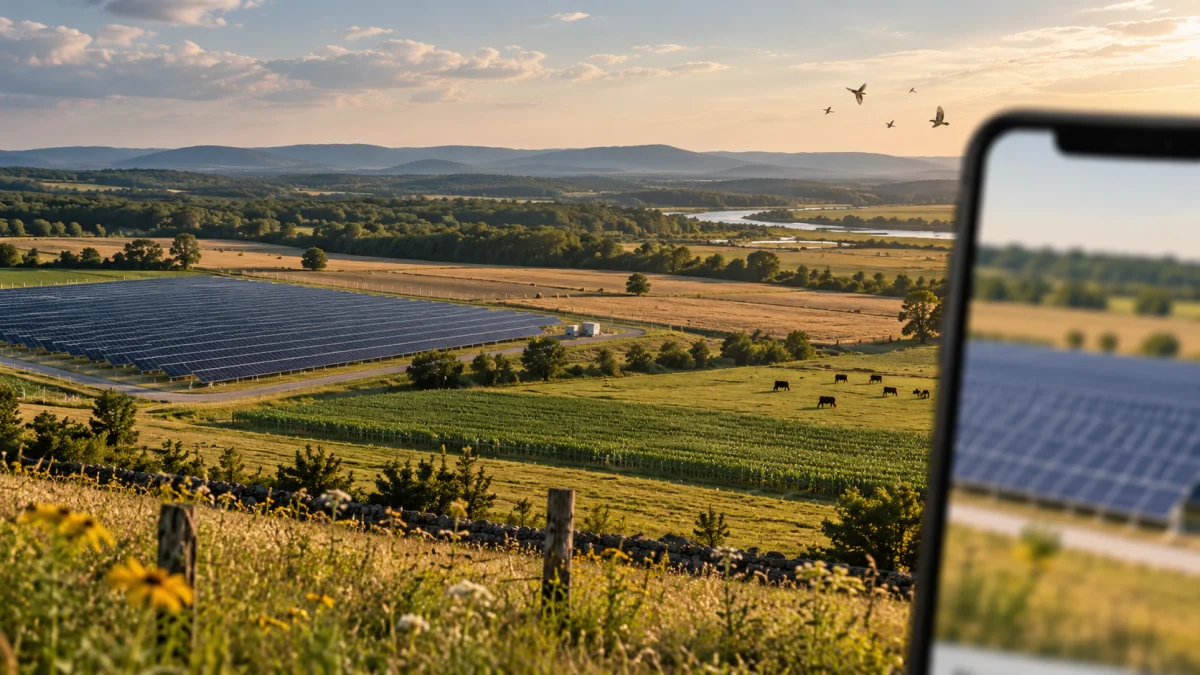
No, the evidence does not show solar farms destroying American agriculture on a national scale. Utility-scale solar occupies a small fraction of U.S. farmland. But solar developments can displace crops, alter soil and drainage, and damage important wildlife habitat when badly sited. Some farmers benefit from long-term solar leases; other farmers, particularly tenants, can lose access to land. These are real trade-offs, not reasons to declare the entire technology a land grab.
The problem with much of the viral anti-solar narrative is not that it starts with nothing. It often starts with something demonstrably true: a contested permit, a foreign-owned developer, a substance inside a panel, or an environmentally sensitive field. Then the argument makes a leap the evidence cannot support. One project becomes proof that America’s farms are vanishing. A hazard inside a sealed product becomes proof of poisoned soil. A voluntary lease becomes foreign seizure. A disagreement with regulators becomes evidence of a hidden conspiracy.
The distinction matters because you can oppose a poorly located solar project without accepting misinformation about solar energy. And you can recognize misinformation without pretending every solar proposal deserves approval.
The facts, at a glance
| Claim circulating online | What the evidence actually establishes |
|---|---|
| “Solar is taking over America’s farmland.” | Not on a national scale shown by available data. USDA estimated about 336,000 rural acres directly affected by solar in 2020, compared with roughly 897 million U.S. farmland acres. A solar trade group estimated a still-small 0.07% farmland footprint in June 2026. The measures and dates differ. |
| “Solar targets the country’s best farmland.” | Agricultural land is often selected, and some projects use productive soil. Research does not establish that solar disproportionately selects USDA-designated prime farmland compared with similar available parcels. |
| “Solar panels poison the soil.” | EPA says intact, operating panels do not leach their contained toxic metals. Damaged panels, manufacturing waste, and end-of-life handling require separate scrutiny. |
| “Foreign companies are stealing farms.” | Foreign involvement and long-term leases exist. A lease, corporate ownership of a developer, and ownership of the land itself are different legal and economic relationships. |
| “There is no cleanup plan.” | Siting regimes can require decommissioning plans and financial security. Whether the actual plan and funding are adequate is a legitimate project-specific question. |
| “A controversial permit proves corruption.” | A regulatory decision can be challenged, including for inadequate environmental protections. It does not, by itself, prove bribery, hidden control, or improper coordination. |
The sources behind these distinctions are the USDA Economic Research Service’s land-cover study, the Solar Energy Industries Association’s farmland map, the EPA’s solar-panel guidance, and New York’s public renewable-siting records. The industry-produced map is useful evidence, but it is not an independent agricultural census.
How much American farmland do solar farms actually use?
The most commonly confused figures answer two completely different questions: How much land does solar cover, and how often is a solar project built on agricultural land?
In a 2024 USDA study covering rural solar development through 2020, researchers estimated that solar directly affected about 336,000 acres of rural land. For scale, the report compared solar and wind development with approximately 897 million acres of U.S. farmland. Dividing 336,000 by 897 million gives about 0.037%, or roughly four one-hundredths of one percent.
That calculation illustrates scale. It is not a precise 2020 solar-on-farmland percentage: the numerator is rural land affected by solar, which includes some nonagricultural sites, while the denominator is all U.S. farmland. Nor should the 2020 figure be presented as the footprint in 2026, after additional solar installations.
In June 2026, the Solar Energy Industries Association (SEIA) published a new interactive farmland map and reported that solar occupies about 0.07% of U.S. farmland, and 0.04% of all U.S. land. Those are industry estimates that should be read with their mapped definitions and data vintage, not mistaken for fresh USDA measurements. A separate January 2026 American Clean Power analysis also cites 0.07%, but for the average state-level share of prime farmland used by solar. The identical-looking percentages have different denominators and calculations.
Now consider another USDA finding: more than 70% of utility-scale solar projects installed in rural areas from 2012 through 2020 were situated on agricultural land, including 43% on cropland and 28% on pasture or rangeland. Those are shares of projects, not the percentage of American farmland occupied. USDA published the regional breakdown in July 2024.
All three observations can be true:
- Solar occupies a small share of national farmland.
- A large share of rural solar projects has been sited on land previously used for agriculture.
- A particular community can face a substantial change to the fields and habitat around it.
When someone presents the second fact as proof that solar is consuming most farmland, they have switched the denominator. The share of solar projects built on farms is not the share of farms covered by solar.
But isn’t prime farmland being used?
Yes, in some cases. Prime farmland is a USDA soil classification reflecting favorable characteristics for agricultural production; it is not synonymous with a field currently growing food. Prime soils can exist under pasture and some other land uses. See the USDA Natural Resources Conservation Service definition.
Two 2026 studies add necessary nuance:
- A July study published by USGS-affiliated researchers found that more than 90% of the agricultural-sited solar projects in its land-quality analysis were on land scoring above the national median on a Productive, Versatile, and Resilient (PVR) index. That is a warning about siting and conservation, not a claim that 90% of U.S. solar occupies legally designated prime farmland.
- A separate March 2026 national parcel-level study in Renewable Energy found little positive relationship between the share of USDA-designated prime farmland on a parcel and its likelihood of hosting solar, after examining comparable parcels and other factors. The researchers did find that solar was more likely on some land designated important by state or local authorities, even when not classified as prime.
The studies are not measuring the same thing. One asks about the quality scores of agricultural land where solar already exists. The other asks whether higher-quality parcels are more likely to be selected relative to comparison parcels. Different definitions, samples and statistical questions can yield different observations without either study being fabricated.
The responsible conclusion: The national solar footprint is small. The quality and location of the land being converted still deserve scrutiny. Neither fact cancels the other.
A real conservation dispute, not an imaginary one: Fort Edward, New York
One of 2026’s most visible anti-solar campaigns grew around a legitimate ecological disagreement in Fort Edward, New York.
The Canadian renewable-energy company Boralex proposed a 100-megawatt solar project near the Washington County Grasslands, an area important to declining grassland birds. As the project evolved, the proposed area was reduced from roughly 750 acres to about 527 acres, according to independent reporting by HEATED. The exact distinction between the overall project boundary, disturbance area and panel array matters when comparing acreage.
In a March 2026 conservation statement, Audubon New York and Southern Adirondack Audubon argued that the planned arrays could fragment or displace habitat used by vulnerable species, including the short-eared owl and northern harrier. They criticized the adequacy of the state’s mitigation requirements. Those concerns were not invented by an influencer, nor did they come from a rejection of renewable energy in principle. Audubon explicitly supported renewable development with stronger protections for sensitive habitats.
After negotiations, Grassland Bird Trust and Boralex announced a May 19 agreement under which the developer would fund permanent protection of additional grassland habitat. The Trust withdrew its permitting appeal, saying its mitigation concerns were addressed within that agreement. The announcement did not establish that the physical impacts would disappear, or specify that every affected acre would be replaced acre for acre. Read the joint announcement.
New York’s Office of Renewable Energy Siting and Electric Transmission, or ORES, issued the project’s final permit on May 26, 2026. The state announcement and complete public case docket, matter 23-03023, record the approval, comments, appeals, decision and permit conditions.
This was a dispute over where to build, what habitat would be lost, what protection could compensate for it, and how much local influence the state permitting system allows. Those are serious subjects. They are not evidence that solar development everywhere is destroying farms or that wildlife protection and renewable energy must be incompatible.
If a viral clip shows a real field being cleared, ask what the field contained, how the developer’s plans changed, what the permit requires and whether other locations were assessed. A dramatic photograph is not a national land-use study.
The $24 trillion farmland claim: Watch a real number change meaning
One of the clearest examples of misleading anti-solar messaging concerns an enormous supposed transfer of American farmland.
In a June 26, 2025 post under her own name, influencer Alexandra Fasulo asserted that $24 trillion in farmland would change hands as older owners retired and suggested solar companies were at the front of a coming land grab. Alex Hannaford’s July 30, 2026 investigation for HEATED traced the underlying figure to a real-estate brokerage. Readers can compare her original statement directly with the original data.
The original September 17, 2025 article from National Land Realty discusses an estimated generational transfer of about $70 trillion in wealth, of which nearly $24 trillion was real estate across categories, including homes and income-producing property as well as farmland. It does not say $24 trillion in farmland is set to change hands.
For additional scale, the USDA’s September 2026 farm-sector balance-sheet forecast put the entire U.S. farm sector’s real-estate assets at roughly $3.7 trillion for 2026. That is a point-in-time value, not a measurement of transactions over several decades, so the two figures should not be directly subtracted. But it underscores why a $24 trillion figure covering all real estate cannot simply be relabeled farmland.
The transformation works like this:
- Original statistic: An estimate of wealth moving between generations, with about $24 trillion attributable to many kinds of real estate.
- Changed category: The same amount is described as if it consists of agricultural land.
- Added conclusion: Solar developers are portrayed as preparing to take that land, although neither the source nor the figure measures solar acquisitions.
The manipulation is not in inventing a number from nothing. It is in changing what the number is about, then attaching an unsupported conclusion.
When a startling statistic appears online, ask: What was counted? Who calculated it? Over what period? Does the original source make the same claim? This example fails those checks.
Do solar panels poison farmland?
Operating solar panels are not the same thing as uncontained toxic waste.
Many solar panels contain small amounts of materials such as lead or cadmium, depending on their technology and construction. Their presence matters for manufacturing, damage, disposal and recycling. But whether a substance can be hazardous is a different question from whether people, soil or groundwater are exposed to it during normal use.
The U.S. Environmental Protection Agency’s solar-panel FAQ states that working solar panels do not leach their contained toxic metals because the materials are encapsulated. EPA also explains that some discarded panels do qualify as hazardous waste, depending on composition and testing. California’s Department of Toxic Substances Control similarly distinguishes waste classifications by panel type and test results.
Both propositions matter. Claiming that all functioning panels routinely poison farmland ignores the operating condition and the exposure pathway. Claiming that solar panels contain no potentially hazardous substances, or that disposal is a nonissue, would also be wrong.
A credible allegation of contamination should identify the panel type, whether panels were broken or discarded, the release pathway, sampling methods and measured concentrations. A photograph of solar modules does not establish contamination. Neither does a chemical name on a materials list.
What about mining and manufacturing emissions?
Solar is not impact-free. It requires material extraction, energy-intensive manufacturing, equipment transportation and eventual management of waste. But those upfront costs should be compared with the energy produced over the panel’s useful life, not treated as if they recur every hour the panel generates electricity.
The International Energy Agency’s solar supply-chain assessment estimated that panels typically offset their manufacturing-related emissions in four to eight months of operation, versus an average lifespan of roughly 25 to 30 years. The exact figure varies by manufacturing electricity mix, technology and installation conditions.
An argument that counts the environmental cost of manufacturing solar equipment while ignoring the continual extraction and combustion associated with fossil-fuel generation is an incomplete comparison. That does not absolve a solar developer of damage to a specific ecosystem.
Are solar farms foreign-owned? Are they taking American land?
There is a real international dimension to U.S. solar. The false leap is that foreign involvement always means foreign seizure of farmland.
At least four different questions are frequently collapsed into one:
- Who holds title to the land?
- Who has a long-term lease or easement allowing a project to use it?
- Who owns the company developing or operating the project?
- Where were the modules and their components manufactured?
A Canadian developer may enter a lawful lease with a U.S. landowner without buying the land. That agreement can substantially restrict land use for decades, and its fairness deserves examination, but a voluntary lease is not itself evidence of confiscation. Foreign land acquisitions, investments near sensitive facilities and compliance with applicable reporting laws are separate issues worth evaluating on their own facts.
The USDA’s February 2026 study of foreign investment in agricultural land reported that, in its 2022 dataset, 85% of foreign-held long-term leased agricultural acreage was associated with renewable-energy development, compared with 2% of foreign-owned agricultural acreage. This is a meaningful finding about the use of foreign-held leases, not a finding that 85% of all American farmland or solar projects is foreign-owned. USDA also distinguished leasing from purchasing land and found that agricultural operations often continued alongside renewable uses.
Foreign ownership deserves transparent disclosure. But if a post leaps from a developer’s nationality to claims that a government has stolen farms, ask for deeds, lease terms, corporate records or a documented compulsory acquisition. Nationality is not evidence of a land grab.
Are American solar panels made in China?
There is significant dependence on international supply chains, and it is misleading to deny it. It is equally misleading to describe every solar panel installed in America as imported, with no domestic manufacturing.
The Rhodium Group’s October 15, 2026 Clean Investment Monitor analysis reported annual U.S. manufacturing capacity, as of the third quarter of 2026, of approximately 65 gigawatts for solar modules, 20 gigawatts for cells, 3 gigawatts for wafers, and 10 gigawatts for polysilicon. These are capacities, not proof that every factory ran at full output or that every input was made domestically.
The bottleneck is upstream: U.S. final module assembly capacity is much larger than domestic wafer and cell capacity. “Made in America” therefore requires a precise definition of which manufacturing stage is being described. Ownership of the factory, origin of inputs, and location of final assembly are also distinct questions.
Can the land be farmed again after solar panels are removed?
Sometimes, but not automatically and not at zero cost. Solar arrays can be dismantled, and land can potentially return to agricultural production. But construction can compact soils, disturb drainage, affect vegetation, require access roads and change habitat. Whether a specific field regains its former agricultural productivity depends on the project design, management and restoration work.
USDA’s 2024 land-cover analysis found that, among the solar sites it examined for land-cover change, about 15% shifted out of an agricultural land-cover classification after installation. That historical remote-sensing result is not a measure of permanently sterilized land, and it cannot establish the outcome decades after a project is decommissioned. It does show that solar and agriculture compete for land in some locations.
The USDA Natural Resources Conservation Service’s conservation guidance discusses practices to reduce soil erosion, manage stormwater, protect soil health and preserve possibilities for continuing agricultural uses. These measures are not automatic simply because a developer calls a site environmentally friendly.
New York’s current major-renewable siting regulations, effective in 2026, address construction, decommissioning and financial assurances; the applicable project-specific obligations are reflected in the final permit. For Fort Edward, the public permit docket is the place to inspect the enforceable conditions rather than assume that no restoration plan exists.
A plan is not proof that a site will be perfectly restored. It is a legal and technical commitment whose cost estimate, security, enforcement, periodic updates and soil-restoration standards should be questioned. That is more useful scrutiny than the blanket prediction that every solar site is ruined forever.
Does grazing sheep under panels solve the farmland problem?
Not universally. Agrivoltaics can include livestock grazing or crop production around and beneath solar infrastructure, and some sites can support pollinator habitat. Grazing sheep is agricultural activity, but it is not equivalent to maintaining the former acreage of corn, vegetables or other row crops. Panel spacing, light, machinery access, water and economics affect what is possible.
A credible dual-use claim should specify what is produced, on how many acres, at what yield, and for how long. “There are sheep in the photo” is not an agricultural productivity assessment.
Is solar permitting a secret, unaccountable process?
Criticizing the rules is legitimate. Calling a publicly documented state permitting system a secret conspiracy requires evidence that goes beyond an unpopular outcome.
In New York, major renewable projects generally fall under the state’s ORES process. The New York Public Service Law, Section 142, sets procedures for applications, public comment, hearings and decisions. It also authorizes ORES, under specified conditions, to decline to apply local laws found unreasonably burdensome in light of state climate objectives and project benefits. That power raises a genuine question about the balance between state authority and local control. The statute also contains decision deadlines and a conditional mechanism for permits to be deemed granted if a deadline is missed. Those provisions should be described accurately rather than pretending local concerns carry the same legal weight in every case.
But the existence of accelerated review, state preemption, a rejected appeal or a redacted environmental record does not establish bribery or a hidden chain of command. There are public legal standards, filings, comments and orders. Some environmental data, such as sensitive species locations, may be withheld from general publication for reasons other than concealment of wrongdoing; each redaction must still be assessed on its merits.
In Fort Edward’s case, the official record shows an application, public comments, party petitions, appeals and final determinations. A critic can reasonably argue that the process provided inadequate protection or insufficient local control. That claim is different from asserting, without independent proof, that the agency is a “deep state” operation or that approval was purchased.
The right questions are concrete: Which law authorized the decision? Which environmental standard was applied? Which evidence was accepted or rejected? What appeal rights existed? What conditions can actually be enforced?
How a local solar dispute became part of national political messaging
The public record also shows how the story moved beyond the Fort Edward permit.
Alexandra Fasulo, a social-media creator and president of the American Land Rescue Fund, publicly challenged solar projects in New York. In a June 29, 2026 post under her own name, she wrote that she had spoken and exchanged messages with country musician John Rich, whom the federal administration had appointed special envoy for American landowners, and had sent him research. She described subsequent contact involving federal officials and a letter questioning New York’s solar-siting practices.
The administration’s concerns became public: WXXI’s June reporting documented a letter associated with Agriculture Secretary Brooke Rollins, EPA Administrator Lee Zeldin and Rich. It challenged New York’s soil classifications and end-of-life planning. POLITICO’s September investigation independently reported Fasulo’s White House meeting and the amplification of her work by officials. On October 21, a Putnam County government release publicly described another roundtable involving Fasulo, Rich and local officials.
These are documented contacts and instances of political amplification, not just similar wording between unrelated accounts. They show how a local environmental controversy can enter discussions involving national policymakers.
They do not, by themselves, prove secret sponsorship, paid messaging or direction by a fossil-fuel company.
There is a broader history worth distinguishing. The Energy and Policy Institute’s investigation of opposition to wind and solar identifies organizations and networks with fossil-fuel-linked financial support. For a concrete example, the institute traced $750,000 in 2020–2022 contributions from the foundation of coal-industry executive Joseph Craft to the Texas Public Policy Foundation, an organization that has campaigned against renewable-energy policies. The foundation’s publicly available tax filings provide a route for examining the underlying financial records. This is a documented funding relationship involving that foundation and that organization; it is not evidence that those donors financed Fasulo.
Public IRS data compiled by ProPublica show the American Land Rescue Fund reported $65,917 in contributions for 2025. Those publicly available records do not identify the donors. Fasulo told HEATED she had not accepted fossil-fuel money. We found no public evidence in the sources reviewed that establishes such funding to her. Absence of a disclosed donor list is not proof of hidden industrial financing.
The distinction matters. A person can share an industry’s interests without being paid by it; an organization can receive money without every statement being false. Follow documented money and communications, but do not substitute “who benefits?” for “what can be proved?”
The strongest critique of an inaccurate claim is that it fails against the evidence. It does not need an invented motive to fail.
Seven ways a misleading solar narrative is built
These methods are not exclusive to one ideology, company, influencer or technology. They are patterns readers can learn to detect.
| Technique | What it looks like | The question that exposes it |
|---|---|---|
| 1. Scale distortion | A video of one large array becomes “America’s farmland is disappearing.” | How many acres, compared with what total, and in which year? |
| 2. Changing the category | A $24 trillion estimate covering all real estate becomes $24 trillion in farmland. | What does the original source actually count? |
| 3. Hazard becomes exposure | A metal inside a sealed panel becomes proof of poisoned soil. | Has the substance been released and measured at the site? |
| 4. Conflating ownership | Imported components, a foreign developer and a farmland lease become “foreign seizure.” | Who owns the land title, who leases it and who manufactures what? |
| 5. Generalizing from a real exception | A poorly chosen site becomes proof that solar cannot be built responsibly anywhere. | Is the objection specific to this location or supported across projects? |
| 6. Treating disagreement as corruption | An agency rejects an appeal, so the agency must be secretly controlled. | Which document or transaction proves improper conduct? |
| 7. Making the claim impossible to test | Every contrary scientist, farmer or agency is declared bought or compromised without evidence. | What evidence would the speaker accept as disproving the claim? |
The last pattern is especially revealing. If every disagreeing expert is automatically corrupt, there is no longer a way to test the claim. A suspicion has been turned into an explanation for every possible outcome. That is not an investigation. It is an argument designed to survive without verification.
A useful distinction comes from the National Academies’ 2025 assessment of scientific misinformation: misinformation concerns claims inconsistent with the weight of scientific evidence, whether spread deliberately or accidentally. Disinformation adds an element of knowing falsity. Being wrong, exaggerating or repeating misleading content does not automatically prove intent to deceive.
And not all community opposition is misinformation. A 2026 study of 81 solar-opposition groups in the United States and United Kingdom found a complex mix of information sources and disagreements, rather than support for explaining opposition solely as biased-source consumption. Communities may have legitimate disputes about cost, landscape, land rights or governance. Calling every objector a propagandist would be its own form of distortion.
What an evidence-based objection to a solar project looks like
A credible objection identifies the specific project and the specific harm, not a generalized conspiracy. Before taking a position on a proposal, residents should be able to examine:
- Land and soil: Which parcel acreage is covered by panels, roads and fencing? How much is active cropland, pasture, prime soil or farmland of statewide importance? Are drainage and topsoil protected?
- Ecology: What wetlands, migratory routes, grassland-bird habitat or protected species are present? What alternatives, setbacks and mitigation measures were considered?
- People and property rights: Who owns and farms the land? Are there agricultural tenants whose leases or livelihoods could be disrupted? Are affected neighbors and local officials able to participate meaningfully?
- Economics: What compensation goes to landowners, tenants, local governments and the surrounding community? What financial benefits are projected, and who bears residual risk?
- End of life: Is there a detailed restoration plan, an independently assessed cost estimate, enforceable financial security and a way to update it as costs change?
- Alternatives: Could a less sensitive site, previously developed land, roof space or a different project layout avoid the harm? What are the grid-connection and cost trade-offs?
Solar developers should have to answer those questions. So should anyone demanding that a project be stopped. The goal is accountable siting, not a presumption that the developer or every critic is right.
How to call out a misleading solar claim without repeating it
When responding publicly, attack the unsupported step in the reasoning, not a person’s presumed intentions. The most useful corrections are specific enough that another reader can verify them.
If someone says solar is swallowing U.S. farms:
USDA found that many rural solar projects were built on agricultural land, but that is not the same as saying solar occupies a large share of national farmland. What’s the acreage, the denominator and the year behind your claim?
If someone says panels are poisoning soil:
EPA says intact working panels do not leach their contained toxic metals. If this project has a contamination problem, show the panel condition, sampling results and exposure pathway. Waste handling is a separate issue.
If someone says foreigners have taken the land:
Is the property owned by a foreign investor, leased voluntarily by an American landowner, or developed by a foreign-owned company? Those are different claims. Which property or corporate record supports this one?
If someone says the permit proves a conspiracy:
Point to the legal provision, the decision and the specific evidence of improper conduct. A disputed permit can justify an appeal, but it isn’t proof of a secret payoff.
The goal is not to win a comment section. It is to show everyone reading where the evidence ends and the speculation begins.
Five questions to ask before you share the next video
- Can I state the claim in one testable sentence? Separate measurable assertions from anger, suspicion and predictions.
- Where is the original record? Open the actual study, permit, deed, report or dataset rather than relying on a creator’s summary.
- Has the denominator or category changed? A percentage of projects is not a percentage of farmland. A forecast about real estate is not a farmland valuation.
- Does a local example justify a national claim? A real habitat dispute may support changing the project’s design, not condemning every solar farm.
- What evidence could change the speaker’s mind? If every correction is dismissed as corruption without proof, treat the claim with serious skepticism.
Research on this approach is encouraging. A 2026 meta-analysis of 33 misinformation-inoculation experiments found that teaching people to recognize manipulation techniques improved their ability to distinguish reliable from unreliable material without simply making them distrust everything.
Frequently asked questions
Are solar farms permanently destroying prime farmland?
Not inherently. A solar installation may remove land from crop production for decades, and poor construction can cause lasting damage, but physical restoration is possible. The quality of the soil-restoration plan, project management and financial security determines whether that promise is credible. A temporary lease is not proof of perfect future restoration, and it is not automatically permanent destruction.
Do solar farms reduce the amount of land available for food production?
They can, especially when they replace actively cropped fields or displace tenant operators. Nationally, however, the measured footprint remains a small share of U.S. farmland. The relevant local question is what was being produced on the site, what will continue, and whether the project displaces other farmers.
Does prime farmland always mean land currently growing crops?
No. It is a land and soil capability designation, not a current-use category. Depending on the soil’s classification and conditions, land may count as prime even when it is pasture or another eligible use.
Are all solar panels made in China?
No. U.S. module-manufacturing capacity expanded substantially by 2026, while domestic wafer and cell production remained much more limited. The answer depends on whether you mean raw materials, wafers, cells, completed modules or corporate ownership.
Can people oppose a solar farm without spreading misinformation?
Absolutely. Habitat fragmentation, farmland conversion, tenant displacement, construction impacts, weak decommissioning guarantees and inadequate public participation are specific, testable concerns. Opposition becomes misleading when a speaker substitutes sweeping claims for the evidence about the actual project.
How can I check who really owns or controls a proposed solar farm?
Start with the county recorder’s deeds and easements, the project’s public permitting docket, the operating entity’s state business records, and any available corporate ownership disclosures. A developer’s country of incorporation does not tell you who owns the underlying land.
The test is the evidence, not the side someone is on
Solar is a large physical infrastructure technology. It uses land, materials, labor and money. It can produce public benefits and impose real local costs. Nobody should be asked to ignore those costs because the project is labeled clean energy.
But nobody should be persuaded that America’s farms are being poisoned or seized simply because a compelling video combines a real controversy with a large number, a frightening image and an accusation of corruption.
You do not have to defend every solar project to reject misinformation about solar energy. You do not have to oppose renewable energy to demand better siting and accountable permits. And you do not need proof of someone’s secret motive to demonstrate that a factual claim has failed.
When you encounter the next alarming post, identify the claim, trace the source, check the scale, examine the local record and call out the exact leap the evidence does not support. That is how a genuine environmental concern stays a genuine environmental concern instead of becoming a vehicle for misinformation.
References and Further Reading
Agricultural land, siting and soil quality
- USDA Economic Research Service, Utility-Scale Solar and Wind Development in Rural Areas: Land Cover Change (2009–20) (2024). Primary historical analysis of rural project siting, land cover and acreage. Its study period is not current-year deployment.
- USDA ERS, Solar projects were located mostly on agricultural land between 2012 and 2020 (2024). Explains the 43% cropland and 28% pasture/rangeland project-siting shares.
- Gu et al., Analyzing land characteristics associated with historical large-scale solar photovoltaic deployment in the United States (2026). National geospatial research using the PVR land-quality index; not a prime-farmland acreage census.
- Winikoff et al., Cashing out? Farmland quality and the adoption of utility-scale solar energy (2026). National parcel-level comparison of soil classifications and solar adoption, explaining why quality measures cannot be collapsed into one figure.
- USDA NRCS, Prime and Other Important Farmlands. Official explanation of what prime farmland means.
- USGS and Lawrence Berkeley National Laboratory, United States Large-Scale Solar Photovoltaic Database, version 4.0 (April 2026). Public location and array-boundary data; installation coverage lags real-world completion.
- Solar Energy Industries Association, Prime Farmland & Solar Overlap (June 2026). Industry-produced comparison map, useful for geography but not an independent government census.
- American Clean Power, Utility-Scale Solar on Farmland by the Numbers (January 2026). Industry GIS analysis of state prime-farmland shares; its 0.07% state-average measure differs from a national acreage share.
Panel safety, manufacturing, ownership and restoration
- U.S. EPA, Solar Panel Frequent Questions. Primary federal guidance on safe operating panels and hazardous-waste determinations for discarded modules.
- International Energy Agency, Solar PV Global Supply Chains. Lifecycle manufacturing impacts and emissions payback, with explicit technology and supply-chain context.
- Rhodium Group, The State of US Clean Energy Supply Chains in 2026 (October 2026). Current reported manufacturing capacities, separated by polysilicon, wafer, cell and module stages.
- USDA ERS, Characterizing Foreign Investment in U.S. Agricultural Land, 2022 (February 2026). Distinguishes foreign-owned agricultural land from foreign-held long-term leases and measures renewable-energy associations.
- USDA NRCS, Conservation Guidance for Utility-Scale Solar Projects (2025). Soil, drainage, vegetation and ongoing agricultural-use practices for project evaluation.
Fort Edward and public records
- New York State Department of Public Service, Fort Edward Solar, public case docket 23-03023. The authoritative permitting record, including comments, appeals, decision and final conditions.
- Audubon New York, New York State Regulations Fall Short for Grassland Birds (March 2026). Specific ecological objections from conservation advocates who also support renewable energy.
- Grassland Bird Trust and Boralex, Collaboration to Advance Grassland Bird Conservation (May 2026). Joint statement describing habitat-protection funding and withdrawal of the Trust’s appeal; does not prove impacts vanished.
- New York State Senate, Public Service Law §142. Governing statutory provisions addressing permit review, public process, local laws and decision deadlines.
- New York State Department of Public Service, Part 1101 Major Renewable Energy Facility Siting Regulations (2026). Updated regulatory rules, including application requirements, environmental conditions and decommissioning provisions.
Claim provenance, political amplification and misinformation research
- Alexandra Fasulo, You don’t have to sit there and take it (June 2025). Original, attributed public assertion about $24 trillion in farmland and solar, allowing comparison with the source statistic.
- National Land Realty, America’s Impending Great Wealth Transfer (September 2025). Original real-estate article underlying the misapplied $24 trillion figure.
- USDA ERS, Farm Sector Assets, Debt, and Wealth (2026). Current forecast of U.S. farm-sector real-estate asset value, a point-in-time measure rather than a multidecade turnover estimate.
- Alex Hannaford for HEATED, The influencer teaching millions to fear solar (July 2026). Original interviews, claim tracing and reporting about the Fort Edward dispute and Fasulo’s messaging. Claims attributed to its reporting are identified as such.
- Alexandra Fasulo, Kathy’s got some explaining to do (June 2026). First-person account of her communications with John Rich and response to the federal letter; her interpretations are not independent proof.
- Marie J. French for POLITICO, An unlikely power player in the fight over solar on farmland (September 2026). Independent reporting on political access and amplification, available through a reproduction hosted by the Governors’ Wind Energy Coalition.
- Energy and Policy Institute, Fueling the Opposition (2024). Interested-party investigation that identifies specific fossil-fuel-linked funding relationships; assess its factual claims against referenced financial documents rather than treating every allegation as established.
- ProPublica Nonprofit Explorer, Joseph W. Craft III Foundation. Public IRS return access for checking the foundation’s historical charitable grants, including those discussed in the Energy and Policy Institute investigation.
- ProPublica Nonprofit Explorer, American Land Rescue Fund Inc.. Publicly reported financial data; donor identities cannot be inferred from aggregate contributions.
- National Academies, Understanding and Addressing Misinformation About Science (2025). Evidence-based distinctions between misinformation, disinformation and the limits of inferring intent.
- Simchon et al., A signal detection theory meta-analysis of psychological inoculation against misinformation (2026). Research supporting instruction in manipulation techniques without indiscriminate distrust.
Editorial currency note: Reviewed October 26, 2026. Permits, ownership, manufacturing capacity and solar acreage change over time. Historical USDA data, current industry estimates and project-specific regulatory records must be read with their original time periods and definitions. This article does not allege that any named individual received undisclosed fossil-fuel funding without documentary evidence.