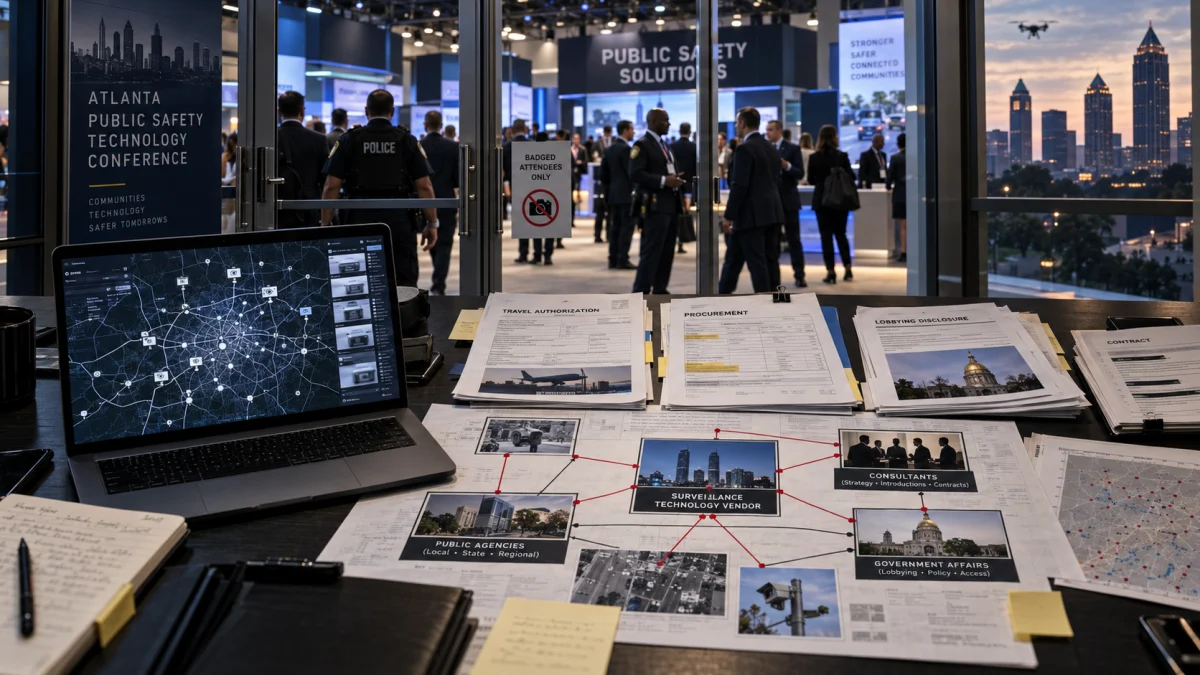
Yes, Flock Safety kept journalists out of Flock Forward 2026. But the drone, antennas and irony of a surveillance company being surveilled were not the most important part of the story.
Flock’s own conference materials, public travel records and the website of a consulting firm that works with the company reveal something more consequential: part of the relationship infrastructure surrounding the sale and adoption of Flock technology by public agencies.
Flock Forward was a private customer event, and its agenda included genuine training on investigations, legal defensibility, deployment, auditing and technology governance. It was not simply a room where police chiefs were being handed sales brochures.
But Flock also explicitly designed the conference around implementation, investment decisions, expanding partnerships, scaling programs and preparing for "city council conversations." Its website offered prospective attendees a link labeled "Justify This Expense." Public records show that at least some law-enforcement employees attended earlier Flock Forward conferences on government-authorized travel. And Public Safety Strategies Group, a consultancy staffed by former senior law-enforcement and government officials, publicly says it has helped Flock grow among law-enforcement organizations through its professional network.
None of that proves corruption, improper procurement or a quid pro quo.
It does answer a question largely missing from the viral coverage: what happens around the moment a private surveillance company becomes a government vendor?
For readers trying to understand what Flock cameras themselves can actually record and search, sherafy.com has separately examined how Flock’s nationwide license-plate-reader network works and what a forensic examination of a compromised Flock camera revealed about on-device image capture. This investigation concerns a different layer of the system: how the technology is introduced, supported, expanded and discussed inside the public-safety market.
What Actually Happened at Flock Forward 2026?
Flock Forward 2026 ran from August 18 through August 20 in Atlanta. Flock’s official conference page described it as an event for law-enforcement leaders, public-safety professionals, private-sector security leaders and invited partners, with more than 500 attendees expected.
Cybersecurity researcher Benn Jordan said he bought a $350 ticket but was later told journalists would not be admitted. He also said his Hilton reservation was canceled after a Flock employee contacted the hotel. Jordan later published a video showing how he and collaborators monitored the event from outside using wireless-monitoring equipment and drone footage, then used publicly available information to investigate people they identified as attendees.
The media-exclusion portion is independently corroborated.
InvestigateTV also tried to attend. In its September 8 report, the outlet said a Flock spokesperson told it: "Flock Forward is a customer event and not open to the media." InvestigateTV also photographed and filmed law-enforcement personnel at a rooftop event associated with the conference, including Chambers County, Texas, Chief Deputy Skylor Hearn. Its report on the conference and related encounters with Flock provides independent evidence that the media restriction was not unique to Jordan.
Jordan’s separate allegation that Flock caused his hotel reservation to be canceled is less independently established. sherafy.com has not obtained the underlying hotel email or communication, so that portion should be treated as Jordan’s account, not as a separately verified fact.
That distinction matters because most of the broader story can be established without relying on Jordan at all.
Flock’s Own Agenda Shows Why the Conference Matters
The strongest evidence about Flock Forward comes from Flock itself.
The company’s 2026 conference page advertised more than 500 attendees and a $350 registration price that included sessions, meals and other conference experiences. Alongside the ticket link, Flock displayed another link labeled "Justify This Expense."
That is not inherently unusual for a professional conference. Employers commonly ask workers to justify travel and training costs.
It is nevertheless relevant when a substantial part of the advertised audience consists of public employees whose agencies may be paying those costs.
Flock also promised attendees access to compliance experts who could discuss trust, transparency, regulation and how to prepare for "city council conversations."
That language places the conference squarely at the intersection of technology, public administration and political approval.
The agenda makes the same point more clearly.
A session called "Measuring What Matters" discussed how data could guide priorities and investment decisions. Another, "Deploy for Impact," began with the sentence: "The work starts after signature." It focused on stakeholder alignment, adoption, governance, training and scaling programs after deployment.
A legal session addressed constitutional considerations, policy design, prosecutorial expectations and how agencies could make technology-derived evidence more defensible in court.
Another session, "The Network You Know, the Partners You Don’t," discussed relationships among law-enforcement agencies, universities, retailers, housing communities and other organizations already connected through shared technology. Flock told attendees they would leave with ideas for strengthening relationships, identifying partnership opportunities and creating more value from existing connections.
Those are not hidden activities. Flock advertised them publicly.
And that is precisely why the conference is more interesting than the viral framing suggests.
Flock Forward was partly educational, partly operational and partly about how an installed technology program becomes embedded, defended, expanded and connected to additional partners.
The Consulting Firm Jordan Identified Is Real, and So Is Its Flock Relationship
Jordan’s video eventually focused on Public Safety Strategies Group, or PSSG, and two of its senior figures: former Hennepin County Sheriff Rich Stanek and former Minnesota state senator Julianne Ortman.
One correction is important immediately.
Ortman is not a current Minnesota senator. PSSG’s current team biography says she served in the Minnesota Senate from 2002 through 2016 and now works as a managing partner and senior expert at the consulting firm. She previously served as a Carver County commissioner and later as Stanek’s chief of staff at the Hennepin County Sheriff’s Office.
Stanek is PSSG’s principal consultant. His PSSG biography describes a career that included service as Hennepin County sheriff, Minnesota commissioner of public safety, director of homeland security and a five-term member of the Minnesota House of Representatives.
The important question is not whether former officials became consultants. That is common across government-facing industries.
The important question is whether there is evidence connecting their consultancy to Flock’s growth in law enforcement.
There is.
A Flock Executive Publicly Credits PSSG With Helping the Company Grow
PSSG’s own website publishes a testimonial attributed to Bob Carter, National Director of Strategic Relations at Flock Safety.
Carter says Rich Stanek and his team were "extremely helpful in Flock’s growth and development as services provider to law enforcement organizations." The testimonial also praises PSSG’s longstanding network of law-enforcement professionals.
The full testimonial is published on PSSG’s homepage.
That does not tell us how much Flock pays PSSG, what its exact statement of work says, whether PSSG receives commissions, or whether particular introductions led to particular contracts.
But it does establish something important without inference:
Flock itself has publicly credited PSSG with helping its growth in the law-enforcement market.
That is far stronger evidence than merely identifying Ortman in a crowd.
What Does PSSG Actually Sell?
PSSG is also unusually explicit about its services.
Its services page advertises expertise in public finance, government procurement and grants. For technology companies entering the public-safety market, it advertises go-to-market strategy built around procurement requirements and "relationship and reputational development" through outreach to agency leadership.
The firm also describes work involving law-enforcement technology, public policy, communications and advocacy.
A separate testimonial from another PSSG client, Saadian Technologies, is especially useful for understanding the firm’s general business model. That customer says PSSG helped it understand pricing and procurement, identify which conferences to prioritize and make introductions through a network of sheriffs and senior command staff.
That testimonial does not establish that PSSG performed those exact tasks for Flock.
It does establish what PSSG is capable of providing and what at least one other public-safety technology client says it purchased from the firm.
Put those records together and a clearer picture emerges:
- PSSG markets procurement expertise and agency-leadership outreach.
- PSSG is staffed by former senior law-enforcement and government officials.
- PSSG advertises a longstanding network of public-safety professionals.
- A Flock executive publicly says that network and PSSG’s work were helpful to Flock’s law-enforcement growth.
That is a documented business relationship.
It is not evidence of a secret arrangement.
The Viral Video Makes One Claim the Public Record Does Not Yet Support
Jordan goes one step further in the video.
He says Flock pays PSSG to obtain "confidential leads" for new police contracts around the country.
That exact characterization could not be independently verified from the records sherafy.com reviewed.
We found strong evidence for the surrounding proposition: a consulting relationship exists; PSSG works in procurement and relationship development; and Flock credits the firm with helping its growth among law-enforcement organizations.
What we did not locate is a Flock-PSSG contract, statement of work, invoice, proposal, email or other primary record describing PSSG’s role as obtaining "confidential leads."
That does not prove Jordan’s statement is false.
It means the available evidence stops short of establishing it as fact.
That distinction is important because the verified story is already substantial. There is no need to stretch it.
Are Taxpayers Paying for People to Attend Flock Forward?
Sometimes, demonstrably yes.
The public record does not support a claim that every government attendee at Flock Forward 2026 traveled at taxpayer expense. The conference also included private-sector security professionals, and public employees could theoretically attend through several different funding arrangements.
But government records show that taxpayer-funded or government-authorized attendance has occurred in prior years.
An Alameda County Sheriff’s Office out-of-state travel authorization for Flock Forward 2024 covered two sergeants traveling from Oakland to Atlanta. Alameda County’s Board of Supervisors agenda listed an authorized cost of $1,582.10 per person, or $3,164.20 total for those two travelers.
The following year, the county’s July 8, 2025 Board of Supervisors agenda included three separate Flock Forward travel items for sheriff’s personnel:
| Year | Alameda County Sheriff’s Office travelers | Listed authorized cost |
|---|---|---|
| 2024 | 2 sergeants | $3,164.20 total |
| 2025 | Sheriff’s technician + crime technician | $1,861 each |
| 2025 | 1 sergeant | $1,458 |
| 2025 | 2 sergeants | $1,861 each |
| 2024–2025 combined | 7 travelers | $12,066.20 |
The combined figure is a sherafy.com calculation from the amounts listed in the county’s official agenda records. These are authorized or listed travel costs, not proof that every dollar was ultimately spent or reimbursed.
That is enough to resolve the basic question.
The idea that taxpayers can fund attendance at Flock Forward is not hypothetical.
What remains unknown is the scale of public funding for the 2026 event nationally.
What About the Free Swag?
Jordan’s video and InvestigateTV footage showed attendees around Flock-branded items at conference events.
That is not enough to establish an ethics violation.
Public-employee gift rules vary by jurisdiction. Whether a conference item creates an issue can depend on its value, who received it, whether an exception applies and the employee’s agency or state ethics rules.
Without a reliable inventory, recipient list and value for the items distributed, the evidence does not support calling the swag improper.
The more defensible question is narrower: when government employees attend vendor-sponsored events, what benefits are provided, who pays for them, and what disclosure rules apply?
Those questions can be answered with records. The available video cannot answer them by itself.
Flock Also Uses Conventional Registered Lobbying Channels
PSSG should not automatically be described as Flock’s lobbying firm. The evidence reviewed here establishes consulting, procurement and relationship-development work, not that every PSSG activity for Flock constitutes regulated lobbying.
Flock separately uses disclosed government-affairs channels.
A federal Lobbying Disclosure Act filing shows Mercury Public Affairs reporting $120,000 in lobbying income from Flock Group Inc. d/b/a Flock Safety for the first quarter of 2026, covering "issues related to safety and security" before the U.S. House, Senate and Office of Administration.
Massachusetts’ official Lobbyist Public Search database lists Flock as a 2026 client of Shawmut Strategies Group and reports $45,000 in compensation through June 30, 2026. Earlier state disclosures describe Shawmut’s work for Flock as involving law-enforcement technology.
Lobbying is legal, regulated and common for companies that sell into government markets.
Its relevance here is not that it proves wrongdoing. It shows that Flock’s public-sector business operates through several distinguishable channels:
direct customer relationships, conferences and training, outside consultants, and registered government affairs.
Those categories should not be collapsed into one another.
One Biographical Detail Was Already Out of Date
There is a small discrepancy in the public records that is worth noting because it illustrates why this story needs source-by-source verification.
PSSG’s current biography for Julianne Ortman says she concurrently serves as executive director of the National Fusion Center Association. The NFCA’s own current leadership page lists the executive-director position as vacant.
PSSG’s description therefore appears to be stale on that point.
That does not materially alter the Flock-PSSG relationship. It simply means PSSG’s own biographies, like any interested-party source, should not be treated as automatically current in every detail.
What the Viral Reel Gets Right, and Where It Goes Too Far
| Claim | What the evidence supports |
|---|---|
| Flock Forward excluded journalists. | Supported. Flock independently told InvestigateTV that the customer event was not open to media. |
| Jordan was denied access after buying a ticket. | Supported by Jordan’s account and secondary reporting. |
| Flock caused Jordan’s Hilton reservation to be canceled. | Attributed but not independently established by sherafy.com. We have not reviewed the underlying hotel communication. |
| Public officials and law-enforcement personnel attended. | Supported. Flock advertised the event to public-safety leaders, featured agency presenters and InvestigateTV documented officers at the event. |
| Taxpayer money can pay for Flock Forward attendance. | Supported. Alameda County records document government-authorized conference travel in 2024 and 2025. |
| Julianne Ortman is a Minnesota senator. | Misleading in the present tense. She is a former Minnesota state senator who left office in 2016. |
| Ortman is a PSSG managing partner and Rich Stanek is a senior PSSG figure. | Supported by PSSG’s current team page. |
| Flock uses PSSG to help grow its law-enforcement business. | Strongly supported. A Flock executive testimonial on PSSG’s site says so directly. |
| PSSG is paid to obtain confidential leads for police contracts. | Not independently established from the records reviewed. |
| Conference swag violated ethics rules. | Not established. Value, recipients and applicable rules would need to be documented. |
| The relationships prove corrupt procurement or a quid pro quo. | Not supported by the evidence reviewed. |
The table is important because the underlying story does not need every viral claim to be true.
Most of the institutional structure Jordan pointed toward can be documented independently.
The Bigger Transparency Problem Is What We Still Cannot See
The public record tells us more than the viral clip did, but it also makes the remaining gaps clearer.
We still do not know:
- the precise scope of PSSG’s current or past work for Flock;
- how much Flock has paid PSSG;
- whether compensation is hourly, flat-fee, retainer, commission-based or tied in any way to specific contracts;
- whether PSSG supplied particular sales leads or introductions that became public contracts;
- which government agencies sent personnel to Flock Forward 2026;
- how much public money was spent nationally on 2026 attendance;
- whether Flock subsidized registration, lodging or travel for any government attendees;
- the value and recipients of vendor merchandise distributed at the event; and
- whether attendees later participated in decisions to buy, expand or renew Flock products.
Those are not accusations disguised as questions.
They are the records that would be necessary to evaluate the relationships properly.
And they matter because public procurement is different from ordinary consumer sales. The ultimate purchaser is often a government agency spending public money on technology that can affect people who never consented to become customers of the vendor.
That does not make relationship-building improper.
It makes the relationship-building a legitimate subject for public scrutiny.
The Flock Debate Has Now Reached the Senate
The timing of this investigation is not accidental.
On September 23, 2026, the Senate Judiciary Committee’s Subcommittee on Crime and Counterterrorism held a hearing titled "Always Watching: Flock’s Nationwide AI Surveillance Network".
Benn Jordan appeared as one of the witnesses.
His prepared Senate testimony focused primarily on cybersecurity and privacy rather than the conference-consulting relationships examined here. But one part is relevant to evaluating him as a source.
Jordan told senators that Flock’s response to his earlier research had previously been defensive, but that the company had more recently invited him and other researchers to review its hardware and platform. He wrote that, although there had not yet been enough time for a full review, it appeared Flock was taking security "a lot more seriously" than a year earlier.
That concession complicates the easiest version of this story.
Jordan is a critic of Flock. He is not claiming that nothing the company does can improve.
The same standard should apply in the other direction: where his claims are independently supported, they should be recognized; where the available documents do not reach as far as his wording, the limitation should be stated plainly.
Flock’s Government Relationships Are Neither a Smoking Gun Nor Irrelevant
There is a tendency in surveillance debates to force every fact into one of two stories.
One story says a technology company is simply selling a useful product, so the relationships around that sale are ordinary business and not worth examining.
The other treats every former official, conference invitation or lobbying disclosure as evidence of corruption.
The records reviewed here support neither extreme.
Flock is a private company selling technology into a government market. It hosts customer conferences. It works with consultants who understand public-safety procurement and maintain relationships with agency leaders. It employs conventional government-affairs representation. Public employees sometimes attend its conference using publicly authorized travel funds.
All of those things can be lawful and ordinary.
They are also part of how government technology markets actually function.
That matters when the product at issue is not office furniture or payroll software, but a network of cameras and databases capable of generating searchable records about where vehicles appear.
Communities debating whether to adopt, expand or retain that technology need to understand more than what the cameras can do. They also need a clear record of who is promoting the systems, who is advising the vendor, who is paying for government personnel to attend vendor events, what benefits are provided and which relationships surround procurement and expansion decisions.
That is not an allegation of corruption.
It is basic visibility into the machinery of public purchasing.
The Bottom Line
Flock Safety’s decision to exclude journalists from Flock Forward created an irresistible visual joke: a surveillance company wound up being surveilled from outside its own conference.
But the joke is not the important part.
Flock’s own conference agenda describes a customer event built around implementation, investment, legal defensibility, expansion, partnerships and preparation for city-council discussions. Public records show that government agencies have paid or authorized costs for employees to attend earlier Flock Forward events. Public Safety Strategies Group openly markets procurement and agency-relationship expertise, and a Flock executive publicly credits the firm with helping Flock grow among law-enforcement organizations.
Those are verified facts.
The evidence does not establish that those relationships are corrupt, that public officials received improper gifts, or that PSSG was paid to obtain the "confidential leads" described in Jordan’s video.
The more defensible conclusion is also the more useful one:
The expansion of surveillance technology into government is not just a story about cameras. It is also a story about conferences, consultants, procurement expertise, professional networks and government affairs. Much of that infrastructure is visible in public records once someone bothers to connect it.
And where the records stop, that boundary should be just as visible.
References and Further Reading
Flock Safety and Conference Materials
Flock Forward 2026 — Flock Safety
Flock’s official conference page. Establishes the dates, target audience, 500-plus-attendee claim, $350 ticket price, "Justify This Expense" link, city-council language and the detailed 2026 agenda.
Public Safety Strategies Group
Public Safety Strategies Group — Homepage and Client Testimonials
Contains the testimonial from Flock Safety National Director of Strategic Relations Bob Carter crediting PSSG with helping Flock’s growth among law-enforcement organizations, along with testimonials from other public-safety technology clients.
PSSG Services
Describes the firm’s work in government procurement, go-to-market strategy, law-enforcement technology, policy and relationship development through agency and leadership outreach.
PSSG Team — Rich Stanek and Julianne Ortman
Provides PSSG’s current descriptions of Stanek’s and Ortman’s professional roles and public-sector backgrounds.
Government Travel and Procurement Records
Alameda County Sheriff’s Office — Flock Forward 2024 Out-of-State Travel Authorization
Official county travel authorization for two sheriff’s office sergeants traveling to Flock Forward in Atlanta in June 2024.
Alameda County Board of Supervisors — July 8, 2025 Agenda
Lists three separate 2025 Flock Forward travel items for Alameda County Sheriff’s Office personnel and the authorized per-person costs used in this article’s calculation.
Lobbying and Government Affairs Records
Federal Lobbying Disclosure Act Filing — Mercury Public Affairs for Flock Safety, Q1 2026
Primary federal disclosure reporting $120,000 in lobbying income connected to Flock in the first quarter of 2026 and identifying safety and security as the issue area.
Massachusetts Lobbyist Public Search — Flock Group Inc. d/b/a Flock Safety
Official Massachusetts lobbying database listing Flock as a client of Shawmut Strategies Group and reporting 2026 compensation and expenses.
Congressional Oversight
Always Watching: Flock’s Nationwide AI Surveillance Network — U.S. Senate Judiciary Committee
Official hearing page for the September 23, 2026 Senate Judiciary subcommittee hearing, including the witness list.
Benn Jordan — Prepared Testimony to the Senate Judiciary Committee
Jordan’s written testimony discussing Flock security issues, his recent engagement with the company and his view that Flock appeared to be taking security more seriously than a year earlier.
Independent Reporting
Flock Worker Calls Police on InvestigateTV Reporter Filming Public Camera Installation — InvestigateTV/WBTV
Includes InvestigateTV’s independent attempt to attend Flock Forward, Flock’s statement that the event was not open to media and reporting from outside the conference.
Related sherafy.com Coverage
Can Flock Cameras Track You? What the Nationwide Network Can and Can’t Actually Do
Explains what Flock’s ALPR network records, how searches work and where the privacy and Fourth Amendment debates actually stand.
Flock Camera Hack Reveals 1.6M Images and Person Detection
Examines recovered camera data showing the volume of on-device image capture and computer-vision processing without conflating person detection with facial recognition.
Are Cities Replacing Flock Cameras With Axon? What the Records Show
Tracks municipalities leaving Flock and asks whether they are reducing surveillance or merely changing technology vendors.
Can the Public Access Flock Camera Data? Who Gets to Search?
Examines search access, auditability and the governance problem created when publicly funded surveillance systems are easier for insiders to search than for the public to scrutinize.
Editorial currency note: Conference materials, employment roles, lobbying registrations, contracts and government procurement relationships can change. This article reflects records reviewed through September 24, 2026. Dollar amounts from Alameda County travel records describe listed or authorized costs and should not be interpreted as proof of final reimbursement unless a post-travel accounting record establishes the actual expenditure.