Yes. Flock cameras can be used to track portions of a vehicle’s movements—but not in the way a GPS tracker continuously follows a person.
Update — September 16, 2026: New forensic reporting has provided the clearest look yet inside an actual Flock license-plate reader. After hackers physically removed a camera and copied much of its storage, 404 Media and WIRED found that the device generated rapid bursts of photographs—about 1.6 million images associated with roughly 50,200 vehicle detections across 21 days of recovered logs—along with thousands of short video clips. Its on-device computer vision also explicitly detected people, vehicles, bicycles and license plates, although researchers found no evidence of active facial recognition. Importantly, those internal captures are not necessarily the same as the finished records available to police.
We broke down exactly what the recovered files reveal—and what they do not prove—in our new investigation: Inside the Flock Camera Hack: What 1.6 Million Images Reveal About How the Cameras Actually Work.
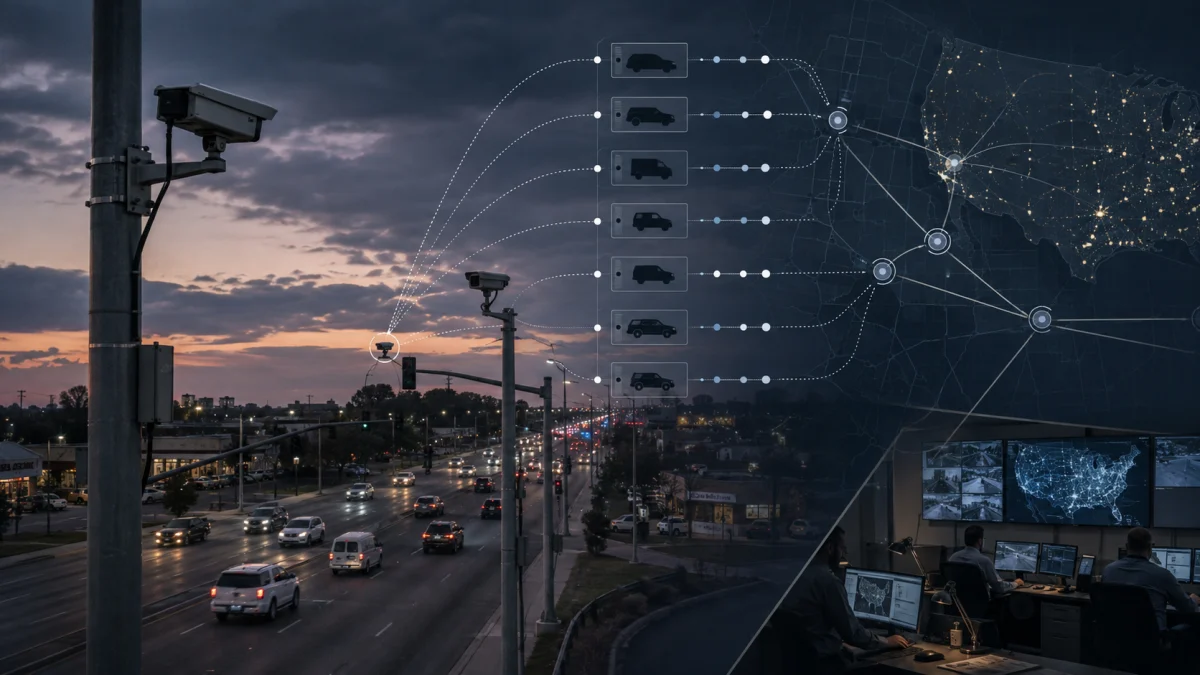
A standard Flock license-plate reader creates a timestamped record showing that a particular vehicle appeared at a particular camera location. One camera produces one observation. But when the same vehicle passes multiple cameras, those observations can be searched and connected to reconstruct parts of where that vehicle has been.
The scale matters.
Flock says its license-plate-reader network now includes more than 120,000 cameras across 49 states. The company explicitly markets access to its network as a way for investigators to follow leads beyond their own jurisdiction.
And contrary to a common argument about mass surveillance, this system does not require enough government employees to sit around watching every camera.
That is precisely what the automation eliminates.
The cameras capture vehicles automatically. Software reads plates and vehicle characteristics. The records are indexed. Hotlists generate automatic alerts. Investigators can later search stored observations in seconds.
Human manpower becomes a constraint when police want to investigate someone, conduct physical surveillance, stop a vehicle or make an arrest. It is much less of a constraint on the underlying collection and search of data.
That is the most important fact to understand about Flock.
It is neither an omniscient system continuously watching every American nor simply a harmless collection of cameras taking isolated license-plate photographs. It is a large, automated system that turns ordinary vehicle movements into searchable records.
Whether that tradeoff is acceptable is a political and constitutional question.
What the technology can do is a factual one.
What Does a Flock Camera Actually Record?
This article concerns Flock’s license-plate-reader cameras, rather than every camera, drone or video-analytics product the company sells.
Flock describes its standard LPR product as creating still, point-in-time vehicle observations on public roadways. That remains an accurate description of the searchable LPR record presented to investigators.
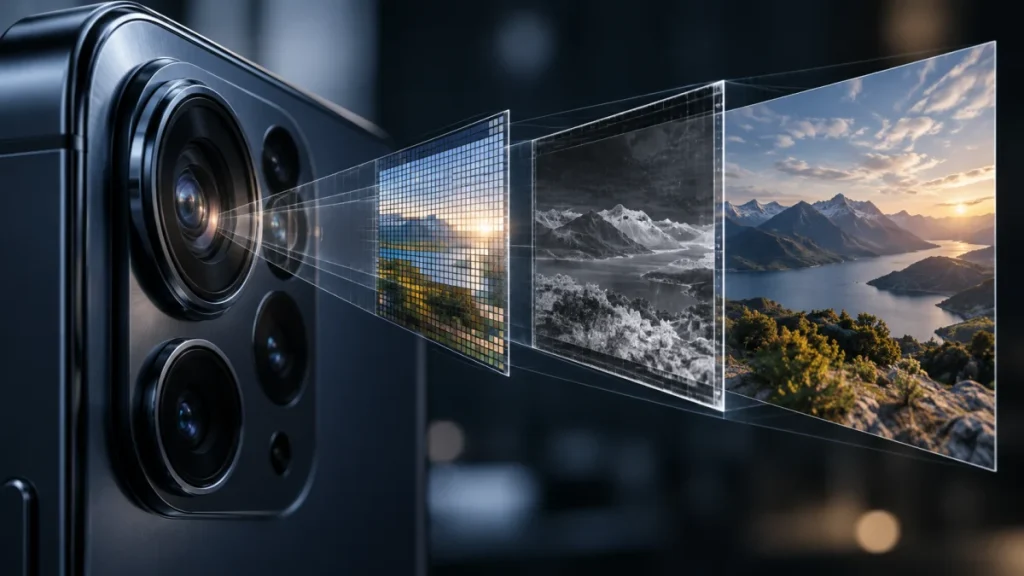
But a September 2026 forensic examination of a physically compromised Flock camera revealed that the physical device does considerably more during the capture process. The camera generated rapid bursts of still images and thousands of short, silent video clips as vehicles passed, while on-device computer-vision software detected objects including vehicles, license plates, bicycles and people. Researchers found no evidence that the camera was performing facial recognition.
Those internal captures should not be confused with the finished police record. The evidence does not show that every frame or video clip is uploaded, permanently retained or made searchable to investigators. The standard LPR system converts selected observations into searchable information including the license plate, time, location and visible vehicle characteristics.
| Information | Standard Flock LPR |
|---|---|
| License plate | Yes |
| Time of observation | Yes |
| Camera location | Yes |
| Vehicle make/model or body type | Yes |
| Vehicle color | Yes |
| Visible features such as roof racks, stickers or toolboxes | Yes |
| Missing or obscured plate | Can be identified |
| Driver’s identity | No |
| Purpose of the trip | No |
| Facial recognition | No |
| Continuous GPS-style location | No |
Flock says its standard LPR cameras do not use facial recognition and do not identify the people inside a vehicle.
The newly recovered camera software did include generic person detection, meaning it could recognize that a human appeared within an image; that is fundamentally different from facial recognition or identifying who that person is.
That limitation is real.
But it can also become misleading when used to suggest that the system cannot track movement.
The database does not need to know the driver’s face to establish that a particular vehicle was photographed at Location A at 8:14 a.m., Location B at 8:36 a.m. and Location C at 9:02 a.m.
So Can Police See Everywhere You’ve Driven?
No.
Flock does not provide a complete GPS record of every mile traveled by every vehicle.
A Flock camera can only record a vehicle when that vehicle passes a camera capable of seeing it. Coverage varies dramatically between jurisdictions, and many roads have no Flock camera at all.
But the opposite claim—that Flock cannot track vehicles because each camera captures only one moment—is also wrong.
Suppose the same vehicle appears near a home in the morning, passes a camera near a workplace later, appears near a medical complex that afternoon and is photographed near a political demonstration that evening.
The camera does not know why the driver went to any of those places.
But the location history exists.
An investigator may be able to connect those observations and draw conclusions from them.
The federal court considering Norfolk, Virginia’s Flock network described substantially this capability. Authorized users could search for full or partial plates and vehicle characteristics, retrieve photographs and receive real-time alerts when vehicles on hotlists were detected. Norfolk operated 176 cameras in 75 clusters, plus access to additional cameras operated by third parties.
Two plaintiffs’ vehicles in that litigation were photographed approximately 475 and 325 times during a four-and-a-half-month period, respectively. During a typical retention window, the city’s system captured matching plates roughly two or three times per day on days when those vehicles were seen.
That is not continuous GPS surveillance.
It is still location surveillance.
The Camera May Be Local. The Network Is Not Necessarily Local.
This is where the privacy question becomes considerably larger than the pole at the end of your street.
Flock’s value to law enforcement comes partly from what the company calls its nationwide network. A police department investigating a vehicle does not necessarily have to rely only on cameras that department physically purchased.
A striking example emerged in August 2026.
Public records obtained by WIRED showed that data from several dozen Flock cameras operated by police in Alpharetta, Georgia, was accessible to more than 2,000 organizations. Alpharetta, in turn, received Flock data from more than 1,300 other entities. Those organizations included police departments, colleges, airports and other government agencies scattered around the country.
That does not mean every Flock customer automatically has unrestricted access to every other customer’s cameras.
Flock says customers control sharing and that sharing is turned off by default for new and onboarding customers. The Alpharetta records nevertheless demonstrate how expansive an agency’s actual sharing network can become.
This distinction matters:
A camera can belong to a local police department while the information it produces becomes useful far beyond that department’s geographic boundaries.
That network effect is not an accidental side feature.
It is one of Flock’s selling points.
Why Flock Does Not Need Thousands of People Watching Cameras
One argument against concerns about automated surveillance sounds intuitive:
There are too many cameras, too many cars and too much data. Government could never hire enough people to watch everyone.
That would be persuasive if Flock worked like an old-fashioned security room filled with television screens.
It does not.
Modern license-plate surveillance separates the process into several stages:
| Stage | Primarily automated? |
|---|---|
| Photograph passing vehicle | Yes |
| Read license plate | Yes |
| Classify visible vehicle characteristics | Yes |
| Record time and location | Yes |
| Store and index record | Yes |
| Compare against hotlists | Yes |
| Generate alerts | Yes |
| Search historical observations | Software-assisted |
| Decide whether a result matters | Human |
| Investigate a person or vehicle | Human |
| Stop a vehicle | Human |
| Arrest someone | Human |
The manpower bottleneck therefore appears after much of the surveillance has already happened.
A police department may lack enough officers to respond to every alert. That is a real limitation.
One evaluation of a major fixed-ALPR expansion illustrates exactly that problem. Researchers found only 87 documented patrol responses to active ALPR alerts over roughly 26 months despite a much larger volume of alerts, concluding that officers appeared too stretched to act on many of them.
But that does not make the underlying system incapable of collecting information.
It shows the difference between surveillance capacity and enforcement capacity.
A government may be able to cheaply collect and search vastly more information than its employees could ever gather through traditional physical surveillance. It may simultaneously lack the officers necessary to act on every result.
Both things can be true.
Is Flock Really a “Panopticon”?
“Panopticon” is ultimately a political metaphor, not a technical specification.
But the analogy is more complicated than simply asking whether someone is watching every camera.
The central insight of panoptic surveillance is almost the opposite: continuous human observation is unnecessary if observation can occur whenever authorities choose and the person being observed cannot reliably know when it will happen.
In that sense, modern automated surveillance makes the analogy stronger rather than weaker.
Flock cameras operate without investigators deciding in advance that a particular driver should be followed. Records can exist first and become important later.
That is retrospective surveillance.
Someone can become a suspect tomorrow and investigators may then search observations generated when that person was simply driving around yesterday.
But calling Flock an all-seeing panopticon can also overstate what exists.
Flock cameras do not cover every road. Standard LPRs do not follow people inside buildings. They generally identify vehicles rather than drivers. Retention periods limit how far backward ordinary searches can go, unless records have been preserved separately.
The most accurate description is therefore less dramatic and more consequential:
Flock is a large, partially interconnected system for automated retrospective vehicle-location surveillance.
That is significant enough without exaggerating it.
Police Misuse of License-Plate Data Is No Longer Hypothetical
It would be unfair to assume that every police search of Flock is abusive.
It would be equally indefensible to dismiss abuse as merely theoretical.
The Washington Post identified at least 69 police officials who had been accused, charged or convicted of improperly using Flock or other license-plate-reader systems. In at least 15 cases, the potential misconduct was reportedly first detected by someone outside the officer’s department.
One Indianapolis officer’s records showed 3,759 searches over ten months involving vehicles used by his wife and two close personal acquaintances, according to the Post. The department subsequently suspended the officer and opened investigations. Police officials acknowledged that the department had not previously maintained a regular practice of auditing officers’ Flock searches.
Records obtained by WIRED documented another case in Alpharetta in which an officer used Flock to monitor vehicles associated with a former romantic partner and another officer. He later resigned after an internal investigation.
These cases prove something important, but limited:
Flock can be misused by authorized users for personal surveillance.
They do not establish that misuse represents a large percentage of all Flock searches.
That prevalence remains unknown from the publicly available cases.
Flock Is Now Strengthening Its Safeguards
Flock has not simply denied that misuse is possible.
In August 2026, the company announced substantial changes to how it intends to govern searches, including mandatory case codes, offense filtering, expanded automated auditing, proactive lockouts for abnormal behavior and mandatory multifactor authentication.
The timing matters.
The Washington Post reported that Flock’s automated Audit Assistance system had previously been voluntary and was being used by only about one-third of its approximately 7,000 law-enforcement customers. Flock subsequently said the feature would become mandatory.
These are meaningful safeguards.
They also illustrate a broader governance problem with rapidly deployed surveillance systems:
Some of the strongest protections being promoted today were strengthened only after real-world misuse demonstrated why they were necessary.
Technology can spread faster than oversight.
How Long Does Flock Keep Your Location Data?
There is currently no single answer that applies to every Flock deployment.
Flock announced on August 13, 2026, that it was changing its recommended and default ALPR retention period from 30 days to seven days and introducing an “Evidence Mode” that allows specific records connected to active investigations to be preserved longer.
However, Flock’s own public documentation is not yet internally consistent.
Its Evidence Policy, last updated one day earlier on August 12, repeatedly states that the company’s “standard” or “default” retention period is 30 days, while also referring elsewhere to jurisdictions whose rules differ from seven days.
Other Flock pages currently describe seven days as the default.
The reasonable interpretation is that Flock is transitioning its recommended/default policy while some legal and policy documentation still reflects the earlier 30-day system.
But local rules can differ anyway.
Norfolk, for example, had moved from 30-day retention to approximately 21 days under Virginia law when the federal court considered its system.
And records downloaded or preserved as evidence can outlive the ordinary rolling retention period.
So “Flock deletes everything after seven days” is too categorical.
The better answer is:
Flock currently says seven days is its recommended/default ALPR retention period, but actual retention depends on the jurisdiction, customer agreement, legal requirements and whether particular records have been preserved for an investigation.
Who Owns Flock Camera Data?
Flock says its customers—not Flock—own the customer data collected through their systems.
Its current contract explanation states that Customer Data is not Flock property.
But “the police own it, therefore Flock has no rights to use it” would also be inaccurate.
Flock’s contractual terms grant the company a limited, non-exclusive, royalty-free, irrevocable, perpetual, worldwide license to use and disclose Customer Data to provide its services and to use that data to support and improve Flock products and services.
That is a licensing right, not ownership.
The distinction matters when discussing what a private surveillance vendor can legally do with data generated on behalf of government customers.
Are Flock Cameras Constitutional?
There is no final nationwide ruling that makes every Flock deployment constitutional or unconstitutional.
The strongest current test case is Schmidt v. City of Norfolk.
In January 2026, a federal district judge ruled in Norfolk’s favor.
The court concluded that Norfolk’s particular network did not capture enough of a person’s movements to constitute a Fourth Amendment search at the collection stage. The opinion emphasized that the city’s 176 cameras covered only a small portion of its road network and that cameras photographed vehicles only when they passed particular locations.
The court did not say that ALPR surveillance can never become constitutionally significant.
In fact, the opinion acknowledged serious uncertainty about the point at which governmental use of ALPR cameras might cross the constitutional line.
The plaintiffs appealed.
That appeal, Schmidt v. City of Norfolk, No. 26-1227, remains before the U.S. Court of Appeals for the Fourth Circuit. The docket shows supplemental briefing continuing through July 23, 2026.
And while that appeal was pending, the Supreme Court issued a major location-privacy decision.
The Supreme Court Just Changed the Location-Tracking Debate
On June 29, 2026, the Supreme Court decided Chatrie v. United States.
The case involved Google Location History obtained through a geofence warrant—not Flock cameras.
That distinction is important.
But the Court held that law enforcement conducts a Fourth Amendment search when it acquires a person’s cell-phone Location History from Google, because people have a legitimate expectation of privacy in that location information.
The Court also rejected the idea that only long-term location surveillance can raise constitutional concerns.
The government had argued that obtaining approximately two hours of Location History was too short a period to qualify as a search. The Court disagreed, emphasizing that even short periods of precise location data can reveal visits to deeply private places or attendance at political events.
That does not mean Chatrie automatically invalidates Flock.
Google Location History is much denser and more precise than ordinary ALPR data. It can record a phone’s location hundreds of times per day, accompany a person outside a vehicle and potentially reveal movement inside buildings. The Supreme Court expressly emphasized those capabilities.
Flock observations are much more fragmented.
Still, Chatrie makes one simplistic argument considerably harder to sustain:
The government may collect or acquire location histories without Fourth Amendment scrutiny merely because each individual observation occurred somewhere publicly visible.
The emerging constitutional question is increasingly about what happens when large numbers of individually ordinary observations become a searchable history of someone’s movements.
Flock sits directly inside that unresolved problem.
Do Flock Cameras Actually Reduce Crime?
The privacy debate does not resolve the separate question of whether the technology works.
And the evidence here is more complicated than either side often admits.
A new August 2026 working paper examined staggered deployments of fixed Flock ALPR networks across 216 U.S. law-enforcement agencies, using National Incident-Based Reporting System data from 2017 through 2023.
Researchers found that after deployment:
| Outcome | Estimated change |
|---|---|
| Motor-vehicle theft | 11.0% decrease |
| Motor-vehicle-theft arrest clearance | 15.9% increase |
| Median recovery delay among vehicles recorded as recovered | About 0.28 days shorter |
| Recovery timing across all stolen vehicles | No detectable aggregate improvement |
Those findings should not be dismissed.
But they should not be oversold either.
The authors specifically warn that the increase in arrest clearance began during the final months before recorded camera deployment, weakening the claim that the cameras themselves caused the entire improvement. They also found no detectable additional benefit as networks became denser after their initial deployment once time since adoption was accounted for.
And the paper is currently a working paper, not a completed peer-reviewed consensus.
Earlier studies have produced mixed results.
A National Institute of Justice-supported study found LPR use increased stolen-vehicle recoveries but did not increase arrests or clearly reduce crime in patrol hot spots.
A recent systematic review likewise characterized the evidence for license-plate-reader effectiveness as limited or mixed.
So the most defensible conclusion today is:
Automated license-plate readers appear capable of producing real investigative benefits, particularly involving stolen vehicles, and emerging evidence suggests fixed networks may reduce motor-vehicle theft. But there is not strong evidence that broad Flock deployment produces sweeping reductions in crime generally.
Privacy and effectiveness are also separate questions.
A technology can work and still impose unacceptable surveillance costs.
A technology can produce legitimate public-safety benefits without justifying unlimited access to the information it generates.
Would Flock Be Useless During Large-Scale Civil Unrest?
There is no credible evidence that can answer that question with certainty.
Claims that an automated surveillance network could effortlessly suppress widespread political unrest are speculation.
Claims that such a system would become useless because government lacks enough manpower are also too broad.
The evidence supports a narrower conclusion.
Flock can make it easier to identify vehicles, generate leads and reconstruct portions of past movement without deploying an officer to physically follow each vehicle.
But information is not the same thing as control.
Police still need human beings to investigate leads, locate people, conduct stops, make arrests and carry out other enforcement actions.
A surveillance system can therefore scale much more efficiently than the government’s ability to physically intervene.
That is not a contradiction.
It is one of the defining characteristics of automated surveillance.
What Should a Community Know Before Installing Flock Cameras?
The meaningful question for a city council or resident is not simply:
“Are we getting license-plate readers?”
It is:
What surveillance system are we actually authorizing?
At minimum, residents should be able to obtain clear answers to these questions:
| Question | Why it matters |
|---|---|
| How many cameras are operating? | Determines network density |
| Where are they generally located? | Shows what movements are observable |
| What is the actual local retention period? | Determines retrospective reach |
| Can evidence be preserved beyond that period? | Reveals practical maximum retention |
| Which outside agencies receive access? | Determines how local the network really is |
| Can nationwide searches reach local data? | Determines cross-jurisdiction exposure |
| Are federal agencies allowed access? | Important for immigration and federal investigations |
| What offenses can justify a search? | Defines permissible use |
| Is a case number mandatory? | Creates accountability |
| Are searches routinely audited? | Determines whether misuse can realistically be caught |
| Who reviews abnormal-search alerts? | Automated detection is useless without follow-up |
| How many searches occur each month? | Measures actual use |
| How many misuse incidents have occurred? | Tests whether safeguards work |
| What happens after a false plate read or bad match? | Determines real-world harm from errors |
| Does the public receive periodic audit reports? | Allows independent oversight |
Flock itself now provides tools intended to answer some of these questions, including transparency portals, mandatory case information, Audit Assistance and configurable sharing controls.
The existence of those tools is useful.
Whether an individual police department actually uses them well is another question.
The Real Flock Debate Is Not Whether Someone Is Watching Every Camera
The strongest argument against concern about Flock is that it is not an all-seeing machine.
That is true.
The strongest argument for concern is not that it is one.
A Flock camera generally records a vehicle at a specific public place and time. It does not know who is driving. It does not know why the person is there. It does not continuously follow that person afterward.
But enough discrete observations can become a movement history.
Enough local networks can become a national investigative resource.
And software can perform the capture, recognition, indexing, matching and alerting functions at a scale no human surveillance operation could economically reproduce.
That is why the argument that government “doesn’t have enough manpower to watch everyone” misses the technological change.
Nobody has to watch everyone.
The records can be created automatically and searched when someone becomes interesting.
Human scarcity remains a substantial limit on what police can physically investigate or enforce. It is much less effective as a limit on how much automated information can be gathered in the first place.
At the same time, none of this proves the existence of a secret plan to monitor or blackmail every American. There is no evidence supporting that claim.
Nor does the evidence establish that Flock is useless. It has documented investigative applications, and emerging research suggests measurable benefits against vehicle theft.
The important questions are therefore more concrete:
Who can search the records?
How far can they search?
How long do the records survive?
What prevents personal or political misuse?
What happens when safeguards fail?
And at what point does a sufficiently dense history of public movements become the kind of location surveillance the Fourth Amendment protects against?
Those questions do not require imagining a hypothetical future surveillance state.
The infrastructure that makes them necessary already exists.
References and Further Reading
Flock Safety — The Price of “Free” LPR and description of its 120,000-camera national network — Flock’s own description of the scale and cross-jurisdiction value of its network.
Flock Safety — What Do Flock Cameras Actually Capture? — Company’s current description of standard LPR data collection, facial-recognition limitations and retention.
Schmidt v. City of Norfolk — January 27, 2026 federal district-court opinion — Primary judicial record describing Norfolk’s Flock system and the court’s Fourth Amendment analysis.
Fourth Circuit docket — Schmidt v. City of Norfolk, No. 26-1227 — Current appellate docket for the constitutional challenge to Norfolk’s ALPR network.
Supreme Court — Chatrie v. United States — June 29, 2026 Supreme Court decision addressing government acquisition of detailed location histories.
CrimRxiv — Automated License Plate Readers, Vehicle Theft, and Clearance — August 2026 working paper analyzing fixed Flock deployments across 216 agencies.
National Institute of Justice — Do License Plate Readers Enhance the Deterrent Effects of Police Patrol? — Earlier empirical evidence showing improved stolen-vehicle recovery but limited evidence of broader crime-prevention effects.
WIRED — How an Atlanta Suburb Ended Up Sharing Flock Data With More Than 2,000 Organizations — Public-record investigation illustrating the potential scale of cross-agency data sharing.
The Washington Post — Police Misuse of Flock and Other License-Plate Readers — Investigation documenting dozens of alleged or substantiated misuse cases and gaps in departmental auditing.
Flock Safety — August 2026 Privacy, Accountability, Security and Transparency Changes — Company’s announcement of shorter recommended retention, mandatory auditing and additional controls.
Flock Safety Evidence Policy — Current company policy relevant to retention, evidence preservation and data security; notably still contains 30-day retention language.
Flock Safety — Data Ownership and License Rights — Company’s explanation of customer ownership and Flock’s contractual license to use customer data.
Sen. Josh Hawley — August 26, 2026 Flock Safety investigation letter — Primary congressional record showing current federal scrutiny of Flock’s collection, retention and dissemination practices.
Editorial currency note: Flock’s retention defaults, sharing controls, audit requirements and federal-access rules are changing rapidly, and Schmidt v. City of Norfolk remains on appeal as of September 1, 2026. Those portions of this article should be checked when material new court rulings or policy changes occur.