A physically compromised Flock Safety license-plate reader has provided one of the clearest looks yet at what happens inside the camera before a vehicle becomes a searchable record in Flock’s system.
The findings are more complicated—and more revealing—than the familiar description of a roadside camera taking a picture of a license plate.
A joint investigation by 404 Media and WIRED analyzed data and software copied from a Flock camera physically removed by hackers. Across roughly 21 days of recoverable logs, the device recorded about 50,200 vehicle detections and generated approximately 1.6 million images. A typical passing vehicle produced about 28 images, while some generated more than 100.
The recovered camera also contained 27,321 short video clips, and its computer-vision software explicitly detected people, vehicles, license plates and bicycles.
But several distinctions are essential.
The 1.6 million images were not 1.6 million unique vehicles, and the reporting does not establish that all 1.6 million images became searchable police records. The person-detection model is not facial recognition. And there is no evidence from this investigation that standard Flock license-plate cameras allow police to search pedestrians by identity.
What the investigation does show is important enough without exaggeration:
The physical Flock camera performs considerably more local image capture and computer-vision processing than a simple “one car, one license-plate photo” description suggests.
The Camera Did Not Just Take One Picture of Each Car
The most immediately surprising finding is the volume of imagery generated by a single passing vehicle.
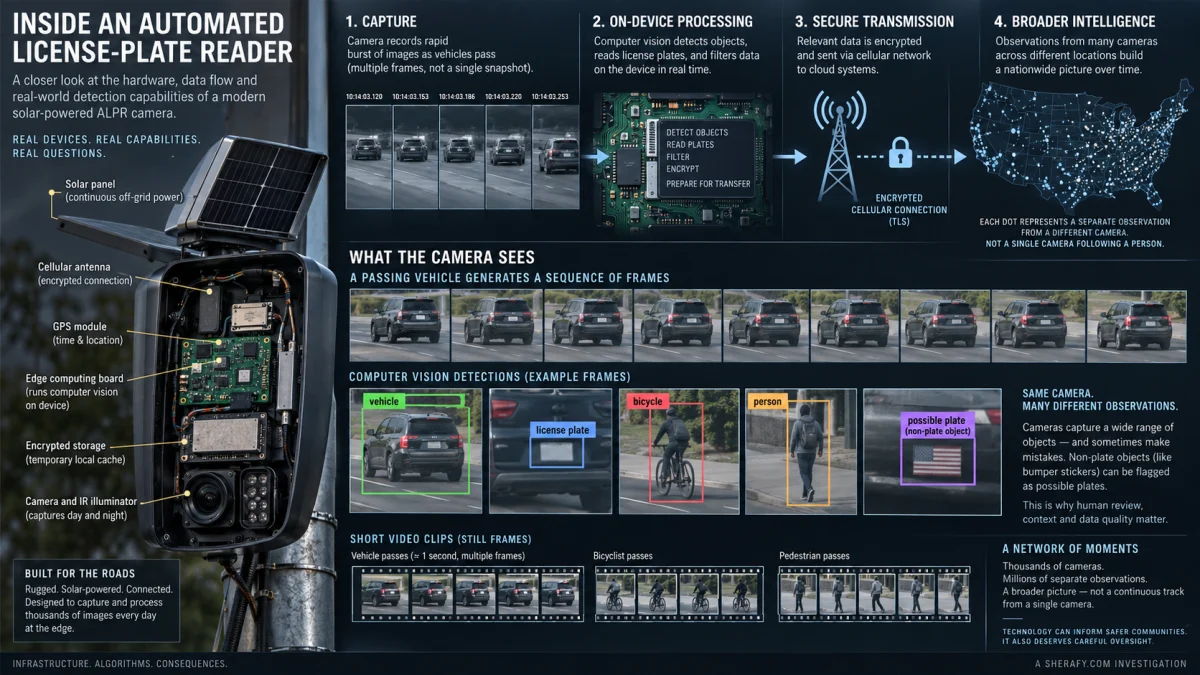
According to the recovered code and logs, motion entering the camera’s field of view triggers a rapid sequence of photographs. The camera uses different exposures to capture both the license plate and the wider vehicle scene, analyzes the resulting imagery, crops useful regions and sends selected information to Flock over a cellular connection.
A typical vehicle generated about 28 images. Some generated more than 100. Across the periods represented in the recovered logs, roughly 50,200 vehicle detections produced about 1.6 million images.
That does not mean Flock’s police interface gives an officer 28 photographs every time a car passes a camera.
It exposes a distinction that matters when discussing surveillance technology:
What a device temporarily captures and processes is not necessarily the same thing as what the finished surveillance product stores and presents to a user.
Flock’s current License Plate Reader Usage and Privacy Policy describes LPR data as including a license-plate image, vehicle image, visible vehicle characteristics, plate number and state, date, time and camera location. Flock says that data is stored only briefly on the camera before transfer to its cloud infrastructure.
The newly recovered files provide a view of the processing that happens before that finished record emerges.
The Recovered Flock Camera Also Contained Short Video Clips
This may be the most consequential distinction for anyone asking whether Flock cameras “record video.”
Flock has publicly described its LPR cameras as recording still images of vehicles when triggered by motion. Its May 2025 security disclosure uses that language explicitly. Flock’s own security alert says images and associated metadata are encrypted and transmitted to the cloud.
Yet investigators examining the compromised camera recovered 27,321 MP4 video clips.
According to WIRED and 404 Media, the clips were approximately one to two seconds long, recorded at 1,024 by 768 pixels and contained no audio. They were separate from the higher-resolution bursts of still photographs taken as vehicles passed.
That does not establish that Flock’s standard LPR product functions like a continuously recording surveillance camera.
There is no evidence here of 24-hour continuous video recording.
Nor does the investigation establish that police officers can routinely retrieve these short internal clips through Flock’s normal LPR interface.
The narrower conclusion is stronger:
At least this Flock LPR was capable of generating and temporarily storing short video segments as part of its on-device processing, even though the finished LPR product is generally described in terms of still-image vehicle records.
That distinction deserves much more attention than simply arguing over whether a Flock camera is technically a “video camera.”
The Software Explicitly Detected People
The recovered computer-vision software contained object-detection models capable of recognizing several categories, including:
- vehicles;
- license plates;
- bicycles; and
- people.
When the software detected a person, it recorded where that person appeared within the image and a confidence score representing how certain the model was about the detection.
WIRED extracted the models and tested them separately. They successfully detected people in test imagery, including a photograph of one of WIRED’s reporters.
Researchers then ran the model across the 27,321 short clips recovered from the camera.
It identified people in 11 clips.
All 11 were motorcycle riders.
The small number is important context. The camera was mounted above a roadway and pointed toward vehicle traffic, making pedestrians relatively unlikely to appear within its view.
Still, the underlying technical finding is clear:
The camera itself possessed computer vision capable of recognizing that a human being was present in the scene.
Does That Mean Flock LPR Cameras Can Search for People?
Not based on the evidence currently available.
There is a significant difference between a machine-learning model detecting a generic object classified as “person” and a police surveillance system allowing investigators to search for individual people.
Flock’s own documentation makes that distinction.
Its current FreeForm documentation says its broader surveillance platform can combine vehicle results from LPR systems with person-related results from enabled video cameras. But Flock explicitly states that people search and people-related alerts do not work on LPR cameras; those capabilities are limited to enabled video cameras and video feeds.
So two statements can simultaneously be true:
The software inside this Flock LPR could detect a person.
That does not mean a police user could search the LPR database for that person.
The first concerns what the computer vision running on the physical device can recognize.
The second concerns what information Flock exposes through its investigative platform.
Conflating the two would overstate what the hack established.
Did Researchers Find Facial Recognition Inside the Camera?
No.
This is another place where the evidence needs to remain precise.
WIRED and 404 Media reported finding no evidence that Flock’s software on the recovered camera was performing facial recognition. Some facial-analysis capability existed as part of the underlying Android operating system, but investigators found no indication that Flock had enabled or was actively using it.
Flock likewise says its FreeForm people-search technology does not use facial or biometric recognition. Its person searches rely instead on visible characteristics within supported video feeds.
Therefore:
Person detection is verified. Facial recognition is not.
A system recognizing “there is a human here” is technically and legally different from a system attempting to determine which human is there.
Why Was the Camera Looking at Bumper Stickers and an American Flag Patch?
Another striking finding came from the model intended to locate license plates.
The camera sometimes incorrectly classified other rectangular or plate-like graphics as possible plates.
According to the joint investigation, the system cropped images containing bumper stickers, dealership frames and other graphics as though they might contain license plates. In one instance, it isolated an American flag patch on a motorcycle saddlebag.
This does not prove that Flock intentionally catalogs political bumper stickers, flags or ideological symbols.
There is no evidence in the recovered material establishing such a feature.
The more defensible conclusion is technical: the plate detector examines parts of the wider visual scene and sometimes mistakes unrelated graphics for plates.
That is useful information because it again demonstrates the gap between the final record a user sees and everything the computer-vision pipeline may inspect while generating that record.
Surprisingly, the Camera Itself May Not Be Reading Your License Plate
One of the investigation’s most useful findings concerns where the actual identification happens.
Although the roadside unit performs motion detection, captures images, runs object-detection models and selects or crops imagery, the researchers concluded that the camera itself does not appear to perform the final license-plate reading or determine characteristics such as vehicle make, model and color.
Those functions appear to occur on Flock’s servers after the relevant data is transmitted from the camera.
That suggests a processing chain roughly like this:
Vehicle enters view → camera detects motion → camera captures multiple exposures → local computer vision finds relevant objects → useful imagery is selected and cropped → data is transmitted → Flock’s cloud performs additional identification and classification → searchable vehicle record is created.
That architecture helps explain why looking only at the finished police interface can provide an incomplete picture of what the roadside hardware is doing.
The Hack Also Raises a Security Question Flock Has Faced Before
The hackers did not decrypt everything on the camera.
Investigators reported that substantial portions of the device’s most sensitive storage remained encrypted and inaccessible.
But the hackers said they found an encryption key within a “media” partition on the device. That key allowed them to unlock another area containing thousands of vehicle-detection videos and still images.
That matters because Flock had previously addressed the possibility of someone gaining physical access to one of its devices.
In a May 2025 security alert discussing vulnerabilities discovered by an independent security researcher, Flock characterized the disclosed issues as low-risk because exploitation required physical access. The company further stated that even someone who physically accessed the device would not be able to access footage because imagery remained locally only for a short time after transmission to the cloud.
The new forensic findings complicate that assurance.
They do not demonstrate that Flock’s encryption as a whole has been defeated, nor do they establish that every deployed Flock camera has the same recoverable data.
They do show that, on the camera examined by 404 Media and WIRED, physical compromise allowed hackers to retrieve a key that unlocked a meaningful amount of locally stored media.
Asked about the finding, Flock said it had not received the technical details through its vulnerability-disclosure process and did not have enough information to assess the claims. The company encouraged the researchers to submit any legitimate vulnerability findings directly to its security team. Flock also emphasized that unauthorized removal and tampering with its cameras is illegal.
That response is relevant. It does not, however, erase what journalists were independently able to verify from the files they examined.
Does One Flock Camera Really “Track You Across the Country”?
No single roadside camera does.
This is where the physical camera and the larger Flock network need to be separated.
A camera creates observations at its own location. The broader tracking capability emerges when observations from many cameras become indexed, searchable and—in some deployments—shared across jurisdictions.
Flock’s policy defines its LPR records as including the vehicle image and plate alongside the date, time and camera location. Those individual observations can then become points in a vehicle’s movement history.
We examined that broader question in detail in our earlier sherafy.com investigation, Can Flock Cameras Track You? What They Record and Who Can Search It.
The important distinction is:
The hacked camera tells us more about how an individual observation is created. The network determines how those observations can be connected and searched later.
Those are two different layers of the same surveillance system.
What the 1.6 Million Number Actually Means
The “1.6 million images” figure is dramatic enough that it is likely to become detached from its context.
Here is what the reporting actually establishes.
The recovered logs represented approximately 21 days of activity across several periods.
During those periods:
- approximately 50,200 vehicle detections were logged;
- the device generated approximately 1.6 million images;
- a typical passing vehicle produced around 28 images;
- some vehicle events produced more than 100 images;
- approximately 3,300 vehicles per day appeared in the logs on a typical day;
- the busiest recovered day contained 4,454 vehicle detections.
Older logs had apparently already been overwritten or were no longer recoverable, meaning the camera had almost certainly operated outside the periods represented by the recovered data.
The 1.6 million figure therefore describes the volume of imagery generated during the camera’s processing pipeline.
It should not be translated into “Flock stored 1.6 million searchable surveillance records about 1.6 million people.”
That is not what the evidence shows.
So What Did the Flock Camera Hack Actually Prove?
The most important findings can be stated without speculation.
Verified: A physically compromised Flock LPR examined by WIRED and 404 Media generated rapid bursts of photographs as vehicles passed. Recovered logs indicated roughly 1.6 million images associated with about 50,200 vehicle detections over approximately 21 days.
Verified: The device contained tens of thousands of short, silent video clips in addition to higher-resolution still photographs.
Verified: Computer-vision models running on the camera explicitly detected people, vehicles, bicycles and license plates.
Verified: The models could detect humans, although the recovered roadway footage produced only 11 person detections, all motorcycle riders.
Verified: The plate detector sometimes mistook unrelated graphics—including bumper stickers and an American flag patch—for possible license plates.
Verified: Investigators found no evidence that Flock’s software on the camera was actively performing facial recognition.
Verified: Hackers recovered an encryption key from the device that allowed access to some locally stored media, while other sensitive storage remained encrypted.
Not established: That every generated image was uploaded to Flock’s servers or available to police.
Not established: That standard Flock LPR users can search for pedestrians.
Not established: That the cameras intentionally classify political or ideological imagery.
Not established: That the recovered person-detection capability constitutes facial recognition.
Those boundaries matter.
The most revealing part of the investigation is not a hidden facial-recognition system or proof of some previously unknown nationwide program.
It is something more concrete.
For years, public discussions about automated license-plate readers have often treated the roadside device as though it simply snaps a photograph, reads a plate and sends the result away.
The recovered Flock camera shows a more complicated machine at work: a small edge-computing system continuously waiting for motion, capturing bursts of imagery, producing short video segments, running computer-vision models against the scene, identifying objects and selecting which information should move deeper into the surveillance pipeline.
And once a selected vehicle observation reaches the larger Flock system, it can become something entirely different: a searchable record tied to a time and place.
Understanding that distinction—between what the camera sees, what the device processes, what the cloud retains, and what an investigator can ultimately search—is now essential to any serious discussion of what these cameras actually do.
References and Further Reading
Original Forensic Reporting
Hackers Stole Flock’s Camera Software, Revealing How the Company Tracks Cars and People — 404 Media Joseph Cox and Dhruv Mehrotra’s September 16, 2026 investigation, produced with WIRED, details the recovered camera software, local storage, image-generation pipeline, short video clips, person-detection models and encryption-key finding.
Hackers Got Inside a Flock Camera. Its Data Shows How the System Really Works — WIRED WIRED’s independent analysis of the recovered files, including testing of the camera’s computer-vision models against test images and more than 27,000 recovered clips.
Flock Safety Documentation
Flock Safety License Plate Reader Usage and Privacy Policy Flock’s current description of what constitutes LPR data, its security controls, cloud transfer, retention and customer access.
Flock FreeForm Search Documentation Flock’s current explanation of its natural-language surveillance search tools. Particularly relevant because Flock explicitly states that person search is limited to enabled video cameras and feeds rather than LPR cameras.
Flock Safety Gunshot Detection and License Plate Reader Security Alert Flock’s May 2025 response to earlier hardware-security findings, including its statements about physical access, local media retention and access to footage.
Related sherafy.com Research
Can Flock Cameras Track You? What They Record and Who Can Search It — sherafy.com Our broader explainer on how individual Flock observations can become searchable vehicle-location histories, how cross-agency sharing works, retention limits, documented misuse and the legal questions surrounding networked automated license-plate readers.
Editorial currency note: Flock’s products, security controls, retention policies and search capabilities have changed repeatedly. This article reflects publicly available information and reporting as of September 16, 2026.