Yes, a growing number of American cities and counties are abandoning Flock Safety’s automated license-plate readers. And yes, several of them are replacing Flock with cameras made by Axon Enterprise.
But that does not mean the anti-Flock backlash was secretly manufactured to clear the market for Axon. We found no evidence supporting that claim.
What the records show is more complicated—and arguably more important.
A genuine grassroots revolt over mass surveillance, police misuse and sprawling data-sharing networks has made Flock politically toxic in a growing number of communities. In some of those places, residents have succeeded in eliminating automated license-plate readers altogether. In others, however, government officials have responded by changing vendors while preserving the underlying surveillance capability.
Sometimes they have expanded it.
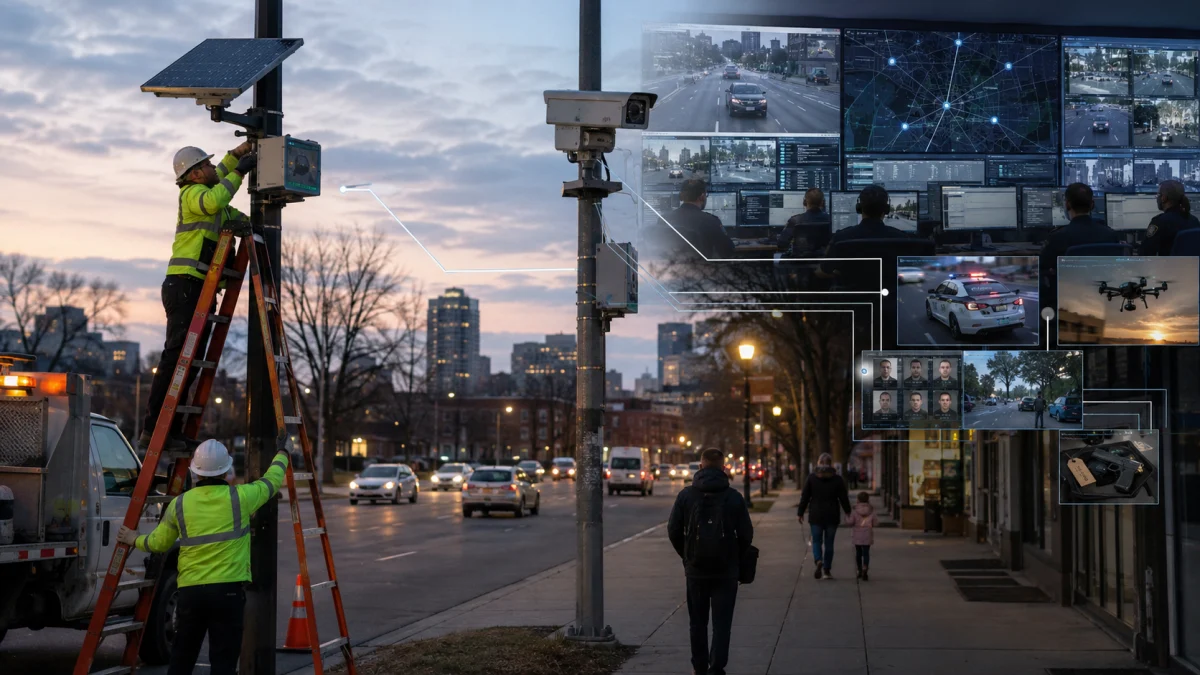
That transition has created a significant commercial opportunity for Axon, the company best known for Tasers and police body cameras. Axon already supplies many departments with cameras, cloud evidence storage, in-car systems, drones, real-time crime-center software and artificial intelligence tools. Adding fixed license-plate readers can therefore deepen an existing relationship rather than create a new one.
Axon is not hiding that it sees an opportunity.
During the company’s August 5, 2026 earnings call, CEO Rick Smith explicitly brought up the "DeFlock movement", acknowledged that some critics "aren’t all wrong," and told investors Axon was seeing a "significant number of agencies want to come over to Axon" from existing license-plate-reader systems because of its privacy controls.
There is another piece of history rarely mentioned in discussions about the two companies:
Axon was once an investor in Flock.
Axon’s SEC filings show it invested $4.7 million in Flock in March 2020, followed by another $2.1 million that October. The companies became commercial partners. Axon promoted Flock’s fixed license-plate readers, integrated them with its own mobile ALPR technology and later made Flock data accessible through Axon Evidence.
That partnership collapsed in early 2025.
Two months later, Axon introduced its own fixed roadside license-plate readers.
By 2026, Axon was telling investors that agencies were converting existing ALPR systems to its products amid the DeFlock backlash.
None of that proves a conspiracy.
It does reveal something worth investigating carefully:
A movement trying to dismantle one surveillance network is simultaneously creating an opportunity for an even larger police-technology company to absorb parts of that network into a much broader ecosystem.
The Flock Backlash Is Real—and It Is Accelerating
The revolt against Flock is not an internet fabrication.
Secure Justice, a California anti-surveillance organization tracking municipal decisions, counted 214 cities and counties that had dropped Flock since 2021 as of August 28, 2026. Ninety-three of those actions occurred during August alone, according to Ars Technica.
Flock disputes any suggestion that its business is collapsing. The company told Ars that new municipal partnerships in 2026 were outpacing nonrenewals by roughly 10 to one. Both things can therefore be true: Flock can continue expanding nationally while experiencing an unprecedented wave of cancellations in individual communities. (Ars Technica)
The backlash also has identifiable causes.
A recent WIRED investigation found that police in Alpharetta, Georgia, made data captured by their Flock cameras accessible to more than 2,000 police departments, colleges, airports and government organizations, while Alpharetta itself received Flock data from more than 1,300 organizations.
That network included entities far beyond neighboring police departments. (WIRED)
The Washington Post separately identified at least 69 police officials accused, charged or convicted of misusing Flock or other license-plate-reader systems, and found that some departments were not routinely auditing employee searches even when the technology was widely deployed. (The Washington Post)
Recent cases have included officers accused of querying ALPR systems to track former romantic partners. (People.com)
Meanwhile, the independent project Have I Been Flocked? has aggregated more than 242 million police plate-search records obtained through public audit logs. Those records do not represent every vehicle photographed by Flock; they document searches made by users of the system. Their sheer volume has nevertheless helped transform an abstract privacy debate into something ordinary drivers can see for themselves. (Business Insider)
So there is no need to invent a secret psychological operation to explain why Flock suddenly faces angry city halls and residents.
The documented system provides plenty of explanation on its own.
What Does It Actually Mean When a City "Drops Flock"?
This is where much of the current coverage becomes misleading.
A city can "drop Flock" in several completely different ways.
It can turn the cameras off and end ALPR surveillance.
It can replace Flock with Axon.
It can replace Flock with another ALPR company.
It can stop using fixed cameras while retaining ALPR-equipped police vehicles.
It can suspend the program temporarily while reviewing policy.
Or it can cancel a Flock contract while privately operated Flock cameras continue scanning roads throughout the same city.
Those outcomes should not be treated as equivalent.
The question that matters is not simply:
Did the city fire Flock?
It is:
What happened to the surveillance after Flock left?
Here are several confirmed examples.
| Jurisdiction | Flock outcome | What happened next |
|---|---|---|
| Denver, Colorado | All 110 city-operated Flock readers were removed when the contract expired | Denver approved 50 Axon ALPR cameras under a one-year, $150,000 contract. (MCC Meetings) |
| Douglas County, Colorado | County is replacing 50 Flock readers | Commissioners approved a roughly $22.8 million, 10-year Axon agreement including 100 Axon Outpost readers and a drone program. (Douglas County Legistar) |
| Hayward, California | Existing ALPR cameras are being replaced | City Council approved an Axon real-time information package containing 64 replacement ALPR cameras, drones and other integrated technologies, capped at $2.945 million over five years. (Hayward Legistar) |
| Amherst, New York | Town is switching away from Flock | Amherst had 17 Flock cameras and approved the purchase of 24 Axon cameras for $300,000. (Investigative Post) |
| Town of Tonawanda, New York | Flock agreement will end | Officials approved replacing roughly a dozen Flock cameras with Axon beginning in 2027. The town supervisor made clear that the objection was not to ALPR technology itself. (BTPM) |
| Tempe, Arizona | Flock cameras were switched off and contract ended | The city explicitly says it will not seek another ALPR company to replace the system. (https://www.azfamily.com) |
| Ferndale, Michigan | City ended its Flock partnership over privacy concerns | Officials subsequently proposed an Axon ALPR system. Axon already supplied Ferndale’s body cameras, in-car cameras and evidence storage, and the proposed ALPR deal was made contingent on broader surveillance safeguards. (Ferndale) |
That table captures the central problem with treating every Flock cancellation as either a total privacy victory or a cynical illusion.
Some are genuine reductions in surveillance. Some are vendor substitutions. Some become broader technology procurements.
Denver Shows That Changing Vendors Can Change Privacy Rules
Denver is an important case because simply saying "Flock became Axon" leaves out material differences.
The city had approximately 110 or 111 Flock readers. Its replacement contract provides only 50 Axon cameras.
More importantly, Denver officials attached restrictions to the new system.
The proposed terms included a 21-day retention period, requirements for a case number and reason when conducting searches, city ownership and control of the data, prohibitions on selling the data or using it to train AI models, and a ban on facial recognition. Officials also emphasized that Axon’s system did not operate the same kind of nationwide searchable network that had become a central criticism of Flock. (Axios)
The Denver City Council ultimately approved the agreement 7-6. (Denver Legistar)
That does not make Denver’s new ALPR program privacy-neutral.
The city is still recording vehicles traveling on public roads.
But it demonstrates why treating every license-plate-reader vendor as technically identical obscures the real policy questions.
A vendor change can preserve surveillance while reducing its scale or altering its safeguards.
That distinction matters.
Douglas County Shows How a Vendor Exit Can Become a Platform Expansion
Douglas County provides almost the opposite example.
The sheriff’s office is moving away from approximately 50 Flock cameras.
Its Axon agreement includes 100 Axon Outpost ALPR cameras—doubling the fixed-reader count—and a drone-as-first-responder program. County records place the underlying Axon quote at approximately $22.77 million, with an initial 2026 purchase request of roughly $1.93 million. (Douglas County Legistar)
The county was not starting from zero with Axon.
The sheriff’s office already used Axon body cameras and Tasers and was integrating Axon’s Draft One AI report-writing technology. The agreement adds plate readers and drones deeper into that existing stack. (Axios)
That makes Douglas County one of the clearest examples of what might be called platform expansion through vendor replacement.
Flock leaves.
Automated license-plate surveillance remains.
The number of fixed readers doubles.
Drones are added.
And more of the department’s technology ends up inside one vendor’s ecosystem.
That is a legitimate surveillance-consolidation story.
It does not require a secret conspiracy to make it significant.
Why Axon Is So Well Positioned to Benefit
Axon’s advantage is bigger than the quality or price of one roadside camera.
It already has relationships with police departments for products that can include body cameras, Tasers, vehicle cameras, Axon Evidence, records systems, Fusus real-time operations, drones and AI applications.
For an agency already operating within that environment, adding an Axon license-plate reader is not merely buying another camera.
It can be another component of an existing platform.
Axon’s CEO effectively explained this strategy to investors in August.
Smith described Axon’s technology as connecting body cameras, drones, fixed cameras, in-car systems, license-plate readers and 911 tools to what he called a large customer-controlled public-safety data repository, with AI and real-time operations layered above it and Tasers, drones and communications providing ways to act on that information.
In the same earnings call, Smith explicitly connected privacy concerns surrounding the DeFlock movement with customer conversions to Axon.
That is important evidence.
There is no evidence Axon created the backlash.
There is direct evidence Axon is benefiting from it.
Those are very different claims.
The History Almost Nobody Mentions: Axon Invested in Flock
Today’s rivalry also makes more sense when viewed backward.
In March 2020, Axon invested $4.7 million in Flock Group and signed a commercial partnership agreement.
In October of that year, Axon invested another $2.1 million.
Its SEC filing also disclosed warrants tied to partnership performance.
Axon’s public announcement described the relationship as a way of combining Flock’s fixed ALPR cameras with Axon’s mobile license-plate-recognition technology.
Axon’s sales organization would help sell Flock systems to law enforcement agencies. At the time, both companies publicly emphasized ethics and privacy as selling points. (Axon IR)
By June 2021, Axon said customers using Flock’s fixed cameras and Axon’s Fleet 3 mobile ALPR could access the systems through Axon Evidence. (Axon IR)
The two companies were not merely interoperable competitors.
They were commercially aligned.
Then the relationship broke apart
By early 2025, the partnership had deteriorated into a public fight.
Axon CEO Rick Smith accused Flock of erecting barriers around integrations and attempting to push customers further into Flock’s own ecosystem.
Flock CEO Garrett Langley disputed that account and said Axon had unexpectedly decided that continued openness was no longer in its interest.
Each company blamed the other for the breakdown. There is not enough independent evidence in the public record to simply declare one version correct. (Forbes)
Then came an important development.
On April 22, 2025—roughly two months after the dispute became public—Axon announced Outpost and Lightpost, its own fixed ALPR cameras.
The former Flock investor and partner had become a direct competitor in Flock’s core fixed-camera market. (Axon IR)
Axon’s latest annual filing now explicitly lists Flock alongside companies including Genetec, Motorola Solutions, PlateSmart and Rekor as competitors in the fixed-ALPR market. (SEC)
The chronology is therefore straightforward:
2020: Axon invests in Flock and partners with it.
2021: Their fixed and mobile ALPR systems are integrated.
Early 2025: The partnership collapses publicly.
April 2025: Axon launches its own fixed ALPR cameras.
2026: The anti-Flock movement accelerates.
August 2026: Axon’s CEO tells investors that significant numbers of agencies are converting existing plate-reader systems to Axon amid concerns about privacy.
That is a remarkable corporate transition.
But chronology is not causation.
Nothing we found shows that Axon created or covertly orchestrated the movement attacking Flock.
Axon Is Not an ALPR Monopoly
Another viral claim does not survive scrutiny: Axon has not taken over the entire license-plate-recognition market.
Axon’s own SEC filing describes a competitive field that includes Flock Safety, Genetec, Motorola Solutions, Jenoptik, Neology, NDI Recognition Systems, PlateSmart and Rekor.
It also lists substantial competitors across body cameras, digital evidence management, real-time crime centers, 911 software and drones. (SEC)
Calling Axon an ALPR monopoly would therefore be inaccurate.
The more serious concentration question is vertical integration.
Axon does not need to own every license-plate camera to become unusually important.
Its strategic advantage is that a single company can increasingly provide several stages of the same law-enforcement workflow:
a sensor captures information;
software integrates it;
AI analyzes it;
a real-time crime center presents it;
evidence software stores it;
an officer receives it;
and other Axon hardware may become part of the response.
Axon’s CEO described the company’s strategy in almost exactly those end-to-end terms during the August earnings call.
The important question is therefore not:
Does Axon control every surveillance camera?
It doesn’t.
The better question is:
How much of a police department’s technological nervous system should one company control?
Does Axon Automatically Send Municipal License-Plate Data Into a Federal Database?
We found no evidence supporting that claim.
Axon’s current documentation for ALPR sharing through Fusus says cross-agency sharing is not enabled by default.
Instead, an agency holding the data must initiate a relationship with another specific agency. The recipient must separately accept it. The relationship can be revoked, and searches can be restricted by hotlists, device type and offense category.
Most importantly, Axon says the underlying ALPR records remain inside the originating agency’s tenant rather than being duplicated into a separate centralized ALPR repository. (Axon.com)
That description comes from Axon itself and should be treated as vendor documentation rather than an independent audit of every implementation.
But it still matters.
The available evidence does not support writing that every municipal Axon camera automatically feeds one federal database.
That would turn a legitimate platform-concentration concern into an unsupported technical claim.
Flock and Axon Present Different Surveillance Risks
The distinction between them is worth understanding.
Flock’s most controversial advantage has been the extraordinary horizontal breadth of its network.
A police department does not necessarily have to rely only on cameras inside its jurisdiction. Depending on configuration and permissions, it can obtain access to plate data collected by other Flock customers.
That network effect is what makes cases like Alpharetta so remarkable. A relatively small city can become connected to thousands of other organizations. (WIRED)
Axon’s emerging advantage is different.
It has vertical depth.
The same company can provide the camera, patrol-car system, body camera, cloud evidence platform, real-time operations software, drones, AI tools and other equipment.
Axon’s new Fusus ALPR-sharing feature still allows cross-agency searches. But according to its current documentation, those relationships are individually established and donor-controlled rather than automatically creating one universal searchable pool. (Axon.com)
That can be a meaningful privacy improvement.
It does not eliminate the underlying civil-liberties question created when governments continuously record vehicles that have done nothing wrong.
And it creates a different governance problem:
The more technologies an agency consolidates inside one platform, the more costly and operationally difficult it may eventually become to leave that platform.
That is the kind of structural concern municipal officials should be evaluating before they sign five- or ten-year agreements.
The Trump–Axon–ICE Timeline Is Real. The Viral Version Gets an Important Fact Wrong.
There is also a striking federal financial chronology surrounding Axon.
A federal periodic transaction disclosure filed for President Donald Trump reports an Axon Enterprise purchase on February 10, 2026 in the $1,000,001-to-$5,000,000 range. Reporting based on the Office of Government Ethics filing has independently identified the same transaction. (Gaslit Media)
Then, on February 24—14 days later—U.S. Immigration and Customs Enforcement posted a federal procurement notice involving conductive-energy weapons.
The estimated value was $220 million over five years, with ICE anticipating the acquisition of approximately 17,800 weapons. (HigherGov)
That chronology deserves scrutiny.
But describing it as:
"Trump bought Axon stock and two weeks later ICE gave Axon a $220 million contract"
would be false.
ICE’s February 24 posting was explicitly a Sources Sought Notice/Request for Information.
The notice states that it was neither a request for quotation nor a request for proposal and that no award would be made from that notice. The procurement record still identifies it as not awarded. (HigherGov)
There is another major piece of context.
ICE was already buying Axon conductive-energy weapons long before Trump’s February 2026 stock transaction.
Federal contracting records show ICE awarded Axon a Taser-related indefinite-delivery contract in September 2023, with a $22 million ceiling. Task orders followed in 2023, 2024, 2025 and 2026. (Federal Compass)
That substantially weakens any argument that the February stock transaction somehow initiated the ICE-Axon procurement relationship.
The appropriate conclusion is narrower:
The timing creates a legitimate government-ethics question worth examining. The public records we reviewed do not establish that Trump directed either the investment decision or the ICE procurement, knew the RFI was coming, or caused ICE to favor Axon.
An unusual chronology deserves investigation.
It does not deserve invented certainty.
Were Viral Videos of People Destroying Flock Cameras Part of an Engineered Vendor Swap?
There is no evidence of that either.
Videos showing people damaging, cutting down or disabling Flock cameras are real. The phenomenon has become prominent enough that The Verge recently documented a decentralized movement of camera destruction and the sympathetic online communities surrounding it. (The Verge)
But we found no documentary evidence connecting those acts to:
Axon;
federal officials;
municipal procurement officials;
social-media platforms deliberately promoting the videos for a commercial purpose;
or a coordinated campaign designed to make Flock equipment politically replaceable.
People have also already faced investigations and criminal consequences for damaging surveillance equipment, undermining the idea that authorities are waiting for some future moment to suddenly make vandalism illegal.
The simplest evidence-based conclusion is that the anti-Flock movement contains both lawful political organizing and unlawful destruction of equipment.
Claims that someone secretly engineered the latter for Axon’s benefit require evidence that currently does not exist.
Tempe Proves That Removing Flock Can Actually Mean Removing Surveillance
This is an important counterexample.
Tempe, Arizona, operated 33 Flock cameras.
In August, city officials shut them down and announced that Tempe would terminate the Flock contract.
Then the city went further:
Tempe said it would not look for another ALPR vendor.
Mayor Corey Woods acknowledged that the cameras had helped police but said the risk of misuse had become too great. (https://www.azfamily.com)
That is materially different from Denver, Douglas County or Hayward.
It means the public debate produced a reduction in surveillance capability rather than simply a new supplier.
Any investigation claiming the entire DeFlock movement is an illusion has to explain Tempe.
It cannot.
Ferndale Shows Why the Fight Over Policy Matters More Than the Logo
Ferndale, Michigan, offers another revealing case.
The city ended its relationship with Flock in November 2025 following community objections and privacy concerns. (Ferndale)
Police then proposed Axon as the replacement.
The recommendation made institutional sense: Axon already provided Ferndale with body-worn cameras, vehicle cameras and evidence storage. (C & G Newspapers)
The proposed five-year ALPR agreement was worth about $110,168 and was made contingent on additional surveillance rules and oversight. The city’s own staff report cited concerns with Flock’s protection of images from access by unauthorized agencies. (CloudFront)
That case demonstrates the strategic question residents increasingly face.
If the objection is:
"We don’t trust Flock,"
then replacing Flock may satisfy it.
If the objection is:
"The government should not continuously build searchable records of innocent people’s movements without stronger rules,"
then the vendor’s name is secondary.
The policy has to follow the surveillance.
The Real Battle Is Over the Rules, Not the Camera Brand
This may be the most important lesson emerging from the DeFlock movement.
A municipality deciding whether to replace Flock should be asking much more than which company’s brochure promises better privacy.
It should establish, in enforceable policy or contract language:
how long plate records are kept;
who is permitted to search them;
whether a case number is mandatory;
what level of suspicion is required;
whether every search is audited;
whether suspicious searches trigger automatic review;
which outside agencies can query the data;
whether immigration authorities can obtain access;
whether federal agencies can conduct searches through local partners;
whether private cameras can join the network;
whether vehicle records can be combined with other databases;
whether AI can infer patterns of travel or association;
whether the vendor can introduce additional analytics later without another public vote;
whether the data can train AI systems;
whether the city truly owns and controls its records;
and how difficult it will be to migrate away from the vendor years later.
Denver’s experience demonstrates that some of these protections can be negotiated.
Douglas County demonstrates that changing vendors can also become an opportunity to install more sensors and deeper integration.
Tempe demonstrates that a community can decide not to replace the cameras at all.
Those are fundamentally different political outcomes.
What the Evidence Supports—and What It Does Not
| Claim | Evidence |
|---|---|
| U.S. municipalities are dropping Flock at an accelerating rate. | Verified. Secure Justice counted 214 jurisdictions since 2021 as of Aug. 28, including 93 during August. |
| Some cities dropping Flock are replacing it with Axon. | Verified. Denver, Douglas County, Hayward, Amherst and Tonawanda provide documented examples. |
| Some Flock-to-Axon transitions expand surveillance capability. | Verified in specific cases. Douglas County is moving from 50 Flock readers to 100 Axon readers while adding drones. |
| Other Flock exits reduce surveillance. | Verified. Denver cut its municipal fixed-camera count substantially and imposed additional controls. |
| Some communities eliminate ALPR surveillance entirely. | Verified. Tempe says it will not replace Flock with another provider. |
| Axon is commercially benefiting from the DeFlock controversy. | Verified. Axon’s CEO told investors that agencies are converting existing license-plate-reader systems to Axon amid privacy concerns. |
| Axon was once a Flock investor and partner. | Verified through Axon’s SEC filing and company announcements. |
| Axon later became a direct Flock competitor. | Verified. Axon launched fixed ALPR cameras in 2025 and now lists Flock as a competitor. |
| Axon engineered the anti-Flock movement. | No supporting evidence found. |
| Viral vandalism videos were deliberately promoted to facilitate an Axon takeover. | No supporting evidence found. |
| Every Axon ALPR automatically feeds a federal surveillance database. | Not supported by current Axon documentation. |
| Axon has a monopoly on ALPR surveillance. | False. Multiple major competitors remain. |
| A Trump disclosure reports a $1M–$5M Axon stock purchase on Feb. 10, 2026. | Verified. |
| ICE gave Axon a $220M contract 14 days later. | False as stated. ICE issued an RFI contemplating a potential $220M procurement; it was not a contract award. |
| The Trump-Axon-ICE timing merits scrutiny. | Reasonable. |
| The records prove Trump caused or influenced the ICE procurement. | No. |
So Are Citizens Winning—or Being Fooled?
The answer is neither as comforting nor as conspiratorial as social media makes it sound.
The DeFlock movement is producing real results.
Cameras are being shut off. Contracts are being canceled. Municipal officials are being forced to explain data retention and sharing practices that received little public attention when these networks were installed. Misuse that once remained buried in audit logs is now being exposed.
That is not fake resistance.
But defeating Flock Safety and defeating mass automated vehicle surveillance are not the same thing.
In Denver, removing Flock resulted in a smaller network with substantially different restrictions.
In Tempe, it resulted in no replacement system at all.
In Douglas County, 50 Flock cameras are giving way to 100 Axon cameras and a broader technology package that includes drones.
And sitting behind these municipal decisions is a much larger corporate transformation: Axon, once a Flock investor and partner, is now its competitor, selling an ALPR product that can plug into one of the broadest integrated police-technology ecosystems in the country.
Axon itself acknowledges that the DeFlock movement is helping drive agencies toward its platform.
That does not prove somebody engineered the uprising.
It proves something more ordinary and more useful to understand:
Markets adapt to political pressure.
A public revolt can kill a vendor without killing the underlying technology.
It can even reward a competitor that is better positioned to address the criticism while offering governments a larger package of capabilities.
So when a city announces that it has "removed Flock," residents should ask one more question before declaring victory:
What replaced it?
Because the difference between dismantling a surveillance network and merely changing the company’s name on the invoice can be enormous.
Methodology
sherafy.com reviewed municipal legislative records and procurement documents, Axon SEC filings and investor materials, federal contracting records, Axon technical documentation, contemporary investigative reporting and public-record-based reporting on Flock deployments and misuse.
We treated contract termination, nonrenewal, camera deactivation, proposed replacement, approved replacement and deployed replacement as separate events rather than collapsing all of them into a single "Flock cancellation" category.
We likewise distinguish company claims about their own systems from independently demonstrated behavior. Axon’s descriptions of its sharing architecture are therefore reported as current product documentation, not as an independent certification that every deployment always operates according to those controls.
Counts of municipal Flock departures are changing rapidly and should be understood as a dated snapshot rather than a permanent total.
References and Further Reading
- Axon Enterprise 2020 Form 10-K — SEC filing documenting the company’s $4.7 million and $2.1 million Flock investments — Primary corporate filing establishing Axon’s financial investment in Flock.
- Axon Announces Partnership and Investment in Flock Safety — April 2020 — Axon’s contemporaneous description of the original commercial partnership.
- Axon Fleet 3 Launch and Flock Integration — June 2021 — Documents integration of Flock fixed ALPR and Axon mobile ALPR through Axon Evidence.
- Axon Announces Outpost and Lightpost Fixed ALPR Cameras — April 2025 — Primary source documenting Axon’s entry into the fixed-camera market.
- Axon 2025 Form 10-K — SEC filing describing Flock and other ALPR competitors — Useful for assessing monopoly claims and Axon’s broader competitive landscape.
- Axon Q2 2026 Earnings Call Transcript — Primary source for CEO Rick Smith’s discussion of DeFlock, customer conversions and Axon’s integrated public-safety platform.
- Axon Fusus ALPR Sharing Documentation — Current vendor documentation explaining partner-specific sharing, tenant control and revocation.
- Denver Resolution 26-0246 — Axon ALPR Contract — Primary municipal record approving 50 Axon cameras for $150,000.
- Douglas County Axon Purchase Record — Primary county record for the Axon Outpost and drone agreement.
- Hayward City Council Axon Real-Time Information Center Agreement — Primary municipal record documenting 64 replacement ALPR cameras, drones and integrated technologies.
- Ferndale Police Department Ends Partnership With Flock Safety — City’s official announcement explaining its decision to leave Flock.
- ICE Conductive Energy Weapons Sources Sought Notice 70CMSW26I00000054 — Reproduces the federal notice, including its $220 million estimate and explicit statement that no award would be made from the RFI.
- ICE’s Existing 2023 Axon Conductive-Energy-Weapons Contract — Establishes that ICE’s Axon procurement relationship predates the February 2026 stock transaction.
- Ars Technica: Cities Terminate Flock Contracts at Record Pace in August — Reports Secure Justice’s latest cancellation tally and Flock’s response.
- WIRED: How an Atlanta Suburb Ended Up Sharing Flock Data With More Than 2,000 Organizations — Public-record-based investigation illustrating the scale of Flock’s cross-agency network.
- The Washington Post: Police Departments Weren’t Looking for Officers Abusing Flock — Investigation into ALPR misuse and inadequate internal auditing.
- Forbes: Axon and Flock’s 2025 Partnership Breakdown — Documents the competing accounts of why the former partners split.
- Tempe Turns Off Flock Cameras and Says It Will Not Replace Them — Important counterexample showing a Flock cancellation that actually ends the municipal ALPR program.
Editorial currency note: Municipal Flock cancellations, replacement contracts, Axon deployments and federal procurement actions are moving quickly. Figures and implementation statuses above are current through August 29, 2026 and should be rechecked if this article is substantially updated later.