
Yes, Singapore now has a working biological-computing system that uses living human neurons. But the viral version of the story gets several important details wrong.
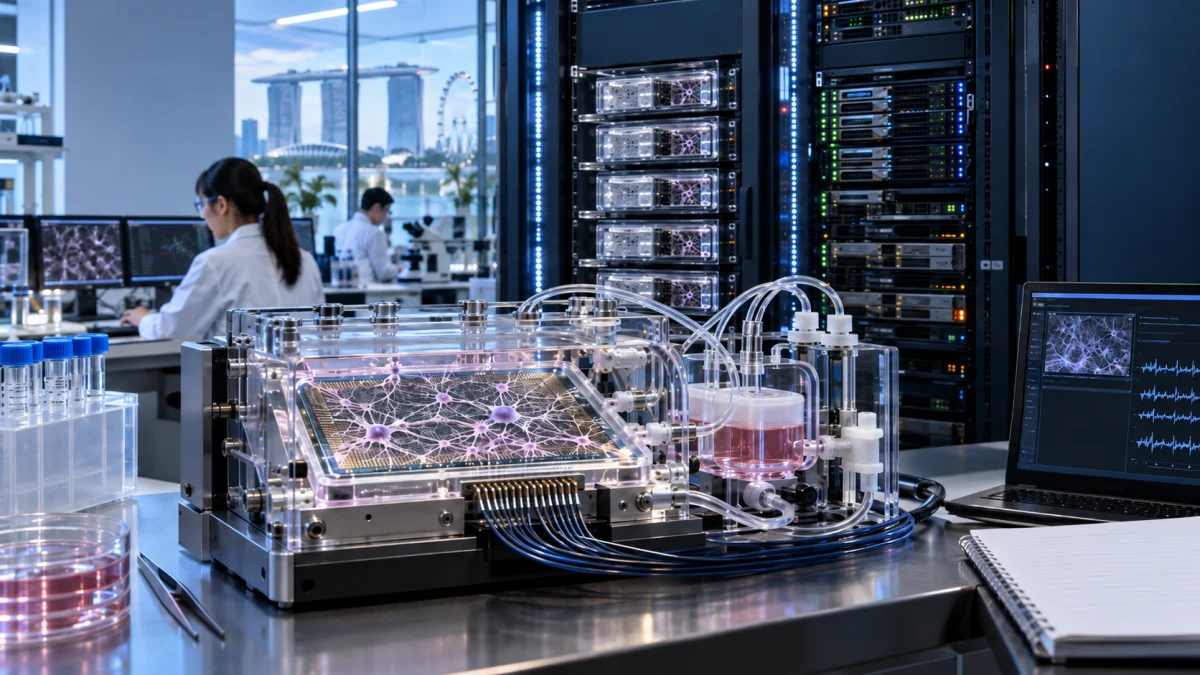
The installation at the National University of Singapore contains 20 biological computers called CL1s, developed by Australian company Cortical Labs and operated in partnership with NUS Medicine and data-center company DayOne. The neurons are grown in a laboratory from reprogrammed human cells, placed on electrode-equipped silicon chips, electrically stimulated and monitored as they adapt to information fed into them.[1]
They really do need nutrients. Technicians reportedly replenish a mixture containing sugar, micronutrients and pH buffers every three days while a life-support system regulates gases and other conditions needed to keep the cultures alive.[2]
What Singapore has not demonstrated is a biological replacement for an Nvidia GPU farm that performs equivalent AI work for half the money.
That distinction matters.
| Viral claim | What the evidence actually supports |
|---|---|
| Singapore built a data center powered by human brain cells | Broadly true. It is a 20-unit biological-computing research prototype at NUS Medicine, not a conventional hyperscale data center. |
| It contains 800,000 human brain cells | Not as stated. Current descriptions put a typical CL1 at about 200,000 neurons, meaning the 20-unit rack contains at least roughly 4 million. Earlier systems used 800,000 to 1 million. |
| Scientists removed brain cells from people | No. The neurons are grown from human cells reprogrammed into stem cells and differentiated into neurons. |
| The cells must be fed sugar every three days | Essentially true, but simplified. They receive nutrient medium plus controlled gases and other life-support conditions. |
| The system costs half as much as a regular AI computer | Not demonstrated. A reported rental-price comparison does not establish equivalent performance or cost per completed workload. |
| These computers could replace GPUs | Not currently. Even Cortical Labs says conventional silicon remains superior for fast, precise, repeatable computation such as large-language-model workloads. |
What Singapore actually built
The Singapore project is housed at the NUS Life Sciences Institute. The Straits Times reported that the system went live on July 16, 2026. NUS later demonstrated it to invited guests on August 6 and publicly announced the project on August 17.[1:1][2:1]
The installation consists of 20 CL1 biological-computing units in a single rack. NUS and DayOne describe it as the world’s first independently operated biologically integrated server rack.[1:2]
That wording is more precise than saying Singapore has replaced an ordinary data center with living brains.
Cortical Labs had already opened a larger biological-computing installation in Melbourne containing 120 CL1 units earlier in 2026. The Singapore project is particularly significant because it places the technology under independent operation at NUS and is intended as a validation step toward a potentially larger commercial deployment. DayOne’s original plan contemplated eventually scaling the Singapore project to as many as 1,000 units if the technology proves useful.[3]
In other words, this is real infrastructure—but still experimental infrastructure.
These are human neurons, but they are not tiny human brains
The phrase “human brain cells” is technically understandable but easy to misinterpret.
Researchers are not extracting chunks of someone’s brain and wiring them into computers.
Current reporting from NUS says the neurons are produced from human blood cells that are first reprogrammed into induced pluripotent stem cells and then differentiated into neurons.[2:2] Other Cortical Labs systems can use several biological configurations, including flat neuronal cultures, organoids and other structured neural cultures.[4]
The Singapore CL1 systems are publicly described as neurons growing on an electrode-fitted silicon chip.
That chip is crucial.
The neurons do not contain USB ports, understand Python or somehow “see” the internet. Conventional electronics and software convert information into patterns of electrical stimulation that the neurons can receive. Electrodes then measure how the neural network responds.
Software interprets those responses and feeds consequences back into the system.
That creates a closed loop:
the computer stimulates the neurons, the neurons respond, the outside environment changes, and the result is fed back to the neurons.
Over repeated cycles, the biological network can alter its activity.
That adaptation—not raw arithmetic—is the part researchers are interested in.
So where did the “800,000 brain cells” number come from?
This is one of the more interesting discrepancies in coverage.
An IEEE Spectrum profile published in 2025 reported that each CL1 contained approximately 800,000 lab-grown human neurons.[5] Cortical Labs’ earlier DishBrain experiments also frequently appeared in coverage with neuron counts in roughly that range.[6]
But by May 2026, Cortical Labs chief scientific and operations officer Brett Kagan gave a more specific current figure.
Kagan said a CL1 typically houses around 200,000 neurons, while earlier work used between 800,000 and 1 million.[4:1] Current NUS material describing the Singapore installation likewise says each CL1 contains at least 200,000 neurons.[7]
That means the defensible minimum for Singapore’s 20-unit rack is about:
20 × 200,000 = 4 million living neurons.
The actual number could be higher depending on the cultures being used, but publicly available information does not justify confidently describing the entire Singapore facility as an “800,000-cell computer.”
If anything, the viral version appears to have taken a familiar number from earlier Cortical Labs descriptions and attached it to a much larger rack-scale deployment.
Yes, somebody really has to feed the computers
This part sounds like satire, but it is substantially true.
Unlike silicon transistors, neurons are living cells. They require nutrients, stable chemistry, temperature control, gas exchange and waste management.
At the Singapore facility, technicians reportedly service the cultures every three days with a nutrient mixture containing sugar, micronutrients and compounds that stabilize pH. A gas system supplies carbon dioxide, oxygen and nitrogen.[2:3]
Cortical Labs says the CL1’s integrated life-support system can keep neural cultures viable for up to six months.[8]
After that, biology creates a maintenance problem ordinary computers do not have: the living computing substrate eventually has to be replaced.
So although the neurons themselves are extraordinarily low-power computing elements, a biological computer also needs pumps, sensors, fluid handling, environmental controls and trained people capable of maintaining cell cultures.
This is not a maintenance-free server with a cup of glucose poured into it twice a week.
It is closer to a computer permanently attached to a miniature laboratory.
What can living neurons actually compute?
This is where the story becomes more scientifically interesting than the viral version.
Cortical Labs’ best-established result predates the Singapore data center.
In 2022, researchers published the DishBrain experiment in the peer-reviewed journal Neuron. Human and mouse neurons were grown on high-density electrode arrays and connected to a simplified version of the game Pong.
The neurons received electrical information corresponding to the game environment, while their electrical activity controlled the paddle. Cultures receiving structured closed-loop feedback improved their performance over time in ways that control conditions did not.[6:1]
Calling that “brain cells playing Pong” is simplified, but it is not invented.
The more important finding was that the neural cultures adapted rapidly from relatively little experience.
A follow-up peer-reviewed study published in 2025 compared DishBrain cultures against three deep-reinforcement-learning methods—DQN, A2C and PPO—in a simplified Pong environment. Under conditions where learning opportunities were restricted to comparable real-world timescales, the biological cultures showed higher sample efficiency across several measures.[9]
That is potentially important.
Modern machine-learning systems often compensate for inefficient learning by consuming enormous datasets and repeating training operations millions or billions of times. Biological nervous systems evolved under very different constraints. Animals have to learn while actually living in the world.
If small neuronal cultures can exploit that same biological adaptability, there may be computational problems where neurons are useful even if they never become good substitutes for silicon processors.
There is an important caveat: several authors of the 2025 study worked for Cortical Labs, and senior author Brett Kagan held company shares and patent interests related to the work. The paper discloses those conflicts.[9:1]
The result is therefore evidence worth taking seriously, not proof that biological computing has already beaten modern AI.
The real opportunity is probably not running ChatGPT on brain cells
Cortical Labs itself does not claim that today’s CL1 is simply a better GPU.
The company has identified potential uses in areas such as robotics, drug discovery, cybersecurity and fraud detection—especially situations where data is sparse or conditions change unpredictably.[1:3]
That distinction is critical.
Traditional processors are extraordinarily good at exact, high-speed, repeatable mathematics. GPUs can perform vast numbers of matrix operations in parallel. Those characteristics make them ideal for training and running contemporary neural networks.
Biological neurons work differently.
They are noisy, variable, slow by conventional clock-speed standards and difficult to program. Researchers do not even completely understand how biological neural networks encode all of their information.
But neurons are also adaptive.
A biological system may therefore be interesting precisely where a conventional system’s disadvantages become expensive: learning continuously, reacting to unfamiliar situations or extracting behavior from very few examples.
That is the hypothesis Singapore is now helping test.
It is not yet the conclusion.
Does a CL1 really use only 30 watts?
According to Cortical Labs founder Hon Weng Chong, yes: approximately 30 watts per CL1, including its life-support equipment.[2:4]
IEEE Spectrum previously reported that a 30-unit rack consumes roughly 850 to 1,000 watts, which is consistent with a draw in that general range per machine once rack-level equipment is included.[5:1]
For comparison, Nvidia lists the maximum configurable thermal-design power of an H100 SXM GPU at 700 watts.[10]
That sounds spectacular:
30 watts versus 700 watts.
But it is also an incomplete comparison.
An H100 can perform enormous quantities of well-defined numerical computation that a CL1 currently cannot. Comparing their wattages without comparing the amount and quality of useful work produced is like comparing the fuel consumption of a motorcycle and a freight truck without mentioning what they are carrying.
The scientifically meaningful number would be something closer to:
energy consumed per successfully completed equivalent task.
That benchmark does not yet exist for CL1 versus H100-class hardware.
The power figure is therefore real.
The implied performance advantage is not yet established.
Is biological computing really “half the cost”?
This claim requires even more caution.
The Straits Times reported a current price of about US$2,200 per month to access one CL1 and compared that with roughly US$4,300 per month for renting a high-end AI chip through major cloud platforms.[2:5]
Numerically, $2,200 is about half of $4,300.
But those are rental prices for two very different computing resources.
They do not show that a CL1 can perform $4,300 worth of GPU computation for $2,200.
To establish that, researchers would have to give both systems a meaningfully comparable task and measure factors such as performance, accuracy, training data, time, energy use, uptime, labor, consumables and total cost.
No apples-to-apples benchmark of that kind has been published by the Singapore partners or in the peer-reviewed studies reviewed for this article.
There is another clue that the comparison should not be treated as a benchmark: Chong himself has acknowledged that traditional silicon is still far better at the fast, precise and repeatable calculations underlying large language models.[2:6]
Earlier reporting also put Cortical Labs’ cloud access at $300 per week, indicating that public pricing has changed or that different access arrangements may exist.[5:2]
So the careful conclusion is:
CL1 access may currently rent for roughly half the cited price of one high-end cloud AI chip. That does not mean it delivers equivalent computing for half the cost.
Those are very different claims.
Why Singapore is interested anyway
Singapore is an unusually logical place to test this technology.
The country is a major regional data-center hub, but land, electricity and water are constrained. Singapore’s Infocomm Media Development Authority says the country already has more than 1.4 gigawatts of data-center capacity and has created a Green Data Centre Roadmap aimed at adding capacity while improving energy efficiency.[11]
The government is deliberately looking for technologies that allow more computation from constrained resources.
Biological computing therefore does not have to outperform every conventional processor to become interesting.
A specialized biological accelerator that delivers useful adaptive computation at tens of watts could have value even while conventional silicon continues handling almost everything else.
That is a much more plausible near-term model than data centers filled entirely with neurons.
Are the brain cells conscious?
There is no good evidence that the CL1 cultures are conscious, self-aware or capable of hearing someone talk to them.
They do not have ears, eyes or an intact brain architecture. Information reaches them through electrical stimulation generated by the computer interface.
The consciousness question does deserve more than ridicule, however.
The original DishBrain paper controversially used the word “sentience” in its title. The researchers were using a minimal technical definition centered on a system’s ability to sense environmental states and adapt its behavior—not claiming that a dish of neurons possessed human-like subjective awareness.[6:2]
Bioethicists have nevertheless argued that increasingly sophisticated closed-loop neural systems require continued scrutiny because future systems could eventually develop properties carrying moral significance. A 2023 analysis of DishBrain concluded that the experiment did not provide clear evidence of artificial suffering, while arguing that future development should proceed cautiously.[12]
Current International Society for Stem Cell Research guidance similarly states that there is no biological evidence at present showing consciousness or pain perception in central-nervous-system organoids sufficient to require specialized oversight solely on that basis. The organization specifically warns researchers against language or imagery that misleadingly implies human consciousness or human-like cognitive abilities.[13]
That is the appropriate balance.
Pretending these are tiny imprisoned humans is unsupported.
Pretending that moral questions could never arise as biological computing becomes more complex would be premature.
The most important thing Singapore is testing is not whether neurons are cheaper than GPUs
The eye-catching comparison is biological cells versus Nvidia chips.
The more consequential experiment is whether living neural networks can become a reliable, programmable and scalable computing resource at all.
Researchers already know that neurons can adapt.
What they do not yet know is whether that advantage can survive the transition from laboratory demonstrations to useful infrastructure.
Can neural cultures be produced consistently?
Can thousands of them behave predictably enough for customers?
Can programmers reliably encode information into biological networks and decode useful answers?
Can the cells perform commercially valuable tasks better enough—or with little enough data or energy—to justify the inconvenience of maintaining living tissue?
Can a biological computing platform remain dependable when its processor is literally changing, aging and eventually dying?
Singapore’s 20-machine installation begins to turn those questions from isolated laboratory experiments into infrastructure problems.
That is what makes the project significant.
Bottom line
Singapore’s brain-cell computer story is not fake.
In some respects, the reality is stranger than the viral version: researchers have put millions of living human neurons into networked computing devices, mounted those devices in a server rack and created a facility where computer maintenance includes feeding the processors nutrients.
But several viral conclusions run ahead of the evidence.
The Singapore rack contains at least several million neurons, not merely 800,000. The cells are grown from reprogrammed human cells rather than removed from people’s brains. A CL1 really can operate at roughly 30 watts, but that does not make it equivalent to a 700-watt GPU. And a reported monthly rental price roughly half that of high-end cloud AI hardware does not prove equivalent computation at half the cost.
The strongest evidence for biological computing is currently narrower—and arguably more interesting.
Living neuronal networks have demonstrated rapid, closed-loop adaptation and unusually high sample efficiency on limited experimental tasks.
Whether that capability can become useful, scalable computing is precisely what Singapore’s strange new server rack is trying to find out.
Endnotes
References and Further Reading
Primary project sources
NUS Medicine — Biological Data Center Prototype in Singapore Read the NUS Medicine announcement The primary institutional description of the 20-unit installation, the August 2026 demonstration and the roles of NUS Medicine, DayOne and Cortical Labs.
DayOne — Singapore Biological Data Center Partnership Read DayOne’s March 2026 announcement Useful for understanding the project’s planned progression from a 20-unit research deployment toward a potentially larger commercial installation.
Cortical Labs — CL1 Product Documentation View the CL1 documentation Describes the device’s closed-loop architecture, integrated life support and claimed culture lifespan.
Peer-reviewed biological-computing research
Kagan et al. — “In Vitro Neurons Learn and Exhibit Sentience When Embodied in a Simulated Game-World” Read the study in Neuron The foundational DishBrain paper demonstrating adaptive behavior by human and mouse neuronal cultures in a closed-loop Pong environment.
Khajehnejad et al. — “Dynamic Network Plasticity and Sample Efficiency in Biological Neural Cultures” View the PubMed record A 2025 comparison between biological neural cultures and several deep-reinforcement-learning algorithms. Particularly relevant to claims that biology may learn from fewer examples.
Independent technical reporting
IEEE Spectrum — “Biological Computer: Human Brain Cells on a Chip” Read the IEEE Spectrum profile Detailed early reporting on CL1 neuron counts, pricing, rack power consumption and commercialization.
The Straits Times — “Singapore’s Newest Data Centre Needs to Be Fed” Read The Straits Times report The most detailed reporting from the Singapore installation on feeding schedules, power use, current access pricing and the limits Cortical Labs itself places on comparisons with silicon AI.
Neurofounders — “Inside Biocomputing’s Early Commercial Phase” Read the May 2026 interview Important because Cortical Labs’ Brett Kagan explains that CL1 systems typically use around 200,000 neurons while earlier work used 800,000 to 1 million, helping reconcile apparently conflicting public figures.
Ethics and responsible development
International Society for Stem Cell Research — Guidelines for Stem Cell Research and Clinical Translation Read the ISSCR guidelines Authoritative guidance on ethical oversight and communication surrounding neural organoids, including current evidence regarding consciousness and pain.
“Playing Brains: The Ethical Challenges Posed by Silicon Sentience and Hybrid Intelligence in DishBrain” Read the Science and Engineering Ethics paper A useful independent examination of what DishBrain does and does not establish about sentience, suffering and future ethical risk.
Singapore data-center policy
IMDA — Green Data Centre Roadmap Read Singapore’s Green Data Centre Roadmap factsheet Provides the policy context behind Singapore’s interest in computing technologies that could reduce the electricity and resource intensity of data centers.
Editorial currency note: Biological computing is developing rapidly. CL1 neuron counts, pricing, commercial deployments and performance claims may change as Cortical Labs modifies the platform and the Singapore prototype progresses beyond its validation phase. Figures in this article reflect public information available through September 12, 2026.
NUS Medicine. “NUS Medicine, DayOne and Cortical Labs Unveil Biological Data Center Prototype in Singapore.” August 17, 2026. NUS Medicine announcement ↩︎ ↩︎ ↩︎ ↩︎
Lee Li Ying. “Forget Silicon Chip Servers, Singapore’s Newest Data Centre Needs to Be Fed.” The Straits Times, August 15, 2026. The Straits Times report ↩︎ ↩︎ ↩︎ ↩︎ ↩︎ ↩︎ ↩︎
DayOne. “DayOne and Cortical Labs to Develop Singapore’s First Biological Data Center.” March 10, 2026. DayOne partnership announcement ↩︎
Dominic Borkelmans. “Inside Biocomputing’s Early Commercial Phase.” Neurofounders, May 13, 2026. Includes comments from Cortical Labs CSO/COO Brett Kagan on current and earlier neuron counts. Neurofounders interview ↩︎ ↩︎
Eliza Strickland. “Biological Computer: Human Brain Cells on a Chip.” IEEE Spectrum, 2025. IEEE Spectrum CL1 profile ↩︎ ↩︎ ↩︎
Brett J. Kagan et al. “In Vitro Neurons Learn and Exhibit Sentience When Embodied in a Simulated Game-World.” Neuron 110, no. 23, 2022. Peer-reviewed DishBrain study ↩︎ ↩︎ ↩︎
NUS Medicine Neuroscience Translational Research Programme. Current description of Singapore’s CL1 installation and neuron count. NUS Neuroscience project page ↩︎
Cortical Labs. “CL1.” Product documentation describing closed-loop operation, integrated life support and culture viability of up to six months. Cortical Labs CL1 documentation ↩︎
Moein Khajehnejad et al. “Dynamic Network Plasticity and Sample Efficiency in Biological Neural Cultures: A Comparative Study with Deep Reinforcement Learning.” Cyborg and Bionic Systems 6, 2025. PubMed record and abstract ↩︎ ↩︎
NVIDIA. “H100 Tensor Core GPU — Product Specifications.” Lists H100 SXM maximum configurable TDP of up to 700 watts. NVIDIA H100 specifications ↩︎
Singapore Infocomm Media Development Authority. “Charting Green Growth for Data Centres in Singapore.” May 30, 2024. IMDA Green Data Centre Roadmap factsheet ↩︎
Lavinia Marin and Constantin O. Bratu. “Playing Brains: The Ethical Challenges Posed by Silicon Sentience and Hybrid Intelligence in DishBrain.” Science and Engineering Ethics, 2023. Peer-reviewed ethics analysis ↩︎
International Society for Stem Cell Research. “Guidelines for Stem Cell Research and Clinical Translation,” Version 1.2, August 2025. ISSCR Guidelines ↩︎