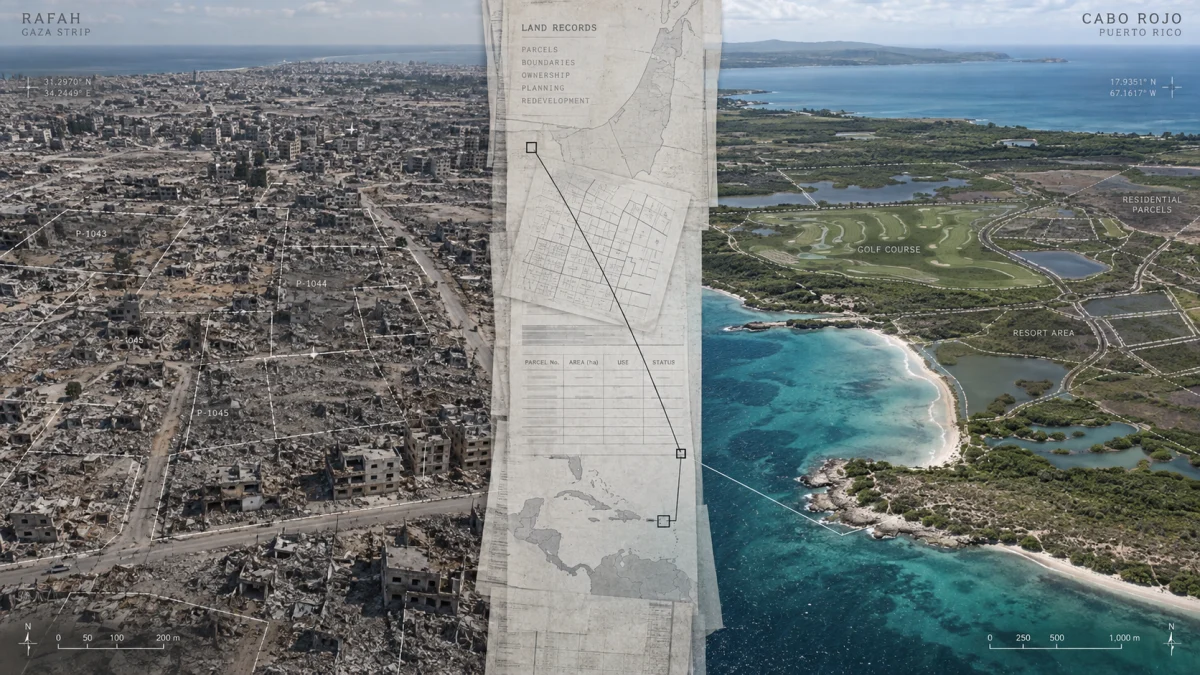
The short answer is that Gaza’s “New Rafah” and Puerto Rico’s Esencia are not equivalent projects, but the comparison Bisan Owda is making is not baseless.
New Rafah emerges from the destruction and mass displacement of Gaza, amid Israeli military control and an internationally supervised reconstruction process. Esencia is a privately financed luxury residential and tourism development moving through Puerto Rico’s land-use and permitting system.
Those differences matter.
But Owda’s deeper question survives them: when governments and extremely wealthy outside investors propose dramatically remaking valuable land, who gets to decide what happens to it, who gets access afterward, and how much power do the people already connected to that land retain?
Once we followed those questions into Gaza reconstruction plans, Puerto Rican legislative records, environmental filings, tax-incentive documents, archaeological studies and property data, several of the provocative points in Owda’s video turned out to have substantial factual foundations.
Some require context. A few are better understood as political rhetoric than literal technical claims. None of that makes the underlying story disappear.
This investigation began with a September 2026 reel by Palestinian journalist and filmmaker Bisan Owda, whose post brought the comparison to our attention. Rather than treating a two-minute social-media video as either authoritative or something to debunk line by line, we followed the records behind it. Watch Bisan Owda’s original Instagram reel
What is “New Rafah”?
The phrase does not refer to a social-media invention.
Jared Kushner publicly presented a broad Gaza redevelopment master plan in January 2026. Its first major redevelopment area was labeled “New Rafah.” The proposal included more than 100,000 permanent housing units, approximately 200 education centers, 180 cultural, religious and vocational centers, and 75 medical facilities.
The larger Gaza concept went well beyond emergency reconstruction. Renderings showed new residential districts, industrial and technology areas and extensive coastal tourism development. (ABC News)
The Board of Peace subsequently described Rafah as the starting point for a phased redevelopment program and said its first phase could contain more than 100,000 homes serving more than 500,000 residents. (Board of Peace)
So when Owda talks about a devastated Rafah being envisioned as a new modern city, the premise is substantially grounded in the plans themselves.
There is, however, an important chronological distinction.
The enormous master plan and the immediate project being prepared around Rafah are related, but they are not identical. More recent implementation discussions have included a much smaller temporary-housing program for displaced Palestinians while the broader redevelopment scheme remains a longer-term ambition.
The cleanest way to understand it is:
New Rafah is the larger redevelopment vision. The temporary Rafah compounds are an early implementation mechanism within an evolving reconstruction process.
That distinction adds context without negating Owda’s larger point.
The biometric-screening concern is not imaginary
One of the strongest claims underlying Owda’s argument concerns control over the people who would live in reconstructed areas.
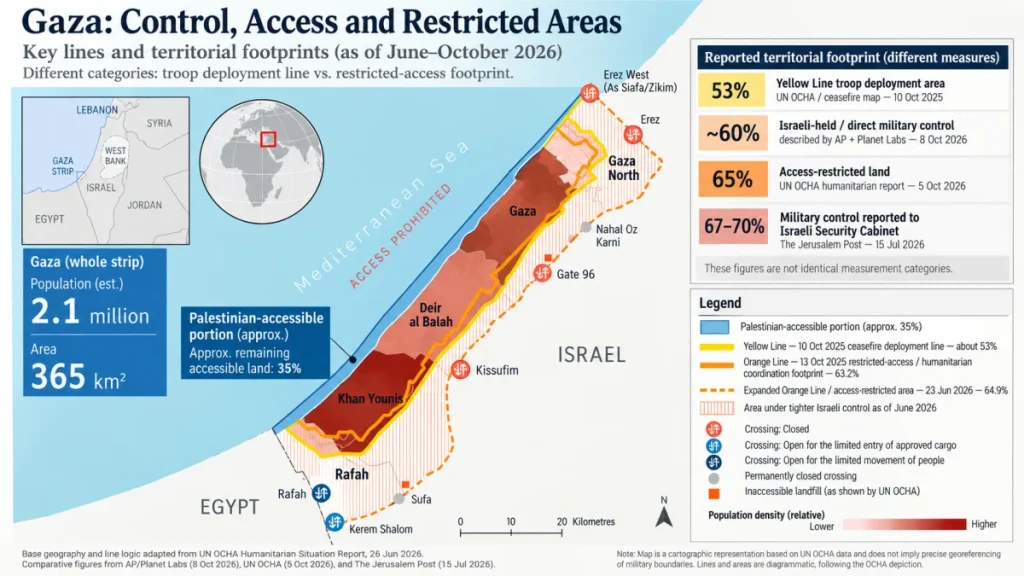
Planning material examined by the Carnegie Endowment describes prospective residents of a temporary Rafah compound being security-vetted and subjected to biometric scanning before receiving shelter. Carnegie traces that requirement to the U.S.-led Civil-Military Coordination Center plan and related Board of Peace planning. (Carnegie Endowment)
That does not, by itself, prove a permanent system of authoritarian control over every reconstructed neighborhood in Gaza.
It does create a legitimate question.
If access to shelter in a planned community is conditioned on security approval and biometric identification, the authority operating that system gains substantial practical power over who enters and who lives there.
Owda characterizes this as a form of social control. That is an interpretation of the security architecture, not a separate factual claim invented without evidence.
There is also relevant evidence pointing toward a different intended long-term structure.
The Board of Peace’s July 2026 roadmap says its stated objective includes a complete Israeli withdrawal from Gaza, Palestinian governance, reconstruction and a credible path toward Palestinian self-determination and statehood. It assigns civilian governance and internal security to a Palestinian National Committee for the Administration of Gaza during the transitional period. (Board of Peace)
Both facts belong in the same article.
The current reconstruction process involves substantial external supervision and security control. The official roadmap says that arrangement is supposed to terminate in Palestinian governance and Israeli withdrawal.
Whether implementation ultimately matches that stated end state is a question that remains open.
The overlooked Gaza problem is not the skyscrapers. It is the land underneath them.
The most consequential issue we found is largely absent from the architectural renderings.
Who owns reconstructed Gaza?
The final Gaza Rapid Damage and Needs Assessment conducted jointly by the World Bank, United Nations and European Union describes enormous damage to Gaza’s property-registration system.
Before October 2023, approximately 63% of Gaza’s land was privately owned.
The subsequent destruction severely damaged land-administration offices, cadastral records, digital files and surveying archives. According to the assessment, roughly 80% of Gaza’s 218,000 physical property-boundary beacons were destroyed.
By mid-2025, more than 65% of property owners had lost their personal property documents. (United Nations)
Those numbers fundamentally change the reconstruction question.
Suppose an apartment building, road and every recognizable parcel marker around it have been destroyed. Its owner is displaced. The deed is gone. The local land office has been damaged. The survey markers identifying the parcel have disappeared.
A reconstruction authority cannot simply put a new building there.
Someone must determine:
- where the original parcel ended;
- who owned it;
- whether ownership was individual, inherited or shared;
- which evidence is sufficient when the deed has disappeared;
- what rights displaced or absent owners retain;
- what happens when claims conflict;
- and who gets the final authority to decide.
The World Bank-UN-EU assessment explicitly says restoring the system will require re-surveying parcels, recovering cadastral information, legal assistance, community validation and dispute-resolution mechanisms. (United Nations)
The problem is already materializing. The Financial Times reported on September 8 that Palestinians are scrambling to preserve deeds, tax records, utility records and other evidence capable of proving ownership as Gaza approaches reconstruction. (Financial Times)
This makes the land issue much more concrete than arguments over futuristic concept art.
Who controls reconstruction matters because whoever reconstructs a destroyed city must eventually decide how the old property map becomes the new property map.
What exactly is Esencia in Puerto Rico?
Approximately 10,400 kilometers away, Proyecto Esencia presents a very different factual situation.
Esencia is a massive luxury residential and tourism development planned for Cabo Rojo on Puerto Rico’s southwest coast.
Its final environmental impact statement describes a project on approximately 1,504 acres, with:
- 530 hotel units;
- 1,132 tourism residences;
- two golf courses;
- a school with accommodations for 500 students;
- medical facilities;
- commercial and entertainment areas;
- and associated infrastructure.
The environmental statement estimated the project cost at approximately $2.684 billion. (Scribd)
Earlier development plans have also included a private airfield. Esencia is being developed by Reuben Brothers and Three Rules Capital. (Bloomberg)
This is therefore not simply a new hotel on an existing resort property.
It is effectively a new luxury community on a scale large enough to raise regional questions about housing, water, transportation, environmental resources and coastal access.
Esencia has received an extraordinary tax-incentive package
This is among the strongest parts of the Puerto Rico side of the story.
During an August 27 Puerto Rico Senate hearing, the Puerto Rico Tourism Company testified that Esencia has $1.244 billion in eligible tourism investment associated with an estimated $497,691,636.80 in tax credits across six phases.
Nearly half a billion dollars.
The Tourism Company also characterized the project’s design as predominantly residential and emphasized that residential activity alone does not qualify as tourism activity for purposes of the incentive. (Senado de Puerto Rico)
The incentives do not mean Puerto Rico wrote the developers a $498 million check. A tax credit and a direct expenditure are different fiscal mechanisms.
But the economic significance is still real.
Puerto Rico has made a very large amount of potential tax benefit available in connection with the development.
That gives substance to the broader concern Owda raises about governments using public policy to make large-scale outside investment economically attractive.
What about Act 60?
Owda invokes Puerto Rico’s famous tax-incentive system, usually referred to as Act 60.
The shorthand needs explanation, but the underlying subject is legitimate.
Puerto Rico—not the U.S. Congress—enacted Act 60 in 2019. The law consolidated more than 30 existing Puerto Rican incentive statutes covering industries ranging from tourism and finance to manufacturing, exports and individual investors. (Microsoft Azure App Service)
Esencia’s approximately $498 million tourism incentive traces specifically to Puerto Rico’s earlier Tourism Development Act 74 of 2010, according to Tourism Company testimony, rather than simply to the individual-investor provisions most outsiders associate with the phrase “Act 60.” (Senado de Puerto Rico)
That is a technical distinction worth explaining.
It does not erase Owda’s broader point that Puerto Rico has intentionally used favorable tax treatment to attract outside capital.
Esencia is approved to proceed further. It is not fully approved for construction.
This distinction is especially important because the story is moving quickly.
Puerto Rico’s Permit Management Office approved Esencia’s Consulta de Ubicación, or location consultation, on July 30, 2026.
That was an important approval.
It was not a construction permit.
Puerto Rico government officials reiterated during September Senate hearings that approval of the environmental statement and location consultation does not itself authorize construction. Additional conditions, permits and agency approvals remain necessary. (Senado de Puerto Rico)
The developers themselves acknowledged before the Senate that failure to comply with more than a dozen conditions attached to the location approval could prevent the project from advancing. (El Nuevo Día)
This matters because online arguments sometimes describe Esencia either as an accomplished fact or as merely a hypothetical proposal.
Neither is quite right.
The project has cleared major regulatory stages but still has material conditions to satisfy.
Water may become one of those decisive conditions
A project this large needs a substantial water supply.
Puerto Rico’s Aqueduct and Sewer Authority told the Senate that the existing system could not provide the required supply. The Puerto Rico Electric Power Authority also warned about the limitations of the Lajas Valley irrigation system as a backup water source and urged careful analysis of groundwater extraction because of the potential vulnerability of coastal aquifers to saltwater intrusion. (Senado de Puerto Rico)
The developers now say Esencia will not rely on the public water or electricity networks.
Instead, they propose groundwater wells, treatment, rainwater capture and reuse, with reverse osmosis or seawater desalination available as alternatives, alongside an independent solar-and-battery electrical system. (Senado de Puerto Rico)
That does not mean the water problem has been solved.
Nor does it mean the developers’ proposed solution cannot work.
At this stage the relevant question is empirical:
Can Esencia demonstrate a sustainable independent water supply without materially harming the aquifer or surrounding users?
Puerto Rican authorities are still requiring that question to be answered.
Is Esencia really taking three miles of Puerto Rico’s beach?
Owda describes the project in the rhetorical language of land seizure and private coastline.
Legally, Puerto Rico’s beaches are not simply being converted into three miles of privately owned resort beach.
Esencia’s own final environmental plan provides for public access from its entrances to the coast and specifies four vehicular beach-access points with parking and visitor facilities. (Scribd)
But the dispute does not end with the words “public access.”
A coastline can remain legally public while becoming more difficult, intimidating or inconvenient for ordinary residents to use if access is routed through a vast private luxury development.
That is why legal ownership and practical accessibility are two different questions.
The correct test is not whether Esencia’s developers promise public access. They do.
It is whether those public routes remain genuinely usable after the development is built.
That is measurable and should be monitored.
The archaeology beneath Esencia is real
Another line in Owda’s video evokes luxury recreation being built over ancestral land.
Again, reading that as a literal claim that specific golf holes have already been proven to sit atop identified human graves would miss what the underlying record actually shows.
Esencia’s archaeological work identified 171 archaeological findings across the project area in its final environmental review.
The final statement says approximately 75% are expected to remain outside areas of direct construction impact, while some require design coordination and preservation measures. (Microsoft Azure App Service)
Earlier archaeological surveys had already documented more than 140 historic and prehistoric resources in the area, prompting the Puerto Rico Institute of Culture to require additional archaeological investigation. (Bonita Radio)
So the underlying concern is legitimate:
Esencia is being developed across a landscape containing substantial documented pre-Columbian and historic archaeological resources.
Whether individual sites are preserved, excavated, buried in place or affected by construction is a more precise question than simply declaring that the resort is being built over graves.
Esencia did not create Cabo Rojo’s housing problem
Housing is another place where chronology matters.
Cabo Rojo was already becoming substantially more expensive before Esencia was publicly announced.
An investigation by Puerto Rico’s Centro de Periodismo Investigativo analyzed 1,376 property transactions and found that the median sale price in Cabo Rojo increased from $129,500 in 2019 to $200,000 in 2024, a 54% increase.
Esencia was not announced until May 2024.
It therefore cannot reasonably be blamed for the entire preceding price increase. (Centro de Periodismo Investigativo)
But that does not eliminate the forward-looking concern.
CPI interviewed local real-estate agents who reported sellers already anticipating additional demand associated with Esencia, including owners waiting for the project to raise the value of surrounding property. Cash purchases also increased sharply during the period CPI examined. (Centro de Periodismo Investigativo)
The evidence supports a more careful conclusion:
Esencia is entering a housing market that was already under severe affordability pressure, and there is a plausible mechanism through which a multibillion-dollar luxury development could intensify that pressure.
How large that effect eventually becomes cannot yet be known.
“Puerto Rico without Puerto Ricans” is rhetoric. The demographic problem behind it is not.
Puerto Rico’s resident population peaked at approximately 3.83 million in 2004.
By 2025 it had fallen to about 3.18 million.
At the same time, approximately 6.1 million people of Puerto Rican origin now live in the 50 states and Washington, D.C.—nearly twice Puerto Rico’s current island population. (Pew Research Center)
Obviously Puerto Rico is not literally becoming a territory with no Puerto Ricans.
But Owda’s formulation rests on a real demographic backdrop: decades of population loss, migration and a housing market increasingly shaped by outside and diaspora demand.
That context helps explain why enormous luxury projects and tax incentives can provoke reactions extending well beyond ordinary environmental disputes.
Is Puerto Rico a colony?
Owda calls Puerto Rico a colony.
We do not need to resolve the political vocabulary before explaining the institutional reality.
Under U.S. law, Puerto Rico is an unincorporated territory of the United States. The U.S. Department of the Interior defines an unincorporated territory as one in which Congress has determined that only selected parts of the Constitution apply by force of territorial incorporation. (U.S. Department of the Interior)
Puerto Rico has no voting senators and its House resident commissioner cannot vote on final passage of legislation on the House floor.
The island’s political status also remains before the United Nations Special Committee on Decolonization, which again held hearings specifically concerning Puerto Rico in June 2026. (United Nations)
“Colony” therefore functions simultaneously as a political characterization and a description used within longstanding decolonization arguments.
For this investigation, the more useful fact is simpler:
Puerto Rico exercises substantial local self-government but does not possess the sovereign authority of either an independent country or a U.S. state.
That political structure is relevant when discussing control over land, tax policy and economic development.
What does Owda mean by “Zionist investment” in Esencia?
This deserves particularly careful treatment because ideological labels can easily substitute for evidence.
Esencia is being developed by Reuben Brothers and Three Rules Capital. (Bloomberg)
There are documented Israel-related connections within the Reuben business and philanthropic network.
Reuben Brothers invested in the Israeli satellite-communications company hiSky. (Finder)
The Reuben Foundation, previously called the Reuben Brothers Foundation, formally lists Israel among the countries where it operates. Its publicly filed accounts have documented grants to organizations including BICOM and British Friends of Boys Town Jerusalem. (Register of Charities)
Those are facts.
What we did not find is evidence that the Israeli government finances Esencia, that Esencia is being built as part of an Israeli state policy, or that its Puerto Rican development purpose is itself a political project related to Israel.
That leaves the most defensible description:
Owda’s phrase “Zionist investment” is a political characterization of investors with documented Israel-related business and philanthropic connections. The connections themselves are real; a specifically political Israeli purpose for Esencia has not been established by the public evidence we reviewed.
No inference about a person’s politics should be made simply from Jewish identity, nationality or family background. There is no need to do so when actual institutional records are available.
What about Owda’s reference to the UAE and Sudan?
Owda also connects the United Arab Emirates’ role in Gaza reconstruction to the war in Sudan.
That subject is large enough to warrant its own investigation, but the underlying concern is not fringe.
The United States formally determined in January 2025 that members of Sudan’s Rapid Support Forces and allied militias had committed genocide. At the same time, it sanctioned seven RSF-owned companies located in the UAE over their roles in weapons procurement. (U.S. Department of State)
Since then, additional evidence of UAE-linked support for the RSF has accumulated. Human Rights Watch reported in May 2026 that Colombian contractors deployed to support the RSF had apparently been recruited by a UAE-based company and transited through UAE military facilities. The UAE denies providing military support to the RSF. (Human Rights Watch)
A UN investigation reported in September that foreign networks connected to the UAE and other countries were continuing to supply expertise or military support that fuels the Sudan conflict. (AP News)
The distinction is important:
There is a substantial evidentiary basis for scrutiny of UAE support connected to the RSF. The formal U.S. genocide determination, however, concerns the RSF and allied militias—not a legal finding that the UAE itself committed genocide.
That is enough context for the present article without turning this into a separate investigation of Sudan.
So are New Rafah and Esencia really comparable?
Only at the right level of abstraction.
If the claim is that Palestinians in Gaza and residents of Cabo Rojo are experiencing the same legal process, the answer is clearly no.
If the claim is that Esencia is equivalent to wartime displacement, also no.
But that is not the only way to understand the comparison.
| Question | Gaza / New Rafah | Puerto Rico / Esencia |
|---|---|---|
| What produced the redevelopment opportunity? | Extraordinary wartime destruction and mass displacement | Private land development and government land-use approval |
| Who is driving redevelopment? | Palestinian transitional bodies, U.S.-led international governance, regional governments and investors | Private developers operating through Puerto Rican institutions |
| Is outside capital important? | Yes | Yes |
| Are property rights an issue? | Extremely: records, boundaries and documents have been destroyed | Primarily through land use, zoning, archaeology, housing pressure and coastal access |
| Is access contested? | Security vetting, biometrics and territorial control are material issues | Public beach access and infrastructure remain material issues |
| Do local people have political institutions involved? | Yes, but under an externally supervised transitional structure | Yes, through Puerto Rico’s elected and administrative institutions |
| Is the project complete? | No | No |
| Is there a serious self-determination question? | Yes | Yes, although under fundamentally different legal and historical circumstances |
The comparison becomes weak when it demands equivalence.
It becomes considerably stronger when it asks about power.
The real common denominator is who gets to define “development”
“Development” sounds inherently positive.
Sometimes it is.
A rebuilt hospital is development. Safe housing for displaced families is development. Reliable electricity, schools and jobs are development.
But the word itself does not answer the important questions.
Who designed it?
Who approved it?
Who owns the underlying land?
Who receives the financial return?
Who receives the housing?
Who can enter?
Whose archaeological or cultural resources are affected?
What happens to residents who cannot afford the transformed area?
And can the people who already live there realistically say no?
Those questions apply very differently in Gaza and Puerto Rico, but they are legitimate in both places.
That is the strongest part of Owda’s comparison.
Bisan Owda’s argument is better treated as a research lead than a checklist
Social-media videos compress complicated political, legal and economic questions into minutes.
Owda does that here.
Terms such as “colony,” “Zionist investment,” “ancestral graveyards,” or “Puerto Rico without Puerto Ricans” communicate an argument rather than statutory definitions.
A useful investigation should not simply adopt those descriptions as established facts.
But it also should not deliberately interpret them in the narrowest imaginable way and then announce that the speaker is wrong.
The better test is:
What factual proposition lies underneath the rhetoric, and how strong is the evidence for it?
Applied here, that produces a surprisingly substantial record.
New Rafah is a real redevelopment project emerging from territory devastated by war. Biometric and security screening have appeared in plans for temporary housing. Gaza’s property-record infrastructure has been catastrophically damaged. Outside governments and investors will play major roles in reconstruction.
Esencia is a real multibillion-dollar luxury development. Puerto Rico has approved an estimated tax-credit package approaching $498 million. The project encompasses extensive archaeological resources and valuable coastline. It enters an already difficult housing market. Its water plan remains under regulatory scrutiny. And it is being developed in a territory whose relationship with the United States has remained a decolonization question at the UN for decades.
Those facts do not make Gaza and Puerto Rico the same.
They do explain why Bisan Owda saw a connection.
And they leave one question that should follow both projects for years:
When powerful institutions promise to remake a place for a better future, how much authority over that future remains with the people who already call the place home?
References and Further Reading
Bisan Owda and the original claim
Bisan Owda — Original Instagram reel comparing Rafah and Cabo Rojo The video that prompted this investigation and establishes Owda’s original argument in context.
Gaza reconstruction and land rights
Board of Peace — Gaza Roadmap, July 2026 Primary statement of the current reconstruction, governance and Israeli-withdrawal framework.
Board of Peace — Inaugural Meeting and Phased Gaza Redevelopment Plan Primary source for the planned Rafah-first reconstruction sequence and housing numbers.
United Nations, World Bank and European Union — Gaza Strip Rapid Damage and Needs Assessment The most important technical source for Gaza’s destroyed cadastral records, property markers and documentation.
United Nations — Board of Peace Report Under Security Council Resolution 2803 Primary UN record describing the transitional governance framework.
Carnegie Endowment — The Board of Peace Plan for Gaza Detailed analysis of reconstruction proposals, property rights and the biometric-vetting provisions reported for the Rafah compound.
Financial Times — “The battle to prove who owns Gaza’s ruins” September 8, 2026 reporting on Palestinians trying to preserve and reconstruct proof of property ownership.
Esencia and Puerto Rico
Puerto Rico Senate — AAA, AEE and Tourism Company testimony on Esencia Primary legislative source for the water dispute and approximately $497.7 million estimated tourism tax credit.
Puerto Rico Senate — September 1 hearing with Esencia developers Primary source documenting the developers’ proposed water and energy independence and outstanding regulatory questions.
Puerto Rico Senate — OGPe, DRNA, Planning Board and Cabo Rojo testimony Important current source on permitting, coastal boundaries, government review and remaining project conditions.
Puerto Rico Permit Management Office — Esencia public document repository Official portal containing the location consultation and environmental records.
Centro de Periodismo Investigativo — Esencia and Cabo Rojo’s affordable-housing problem Original analysis of 1,376 property transactions showing the housing-price trend that predates Esencia.
U.S. Department of the Interior — Definitions of U.S. territorial political status Authoritative U.S. definition of Puerto Rico’s status as an unincorporated territory.
United Nations — 2026 Special Committee on Decolonization materials concerning Puerto Rico Documents the continued consideration of Puerto Rico by the UN decolonization system.
Investors and related claims
Esencia — Development team and project partners The project’s own identification of Reuben Brothers and Three Rules Capital.
UK Charity Commission — Reuben Foundation records Regulatory records for the Reuben family’s philanthropic foundation, including countries of operation.
Startup Nation Central — hiSky investment record Documents Reuben Brothers’ investment in an Israeli satellite-communications company.
UAE and Sudan context
U.S. Department of State — Genocide Determination in Sudan and Accountability Measures Primary source for the U.S. genocide determination concerning the RSF and sanctions on RSF-owned UAE companies.
Human Rights Watch — UAE-linked support and Colombian contractors fighting with Sudan’s RSF Detailed investigation into additional evidence of external support for the RSF.
Editorial currency note: Both the Gaza reconstruction framework and Proyecto Esencia remain active, evolving processes. Esencia has obtained important environmental and location approvals but had not received full construction authorization as of September 8, 2026. Gaza’s transitional governance and reconstruction arrangements are likewise still being implemented. These facts should be reviewed before any later republication or major update.