Last updated: October 5, 2026
Flydubai flight FZ1073 from Dubai to Tel Aviv made an emergency landing in Tabuk, Saudi Arabia, on September 30 after a violent cockpit attack and an extraordinary series of altitude changes. Public flight data show the Boeing 737 MAX 8 losing more than 14,000 feet in roughly half a minute during one part of the event. The aircraft carried 174 passengers and eight crew members, 182 people in total.
The central factual picture is now much clearer than it was when this article was first published.
On October 3, the UAE Attorney-General announced through the Emirates News Agency that the investigation had found the co-pilot attempted to carry out a terrorist act, attacked Captain Smit Machchhar inside the cockpit with the aircraft’s emergency crash axe, and tried to take control of the flight controls. That is a major evidentiary upgrade. The crash axe is no longer an unverified passenger rumor, and terrorism is no longer merely an early characterization by Israeli politicians. It is now the stated finding of the UAE official leading the criminal investigation, although the investigation and any criminal proceedings are not complete.
The inquiry has also produced evidence of premeditation. On October 5, Reuters reported that two Israeli officials with knowledge of the UAE probe said the co-pilot told Emirati interrogators he had planned an attack before he was hired by Flydubai and had applied to the airline after looking for carriers that flew to Tel Aviv. A third source briefed on the probe said he had previously operated a Tel Aviv flight and had intended to hijack and crash it but did not go through with the plan. Associated Press independently reported that the UAE-led initial investigation found he had originally planned an attack in July and specifically sought work with an airline serving Israel.
Multiple Reuters and AP sources identify the co-pilot as Hamam al-Hammami, a 29-year-old Omani national. The UAE and Flydubai have not publicly named him, so sherafy.com treats the name as strongly corroborated reporting rather than a formal Emirati identification.
Those developments substantially narrow the range of responsible interpretations. The public evidence now strongly supports a planned attempt to seize the aircraft for a terrorist purpose, not a spontaneous cockpit dispute or unexplained mental-health episode. What remains unresolved is whether al-Hammami acted entirely alone, whether another person or organization encouraged or assisted him, and what precise ideological pathway led to the attack.
The Iran claim has moved in the opposite direction. President Donald Trump said on October 1 that, based on what he was hearing, he suspected an Iranian connection and threatened retaliation if Iran were responsible. He did not disclose evidence. By October 5, AP reported that regional officials still had found no Iranian nexus, while Reuters’ account of the investigation points to a plan that allegedly predated the suspect’s Flydubai employment. That does not logically exclude later outside influence, but there is still no publicly disclosed evidence tying Iran, the IRGC or an Iranian proxy to FZ1073.
The false-flag theory has also become harder to sustain on the public record. Saudi Arabia independently investigated the assault and transferred both pilots to the UAE; the UAE’s own prosecutor now says the evidence shows a planned terrorist act; major news organizations report statements from the suspect’s interrogation; and AP reports that the UAE supplied Israel with the passenger and crew information, including nationalities, before departure and Israel raised no red flags. None of that makes state deception logically impossible. It does mean a false-flag allegation now requires affirmative evidence of orchestration or fabricated evidence across multiple institutions. No such evidence has surfaced.
Another major issue has emerged instead: how a pilot reportedly flagged for extremist views in Oman was later hired by Flydubai and cleared onto an Israel-bound flight. AP reports that al-Hammami had previously been barred from flying on Oman’s national airline because of extremism concerns. Australian and New Zealand authorities are now investigating his history in their countries, and Israel has ordered a review of foreign civil-aviation security. The security failure increasingly looks systemic: employment vetting, information sharing, route eligibility and Israeli pre-flight screening all warrant scrutiny.
The most useful way to understand FZ1073 is therefore to keep four questions separate:
- What happened aboard the aircraft? A violent cockpit attack with the emergency crash axe, an attempt to take the flight controls, extreme altitude loss, passenger intervention and a safe diversion are now strongly established.
- Was it a deliberate terrorist attack? The UAE Attorney-General says the investigation found that the co-pilot attempted a terrorist act. That is now the leading official criminal finding, though final proceedings and technical findings remain pending.
- Was it premeditated? Reuters and AP report that the UAE-led investigation has found planning before the suspect joined Flydubai and an earlier aborted plan involving an Israel-bound flight. Those details are source-based investigative reporting, not yet a published UAE evidentiary record.
- Was anyone else behind him? That remains unresolved. Regional officials say no Iranian nexus has been found so far, and no public evidence establishes outside direction, organizational support or an Israeli false flag.
The short answer
FZ1073 departed Dubai International Airport for Ben Gurion Airport aboard a Boeing 737 MAX 8 identified in aviation reporting as registration A6-FKF. About two hours into the flight, co-pilot Hamam al-Hammami, as he has been identified by multiple Reuters and AP sources, attacked Captain Smit Machchhar inside the cockpit.
The UAE Attorney-General now says the co-pilot used the cockpit’s emergency crash axe, attempted to take control of the flight controls and was carrying out a terrorist act. Captain Machchhar later described from his hospital bed how he could feel the aircraft going down while he was injured on the floor and forced himself to reach and open the cockpit door. Reuters reported his first-person account during a video call with Indian Prime Minister Narendra Modi.
Once the door opened, passengers and crew entered, subdued the co-pilot and removed him from the controls. Additional qualified Flydubai pilots traveling aboard then took over and landed the aircraft safely in Tabuk.
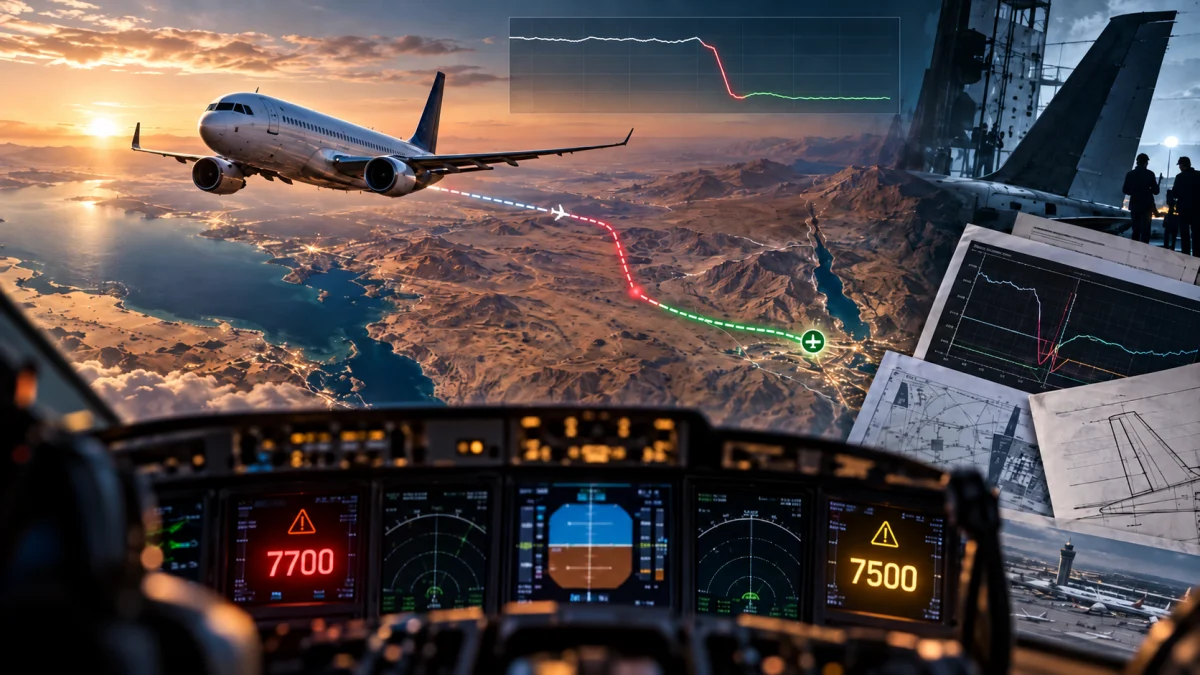
Public flight data show multiple severe altitude changes. One reconstruction using Flightradar24 data measured a fall from approximately 30,875 feet to 16,750 feet in 29 seconds. Other reconstructions using a wider portion of the event describe a roughly 17,000-foot initial descent followed by a climb and another drop. Those figures measure different portions of the same unstable sequence rather than necessarily contradicting one another.
The flight transmitted 7700, the general emergency code, and 7500, the code associated with hijacking or unlawful interference. Saudi authorities say the aircraft carried 174 passengers and eight crew, or 182 people in total.
The criminal investigation is being led by the UAE. The suspect is in Emirati custody, and Reuters reported on October 5 that the UAE had not announced formal charges and that it was not publicly known whether he had legal counsel. The UAE’s published findings so far establish the crash-axe attack, an attempted seizure of the controls and an attempted terrorist act. Investigators are still examining motive, connections, physical evidence and digital evidence.
The newest reporting also points strongly to premeditation. Reuters says the suspect told UAE interrogators he planned the attack before Flydubai hired him and sought employment with an airline flying to Tel Aviv. A source briefed on the investigation said he had previously intended to hijack and crash another Tel Aviv flight but abandoned the attempt. AP separately reports that the initial UAE-led investigation dates an earlier plan to July.
Those findings make a deliberate anti-Israel or anti-Israeli target selection much more plausible than it appeared on the first day. They do not establish Iranian direction. As of October 5, AP reports that regional officials have found no Iranian nexus.
Flydubai has suspended flights to and from Israel while the investigation continues.
What is confirmed, what is strongly supported, and what remains unresolved
| Claim | Current evidence status |
|---|---|
| A serious security incident occurred on FZ1073 | Confirmed by Flydubai, the UAE and Saudi authorities |
| The co-pilot assaulted Captain Smit Machchhar | Confirmed by Saudi Arabia’s preliminary investigation and the UAE Attorney-General |
| The weapon was the cockpit emergency crash axe | Confirmed by the UAE Attorney-General on October 3 |
| The co-pilot attempted to seize the flight controls | Confirmed by the UAE Attorney-General |
| The UAE investigation found an attempted terrorist act | Confirmed as the UAE Attorney-General’s current investigative finding; this is not yet a final court judgment |
| The flight diverted to Tabuk and landed safely | Confirmed by Flydubai and Saudi authorities |
| FZ1073 carried 174 passengers and eight crew members | Confirmed by the Saudi Interior Ministry, for 182 people aboard in total |
| Captain Machchhar opened the cockpit door while injured | Confirmed by Machchhar’s own public account and corroborated by passenger/official reporting |
| Passengers and crew subdued the co-pilot | Strongly supported by verified video, passenger accounts and airline/official reporting |
| Additional Flydubai pilots took control and landed | Strongly supported; Flydubai says traveling personnel secured and landed the aircraft |
| The aircraft made an extreme descent | Confirmed by public flight-tracking data; exact figures vary by measurement window |
| FZ1073 transmitted 7700 and 7500 | Confirmed by public flight-data sources including Flightradar24 and AirNav Radar |
| The co-pilot is Hamam al-Hammami, 29, an Omani national | Strongly corroborated by multiple Reuters and AP sources; UAE authorities and Flydubai have not publicly named him |
| The attack was planned before al-Hammami joined Flydubai | Reported by Reuters from two Israeli officials with knowledge of the UAE probe and by AP from a regional official describing the UAE-led investigation; not yet published as a formal UAE evidentiary finding |
| He sought employment with an airline flying to Tel Aviv in order to attack | Reported by Reuters and AP from sources briefed on the investigation |
| He previously intended to hijack and crash an earlier Tel Aviv flight | Reported by Reuters from a source briefed on the UAE probe; AP separately reports an earlier July plan |
| Ben Gurion Airport was an intended crash target | Reported by Reuters from a source briefed on the investigation; not yet stated in a public UAE release |
| He had previously been barred from flying in Oman over extremist concerns | Reported by AP and other major outlets citing officials/sources; Oman has not publicly detailed the decision |
| The UAE shared passenger and crew information, including nationalities, with Israel before departure | Reported by AP from regional officials; those officials say Israel raised no red flags |
| The attacker acted entirely alone | Not established. Earlier Israeli assessments leaned toward a lone actor; the UAE is still investigating connections and outside direction |
| Iran directed or assisted the attack | Not established and currently unsupported by disclosed evidence. Trump has suggested a link without showing evidence; AP reports regional officials have found no Iranian nexus so far |
| Another terrorist organization directed the attacker | No public evidence currently establishes this; the UAE continues examining connections |
| Israel staged or directed the incident as a false flag | No affirmative public evidence supports this theory |
| The aircraft’s visible rudder damage was caused deliberately by the attacker | Not established; the damage is documented, but the mechanism and timing remain under technical investigation |
| Formal criminal charges have been announced | No, as of October 5. Reuters reports the UAE has not publicly announced charges |
The table now shows an important shift. The event, weapon, attempted seizure of the controls and terrorism classification are much less uncertain than they were on September 30. The remaining uncertainty is concentrated around the exact target, ideological pathway, outside assistance, security failures and final technical reconstruction.
A minute-by-minute reconstruction of FZ1073
Public flight data provide an unusually useful external record of the aircraft’s movements. They cannot tell us what was happening inside the cockpit, and published reconstructions differ slightly on some timestamps. Until investigators release the flight-data recorder and air-traffic records, these times should remain approximate.
| Approximate time, UTC | Event |
|---|---|
| 03:05 | FZ1073 departs Dubai International Airport |
| Around 05:21 | Sharp altitude changes begin; public reconstructions show the aircraft falling from roughly 34,000 feet toward the mid-16,000-foot range within about two minutes, with one measured segment losing more than 14,000 feet in 29 seconds |
| 05:28:48 | Flightradar24 records code 7700, the general emergency code |
| Around 05:35 | Flightradar24 records code 7500, associated with unlawful interference |
| Around 05:42 | Public tracking shows the aircraft briefly entering Jordanian airspace |
| Around 05:46 | The aircraft turns back and proceeds southwest toward Tabuk |
| 06:28 | A 7700 squawk is again received by satellite as the aircraft approaches Tabuk |
| 06:45 | Saudi authorities give 9:45 a.m. local time as the safe landing time |
| About 06:58 | Flightradar24 and AirNav Radar receive the aircraft’s final ADS-B signal at Tabuk; this appears to be a tracking/recording-time difference rather than evidence of a second landing |
| 14:40 | A replacement Flydubai aircraft carrying the passengers departs Tabuk at 5:40 p.m. local time, according to Saudi authorities |
| October 1 | After treatment and medical clearance, the captain and co-pilot leave Saudi Arabia for Abu Dhabi accompanied by a UAE security team |
India Today’s reconstruction calculated a 14,125-foot loss in 29 seconds during one portion of the descent. Flightradar24’s own reconstruction places the first 7700 signal at 05:28:48 UTC and the 7500 signal at about 05:35. AirNav Radar independently reports a similar emergency-code sequence and a final ADS-B transmission at about 06:58 UTC.
Saudi Arabia’s official account as reported by Saudi Gazette gives the emergency request at 8:44 a.m. local time and the landing at 9:45 a.m. The difference between that official landing time and the final public ADS-B timestamp should not be artificially "resolved" without the underlying ATC and flight-recorder records.
What happened inside the cockpit?
The cockpit sequence is now considerably clearer than it was in the first hours after the story broke.
The UAE Attorney-General says the co-pilot attacked Captain Machchhar with the aircraft’s emergency crash axe and tried to take control of the flight controls. That resolves the early conflict between reports describing a knife, a stabbing or an unidentified sharp object.
Machchhar has now given his own public account. In a video call with Indian Prime Minister Narendra Modi reported by Reuters, he said that while badly injured and on the cockpit floor he could feel the aircraft going down. He forced himself toward the security door and managed to open it. In a later conversation with Netanyahu, Machchhar described the attack as beginning after the co-pilot said he wanted to pray, which the captain said was not unusual behavior by itself.
That firsthand account resolves one of the early online "mysteries." Passengers did not somehow break through a hardened post-9/11 cockpit door from the cabin. The wounded captain opened it from inside.
Once the cockpit became accessible, passengers and crew entered, overpowered the co-pilot and pulled him away from the controls. Two additional Flydubai pilots or qualified airline personnel traveling aboard then took over the flight deck. Flydubai’s own statement says traveling personnel secured the aircraft, diverted it and landed safely in Tabuk.
The remaining technical sequence still requires the cockpit voice recorder, flight-data recorder and aircraft-system data: exactly which control inputs produced the dives, when automation was disconnected, whether engines or other systems were manipulated, and how the aircraft sustained its later-observed rudder damage.
Did the co-pilot actually try to crash the plane?
The evidence now strongly supports that conclusion, and it no longer rests mainly on Israeli political statements.
On October 3, the UAE Attorney-General said the investigation found that the co-pilot had begun executing a planned terrorist act, attacked the captain with the crash axe and attempted to seize the flight controls.
Reuters then reported on October 5 that two Israeli officials with knowledge of the UAE probe said the suspect told Emirati interrogators he had planned the attack before he was hired by Flydubai. A third source briefed on the investigation said his intended target on FZ1073 was Ben Gurion Airport and that he had previously intended to hijack and crash another Tel Aviv flight before abandoning that attempt.
AP independently reports that the UAE-led initial investigation found he had planned an attack for July and specifically sought employment with an airline serving Israel.
Those source-based details have not yet been released in a formal UAE evidentiary report, so the precise target and earlier aborted attempt should remain attributed rather than presented as adjudicated fact. But the broader proposition is now much stronger: this was not simply "two pilots fighting while the aircraft happened to descend."
The physical record points in the same direction:
- the captain was attacked with a crash axe;
- the co-pilot attempted to seize the controls;
- the aircraft underwent extreme and repeated altitude changes;
- the flight transmitted code 7500 for unlawful interference;
- the captain opened the cockpit door while the aircraft was going down;
- passengers and crew subdued the co-pilot; and
- qualified relief pilots took over and diverted the aircraft.
A final technical investigation should still establish who made each control input, when automation was disengaged, whether engines or flight systems were intentionally manipulated and how those actions correspond to the descent.
But as of October 5, an intentional attempt to use or destroy the aircraft in a terrorist attack is the leading evidence-based explanation, not a speculative add-on to the story.
Was this a hijacking?
In the ordinary aviation-security sense, an attempted hijacking or unlawful seizure is now a reasonable description, but the apparent objective was destruction rather than diversion to another destination.
The FAA’s published guidance identifies transponder code 7500 with hijacking or unlawful interference. FZ1073 transmitted 7500 during the crisis.
The UAE Attorney-General says the co-pilot tried to take control of the aircraft. Reuters further reports that a source briefed on the UAE probe says the plan was to crash the plane into Ben Gurion Airport and that an earlier Israel-bound flight had also been considered for hijacking and a crash.
That makes "hijacking" more defensible than it appeared on the first day, when Netanyahu himself said he was not sure that label fit and suggested a possible suicide attempt instead. The evidence has advanced since that interview.
The most precise description is therefore an attempted seizure of the flight controls in a planned terrorist attack, reportedly intended to end in a deliberate crash. That avoids implying the attacker merely wanted to reroute the plane.
Was it terrorism?
The answer has changed materially: the UAE Attorney-General now says the investigation found that the co-pilot attempted to carry out a terrorist act.
That matters because the terrorism characterization no longer depends mainly on statements from Israeli Defense Minister Israel Katz or Prime Minister Benjamin Netanyahu. On October 3, UAE Attorney-General Hamad Saif Al Shamsi said through the Emirates News Agency that investigators had found the co-pilot began executing a planned terrorist act, attacked the captain with the crash axe and tried to seize the aircraft controls.
This is an official criminal-investigation finding from the jurisdiction leading the case. It is still not the same thing as a final criminal judgment. The UAE says investigators are continuing to establish the full circumstances, motive and "related connections" while examining physical and digital evidence.
The newer evidence of premeditation also makes an ideological or coercive motive more plausible. Reuters and AP report that the suspect planned an attack before he joined Flydubai and specifically sought an airline serving Israel. If those interrogation and investigative findings hold up, the Israeli destination was not incidental.
A lone actor can still commit terrorism. Organizational membership, a state sponsor or a public claim of responsibility is not universally required for an act to be terrorist in nature. For example, the U.S. federal definition of international terrorism in 18 U.S.C. § 2331 focuses on violent acts that appear intended to intimidate or coerce civilians or affect government conduct through specified forms of violence. UAE law, not U.S. law, will govern the core prosecution, but the conceptual distinction matters.
So two questions should not be collapsed:
Was FZ1073 an attempted terrorist attack? The UAE’s current answer is yes.
Was it directed by Iran, al-Qaeda, another group or anyone outside the cockpit? That remains unresolved, and no such connection has been publicly established.
What evidence now points toward an ideological motive?
The evidence is considerably stronger than the first-day anecdotes about prayer or conservative personal behavior.
Religious observance by itself proves nothing. The early reports that the co-pilot prayed frequently or avoided shaking hands with women were weak evidence and should never have been treated as proof of violent extremism.
The more probative evidence now comes from three different directions.
First, the UAE itself has classified the attempted act as terrorist and says it is examining motive, connections, digital evidence and physical evidence.
Second, Reuters and AP report evidence of targeted premeditation: the suspect allegedly planned an attack before joining Flydubai, looked for an airline that served Tel Aviv and had previously contemplated an attack on an Israel-bound flight. That makes the Israeli destination appear purposeful rather than incidental.
Third, AP reports that al-Hammami had previously been barred from flying on Oman’s national airline because of concerns that he had adopted extremist views. Other reporting says Oman Air had moved him away from flight duties. Oman has not publicly released the underlying personnel or security records, so the precise basis and process remain unclear.
Netanyahu has separately said the co-pilot underwent "Islamist radical indoctrination," and Israeli officials have alleged that social-media material associated with him included anti-Jewish or extremist content. Those claims should still be distinguished from evidence released by the UAE. The underlying account data and full context have not been published.
The international background investigation is widening. Australian Federal Police say a joint counterterrorism team including the AFP, Victoria Police and ASIO is examining his links to Australia, where he studied at RMIT University for a period without completing the engineering qualification. New Zealand police have also said they are examining his time there. Royal Air Maroc told AP that he completed a three-month theoretical training period in 2025 but was not selected for employment.
None of this, by itself, identifies an outside sponsor. What it does is move the motive analysis away from a spontaneous personal crisis and toward premeditated ideological targeting, while leaving the organizational question open.
Was Iran behind FZ1073?
There is still no publicly disclosed evidence that Iran directed, financed or assisted the attack, and the reporting since October 1 has weakened rather than strengthened that theory.
President Donald Trump said on October 1 that, based on what he was hearing, he suspected an Iranian connection and threatened severe retaliation if Iran were found responsible. He did not disclose the intelligence or evidence behind that statement.
By October 5, Associated Press reported that regional officials had still found no Iranian nexus and noted that Trump had produced no evidence supporting his initial speculation.
The newer planning evidence points first toward the suspect himself. Reuters reports that two Israeli officials with knowledge of the UAE probe say al-Hammami told interrogators he planned the attack before he was hired by Flydubai and applied after searching for airlines that flew to Tel Aviv. AP separately reports that the UAE-led investigation found he had planned an attack for July.
That timeline does not logically prove that no outside actor ever influenced or assisted him. A person can conceive a plan independently and later receive encouragement, support or direction. Investigators still need to examine communications, money, travel, contacts and digital records.
But the public evidentiary balance matters. No credible reporting reviewed by sherafy.com has produced:
- communications with Iranian officials or the IRGC;
- payments or operational assistance from Iran;
- a proxy-group connection;
- Iranian tasking or recruitment;
- a claim of responsibility; or
- corroborated intelligence released publicly tying the plot to Tehran.
The UAE says it is continuing to investigate "related connections." If evidence of Iranian direction emerges, the assessment should change with it.
As of October 5, the strongest formulation is:
The attack is now officially being treated by the UAE as a planned terrorist act. The public evidence increasingly supports al-Hammami’s own premeditated targeting of an Israel-bound flight. No Iranian nexus has been publicly established, and regional officials say they have not found one so far.
Netanyahu did not publicly predict an Iranian attack on this flight the day before
This point remains important because it was one of the main foundations of early false-flag speculation.
On September 29, one day before FZ1073, Netanyahu made a public warning from the Tel Nof air base. He said Israel had indications that "our enemies" might try to attack ahead of Israel’s October 27 election. The public statement reported at the time did not specifically say Iran was about to attack an aircraft and did not identify Flydubai, FZ1073 or a comparable aviation scenario.
Later that night, Netanyahu briefed opposition leader Yair Lapid. Netanyahu’s office said warnings of possible attacks "on various fronts" had been presented in detail. Lapid subsequently said the briefing contained nothing resembling the Flydubai incident, not even indirectly, according to The Jerusalem Post.
The Associated Press later reported that Netanyahu said Israel had received no specific warning of the FZ1073 incident.
The chronology has become even less probative of specific foreknowledge now that Reuters and AP report the suspect had been planning an Israel-bound aviation attack for months and may have formed the plan before joining Flydubai. That is evidence of the suspect’s prior intent, not proof that Netanyahu knew the operation was coming.
The accurate chronology is therefore:
- Netanyahu publicly warned on September 29 that unspecified "enemies" could attempt attacks before the election.
- He briefed Lapid that night about possible threats on various fronts.
- FZ1073 suffered the cockpit attack the next morning.
- Netanyahu and other Israeli officials initially did not have a settled public account of motive or Iranian involvement.
- Trump later suggested an Iranian connection without disclosing evidence.
- The UAE subsequently classified the event as an attempted terrorist act.
- Reuters and AP then reported evidence of planning by al-Hammami predating the September 29 warning, including an earlier contemplated attack on an Israel-bound flight.
- As of October 5, AP says regional officials have found no Iranian nexus.
The timing of Netanyahu’s warning remains politically interesting and legitimate to document. It is not evidence that he predicted, planned or had specific advance knowledge of FZ1073.
What about the theory that FZ1073 was an Israeli false flag?
No affirmative public evidence supports the conclusion that Israel staged, directed or facilitated the FZ1073 attack. The evidence developed since October 1 makes that theory substantially harder to sustain.
The suspicion did not arise from nowhere. Netanyahu publicly warned one day before FZ1073 that unspecified "enemies" might attempt attacks before Israel’s October election. Israeli officials used terrorism language rapidly. Israel was in an election campaign. And the Omani co-pilot’s assignment to a Tel Aviv flight exposed a real security failure.
Those facts justify scrutiny. They do not establish orchestration.
The evidentiary record now contains several independent layers that a false-flag theory must account for:
- Saudi Arabia’s own preliminary investigation found that the co-pilot assaulted the captain.
- The UAE Attorney-General says Emirati investigators found that the co-pilot used the cockpit crash axe, attempted to seize the controls and was carrying out a terrorist act.
- Reuters and AP report that the UAE-led investigation found prior planning, including a plan that allegedly predates the suspect’s Flydubai employment and an earlier contemplated attack on an Israel-bound flight.
- Captain Machchhar has personally described opening the cockpit door while wounded and feeling the aircraft descending.
- Public flight data independently document the extreme altitude changes and emergency transponder codes.
- AP reports that Emirati authorities gave Israel passenger and crew information, including nationalities, before the flight and Israel raised no red flags.
The last point is particularly important. The existence of an Omani co-pilot on the route is no longer evidence that Israel necessarily did not know his nationality. According to AP’s regional sources, the information was transmitted and no warning was raised. That points more directly toward a screening, responsibility or intelligence-sharing failure.
A sophisticated state operation could theoretically manufacture or manipulate evidence. But once a theory requires the UAE investigation, reported interrogation evidence, Saudi findings, flight data, the captain’s account and multiple pre-flight institutions to be false or coordinated, the burden of evidence rises sharply.
What is real and deserves scrutiny
- Netanyahu really did warn on September 29 that "enemies" might try to attack Israel before the election.
- Israeli officials really did move quickly to call FZ1073 terrorism before the UAE had publicly reached that conclusion.
- Israeli law and operating arrangements reportedly contained restrictions relevant to pilots from countries without diplomatic relations with Israel.
- The UAE reportedly sent Israel crew and passenger information, including nationalities, before departure.
- Israel reportedly raised no red flag on the co-pilot.
- Israeli agencies and ministries are now publicly disputing who was responsible for vetting the information.
- AP reports that the co-pilot had already been flagged over extremist concerns in Oman, creating a serious international information-sharing question.
Those are meaningful failures and contradictions. They are worth investigating without converting them into evidence of authorship.
What has not been established
There is no public evidence reviewed for this article showing that:
- Israel recruited, controlled or communicated with al-Hammami;
- Israeli officials had specific advance knowledge of his plan;
- an Israeli agency arranged his employment at Flydubai or his assignment to FZ1073;
- Israel supplied or planted the crash axe;
- the UAE’s reported interrogation evidence was fabricated;
- Saudi Arabia’s preliminary findings were fabricated;
- the flight-data record was manipulated; or
- Israel created evidence to falsely implicate Iran or another actor.
Political benefit is not evidence of authorship
A government can exploit an attack politically without having caused it. A suspiciously timed warning can justify examining foreknowledge without proving operational involvement.
The sequence
warning -> attack -> political benefit
still does not establish
warning -> planning -> attack.
The new evidence of a plan allegedly formed before al-Hammami joined Flydubai cuts even further against using timing alone as proof of an Israeli operation. It does not make a false flag metaphysically impossible. It means the theory now needs an actual causal link: communications, tasking, recruitment, payments, facilitated access, fabricated evidence or credible testimony connecting an Israeli actor to the plot.
No such link has surfaced publicly.
This is the same evidentiary principle sherafy.com has applied in other investigations involving allegations of advance knowledge or politically useful crises: motive and benefit can justify deeper investigation, but they do not substitute for the missing causal link. See our separate analysis, Did Netanyahu Let October 7 Happen? What the Evidence Actually Shows.
The strongest competing explanations, tested against the public evidence
The evidence has narrowed the field since the first days of the investigation. A spontaneous personal dispute is now a poor fit. The main unresolved question is no longer whether the attack was deliberate, but whether a premeditated terrorist plan was entirely self-directed or had outside assistance.
| Hypothesis | What we would expect to find if true | What the public record currently shows |
|---|---|---|
| Spontaneous personal or suicidal act | Little prior planning; evidence of immediate crisis or grievance rather than target selection | Now a weak standalone explanation. UAE investigators call it an attempted terrorist act, and Reuters/AP report planning that predates the attack by months and possibly predates Flydubai employment |
| Ideological lone-actor terrorism | Deliberate selection of Israel/Israelis, prior planning, extremist history, but no handler or operational sponsor | Currently the best-supported motive model. UAE calls it terrorism; Reuters/AP report targeted preplanning; AP reports prior extremist concerns in Oman; no outside sponsor has been publicly established |
| Organized jihadist or other terrorist plot | Communications, handlers, group links, money, tasking, operational support or a credible claim | Still possible but unproven. UAE is examining related connections; no organization has been publicly tied to the attack |
| Iranian-directed operation | Iranian or proxy communications, tasking, financial or operational links, or corroborated intelligence | Unsupported by disclosed evidence. Trump suggested a link but showed no evidence; AP says regional officials have found no Iranian nexus so far |
| Israeli false flag | Specific foreknowledge plus an operational connection to the attacker, facilitated employment/assignment, manipulated evidence or another causal link | No such evidence has surfaced. UAE and Saudi findings, reported interrogation evidence, the captain’s account and pre-flight crew-data sharing instead point toward a real attack plus serious screening failures |
The table should still be revisited if the UAE releases digital evidence, formal charges, interrogation records or a final investigative report. For now, premeditated lone-actor terrorism is the model that requires the fewest unsupported assumptions, while outside direction remains an open investigative question.
Why was an Omani co-pilot on a Tel Aviv flight?
This has become one of the most important parts of the story, but the strongest question is no longer simply nationality. It is how multiple screening and information-sharing systems failed to identify a pilot who was reportedly already known elsewhere for extremist concerns.
Multiple Reuters and AP sources identify the co-pilot as Hamam al-Hammami, an Omani national. Oman does not have diplomatic relations with Israel.
Netanyahu has said Israel has long-standing arrangements with foreign carriers intended to prevent pilots who are citizens of countries without diplomatic relations from operating flights into Israel. Earlier Israeli reporting also said Flydubai’s authorization contained a nationality restriction.
The evidence now shows that the system was messier than that rule suggests.
First, earlier Channel 12 reporting said dozens of Omani Flydubai pilots had flown into Israel in prior years, suggesting the nationality condition was not consistently enforced.
Second, AP now reports that UAE authorities supplied Israel with the passenger and crew list before FZ1073, including nationalities, and Israel raised no red flags. Israeli law, AP reports, requires foreign airlines to provide passenger and crew information as much as 48 hours before a flight.
Third, Israeli institutions disagree publicly about who was responsible for acting on that information. The Shin Bet says the Transportation Ministry is responsible for vetting passenger lists from foreign flights. Transportation Minister Miri Regev says security agencies are responsible for flight security and that her ministry was not given the relevant warnings. Israel’s aviation-security officials have also said their system relies heavily on local security checks for foreign carriers.
Fourth, the employment-vetting question is now more serious. AP reports that al-Hammami had been barred from flying on Oman’s national airline because of concerns over extremist views. If that reporting is correct, investigators need to determine what information Oman Air or Omani authorities possessed, whether it was available to Flydubai, whether Flydubai requested it and what checks were actually performed before hiring him.
Reuters adds another potentially important fact: two Israeli officials say al-Hammami told UAE interrogators he sought an airline that flew to Tel Aviv before applying to Flydubai. If corroborated, that would make the hiring process itself part of the attack chronology.
The security failure therefore appears to have several possible layers:
- employment vetting at Flydubai;
- information sharing between Oman and the UAE;
- crew-eligibility enforcement for Israel-bound flights;
- Israeli pre-flight screening of the crew data it reportedly received; and
- unclear institutional responsibility inside Israel for foreign-airline security.
What remains missing are the primary records: the exact Israeli operating condition, Flydubai’s hiring and security-vetting file, Oman Air’s personnel/security documentation, any intelligence-sharing records, and the pre-flight submission showing exactly what Israel received and when.
Until those records are public, it would still be too strong to claim that the co-pilot was secretly or uniquely inserted onto FZ1073. The evidence instead points to a potentially serious multinational vetting and enforcement failure that a premeditating attacker may have exploited.
Does the timing of the attack argue against an anti-Israeli motive?
No. The newer evidence largely defeats that argument.
One early argument noted that the cockpit attack occurred well before FZ1073 would normally have landed in Tel Aviv and asked why an attacker targeting Israel would act before the aircraft reached Israeli airspace. That was a fair question when the objective was unknown.
Reuters now reports, citing a source briefed on the UAE investigation, that al-Hammami intended to crash FZ1073 into Ben Gurion Airport. Reuters and AP also report that he had previously contemplated an attack on another Israel-bound flight. Those claims have not yet been published in a formal UAE evidentiary report, so the precise target should remain attributed. But they change the logic substantially.
An attacker intending to seize a commercial aircraft and turn it into a weapon would need time to incapacitate the other pilot, gain control, defeat any intervention and position the aircraft. There is no obvious reason the attack would have to begin only after crossing into Israeli airspace. Acting earlier can be entirely consistent with a plan whose ultimate target is in Israel.
The public flight path also shows the crisis unfolding as the aircraft was already well along the route toward Israel. The fact that passengers and crew regained control before the aircraft reached the reported target is not evidence that the target was fictional; it may simply mean the plan failed before its final phase.
The defensible conclusion is now:
The timing does not argue meaningfully against an anti-Israeli motive. If the Reuters account of the intended Ben Gurion target is confirmed, the timing is consistent with an attempted seizure begun before the aircraft reached the target area.
How did passengers get through the cockpit door?
This is no longer a mystery. Captain Smit Machchhar says he opened the cockpit door from inside while badly injured.
In his public account to Indian Prime Minister Narendra Modi, Machchhar said he was on the cockpit floor, could feel the aircraft going down and forced himself toward the door. He managed to open it, allowing people from the cabin to enter. Reuters reported the exchange.
That resolves the early contradiction created by post-9/11 cockpit security. Passengers did not defeat the hardened cockpit door from outside. The authorized captain released it from inside during the emergency.
Once the door opened, passengers and crew were able to reach the co-pilot, restrain him and clear the flight deck for the relief pilots. The exact door-system timestamps can still be checked against aircraft data, but the basic mechanism is now supported by the captain’s own firsthand account.
Why were extra Flydubai pilots already aboard?
The presence of additional pilots on the flight generated suspicion because they happened to be available when both operating pilots became incapacitated or involved in the confrontation.
The later reporting provides a specific operational explanation. Channel 12, reported by The Times of Israel, says the two relief pilots were aboard so they could operate the return flight from Tel Aviv to Dubai. The original crew would otherwise have exceeded permitted duty-time limits. One of the relief pilots was reported to be British.
That is a more concrete explanation than the early speculation that their presence reflected an advance security warning. No public evidence currently supports the claim that the relief crew was placed aboard because anyone knew an attack was coming.
Flydubai independently confirms the more important point: qualified airline personnel traveling aboard were able to secure and land the aircraft after the cockpit crisis.
Where did the weapon come from?
This question is now largely answered. The UAE Attorney-General says the co-pilot used the aircraft’s cockpit emergency crash axe.
That is an important correction to the first-day narrative. Passengers and early reports described a knife, pocketknife or stabbing weapon, which led to obvious questions about how the attacker supposedly smuggled a blade through Dubai airport security.
The October 3 UAE statement says the weapon was the Crash Axe, emergency equipment kept in or accessible from the cockpit for use in situations such as evacuation or structural emergencies.
So the strongest available evidence does not indicate that al-Hammami needed to carry a knife through passenger security. The weapon was already part of the aircraft’s emergency equipment.
That changes the security question rather than eliminating it. Investigators should now determine:
- exactly where the crash axe was stored on this aircraft;
- whether access or securing procedures complied with Boeing, airline and regulatory requirements;
- whether an authorized pilot could obtain it without any secondary safeguard;
- whether cockpit emergency tools need different storage or access controls in light of an insider threat; and
- whether the attack reveals a security tradeoff between making emergency equipment rapidly accessible and preventing malicious use by an authorized crew member.
The relevant failure, if one is found, may therefore be an insider-security and equipment-control problem, not an airport-screening failure.
Did passengers save the airplane?
The evidence supports a shared answer: passengers were critical to stopping the attacker, while qualified Flydubai personnel ultimately controlled and landed the aircraft.
Passengers have described entering the cockpit, helping restrain the alleged attacker and removing him from the controls. Flydubai says on-duty personnel traveling on the flight secured the aircraft, diverted it and landed in Tabuk.
Those are not competing accounts. They describe different parts of the rescue.
The captain’s reported decision to open the cockpit door while wounded appears to have enabled the intervention. Passengers then helped neutralize the immediate threat. Additional pilots aboard provided the professional flight crew needed to stabilize and land a badly stressed aircraft.
The aircraft appears to have suffered serious rudder damage
Post-landing photographs show substantial damage to the Boeing 737 MAX 8’s rudder, the movable control surface on the vertical tail. The Associated Press reported that much of the rudder appeared to be missing and cited aviation experts who were struck by the fact that the aircraft remained controllable.
The damage is visible. Its precise cause is not yet established.
FZ1073 underwent an exceptionally violent flight profile, with rapid altitude and speed changes that could produce unusual aerodynamic loads. But it would be premature to state that the alleged attacker “ripped off the rudder” by putting the aircraft into a dive. Investigators need the flight-data recorder, structural inspection and engineering analysis to determine when the damage occurred and what loads caused it.
The defensible statement is simpler:
FZ1073 landed with major visible rudder damage after an extreme in-flight event, and investigators have not yet publicly established the precise cause of that damage.
Why did the plane land in Saudi Arabia?
Once control was restored, the immediate priority was getting the aircraft safely on the ground.
Tabuk was a practical diversion airport in the region. Both operating pilots were injured, the aircraft had undergone violent maneuvers and the crew could not assume the airplane was structurally undamaged.
Saudi Arabia and Israel do not maintain formal diplomatic relations, which made the landing politically notable. Operationally, however, an emergency aircraft needs the safest available airport, not the most diplomatically convenient one.
The Prince Sultan bin Abdulaziz International Airport account says its air traffic control center received the emergency request at 8:44 a.m. local time, activated emergency procedures and received the aircraft at 9:45 a.m. Both operating pilots were taken to hospital. Passengers were cared for in the terminal and later departed aboard a replacement aircraft.
How many people were aboard?
This is now one of the questions that can be answered cleanly.
Saudi Arabia’s Interior Ministry says FZ1073 landed with 174 passengers and eight crew members aboard, for a total of 182 people. That resolves much of the first-day confusion, when reports alternated between "174 passengers," "174 people" and estimates approaching 180.
The distinction mattered because the aircraft carried not only the operating pilots and cabin crew but also additional Flydubai personnel, including relief pilots who later helped land the aircraft.
Most of the passengers were Israeli according to Israeli and independent reporting, but the Saudi statement supplies the clearest authoritative total: 174 passengers + 8 crew = 182 people aboard.
Who were the pilots?
The captain is Smit Machchhar, an Indian national with about 17 years of flying experience and roughly 11 years as a captain, according to his own public account. He was badly injured but survived. He was treated first in Saudi Arabia and then in Abu Dhabi, where he spoke publicly from his hospital bed with Indian Prime Minister Narendra Modi and later with Israeli Prime Minister Benjamin Netanyahu.
Machchhar’s first-person account is now a central piece of evidence. He said he could feel the aircraft descending while he was injured on the floor and forced himself to reach the cockpit door because he understood that the people aboard could die if he did not get it open.
The co-pilot has been identified by multiple Reuters and AP sources as Hamam al-Hammami, 29, an Omani national. The UAE and Flydubai have not publicly named him, and Oman has not issued a detailed public account of his background, so the identity should remain attributed even though it is now multiply corroborated.
The emerging employment history is significant:
- AP reports that he had been barred from flying on Oman’s national airline because of concerns over extremist views.
- Reporting places him at Oman Air before leaving flight duties there.
- Royal Air Maroc told AP that he completed a three-month theoretical training period in 2025 but was not selected for employment.
- He later joined Flydubai.
- Reuters reports that two Israeli officials say he told UAE interrogators he had looked for airlines serving Tel Aviv before applying to Flydubai.
- Australian authorities confirm he studied in Australia for a period, and a joint counterterrorism team is investigating his links there. New Zealand police are also examining his time in that country.
The suspect remains in UAE custody. Reuters reported on October 5 that the UAE had not announced formal charges and that it was not publicly known whether he had appointed legal counsel.
Who is investigating FZ1073?
There are now parallel criminal, intelligence, counterterrorism and aviation-safety investigations spanning several countries.
The lead criminal process is in the United Arab Emirates. The UAE Attorney-General’s October 1 order created a specialized Public Prosecution team. On October 3, the Attorney-General announced the investigation’s first major substantive finding: the co-pilot attempted a terrorist act, used the crash axe against the captain and tried to seize the flight controls. The UAE says investigators are continuing to examine motive, connections, technical evidence, physical evidence and digital evidence.
The UAE has jurisdiction because the aircraft is registered there and flies the UAE flag. The suspect is now in Emirati custody. Reuters reports that Israel is receiving updates about the UAE investigation.
Saudi Arabia handled the immediate emergency, hospitalized both pilots and conducted the first local security inquiry. Its Interior Ministry said the preliminary investigation found that the co-pilot assaulted the captain. Saudi Arabia then transferred both pilots to Abu Dhabi with a UAE security team after medical clearance.
Separately, Saudi Arabia’s National Transport Safety Center has opened an aviation-safety investigation into the emergency landing and contributing safety factors. That technical/safety process is distinct from the UAE criminal case.
Israel is conducting its own security review and participating in the broader inquiry because the flight was bound for Tel Aviv and carried mostly Israeli passengers. Netanyahu has ordered a review of "all security aspects" of foreign civil aviation to Israel. The investigation is now also examining how pre-flight crew information was handled and why no warning was raised.
The background investigation has spread farther. Australian Federal Police say a joint counterterrorism team involving the AFP, Victoria Police and ASIO is investigating al-Hammami’s links to Australia. New Zealand police have said they are investigating his time there. AP has also reported involvement by Oman and the United States in the broader effort.
This division matters because the investigations answer different questions:
- UAE prosecutors can establish planning, motive, criminal responsibility and outside connections;
- Saudi safety investigators can reconstruct aircraft behavior, damage and operational factors;
- Israeli authorities can examine route security, pre-flight screening and foreign-airline oversight; and
- Australian, New Zealand and other authorities can reconstruct the suspect’s earlier contacts, education and potential radicalization history.
The final account will likely require evidence from all of those streams rather than any single government’s political narrative.
What investigators should be able to determine
Unlike many aviation disasters, this event left an unusually rich body of surviving evidence. The aircraft survived. Both operating pilots survived. Passengers and relief pilots witnessed key portions of the event. Video exists. Public tracking systems captured the external flight profile. Investigators should have the cockpit voice recorder, flight-data recorder, aircraft itself, digital devices and employment/security records.
Several questions that were open on September 30 have already been answered: the weapon was the crash axe; the UAE says the co-pilot attempted to seize the controls; the UAE now classifies the act as terrorist; and the suspect is in Emirati custody.
The remaining high-value questions include:
- exactly what the cockpit voice recorder captured before and during the attack;
- which control inputs produced each dive, climb and recovery;
- whether engines, autopilot or other flight systems were intentionally manipulated;
- whether the reported intended target was Ben Gurion Airport, another target or simply destruction of the aircraft;
- whether the earlier reported July/previous-flight plan is corroborated by schedules, communications or digital evidence;
- when al-Hammami first formed the plan and whether anyone encouraged, financed or assisted him;
- whether any Iranian, jihadist or other organizational nexus exists;
- what digital evidence supports the terrorism and radicalization findings;
- why Oman Air reportedly removed or barred him from flying and what records existed;
- what Flydubai knew or could reasonably have learned before hiring him;
- what passenger and crew data the UAE sent Israel before FZ1073 and which Israeli body reviewed it;
- why the Omani nationality and any other risk indicators generated no pre-flight red flag;
- whether the crew assignment complied with the applicable Israel-Flydubai security arrangements;
- what caused the aircraft’s rudder damage; and
- whether cockpit emergency-equipment security needs to change after the malicious use of a crash axe by an authorized pilot.
Those findings will determine whether FZ1073 is ultimately understood primarily as a lone-actor insider attack, a wider terrorist conspiracy, a failure of international aviation-security information sharing, or some combination of those.
What changed after the incident?
The story has evolved rapidly since September 30:
- Flydubai suspended flights to and from Israel while the investigation continues.
- Saudi Arabia’s preliminary inquiry established that the co-pilot assaulted the captain and transferred both pilots to Abu Dhabi after medical clearance; Saudi Arabia also opened a separate aviation-safety investigation.
- On October 3, the UAE Attorney-General moved beyond merely investigating terrorism and said the evidence showed an attempted terrorist act, identifying the cockpit crash axe as the weapon and an attempt to seize the flight controls.
- AP and other reporting identified the suspect as Hamam al-Hammami, while the UAE has not formally published his name.
- AP reported that he had previously been barred from flying on Oman’s national airline over extremist concerns, greatly expanding the employee-vetting and intelligence-sharing questions.
- AP reported that the UAE had provided Israel with passenger and crew information, including nationalities, before FZ1073 and that Israel raised no red flags. Israeli agencies and ministries are now disputing responsibility for screening foreign-airline information.
- Reuters and AP reported on October 5 that the UAE-led investigation found prior planning, including a plan before Flydubai hired him and an earlier contemplated attack on an Israel-bound flight.
- Australia and New Zealand opened inquiries into the suspect’s earlier history in those countries.
- Israel ordered a broader review of foreign civil-aviation security.
- President Trump continued to suggest an Iran connection without disclosing evidence, while AP reported that regional officials had found no Iranian nexus so far.
The aviation-security implication is now broader than cockpit-door security. FZ1073 increasingly looks like an insider-threat and vetting failure: the alleged attacker was authorized to be in the cockpit, had access to emergency equipment, and may have deliberately sought employment that would put him on Israel-bound flights.
That raises a harder policy question than ordinary passenger hijacking: how airlines and governments share security-relevant information about pilots without turning employment screening into unaccountable profiling, and how cockpit safety equipment remains accessible for emergencies without becoming an easy weapon for a malicious insider.
Bottom line
The Flydubai FZ1073 story has crossed an important evidentiary threshold since the October 1 version of this article.
The physical event is no longer seriously ambiguous. The UAE Attorney-General says the investigation found that the co-pilot used the cockpit emergency crash axe, attacked Captain Smit Machchhar, attempted to take control of the aircraft and was carrying out a terrorist act. Machchhar has personally described opening the cockpit door while wounded as he felt the aircraft going down. Passengers and crew subdued the attacker, relief pilots took over, and the aircraft landed safely in Tabuk with 182 people aboard.
The attack also increasingly appears premeditated. Reuters and AP report that the suspect, identified by multiple sources as Hamam al-Hammami, had planned an attack before he joined Flydubai, deliberately sought an airline serving Tel Aviv and had previously contemplated an attack on an Israel-bound flight. Those specific interrogation details remain source-based reporting rather than a published UAE evidentiary record, but they are independently reported enough to materially change the analysis.
That means the strongest current model is no longer "possible terrorism versus a personal crisis." The UAE already treats the act as terrorist. The unresolved question is whether this was a self-directed ideological attack or part of something larger.
The public evidence presently favors a premeditated lone-actor terrorist plot because it explains the deliberate target selection, the prior planning, the reported extremist concerns in Oman and the absence so far of a demonstrated outside sponsor. That conclusion is provisional, not final.
The Iran theory has not gained evidentiary support. Trump has suggested a link but disclosed no proof. AP reports that regional officials have found no Iranian nexus. The reported planning before al-Hammami’s Flydubai employment also points first toward his own long-running intent, although it cannot rule out later influence or assistance.
The Israeli false-flag theory is weaker still on the current record. Netanyahu’s pre-election warning remains worth documenting, as do the political benefits and the real aviation-security failures. But the UAE now publicly identifies the event as a planned terrorist act; Reuters and AP report interrogation evidence of prior planning; Saudi Arabia independently investigated the assault; and AP says Israel received pre-flight crew information and failed to flag the Omani co-pilot. That points toward a security failure, not evidence of Israeli orchestration.
The most consequential unanswered story may ultimately be the security chain itself. AP reports that al-Hammami had previously been barred from flying on Oman’s national airline because of extremist concerns. Yet he later joined Flydubai, reportedly sought access to Israel-bound flying, and appeared on a crew list sent to Israel without generating a warning. Investigators now need to determine which institutions knew what, when they knew it, and why the information did not stop him from reaching the cockpit of FZ1073.
The responsible conclusion as of October 5 is therefore:
FZ1073 survived a planned terrorist attack by an authorized cockpit insider, according to the UAE’s lead prosecutor. The evidence strongly supports deliberate premeditation and an attempt to seize the aircraft. The public record does not establish Iranian direction, another organizational sponsor or an Israeli false flag. The next decisive evidence should come from the UAE’s digital and criminal investigation, the flight recorders, and the multinational review of how a reportedly flagged pilot was hired and cleared onto an Israel-bound flight.
References and Further Reading
Primary and authoritative aviation, criminal and government sources
- UAE Attorney-General: Planning and attempted terrorist act behind FZ1073 — The most important post-October 1 primary update. The UAE Attorney-General says the co-pilot attempted a terrorist act, used the cockpit crash axe and tried to take control of the flight controls; the investigation continues into motive and connections.
- Flydubai: official FZ1073 updates — Confirms the flight-deck altercation, says traveling on-duty Flydubai crew secured and landed the aircraft, states that motive remains unknown, and records the temporary suspension of Israel service.
- UAE Attorney-General: specialized Public Prosecution investigation into FZ1073 — Establishes the UAE criminal investigation and its mandate to examine motive, terrorist purpose, prior planning and outside direction.
- UAE Ministry of Foreign Affairs: jurisdiction and scope of FZ1073 investigation — States that UAE judicial authorities have jurisdiction because the aircraft is UAE-registered and UAE-flagged, and confirms the terrorism/planning inquiry.
- UAE General Civil Aviation Authority: security incident involving Flydubai FZ1073 — Confirms the security incident, crew injuries, diversion to Tabuk and continuing operational/security investigation.
- Saudi Interior Ministry clarification on FZ1073 via Sabq — English-language publication of Saudi Arabia’s official account of its preliminary findings; gives the 174-passenger/eight-crew manifest, says the co-pilot assaulted the captain and confirms the medical clearance and transfer of both pilots with a UAE security team.
- Saudi National Transport Safety Center safety investigation, via Okaz — Reports the Saudi transport-safety center’s announcement that a safety-investigation team is collecting evidence and examining aviation-safety aspects of the emergency landing.
- Prince Sultan bin Abdulaziz International Airport account via Saudi Gazette — Gives the emergency-call and official landing times, reports both operating pilots were taken to hospital and confirms the replacement aircraft.
- FAA guidance on unlawful interference and transponder code 7500 — Explains the meaning and air-traffic handling of code 7500.
- 18 U.S.C. § 2331, terrorism definitions — Useful for explaining why group membership or state sponsorship is not inherently required for an act to fit a terrorism definition; not presented as the controlling law for this incident.
Flight data and aviation reconstruction
- Flightradar24: FZ1073 route, altitude and emergency-code reconstruction — Primary public tracking reconstruction documenting the descent, 7700/7500 sequence, route change and final signal at Tabuk.
- AirNav Radar: FZ1073 diversion and ADS-B chronology — Independently documents the transponder sequence, route and final ADS-B reception near Tabuk.
- Associated Press: minute-by-minute flight-data reconstruction — Reconstructs the sharp descents, emergency codes, course changes and final approach using public tracking data.
- India Today OSINT reconstruction of FZ1073 — Calculates a 14,125-foot loss in 29 seconds from Flightradar24 data.
- Khaleej Times flight-data timeline — Provides an independent Flightradar24-based chronology and documents early misinformation about the pilots’ nationalities.
- Al Jazeera: FZ1073 flight timeline — Reconstructs the aircraft’s route, altitude changes and emergency-code sequence.
- Flightradar24 FZ1073 flight-history page — Public flight-history source underlying several independent reconstructions.
Independent reporting and cockpit reconstruction
- Reuters: Co-pilot planned attack before being hired by Flydubai, via Investing.com — Reports, citing officials with knowledge of the UAE probe, that the suspect planned the attack before joining Flydubai, sought an airline flying to Tel Aviv and previously contemplated hijacking and crashing another Tel Aviv flight.
- Reuters: Captain Smit Machchhar describes opening the cockpit door, via Internazionale — First-person account from the wounded captain explaining that he could feel the aircraft going down and forced himself to open the cockpit door.
- Associated Press Fact Focus: planned attack, screening failures and no Iranian nexus found — October 5 synthesis reporting the UAE-led investigation’s prior-planning finding, the suspect’s effort to seek Israel-serving employment, the screening dispute and regional officials’ statement that no Iranian nexus had been found.
- Associated Press: UAE shared FZ1073 passenger and crew information with Israel before departure — Reports that Israel received crew and passenger information, including nationalities, and raised no pre-flight red flags; documents the institutional dispute over screening responsibility.
- Associated Press: co-pilot had been flagged over extremist concerns in Oman — Reports the suspect’s identity from multiple sources and that he had been barred from flying on Oman’s national airline because of extremist concerns.
- ABC News Australia: Joint Counter Terrorism Team investigates the suspect’s Australian links — Confirms the AFP/Victoria Police/ASIO inquiry and provides independently sourced details on his Australian education and Royal Air Maroc training.
- Associated Press: Trump says Iran would be hit if linked to the FZ1073 attack — The most important October 1 update on the Iran allegation; also reports the 182-person total, UAE handover, multinational investigation and Netanyahu’s radicalization claim.
- Reuters: Netanyahu alleges radicalization; Israeli security officials say co-pilot likely acted alone, via MarketScreener — Reports Netanyahu’s October 1 claims, the initial lone-actor assessment and that Israeli officials had not identified Iranian involvement so far.
- Reuters: passenger accounts and reconstruction of the cockpit crisis, via Investing.com — Includes passenger testimony, Reuters-verified video and reporting on how the cockpit door was opened and the alleged attacker subdued.
- Reuters: passengers foil alleged crash attempt, via Internazionale — Reports the alleged crash attempt, intervention, security response and unresolved motive.
- Associated Press: what is known about the Flydubai flight — Broad independent reconstruction covering the attack, intervention, injuries and aircraft damage; useful for the first-day state of the evidence before the UAE identified the crash axe.
- CBS News: Netanyahu says motive and possible Iranian involvement remain undetermined — Important interview in which Netanyahu says it is too early to link Iran, discusses a possible suicide-attempt interpretation and reports independent confirmation from an Omani official of the attacker’s citizenship.
- India’s diplomatic mission says Captain Smit Machchhar was stable in hospital, via Khaleej Times — Independently confirms the injured captain’s identity and Indian nationality.
Motive, Iran and the political chronology
- Netanyahu’s September 29 warning about possible pre-election attacks — Records the actual public wording: Netanyahu referred to unspecified "enemies," not specifically to an Iranian aviation attack.
- Jerusalem Post: Lapid says the security briefing contained nothing resembling FZ1073 — Documents the opposition leader’s account of the briefing he received after Netanyahu’s warning.
- Times of Israel: current Israeli assessment reportedly saw no Iranian or organizational direction — Preserves the first-day report that Israeli security officials had no indication the attacker was directed by Iran or another organized entity.
- Times of Israel: fellow pilot describes the co-pilot as a religious extremist — Included because this characterization circulated widely; the cited behavior is anecdotal and does not establish violent ideology or motive.
- Times of Israel live coverage: official says co-pilot’s social media discussed killing Jews — Records a materially stronger Israeli allegation about ideological motive; the underlying posts have not been publicly released in the sources reviewed here.
- Jerusalem Post: Israeli political dispute over using FZ1073 as vindication of Netanyahu’s warning — Documents the immediate political argument over what the incident did and did not prove.
Crew assignment, oversight and post-incident aviation response
- Jerusalem Post: Transportation Ministry source says Flydubai’s agreement restricted pilot nationalities — Raises the compliance question surrounding the Omani co-pilot. The underlying operating/security condition has not been publicly produced in the reporting reviewed here.
- Times of Israel: Channel 12 reports dozens of Omani Flydubai pilots had previously flown into Israel — Important October 1 reporting suggesting the nationality restriction was not consistently enforced and Israeli authorities largely relied on the airline.
- Ynet: how responsibility for Flydubai security and foreign-airline oversight was divided — Explains the distinction between Shin Bet responsibility for Israeli carriers and the oversight system for foreign airlines, while documenting prior security concerns about UAE flights.
- Times of Israel: why two relief pilots were aboard FZ1073 — Reports that the relief pilots were rostered to operate the return flight from Tel Aviv because of crew duty-time limits.
- Jerusalem Post: earlier explanation for the additional pilots aboard FZ1073 — Preserves the first-day operational explanation for why additional qualified pilots were traveling on the flight.
- Flydubai: temporary suspension of Israel service — The airline’s direct statement that flights to and from Israel are suspended while authorities investigate.
Related sherafy.com background
- Did Netanyahu Let October 7 Happen? What the Evidence Actually Shows — A separate evidence-chain analysis distinguishing documented warning failures, inference and stronger allegations of deliberate non-action.
- What Did Iran Offer Trump? Iran’s Seven Conditions, Hormuz and the Claim He Must Leave Office — Background on the current Iran-Israel-U.S. conflict and how separate Iranian statements can be inaccurately collapsed into a single claim.
Editorial currency note: This article concerns active criminal, counterterrorism and aviation-safety investigations. The UAE Attorney-General now publicly characterizes the incident as an attempted terrorist act and identifies the crash axe and attempted seizure of the controls. More specific claims about the suspect’s identity, pre-Flydubai planning, earlier aborted attack, intended target and employment history rely partly on Reuters/AP sources with knowledge of the investigation and should be revisited when the UAE publishes formal charges, interrogation evidence or a final report. No Iranian or other outside sponsor has been publicly established as of October 5, 2026.