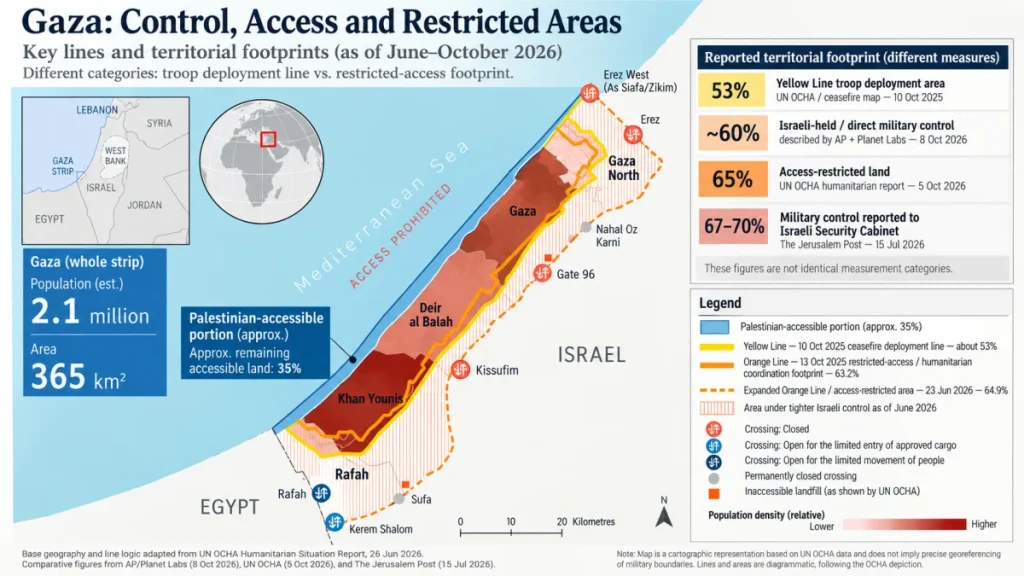
Israeli Finance Minister Bezalel Smotrich says Israel should go to war in the occupied West Bank and “do there what we did in Gaza.”
Taken by itself, that sentence leaves room for interpretation. Smotrich says he is talking about destroying armed groups, confiscating weapons, eliminating tunnels and other militant infrastructure, and dismantling the Palestinian Authority, which he calls a terrorist authority.
But the sentence does not exist by itself.
Smotrich has previously said that major West Bank cities should become like devastated areas of Gaza, become “uninhabitable ruins,” and see residents “forced to migrate.” Years before the current war, he published a political plan calling for permanent Israeli sovereignty over the West Bank, massive settlement expansion, the elimination of Palestinian national sovereignty, financial assistance for Palestinians who choose to emigrate rather than accept that outcome, and decisive military defeat of those who continue armed resistance.
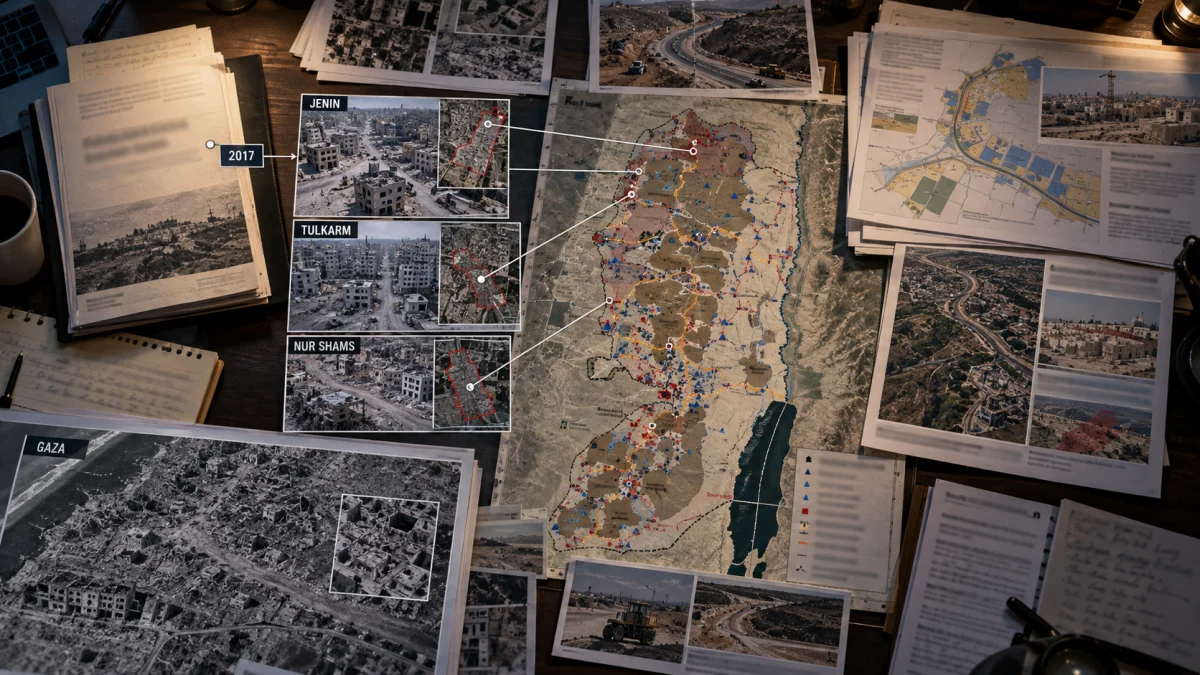
He later gained substantial governmental authority over settlement planning and West Bank land administration. Israeli settlement expansion has accelerated. The Palestinian Authority is being deprived of roughly $6 billion in revenues collected by Israel on its behalf. And more than 33,000 Palestinians remain displaced from Jenin, Tulkarm and Nur Shams refugee camps after Israeli military operations emptied the camps and extensively altered their physical landscape.
Most importantly, when Smotrich was asked what his proposed West Bank war would actually look like, he pointed directly at those emptied camps.
“We’ve already done it,” he said.
That does not establish that Israel’s Cabinet has formally adopted a plan to wage a Gaza-scale war throughout the West Bank. The public record does not show such a decision.
It does, however, make one interpretation increasingly difficult to sustain: that Smotrich is merely using “Gaza” as loose shorthand for ordinary counterterrorism.
His own statements, political writings and chosen examples point to something broader: military suppression of armed opposition operating alongside the dismantling of Palestinian national governance, permanent Israeli territorial control, settlement expansion and population displacement.
What Did Smotrich Actually Say?
On September 27, 2026, Smotrich appeared on Ynet’s political podcast and was asked about warnings from senior Israeli security officials that the West Bank was approaching a dangerous escalation.
His answer was that Israel should “go to war” there and “do there what we did in Gaza.” He also called for dismantling the Palestinian Authority.
Ynet then asked the question that matters most: What does going to war mean?
Smotrich responded that Israel had “already done it,” pointing to three emptied refugee camps. He said their populations had been evacuated, militants had been cleared out and he wanted the same approach to eliminate armed fighters, weapons, tunnels and other militant infrastructure elsewhere.
In the same interview, he advocated Israeli annexation at least as far as the Yellow Line inside Gaza and extending Israel’s northern border to the Litani River in Lebanon. Read the full Ynet interview with Smotrich.
There is a genuine security component to what he is saying. Armed Palestinian groups operate in the West Bank and have carried out attacks against Israelis. Pretending otherwise would make the rest of the analysis weaker.
But security is not the whole proposal.
To understand why, we have to go backward.
Smotrich Had Already Explained His “Gaza” Comparison
The September 2026 interview was not Smotrich’s first attempt to explain what applying a Gaza-style approach to the West Bank could mean.
On February 10, 2025, while large Israeli operations were underway in the northern West Bank, Smotrich publicly compared specific Palestinian cities with some of the most heavily damaged areas of Gaza.
A subsequent United Nations Secretary-General report records him saying Tulkarm and Jenin would resemble Jabalia and Shuja’iyya, while Nablus and Ramallah would resemble Rafah and Khan Younis. He said those places would become “uninhabitable ruins” and their residents would be “forced to migrate” and seek lives elsewhere.
That earlier statement materially changes how the September 2026 remark should be interpreted.
If the only available statement were “do what we did in Gaza,” it would be reasonable to ask whether Smotrich meant solely the destruction of armed organizations.
But he has previously supplied additional content to the analogy himself: physical devastation severe enough to make Palestinian population centers uninhabitable, accompanied by population departure.
That does not prove that every future West Bank operation would reproduce Gaza building for building.
It does narrow the range of plausible meanings.
What Did Israel Actually “Do in Gaza”?
The phrase “what we did in Gaza” can become an abstraction unless the underlying result is quantified.
As of June 16, 2026, a United Nations Satellite Centre assessment summarized by OCHA identified 201,290 damaged structures in Gaza, approximately 82 percent of all structures in the territory.
Of those:
- 134,422 were assessed as destroyed;
- 13,848 as severely damaged;
- 28,096 as moderately damaged; and
- 24,924 as possibly damaged.
UNOSAT estimated that 328,627 housing units had sustained damage.
A separate final Rapid Damage and Needs Assessment conducted jointly by the World Bank, United Nations and European Union estimated $35.2 billion in direct physical damage and $71.4 billion in recovery and reconstruction needs. It found more than 371,000 housing units damaged or destroyed, more than half of hospitals non-functional and nearly all schools damaged or destroyed. Around 1.9 million people had been displaced, often repeatedly.
None of those statistics tells us by itself what Smotrich intends to reproduce in the West Bank.
His earlier words do.
When a politician who previously discussed making West Bank cities uninhabitable later says Israel should do there what it did in Gaza, the physical consequences of the Gaza campaign are relevant evidence for interpreting the statement.
That is not mind-reading. It is reading the latest statement alongside the speaker’s earlier explanation of the same idea.
The Three Empty Refugee Camps Are the Most Important Part of His Answer
The strongest evidence may be the example Smotrich chose when Ynet pressed him to explain himself.
He pointed to Jenin, Tulkarm and Nur Shams refugee camps.
Israeli forces launched Operation Iron Wall in Jenin on January 21, 2025 and subsequently expanded operations to Tulkarm and Nur Shams. Israel said the operations targeted armed groups, weapons, explosives and militant infrastructure.
There was real armed activity in these areas. That point should not be obscured.
But what followed went substantially beyond arrests.
A September 2026 investigation by the UN Human Rights Office found that Israeli forces forcibly displaced the entire populations of all three camps, destroyed hundreds of homes, extensively damaged roads and other infrastructure, disrupted water and electricity, and continued preventing residents from returning.
The displacement has not proved temporary.
On September 28, 2026, one day after Smotrich’s interview, the UN told the Security Council that all three camps remained empty and more than 33,000 residents remained displaced, describing it as the longest and largest West Bank displacement since 1967.
This makes Smotrich’s answer unusually revealing.
He did not point to a raid where militants were arrested and civilian life quickly resumed.
He pointed to three places where tens of thousands of civilians remain unable to return.
Whatever else he intends by the “Gaza model,” mass and continuing population displacement is already part of the precedent he identifies as successful.
Is Hamas in the West Bank?
Yes.
The claim sometimes made in discussions of this story that “Hamas isn’t in the West Bank” is incorrect if taken literally.
Hamas, Palestinian Islamic Jihad and other armed organizations have operated there for years. The U.S. State Department’s Country Reports on Terrorism documented Hamas, PIJ and the Popular Front for the Liberation of Palestine operating in the West Bank, along with attacks and Israeli counterterrorism operations.
But there is an equally important distinction:
Hamas does not govern the West Bank the way it governed Gaza.
The internationally recognized Palestinian Authority administers parts of the West Bank under the Oslo framework. Its security forces have repeatedly arrested Hamas and PIJ members, seized illegal weapons and cooperated with Israeli and U.S.-supported counterterrorism programs.
The same State Department report says Palestinian Authority security forces and Israeli forces both constrained Hamas and other armed groups, including through arrests. Palestinian security forces proactively arrested people suspected of planning attacks or supporting militant organizations.
The Palestinian Authority has serious problems of its own. Human-rights reporting documents arbitrary detention, political repression and abuses by its security forces. It is not necessary to portray the PA as democratic or benign to recognize the relevant fact here: it is a political rival of Hamas and has participated in suppressing Hamas and other armed organizations.
That creates an obvious question.
If the Goal Is Destroying Hamas, Why Dismantle the Palestinian Authority?
Smotrich has an answer: he calls the Palestinian Authority itself a terrorist authority and accuses it of encouraging or supporting violence against Israel.
But analytically, that does not end the question.
If the objective were simply to reduce Hamas’s ability to operate in the West Bank, abolishing the Palestinian institution whose security forces have historically arrested Hamas members presents an apparent contradiction.
And Israeli national-security analysts have noticed it too.
In April 2026, researchers at Israel’s Institute for National Security Studies described a broader transformation in government policy. Their analysis said the government was pursuing Israeli sovereignty, blocking a future political settlement, weakening the Palestinian Authority toward collapse and pushing Palestinians from places of residence.
Their conclusion was striking: the policy, in their assessment, effectively adopts principles of Smotrich’s Decisive Plan.
That is analysis by INSS, not proof of a secret Cabinet plan.
But the apparent contradiction becomes much easier to explain when Smotrich’s own political writings are considered.
The Palestinian Authority is not merely a security organization. It is the closest thing currently existing to a Palestinian national government in the West Bank.
And eliminating Palestinian national government is part of Smotrich’s long-standing political project.
What Is Smotrich’s “Decisive Plan”?
Smotrich published his Israel’s Decisive Plan in 2017, six years before the October 7 attacks.
That timing matters.
Whatever one believes October 7 changed about Israeli security thinking, Smotrich’s underlying objective for the West Bank predates it.
The premise of his plan is that two competing national movements cannot ultimately exercise sovereignty over the same territory. Peace, in his argument, therefore requires one side’s national project to prevail and the other to abandon its competing claim.
Smotrich states that there should be “one expression of national self-determination west of the Jordan River.”
His answer is Israeli Jewish national self-determination.
1. Apply Israeli sovereignty
The plan calls for Israeli sovereignty throughout what Smotrich calls Judea and Samaria, the territory more commonly referred to internationally as the West Bank.
2. Expand settlements until Palestinian statehood becomes impossible
Settlement is not incidental to the plan.
It is one of its principal mechanisms.
Smotrich argues for establishing additional Israeli cities and settlements and moving hundreds of thousands more Israelis into the territory. The objective is to create an irreversible geographic and demographic reality that eliminates realistic expectations of an independent Palestinian state.
3. Replace Palestinian national government with local administration
Palestinians who accept Israeli sovereignty would be permitted local municipal government dealing with everyday civilian affairs.
But the Palestinian national political project would be dismantled.
Smotrich acknowledges that Palestinians would not initially vote for the Knesset even though Israel would exercise sovereignty over them. He proposes possible pathways to residency or citizenship for some Palestinians subject to conditions, including loyalty to the state.
4. Help Palestinians emigrate if they refuse that political outcome
For Palestinians unwilling to abandon national aspirations, Smotrich proposes financial and logistical assistance to leave for other countries.
In the original document, he presents this as voluntary emigration rather than forced expulsion.
That distinction matters.
It also becomes much harder to evaluate in isolation once later statements about making Palestinian cities uninhabitable and forcing residents to seek lives abroad are added to the record.
5. Militarily defeat continuing armed resistance
Palestinians who continue armed opposition would, under the plan, face decisive military force.
Smotrich argues that the overall framework is moral because he believes decisive Israeli victory would eventually replace perpetual conflict with stability and end generations of bloodshed.
The plan is therefore not simply a security doctrine.
It is a proposed political end state.
For the larger history of this current in Israeli politics, including the distinction between literal conspiracy claims about “Greater Israel” and documented annexationist political programs, see sherafy.com‘s What Is “Greater Israel” and Is It Actually Real? What Israeli Leaders Have Said and Done.
How Much of the Decisive Plan Has Actually Become Policy?
This is where the issue requires discipline.
It would be wrong to say Israel has formally adopted Smotrich’s entire 2017 manifesto.
It would also be difficult to argue that the manifesto remains merely theoretical.
Smotrich gained real authority over West Bank civilian administration
Beginning in 2023, significant West Bank administrative powers were transferred to a new Settlement Administration under Smotrich in his additional role inside the Defense Ministry.
The Defense Minister retained security powers. Smotrich did not become commander of Israeli military operations in the West Bank.
But his authorities include major civilian functions concerning land designations, planning, settlement regularization and aspects of demolition administration. The government also delegated important settlement-planning authority to him. A UN human-rights report details the division of authority.
That distinction is important.
Smotrich does not personally order every military raid.
He does possess significant authority over the civilian machinery capable of changing the long-term territorial reality.
Settlement expansion has accelerated
On March 25, 2026, Israel’s Cabinet approved 34 settlements across Area C in a single decision, including newly designated settlements and the legalization or restructuring of existing outposts and neighborhoods. A UN Secretary-General report described it as the most extensive single Cabinet approval of its kind to date.
The expansion did not stop there.
Between June 13 and September 18, Israeli planning authorities advanced or approved nearly 4,570 additional housing units in Area C and 3,515 in East Jerusalem. The Housing Ministry also published tenders for nearly 2,240 Area C units, including 1,234 in the strategically important E1 area.
Israel’s Security Cabinet also allocated approximately $430 million toward temporary housing in dozens of newly established settlements.
Land administration is changing too
In May 2026, Israeli authorities launched a new system for processing land-registration applications in Area C.
Israeli officials describe the broader program as strengthening governance and resolving land status. UN officials warn it can deepen Israeli territorial control and facilitate further settlement expansion.
In June, after passage of extended tax benefits for settlements, Smotrich described the measure as another step toward his stated objective of one million Israeli residents in the West Bank.
The Palestinian Authority is being financially weakened
At the same time Smotrich is publicly calling for the PA’s dismantlement, Israel has continued withholding Palestinian clearance revenues.
As of September 28, 2026, the UN reported that approximately $6 billion remained withheld. It said the PA could no longer reliably deliver basic services, maintain social-protection systems or pay full salaries to civil servants and security personnel.
That is not equivalent to formally abolishing the Palestinian Authority.
It is substantial pressure on the institution Smotrich wants eliminated.
Plan, Policy and Evidence: What Actually Matches?
| Smotrich’s documented objective | What has happened | Evidence status |
|---|---|---|
| Prevent viable Palestinian national sovereignty | Settlement expansion and policies making territorial continuity increasingly difficult | Documented direction; does not alone prove every action follows his plan |
| Apply Israeli sovereignty | Knesset has endorsed sovereignty in a nonbinding vote; civilian Israeli administrative authority has expanded | Partially advanced, not full formal annexation of the entire West Bank |
| Massively expand settlement | Dozens of settlements approved and thousands of housing units advanced | Documented |
| Increase Israeli population | Smotrich publicly promotes a one-million-resident objective | Documented objective |
| Replace Palestinian national governance with subordinate local administration | Palestinian Authority still exists | Not implemented |
| Weaken or dismantle PA | Roughly $6 billion in revenues withheld; Smotrich explicitly calls for dismantlement | Financial pressure documented; dismantlement remains a proposal |
| Militarily eliminate armed resistance | Large military operations against West Bank armed groups | Documented |
| Population departure from areas transformed by military force | Three northern refugee camps remain empty with more than 33,000 residents displaced | Documented in those areas; not proof of an identical policy throughout the West Bank |
| Assisted Palestinian emigration | Proposed explicitly in 2017 | Documented proposal; no basis to say the entire 2017 mechanism has been implemented |
That is the most important distinction in the article.
Some elements remain political aspiration.
Others are now government policy.
Others have occurred in particular locations without establishing that the same policy has been ordered for the entire West Bank.
Is This Really Just Smotrich?
His precise proposal to conduct a Gaza-style West Bank war is his statement.
It should not be casually attributed to every Israeli, every member of the government or Israeli society as a whole.
But the broader project of extending Israeli sovereignty and settlement across the West Bank cannot accurately be reduced to the views of one marginal politician either.
On July 23, 2025, the Knesset voted 71–13 for a declaration calling on the government to apply Israeli sovereignty to the West Bank and Jordan Valley. The motion was nonbinding and did not itself annex territory. It also did not endorse every component of Smotrich’s Decisive Plan or his later Gaza-war proposal.
But 71 members of the 120-seat Knesset voted for it.
Support came from beyond Smotrich’s own party. Read the Knesset’s official record of the vote.
That distinction matters because two opposite errors are possible.
One is to extrapolate Smotrich’s every statement to an entire country.
The other is to dismiss him as politically irrelevant even as important components of the territorial program he has promoted are being implemented by the government and receiving wider parliamentary support.
Neither accurately describes the evidence.
Security Policy or Territorial Policy?
This is one of the article’s hardest questions because the answer can be both.
There are legitimate Israeli security concerns in the West Bank.
Hamas, PIJ and other armed groups operate there. Israelis have been killed and wounded in shootings, bombings, stabbings and vehicle attacks. Israeli forces have encountered weapons, explosives and organized armed groups during raids.
That establishes a genuine counterterrorism context.
It does not explain everything else.
Counterterrorism alone does not logically require:
- permanent Israeli sovereignty over the West Bank;
- building civilian Israeli settlements;
- moving hundreds of thousands of additional Israeli civilians into occupied territory;
- making a Palestinian state geographically impossible;
- replacing Palestinian national government with subordinate municipal authorities;
- encouraging Palestinians to emigrate;
- or withholding billions of dollars from a Palestinian Authority whose security forces themselves arrest Hamas and PIJ members.
Those are political and territorial choices in addition to security policies.
And Smotrich does not hide the territorial objective.
His 2017 plan describes settlement as the method for making Israeli control irreversible. His subsequent statements explicitly oppose Palestinian statehood. His current proposal combines a Gaza-style military campaign with dismantling the Palestinian national governing institution.
So the strongest evidence-supported conclusion is not that the security explanation is fake.
It is that security and territorial ideology overlap in Smotrich’s program, and the existence of the first does not erase evidence of the second.
That conclusion is also consistent with the April 2026 INSS analysis, whose authors argue that “absolute security” has become the framework through which policies of sovereignty, PA weakening and Palestinian displacement are being advanced.
What Is Happening Outside the Refugee Camps?
The wider West Bank does not currently resemble Gaza in overall physical destruction.
But displacement pressures have increased.
As of September 14, 2026, OCHA had documented more than 4,300 Palestinians displaced across the West Bank during 2026 through demolitions, evictions, settler attacks and related access restrictions.
More than 2,600 of those displacements occurred in connection with settler violence or access restrictions.
OCHA had recorded more than 1,600 settler attacks resulting in casualties or property damage across 275 Palestinian communities during the year.
The latest UN Security Council briefing adds that during the June 13 to September 18 reporting period alone, the UN documented 630 settler attacks, 11 Palestinian deaths associated with those attacks, hundreds of injuries and the full depopulation of three additional Palestinian communities.
These figures do not establish that every settler attack is centrally ordered by the Israeli government.
They do establish that population displacement is occurring through several mechanisms simultaneously: military operations, demolitions, eviction, settler violence and restrictions on access to land.
sherafy.com examined that wider pattern separately in Is Israel Ethnically Cleansing the West Bank? What the Evidence Shows.
Can Israel Legally Evacuate Civilians During a Military Operation?
Yes, in limited circumstances.
International humanitarian law does not prohibit every wartime evacuation.
The Fourth Geneva Convention permits temporary evacuation of protected civilians when their own security or imperative military reasons require it.
But the exception has limits.
In its 2024 advisory opinion on Israel’s occupation, the International Court of Justice explained that forcible transfer does not require someone to be physically dragged across a border.
A transfer can be forcible when circumstances leave people no genuine choice but to leave.
The Court also emphasized that lawful security evacuations are supposed to be temporary. Civilians must be permitted to return when the military reason requiring the evacuation ends. Permanent or indefinite evacuation falls outside that exception.
That legal distinction is directly relevant to Jenin, Tulkarm and Nur Shams.
Israel can argue that removing civilians from areas of active fighting protected them while operations against armed groups took place.
But more than a year and a half later, the camps remain empty.
Homes and infrastructure have been destroyed or physically reconfigured.
Residents still cannot return.
That is why the UN Human Rights Office concluded that the operations raise concerns of prohibited forcible transfer rather than merely temporary battlefield evacuation.
The distinction is not semantic.
Temporary civilian evacuation during combat and creating a new reality in which the civilian population cannot return are legally different things.
Is This Annexation?
There are two related questions.
Has Israel formally annexed the entire West Bank?
No.
The West Bank has not simply been incorporated wholesale into Israel under one formal act of annexation.
Can annexation occur without one dramatic declaration?
Yes.
In its 2024 advisory opinion, the International Court of Justice examined what is commonly called de facto annexation: conduct designed to establish permanent control over occupied territory and make that control effectively irreversible.
The Court concluded that Israeli policies and practices had already resulted in the annexation of large parts of the occupied Palestinian territory and violated the Palestinian right to self-determination. It also concluded that Israel’s continued presence in the occupied territory is unlawful. Read the ICJ advisory opinion.
Israel disputes major elements of the international legal characterization of the occupation and settlements.
But that disagreement does not change what the ICJ actually held.
For Smotrich, meanwhile, sovereignty is not an accusation imposed by critics. It is an explicit political objective.
Is It Ethnic Cleansing?
“Ethnic cleansing” is widely used descriptively but is not itself a standalone treaty offense with one universally codified definition comparable to genocide.
The legally more precise questions concern forcible transfer, deportation, persecution and related crimes.
That distinction does not make the underlying conduct less serious.
If civilians are systematically driven from territory by violence, destruction, intimidation or conditions deliberately making continued residence impossible, the fact that they were not individually loaded onto buses at gunpoint does not automatically make the movement voluntary.
The ICJ’s no-genuine-choice standard is important here.
And the factual question becomes even more serious because population reduction is not merely something outside observers infer from current events. Smotrich’s own political writings contemplate Palestinian emigration, while his later statements explicitly connect Gaza-like destruction with Palestinians leaving for other countries.
For a full treatment of the terminology, evidence and competing explanations, see sherafy.com‘s Is Israel Ethnically Cleansing the West Bank? What the Evidence Shows.
Does “Do What We Did in Gaza” Mean Smotrich Called for Genocide in the West Bank?
Not automatically.
That requires more careful reasoning than either side of the argument usually gets in a headline.
Genocide has a specific legal requirement: prohibited acts must be committed with intent to destroy, in whole or in substantial part, a protected national, ethnic, racial or religious group as such.
An intent to expel a population from territory is not automatically identical to an intent to physically or biologically destroy the group.
Forcible transfer, unlawful annexation, persecution and genocide can overlap factually, but they are not interchangeable legal concepts.
So Smotrich did not need to use the word genocide for his statement to be legally relevant.
But saying “Gaza” does not, by itself, prove genocidal intent either.
Gaza itself now has a formal UN Commission genocide finding
In September 2025, the UN Independent International Commission of Inquiry concluded on reasonable grounds that Israeli authorities and security forces had committed four of the five underlying genocidal acts listed in the Genocide Convention and possessed the required specific intent to destroy Palestinians in Gaza in whole or in part.
The Commission also said its Gaza analysis raised serious concern that the specific intent it identified could extend to Palestinians elsewhere in the occupied territory, including the West Bank and East Jerusalem.
Israel categorically rejects the Commission’s genocide finding. Its government argues that the Commission used unreliable evidence, disregarded Hamas’s conduct and confused extensive wartime destruction with an Israeli intent to destroy Palestinians as a people. Israel says its objective has been dismantling Hamas while attempting to reduce civilian harm. Read Israel’s official response.
The International Court of Justice case brought by South Africa is separate from the Commission’s finding.
The ICJ has issued multiple provisional-measures orders in that case but, as of September 29, 2026, has not issued a final merits judgment determining that Israel committed genocide. View the ICJ South Africa v. Israel case record.
So what can responsibly be said about Smotrich?
His September sentence alone is not enough to establish the legal elements of genocide in the West Bank.
But statements by political leaders can be evidence of intent, and this statement is not isolated.
A serious intent analysis would also consider:
- his 2017 political program;
- his February 2025 description of West Bank cities becoming uninhabitable;
- his statement that residents would be forced to seek lives abroad;
- his longstanding rejection of Palestinian national sovereignty;
- and his later identification of three emptied refugee camps as evidence that the approach has already been implemented.
The responsible answer therefore is neither “he didn’t say the word genocide, so the question ends there” nor “he said Gaza, therefore genocide is legally proven.”
The evidence has to be assessed cumulatively.
Is “Voluntary Emigration” Still Voluntary if Conditions Push People Out?
This may be the hardest question raised by Smotrich’s original plan.
In 2017, he framed assistance for Palestinian emigration as a choice.
If a person freely decides to move abroad and accepts financial assistance to do so, that is not the same thing as deportation.
But whether a departure is genuinely voluntary depends on the circumstances producing the decision.
Consider the full sequence of ideas Smotrich has expressed:
- Palestinian national sovereignty must be permanently defeated.
- Settlement should create an irreversible Israeli territorial reality.
- Palestinians who remain would live under Israeli sovereignty.
- Those refusing that political outcome could receive assistance to emigrate.
- Armed resistance would be decisively crushed.
- He later said Palestinian cities should become uninhabitable and residents should leave for other countries.
- He now cites camps whose populations remain displaced as an example of what Israel has already accomplished.
The label “voluntary” cannot answer the coercion question by itself.
International humanitarian law recognizes precisely this problem. Physical force is not the only thing capable of making displacement forcible. If the surrounding circumstances leave civilians with no genuine alternative to departure, the legal analysis can change.
That does not prove every Palestinian who emigrates from the West Bank has been illegally transferred.
It means voluntariness has to be evaluated from the actual conditions, not simply from whether a person eventually signed a form, accepted money or crossed a border without a soldier physically pushing them.
The Moral Logic of the Decisive Plan
Smotrich explicitly presents his plan as moral.
His argument is roughly this:
The conflict continues because two national movements believe they can eventually control the same territory. Endless management of that conflict produces endless violence. A decisive Israeli victory would extinguish Palestinian expectations of national sovereignty, after which Palestinians could live peacefully as individuals under Israeli rule, leave if they reject that arrangement, or face military defeat if they continue armed resistance.
That is a coherent argument in the sense that its premises lead toward its conclusion.
But the moral burden is contained inside the premises.
The proposed “peace” is not reciprocal.
One national group’s right to collective self-determination is treated as permanent and non-negotiable.
The other’s is the thing that must disappear.
One population’s settlement and political sovereignty are deliberately expanded to become irreversible.
The other population is asked to relinquish national political aspirations, live initially without equivalent national electoral power, emigrate, or face force if opposition becomes armed.
That does not make the plan logically inconsistent.
It makes its ethical structure explicit.
Smotrich’s argument is peace through decisive asymmetric victory, not peace through equal political accommodation.
Whether someone considers that morally acceptable therefore depends partly on what moral weight they assign to equal political agency and national self-determination.
If equal collective political rights are treated as a baseline requirement, the plan does not satisfy that requirement by design.
If permanent Israeli national sovereignty is treated as the overriding moral objective, Smotrich’s argument reaches a different conclusion.
Putting the assumptions on the table is more useful than simply attaching an adjective to the plan.
What About the Argument That Palestinians Could Simply Accept Israeli Rule?
That formulation leaves out the central dispute.
The Decisive Plan is not merely asking Palestinians to obey ordinary laws while living in Israel.
It requires abandonment of Palestinian national sovereignty while preserving Israeli Jewish national sovereignty.
That is a much larger demand.
It also creates a problem of political equality.
If Israel exercises permanent sovereign authority over Palestinians while those Palestinians do not exercise equal national political power over the government controlling them, the question is no longer simply one of borders.
It becomes a question about what rights permanent subjects of a state possess.
Smotrich’s plan recognizes this problem and proposes possible future pathways to individual status or citizenship for some Palestinians.
But the immediate structure he describes is deliberately asymmetric.
That is why the debate cannot be reduced to whether Palestinians are willing to “live peacefully.”
It concerns the political conditions under which they would be permitted to remain.
What Would Dismantling the Palestinian Authority Actually Do?
There is another practical problem.
The Palestinian Authority provides civilian services to millions of Palestinians and employs tens of thousands of security personnel.
If it disappears, somebody must replace those functions.
There are only a few broad possibilities:
- Israel assumes substantially greater direct responsibility;
- local Palestinian municipal structures replace national institutions, resembling Smotrich’s proposal;
- another Palestinian or international body takes over;
- or a governance vacuum develops.
A vacuum could also create new security problems.
That is why some Israeli security analysts oppose policies that drive the PA toward collapse even while strongly criticizing the PA itself.
The current fiscal crisis therefore matters beyond accounting.
With roughly $6 billion in revenues withheld, the UN says the PA is struggling to pay security personnel and civil servants and to maintain essential services.
Weakening that institution while simultaneously arguing that its eventual disappearance is desirable is not merely an accidental side effect that can be ignored when interpreting policy.
At minimum, it is consistent with Smotrich’s stated desired end state.
Whether every fiscal measure is being undertaken because of that end state is a separate question requiring evidence.
What We Know, What We Can Reasonably Infer and What Has Not Been Proven
| Question | Best-supported answer |
|---|---|
| Did Smotrich really say Israel should do in the West Bank what it did in Gaza? | Yes. Verified from his Ynet interview. |
| Did he say this simply meant arresting Hamas members? | No. He described eliminating militants, weapons and tunnels, but also dismantling the PA and cited emptied refugee camps as precedent. |
| Has he previously connected Gaza-style destruction with West Bank population displacement? | Yes. His February 2025 statement discussed cities becoming uninhabitable and residents being forced to leave. |
| Is Hamas present in the West Bank? | Yes. Hamas and other armed groups operate there. |
| Does Hamas govern the West Bank? | No. The PA administers parts of it and its security forces have also acted against Hamas and PIJ. |
| Does Smotrich’s territorial agenda predate October 7? | Yes. His Decisive Plan was published in 2017. |
| Does that plan call for Palestinian national sovereignty to end? | Yes. Explicitly. |
| Does it call for Israeli sovereignty and major settlement expansion? | Yes. Explicitly. |
| Does it discuss Palestinian emigration? | Yes. It proposes assistance for Palestinians who refuse the political arrangement and wish to leave. |
| Has Israel formally adopted the entire Decisive Plan? | No evidence establishes that. |
| Have substantial elements moved from ideology into government policy? | Yes. Settlement expansion, expanded Israeli civilian administration, sovereignty initiatives and pressure on the PA are documented; INSS explicitly assesses current policy as adopting major principles of the plan. |
| Have Palestinian communities already been emptied? | Yes. More than 33,000 residents of Jenin, Tulkarm and Nur Shams camps remain displaced. |
| Does every Israeli support Smotrich’s program? | No such conclusion follows from the evidence. |
| Is broader West Bank sovereignty limited to Smotrich’s small party? | No. A 2025 nonbinding Knesset sovereignty declaration passed 71–13. |
| Does Smotrich’s statement legally prove genocide in the West Bank? | No. A statement is evidence relevant to intent, not a complete legal finding by itself. |
| Is population displacement automatically genocide? | No. Forcible transfer and genocide are distinct legal concepts, though the same conduct can sometimes be relevant to both. |
| Can security concerns explain some Israeli military activity? | Yes. Armed groups genuinely operate in the West Bank. |
| Do security concerns alone explain settlement, sovereignty, Palestinian-state prevention and PA dismantlement? | No. Those objectives require a political and territorial explanation, and Smotrich has publicly supplied one. |
The Strongest Reasonable Conclusion
There is a difference between proving a hidden plan and recognizing an openly stated one.
The evidence does not show that every Israeli operation in the West Bank is secretly directed by one document Smotrich wrote in 2017.
It does not show that every Israeli official has adopted his entire program.
It does not establish a Cabinet order to destroy West Bank cities on Gaza’s scale.
And it does not allow us to convert one inflammatory sentence into a completed legal finding of genocide.
But those limitations should not be turned into excuses to ignore the evidence that does exist.
Smotrich has repeatedly described the political end state he wants.
He wants Palestinian national sovereignty defeated.
He wants permanent Israeli sovereignty and vastly expanded Israeli settlement.
He wants the Palestinian Authority dismantled.
His earlier plan offers emigration as one answer for Palestinians who refuse that political order.
He later described West Bank cities becoming uninhabitable and residents leaving for other countries.
He now says Israel should “do in the West Bank what we did in Gaza.”
And when asked what that means, he does not point only to dead militants or seized weapons.
He points to three refugee camps that remain empty and says Israel has already begun.
Meanwhile, the current government has approved dozens of settlements, advanced thousands of additional housing units, deepened Israeli civilian administration of occupied territory, funded new settlement infrastructure and continued measures contributing to an acute Palestinian Authority fiscal crisis.
An Israeli national-security institute now says government policy effectively reflects principles of Smotrich’s Decisive Plan. The Knesset has separately endorsed applying Israeli sovereignty to the West Bank and Jordan Valley by a 71–13 nonbinding vote.
That is enough evidence to draw a substantive conclusion without pretending certainty where it does not exist:
Smotrich’s Gaza analogy is best understood as part of a broader political-territorial program, not merely as shorthand for intensified counterterrorism. Military suppression of armed groups is one component. The documented program around it also involves dismantling Palestinian national governance, making Palestinian sovereignty impossible, consolidating permanent Israeli control, expanding settlement and accepting or encouraging Palestinian population departure as part of the resulting political order.
The exact extent to which the Israeli government will implement that program remains unresolved.
Its existence does not.
And after Smotrich’s latest interview, neither does the meaning of the precedent he wants Israel to follow.
What to Watch Next
The strongest evidence going forward will not be another speech.
It will be policy.
Several observable developments would materially change the assessment:
- military orders extending the emptied-camp model to additional population centers;
- continued or permanent prohibitions on residents returning to Jenin, Tulkarm or Nur Shams;
- formal measures dismantling Palestinian Authority institutions;
- additional Israeli administrative authority extending into Areas A or B;
- new settlement or road projects changing Palestinian territorial continuity;
- formal application of Israeli sovereignty;
- government programs facilitating Palestinian emigration;
- or an explicit Cabinet decision adopting a West Bank military doctrine modeled on Gaza.
Those are measurable events.
They are also a better test of intent than rhetoric alone.
The reason Smotrich’s September 2026 statement matters is that, in this case, the rhetoric already comes with a nine-year paper trail and a growing set of facts on the ground.
References and Further Reading
Smotrich’s Own Statements and Political Program
Ynet — Smotrich: Israel should “go to war” in West Bank, “do what we did in Gaza”
The September 27, 2026 interview containing Smotrich’s current proposal, his call to dismantle the Palestinian Authority, his description of the emptied refugee camps as precedent and his territorial comments about Gaza and Lebanon.
Bezalel Smotrich — Israel’s Decisive Plan
The primary 2017 text laying out Smotrich’s proposed political end state: Israeli sovereignty, settlement expansion, elimination of competing Palestinian national sovereignty, local Palestinian administration, assisted emigration and military defeat of armed resistance.
UN Secretary-General — Israeli Settlements in the Occupied Palestinian Territory, A/80/399
Records Smotrich’s February 2025 statement comparing West Bank cities with devastated areas of Gaza and saying residents would be forced to seek lives elsewhere.
West Bank Policy, Settlement and Government Authority
Institute for National Security Studies — A Conceptual Shift in the West Bank: Absolute Security, Decisive Outcome, and the Application of Sovereignty
April 2026 analysis by an Israeli national-security research institute concluding that government policy was effectively adopting important principles of Smotrich’s Decisive Plan.
UN High Commissioner for Human Rights — Israeli Settlements and Transfer of West Bank Administrative Powers
Explains the division of authority between Israel’s Defense Minister and Smotrich’s additional ministerial role, including settlement planning, land administration and the Settlement Administration.
UN Secretary-General — Implementation of Security Council Resolution 2334, June 2026
Documents the March approval of 34 settlements, thousands of additional housing units, the new Area C land-registration process, demolitions and Smotrich’s one-million-resident objective.
UNSCO — Security Council Briefing on Resolution 2334, September 28, 2026
The most current UN summary used in this article, covering settlement expansion through September 18, the continuing displacement of more than 33,000 refugee-camp residents, settler attacks and the PA fiscal crisis.
Knesset — 71–13 Vote Calling for Israeli Sovereignty in the West Bank and Jordan Valley
Official parliamentary record showing that support for applying Israeli sovereignty extends beyond Smotrich’s party, while also making clear that the declaration itself was nonbinding.
Armed Groups and the Palestinian Authority
U.S. State Department — Country Reports on Terrorism: Israel, the West Bank and Gaza
Documents Hamas, PIJ and other armed groups operating in the West Bank while also documenting Palestinian Authority security operations and arrests targeting those organizations.
Refugee Camps, Displacement and Settler Violence
OHCHR — Destruction of Palestinian Refugee Camps in the Northern West Bank
Detailed investigation of operations in Jenin, Tulkarm and Nur Shams, including population displacement, destruction, infrastructure damage and continued prevention of residents’ return.
OCHA — Humanitarian Situation Report, September 18, 2026
Provides current cumulative figures for displacement, demolitions, settler attacks and affected Palestinian communities across the West Bank.
Gaza Destruction
OCHA / UNOSAT — Gaza Structural Damage Assessment, August 2026
Reports the June 2026 satellite assessment finding approximately 82 percent of Gaza’s structures damaged and more than 134,000 destroyed.
World Bank, United Nations and European Union — Final Gaza Rapid Damage and Needs Assessment
Technical assessment estimating $35.2 billion in physical damage and $71.4 billion in recovery and reconstruction needs.
International Law and Genocide Findings
International Court of Justice — Advisory Opinion on Israel’s Policies and Practices in the Occupied Palestinian Territory
The ICJ’s July 2024 opinion addressing settlements, annexation, self-determination and forcible transfer, including the principle that displacement can be forcible even without physical compulsion when people have no genuine choice but to leave.
UN Independent International Commission of Inquiry — Legal Analysis of Genocide in Gaza
The Commission’s September 2025 finding that Israeli authorities and forces committed genocide in Gaza, including its discussion of specific intent and concern about possible extension of that intent elsewhere in the occupied Palestinian territory.
Permanent Mission of Israel to the UN in Geneva — Israel’s Response to the Commission’s Genocide Finding
Israel’s official rejection of the Commission’s conclusions, evidence base and methodology.
International Court of Justice — South Africa v. Israel Case Record
Official docket for the separate Genocide Convention case. The ICJ has imposed provisional measures but has not issued a final merits judgment determining that Israel committed genocide.
Related sherafy.com Coverage
What Is “Greater Israel” and Is It Actually Real? What Israeli Leaders Have Said and Done
A broader examination of competing meanings of “Greater Israel,” territorial politics, annexation proposals and the documented political programs behind them.
Is Israel Ethnically Cleansing the West Bank? What the Evidence Shows
A detailed examination of displacement, settlement, forcible-transfer law and the evidence behind the ethnic-cleansing characterization in the West Bank.
Editorial currency note: This article is current through September 29, 2026. Settlement approvals, military operations, Palestinian Authority finances, refugee-camp access, displacement figures and international legal proceedings remain active and should be updated as new primary evidence becomes available.