No, the United Nations did not literally give Donald Trump ownership or sovereignty over Gaza. But Norman Finkelstein’s underlying claim points to something real and unusually consequential.
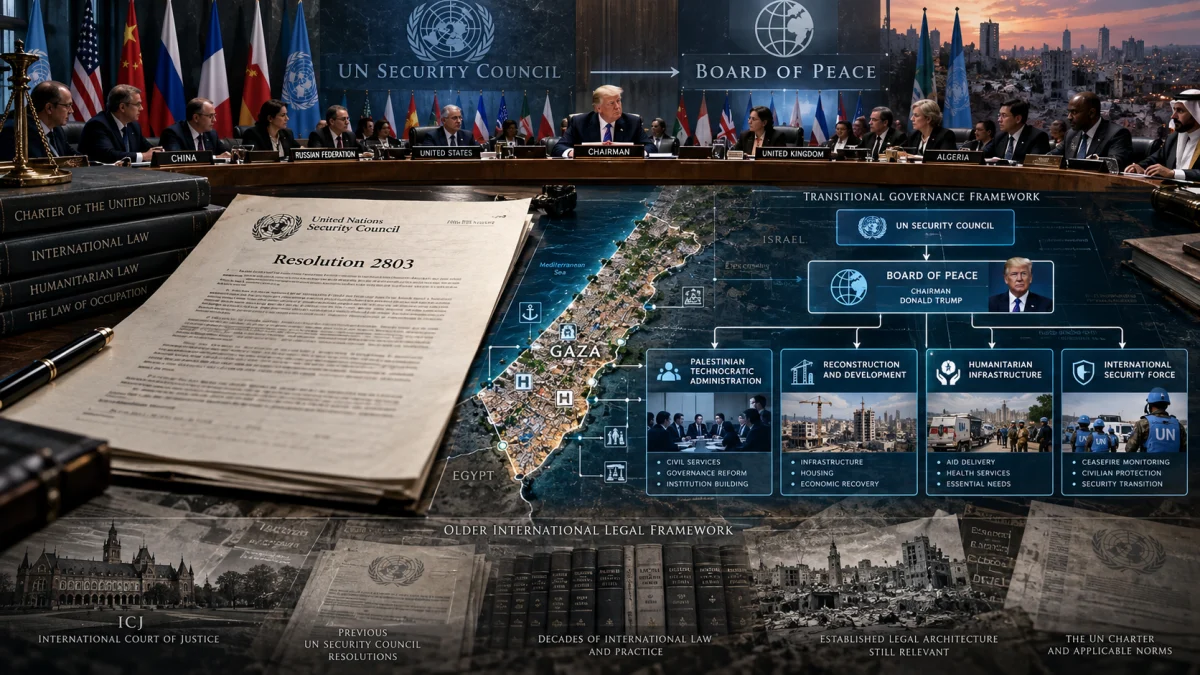
UN Security Council Resolution 2803 created a transitional governance architecture for Gaza in which a new international organization called the Board of Peace sits above a Palestinian technocratic administration, oversees major elements of reconstruction and governance, guides an international security force and operates under the chairmanship of Donald Trump.
The resolution does not contain a deed. Gaza did not become American territory. Palestinian sovereignty was not legally transferred to Trump.
But reducing the story to those corrections would miss what actually happened.
The Security Council authorized an externally controlled transitional system with powers reaching into governance, reconstruction, public services, humanitarian assistance, movement in and out of Gaza and security, while the eventual restoration of Palestinian Authority control was placed behind a series of conditions.
A later Board of Peace charter then went further. It named Trump personally as its inaugural chairman, gave him approval or veto authority over major decisions, allowed him to select and remove senior officials, made him the final authority on interpreting the charter, and expanded the organization’s stated mission far beyond Gaza.
That is the documentary foundation underneath Finkelstein’s deliberately provocative formulation that “President Trump owns Gaza. They gave it to him.”
The ownership language is rhetorical.
The concentration of authority is not.
What Norman Finkelstein Actually Said
In a September 25, 2026 appearance on The Tea with Myriam François, Finkelstein focused on Security Council Resolution 2803 and argued that it fundamentally disrupted the international legal framework that had governed the Palestine question for decades. The episode itself describes this section as examining “The UN Resolution That Changed Gaza’s Legal Status.” The Tea with Myriam François: Israel Has Been Told To Leave. Who Will Enforce It?
In the viral excerpt, Finkelstein says:
“President Trump owns Gaza. They gave it to him.”
He then argues that the General Assembly, Security Council, International Court of Justice and other UN institutions had spent decades developing a legal framework for Israel and Palestine, only for Resolution 2803 to effectively wipe that framework away.
That second claim needs considerably more qualification.
Resolution 2803 did not literally abolish previous Security Council resolutions, the UN Charter, occupation law, the Geneva Conventions, the International Court of Justice’s rulings or the Palestinian right to self-determination.
In fact, the resolution’s own preamble explicitly notes prior relevant Security Council resolutions concerning the Middle East and Palestine.
But Finkelstein is pointing to a genuine discontinuity: instead of building Gaza’s transition explicitly around the older architecture of occupation, Palestinian sovereignty and established UN formulas, Resolution 2803 created a new governing mechanism centered on the Trump plan and a non-UN body chaired by Trump.
That distinction matters.
What Resolution 2803 Actually Did
The Security Council adopted Resolution 2803 on November 17, 2025, by a vote of 13 in favor, none against and two abstentions, from China and Russia.
The resolution endorsed Trump’s Comprehensive Plan to End the Gaza Conflict and formally welcomed the Board of Peace as a “transitional administration with international legal personality.”
That phrase carries substantially more meaning than “reconstruction committee.”
Under paragraph 4, the Security Council authorized the Board and participating states to establish operational entities responsible for:
- transitional governance;
- supervision and support of a Palestinian technocratic administration;
- Gaza reconstruction and economic recovery;
- public services;
- humanitarian assistance;
- measures facilitating movement into and out of Gaza;
- and additional tasks considered necessary to implement the Comprehensive Plan.
Those entities operate under the Board of Peace’s “transitional authority and oversight.”
The Security Council separately authorized an International Stabilization Force, or ISF, operating under the strategic guidance of the Board.
Its mandate includes assisting with demilitarization, dismantling military infrastructure, permanently decommissioning weapons held by non-state armed groups, protecting civilians and humanitarian operations, supporting Palestinian police and securing humanitarian corridors.
The resolution authorizes the force to use “all necessary measures” consistent with international law.
That is an unusually extensive package of administrative and security authority.
So Does Trump “Own” Gaza?
No, not as a matter of property law or sovereignty.
Nothing in Resolution 2803 transfers title to Gaza.
Nothing declares Gaza American territory.
Nothing grants Trump Palestinian sovereignty.
Nothing gives the Board permanent territorial ownership.
That part of Finkelstein’s statement should therefore be understood as political rhetoric rather than a literal legal description.
But consider what the resolution actually establishes.
| Question | What the documents say |
|---|---|
| Did Trump receive ownership of Gaza? | No. There is no transfer of title or sovereignty. |
| Does Trump chair the body overseeing Gaza’s transition? | Yes. The Comprehensive Plan expressly places the Board of Peace under Trump’s chairmanship. |
| Does that body supervise Palestinian transitional governance? | Yes. Palestinian day-to-day administration operates within a system subject to Board oversight. |
| Can Board entities oversee reconstruction and public services? | Yes. Those functions are expressly authorized. |
| Can the system affect movement into and out of Gaza? | Yes. Paragraph 4 expressly includes measures facilitating movement. |
| Does the international security force operate under Board guidance? | Yes. The resolution says the ISF operates under the Board’s strategic guidance. |
| Did the UN abolish Palestinian sovereignty? | No. The resolution anticipates eventual Palestinian Authority control and refers to self-determination and statehood. |
| Has this entire system actually taken control inside Gaza? | No. Implementation remains incomplete as of September 2026. |
So “Trump owns Gaza” is legally inaccurate if treated literally.
“The Security Council authorized a Trump-chaired external body to exercise sweeping transitional authority over Gaza” is substantially closer to the documentary record.
That is already remarkable enough.
The Most Important Sentence in Resolution 2803 May Be About Palestinian Self-Determination
Resolution 2803 says the Board will exercise its transitional role until the Palestinian Authority has “satisfactorily completed its reform program” and can securely and effectively regain control.
It then says:
“After the PA reform program is faithfully carried out and Gaza redevelopment has advanced, the conditions may finally be in place for a credible pathway to Palestinian self-determination and statehood.”
That wording deserves attention.
Because Palestinian self-determination did not suddenly become a possible future aspiration in 2025.
The International Court of Justice had addressed it directly one year earlier.
In its landmark July 19, 2024 advisory opinion, the ICJ characterized Palestinian self-determination as a fundamental right and said Israel has an obligation not to impede Palestinians from exercising that right across the Occupied Palestinian Territory.
The Court specifically held that occupation cannot leave a population indefinitely suspended and uncertain while being denied self-determination. It also described the right as inalienable and said its existence cannot be made conditional by the occupying power.
The ICJ further found that the West Bank, East Jerusalem and Gaza constitute a single Palestinian territorial unit for purposes of that analysis.
This does not automatically make Resolution 2803 unlawful.
The Security Council is not Israel, and the resolution does not explicitly say Palestinians lack a right to self-determination until the Board grants one.
The tension is subtler.
The ICJ describes Palestinian self-determination as an existing legal right. Resolution 2803 describes a future “pathway” toward exercising self-determination and statehood that becomes credible only after reform and redevelopment conditions have been satisfied.
Those are not necessarily identical propositions.
But neither are they comfortably interchangeable.
This Is Where Finkelstein’s “80 Years of Law” Argument Has Real Substance
Finkelstein says Resolution 2803 effectively “whited out” decades of UN law.
Literally, it did not.
The older resolutions still exist. Resolution 2803 itself acknowledges previous relevant Security Council resolutions. International humanitarian law still applies. The UN Charter still applies. The ICJ advisory opinion still exists. A Security Council resolution cannot simply make peremptory norms of international law disappear because it does not repeat them.
Several legal analyses have made exactly this distinction: omission is consequential, but omission is not repeal.
What Resolution 2803 conspicuously does not do is rebuild its operative framework around many of the specific earlier resolutions that historically defined the Palestine question.
It does not expressly anchor the new governance structure to landmark resolutions such as Security Council Resolutions 242, 338 or 2334.
International-law scholar Marc Weller, writing for Chatham House shortly after the resolution was adopted, noted that multiple Security Council delegations raised precisely this concern. Chatham House analysis of Security Council Resolution 2803
The American Society of International Law likewise described the Board of Peace as a sui generis institution, rather than a UN subsidiary body, and identified serious unresolved questions over self-determination, occupation law and Security Council authority. American Society of International Law: Resolution 2803 and the Limits of Transition in Gaza
So Finkelstein’s wording is too absolute as a statement of black-letter law.
But his broader observation is stronger:
Resolution 2803 does not formally erase the existing legal framework. It constructs a new operational framework that largely works around it.
That is a much more defensible claim.
Resolution 2803 and the Board of Peace Charter Are Not the Same Thing
This is arguably the most important distinction missing from casual discussions of the issue.
There are actually two separate documents.
First came Security Council Resolution 2803, adopted in November 2025.
Then came the Board of Peace’s own founding charter, dated January 16, 2026. Official Board of Peace Charter
They should not be conflated.
The Security Council authorized the Board’s Gaza-related transitional role until December 31, 2027, subject to further Security Council action.
The Board’s later charter, however, does something considerably broader.
It does not even define its mission around Gaza.
Instead, Article 1 describes the Board of Peace as an international organization seeking to promote stability, restore governance and secure peace in “areas affected or threatened by conflict.”
A search of the charter itself reveals no Gaza-specific limitation.
That creates a critical distinction:
The Security Council gave the Board a particular mandate concerning Gaza. The Board’s members subsequently wrote themselves a charter describing a much broader international organization.
Those are not legally synonymous.
The Charter Also Gives Trump Personally Extraordinary Power
The charter becomes even more unusual when examining how the organization is governed.
Article 3.2 does not merely say the president of the United States will chair the organization.
It names Donald J. Trump personally as inaugural chairman and separately identifies him as the inaugural representative of the United States.
That distinction matters.
Under the charter:
- Board decisions require majority support and the chairman’s approval;
- Trump may cast a tie-breaking vote;
- he has exclusive authority to create, modify or dissolve subsidiary entities;
- he selects the Executive Board;
- Executive Board members can be removed and reappointed at his discretion;
- Executive Board decisions remain subject to his veto;
- he appoints his own successor;
- replacement of the chairman otherwise requires voluntary resignation or incapacity;
- the chairman determines when the organization should dissolve or be renewed;
- and the chairman is the final authority on the meaning, interpretation and application of the charter.
The chairman may also issue resolutions and directives on behalf of the organization.
None of that means Trump obtained sovereignty over Gaza.
It does mean that the international body placed at the center of Gaza’s transitional architecture later adopted an institutional constitution concentrating striking authority in Trump’s chairmanship.
And that second development cannot simply be attributed to the Security Council.
What Authority Came From the UN, and What Authority Did the Board Give Itself?
This distinction is essential.
The Security Council authorized:
Gaza-specific transitional administration, reconstruction mechanisms, public-service coordination, humanitarian functions, movement-related measures and a temporary International Stabilization Force.
That authority currently runs through December 31, 2027 unless the Council takes further action.
The later Board charter created:
A broader international organization with a potentially global peace-building mission, its own membership system, its own Executive Board, continuing organizational life, internal legal capacities and extensive chairman powers.
The Security Council did not expressly authorize Donald Trump to create a permanent global alternative peace organization exercising those powers around the world.
Legal commentators have therefore questioned whether the charter represents what amounts to mandate expansion beyond the Gaza-specific authority Resolution 2803 supplied.
That question has not been definitively resolved by an international court.
But the distinction itself is factual and important.
There Is Another Problem: Palestinian Administration Is Local, but Ultimate Transitional Authority Is External
The Comprehensive Plan says Gaza’s day-to-day government will be run by a technocratic Palestinian committee.
That point should not be omitted.
The National Committee for the Administration of Gaza, or NCAG, is composed of Palestinians and is intended to administer civil services.
That makes it inaccurate to say Trump personally makes every municipal decision in Gaza.
But the same architecture places the Palestinian committee beneath an external supervisory structure.
The Comprehensive Plan describes the committee as operating under the oversight and supervision of the Board of Peace, chaired by Trump. Resolution 2803 similarly establishes Board transitional authority over the operational entities carrying out the plan.
This is why the sovereignty question cannot be reduced to whether Palestinians occupy desks inside the administration.
A government can be staffed locally while consequential authority over financing, reconstruction, security, institutional design and political transition sits elsewhere.
International-law scholars have consequently focused less on the nationality of the technocrats than on who ultimately controls the transition and who decides when that transition ends.
Did Palestinians Consent to This Arrangement?
This question is more complicated than either side’s slogans suggest.
Resolution 2803 says the parties accepted the Comprehensive Plan, and several Arab and Muslim governments supported the Security Council initiative. The Palestinian Authority also welcomed regional support for the framework.
That political support mattered to Security Council members considering the resolution.
But legal analysts have distinguished that support from a formal transfer of sovereign authority by Palestine.
Chatham House noted that the Palestinian Authority did not formally invite the mission in the manner a sovereign government might invite an international administration.
The American Society of International Law similarly identified the lack of a clear Palestinian-consent mechanism as one of the framework’s central legal problems.
This is one reason comparisons with earlier UN transitional administrations such as East Timor or Kosovo are imperfect.
The superficial structure may look familiar.
The legal and political foundations are not identical.
Did Resolution 2803 Violate International Law?
There is currently no final judicial ruling answering that question.
That distinction matters.
Critics have advanced serious legal arguments.
UN Special Rapporteur Francesca Albanese argued shortly after adoption that Resolution 2803 conflicts with Palestinian self-determination and risks replacing established legal obligations with externally controlled governance. That is her legal assessment, not a binding court judgment. UN expert statement on Resolution 2803 and Palestinian self-determination
ASIL’s analysis raises a related question: Security Council authority is broad, but it is not generally understood to permit the Council to override peremptory norms such as self-determination.
Other international-law analyses have focused on the resolution’s ambiguous Chapter VII basis, the extent of authority delegated to a body outside the UN system and the accountability structure surrounding the international force.
Supporters of the framework point to a different reality.
The Security Council was trying to preserve a ceasefire, establish a mechanism for reconstruction, facilitate humanitarian assistance, demilitarize Gaza, obtain Israeli withdrawal and eventually restore Palestinian governance.
Resolution 2803 itself repeatedly requires actions to remain consistent with international law, and it expressly contemplates the Palestinian Authority ultimately reassuming control.
Both things can be true:
A transitional arrangement may pursue legitimate goals while still raising serious questions about the legality, accountability and distribution of authority used to pursue them.
That is the actual debate.
There Is an Important Reality Check: Trump Does Not Currently Exercise Full Control Over Gaza
The legal architecture on paper should not be confused with operational reality.
A new United Nations report dated September 24, 2026 says the Board of Peace and the Palestinian NCAG were constituted in January and have engaged in extensive planning.
But the NCAG has still not entered Gaza to assume its governance functions.
The International Stabilization Force has likewise not yet deployed personnel inside Gaza.
Implementation of Resolution 2803 therefore remains incomplete.
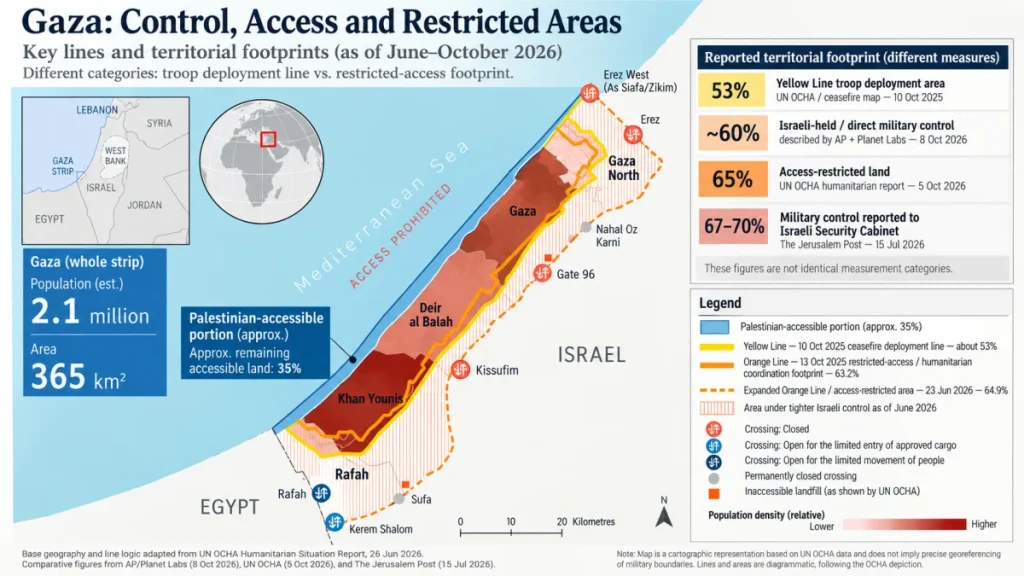
The same UN report says military activity continues, Hamas and other armed groups have not disarmed and substantial portions of Gaza remain inaccessible or heavily restricted.
That gives us three separate concepts that should never be collapsed:
legal authorization, institutional architecture and actual control on the ground.
Resolution 2803 created the first.
The Board charter built the second.
The third remains contested and incomplete.
So Was Finkelstein Wrong?
The most precise answer is:
Finkelstein’s statement that Trump “owns Gaza” is not literally correct as a description of sovereignty or property law. His broader argument that Resolution 2803 placed extraordinary authority over Gaza’s political transition into a Trump-chaired external structure is substantially supported by the documents.
His claim that the resolution “abolished” 80 years of international law is also too literal if read as a formal legal proposition.
Earlier resolutions remain in force. Palestinian self-determination did not disappear. The ICJ’s advisory opinion did not vanish. Occupation law did not cease to exist.
But Finkelstein has identified a real structural break.
Instead of beginning with those established legal principles and asking how to implement them, Resolution 2803 begins with Trump’s Comprehensive Plan and authorizes a new external institution to administer the transition.
Palestinian self-determination appears not as the starting legal premise of the system but as something toward which a future “credible pathway” may emerge once reform, redevelopment and security conditions have been satisfied.
That difference is not semantic.
It goes directly to the question of who possesses authority while Palestinians wait.
The Part of Finkelstein’s Argument That Should Be Taken Most Seriously
sherafy.com has previously discussed why Finkelstein’s published work performed unusually well in our source-validation research while also emphasizing that strong source performance is not a license to accept every formulation without verification. sherafy.com: Reflections on Verification, Truth, and Norman Finkelstein
This is a good example of why that distinction matters.
If the viral quote is fact-checked at its most literal level, the result is easy:
No, Trump does not own Gaza.
True.
And woefully incomplete.
The harder question is what powers the international system actually placed behind him.
Those documents show a Trump-chaired Board overseeing the transitional framework; Palestinian civil administration nested inside that system; reconstruction, public services and movement falling within Board-authorized structures; a security force operating under Board guidance; Palestinian Authority control deferred until specified conditions are met; and a subsequent charter giving Trump extensive personal authority over the institution itself.
The UN did not hand Trump a deed to Gaza.
It handed an institution chaired by Trump an extraordinary role in deciding how Gaza is governed during one of the most consequential political transitions in Palestinian history.
Those are different claims.
The second one is the story.
References and Further Reading
Primary Documents
UN Security Council Resolution 2803 (2025)
United Nations: Security Council Resolution 2803 and Comprehensive Plan to End the Gaza Conflict
The primary Security Council record establishing the Board of Peace’s Gaza mandate, authorizing transitional administrative entities and the International Stabilization Force, and setting the current authorization through December 31, 2027.
Board of Peace Charter
Official founding Charter of the Board of Peace
The January 2026 organizational charter naming Donald Trump as inaugural chairman and defining the Board’s governance, chairman powers, membership, legal personality and broader peace-building mission.
International Court of Justice Advisory Opinion, July 19, 2024
ICJ: Legal Consequences Arising from Israel’s Policies and Practices in the Occupied Palestinian Territory
The Court’s primary opinion addressing the legal status of the Occupied Palestinian Territory, Israel’s continued presence and the Palestinian people’s right to self-determination.
September 2026 UNSCO Report
United Nations: Report to the Ad Hoc Liaison Committee, September 2026
Provides the most current UN assessment located for this article on implementation of Resolution 2803, including the status of the Palestinian transitional committee and International Stabilization Force.
Legal Analysis
Marc Weller, Chatham House: What Is Security Council Resolution 2803, and What Does It Mean for the Trump Gaza Plan?
Read the Chatham House legal analysis
Detailed examination of the resolution’s authority, possible Chapter VII basis, Palestinian participation, security mandate and relationship to previous UN frameworks.
American Society of International Law: The Security Council as Architect? Resolution 2803, the Board of Peace, and the Limits of Transition in Gaza
Read the ASIL analysis
Examines the Board as a sui generis international institution and analyzes the framework against occupation law and the Palestinian right to self-determination.
Just Security: Analysis of Resolution 2803 and the International Stabilization Force
Read the Just Security analysis
Explores the disputed Chapter VII foundation and legal implications of the international security mandate.
Interview and sherafy.com Context
The Tea with Myriam François: Israel Has Been Told To Leave. Who Will Enforce It?
Listen to the September 25, 2026 Norman Finkelstein interview
The interview from which the viral Resolution 2803 comments discussed in this article originate.
sherafy.com: Reflections on Verification, Truth, and Norman Finkelstein
Read our previous examination of Finkelstein as a research source
Explains sherafy.com‘s earlier source-validation work involving Finkelstein’s scholarship and the distinction between factual reliability and rhetorical framing.
sherafy.com Israel-Palestine & Gaza Knowledge Hub
Explore the Israel-Palestine research collection
Our central index for evidence-driven reporting and explainers on Gaza, Israel, Palestine and the international legal framework surrounding the conflict.
Editorial currency note: This article reflects the legal documents and implementation status available through September 28, 2026. Resolution 2803 currently authorizes the Board of Peace and associated international presences through December 31, 2027, subject to further Security Council action. The governance, security and implementation status may change substantially before that date.