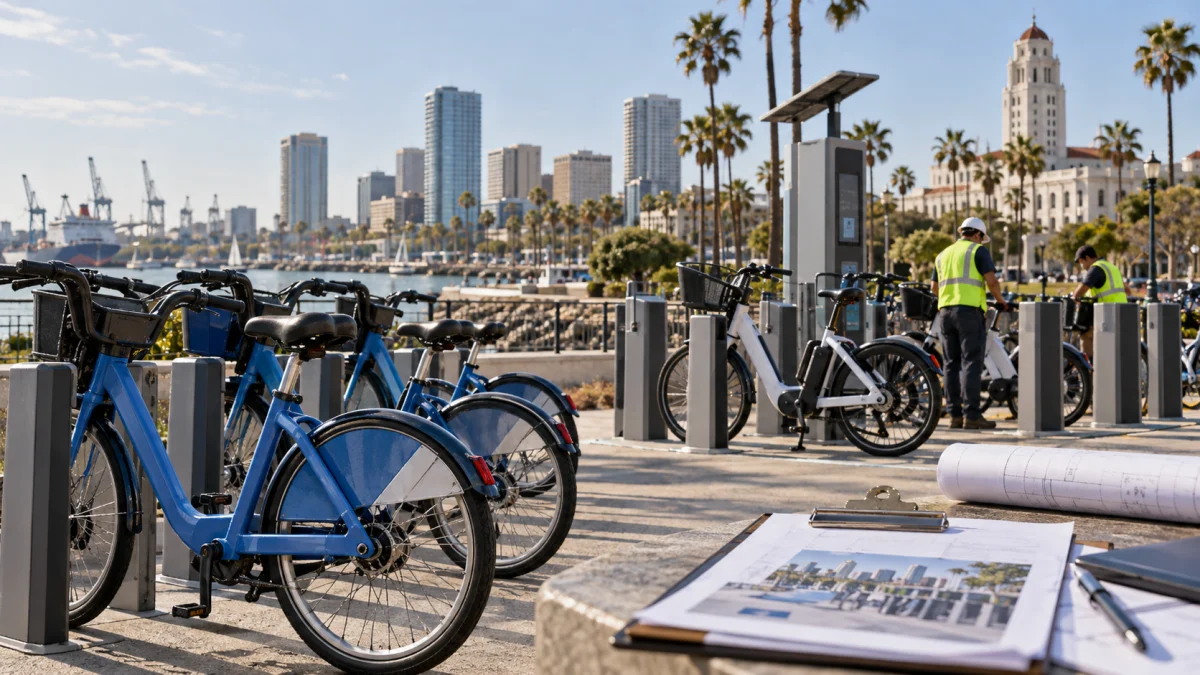
Long Beach is scheduled to decide on October 6, 2026, whether to award Drop Mobility California LLC a three-year contract worth up to $25,681,170 to operate, maintain and modernize the city’s BikeShare program. At the same meeting, city staff is asking the council to extend longtime local operator Pedal Movement’s existing contract through December 31, 2026, apparently allowing time for the current system to continue during the transition.
The controversy spreading among Long Beach residents contains some important truths. Pedal Movement has operated the local BikeShare program since 2017. The Long Beach company also performed major refurbishment work on more than 1,000 bikes acquired from other cities. And the proposed replacement contractor is identified on the council agenda as being from San Francisco.
But several claims circulating online go further than the evidence supports.
The proposed $25.7 million contract is not simply Pedal Movement’s existing maintenance job handed to another company at a much higher price. Long Beach’s new procurement combines bikes, e-bike technology, software, infrastructure, local operations, maintenance, customer service and modernization under a single turnkey contract. Public records also contradict claims that Drop Mobility has no real bike-share experience.
The most important question is therefore not whether Pedal has served Long Beach or whether Drop has ever operated bike-sharing systems. Both can be documented.
The harder question is why Long Beach staff recommends changing operators, how the city determined that Drop satisfied the RFP’s unusually specific experience requirements, and how the competing proposals were actually evaluated. The procurement record reviewed by sherafy.com shows the required qualifications and the city’s recommendation, but it does not provide enough bidder-by-bidder detail to reconstruct that decision from beginning to end.
What Long Beach is voting on October 6
The Long Beach City Council agenda for October 6 contains two related BikeShare items under unfinished business.
| Item | Proposed action |
|---|---|
| Drop Mobility California LLC | Award RFP PW-25-631 for BikeShare operation, maintenance and modernization: $23,346,518, plus a 10% contingency of $2,334,652, for a maximum of $25,681,170. Initial term: three years, with two optional one-year renewals. |
| Pedal Movement Inc. | Add $709,586, plus a 10% contingency of $70,959, to the existing contract, bringing its authorized maximum to $8,261,369, and extend it through December 31, 2026. |
The same items appeared on the September 22 council agenda but were continued to October 6. The public records reviewed for this article do not establish why the council continued them, so it would be premature to describe the October meeting as a “revote” or infer that the delay reflects a procurement problem.
As of October 1, the Drop contract has not been finally approved by the council.
The $25.7 million contract is not simply Pedal Movement’s maintenance job at a higher price
This distinction is central to understanding the controversy.
Long Beach’s current BikeShare system is split between separate contracts. According to the city’s PW-25-631 procurement record, Pedal Movement handles local operations and maintenance, while Mobility Cloud provides the existing Social Bicycles, or SoBi, hardware and software platform. The City of Long Beach owns the bikes.
When the city prepared the new RFP, it described an existing network of 112 parking hubs and approximately 1,042 racks. About 650 beach-cruiser bikes were operational, while roughly 250 more required major maintenance. The system recorded more than 80,000 rides in 2024.
The new solicitation is designed to replace that fragmented structure with one integrated contractor responsible for much more than maintaining the existing blue bicycles.
What Long Beach has now versus what the new RFP seeks
| Current structure | New PW-25-631 structure |
|---|---|
| Pedal Movement performs local operations and maintenance | One prime contractor manages the integrated system |
| Mobility Cloud provides current hardware/software platform | Contractor provides the modernized technology platform |
| Predominantly pedal bikes | Baseline deployment centered on approximately 700 pedal-assist e-bikes, while retaining pedal-bike capability |
| Existing hub/rack network | New and upgraded parking and electrification infrastructure |
| Separate operational and technology responsibilities | Operations, maintenance, bikes, software, customer service, data and reporting integrated under one contract |
| Existing local equity program | Continued equity requirements and non-digital access options |
The RFP also calls for multilingual and accessible digital services, battery operations, fleet rebalancing, customer support, data reporting, scalable capacity for major events and planning for demand associated with the 2028 Olympic and Paralympic Games.
Long Beach would continue to own the physical equipment purchased with city funds. The procurement also contemplates retaining existing pedal bicycles where useful and allows vendors to propose retrofit concepts that could extend the life of older bikes.
That does not answer whether Drop is the best contractor or whether the proposed price is justified. It does mean that comparing the full $25.68 million modernization contract directly with Pedal’s current operations-and-maintenance work would be an apples-to-oranges comparison.
Pedal Movement’s Long Beach record is well documented
The local company’s history with BikeShare is not merely a claim made by supporters.
A 2019 Long Beach council record says three proposals were received under an earlier competitive solicitation for BikeShare operations and maintenance. A city selection committee determined that Pedal Movement, identified as a Long Beach firm, was the most qualified proposer.
The city specifically cited Pedal’s experience with the Social Bikes equipment, its prior operation of the Long Beach system and its familiarity with the city and program.
A later 2023 council record states that BikeShare launched in 2016 and that Pedal Movement began operating the program in 2017 when Long Beach took ownership from the original operator.
Pedal really did refurbish more than 1,000 bikes
One of the strongest claims in the viral local discussion is also one of the easiest to verify precisely.
In March 2021, the city authorized up to $872,911 for Pedal Movement to refurbish 1,007 bicycles acquired from New Orleans and Santa Monica as part of Long Beach’s BikeShare expansion.
So the general claim that local Pedal employees helped put previously used or non-operational bicycles back into service has documentary support. The public record is stronger than the vague social-media version: the city identified the number of bikes, where they came from and the amount authorized for the work.
What the new RFP required bidders to prove
The most consequential part of the procurement may be its minimum qualifications.
Long Beach did not simply ask whether a company sold e-bikes or software. PW-25-631 required substantial municipal or regional bike-share experience.
| Requirement | What the RFP required |
|---|---|
| Bike-share experience | At least three years of demonstrated municipal or regional bike-share experience |
| Vehicle types | Experience deploying and managing both pedal and pedal-assist bicycles |
| Large-fleet experience | A proven track record managing fleets of at least 1,000 vehicles in urban environments comparable to Long Beach |
| Initial scale | Capacity to deploy at least approximately 700 pedal-assist bicycles and scale for major events |
| Local facility | A plan for a physical operations facility within Long Beach |
| Local field operations | W-2 local employees or a qualified local subcontractor for maintenance, rebalancing, battery work, inspections and other field operations |
The evaluation was also not a lowest-price competition.
The RFP assigned:
- 40% to method of approach;
- 25% to organizational capacity and experience;
- 20% to communications and reporting; and
- 15% to reasonableness of cost.
That weighting matters. A bidder could theoretically be more expensive and still rank higher if evaluators considered its technical approach, organizational capacity or implementation plan substantially stronger.
It also makes the underlying score sheets and qualification review especially important to anyone trying to understand why staff selected the recommended contractor.
Does Drop Mobility actually have BikeShare experience?
Yes. Public records contradict the claim that Drop Mobility does not run or participate in real bike-share programs.
That does not automatically establish that Drop was the right choice for Long Beach, but its municipal experience is not fictional.
Rialto, California
In 2021, the City of Rialto evaluated five companies for its bike-share program: BCycle, Drop Mobility, Koloni, Pedal Movement and Tandem Mobility. According to Rialto’s official council record, the city shortlisted BCycle, Drop and Koloni, then selected Drop Mobility after interviews and reference checks for installation, operation and maintenance of the system.
That record is notable for another reason: Pedal Movement and Drop Mobility have competed for a California municipal bike-share contract before.
Rialto’s system, however, is much smaller than Long Beach’s. It should not be treated as proof by itself that Drop satisfies Long Beach’s 1,000-vehicle comparable-urban-system requirement.
Vail, Colorado
The Town of Vail reported in May 2026 that its regional Shift Bike system had entered its fifth season with 165 e-bikes and 35 hubs and that the system is run by Drop Mobility, which supplies the bikes, software and operational expertise.
Again, that establishes real operating experience, but not a 1,000-bike Long Beach-scale system by itself.
New Orleans
The City of New Orleans says its Blue Bikes program relaunched in 2021 through a partnership involving local nonprofit Blue Krewe and Drop Mobility. In that structure, Drop has served as a technology and vehicle partner rather than functioning as the sole local operator.
The distinction matters because “participates in a large bike-share program” and “personally performs every local operating function” are not the same claim.
East Los Angeles
In July 2026, the Los Angeles County Board of Supervisors authorized a contract with Drop Mobility California LLC for the East Los Angeles Demonstration Bicycle Sharing Program, with a maximum contract amount of approximately $1.9 million.
Taken together, these records make one conclusion straightforward: Drop has legitimate municipal bike-share experience.
But they do not resolve the more specific Long Beach procurement question.
The biggest unanswered question is how Long Beach evaluated the winning proposal
Long Beach’s public procurement page provides a useful chronology but not, in the records reviewed by sherafy.com, a complete public reconstruction of how each proposal scored.
The PW-25-631 procurement page shows the following sequence:
| Date | Procurement event |
|---|---|
| Dec. 16, 2025 | RFP PW-25-631 released |
| Mar. 3, 2026 | Final bid-opening/proposal deadline after schedule changes |
| Apr. 17 | Notice of Intent to Short List posted |
| May 11 | Notice of Intent posted |
| May 15 | Update to Notice of Intent to Award |
| May 28 | Second update to Notice of Intent to Award |
| June 3 | Third update to Notice of Intent to Award |
| Sept. 22 | Contract items appear before council and are continued |
| Oct. 6 | Drop award and Pedal extension scheduled as unfinished business |
Those repeated notice updates are worth examining, but their existence is not evidence of misconduct, a protest or a reversed decision. The reason for each update has to come from the underlying documents, not inference from the timestamps.
More importantly, the material reviewed for this article does not provide a bidder-by-bidder public accounting sufficient to answer several obvious questions:
- Which companies submitted complete proposals to PW-25-631?
- Which companies reached the shortlist?
- How did each shortlisted proposal score under the 40/25/20/15 evaluation framework?
- What evidence did evaluators accept as satisfying the requirement for experience managing at least 1,000 vehicles in a comparable urban environment?
- How did the cost proposals compare?
- What changed, if anything, across the three updates to the notice of intent?
This is an important limitation on what can responsibly be concluded.
The city’s recommendation establishes that staff believes Drop should receive the contract. The RFP establishes what bidders were supposed to demonstrate. Drop’s public record establishes relevant bike-share experience. What the accessible record does not yet show is the complete bridge between those facts: the comparative evaluation that produced the recommendation.
That is the document trail that would most clearly resolve the current public debate.
Did Long Beach’s local-business preference apply?
The RFP contains a meaningful local-business preference, but it is easy to overstate what that means.
Under the solicitation, a qualifying Long Beach commercial brick-and-mortar business could receive an additional 10 percentage points in the evaluation. A qualifying Long Beach home-based business could receive five points.
But the preference was not automatic. The bidder had to request it in its proposal and provide the required Long Beach business-license documentation. The RFP also says the preference does not apply to tidelands-funded solicitations and may not apply when certain outside funding sources restrict local preferences.
Pedal Movement has repeatedly been identified in city records as a Long Beach company and was described as a local/SBE firm in the 2019 award. That history does not by itself prove that the company submitted a proposal in the current procurement, requested the 2026 preference or was eligible for it under the funding structure of PW-25-631.
The records reviewed for this article do not establish those points.
So the responsible question is not, “Why did the city ignore Pedal’s automatic 10-point advantage?” There is no basis yet to assume an automatic advantage existed.
The answerable question is: If a qualifying local bidder requested the preference in PW-25-631, was the preference applicable and how was it reflected in the final evaluation?
Would BikeShare jobs actually leave Long Beach?
This is where the viral framing most needs precision.
A change in contractors can plainly put incumbent Pedal Movement employees whose work depends on the BikeShare contract at risk. That concern is real even if the citywide BikeShare program continues.
But the new RFP does not propose eliminating local BikeShare operations or moving all field work to San Francisco.
It specifically requires the selected contractor to use local W-2 employees or subcontract local operations to a local vendor for work including maintenance, rebalancing, battery swapping, hub inspections and other field services. The contractor or its local subcontractor must also maintain a physical facility within Long Beach city limits for maintenance, battery charging and other operations.
That means two different questions are being blurred together in some online discussion:
- Could existing Pedal employees lose their current jobs if Pedal loses this work? Yes, depending on what work Pedal retains and whether the incoming operator offers them positions.
- Does the Drop contract eliminate local BikeShare jobs and move the operation out of Long Beach? The RFP says the opposite: local operations and a Long Beach facility are required.
What remains unknown from the records reviewed here is highly relevant to workers: whether Drop has committed to hire incumbent Pedal employees, how many local positions its operating plan requires, what the job classifications and wages would be, and whether Drop intends to operate directly or through a Long Beach subcontractor.
Those questions should be answered before anyone treats “all the jobs are leaving Long Beach” or “nobody’s job is at risk” as established fact.
What happens to the familiar blue bikes?
Long Beach owns the BikeShare bicycles. Pedal Movement does not.
That matters because replacing the operations contractor does not necessarily mean every existing bike disappears.
When the RFP was prepared, the city estimated that approximately 650 existing beach cruisers were operational and another 250 required major maintenance. The modernization plan calls for a substantial new pedal-assist fleet while preserving the ability to use pedal bicycles. The solicitation also permits concepts for retrofitting or extending the useful life of existing equipment.
So the likely transformation is broader than simply removing one company’s bicycles and replacing them with another company’s bicycles. The city is procuring a new operating and technology platform around assets it owns, while adding a large e-bike component and updated infrastructure.
Exactly how many current bikes ultimately remain in regular service will depend on the final implementation plan.
What is verified, contradicted and still unknown?
| Claim or question | What the public record currently shows |
|---|---|
| Pedal Movement has operated Long Beach BikeShare since 2017. | Verified. Long Beach says Pedal began operating the program in 2017. |
| Pedal refurbished old bikes for the city. | Verified. The city authorized refurbishment of 1,007 bikes acquired from New Orleans and Santa Monica. |
| Drop Mobility has no real bike-share experience. | Contradicted. Municipal records document Drop’s work in Rialto, Vail, New Orleans and other systems, plus a 2026 Los Angeles County contract. |
| Drop is an out-of-town company. | Verified in the council record. The October 6 agenda identifies Drop Mobility California LLC as being “of San Francisco, CA.” |
| The city is paying $25.7 million for the same maintenance work Pedal already does. | Misleading. PW-25-631 is a broader turnkey modernization contract covering equipment, e-bikes, technology, infrastructure, software, operations and maintenance. |
| All BikeShare jobs will leave Long Beach. | Not established. Current Pedal jobs may be at risk, but the new RFP requires local field operations and a Long Beach facility. |
| Pedal automatically gets a 10-point local preference. | Not established. The preference must be requested and may depend on funding eligibility. The reviewed record does not establish Pedal’s status in this RFP. |
| Drop clearly failed the 1,000-vehicle experience requirement. | Not established. Public sources show relevant experience, but the reviewed record does not show the city’s bidder-specific qualification analysis. |
| The public documents reviewed here fully explain why Drop was selected. | No. They establish the requirements, timeline and recommendation, but not a complete bidder-by-bidder scoring reconstruction. |
That last distinction is important. Lack of a complete evaluation record in the materials reviewed by sherafy.com is not evidence that evaluators lacked a basis for their decision. It means the public cannot reconstruct that basis from these records alone.
What happens next?
The Drop award and Pedal extension are scheduled for the October 6, 2026 Long Beach City Council meeting as unfinished business.
If the council approves the recommended actions, Pedal’s current contract would run through the end of December while the city moves toward the new integrated system. The Drop contract would initially run for three years, with two additional one-year options available to the city.
The most useful records to watch next are not more social-media posts. They are the proposal evaluation sheets, shortlist documents, bidder qualification records, cost proposals, local-preference determinations and any transition plan describing local staffing.
Those documents can answer questions that neither supporters nor critics of the proposed change should have to guess about.
Long Beach BikeShare contract FAQ
Who currently operates Long Beach BikeShare?
Pedal Movement has handled Long Beach BikeShare’s local operations and maintenance since 2017. The current system also relies on Mobility Cloud for its existing SoBi technology platform. Long Beach owns the bicycles.
Is Long Beach replacing Pedal Movement?
City staff is recommending a new integrated BikeShare contract with Drop Mobility. At the same time, staff wants to extend Pedal’s existing contract through December 31, 2026. If the Drop contract is approved and implemented as proposed, Drop would replace the current operating structure rather than simply become another vendor alongside Pedal indefinitely.
How much is the proposed Drop Mobility contract?
The recommended three-year contract is $23,346,518, with a 10% contingency of $2,334,652, for a maximum initial authorization of $25,681,170. The city would also have two optional one-year renewals.
Does Drop Mobility operate other bike-share programs?
Yes. Public municipal records document Drop’s involvement in multiple bike-share systems, including direct operating roles and technology or vehicle partnerships. Examples include Rialto, Vail and New Orleans, as well as a 2026 Los Angeles County contract for East Los Angeles.
Will BikeShare still employ people in Long Beach?
The RFP requires local field operations and a physical Long Beach operations facility. It allows the contractor to use local W-2 employees or a qualified local subcontractor. What is not yet established in the public records reviewed here is whether current Pedal employees would be offered those jobs.
Does the city have to choose a Long Beach company?
No. The RFP uses a weighted competitive evaluation. Qualifying local businesses can receive a preference when the program applies and they request it correctly, but being local does not automatically guarantee the contract.
What is PW-25-631?
PW-25-631 is Long Beach’s solicitation for a new integrated citywide BikeShare program covering modernization, vehicles, technology, operations and maintenance.
When is the City Council vote?
The proposed Drop award and Pedal extension are scheduled for the October 6, 2026 Long Beach City Council meeting.
References and Further Reading
Primary Long Beach records
-
Long Beach RFP PW-25-631 procurement page — Official procurement record containing the BikeShare solicitation timeline, addenda, shortlist notice and notices of intent.
-
Long Beach City Council agenda, October 6, 2026 — Official agenda containing the recommended Drop Mobility award and Pedal Movement contract extension.
-
Long Beach City Council agenda, September 22, 2026 — Official agenda showing the BikeShare items before they were continued to October 6.
-
2019 Pedal Movement BikeShare operations award — City record describing the earlier competitive procurement, three proposals received and the city’s selection of Pedal Movement as the most qualified proposer.
-
2021 authorization to refurbish 1,007 BikeShare bicycles — Primary record documenting Pedal Movement’s refurbishment work on bikes acquired from New Orleans and Santa Monica.
-
2023 Pedal Movement operations and maintenance contract — City record summarizing Pedal’s operation of Long Beach BikeShare since 2017 and the then-current operating arrangement.
Records documenting Drop Mobility experience
-
City of Rialto bike-share contract record — Official municipal record documenting a five-company competition in which Rialto selected Drop Mobility for bike-share installation, operation and maintenance.
-
Town of Vail: Shift Bike enters fifth season — Municipal update identifying Drop Mobility as the operator of the regional Shift Bike e-bike system.
-
City of New Orleans Blue Bikes program — City overview of the Blue Bikes program and its relaunch partnership involving Blue Krewe and Drop Mobility.
-
Los Angeles County Board of Supervisors agenda, July 21, 2026 — Official county record authorizing a contract with Drop Mobility California LLC for the East Los Angeles Demonstration Bicycle Sharing Program.
Editorial currency note
This article reflects public records reviewed through October 1, 2026. The proposed Drop Mobility contract was still pending a City Council decision scheduled for October 6. Contract status, council action, transition plans and publicly available procurement records may change after publication.