
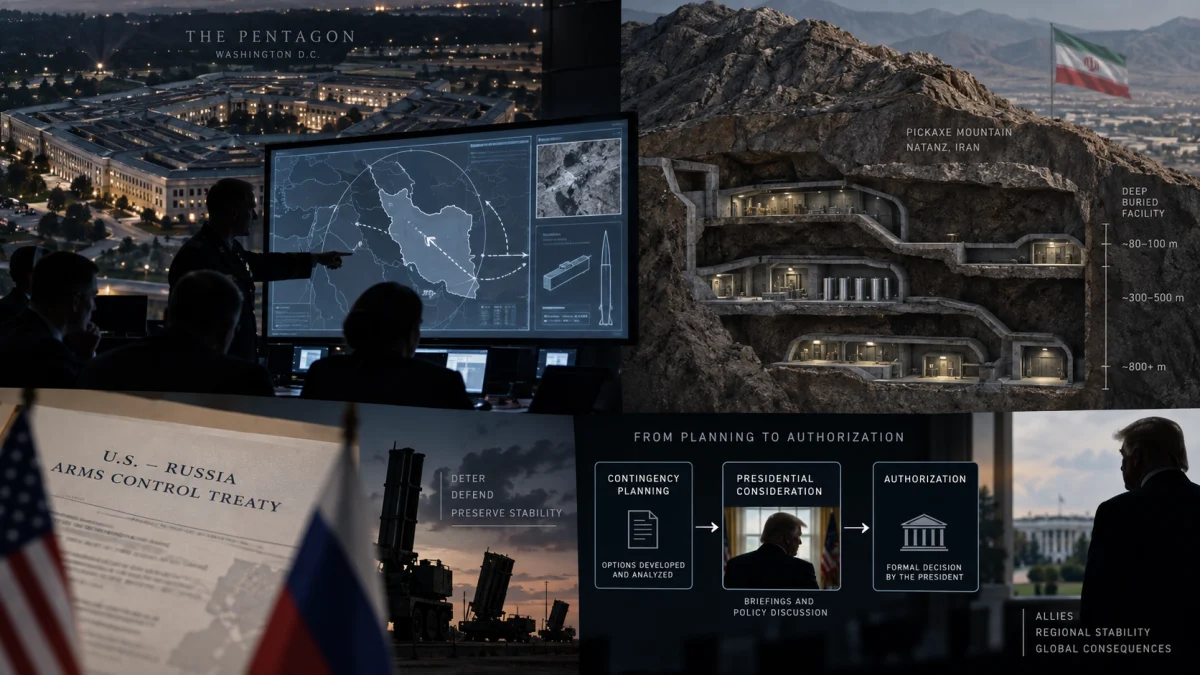
There is no public evidence that President Donald Trump has authorized, decided upon or is imminently preparing a nuclear strike on Iran. The Pentagon has not publicly confirmed such an attack plan, and Trump was directly asked on August 31, 2026, whether he had ruled out using a nuclear weapon against Iran. He said that he had and that he saw no reason to use one.
But dismissing the entire nuclear-planning story as fabricated would also be wrong.
The Pentagon is conducting a real nuclear-strategy review. Senior officials have publicly said they want to give the president additional limited nuclear options that are credible enough to be usable in an extreme crisis. Iran has also appeared for years in specialist reconstructions of U.S. nuclear contingency planning. And on August 28, Tucker Carlson alleged that offensive nuclear options for Iran had appeared in Pentagon meetings and slide presentations. The Daily Caller News Foundation subsequently reported that it independently confirmed Carlson received that information from an anonymous senior U.S. official with knowledge of the subject.
That makes the underlying subject legitimate.
What it does not establish is that Trump has approved such an option, that the alleged presentation represented anything more than contingency planning, or that a nuclear mission is being prepared for execution.
The viral version circulating online also contains several major factual errors. It confuses two different U.S.-Russian nuclear treaties, incorrectly says America has essentially run out of conventional military options, presents Iranian claims about a new missile as proven fact, and links the war to an alleged plan to destroy al-Aqsa Mosque and construct a Third Temple without evidence establishing that causal chain.
The most defensible conclusion as of September 9, 2026, is therefore more complicated:
Iran-specific U.S. nuclear contingency planning is credible and may be receiving renewed attention during the current war. There is not currently enough public evidence to conclude that a nuclear strike has moved from planning into presidential consideration, authorization or imminent execution.
What is actually verified, alleged and unsupported?
| Claim | Evidence status | What the evidence shows |
|---|---|---|
| Trump is “about to nuke Iran” | Not supported | No authenticated public evidence shows authorization or execution preparations, and Trump publicly ruled nuclear use out on August 31. |
| The Pentagon is reconsidering U.S. nuclear strategy | Verified | Officials publicly described a nuclear-strategy review in March 2026. |
| The Pentagon wants more limited nuclear-use options | Verified | Under Secretary Elbridge Colby said planners want “rationally employable, limited options” that expand presidential decision space. |
| Iran appears in U.S. nuclear contingency planning | Well-supported specialist assessment | Federation of American Scientists researchers identify Iran among the adversaries covered by OPLAN 8010-12. The plan’s current details remain classified. |
| Pentagon slides proposed nuclear strikes on Iran | Source-backed allegation, not independently authenticated | Carlson made the claim; DCNF confirmed that his information came from an anonymous senior U.S. official, but did not publish or authenticate the slides themselves. |
| Former Rep. Marjorie Taylor Greene said nuclear use was being discussed | Real allegation, not confirmation | Greene publicly said she knew nuclear use against Iran was being discussed, but did not provide documentary evidence or explain her source. |
| The 1987 INF Treaty “just expired” | False | The INF Treaty terminated on August 2, 2019. |
| A U.S.-Russian nuclear treaty did expire in 2026 | True | New START reached its expiration date on February 5, 2026. It was a different treaty covering strategic forces. |
| America is running out of missile interceptors | Substantially true | Independent modeling and anonymous-source reporting indicate severe depletion. |
| America has no conventional options left | False | Stocks of some systems are badly depleted, but the United States retains extensive conventional capabilities and continues conventional operations. |
| Iran has a missile that defeats every U.S. interceptor | Not established | Iran claims improved ability to defeat defenses; independent evidence does not establish invulnerability. |
| The war was timed to allow destruction of al-Aqsa and construction of a Third Temple | Unsupported | Real disputes exist over the Temple Mount/Haram al-Sharif, but no credible evidence establishes this war-and-treaty conspiracy. |
What the Pentagon has actually changed
The most important factual foundation underneath the viral claim is real.
At a March 17, 2026 House Armed Services Strategic Forces Subcommittee hearing, Assistant Secretary of Defense Robert Kadlec said the department, under Under Secretary Elbridge Colby and STRATCOM commander Adm. Richard Correll, was conducting a “nuclear strategy review.”
Kadlec described the review primarily as a response to what defense officials call the “two-peer problem”: the United States increasingly has to account simultaneously for the nuclear forces of Russia and China. He also specifically cited New START’s February expiration and questions about whether existing modernization programs would be sufficient.
That chronology immediately contradicts one part of the viral narrative. The review did not suddenly begin within the previous 30 days in response to Iran.
It was publicly acknowledged in March.
The review became more consequential on August 5, when Colby explained its strategic philosophy at the U.S. Strategic Command Deterrence Symposium.
Rather than focusing solely on large strategic weapons whose use could trigger catastrophic retaliation, Colby said the United States needs “rationally employable, limited options” that can manage escalation and give a president credible choices in a regional crisis. He also identified a regional conventional conflict escalating into local nuclear use as the nuclear scenario that worried him most.
This should not be interpreted as an announcement that the United States wants to start a nuclear war. Colby presented these capabilities as deterrence tools: an adversary should not believe it can use a limited nuclear weapon while assuming the United States would refuse to respond because its only alternatives were doing nothing or launching a vastly disproportionate strategic attack.
Still, the policy consequence is important.
A nuclear option deliberately designed to be more credible and limited is, by definition, intended to be a more realistic presidential option than an overwhelmingly destructive strategic exchange.
Whether that ultimately strengthens deterrence or lowers practical barriers to nuclear use is a legitimate strategic debate. What the public record establishes is that the Pentagon wants a broader menu of limited options.
What it does not establish is that the review was designed around Iran.
Iran was already part of U.S. nuclear contingency planning
Another important fact gets lost when the story is framed as though the Pentagon suddenly placed Iran on a nuclear target list this summer.
Researchers with the Federation of American Scientists’ Nuclear Information Project wrote in their March 2026 Nuclear Notebook that the current U.S. strategic nuclear war plan, OPLAN 8010-12, consists of a family of plans directed against four identified adversaries: Russia, China, North Korea and Iran.
The plan traces back to 2012 and has undergone subsequent updates.
There is an important source limitation here.
The current detailed targeting packages and employment options inside OPLAN 8010-12 are classified. The Nuclear Notebook is an unusually detailed open-source reconstruction produced by specialist nuclear researchers; it is not a Pentagon release of the classified plan.
But the historical record matters because it changes how a purported 2026 Iran nuclear presentation should be interpreted.
If Iran has been incorporated into U.S. nuclear contingency planning for years, then discovering that military planners possess a nuclear option involving Iran would not, by itself, demonstrate that Trump recently decided to use one.
Military planning and political intent are different things.
The important question is whether an Iran contingency has moved further along the decision chain:
standing plan → staff analysis → senior briefing → recommendation → presidential consideration → authorization → operational preparation → execution.
The public evidence presently reaches somewhere near the planning-and-briefing end of that chain.
It does not publicly establish the later stages.
What Tucker Carlson actually said about the Pentagon “nuclear slides”
The strongest recent allegation came from Tucker Carlson on August 28.
Carlson said offensive nuclear use against Iran had been discussed in Pentagon meetings and incorporated into slide presentations. The discussion referenced potential Iranian targets including Pickaxe Mountain, a deeply buried site near Natanz.
The important follow-up came from the Daily Caller News Foundation.
DCNF reported that it independently confirmed Carlson received the information from an anonymous senior U.S. official with knowledge of the subject.
That elevates the story above an unsupported assertion by a commentator.
But it is narrower corroboration than headlines such as “Pentagon nuclear plans leaked” can imply.
DCNF did not report that it obtained and authenticated the alleged Pentagon presentation. It did not identify a second official who had independently seen the slides. It did not establish which Pentagon office or military command produced them, when they were produced, who was briefed on them, whether they were recommended by senior commanders or whether Trump ever saw them.
The distinction matters because military organizations routinely prepare contingencies that political leaders never authorize and sometimes never even review.
CENTCOM and STRATCOM declined substantive comment when DCNF asked about the allegation, citing operational security. That silence cannot reasonably be converted into confirmation.
The strongest defensible formulation is therefore:
A senior U.S. official reportedly told Carlson that Iran-specific offensive nuclear options appeared in Pentagon meetings and presentations. The existence and contents of those presentations have not been independently authenticated publicly.
Joe Kent did not independently confirm the nuclear plan
Former National Counterterrorism Center director Joe Kent appeared with Carlson and has been cited in some discussions as additional insider confirmation.
That is misleading.
Kent told DCNF that a limited nuclear strike aimed at a target such as Pickaxe Mountain was what he considered the most plausible nuclear scenario, but he immediately clarified that his analysis was not based on classified information.
He described it as his “general theory” derived from Trump’s publicly stated objectives and from his experience with how military planners respond when a president demands additional options.
Kent’s background makes his strategic reasoning relevant.
It does not make him a second source confirming the alleged Pentagon presentation.
The current source chain is therefore closer to:
anonymous senior U.S. official → Carlson → DCNF confirms that Carlson had such a source.
Former Rep. Marjorie Taylor Greene may represent a separate source stream. She had publicly alleged on August 16 that nuclear use against Iran was being discussed in strategy meetings and said she was not speculating.
But Greene did not identify how she obtained that information, who attended the alleged meetings or whether she was describing the same information later given to Carlson.
Until those source streams can be shown to be independent, they should not be treated as multiple corroborating Pentagon insiders.
Why Pickaxe Mountain makes nuclear contingency planning plausible
The target mentioned in Carlson’s account is not arbitrary.
Pickaxe Mountain is a heavily fortified underground complex near Iran’s damaged Natanz uranium-enrichment facility.
Researchers at the Institute for Science and International Security assessed satellite imagery in July and estimated that the complex is at least 100 meters underground. They also concluded that it remained under construction and did not yet appear operational.
Trump has repeatedly identified Pickaxe Mountain as a possible U.S. target.
On July 13, he said the United States would “take out Pickaxe Mountain,” while also acknowledging that American surveillance showed no current activity there.
On September 4, five days before this article’s publication date, Trump again said the United States might strike Pickaxe Mountain “very soon.” He did not say that strike would be nuclear.
The extraordinary depth of the site helps explain why nuclear options could appear in military analysis.
The United States is simultaneously modernizing nuclear capabilities relevant to unusually hardened targets. The Department of Energy says the newer B61-13 nuclear gravity bomb gives the president additional options against certain harder and large-area military targets. DOE also says the B61-13 program forms part of a broader Defense Department/National Nuclear Security Administration strategy to develop technical solutions for hard and deeply buried targets.
That does not mean the B61-13 was designed for Pickaxe Mountain.
The program predates the current war, and DOE does not publicly identify Pickaxe as its intended target. Nor does the public evidence establish that a B61-13 or any other nuclear weapon has been assigned to an Iran operation.
What the pieces collectively support is a narrower inference:
A deeply buried Iranian facility that Trump repeatedly says he wants neutralized is exactly the kind of target for which military planners could reasonably examine nuclear effects alongside conventional options. The existence of such analysis would be unsurprising; presidential intent to execute it would be an entirely separate question.
There are conventional possibilities as well. The Institute for Science and International Security notes that Pickaxe has above-ground power infrastructure, tunnel entrances and possible ventilation features that could be attacked or disabled even if destroying every underground chamber proved difficult.
That further weakens the claim that nuclear weapons are somehow the only remaining way to address the site.
Trump subsequently said he had ruled nuclear weapons out
This is the strongest direct evidence against the claim that a nuclear strike was already imminent when the viral story spread.
The chronology matters:
August 16: Greene alleges nuclear use is being discussed.
August 28: Carlson says offensive nuclear options appeared in Pentagon meetings and slide decks.
August 31: A reporter directly asks Trump, “Have you ruled out using a nuclear weapon against Iran?”
Trump answers that he has ruled it out and says there is no reason for nuclear use.
A public statement is not proof of everything occurring inside classified military planning.
Military staffs could maintain nuclear contingencies even while the president opposes using them. Trump could also change his position if circumstances changed.
But “Trump is about to nuke Iran” is a claim about current presidential intent and imminence. His subsequent public rejection of nuclear use is therefore highly relevant contrary evidence.
At present, there is no authenticated public evidence showing that Trump privately approved a nuclear option after making that statement.
No, the 1987 nuclear treaty did not just expire
The viral claim’s treaty chronology contains a clear factual error.
The agreement signed by Ronald Reagan and Soviet leader Mikhail Gorbachev on December 8, 1987 was the Intermediate-Range Nuclear Forces Treaty, commonly called the INF Treaty.
It eliminated U.S. and Soviet ground-launched ballistic and cruise missiles with ranges between 500 and 5,500 kilometers, along with associated launchers.
But the INF Treaty did not recently lapse.
The United States withdrew on August 2, 2019, and the treaty terminated that day.
The treaty that really did reach its expiration date this year was New START.
New START was signed in 2010 and imposed numerical ceilings on U.S. and Russian strategic nuclear forces: 700 deployed strategic launchers, 1,550 accountable warheads on deployed launchers and 800 deployed and nondeployed launchers. Its provisions allowed no further treaty extension beyond February 5, 2026.
These are fundamentally different agreements.
| INF Treaty | New START | |
|---|---|---|
| Signed | December 8, 1987 | 2010 |
| Main subject | Certain ground-launched missiles from 500–5,500 km | Strategic nuclear launchers and deployed warhead limits |
| Ended | August 2, 2019 | February 5, 2026 |
| Regulated nuclear explosive yield? | No | No |
| Prohibited “super nukes”? | No | No |
| Made Israel a party? | No | No |
| Prevented U.S. Iran contingency planning? | No | No |
| Expiration newly gave a U.S. president authority to use nuclear weapons? | No | No |
New START’s expiration is still extremely significant.
It removed legally binding bilateral numerical constraints on the strategic arsenals of the United States and Russia at a time when Pentagon planners are adapting to both Russian and Chinese nuclear expansion. Defense officials cited that new environment during the March nuclear-strategy hearing.
But its expiration was not a permission slip for a nuclear attack on Iran.
The viral claim that U.S. and Israeli leaders needed a treaty to disappear before they could manufacture or use some new category of “super nuke” is inconsistent with what either treaty actually regulated.
Could Trump order nuclear use without Congress?
Under the current U.S. command system, the president has sole authority to authorize the use of U.S. nuclear weapons.
Congressional Research Service guidance says the president may consult military advisers but does not require the concurrence of Congress or military advisers before authorizing nuclear use. Military personnel remain obligated to execute lawful orders, and the laws of armed conflict—including necessity, proportionality and distinction—remain relevant to the legality of an order.
That authority did not appear when New START expired.
It already existed.
The existence of presidential launch authority also should not be confused with evidence that a president intends to use it. Those are separate factual questions.
Is the United States really running out of missile interceptors?
There is a serious underlying story here.
U.S. missile-defense inventories have been heavily depleted during the Iran conflict.
CSIS estimated on July 27 that Patriot interceptor inventories had fallen below roughly 1,000, while THAAD inventories were down to approximately 250. Its analysis described the air-defense campaign as largely successful but warned that reduced stocks could force commanders to accept more risk when deciding which incoming threats to intercept.
Reuters subsequently reported that internal U.S. data broadly matched independent estimates showing major Patriot and THAAD depletion. Reuters also reported that the U.S. Army had consumed “virtually all” of its available ATACMS and newer Precision Strike Missile stocks during the war and somewhat less than half of the global Tomahawk inventory, according to sources familiar with the data. Reuters said it could not independently verify every inventory figure.
Exact remaining inventories are classified, so precise public numbers should be treated cautiously.
But serious depletion is well supported.
“America is completely out” is not.
More importantly, Patriot and THAAD are defensive missile interceptors. A nuclear bomb is an offensive weapon.
A nuclear weapon cannot replace a Patriot interceptor whose job is to destroy an incoming ballistic missile.
Therefore the argument—
interceptors are running low → nuclear bombs are the only thing left
—does not make military sense.
Reduced inventories could produce several different strategic responses: commanders could conserve interceptors, prioritize particular assets, alter conventional strike patterns, increase production, reposition defenses, seek a ceasefire or escalate attacks on enemy launch infrastructure.
Nothing in the inventory data uniquely points to nuclear use.
The United States has not run out of conventional military options
Some important conventional weapon categories have been severely depleted. That is different from saying the U.S. military is left with nuclear weapons as its only means of attacking Iran.
Reuters’ August investigation concerned specific high-demand precision systems, particularly ATACMS, PrSM and Tomahawks. It did not report that America’s entire conventional strike arsenal had disappeared.
The United States continues conducting and threatening conventional military operations.
On September 4, for example, Trump described U.S. operations as intermittent strikes and publicly threatened another strike against Pickaxe Mountain.
The genuine strategic question is subtler:
As particular conventional inventories become scarcer, does that make military planners examine alternatives that they previously considered less attractive?
Possibly. Militaries reassess available options as capabilities and risks change.
But there is currently no public evidence showing that depleted conventional stocks have caused Trump to select nuclear employment as the replacement.
Does Iran now have a missile that U.S. defenses cannot stop?
Iran’s Qassem Basir is a real ballistic-missile development.
Iranian authorities describe the solid-fueled missile as having improved range, accuracy and maneuverability, with a range of at least approximately 1,200 kilometers and a roughly half-ton warhead. Iranian officials have also claimed that the missile was tested against a U.S. warship and is designed to defeat missile defenses.
The maneuverability claim is relevant. A missile that changes its flight path can make interception more difficult than a weapon following a highly predictable ballistic trajectory.
But more difficult to intercept is not the same as impossible to intercept.
The strongest claims about Qassem Basir’s ability to evade U.S. defenses originate with Iran, which has a direct strategic incentive to portray its weapons as capable of penetrating American defenses.
Associated Press reporting says it remains unclear whether the missile Iran cited in its claimed test against a U.S. vessel was actually Qassem Basir. U.S. forces have also reported that American warships successfully avoided recent Iranian ballistic-missile attacks.
There is therefore no basis for saying that Qassem Basir “dodges all our interceptor missiles.”
The evidence supports a more measured conclusion:
It may be a more challenging missile-defense target. It has not been demonstrated to be an unstoppable one.
Do the midterms give Trump an incentive to escalate?
The viral argument also claims Trump is running out of political time because the November 2026 midterm elections are approaching, making dramatic military escalation increasingly likely.
Economic and political pressures surrounding a prolonged war are real.
But they do not point automatically toward escalation.
Reuters reported on September 2, citing four people familiar with internal discussions, that senior Trump aides were actually pressing to keep the Iran conflict from escalating before the November 3 election. The reported strategy emphasized economic pressure and containing the conflict for the time being, although the sources said military action could be reconsidered afterward and stressed that no major future escalation was guaranteed.
That reporting relies partly on anonymous sources and does not prove what Trump personally will decide.
It does demonstrate why the viral reasoning is too simple.
Election pressure can create incentives to seek a rapid favorable outcome. It can also create incentives to avoid an unpredictable expansion of a war immediately before voters go to the polls.
The existence of political pressure cannot by itself establish nuclear intent.
Is the Iran war connected to al-Aqsa Mosque and a Third Temple?
This portion of the claim attaches an unsupported causal theory to a genuine and highly sensitive political-religious dispute.
There are real Israeli political movements seeking expanded Jewish prayer and access at the Temple Mount/Haram al-Sharif, the compound containing al-Aqsa Mosque.
Israeli National Security Minister Itamar Ben-Gvir has repeatedly visited the site and challenged longstanding arrangements governing prayer there. Those developments have generated opposition from Palestinians, Jordan and others concerned that the status quo is being eroded.
That political dispute should not be minimized.
But it does not establish the much larger claim that Israel and the United States deliberately timed the Iran war around the expiration of a U.S.-Russian nuclear treaty so al-Aqsa could ultimately be destroyed and replaced by a Third Temple.
No credible documentary evidence, authenticated government record, identified insider testimony or independently corroborated operational evidence located for this review establishes that sequence.
And one of the claimed mechanisms is demonstrably wrong.
The INF Treaty ended in 2019, not immediately before the current conflict. New START did expire in 2026, but Israel was not a party to it, the treaty did not regulate Israeli actions at the Temple Mount, and its expiration was not necessary for the United States to possess or plan for nuclear weapons.
There is therefore a major evidentiary gap between:
some Israeli political and religious actors seek significant changes at the Temple Mount
and
the Iran war was engineered to destroy al-Aqsa and build a Third Temple.
The first proposition describes a documented political dispute.
The second is not established by the evidence currently available.
Why a Pentagon nuclear presentation would not mean Trump decided to use it
This distinction is the most important one in the entire story.
A military contingency can exist precisely because planners are expected to prepare for possibilities leaders hope never occur.
The U.S. president can choose from prepared nuclear plans or, when circumstances permit, ask STRATCOM to develop an alternative. CRS describes a command-and-control system deliberately designed to maintain prepared presidential options.
That means several different propositions must not be collapsed into one:
| Stage | Is there public evidence? |
|---|---|
| Iran appears in longstanding U.S. nuclear contingency planning | Yes, according to specialist open-source reconstruction |
| Pentagon planners may have recently examined Iran-specific nuclear options | Credible source-backed allegation |
| Iran nuclear options appeared in a presentation | Alleged by Carlson through a senior official; presentation not publicly authenticated |
| Senior military leadership formally recommended nuclear use | Not established publicly |
| Trump was briefed on a specific nuclear strike option | Not established publicly |
| Trump considered approving it | Not established publicly |
| Trump authorized nuclear use | No public evidence |
| U.S. forces are preparing an Iran nuclear mission for execution | No authenticated public evidence located |
Calling all eight stages “the Pentagon confirmed Trump is about to nuke Iran” erases precisely the distinctions required to determine whether the claim is true.
What evidence would materially change the conclusion?
The answer should change if stronger evidence emerges.
An authenticated copy of the alleged Pentagon presentation would be significant—particularly if its metadata established who produced it, when it was prepared and for whom.
Independent confirmation from additional current officials who personally saw the material would substantially strengthen Carlson’s allegation. Evidence that the option reached the secretary of defense, National Security Council or Trump would move the story into a different stage of the decision process.
A presidential directive, corroborated Iran-specific change in U.S. nuclear force posture or identifiable execution preparations would be more consequential still.
None of those indicators has been established publicly as of September 9.
That does not prove classified planning is absent.
It means the evidence does not currently justify describing a nuclear attack as imminent.
So, is Trump going to use a nuclear weapon against Iran?
There is currently no evidence strong enough to say that he is.
Trump has publicly ruled nuclear use out. No authenticated nuclear strike order or execution-stage preparation has surfaced. And the Pentagon’s current nuclear-strategy review is primarily presented by officials as a response to the broader Russia-China strategic environment—not as an Iran war plan.
At the same time, there is enough evidence to take the underlying issue seriously.
The Pentagon is deliberately expanding the president’s menu of limited nuclear options. Iran has long appeared in specialist assessments of U.S. nuclear contingency planning. Pickaxe Mountain is an unusually deep Iranian nuclear-related site that Trump repeatedly threatens to attack. The United States is developing nuclear capabilities within a broader strategy for harder and deeply buried targets. And a senior U.S. official reportedly told Tucker Carlson that Iran-specific offensive nuclear options had appeared in Pentagon meetings and slide presentations.
Those facts justify scrutiny.
They do not justify skipping the remaining evidentiary steps.
The claim circulating online gets several important underlying developments right but draws a conclusion much stronger than the available evidence permits. Its treaty chronology is wrong, its characterization of U.S. conventional capability is exaggerated, its description of Iran’s new missile treats an Iranian capability claim as demonstrated fact, and its al-Aqsa theory lacks an evidentiary bridge.
The central unresolved question is no longer whether the United States possesses nuclear contingencies involving Iran. There is substantial evidence that it does.
The question that matters is:
Has any Iran-specific nuclear option moved beyond contingency planning and into senior recommendation, presidential consideration or operational preparation?
As of September 9, 2026, the public evidence does not establish that it has.
References and Further Reading
Primary U.S. government records and statements
HASC Strategic Forces Posture Hearing — U.S. Strategic Command, March 17, 2026 Primary transcript confirming the Pentagon’s nuclear-strategy review, its focus on the Russia-China “two-peer” problem and the significance officials attach to New START’s expiration.
Elbridge Colby Remarks at the 2026 STRATCOM Deterrence Symposium — Department of War, August 5, 2026 Primary source for the administration’s effort to develop additional credible, limited nuclear options and expand presidential decision space.
U.S. Withdrawal From the INF Treaty — Department of State, August 2, 2019 Primary record establishing that the 1987 INF Treaty ended in 2019 rather than 2026.
The Intermediate-Range Nuclear Forces Treaty — Department of State Archive Explains what the INF Treaty actually prohibited: specified ground-launched missiles with ranges between 500 and 5,500 kilometers.
Extension of New START Central Limits: Overview of the Expert Debate — Congressional Research Service, January 13, 2026 Authoritative explanation of New START’s February 5, 2026 expiration date and its 700-launcher, 1,550-warhead and 800-total-launcher central limits.
Authority to Launch Nuclear Forces — Congressional Research Service Nonpartisan congressional reference explaining presidential nuclear-use authority, military consultation and lawful-order requirements.
NNSA Completes First B61-13 Nuclear Gravity Bomb — Department of Energy/NNSA Primary source explaining that the B61-13 provides additional options against certain harder military targets and describing the separate hard-and-deeply-buried-target strategy.
NNSA B61-13 Production Update and Hard-Target Strategy — Department of Energy/NNSA, July 8, 2026 Current government description connecting B61-13 development to the broader U.S. strategy for hard and deeply buried targets.
Nuclear planning and technical analysis
United States Nuclear Weapons, 2026 — Bulletin of the Atomic Scientists / Federation of American Scientists Nuclear Notebook Detailed specialist reconstruction of the U.S. nuclear arsenal and OPLAN 8010-12, including Iran’s longstanding place among the plan’s identified adversaries. Current detailed war-plan contents remain classified.
What to Know About Pickaxe Mountain — Institute for Science and International Security, July 14, 2026 Satellite-imagery assessment estimating the Iranian site at least 100 meters underground and concluding in July that it remained under construction and was not yet operational.
Renewed Iran War Would Test Diminished Interceptor Inventories — Center for Strategic and International Studies, July 27, 2026 Independent modeling of Patriot and THAAD depletion and the operational risks created by declining interceptor stocks.
Reporting on the alleged Iran nuclear presentations
DCNF Investigation of the Reported Pentagon Iran Nuclear Slides — Daily Caller News Foundation, August 31, 2026 Reports that DCNF independently confirmed Carlson’s information came from an anonymous senior U.S. official. Importantly, the report does not say DCNF independently obtained or authenticated the alleged slides.
Trump’s August 31 Oval Office Remarks — Roll Call Factbase Transcript Transcript of Trump’s direct response when asked whether he had ruled out nuclear use against Iran.
Iran war, Pickaxe Mountain and U.S. inventories
Trump Says U.S. May Hit Iran’s Pickaxe Mountain Soon — Reuters, September 4, 2026 Current video and transcript documenting Trump’s renewed threat to strike the deeply buried site.
Trump Says U.S. Will Take Out Pickaxe Mountain — Reuters, July 13, 2026 Earlier reporting documenting Trump’s repeated focus on the underground complex.
U.S. Has Used “Virtually All” of Some Long-Range Precision Missiles During Iran War — Reuters, August 4, 2026 Anonymous-source investigation documenting serious depletion of several offensive and defensive U.S. munition categories while distinguishing those shortages from the overall conventional arsenal.
Iran Says Improved Qassem Basir Missile Can Overcome Defenses — Associated Press, September 2026 Useful independent reporting separating Iran’s claims about the missile from what has actually been demonstrated.
Trump Aides Push to Keep Iran War From Escalating Before Midterms — Reuters, September 2, 2026 Anonymous-source reporting indicating that election pressure is currently producing internal arguments for containment rather than simply forcing immediate escalation.
Editorial currency note: This article is current through September 9, 2026. The Iran conflict is active, precise U.S. weapons inventories and nuclear contingency plans are classified, and presidential policy or military posture can change rapidly. Any authenticated Pentagon presentation, independent confirmation from additional current officials, presidential directive or Iran-specific nuclear force-posture change would warrant immediate reassessment.