The United States Constitution does not guarantee Americans a general right to clean drinking water. However, federal courts disagree over a considerably more troubling question: whether the government violates the Constitution when its own actions expose residents to contaminated drinking water and officials subsequently mislead them about its safety.
On September 4, 2026, the U.S. Court of Appeals for the Fifth Circuit ruled 10–5 against residents of Jackson, Mississippi, who alleged that municipal officials contributed to lead contamination in their drinking water and induced them to consume it through false assurances.
The decision in Sterling v. City of Jackson expressly disagreed with constitutional precedents established in two Michigan drinking-water contamination cases, including the Flint water crisis.
The ruling came despite independently documented government failures, including a six-month delay in communicating elevated lead results. Peer-reviewed research published in 2026 also found evidence of adverse prenatal health effects associated with Jackson's contamination crisis.
The court did not determine that the residents were unharmed, that officials had acted appropriately, or that the water was safe. It determined that the alleged conduct did not establish the constitutional violations the residents asserted.
That distinction is essential to understanding what protections Americans actually have when the institutions responsible for their drinking water become part of the danger.
Is clean drinking water a constitutional right in the United States?
No general federal constitutional right guarantees Americans access to clean, affordable drinking water.
However, that does not mean drinking water is entirely unprotected by American law. Several distinct legal protections exist.
| Legal protection | What it provides |
|---|---|
| U.S. Constitution | Certain protections against government interference with life, liberty and bodily integrity |
| Safe Drinking Water Act | Federal drinking-water standards, monitoring, treatment and enforcement requirements |
| State constitutions | Express environmental rights in certain states |
| State statutes | Additional drinking-water protections and potential legal remedies |
| State tort law | Potential compensation for injuries caused by negligence or other legally actionable conduct |
| International human rights | Recognition of safe drinking water and sanitation as fundamental human rights |
The constitutional controversy arises from the difference between requiring the government to provide a service and prohibiting the government from harming people while providing that service.
A constitutional obligation to supply everyone with clean drinking water would be a positive right requiring government action.
A constitutional protection against involuntary exposure to toxic substances would instead restrict what the government can do to individuals.
The Jackson plaintiffs relied on the latter argument.
What did the federal court actually rule in Jackson, Mississippi?
Four Jackson residents filed a proposed class-action lawsuit in September 2022 against the city, current and former municipal officials, and an engineering contractor.
In their original complaint, the plaintiffs alleged that government decisions contributed to drinking-water contamination, that officials misrepresented the risks, and that residents suffered injuries as a result.
Their federal constitutional claims were brought under 42 U.S.C. § 1983, a federal civil-rights statute that allows individuals to seek relief for certain violations of federally protected rights committed under color of state law.
The plaintiffs advanced two principal constitutional theories:
- Bodily integrity: Government actions caused an unwanted physical intrusion into their bodies through lead-contaminated drinking water.
- State-created danger: Government officials affirmatively created or increased a danger to which residents were subsequently exposed.
Although the original complaint characterized clean drinking water as a fundamental human right, the plaintiffs later expressly disclaimed reliance on a general constitutional right to clean water or competent municipal services.
Their argument was not simply that the city failed to protect them. It was that the city allegedly contributed to the danger itself.
The September 2026 ruling
The Fifth Circuit's majority opinion, authored by Judge Kurt Engelhardt, characterized the asserted rights as protection from government-caused drinking-water contamination and access to accurate information from public officials.
The majority concluded that neither asserted right, as narrowly defined by the court, had the historical foundation required for recognition under the substantive component of the Fourteenth Amendment's Due Process Clause.
Five judges disagreed with that conclusion.
Judge Catharina Haynes, joined by Judges Carl Stewart, Stephen Higginson, Dana Douglas and Irma Carrillo Ramirez, argued that the plaintiffs had plausibly alleged violations of existing constitutional protections and should have been allowed to pursue their claims against the city.
The full majority and dissenting opinions are available in the September 4, 2026 appellate decision.
What the court did and did not determine
The procedural history matters because the residents lost their federal constitutional claims before a trial on the underlying allegations.
At this stage of litigation, courts generally accept well-pleaded factual allegations as true when assessing whether those allegations establish a legally viable claim.
That does not make every allegation an established fact. It means the court is deciding whether the plaintiff has a valid legal claim assuming the properly pleaded allegations are true.
| Question | What the court determined |
|---|---|
| Was Jackson's drinking water always safe? | No such determination |
| Were all government officials acting appropriately? | No such determination |
| Did residents suffer no injuries? | No such determination |
| Did officials comply with every drinking-water regulation? | No such determination |
| Did the allegations establish the asserted constitutional violations? | No |
| Were individual officials entitled to qualified immunity? | Yes |
| Were the remaining state-law claims permanently rejected on their merits? | No; they were dismissed without prejudice |
The court's decision therefore cannot reasonably be interpreted as an exoneration of the institutions involved in Jackson's water crisis.
It concerns the availability of a particular legal remedy.
What happened during the Jackson, Mississippi water crisis?
Jackson's drinking-water problems developed over many years. Aging infrastructure, inadequate maintenance, treatment deficiencies, financial constraints and failures of regulatory oversight contributed to recurring problems with both water quality and reliability.
Importantly, the lead-contamination episode that began in 2014 and 2015 was distinct from the widely publicized water-system collapse of August 2022, although both reflected longstanding institutional and infrastructure failures.
How lead entered Jackson's drinking water
Lead contamination frequently occurs after water leaves a treatment facility.
As water travels through distribution systems and household plumbing, it can dissolve lead from service lines, solder, fixtures and other materials. Water chemistry, including pH and alkalinity, influences the rate at which this corrosion occurs.
A change in water source or treatment can therefore increase lead concentrations at residential taps even if the source water itself contains relatively little lead.
In October 2014, Jackson replaced groundwater service in part of its distribution system with surface water supplied by the O.B. Curtis Water Treatment Plant.
The change also involved differences in water treatment and disinfection.
According to the EPA's 2020 National Enforcement Investigations Center report, investigators were not provided evidence that the city or state had completed a corrosion-control study or water-quality evaluation before implementing the change.
The EPA also found that Jackson had not submitted a formal request to the state for the change in water source.
By June 2015, testing indicated that Jackson had exceeded the federal lead action level.
Groundwater service resumed in the affected area in July 2015 because of water-production and distribution problems. However, elevated lead levels continued to be recorded during subsequent monitoring periods.
The six-month delay in disclosing lead contamination
One of the most consequential findings in Jackson's history is not merely an allegation made by attorneys.
It was independently established by federal investigators.
In August 2024, the EPA Office of Inspector General published Report 24-E-0055, examining the state and federal response to Jackson's drinking-water problems.
The investigation established that:
- Water samples were collected in June 2015.
- The Mississippi State Department of Health received the laboratory results in July 2015.
- The results showed a system-level lead concentration above the federal action level.
- The state health department did not communicate those results to Jackson until January 28, 2016.
For approximately six months, residents were unaware of the elevated lead findings.
The delay also prevented the municipal water system from learning that additional monitoring, consumer notices and public-education requirements had been triggered.
It is important to identify the responsible institution accurately. The inspector general attributed this specific notification delay to the Mississippi State Department of Health. Whether particular city officials independently knew about other contamination risks during the same period is a separate question.
How high were Jackson's lead levels?
According to Jackson's January 2016 public statement, 13 of 58 sampled residences had lead concentrations exceeding 15 parts per billion (ppb), the federal action level at the time.
That represented approximately 22.4% of the sampled residences.
Federal investigators documented the following system-level monitoring results:
| Monitoring period | 90th-percentile lead concentration | Historical federal action level |
|---|---|---|
| 2013–2015, based on 2015 sampling | 28.6 ppb | 15 ppb |
| January–June 2016 | 16 ppb | 15 ppb |
| July–December 2016 | 17 ppb | 15 ppb |
Source: EPA Office of Inspector General, Report 24-E-0055, Table 5.
The 90th-percentile concentration is a regulatory statistic calculated from collected tap-water samples. It is not the average lead concentration across the city.
Similarly, the proportion of sampled homes exceeding the action level cannot be treated as a representative estimate of the proportion of all Jackson households with contaminated water.
The distinction between regulatory compliance and medical safety is equally important.
The federal lead action level is not a threshold below which lead becomes harmless. It determines when specified regulatory actions are required.
Jackson officials publicly assured residents that the water was safe
On January 29, 2016, the day after Jackson received the state's lead findings, the city issued a public statement reproduced by the Jackson Free Press.
After acknowledging the elevated results from 13 residences, the statement declared:
The City is in compliance with state and federal regulations and the City’s drinking water is safe.
The city also announced plans to retest affected homes, expand sampling and distribute consumer information.
The statement is significant because it establishes that residents received broad assurances about water safety even after elevated residential lead levels had been identified.
It does not independently establish that any particular official intentionally lied. Intent, knowledge and the legal significance of the assurances remained disputed matters in the litigation.
Nevertheless, communicating uncertainty accurately is particularly important when the contaminant involved cannot reliably be detected by consumers themselves.
A family cannot make an informed decision about whether to filter its water, purchase bottled water or seek medical testing if it is unaware of the potential exposure.
Jackson's water crisis timeline
| Date | Development |
|---|---|
| October 2014 | Part of Jackson's water system switches from groundwater to surface water. |
| June 2015 | Residential sampling identifies elevated lead concentrations. |
| July 2015 | State health officials receive the results; groundwater service resumes in the affected area. |
| January 28, 2016 | The state finally communicates the lead findings to Jackson. |
| January 29, 2016 | Jackson publicly acknowledges the results while assuring residents that the water is safe. |
| February 2016 | State regulators issue a compliance plan requiring improvements in water treatment. |
| 2016–2017 | Additional treatment and notification deficiencies occur. |
| February 2020 | EPA investigators conduct an on-site inspection of Jackson's water system. |
| August 2022 | A major water-system failure leaves residents without reliable water service. |
| September 2022 | Residents file the Sterling lawsuit. |
| November 2022 | A separate federal enforcement action establishes court-supervised third-party management of the water system. |
| May and August 2024 | EPA inspector general reports document institutional failures. |
| November 2025 | A Fifth Circuit panel revives constitutional claims against Jackson. |
| February 2026 | The panel decision is vacated for rehearing by the full court. |
| July 2026 | Peer-reviewed research examining prenatal lead exposure in Jackson is published. |
| September 2026 | The full Fifth Circuit affirms dismissal of the constitutional claims. |
The historical record establishes that Jackson's drinking-water problems were neither sudden nor attributable to a single isolated mistake.
They developed through a combination of technical, administrative, financial and regulatory failures.
Why is the right to clean water different from the right not to be poisoned?
This distinction is the foundation of the constitutional dispute.
The Supreme Court has generally held that the Fourteenth Amendment does not require governments to provide public services or protect individuals from every danger.
In DeShaney v. Winnebago County Department of Social Services, decided in 1989, the Court explained that the Due Process Clause primarily restricts government interference rather than imposing a general obligation on government to protect individuals.
But the absence of an affirmative obligation to protect someone is not necessarily equivalent to permission to create the danger in the first place.
Consider two hypothetical situations:
- A government fails to provide a household with a water supply.
- A government supplies water that its actions have rendered hazardous and knowingly misrepresents its safety.
The first involves a failure to provide a service.
The second potentially involves affirmative government conduct, physical harm and interference with informed consent.
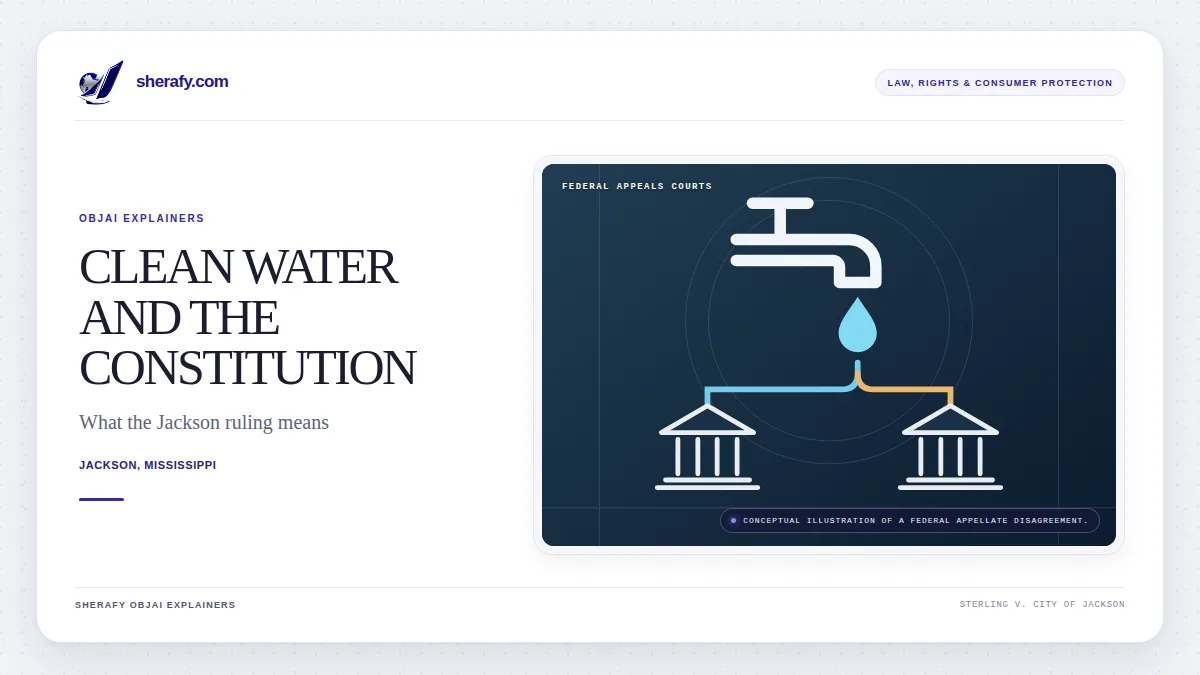
Whether the second situation implicates constitutional bodily integrity is precisely where federal appeals courts disagree.
What is the constitutional right to bodily integrity?
Bodily integrity concerns an individual's control over their own body and protection against unjustified physical interference.
American courts have recognized constitutional interests involving unwanted medical treatment, invasive searches and other forms of nonconsensual physical intrusion.
For example, in Washington v. Harper, the Supreme Court recognized a substantial liberty interest in avoiding the involuntary administration of antipsychotic medication, while also recognizing circumstances in which the government may justify such treatment.
The Jackson residents argued that involuntary ingestion of toxic substances resulting from government misconduct implicates the same underlying constitutional interest.
The Fifth Circuit majority rejected that analogy. Its dissenting judges considered it a plausible application of an existing constitutional protection.
This was not the first time an American court had confronted that question.
Why Flint, Benton Harbor and Jackson received different court rulings
Two decisions from the Sixth Circuit Court of Appeals provide important precedents involving government-caused drinking-water contamination.
Together, they reveal a substantive disagreement in American constitutional law.
Flint, Michigan: Guertin v. Michigan
In April 2014, Flint began supplying residents with water drawn from the Flint River.
The water was distributed without appropriate corrosion-control treatment, contributing to lead leaching from plumbing materials.
The ensuing public-health crisis generated extensive litigation.
In January 2019, the Sixth Circuit decided Guertin v. Michigan.
The court concluded that allegations involving government-caused lead exposure and deceptive assurances could establish a plausible violation of the constitutional right to bodily integrity.
The reasoning did not depend on recognizing a general entitlement to clean drinking water. It focused on nonconsensual exposure resulting from sufficiently culpable government conduct.
The court allowed claims against certain officials to proceed while concluding that allegations against other officials did not establish the required level of constitutional wrongdoing.
The Supreme Court subsequently declined to review the decision in January 2020.
That denial left the Sixth Circuit's decision intact but did not establish a nationwide Supreme Court ruling on the merits.
In November 2021, a federal court approved a $626.25 million partial settlement in the broader Flint water litigation.
The settlement involved multiple defendants and legal claims. It was not a constitutional damages award directly issued in Guertin.
Benton Harbor, Michigan: Mitchell v. City of Benton Harbor
In May 2025, the Sixth Circuit issued another significant ruling involving lead-contaminated drinking water.
Residents of Benton Harbor alleged that government officials failed to adequately address contamination and misled the public about the safety of the municipal water supply.
In Mitchell v. City of Benton Harbor, the court applied its Flint precedent and allowed certain constitutional claims against municipal defendants to proceed.
It upheld dismissal of claims against other defendants whose alleged conduct did not meet the necessary legal standard.
The case reinforced the Sixth Circuit's position that sufficiently culpable government conduct involving contaminated drinking water can implicate constitutional bodily integrity.
Jackson, Mississippi: Sterling v. City of Jackson
The Fifth Circuit's September 2026 opinion expressly rejected the reasoning underlying both Michigan precedents.
Its majority distinguished drinking-water contamination from historically recognized forms of physical intrusion, such as forced medical procedures.
It also declined to treat alleged government deception about drinking-water safety as a constitutional violation of informed consent.
The resulting disagreement can be summarized as follows:
| Legal issue | Flint | Benton Harbor | Jackson |
|---|---|---|---|
| Principal case | Guertin | Mitchell | Sterling |
| Federal appeals court | Sixth Circuit | Sixth Circuit | Fifth Circuit |
| Decision date | January 2019 | May 2025 | September 2026 |
| Government-caused exposure or deception alleged | Yes | Yes | Yes |
| Bodily-integrity claim recognized as legally viable against certain defendants | Yes | Yes | No |
| General constitutional entitlement to clean water established | No | No | No |
| Claims permitted to proceed against certain defendants | Yes | Yes | No, for the asserted federal constitutional claims |
These cases involve different defendants, facts and procedural circumstances. Nevertheless, the appellate disagreement is explicit.
Does the Jackson ruling apply nationwide?
No. The Fifth Circuit's decision is binding precedent within its federal judicial jurisdiction, which includes:
- Mississippi
- Louisiana
- Texas
The Sixth Circuit's decisions govern federal courts within:
- Michigan
- Ohio
- Kentucky
- Tennessee
Other federal appeals courts may have different applicable precedents.
The Fifth Circuit cannot overturn a Sixth Circuit decision. A nationwide resolution of the constitutional disagreement would ordinarily require intervention by the Supreme Court or another relevant development in federal law.
Consequently, where a drinking-water contamination lawsuit arises can materially influence which constitutional arguments are available to affected residents.
Why Jackson residents initially won their appeal and then lost
The September 2026 ruling was not the Fifth Circuit's first decision in the Jackson litigation.
On November 17, 2025, a three-judge appellate panel issued a divided decision that partially revived the residents' lawsuit.
The panel concluded that the plaintiffs had plausibly alleged a violation of bodily integrity by the city. It also recognized the state-created danger doctrine and returned that claim to the district court for further assessment.
The individual municipal officials remained protected by qualified immunity under the panel's decision.
In February 2026, the Fifth Circuit agreed to rehear the case en banc, meaning that the broader court would reconsider the panel's ruling.
The earlier opinion was vacated and ceased to be binding precedent.
On September 4, 2026, the en banc court affirmed the dismissal of the residents' constitutional claims.
What is the state-created danger doctrine?
The state-created danger doctrine concerns circumstances in which affirmative government conduct creates or increases an individual's exposure to harm.
Although the Constitution does not generally require government protection from every danger, numerous federal appellate courts have recognized versions of the doctrine.
Its precise requirements vary between jurisdictions and typically involve more than ordinary negligence.
The 2025 Fifth Circuit panel adopted a framework requiring affirmative government action, a sufficiently particularized danger, causation and conduct severe enough to meet constitutional standards.
The September 2026 majority dismissed the constitutional claims without separately addressing the state-created danger doctrine by name.
Judge Haynes identified that omission in her dissent and argued that the court should have expressly recognized the doctrine and allowed further litigation against the city.
The vacated 2025 opinion therefore cannot be relied upon as establishing the doctrine in the Fifth Circuit.
Why qualified immunity is not the whole explanation
Qualified immunity generally protects individual government officials from civil damages for conduct that did not violate clearly established federal rights.
The September 2026 majority and dissent agreed that the individual municipal officials were entitled to qualified immunity in this litigation.
However, municipalities do not receive the same qualified immunity protection.
Under Monell v. Department of Social Services, a municipality can potentially be liable under Section 1983 when an actionable constitutional violation is attributable to qualifying municipal policy or custom.
The central disagreement in Jackson was whether the residents had plausibly alleged an underlying constitutional violation at all.
By concluding that they had not, the majority eliminated their asserted route to municipal constitutional liability.
The dissent would have permitted the claims against the city to proceed into discovery.
That difference matters. The ruling was not simply a decision protecting individual officials from personal financial liability. It also prevented the plaintiffs from continuing their constitutional case against the municipality itself.
What does the Dobbs abortion ruling have to do with drinking water?
The Supreme Court's 2022 abortion decision, Dobbs v. Jackson Women's Health Organization, features prominently in the Fifth Circuit's Jackson water opinion.
The relationship is not that Dobbs addressed drinking water. It did not.
Rather, the Fifth Circuit relied on its approach to interpreting rights that are not expressly enumerated in the Constitution.
That methodology, which also draws on earlier cases such as Washington v. Glucksberg, places substantial emphasis on whether a narrowly defined asserted right is deeply rooted in American history and tradition.
The Fifth Circuit majority applied that framework to reject the constitutional protections asserted by Jackson residents.
The dissent argued that bodily integrity was already an established constitutional right and that applying it to a modern form of toxic exposure did not require creating a new right.
This raises a broader constitutional question.
Modern industrial chemicals, municipal infrastructure and medical technologies can expose individuals to physical harm in ways that differ from those recognized when the Fourteenth Amendment was adopted in 1868.
The issue is whether historical constitutional protections extend to new mechanisms of government interference.
The Jackson decision illustrates how disputes over the historical interpretation of constitutional rights can have consequences far beyond the context of abortion.
What evidence exists that Jackson's contaminated water harmed children?
Lead is a well-established neurotoxin.
According to the Centers for Disease Control and Prevention, no safe blood-lead level has been identified in children.
Lead exposure can affect neurological development, learning, attention and behavior. Pregnant individuals can also transfer lead to a developing fetus.
The scientific question in Jackson is not whether lead is dangerous. That is established.
The question is what evidence connects Jackson's particular contamination episode to measurable adverse health outcomes.
The 2026 study of prenatal lead exposure
On July 1, 2026, researchers Eunsik Chang, Kendall Kennedy and Justine Mallatt published Lead in Drinking Water and Child Health: Evidence From Jackson, Mississippi in the journal Health Economics.
The researchers used a quasi-experimental approach known as synthetic control.
They constructed a statistical comparison for Jackson from a pool of other geographic areas to estimate how birth outcomes might have developed without the contamination episode.
Their analysis covered the six quarters following the 2014 water-source change.
| Study finding | Result |
|---|---|
| Estimated increase in low-birth-weight births | 1.45 percentage points |
| Bias-corrected estimate | 1.30 percentage points |
| Comparison pool | 304 geographic units |
| Permutation-based p-value | 0.003 |
In practical terms, the estimated effect corresponds to approximately 13 to 15 additional low-birth-weight births per 1,000 births, relative to the modeled comparison population.
Low birth weight is defined as a birth weight below 2,500 grams, or approximately 5.5 pounds.
The researchers noted that their estimates may understate the effect among households directly affected by the water-source change because their birth records could not fully isolate those households.
The study provides important independent evidence of adverse health effects. As with any observational or quasi-experimental analysis, its causal interpretation depends on the quality of the comparison and the validity of its underlying assumptions.
What childhood blood tests revealed
The study also examined historical childhood blood-lead testing records.
The following table shows the proportion of venous blood tests exceeding 5 micrograms per deciliter (µg/dL), the historical CDC blood-lead reference value applicable during the contamination episode.
| Studied area | Before the water-source change | After the water-source change |
|---|---|---|
| Affected ZIP codes | 13 of 652 tests (1.99%) | 23 of 890 tests (2.58%) |
| Other studied ZIP codes | 84 of 2,571 tests (3.27%) | 87 of 3,205 tests (2.71%) |
Source: Chang, Kennedy and Mallatt, 2026, Section 2.4. Percentages calculated from the reported test counts.
The proportion increased in the affected areas while declining in the comparison areas.
However, these results must be interpreted cautiously. Screening was selective, some children may have been tested more than once, and the researchers did not have complete information about individual exposure sources.
The findings therefore cannot be used to establish the total number of children poisoned by Jackson's drinking water.
Nor does a blood-lead concentration below the historical reference value establish that exposure was harmless.
The CDC subsequently lowered its blood-lead reference value to 3.5 µg/dL in 2021.
The strongest scientific conclusion is that Jackson experienced documented elevated lead levels, that the contamination created a recognized public-health hazard, and that peer-reviewed research supports adverse prenatal health effects associated with the crisis.
Individual injuries and their precise causes remain separate medical and legal questions.
Was the Jackson water crisis an example of environmental injustice?
Jackson is Mississippi's capital and a predominantly Black city.
According to the U.S. Census Bureau, approximately 82% of its population identifies as Black alone.
The racial and socioeconomic consequences of the water crisis are therefore inseparable from its local demographic context.
However, understanding environmental injustice requires examining institutional conduct rather than relying solely on demographics.
Two independent EPA inspector general investigations published in 2024 identified substantial failures at multiple levels of government.
The first, Lack of State Financial Support and Local Capacity Prolonged Jackson, Mississippi Drinking Water Issues, examined financial assistance, infrastructure investment and administrative capacity.
The second examined state enforcement and federal regulatory oversight.
| Institution | Documented deficiencies |
|---|---|
| City of Jackson | Infrastructure management, operational capacity, water treatment and internal communication |
| Mississippi State Department of Health | Delayed reporting, inadequate enforcement and missed opportunities to provide technical and financial assistance |
| Environmental Protection Agency | Insufficient oversight of state enforcement before federal intervention |
A separate EPA civil-rights investigation concluded in May 2024 that there was insufficient evidence to establish a Title VI violation concerning the specific state funding and administrative programs investigated.
That finding must be acknowledged. It does not, however, negate the separate inspector general findings or establish that the wider crisis was free from structural inequality.
Environmental injustice and legally proven intentional discrimination are not interchangeable concepts.
The documented record establishes that a predominantly Black community endured serious infrastructure and public-health failures, and that multiple government institutions missed opportunities to prevent or mitigate those failures.
Whether particular decisions constituted unlawful discrimination requires additional evidence and a separate legal analysis.
Can the government legally conceal contaminated drinking water?
No. The Jackson ruling does not provide government officials with blanket legal permission to conceal contamination or misrepresent drinking-water safety.
The absence of a general constitutional right to truthful information does not eliminate statutory disclosure obligations.
The Safe Drinking Water Act and associated federal regulations establish monitoring, treatment, reporting and public-notification requirements for regulated public water systems.
Other laws may also impose liability for particular misrepresentations or wrongful conduct.
For a separate example of how municipal water disclosure can become a legal dispute, see Sherafy’s coverage of The Dalles’ fight over public water-use records.
How long do water systems have to notify residents about contamination?
The EPA's Public Notification Rule establishes three general notification categories.
| Notification category | General deadline | Typical circumstances |
|---|---|---|
| Tier 1 | Within 24 hours | Designated situations involving immediate health risks and other specified hazards |
| Tier 2 | As soon as possible, generally within 30 days | Significant drinking-water violations not classified as Tier 1 |
| Tier 3 | Within 12 months | Certain monitoring, testing or reporting violations |
Specific contaminants and circumstances may trigger additional requirements.
Since October 16, 2024, public water systems have also been subject to a 24-hour Tier 1 notification requirement for system-level lead action level exceedances.
The notification period begins when the water system learns of the exceedance.
This is particularly relevant to Jackson because the historical notification delay occurred between the state regulator and the municipal water system.
Prompt communication between institutions remains essential even when the downstream public-notification deadline is strict.
How federal lead regulations have changed
| Regulatory period | System lead action level | System-wide notification requirement |
|---|---|---|
| Jackson's 2015 contamination episode | 15 ppb | Historical Lead and Copper Rule requirements |
| October 16, 2024, onward | 15 ppb | Within 24 hours of learning of an exceedance |
| November 1, 2027, scheduled compliance date | 10 ppb | Within 24 hours of learning of an exceedance |
The EPA's Lead and Copper Rule Improvements are scheduled to introduce the lower action level and additional protective requirements.
The 24-hour notification requirement in effect today did not apply during Jackson's 2015 contamination episode.
Applying current rules retroactively would misrepresent the historical legal requirements.
Nevertheless, Jackson's experience illustrates why timely notification matters. Delays can deprive households of the opportunity to reduce exposure before harm occurs.
Can you sue the government for contaminated drinking water?
Potentially, yes. The available causes of action depend on the jurisdiction, responsible parties, applicable laws, nature of the misconduct and evidence of injury.
The Jackson decision does not eliminate all drinking-water litigation.
It does, however, demonstrate that identifying a government failure is not the same as establishing a compensable legal claim.
Federal and state legal remedies compared
| Legal mechanism | Potential purpose | Important limitation |
|---|---|---|
| Section 1983 constitutional lawsuit | Compensation or other relief for qualifying federal rights violations | Constitutional precedent, immunity and municipal liability requirements |
| Safe Drinking Water Act citizen suit | Enforcement of applicable federal drinking-water requirements | Generally not a personal-injury compensation mechanism |
| State negligence or personal-injury lawsuit | Compensation for qualifying injuries | Causation, filing deadlines, immunity and damages restrictions |
| State constitutional lawsuit | Enforcement of recognized state constitutional rights | Protections vary significantly between states |
| EPA or state enforcement action | Compliance, corrective orders and remediation | Does not necessarily compensate previously injured residents |
| Legislative compensation or settlement | Financial recovery through negotiated or statutory arrangements | Requires an applicable program, agreement or legislative action |
Can residents sue under the Safe Drinking Water Act?
The Safe Drinking Water Act contains a citizen-suit provision under 42 U.S.C. § 300j-8.
Subject to specified conditions, individuals may bring lawsuits to enforce certain requirements of the Act.
These lawsuits generally require advance notice and may be restricted when government authorities are already diligently pursuing qualifying enforcement proceedings.
The statute can provide an important accountability mechanism, but its principal function is enforcement of drinking-water protections rather than compensation for every person injured by contamination.
A successful enforcement lawsuit may require a water system to correct its operations without providing damages to families exposed before the correction occurred.
Mississippi's government liability restrictions
The Fifth Circuit majority identified state tort litigation as one alternative available to Jackson residents.
However, lawsuits against government institutions in Mississippi are subject to significant statutory restrictions.
Under the Mississippi Tort Claims Act:
- Section 11-46-9 establishes numerous immunity exceptions.
- Section 11-46-11 generally imposes a one-year limitations period, alongside notice and other procedural requirements.
- Section 11-46-15 generally limits qualifying government liability to $500,000 for all claims arising from a single occurrence, subject to statutory exceptions.
- Punitive damages are generally unavailable under the Act.
The application of these restrictions depends on the particular defendants, conduct, insurance arrangements, timing and applicable exceptions.
The Jackson court did not determine whether the plaintiffs would ultimately succeed under state law.
Its dismissal of their remaining state-law claims without prejudice means those claims were not conclusively adjudicated on their merits. It does not guarantee that the claims can successfully be refiled.
This exposes a significant weakness in treating state tort remedies as an automatic substitute for constitutional protections.
A remedy can exist in legislation while being practically difficult or impossible for particular victims to obtain.
Fixing the water system is not the same as compensating victims
On November 29, 2022, a separate federal enforcement proceeding established a court-supervised third-party management arrangement for Jackson's drinking-water system.
The EPA's Jackson drinking-water enforcement and remediation page documents the intervention and infrastructure improvements.
These measures are essential to preventing future harm.
But remediation, prevention and compensation are different objectives.
Replacing a contaminated pipe can prevent additional lead exposure. It cannot reverse exposure that occurred before the pipe was replaced.
Improving a treatment facility can restore reliable drinking-water service. It does not necessarily compensate a family for medical expenses, developmental consequences or other losses already incurred.
That distinction should remain central when evaluating whether Jackson residents have adequate legal remedies.
Is access to clean drinking water a human right?
Internationally, yes. Domestically, the legal enforceability of that right depends on the applicable law.
On July 28, 2010, the United Nations General Assembly adopted Resolution 64/292, recognizing safe drinking water and sanitation as human rights essential to the enjoyment of life and other human rights.
However, international recognition does not automatically create a privately enforceable right under the United States Constitution.
Human rights, constitutional rights and statutory protections are related but legally distinct.
Do any U.S. states recognize a right to clean water?
Yes. Some states provide protections beyond those expressly recognized in the federal Constitution.
| State | Relevant protection |
|---|---|
| New York | Article I, Section 19 of the state constitution expressly recognizes clean air, clean water and a healthful environment. |
| Pennsylvania | Article I, Section 27 of the state constitution recognizes rights involving clean air, pure water and preservation of environmental resources. |
| California | Water Code Section 106.3 establishes a state policy recognizing safe, clean, affordable and accessible water as a human right. |
New York's Environmental Rights Amendment establishes an express state constitutional protection.
Pennsylvania's Environmental Rights Amendment provides another example.
California's Water Code Section 106.3 establishes an important statutory policy, but it also expressly limits the obligations created by the provision.
These protections are not legally identical. Their enforceability, available remedies and application to particular contamination disputes vary.
They demonstrate, nevertheless, that states can recognize environmental and drinking-water protections beyond the federal constitutional baseline.
Are America's drinking-water protections being weakened?
The Jackson ruling itself does not repeal the Safe Drinking Water Act, change federal lead standards or eliminate mandatory contamination notices.
Separate federal regulatory proposals, however, have raised legitimate questions about the future scope of drinking-water protections.
On May 18, 2026, the EPA announced two proposed changes involving per- and polyfluoroalkyl substances, commonly known as PFAS or forever chemicals.
The first proposed rescission rule would remove federal regulatory requirements covering PFHxS, PFNA, GenX chemicals and specified PFAS mixtures.
The second proposed compliance extension rule would allow eligible water systems to request additional time, until 2031, to comply with existing PFOA and PFOS limits.
The public-comment periods closed on July 20, 2026. As of this article's research date, the reviewed agency materials continued to describe these measures as proposals.
PFAS regulation is separate from the lead-contamination litigation in Jackson.
Nevertheless, the broader relationship is important.
When environmental regulations are weakened, delayed or inadequately enforced, the availability of independent legal remedies becomes increasingly consequential.
A regulatory system is only as protective as its standards, enforcement mechanisms and ability to provide meaningful accountability when those protections fail.
What should you do if you suspect lead contamination in your drinking water?
Lead cannot reliably be detected by looking at, smelling or tasting drinking water.
Even water that appears completely clear may contain elevated lead concentrations.
If you suspect contamination, the following steps can help reduce exposure and establish what is occurring:
- Review your water system's Consumer Confidence Report. Public community water systems generally publish annual water-quality reports describing regulated contaminants and compliance information.
- Check your service-line material. Ask your water provider whether your property is served by lead, galvanized material requiring replacement, or plumbing of unknown composition.
- Arrange appropriate laboratory testing. Use a qualified laboratory and follow its sampling instructions. Lead concentrations can vary depending on plumbing, water usage and sampling conditions.
- Use a certified lead-removal filter or verified safe alternative water source. Confirm that the product is specifically certified for lead reduction and follow its maintenance requirements.
- Use cold water for drinking and cooking. Hot tap water can contain higher lead concentrations.
- Do not boil water to remove lead. Boiling does not remove dissolved lead and can increase its concentration through evaporation.
- Discuss suspected exposure with a healthcare professional. Blood-lead testing may be appropriate, particularly for children and pregnant individuals.
- Preserve relevant records. Keep laboratory reports, contamination notices, correspondence, medical records and documentation of related expenses.
- Seek jurisdiction-specific legal advice promptly if injuries have occurred. Government liability claims may have unusually restrictive notice and filing deadlines.
The EPA provides guidance on lead in drinking water, while the CDC provides additional information on reducing lead exposure from drinking water and childhood blood-lead testing.
Different contaminants require different protective measures. Always follow the instructions specific to the identified hazard.
Could the Supreme Court resolve the disagreement between Flint and Jackson?
Potentially.
The Fifth and Sixth Circuits have adopted conflicting approaches to constitutional bodily-integrity claims involving government-caused drinking-water contamination.
Such disagreements can provide grounds for requesting Supreme Court review, although the Supreme Court is not obligated to resolve every conflict between appellate courts.
Under Supreme Court Rule 13, a petition for a writ of certiorari is ordinarily due within 90 days of the relevant appellate judgment, subject to applicable rehearing procedures and extensions.
As of November 25, 2026, no subsequent Supreme Court merits decision resolving the Jackson controversy was identified in the publicly accessible records reviewed for this article.
The Fifth Circuit's September 2026 decision therefore remains the controlling appellate decision identified in the Jackson litigation.
What the Jackson ruling ultimately means for Americans
The Jackson decision does not establish that clean drinking water is unimportant, that lead exposure is harmless or that government officials may freely disregard environmental laws.
It establishes that, within the Fifth Circuit, the conduct alleged by Jackson residents did not support the constitutional claims they brought.
The Sixth Circuit reached a different conclusion about the applicability of constitutional bodily-integrity protections in two Michigan drinking-water contamination cases.
That disagreement exposes a fundamental accountability problem.
The government can establish mandatory drinking-water standards. Federal investigators can document failures to enforce those standards. Scientists can identify measurable health consequences. Residents can experience years of exposure, uncertainty and institutional neglect.
Yet the availability of constitutional relief can depend on where those residents live and how the courts define the right they assert.
The strongest argument advanced by the Jackson plaintiffs was not that the government owes every American unlimited access to a public service. It was that the government should face constitutional accountability when sufficiently culpable government actions cause involuntary exposure to toxic substances.
Recognizing that distinction would not require treating every broken pipe, administrative error or instance of ordinary negligence as a constitutional violation. Existing legal requirements concerning causation, culpability and municipal responsibility already establish substantial barriers.
The disagreement concerns whether even serious, plausibly alleged misconduct can be categorically excluded from constitutional protection.
There is nothing inherently contradictory about recognizing the need for statutory regulation, government remediation and constitutional accountability simultaneously.
Each addresses a different part of the problem.
The absence of a constitutional obligation to provide clean water should not be confused with the absence of a constitutional obligation to refrain from exposing people to poison.
The government may eventually repair Jackson's water system.
The harder question is what justice looks like for the people who consumed its water before those repairs were made.
References and Further Reading
Court decisions and constitutional law
- Sterling v. City of Jackson, U.S. Court of Appeals for the Fifth Circuit, September 4, 2026. The controlling en banc appellate decision dismissing the residents' constitutional claims. Includes the majority opinion and partial dissent.
- Sterling v. City of Jackson, November 17, 2025. The earlier appellate panel decision that would have permitted further litigation against the municipality. Subsequently vacated.
- Sterling v. City of Jackson, February 19, 2026. The order granting rehearing en banc and vacating the earlier panel opinion.
- Sterling v. City of Jackson, federal district court dismissal, 2024. The district court disposition underlying the subsequent appeals.
- Sterling et al. v. City of Jackson et al., original September 2022 complaint. The plaintiffs' initial factual allegations and legal claims. Allegations in a complaint are not independent findings of fact.
- Guertin v. Michigan, Sixth Circuit, January 4, 2019. The principal Flint water-crisis precedent concerning constitutional bodily integrity.
- Mitchell v. City of Benton Harbor, Sixth Circuit, May 6, 2025. Applies the Sixth Circuit's bodily-integrity reasoning to another municipal lead-contamination dispute.
- Jackson v. City of Jackson, Fifth Circuit, June 2, 2026. A separate dispute concerning water utility customers' procedural due-process and contractual claims.
- DeShaney v. Winnebago County Department of Social Services, 1989. Foundational Supreme Court precedent distinguishing government obligations to protect individuals from restrictions on affirmative government conduct.
- Washington v. Harper, 1990. Supreme Court precedent concerning bodily integrity and involuntary medical treatment.
- Monell v. Department of Social Services, 1978. Establishes the framework for municipal liability under Section 1983.
- Dobbs v. Jackson Women's Health Organization, 2022. Relevant to the Fifth Circuit majority's reliance on historical tradition in substantive due-process analysis.
Government investigations and public records
- EPA National Enforcement Investigations Center: Civil Investigation Report, City of Jackson Water System. The 2020 technical investigation documenting treatment, corrosion-control, monitoring and reporting deficiencies.
- EPA Office of Inspector General: State Program Deficiencies and Inadequate EPA Oversight of State Enforcement Contributed to the Drinking Water Crisis in Jackson, Mississippi. Report 24-E-0055, August 12, 2024. Documents regulatory failures and the delayed communication of Jackson's elevated lead results.
- EPA Office of Inspector General: Lack of State Financial Support and Local Capacity Prolonged Jackson, Mississippi Drinking Water Issues. Report 24-P-0038, May 13, 2024. Examines infrastructure funding, state assistance and local operational capacity.
- City of Jackson public statement concerning elevated lead levels, January 29, 2016. Contemporary municipal statement acknowledging elevated lead results while assuring residents that the water was safe.
- EPA civil-rights investigation determination concerning Mississippi's drinking-water programs. Documents the scope and findings of the agency's Title VI investigation.
- EPA: Jackson, Mississippi Drinking Water. Federal enforcement history, court-supervised management and infrastructure remediation.
- Michigan Attorney General: Flint Water Settlement Officially Approved. Official documentation of the broader $626.25 million partial civil settlement.
- U.S. Census Bureau: Jackson City, Mississippi QuickFacts. Population and demographic information.
Scientific research and public-health guidance
- Chang, E., Kennedy, K., and Mallatt, J. (2026). Lead in Drinking Water and Child Health: Evidence From Jackson, Mississippi. Health Economics, 35(10), 1450–1467. Quasi-experimental research examining prenatal lead exposure, birth outcomes and historical childhood blood-lead data. DOI: 10.1002/hec.70121.
- CDC: About Childhood Lead Poisoning Prevention. Established health risks and preventive measures concerning childhood lead exposure.
- CDC: About Lead in Drinking Water. Guidance on contamination pathways, certified filtration and reducing household exposure.
- CDC: Blood Lead Reference Value. Explains the current reference value and its interpretation.
- EPA: Frequent Questions About Lead in Drinking Water. Practical guidance on testing, exposure prevention and lead-containing plumbing.
Drinking-water regulations and legal remedies
- 42 U.S.C. § 1983: Civil Action for Deprivation of Rights. Federal statutory mechanism for qualifying civil-rights claims.
- 42 U.S.C. § 300j-8: Safe Drinking Water Act Citizen Suits. Establishes private enforcement mechanisms and procedural limitations.
- EPA: Public Notification Rule. Explains mandatory public-notification categories and deadlines.
- EPA: Public Notification for Lead Action Level Exceedances. Documents the 24-hour lead notification requirement applicable since October 2024.
- EPA: Lead and Copper Rule Improvements. Explains updated federal lead-control and service-line requirements.
- Mississippi Tort Claims Act. State government liability provisions, immunity exceptions, filing requirements and compensation limitations.
- EPA: Proposed PFAS Rescission Rule. Documents the May 2026 proposal to remove specified federal PFAS regulatory requirements.
- EPA: Proposed PFOA and PFOS Compliance Extension Rule. Documents the proposed extension of certain drinking-water compliance deadlines.
Environmental and human rights
- United Nations General Assembly Resolution 64/292: The Human Right to Water and Sanitation. International recognition of safe drinking water and sanitation as human rights.
- New York Constitution, Article I, Section 19. Express state constitutional recognition of clean water and environmental rights.
- Pennsylvania Constitution, Article I, Section 27. State constitutional environmental protections, including pure water.
- California Water Code, Section 106.3. Statutory recognition of the human right to water, subject to specified limitations.
Editorial note: This article reflects the court decisions, scientific research and regulatory materials reviewed through November 25, 2026. Litigation, regulations and local drinking-water conditions may change. The article provides general legal and public-health information, not individualized legal or medical advice.