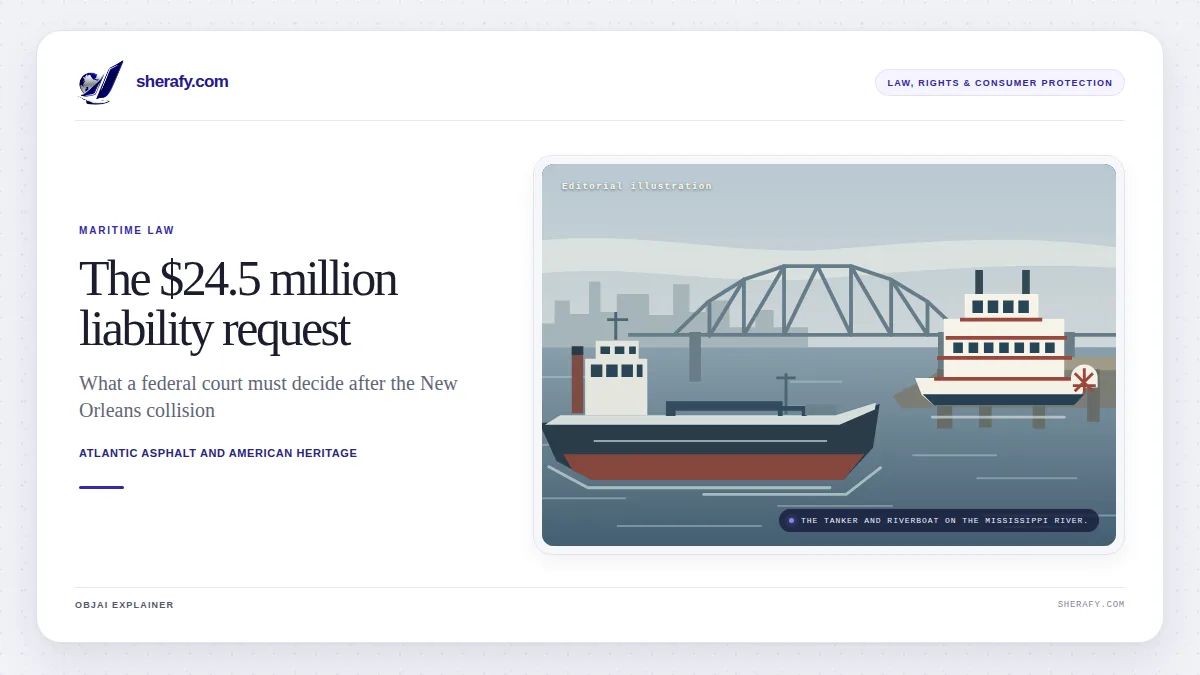
The owners of the Atlantic Asphalt tanker have asked a federal court to limit their liability for the November 13, 2026, collision with the American Heritage cruise ship in New Orleans to $24.5 million. That proposed limit is not an established ceiling on compensation. Federal maritime law generally presumes that a moving vessel is at fault when it strikes a stationary vessel. Losing steering does not automatically excuse the tanker, and even if its owners are found liable, they must separately establish their entitlement to limit that liability.
The tanker's registered owner, Nave Shipping S.A., and management company, Thome Ship Management Pte Ltd, filed a federal complaint seeking exoneration from or limitation of liability on November 20. Their attorneys maintain that the steering failure occurred unexpectedly. Investigators have established a preliminary sequence of events, but they have not yet determined why the steering failed or whether the accident was preventable.
The tanker's earlier operating history contains several leads worth examining, including reported electrical and navigation problems and an abnormal AIS transmission 17 days before the collision. It also contains favorable inspection evidence. Neither establishes the cause of the November accident.
A previous tanker disaster on the same river demonstrates why the distinction matters. In 2021, a Louisiana federal court denied the owners and managers of the American Liberty the protection of the same maritime liability law after finding that relevant failures extended to shore-side management. The Fifth Circuit affirmed that decision in 2022.
Research and litigation status current as of November 25, 2026.
What happened to the American Heritage cruise ship in New Orleans?
On November 13, the Marshall Islands-flagged Atlantic Asphalt, an asphalt tanker, struck the docked U.S.-flagged passenger riverboat American Heritage at New Orleans' Thalia Street waterfront on the Lower Mississippi River. The riverboat subsequently capsized. All people aboard both vessels were accounted for, and no fatalities were reported.
The National Transportation Safety Board's investigation record, DCA27MM003, provides the following casualty details:
| Incident detail | Information |
|---|---|
| Date | November 13, 2026 |
| Approximate collision time | 12:28 p.m. Central Standard Time |
| Location | Lower Mississippi River, mile 96, New Orleans |
| Moving vessel | Atlantic Asphalt |
| Docked vessel | American Heritage |
| Riverboat passengers | 140 |
| Riverboat crew | 50 |
| Total aboard riverboat | 190 |
| Hospitalizations | 36, according to the NTSB |
| Reported fatalities | None |
| Tanker crew injuries | None reported by the NTSB |
| Initial damage estimate | Expected to exceed $2 million, according to the NTSB |
| Investigation status | Ongoing |
The City of New Orleans' November 18 update separately reported that 32 people were transported to area hospitals. The city's transportation count and the NTSB's hospitalization count should not be treated as interchangeable. The available records do not explain their precise difference. The Coast Guard classified the incident as a major marine casualty.
The NTSB's November 15 briefing, as reported by ABC News, established that preliminary voyage data recorder evidence showed a steering casualty aboard the tanker at about 12:26 p.m., approximately two minutes before impact. The NTSB also reported that the riverboat capsized in about 22 minutes. The tanker’s rudder remained toward starboard, and the tanker veered toward the bank. The recorded communications included warnings, requests for assistance and emergency ship-handling orders.
The steering problem was aboard the Atlantic Asphalt, not the American Heritage. Investigators have not yet established whether a physical obstruction, hydraulic failure, electrical fault, control-system problem or other condition caused it.
In maritime law, a moving vessel striking a stationary object is commonly called an allision. That terminology appears frequently in the court records, although collision is also used in ordinary reporting.
Why are the Atlantic Asphalt's owners seeking a $24.5 million liability limit?
Two federal cases establish the foundation of the litigation.
| Date | Development |
|---|---|
| November 13 | The Port of New Orleans files a property-damage lawsuit against the tanker, its owner and manager. A federal warrant authorizing the vessel's arrest is issued. |
| November 15 | NTSB investigators disclose preliminary steering-casualty findings. |
| November 18 | The city concludes daily emergency-response updates; salvage coordination continues. |
| November 20 | Nave Shipping and Thome Ship Management file for exoneration or limitation of liability. |
| November 23 | A federal judge reportedly refuses to lift the vessel arrest. |
| November 24–25 | Additional claims and proceedings are reported, including a reported March 23, 2027, claim-filing deadline. |
The Port of New Orleans filed case 2:26-cv-02611 in the U.S. District Court for the Eastern District of Louisiana. The public docket records the complaint and issuance of the arrest warrant. The port reportedly estimates damage to its Thalia Street Terminal alone at more than $1 million, although that figure is not a judicial damages award.
The separate limitation proceeding, case 2:26-cv-02672, was filed a week later. The docket identifies both the complaint and supporting interim security documents. WDSU's reporting on the filing places the proposed limit at approximately $24.5 million.
By November 24, a court-record review by WWL-TV, reported by The Maritime Executive, identified 13 lawsuits across state and federal courts. Claims included those brought by riverboat passengers, crew members and police officers involved in rescue efforts. The count reflects that review, not a complete independent census of every claim.
How the Limitation of Liability Act works
The federal Limitation of Liability Act originated in 1851. Its current principal provision, 46 U.S.C. § 30523, permits qualifying shipowners to limit certain liabilities to the value of their interest in the vessel and pending freight when the loss occurred without their legally attributable involvement or knowledge.
Pending freight generally refers to qualifying earnings from the voyage. It is not the same as the market value of the asphalt or other cargo being transported.
Under Supplemental Admiralty Rule F, a limitation complaint identifies the vessel's value at the conclusion of the relevant voyage and pending freight. Claimants can challenge the sufficiency of the proposed security and request an appraisal.
Baird Maritime's November 25 report describes the $24.5 million proposal as based on a pre-casualty broker valuation. A November 25 account by Lewis, Kullman, Sterbcow & Abramson (LKSA), a firm representing claimants, instead describes the figure as the vessel and pending freight value after the collision. The available public docket does not reproduce the full supporting valuation, so the precise calculation and its relationship to the legally applicable end-of-voyage value remain unverified.
LKSA reports that the court accepted interim security on November 23 and stayed other suits against the vessel interests. The signed order was not independently obtained. Acceptance of interim security allows the proceeding to move forward. It does not decide whether the owners are entitled to limitation, whether the proposed valuation is correct or whether the claims are valid.
The same law firm says it filed claims for the riverboat's captain and navigation mate on November 24, alleging negligence and challenging the fund's adequacy. These are litigants' positions, not judicial findings.
The vessel interests are asking for two different forms of relief: complete exoneration if they are not legally liable, or limitation if they are liable but qualify for statutory protection.
Is the Atlantic Asphalt automatically at fault under maritime law?
Not automatically, but it begins from a disadvantageous legal position.
In the 1895 Supreme Court case The Oregon, 158 U.S. 186, a moving vessel's impact with a stationary vessel gave rise to a presumption of fault. The principle became known as the Oregon Rule.
The U.S. Court of Appeals for the Fifth Circuit, whose jurisdiction includes Louisiana, explained in American Petrofina Pipeline Co. v. M/V Shoko Maru, 837 F.2d 1324 (1988) that the moving vessel can rebut the presumption by establishing one of three circumstances:
- The stationary object was at fault.
- The moving vessel exercised reasonable care.
- The accident was unavoidable.
This means the tanker is presumptively at fault, but the court must still examine the evidence. The presumption does not establish that the owner knowingly operated a defective ship, nor does it determine the amount of damages or entitlement to limitation.
Does a steering failure excuse a shipowner?
An unexpected mechanical failure is not necessarily an unavoidable accident.
A steering system might fail despite reasonable inspection, proper maintenance and adequate emergency preparations. It might also fail because of a condition that reasonable maintenance should have discovered. A third possibility is that an otherwise manageable failure became catastrophic because of deficient redundancy, communications or emergency response.
The legal consequences differ substantially depending on which explanation the evidence supports.
The vessel interests' reported contention that the failure occurred without warning is their litigation position, not an independent finding. The steering casualty itself is supported by preliminary investigative evidence. Whether it was unforeseeable or reasonably preventable remains open.
Maritime law also allows responsibility to be divided. In United States v. Reliable Transfer Co., 421 U.S. 397 (1975), the Supreme Court established proportional allocation of maritime property-damage liability when comparative fault can reasonably be determined. The eventual outcome need not be a choice between a wholly innocent shipowner and a wholly responsible manufacturer.
Were there warning signs before the Atlantic Asphalt collision?
The tanker's reported operating history deserves scrutiny, but it must be examined system by system rather than treated as proof of a preexisting steering defect.
The Associated Press's November 16 examination and subsequent reporting by The Maritime Executive identified previous mechanical and safety issues. A separate maritime intelligence review by Pole Star Defense identified an earlier abnormal navigational status.
| Date | Reported issue or finding | Significance and limitation |
|---|---|---|
| July 2024 | Autopilot malfunction | Relevant to navigational control, but not necessarily a steering machinery defect. |
| August 2024 | Loss of bridge-to-engine communication | Relevant to maneuvering and command execution; may involve a separate system. |
| August 2025 | Emergency generator deficiency | Relevant to emergency power availability; does not establish that emergency power failed in November 2026. |
| December 2025 | Electrical power failure in Canadian waters | Potentially relevant to electrically dependent systems; original casualty record not independently obtained. |
| June 2026 | Pump-room electrical wiring deficiency | Raises a maintenance question; no established connection to steering. |
| July 15, 2026 | Listed in Coast Guard QUALSHIP 21 program | Favorable historical regulatory evidence. |
| October 19, 2026 | Reported Coast Guard inspection found no deficiencies | Favorable inspection evidence, limited to its scope and date. |
| October 27, 2026 | Reported AIS transmission of Not Under Command status | Warrants investigation but does not establish an actual or recurring steering failure. |
| November 13, 2026 | Steering casualty and collision | Preliminary NTSB findings; underlying cause unresolved. |
The historical deficiency dates above come from reporting and commercial records analysis, not a complete independently retrieved inspection file. Earlier problems were reportedly addressed. Without the original records, it is not possible to determine whether any remained unresolved or recurred.
The October 27 Not Under Command transmission
One of the more consequential leads comes from Pole Star Defense's vessel-screening analysis, published by Tanker Operator.
The company reported that Atlantic Asphalt departed Paulsboro, New Jersey, on October 26 and broadcast a navigational status of Not Under Command (NUC) the following day, 17 calendar days before the New Orleans collision.
Under the U.S. Inland Navigation Rules' definition of Not Under Command and the corresponding international collision regulations, this status describes a vessel whose exceptional circumstances prevent it from maneuvering as required. A propulsion or steering failure could produce such circumstances, but those are not the only possibilities.
There is an additional technical limitation. The International Maritime Organization's AIS operating guidelines, Resolution A.1106(29), identify navigational status as information entered manually. AIS does not independently diagnose the mechanical reason a ship cannot maneuver. For more on what the signal reveals, see Sherafy’s explainer on AIS and ship tracking.
The broadcast could therefore indicate a genuine steering failure, a propulsion or electrical problem, another temporary inability to maneuver, or an incorrect or outdated manual entry. Establishing which explanation is correct would require the underlying AIS messages, their duration, deck and engineering logs and machinery records.
Pole Star Defense itself did not establish a connection between its finding and the subsequent accident. The company sells maritime screening services, a commercial interest worth noting when evaluating its broader recommendations. Its raw AIS dataset was not independently obtained for this article. The transmission remains an attributed investigative lead, not proof of negligence.
Evidence that complicates a simple narrative of poor maintenance
Pole Star's screening recorded 18 deficiencies over 24 port-state-control inspections since 2017, but no inspection-related detentions during that period. Those figures do not establish the number of deficient inspections, since a single inspection can record multiple deficiencies. Nor do they demonstrate an unusually poor safety record without an appropriate fleet comparison.
The Coast Guard's July 15, 2026, QUALSHIP 21 enrollment list also identifies the tanker by IMO number 9798428, certificate number 14653 and a listed expiration date of June 3, 2027. QUALSHIP 21 is a voluntary quality-shipping program for eligible foreign-flagged vessels. The historical entry was identified in indexed government-document text; it does not establish continued enrollment on the accident date.
That favorable evidence belongs alongside the reported deficiencies. A regulatory inspection is a snapshot, not a guarantee against future failure. Equally, a deficiency that was corrected years earlier is not evidence that the same condition persisted until November 2026.
The relevant question is whether any earlier condition was connected to this casualty and whether responsible management knew, or reasonably should have known, about it.
What should investigators examine in the tanker's maintenance records?
Large commercial vessels generally have steering machinery, remote controls and alternative arrangements intended to preserve or restore steering when equipment fails. The existence of backup arrangements is only useful if they are available, functional and understood by the crew.
Federal regulations provide specific benchmarks. Under 33 CFR § 164.25, applicable vessels generally must test designated equipment within 12 hours before entering or getting underway on U.S. navigable waters, subject to regulatory exceptions.
The required tests include primary and secondary steering equipment, relevant remote controls and alarms, rudder indicators, internal vessel-control communications, emergency electrical power and propulsion machinery. Emergency steering drills are generally required within 48 hours before entry unless performed and logged regularly at least every three months.
Investigators should be able to compare those requirements with the tanker's actual testing and drill records, maintenance documentation, alarm histories and voyage data recorder evidence. There is currently no established violation of these requirements by Atlantic Asphalt.
A previous New Orleans casualty illustrates why the underlying records matter. In May 2018, the towing vessel Steve Richoux lost steering and struck the Mardi Gras World pier on the Mississippi River. The NTSB's completed investigation attributed the loss of control to a recurring steering-system problem that had not been reported. Estimated property damage exceeded $3 million.
That case demonstrates how an apparent sudden failure can have an earlier history. It does not establish that the same thing happened aboard Atlantic Asphalt.
What could prevent the tanker owners from limiting their liability?
The court's inquiry into limitation is distinct from the inquiry into fault. Claimants generally bear the initial burden of establishing causative fault, subject to applicable presumptions. Once that burden is met, the burden shifts to the owner to establish lack of privity or knowledge.
As explained by the Fifth Circuit in In re Hellenic Inc., 252 F.3d 391 (2001), the process generally involves determining whether causative negligence or an applicable unseaworthy condition existed, followed by determining whether the owner had privity or knowledge of that condition or conduct.
| Court determination | Potential consequence |
|---|---|
| Legal liability is not established | Exoneration may be granted. |
| Liability is established, but the eligible owner establishes the requisite absence of privity or knowledge | Qualifying liability may be limited. |
| Liability is established and the owner fails to establish entitlement to limitation | The requested statutory cap may be denied. |
| Another party is independently liable | Its responsibility must be determined under the rules applicable to that party. |
Privity generally concerns the owner's participation in the relevant fault. Knowledge can extend beyond what corporate officers actually knew. It may include conditions that responsible management could have discovered through reasonable diligence.
In SCF Waxler Marine, LLC v. Genesis Marine, LLC (5th Cir. 2022), the Fifth Circuit emphasized an important limitation on that principle: the owner's knowledge must concern a negligent act or unseaworthy condition that caused the casualty. Knowledge of unrelated deficiencies does not defeat limitation by itself.
For Atlantic Asphalt, the crucial evidence would include what failed, whether the failure was detectable, whether a relevant earlier incident was reported, how management responded and whether any failure of reasonable diligence contributed to the collision.
Thome's status also requires a separate inquiry. 46 U.S.C. § 30501 includes certain charterers within the statutory definition of owner. Other vessel interests may qualify depending on whether their actual responsibilities and control amount to ownership-like authority. A technical management contract alone does not automatically confer that protection. The court would need to assess Thome's relationship to the tanker and its entitlement independently.
American Liberty: the Louisiana tanker case that demonstrates how limitation can fail
On May 16, 2019, the product tanker American Liberty lost control on the Lower Mississippi River near Reserve, Louisiana, and struck multiple vessels and waterfront structures. The NTSB's completed investigation recorded approximately $40.5 million in reported damage. It identified deficient bridge resource management and miscommunication that delayed the necessary engine response.
The owners and managers sought exoneration or limitation in the Eastern District of Louisiana. In its June 25, 2021, findings of fact and conclusions of law, the district court found that causative failures involved both shipboard personnel and shore-side management. It denied limitation to the American Liberty interests.
The Fifth Circuit affirmed that decision on May 20, 2022. Its unpublished opinion has limited precedential effect, but the litigation provides a valuable factual comparison in the same federal district and on the same river.
| Issue | American Liberty | Atlantic Asphalt |
|---|---|---|
| Vessel type | Tanker | Tanker |
| Waterway | Lower Mississippi River | Lower Mississippi River |
| Loss of control | Investigated and established | Preliminary steering casualty established |
| Relevant management failures | Established by the court | Unresolved |
| Limitation request | Denied | Pending |
The earlier case does not predict the result of the current one. It demonstrates that a shipowner cannot obtain limitation simply by showing that the immediate emergency unfolded aboard the vessel rather than in a corporate office.
Why does maritime law treat tankers differently?
Federal law contains a little-discussed exception that could be relevant to American Heritage injury claims.
Under 46 U.S.C. § 30524, certain seagoing vessels are subject to a supplemental minimum protection for personal injury and death claims. If the ordinary limitation amount cannot satisfy all losses and the injury-and-death share falls below $420 multiplied by the applicable statutory tonnage, the law requires that share to be increased to the threshold.
The extra amount is reserved for personal injury and death claims. It is not an automatic addition of $420 per ton in every case.
The statute expressly excludes several categories of vessels, including tank vessels. It also contains a special rule imputing certain officers' and managing agents' knowledge to owners for covered injury and death claims. The tank-vessel exclusion applies to the section as a whole.
The Atlantic Asphalt is identified as a tank vessel by the NTSB and its insurer. The exclusion therefore appears relevant, subject to the legal application of the statute. The general privity-or-knowledge standard under § 30523 still matters.
The exclusion does not make tanker operators immune from personal injury lawsuits. It also does not establish that the additional protection would have increased recovery in this case had the responsible vessel been of a different type. That depends on the legally relevant tonnage and the final composition and value of proven claims.
Tonnage in this statute is defined specifically. It is not the vessel's cargo-carrying capacity or deadweight tonnage, and a published gross-tonnage figure alone may not reflect all statutory adjustments. A reliable supplemental-fund calculation cannot be produced from ordinary ship-tracking specifications alone.
Congress also amended the limitation framework in 2022 to exclude certain covered small passenger vessels from most of Chapter 305. The current definition and application appear in § 30501 and § 30502. That reform does not automatically exclude a tanker from limitation merely because the vessel it struck carried passengers.
Who actually pays for a ship collision?
Legal responsibility, insurance coverage and the money ultimately recovered are related but separate matters.
Gard's own vessel register identifies Atlantic Asphalt as a Marshall Islands-flagged asphalt tanker built in 2017, with IMO number 9798428, gross tonnage of 14,485, Nave Shipping S.A. as the listed owner and Bureau Veritas as its classification society. Thome is identified as the vessel manager in the litigation records.
Gard also confirmed to Business Insurance that it provides both protection and indemnity and hull and machinery insurance for the tanker.
| Party or mechanism | Potential financial responsibility |
|---|---|
| Nave Shipping | Liability arising from the vessel's operation, subject to applicable defenses and limitation law. |
| Thome Ship Management | Liability arising from independently established operational or management fault. |
| Hull and machinery insurance | Insured physical damage to the tanker and any additional liabilities covered by the policy. |
| Protection and indemnity insurance (P&I) | Covered third-party maritime liabilities, potentially including personal injury and property damage. |
| Equipment manufacturer | Liability if a legally actionable defect and its causal connection are established. |
| American Cruise Lines | Contractual obligations and any independently established legal liability. |
| Limitation fund | Court-supervised security for qualifying claims if limitation is ultimately granted. |
The insurer's exact policy limits, exclusions and applicable security arrangements have not been established in the public records examined. The $24.5 million request is not an insurance coverage limit. A vessel can carry substantially greater insurance coverage than the amount its owner seeks to establish as the statutory limit.
The existence of insurance does not establish the insurer's direct liability to every claimant, and a liability fund does not necessarily encompass every possible recovery from independently responsible parties.
Could the steering equipment manufacturer be responsible?
Yes, if evidence establishes a defect or another actionable failure attributable to the manufacturer.
The Supreme Court's decision in East River Steamship Corp. v. Transamerica Delaval Inc., 476 U.S. 858 (1986) recognizes maritime product liability but limits tort recovery for purely economic loss where a commercial product damages only itself. Injury to people and damage to other property raise different questions.
For this collision, investigators would first need to identify the component or system responsible for the steering casualty. A manufacturer claim would then require evidence of a legally actionable defect, its causal connection to the loss and the responsible entity.
Proof of proper maintenance does not automatically establish a manufacturing defect. Conversely, a defective component does not necessarily eliminate negligence by the owner or manager. No manufacturer has been established as responsible for the Atlantic Asphalt collision.
What happens if damages exceed $24.5 million?
If the court ultimately grants limitation and approves a $24.5 million fund, qualifying claims may have to share that fund. 46 U.S.C. § 30525 provides for proportionate distribution when the relevant amounts cannot satisfy all claims, and Rule F governs the related procedures, including legal priorities and challenges to security.
The following calculation illustrates how a finite fund might affect recovery.
| Hypothetical total approved claims | Assumed available fund | Illustrative recovery rate | Recovery on a $100,000 approved claim |
|---|---|---|---|
| $20 million | $24.5 million | 100% | $100,000 |
| $35 million | $24.5 million | 70% | $70,000 |
| $50 million | $24.5 million | 49% | $49,000 |
| $100 million | $24.5 million | 24.5% | $24,500 |
| $150 million | $24.5 million | 16.33% | $16,333 |
Calculation methodology: Divide the assumed fund by the aggregate approved claims, cap the result at 100%, then multiply by the value of the individual approved claim. Figures are rounded for display.
These are hypothetical examples, not forecasts of damages or settlement amounts. They assume equal claim priority, no separate recovery, no supplemental fund and no modification of the proposed limitation amount. Actual recoveries could differ substantially.
If limitation is denied, the value of the tanker does not impose this particular statutory cap on the unsuccessful defendant's liability. That still does not guarantee full recovery: the legal merits of individual claims, available assets, insurance terms and other factors remain relevant.
The Baltimore bridge disaster shows why a requested cap is not the final outcome
After the Dali struck Baltimore's Francis Scott Key Bridge in March 2024, its owner and operator initially sought to limit liability to approximately $43.7 million.
On May 12, 2026, the Maryland attorney general announced a finalized $2.25 billion settlement with Grace Ocean and Synergy Marine, resolving the state's claims against the vessel interests. That settlement alone substantially exceeded the original requested limitation amount. It did not resolve every casualty-related claim or the state's claims against the shipbuilder.
The outcome was a negotiated settlement, not a judicial ruling that limitation was unavailable. It also does not suggest that the New Orleans collision will produce damages on Baltimore's scale. It establishes a narrower, important point: the amount a shipowner initially seeks to place in a limitation fund does not predetermine the final financial outcome.
The NTSB's completed Dali investigation further illustrates why an initial description of a mechanical emergency can change materially when investigators identify the underlying cause.
Why was the Atlantic Asphalt arrested?
A ship's arrest is a civil admiralty procedure, not a criminal arrest of its crew. A maritime claimant can, in appropriate circumstances, pursue an action against the vessel itself, known as an in rem proceeding, and obtain judicial security for qualifying claims under Supplemental Admiralty Rule C.
The November 13 federal docket records an order authorizing arrest and the issuance of the warrant. Subsequent reporting indicates that the court declined to lift the arrest on November 23.
Judicial vessel arrest is different from restrictions imposed by the Coast Guard for marine safety or accident investigation. It is also different from the financial security posted in a limitation proceeding. The end of one restriction does not necessarily end the others. For example, the Coast Guard's temporary salvage-related safety-zone rule, published November 18, runs through December 11, 2026, unless ended sooner. It restricts unauthorized entry into the specified zone, not all traffic on the Mississippi River. The city separately reported that fuel-removal operations began on November 17.
What does this mean for American Heritage passengers and crew?
American Cruise Lines' November 14 statement said the company was arranging travel, accommodations and ongoing assistance for passengers and crew. In a subsequent statement to Cruise Critic, the company confirmed full refunds for affected cruise guests and those scheduled to board the next sailing.
A ticket refund addresses the purchased cruise service. It is not inherently the same as compensation for medical expenses, lost earnings, pain and suffering, damaged personal property or other legally recoverable losses. Whether a particular loss is compensable depends on the applicable law and evidence.
Riverboat passengers and crew may also have different legal rights. Passengers generally rely on applicable negligence and other personal injury theories. A qualifying seaman employed by the riverboat operator may have separate employment-related remedies, including under the Jones Act, 46 U.S.C. § 30104. The unrelated tanker does not become that seaman's Jones Act employer merely by causing an injury.
The maritime warranty of seaworthiness also protects a particular class of maritime workers; it is not an identical cause of action available to every passenger or third party. In the American Liberty litigation, the district court's May 14, 2021, order dismissed certain third-party unseaworthiness claims while allowing negligence claims to proceed.
Do passengers have a deadline to file a claim?
There are several different deadlines, and they must not be confused.
| Deadline | Governing authority or available information |
|---|---|
| Shipowner's limitation complaint | 46 U.S.C. § 30529 generally requires filing within six months of receiving written notice of a claim. |
| Claim in the Atlantic Asphalt limitation proceeding | March 23, 2027, according to November 25 reporting; the signed order was not independently obtained. |
| General maritime personal injury action | 46 U.S.C. § 30106 generally provides three years, except as otherwise provided by law. |
| Claims against American Cruise Lines | The applicable ticket contract and governing law may establish separate deadlines. |
The cruise line's currently published Terms and Conditions for Passengers prescribe six months for written notice and one year for filing an action against the cruise line concerning personal injury, illness or death, with additional service requirements and stated exceptions. The published terms also prescribe shorter periods for certain other claims.
That contract may differ from the version issued to an individual passenger. Whether its provisions are enforceable and applicable to a particular claim is a separate question. Federal law, including 46 U.S.C. § 30526, regulates certain contractual time limits, subject to statutory applicability and exclusions.
Affected individuals should not assume that the general three-year period overrides a court-ordered deadline or that a cruise operator's contract governs claims against an unrelated tanker. The signed court notice, actual passenger contract and individual circumstances are the appropriate starting points for advice from qualified maritime counsel.
What evidence will determine who ultimately pays?
The preliminary steering finding is only the first link in a longer causal and legal chain. The following matrix identifies the records that would resolve the major questions in the Atlantic Asphalt litigation.
| Unresolved issue | Evidence needed | Current status |
|---|---|---|
| What initiated the steering casualty? | Engineering examinations, alarm histories and NTSB factual findings | Unresolved |
| Was the rudder mechanically stuck or responding to a failed control system? | Steering gear, hydraulic and electrical examination | Unresolved |
| Were backup arrangements available and functional? | Equipment tests, machinery logs and voyage data | Unresolved |
| Were required tests and drills performed? | Test documentation, drill logs and testimony | Unresolved |
| What did the October 27 AIS transmission mean? | Raw AIS messages and bridge logs | Unresolved |
| Were earlier deficiencies corrected and were any related to steering? | Original inspection reports, repairs and engineering records | Partly reported; causal relationship unknown |
| Did management know or have reason to discover a relevant condition? | Maintenance records, communications and safety-management documentation | Unresolved |
| Were emergency responses reasonable? | Voyage data recorder, communications and testimony | Unresolved |
| Did other maritime participants contribute? | Operational records and testimony | Unresolved |
| Why did the riverboat capsize? | Damage surveys and naval architecture analysis | Detailed mechanism unresolved |
| Is $24.5 million the correct limitation valuation? | Complaint, valuation, security documents and appraisal evidence | Proposed figure reported; basis not independently verified |
| Does Thome separately qualify for limitation? | Management agreement, operational-control evidence and judicial findings | Unresolved |
| What insurance funds are available? | Policy terms, limits and security documents | Insurance types established; limits unknown |
| What losses will be recoverable? | Individual injury, property and financial evidence | Unresolved |
| Will the court grant limitation? | Judicial ruling or negotiated resolution | Pending |
A reported state court preservation order covering navigation, maintenance and related evidence is particularly relevant to these questions. It is a procedural measure intended to preserve evidence, not a finding that anyone destroyed evidence or caused the accident.
The NTSB indicated that it expects a preliminary report within about 30 days of the accident, with the final investigation potentially taking much longer, according to Seatrade Cruise News. That schedule is an expectation, not a guarantee. The NTSB's investigation seeks to establish probable cause and improve transportation safety. The civil court determines legal liability, limitation and damages. 49 U.S.C. § 1154 restricts the use of NTSB accident reports in civil damages actions; underlying factual material and independently obtained evidence may be treated differently.
The most consequential unresolved issue is whether the steering casualty was a failure that reasonable precautions could not have prevented, or whether a causative condition existed that responsible management should have identified and corrected. That distinction could affect both the outcome of the negligence claims and the availability of statutory limitation.
Knowing why a ship lost control is not the same as knowing who should bear the cost of the disaster. The proposed $24.5 million ceiling remains a legal request, not the answer.
References and Further Reading
Primary accident, government and technical records
- NTSB: Collision of tank ship Atlantic Asphalt and passenger vessel American Heritage (DCA27MM003). Official casualty record, investigation status and links to the November 14 and 15 media briefings.
- City of New Orleans: November 18 vessel collision response update. Official hospital-transport count, passenger assistance and salvage information.
- U.S. Coast Guard: Safety Zone; Mississippi River, New Orleans, LA, Federal Register document 2026-23452. Temporary navigation restrictions associated with collision response and salvage.
- U.S. Coast Guard: July 15, 2026, QUALSHIP 21 enrollment list. Historical enrollment record identifying Atlantic Asphalt by IMO number and certificate number.
- U.S. Coast Guard: Port State Information Exchange. Official research database for U.S. vessel inspection and casualty records; the complete historical Atlantic Asphalt inspection file was not independently retrieved.
- IMO: Revised Guidelines for the Onboard Operational Use of Shipborne Automatic Identification Systems, Resolution A.1106(29). Primary technical guidance on AIS data, including manually entered navigational status.
- 33 CFR § 83.03: Inland Navigation Rules definitions. Defines the navigational status Not Under Command.
- 33 CFR § 164.25: Tests before entering or getting underway. Specifies equipment testing and emergency steering drill requirements.
- 49 U.S.C. § 1154: Discovery and use of cockpit and surface vehicle recordings and transcripts. Includes statutory restrictions on use of NTSB reports in civil damages litigation.
Federal litigation, statutes and procedural rules
- Board of Commissioners of the Port of New Orleans v. Atlantic Asphalt MV et al., No. 2:26-cv-02611. Public mirror of the November 13 property-damage complaint and vessel-arrest docket.
- In the Matter of Nave Shipping S.A., No. 2:26-cv-02672. Public mirror of the November 20 limitation complaint and related initial security filings. The docket entries are not substitutes for the full signed documents.
- 46 U.S.C. Chapter 305: Exoneration and Limitation of Liability. Statutory framework, including definitions, exclusions, vessel valuation, personal injury provisions and distribution of losses. Individual current sections are linked in the article.
- 46 U.S.C. § 30523: General limit of liability. Core provision governing limitation of qualifying shipowner liabilities.
- 46 U.S.C. § 30524: Limit of liability for personal injury or death. Conditional supplemental protection, statutory tonnage calculation and express tank-vessel exclusion.
- 46 U.S.C. § 30525: Apportionment of losses. Governs proportional distribution when limitation amounts are insufficient.
- Supplemental Admiralty Rule F: Limitation of liability. Federal court procedure for limitation complaints, interim security, valuation disputes and claims.
- Supplemental Admiralty Rule C: In rem actions. Governs qualifying actions against vessels and the arrest process.
- 46 U.S.C. § 30104: Personal injury to or death of seamen. Jones Act employment-related remedies for qualifying seamen.
- 46 U.S.C. § 30106: Time limit on bringing maritime action for personal injury or death. General federal maritime personal injury limitation period.
- 46 U.S.C. § 30526: Time limits for giving notice and filing suits. Federal restrictions on certain contractual notice and filing periods, subject to applicability.
Judicial opinions
- The Oregon, 158 U.S. 186 (1895). Foundational Supreme Court authority for the moving-vessel presumption of fault.
- American Petrofina Pipeline Co. v. M/V Shoko Maru, 837 F.2d 1324 (5th Cir. 1988). Relevant circuit authority identifying the avenues for rebutting the presumption.
- United States v. Reliable Transfer Co., 421 U.S. 397 (1975). Supreme Court authority on proportional allocation of maritime property-damage fault.
- In re Hellenic Inc., 252 F.3d 391 (5th Cir. 2001). Corporate knowledge and entitlement to limitation.
- SCF Waxler Marine, LLC v. Genesis Marine, LLC (5th Cir. 2022). Explains constructive corporate knowledge and the requirement that relevant negligence or unseaworthiness caused the casualty.
- East River Steamship Corp. v. Transamerica Delaval Inc., 476 U.S. 858 (1986). Maritime product liability and the limitation on tort recovery for a commercial product's damage to itself.
- American Liberty litigation: District Court findings of fact and conclusions of law, June 25, 2021. Primary judicial record examining causation, shore-side management and the denial of limitation.
- American Liberty litigation: District Court order, May 14, 2021. Addresses third-party unseaworthiness claims and their distinction from negligence.
- American Petroleum Tankers v. American River Transportation, Nos. 21-30420 and 21-30487 (5th Cir. 2022). Unpublished appellate opinion affirming denial of limitation to the American Liberty interests.
Historical casualty investigations and settlements
- NTSB: Contact of Tanker American Liberty with Multiple Vessels (DCA19FM034). Comparable Louisiana tanker casualty, probable cause and reported damage estimate.
- NTSB: Contact of Towing Vessel Steve Richoux with Mardi Gras World Pier (DCA18FM022). Completed investigation identifying a recurring, unreported steering-system problem.
- Maryland Attorney General: Final settlement with owners and operators of the M/V Dali, May 12, 2026. Primary announcement of the $2.25 billion settlement resolving Maryland's claims against the vessel interests.
- NTSB: Francis Scott Key Bridge collapse investigation findings. Completed investigation of the electrical failure underlying the Dali casualty.
Vessel records, commercial statements and independent reporting
- Gard: Atlantic Asphalt vessel directory. Insurer's primary register identifying vessel characteristics, IMO number, classification society and owner entry.
- OSM Thome: Atlantic Asphalt allision in Mississippi River. Ship-management company's initial statement; useful for its stated position, not an independent determination of cause.
- American Cruise Lines: American Heritage update. Cruise operator's November 14 statement on evacuation and passenger assistance.
- American Cruise Lines: Terms and Conditions for Passengers. Published passenger contract, including notice and litigation provisions; individual ticket versions may differ.
- Associated Press: What we do and don't know about a tanker with steering failure that hit a cruise boat in New Orleans. Independent reporting on preliminary findings, historical deficiencies, repairs and inspection history. Accessible syndicated copy.
- ABC News: Officials investigating steering of tanker in New Orleans riverboat collision. Reporting from the NTSB's November 15 briefing, including preliminary voyage data findings.
- Tanker Operator: Atlantic Asphalt had history of inspection deficiencies, Pole Star study finds. Attributed commercial screening results and earlier AIS status; the underlying data remain outstanding. Alternative publication of the same analysis.
- WDSU: Attorneys file to limit liability in tanker collision with cruise ship. Reporting on the proposed $24.5 million limitation request and vessel interests' stated defense.
- The Maritime Executive: Judge denies release of tanker as owners seek to limit liabilities. November 24 reporting on claims, vessel arrest, preservation efforts and historical mechanical issues.
- Baird Maritime: Judge keeps tanker involved in New Orleans crash under arrest. November 25 specialist reporting on valuation, litigation and the reported claims deadline.
- LKSA: Mississippi River collision in New Orleans, the facts so far. November 25 procedural account and the firm's own claimant allegations; the firm represents claimants and is not an independent source of liability findings.
- WBRZ: New Orleans judge orders crew of tanker to preserve evidence amidst lawsuits. Reporting on the separate preservation order.
- Seatrade Cruise News: Steering casualty preceded tanker's crash into American Heritage riverboat. Preliminary investigation timeline and expected reporting schedule.
- Business Insurance: Gard covers tanker in New Orleans collision. Direct insurer confirmation of hull and machinery and P&I coverage.
- Cruise Critic: American Heritage collision, what we know so far. Reporting incorporating the cruise operator's confirmation of refunds and travel arrangements.
Editorial currency and evidence note: This article reflects available information as of November 25, 2026. The NTSB investigation and litigation are ongoing. The complete limitation complaint, signed later court orders, broker valuation, raw AIS transmissions and original historical inspection records were not independently obtained. Reported details are attributed accordingly. The article explains the governing legal framework and evidence, rather than predicting a judicial outcome or providing individualized legal advice.