The House-passed Protect Economic and Academic Freedom Act of 2026 does not outlaw criticism of Israel. It does not prohibit students from supporting the Boycott, Divestment and Sanctions movement. And after an amendment made in committee, it does not require every college to file the annual anti-boycott certification described in some earlier coverage.
What H.R. 4795 actually does is more structurally consequential.
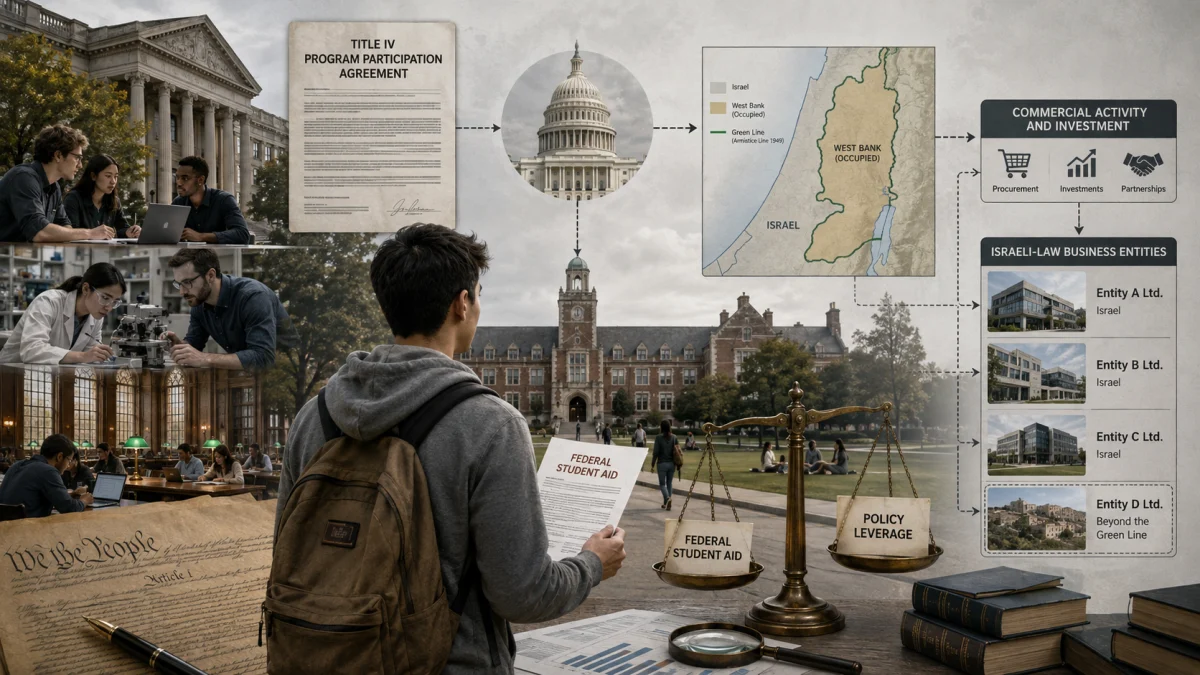
It would make abstaining from certain politically motivated commercial boycotts of Israel a condition of a college’s participation in the federal Title IV student-aid system—the system through which students receive Pell Grants and federal student loans. The restriction extends beyond the State of Israel itself to an entity “licensed or regulated by, or organized under the laws of” Israel, with no geographic exception for Israeli entities operating in the occupied West Bank.
That creates several problems Americans should understand even if they dislike BDS, support Israel, or believe antisemitism on college campuses requires a much stronger federal response.
The first is constitutional: Congress is using an enormous federal benefit largely concerned with financing American students to influence a university’s politically motivated economic activity outside the administration of those student-aid dollars.
The second is territorial: the bill effectively protects qualifying Israeli entities without distinguishing between Israel and Israeli settlements in territory occupied since 1967—a distinction that has major significance under international law and that the United States’ own two-state policy has historically depended upon.
The third is precedential: once Congress establishes that access to federal student aid can depend on whether a university participates in a politically disfavored boycott, the principle does not have to remain confined to Israel.
And the fourth may be the simplest: protecting Jewish students from discrimination is a legitimate government purpose. Protecting a foreign government’s businesses, institutions and settlement-linked entities from politically motivated economic pressure is a different government purpose. H.R. 4795 substantially mixes the two.
That distinction is the part of this debate most worth preserving.
What the House actually passed
On September 3, 2026, the House passed H.R. 4795 by 237–169. The coalition consisted of 203 Republicans, 33 Democrats and one independent voting yes. Two Republicans and 167 Democrats voted no.
The legislation now has two important components.
| Provision | What it does | What funding is at stake |
|---|---|---|
| Section 2 | Requires participating colleges to agree not to engage in a defined “nonexpressive commercial boycott” of Israel or qualifying Israeli-law entities | Title IV federal student aid, including Pell Grants and federal student loans |
| Section 3 | Requires certain colleges to certify annually that Israeli academic exchanges and participants are treated comparably to those from other foreign countries | Title VI international and foreign-language education funds |
The distinction matters.
An earlier version of H.R. 4795 contained a separate annual anti-boycott certification and would have required the Education Department to publish a list of institutions that failed to certify. The Education and Workforce Committee removed both provisions and instead inserted the anti-boycott rule directly into the Title IV Program Participation Agreement colleges sign to participate in federal student aid.
So describing the House-passed bill merely as requiring colleges to “certify that they don’t boycott Israel” is no longer quite accurate.
The annual certification that remains concerns academic exchanges under Title VI.
The commercial-boycott provision is potentially more consequential because it is now embedded in the agreement governing access to the federal student-aid system itself.
Why Pell Grants and student loans matter to this debate
Title IV is not some obscure discretionary grant awarded to universities for Israel-related programs.
It is the federal framework through which eligible institutions participate in programs including Pell Grants and federal student loans. The Education Department describes a Program Participation Agreement as the agreement through which a school accepts the statutory and regulatory obligations attached to participation in Title IV.
H.R. 4795 would add this promise:
The institution will not engage in a “nonexpressive commercial boycott” of a U.S. “major strategic partner.”
Under this legislation, that currently means Israel and qualifying Israeli-law entities. The Congressional Budget Office says violating the agreement could cause a college to lose eligibility for federal student-aid programs, including Pell Grants and student loans.
This does not mean Congress is directly confiscating an individual student’s Pell Grant because someone protested Israel.
But it does mean federal student aid becomes the pressure point.
A university deciding whether to maintain a politically controversial procurement or investment policy would have to consider not merely criticism, donor reaction or litigation, but whether the decision could jeopardize its institutional eligibility for programs upon which many of its students depend.
CBO actually assumes colleges will comply and therefore predicts essentially no change in federal aid spending.
That should not be confused with evidence that the restriction is harmless.
If the purpose of a funding condition is to deter conduct, widespread compliance is exactly how the mechanism is supposed to work.
What counts as a prohibited boycott?
Here the statutory language deserves more attention than the political slogans surrounding it.
H.R. 4795 defines a “nonexpressive commercial boycott” as commercial action—including refusing to deal or terminating business activities—that:
- is intended to limit commercial relations with the protected country or entity; and
- is not based on a “valid business reason.”
It incorporates several exceptions from the federal Anti-Boycott Act but does not itself define what constitutes a “valid business reason.”
That means some claims about the bill go too far.
The bill does not affirmatively require a university to purchase Israeli products, invest in Israeli companies or establish commercial relationships with Israel.
A university that simply never happens to buy something from an Israeli company is not obviously engaged in the boycott defined by the statute. The definition requires commercial action, boycott intent and the absence of a valid business reason.
But consider a different policy:
Our university will no longer contract with companies operating in Israeli settlements in the occupied West Bank because we believe those settlements contribute to violations of Palestinian rights.
That is precisely where H.R. 4795 becomes much harder to dismiss as an ordinary anti-discrimination rule.
The economic decision is being made for a political and human-rights reason. And the bill protects not only Israel, but an entity “licensed or regulated by, or organized under the laws of” Israel.
There is no exception saying: unless that entity operates in territory occupied since 1967.
The West Bank provision may be the most important part of the bill
Israel’s settlements in the West Bank are not an obscure technical detail in this debate.
U.N. Security Council Resolution 2334 reaffirmed that Israeli settlements in Palestinian territory occupied since 1967 have “no legal validity” and called on states to distinguish in their relevant dealings between the territory of the State of Israel and the territories occupied since 1967.
In its 2024 advisory opinion, the International Court of Justice concluded that Israel’s continued presence in the occupied Palestinian territory is unlawful and addressed settlement expansion as part of the legal regime producing that conclusion. The opinion is advisory rather than a conventional judgment between litigating states, but it represents the principal judicial organ of the United Nations applying international law to the occupation.
H.R. 4795 does not formally declare the West Bank part of sovereign Israel.
That distinction is important.
But for purposes of this particular American funding restriction, the bill does something adjacent: it protects an Israeli-law entity based on its legal connection to Israel without providing a territorial limitation.
A settlement-linked business does not become unprotected merely because its relevant activity occurs across the Green Line.
J Street has highlighted exactly this problem. The organization opposes the global BDS movement and supports American academic engagement with Israel, yet opposed H.R. 4795 because its definition can encompass Israeli entities in West Bank settlements.
That opposition matters because it demonstrates that the dispute cannot honestly be reduced to “people who support Israel versus people who support BDS.”
One can oppose BDS against Israel as a whole and still believe Americans must remain free to distinguish between Israel itself and Israeli settlement activity in occupied territory.
The irony hidden inside Congress’s own definition
H.R. 4795 never simply says “Israel” in the operative definition.
Instead, it defines a protected “major strategic partner” by referring to Section 4 of the United States-Israel Strategic Partnership Act of 2014, which declared Israel a major strategic partner of the United States.
But read the provision immediately preceding that designation.
The same 2014 law declared it U.S. policy to support efforts toward a negotiated political settlement producing two states living side-by-side in peace and security.
That produces an unusual result.
Congress is taking a statutory designation enacted alongside explicit support for a two-state political settlement and using it twelve years later to construct an anti-boycott provision that contains no equivalent Israel/occupied-territory distinction.
Again, this does not legally annex the settlements to Israel.
But it weakens the practical distinction in precisely the area covered by this law.
Other Western governments have demonstrated that the distinction is perfectly possible to maintain. European Union funding rules, for example, permit broad cooperation with Israeli institutions while generally limiting eligibility so Israeli entities established in territories occupied since 1967 do not receive covered EU grants and financial instruments on the same basis as entities inside Israel’s pre-1967 territory.
Americans do not have to adopt European policy to recognize the underlying point:
Supporting Israel does not logically require treating Israeli settlements as indistinguishable from Israel.
This is also fundamentally different from America’s existing federal antiboycott law
Supporters of laws like H.R. 4795 sometimes invoke America’s long history of combating boycotts of Israel.
There really is such a history.
But the existing federal Anti-Boycott Act addresses a importantly different problem.
Federal law prohibits specified conduct undertaken with the intent to comply with, further or support a boycott “fostered or imposed by any foreign country” against a country friendly to the United States. The Commerce Department explains that the principal unsanctioned foreign boycott historically covered by these rules is the Arab League boycott of Israel.
The basic concern was foreign coercion:
A foreign government tells an American company, in effect, if you want to do business here, you must boycott that friendly country.
Congress decided American companies should not become instruments of another government’s foreign-policy boycott.
H.R. 4795 borrows the older law’s list of permitted exceptions—but drops the central foreign-government premise.
The university boycott contemplated by H.R. 4795 does not have to be imposed by Saudi Arabia, Iraq, Egypt or any other foreign government.
It can be a policy voluntarily adopted in the United States by an American institution in response to American students, faculty, trustees or administrators making a political judgment about Israeli policy.
That is a significant transformation:
from preventing foreign governments from coercing Americans into their boycotts to using the American government itself to penalize participation in a particular domestically chosen political boycott.
Whatever one thinks of BDS, those are not the same problem.
Calling a boycott “nonexpressive” does not settle the First Amendment question
The bill’s drafters clearly understood the constitutional vulnerability.
That helps explain the repeated use of the phrase “nonexpressive commercial boycott.”
There is real legal precedent supporting their position.
In Rumsfeld v. FAIR in 2006, the Supreme Court upheld federal legislation requiring law schools receiving certain federal funding to provide military recruiters access comparable to other recruiters. The Court concluded the regulated conduct was not inherently expressive simply because the law schools had political reasons for doing it.
And in Arkansas Times LP v. Waldrip, the Eighth Circuit upheld Arkansas’s anti-BDS contracting law. The en banc court concluded that the statute could be read as regulating commercial purchasing decisions rather than protected expression.
Those cases cannot responsibly be ignored.
But neither can the other side of the law.
In NAACP v. Claiborne Hardware, the Supreme Court held that the nonviolent components of a politically motivated civil-rights boycott were protected by the First Amendment, emphasizing speech, assembly, association and petition used to produce political and economic change.
Federal courts reviewing other state anti-BDS laws have also reached conclusions favorable to First Amendment challengers. Courts in cases including Koontz, Amawi, Jordahl and Martin have found serious constitutional problems with various anti-boycott requirements, although subsequent amendments and differing statutory language make the cases imperfect comparisons. The House committee’s own minority report acknowledges both lines of authority.
So the defensible conclusion is not that H.R. 4795 has already been proven unconstitutional.
It has not.
The defensible conclusion is that Congress is legislating directly into an unresolved First Amendment conflict and has attempted to choose one side of that conflict by putting the word “nonexpressive” into the statute.
Courts, not Congress’s adjective, ultimately determine the constitutional character of the regulated activity.
There is another constitutional issue: why is student aid the leverage?
A separate Supreme Court doctrine may prove just as important.
Congress has broad authority to attach conditions to federal spending. It can specify what federal money is intended to fund and impose rules ensuring that recipients use the money accordingly.
But there are limits.
In Agency for International Development v. Alliance for Open Society International, the Supreme Court distinguished permissible restrictions governing a federally funded program from conditions that use federal funding as leverage to control protected activity outside the program.
The Court struck down a requirement forcing U.S. funding recipients to adopt the government’s position opposing prostitution, reasoning that Congress cannot simply use money to regulate speech beyond the boundaries of the funded program.
H.R. 4795 is not identical. It regulates conduct rather than requiring a college to proclaim a particular belief, and that distinction may matter greatly in court.
But the structural question remains unusually sharp:
What does a university’s decision to boycott an Israeli company have to do with whether an American undergraduate should be able to use a Pell Grant at that university?
The Democratic minority on the House Education and Workforce Committee made essentially this argument, saying Title IV federal student aid has “little to no nexus” with the boycott policy H.R. 4795 seeks to regulate.
Contrast that with the bill’s Title VI provision.
Title VI of the Higher Education Act funds international and foreign-language education. Requiring a recipient of international-education money to maintain meaningful access to international academic exchanges is much more closely related to the purpose of the program.
Committee Democrats explicitly said that portion could have formed the basis of bipartisan legislation.
That distinction demonstrates how Congress could have written a much narrower law.
Instead, it chose the far greater leverage of Title IV.
The undefined “valid business reason” creates another problem
Under H.R. 4795, a targeted commercial refusal is prohibited only if it is not based on a “valid business reason.”
The statute does not define the phrase.
That creates obvious questions.
Would any of these qualify?
- concern that operations in occupied territory create legal exposure;
- a university human-rights procurement policy;
- environmental, social and governance criteria;
- reputational risk;
- anticipated student or donor reaction;
- compliance with another country’s territorial rules;
- a board’s determination that an investment creates unacceptable human-rights risk.
Some may eventually be recognized as legitimate business considerations.
Others may not.
But universities would have to make decisions before every boundary has been litigated.
The more risk-averse the university—and the more important its Title IV eligibility—the stronger the incentive to avoid becoming the test case.
This is one reason chilling effects can occur without the government ever actually terminating a university’s eligibility.
CBO expects compliance.
That is probably correct.
Antisemitism is real. That does not make every Israel boycott antisemitic.
This is where criticism of H.R. 4795 has to remain disciplined.
Jewish students can absolutely experience antisemitic harassment, exclusion and discrimination on American campuses.
Federal civil-rights law already gives the government authority to address much of that conduct. The Education Department’s Office for Civil Rights explains that Title VI protections against discrimination based on race, color and national origin extend to students subjected to discrimination because of shared ancestry or ethnic characteristics, including Jewish students. The department is actively investigating universities over alleged antisemitic discrimination under that authority.
If a Jewish student is excluded from an academic program because they are Jewish, investigate it.
If an Israeli student is subjected to unlawful national-origin discrimination, address it.
If protesters threaten students, prosecute actual crimes where appropriate.
If a university tolerates a discriminatory hostile environment prohibited by federal law, enforce civil-rights law.
None of those propositions requires the government to declare that a university’s commercial refusal to deal with an Israeli state institution—or a company operating in a West Bank settlement—is equivalent to discrimination against Jewish students.
Those are analytically different acts.
House Education and Workforce Committee Chairman Tim Walberg presented H.R. 4795 as preventing federally supported universities from discriminating against Israeli students, faculty, institutions and businesses “simply because they are Israeli.”
That is the strongest case for the bill.
But notice how several different categories are joined together in that sentence:
students, faculty, institutions and businesses.
An individual student’s right not to be discriminated against because of ethnicity or national origin does not automatically create a private company’s right to be insulated from politically motivated economic protest.
The distinction is crucial.
Even AIPAC and J Street reveal what the fight is really about
AIPAC strongly supported the measure and urged supporters to contact Congress and demand a yes vote. Its September 1 action alert described H.R. 4795 as legislation intended to protect pro-Israel students and asserted that it preserved First Amendment criticism of Israel.
J Street reached the opposite conclusion despite opposing the global BDS movement itself.
It argued that the legislation improperly extends to West Bank settlement entities, threatens free expression and collapses the distinction between Israel and occupied territory.
That disagreement is illuminating.
The choice is not:
Fight antisemitism or tolerate antisemitism.
Nor is it:
Support Israel or support BDS.
The harder question is:
How much authority should the American government have to attach economic consequences to a domestic institution’s participation in a peaceful political boycott?
That question should be answered as though the next government will use the precedent for a cause you despise.
The precedent is bigger than Israel
Today, Congress has selected Israel because the 2014 Strategic Partnership Act gives Israel the unique statutory designation used by H.R. 4795.
So H.R. 4795 does not currently prohibit colleges from boycotting every U.S. ally.
But legislation creates architecture as well as immediate rules.
If Congress establishes the principle that federal student-aid eligibility is an acceptable tool for discouraging a university’s politically motivated purchasing and investment choices, there is no obvious reason a future Congress could not attempt to extend the mechanism.
Imagine lawmakers deciding that institutions receiving Title IV aid must not participate in politically motivated boycotts involving:
- U.S. defense contractors;
- fossil-fuel companies;
- gun manufacturers;
- Saudi Arabia;
- Taiwan;
- abortion providers;
- companies doing business in a particular state;
- businesses involved in immigration enforcement.
Those hypothetical laws would require their own congressional majorities, their own statutory language and their own constitutional review.
But that is exactly what a precedent is.
The principle should not depend on whether the political boycott currently being suppressed is one you personally like.
Americans have repeatedly used boycotts as instruments of political participation. Sometimes the causes have been admirable. Sometimes they have been foolish. Sometimes they have been morally ugly.
A government confident that a boycott is misguided can argue against it.
It can disclose facts.
It can enforce neutral anti-discrimination laws.
It can ensure that individual students remain protected.
What should make Americans uneasy is the decision to put federal student financing on the other side of the scale.
H.R. 4795 does not formally ban BDS. That almost misses the point.
One defense of H.R. 4795 is literally correct:
A professor can still condemn Israel.
Students can organize a BDS rally.
A newspaper can advocate divestment.
A university president can criticize Benjamin Netanyahu.
The House bill does not criminalize those statements.
But constitutional freedom is not concerned only with whether the government puts someone in jail for speaking.
Government can also affect behavior through benefits, contracts, licenses and funding conditions.
H.R. 4795 says, in substance:
You may advocate the boycott. But if the institution actually implements certain boycott decisions, its participation in the federal student-aid system can be placed at risk.
Whether courts ultimately find that distinction constitutionally permissible is genuinely unsettled.
Whether it is a major exercise of federal leverage is not.
Americans can oppose BDS and still oppose this bill
There is a perfectly coherent position that receives too little attention in polarized debates over Israel:
You can believe Israel has a right to exist.
You can believe antisemitism on college campuses is a serious problem.
You can believe some BDS rhetoric is dishonest, discriminatory or counterproductive.
You can support robust American academic cooperation with Israeli scholars.
You can also believe Israeli settlements in occupied Palestinian territory should not receive the same political treatment as Israel itself.
And you can believe the American government should not condition students’ access to federal financial-aid programs on their university’s willingness to abstain from a particular peaceful political boycott.
None of those positions contradicts the others.
In fact, the existence of organizations such as J Street opposing H.R. 4795 while also opposing global BDS demonstrates the point.
What a better law would do
If Congress’s real objective is protecting Jewish and Israeli students, it can legislate much closer to that objective.
A narrower approach could:
- strengthen enforcement against actual antisemitic harassment and discrimination;
- adequately fund the Education Department’s Office for Civil Rights;
- ensure universities maintain nondiscriminatory access for individual students and faculty;
- protect students from exclusion based on Jewish ancestry or Israeli national origin;
- establish neutral rules for access to university programs;
- create clear due-process requirements for campus discrimination complaints;
- preserve genuinely academic international-exchange programs without attaching unrelated conditions to Pell Grants and student loans.
And if Congress wants to prohibit universities from using Title VI international-education funds themselves to obstruct international academic cooperation, it can debate that directly.
What it does not need to do is transform Title IV student aid into leverage over an institution’s foreign-policy procurement decisions.
The bottom line
H.R. 4795 is often described as Congress telling colleges not to boycott Israel.
That description understates what is happening.
The House has approved a mechanism under which an American university’s ability to participate in Pell Grant and federal student-loan programs can depend on whether the institution engages in certain politically motivated commercial boycotts involving one specially protected foreign country and entities governed by its law.
The statute contains no territorial exception for Israeli entities operating in the occupied West Bank.
It borrows from a federal antiboycott regime originally designed to resist foreign-government coercion of Americans, then applies parts of that framework to domestically chosen American political activity.
It makes motive important by protecting refusals based on a “valid business reason” while targeting refusals intended to limit commercial relations with Israel.
And it uses student aid—a program whose basic function is helping Americans finance higher education—as the enforcement lever.
The bill’s supporters have a legitimate interest in fighting antisemitism. They also have legitimate arguments from Rumsfeld v. FAIR and Arkansas Times that some institutional commercial conduct can be regulated without violating the First Amendment.
That is why declaring H.R. 4795 obviously unconstitutional would be premature.
But legality is not the only standard Americans should apply to government power.
A law can survive constitutional litigation and still be poorly designed.
It can address a real problem with the wrong mechanism.
It can protect one group while creating a precedent that later endangers another.
And it can take the morally compelling objective of protecting Jewish students from discrimination and quietly expand it into something very different: protecting a foreign state and qualifying entities under its law from a particular form of peaceful American political pressure.
Those should not be treated as the same thing.
As of September 3, 2026, H.R. 4795 has passed the House but has not become federal law. It would still need to pass the Senate and be signed by the president.
References and Further Reading
Primary legislation and congressional records
- House Report 119-780 — H.R. 4795 text, committee explanation and minority views — The most important primary source for the House-passed framework, definitions, committee arguments and changes made during markup.
- U.S. House Clerk — Roll Call 295 on H.R. 4795 — Official September 3, 2026 House vote showing passage 237–169 and the party breakdown.
- Congressional Budget Office — H.R. 4795 Cost Estimate — Explains how violation of the Title IV participation agreement could affect Pell Grant and federal student-loan eligibility.
- United States-Israel Strategic Partnership Act of 2014 — Source of Israel’s “major strategic partner” designation; also states U.S. support for a negotiated two-state settlement.
Federal antiboycott law
- 50 U.S.C. § 4842 — Foreign Boycotts — Text of the Anti-Boycott Act provisions addressing boycotts fostered or imposed by foreign countries.
- Commerce Department Office of Antiboycott Compliance — Explains the historical purpose of federal antiboycott rules and their application to unsanctioned foreign boycotts.
First Amendment and funding-condition cases
- NAACP v. Claiborne Hardware Co. (1982) — Supreme Court decision protecting nonviolent political activity associated with the civil-rights boycott at issue in that case.
- Rumsfeld v. Forum for Academic and Institutional Rights (2006) — Important authority supporting the government’s argument that some university conduct can be regulated even when politically motivated.
- Arkansas Times LP v. Waldrip — Eighth Circuit en banc decision — Upheld Arkansas’s anti-BDS contracting requirement as regulation of commercial, nonexpressive conduct.
- Agency for International Development v. Alliance for Open Society International (2013) — Supreme Court decision explaining constitutional limits on using federal funding to regulate activity outside the boundaries of a funded program.
Occupied territory and settlement distinction
- U.N. Security Council Resolution 2334 (2016) — Reaffirms the legal distinction between Israel and territory occupied since 1967 and calls on states to distinguish between them in relevant dealings.
- International Court of Justice — Advisory Opinion of July 19, 2024 — Primary source for the ICJ’s conclusions regarding Israel’s occupation, settlement policies and continued presence in the occupied Palestinian territory.
- European Commission Guidelines on Israeli Entities in Territories Occupied Since 1967 — Useful comparison showing how cooperation with Israel can be maintained while excluding covered activities and entities in occupied territory from certain public funding.
Civil-rights protections and stakeholder positions
- U.S. Department of Education — Title VI and Shared-Ancestry Discrimination — Explains existing federal protections applicable to antisemitic and other ancestry-based discrimination in education.
- House Education and Workforce Committee — Supporters’ Case for H.R. 4795 — Primary interested-party source explaining the House majority’s rationale for the legislation.
- J Street Statement Opposing H.R. 4795 — Useful because J Street opposes global BDS yet also opposes this legislation, particularly over free-expression and West Bank concerns.
- Archived AIPAC Action Alert Supporting H.R. 4795 — Documents AIPAC’s campaign urging House members to support the legislation.
Editorial currency note: This article reflects the House-passed status and legislative text available on September 3, 2026. H.R. 4795 is not yet federal law. Senate action, amendments, agency implementation or subsequent litigation could materially change the analysis.