
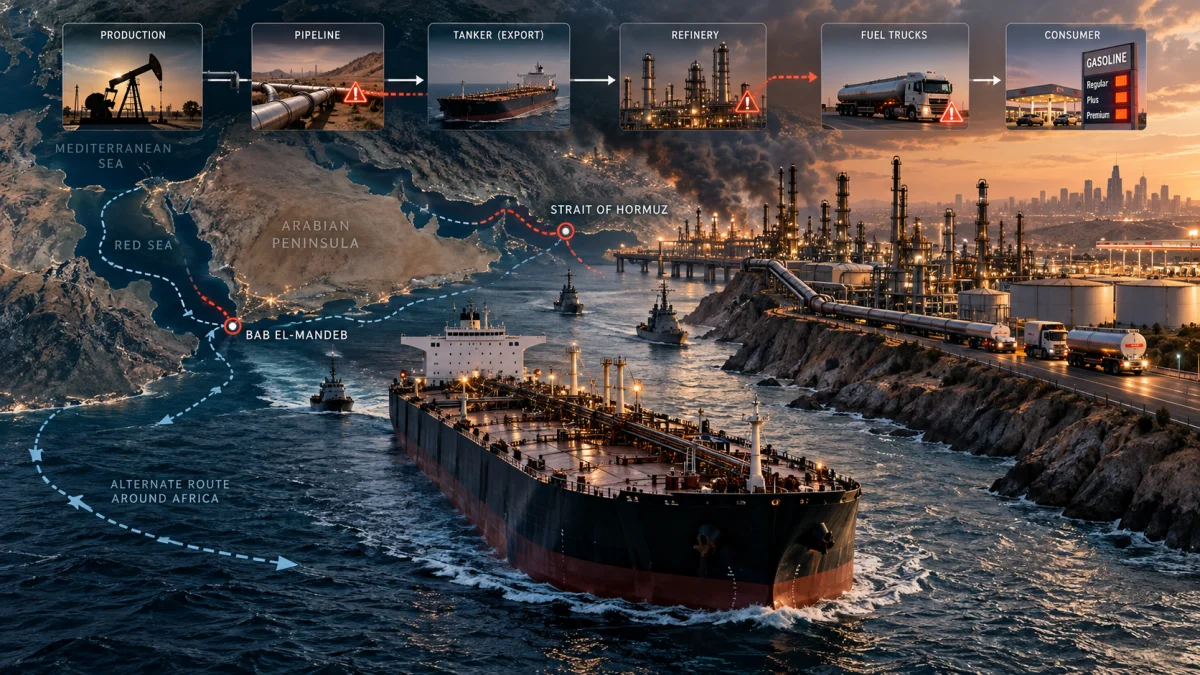
If someone tells you the Iran war will end soon and American gasoline will quickly return to $2 or $3 a gallon, ask one question:
Show me the logistics.
Not the political prediction. Not the television chyron. Not what someone thinks Iran, Israel or the Trump administration wants to happen.
Show me how many barrels are being produced. Show me how many can get out of the Persian Gulf. Show me the tanker capacity. Show me the war-risk premium. Show me the alternative pipelines. Show me the refinery capacity. Show me diesel inventories. Show me how much oil has already been pulled out of storage. Then show me how quickly all of those pieces return to normal after the shooting stops.
Because a barrel of oil existing somewhere underground is not the same thing as a barrel being produced, transported, insured, shipped, refined and delivered to a gas station at the old cost.
That distinction seems to be disappearing from a lot of what passes for oil-market analysis.
And to be clear, the opposite extreme is wrong too. Oil prices do not have to rise every day the war continues. In fact, the latest data show Middle Eastern crude exports recovering sharply. That is real, important and exactly why I would not tell anyone that prices can only go up.
But a recovering supply chain is not the same thing as a recovered supply chain.
That is the part worth understanding.
Oil prices can fall while the underlying system is still damaged
The latest development actually makes the point beautifully.
Preliminary Kpler data reported by Reuters show crude exports from major Middle Eastern producers rebounding strongly in September, to roughly four-fifths of prewar levels. Saudi Arabia and the United Arab Emirates have managed to increase shipments as more oil moves through Hormuz and through alternative arrangements. Reuters: Middle East oil exports rebound in September
That improvement matters. It can push crude prices lower. It can reduce panic premiums. It can change a forecast.
It does not establish that the Iran war is about to end, that the petroleum system has returned to normal, or that retail gasoline will immediately return to whatever price Americans remember from before the conflict.
The U.S. Energy Information Administration’s September outlook is much more cautious.
EIA expects Middle Eastern production to recover as more oil moves through the Strait of Hormuz and alternative routes. But its baseline still assumes export constraints persist through the end of 2026, keeping regional crude production below pre-conflict averages until the second quarter of 2027. EIA September 2026 Short-Term Energy Outlook
EIA further says that, under its assumptions, it will take until roughly Q2 2027 for most production and trade flows to return to pre-conflict averages, with some Persian Gulf producers potentially remaining below their previous production levels even longer. It also specifically warns that changing conditions around Hormuz and alternative routes could produce greater short-term price volatility than its forecast captures.
That is a very different statement from: war ends, gas gets cheap.
The real problem is bigger than crude oil
One of the recurring mistakes in public discussion is treating the oil market as though it were a single number called "the price of oil."
It isn’t.
Crude production matters. So does crude transportation.
Then refining matters.
Then the availability of specific products matters.
Diesel is not gasoline. Jet fuel is not crude. A refinery cannot instantly replace every missing barrel of every product simply because another country is producing oil.
The International Energy Agency’s September Oil Market Report estimated that more than 10 million barrels per day of Gulf production remained shut in during August. It also estimated that observed global oil inventories had fallen another 95 million barrels during August, bringing cumulative draws since February to roughly 507 million barrels. IEA Oil Market Report — September 2026
The refined-product numbers were even uglier.
According to the IEA, Gulf exports of refined petroleum products and LPG remained nearly 60% below February levels. Gulf diesel and gasoil exports averaged only about 390,000 barrels per day in August, a little more than one-quarter of their prewar level.
That matters because diesel moves economies.
Trucks burn it. Agricultural equipment burns it. Construction equipment burns it. Freight networks depend on it.
And EIA now forecasts U.S. distillate inventories, which include diesel and heating oil, to remain below the five-year low through the end of 2026 and most of 2027. EIA: U.S. petroleum products and distillate inventories
So when someone says, "Oil is down today, therefore the problem is ending," they are collapsing an entire petroleum supply system into a single market quote.
That isn’t supply-chain analysis.
A tanker is part of the price of oil
This is another part of the equation that gets strangely little attention outside shipping and commodity circles.
Oil does not teleport.
When normal shipping patterns become dangerous, ships reroute. Owners demand more money. War-risk insurance rises. Voyages take longer. Tankers become tied up for more days per cargo. Ship-to-ship transfers consume time and capacity. A fleet that was large enough under normal operating conditions can suddenly become constrained without a single tanker disappearing.
In September, Reuters reported that rates for very large crude carriers loading in the Gulf of Oman for China had reached record levels, with freight equivalent to approximately $11.50 per barrel on that route. Reuters: Oil tanker rates hit record highs after Iran-U.S. shipping attacks
Then Saudi Arabia increased its reliance on ship-to-ship transfers in the Gulf of Oman. By September 25, Reuters reported that those transfer operations had effectively reached capacity limits, forcing buyers and traders to look for additional transfer locations elsewhere. Reuters: Gulf of Oman ship-to-ship transfers reach capacity limits
Again, the barrels existed.
Moving them was the problem.
That distinction is fundamental.
The Red Sea already showed us how this works
We have already watched a smaller version of this play out.
After Houthi attacks on commercial shipping began disrupting the Red Sea in late 2023, vessels increasingly rerouted around Africa rather than pass through Bab el-Mandeb and the Suez system.
EIA data show oil flows through Bab el-Mandeb and the Suez/SUMED route falling to roughly half their 2023 levels by the first half of 2025. Meanwhile, traffic around the Cape of Good Hope increased substantially. EIA: World Oil Transit Chokepoints
Going around Africa works.
It is also slower.
EIA estimates that bypassing Suez can add approximately 15 days to an Arabian Sea-to-Europe tanker voyage.
That is what supply chains do when disrupted: they adapt.
Adaptation is not normalization.
And that lesson has become even more relevant during the Iran conflict because alternative routes themselves have become targets.
Saudi Arabia’s East-West pipeline became especially important because it allowed oil to bypass Hormuz and reach the Red Sea port of Yanbu. In September, an aerial attack forced the pipeline offline. It has since restarted, another important reason crude flows have improved. Reuters: Saudi Arabia restarts the East-West oil pipeline
That is good news for supply.
But think about what it also tells us.
A route becomes constrained, so the market leans harder on a bypass. The bypass is attacked. The market shifts traffic again. Repairs begin. Tanker movements change. Ship-to-ship transfers increase. Freight rates react. Traders adjust.
That is a functioning adaptive system.
It is not a normal one.
So could gasoline actually get cheaper? Absolutely.
This is where analysis requires some humility.
Gasoline can fall significantly from here.
Middle Eastern exports are recovering. Saudi infrastructure is being repaired. Tanker routes are adapting. U.S. production remains substantial. Demand can weaken. Strategic reserves can be released. Diplomatic progress could sharply reduce the geopolitical risk premium.
EIA itself forecasts lower prices eventually.
Its September forecast has Brent crude averaging about $74 per barrel in 2027, compared with $91 in 2026, and U.S. retail gasoline averaging about $3.35 per gallon in 2027. EIA September forecast: U.S. energy market indicators
So this is not an argument that cheap gasoline is impossible.
It is an argument against pretending the path is obvious.
EIA’s forecast is conditional on production recovering, transportation constraints easing, inventories rebuilding and tanker traffic becoming more normal.
Change those assumptions and you change the forecast.
EIA explicitly says that if Middle Eastern flows remain constrained longer than expected, refined-product markets could stay tighter and prices higher than its baseline.
That is what an actual forecast looks like: assumptions attached.
What would a serious cheap-gas forecast have to explain?
Before confidently promising $2 or $3 gasoline, an analyst should be able to answer at least these questions:
| Question | Why it matters |
|---|---|
| How much Gulf production returns? | Oil cannot be exported if production remains shut in. |
| How much oil can transit Hormuz safely? | Hormuz remains one of the world’s most important energy chokepoints. |
| How much bypass capacity is actually available? | Pipelines and alternative ports have physical limits. |
| What happens to tanker rates and insurance? | Transportation costs become part of the delivered barrel price. |
| How quickly do global inventories rebuild? | More than half a billion barrels of observed inventory have been drawn since February by the IEA’s estimate. |
| What happens to diesel and jet-fuel supply? | Crude availability alone does not fix refined-product shortages. |
| How quickly do damaged facilities restart? | Repairing infrastructure is not instantaneous. |
| Does demand weaken? | High prices can eventually destroy demand, reducing prices for a very different reason. |
| Does the war actually end? | A political prediction is an input to the forecast, not a substitute for one. |
If someone cannot explain those variables, I am not sure what exactly they are analyzing.
We have also heard "soon" before
There is another reason I am skeptical of confident timelines.
The United States and Israel launched coordinated attacks on Iran on February 28, 2026. Reuters explainer on the opening U.S.-Israeli attacks on Iran
On April 8, the White House announced a ceasefire and described the major combat phase as having achieved its objectives in 38 days. The administration said from the beginning that the campaign was supposed to last roughly four to six weeks. White House statement on the April ceasefire and Operation Epic Fury
The conflict did not end there.
On September 18, President Trump again predicted that the war would end soon and said gasoline would return to its previous level or possibly lower afterward. Reuters video and transcript: Trump says the Iran war will end soon
On September 28, he again said the United States would win the war "very soon" and that gasoline prices would come "tumbling down." Reuters: Trump says U.S. will win Iran war very soon
Maybe he is right this time.
Diplomatic conditions can change rapidly.
But a political leader predicting an imminent end to a war is not the same thing as the petroleum supply chain already being positioned for an immediate return to prewar costs.
Those are separate claims.
Americans are already paying more than the number on the gas pump
As of September 28, EIA put the national average price of regular gasoline at $4.465 per gallon, compared with $3.118 a year earlier.
Diesel averaged $6.382 per gallon.
California regular gasoline averaged $6.189, while California diesel was $8.181. EIA weekly gasoline and diesel fuel prices, September 29, 2026 release
But the household effect does not stop at the pump.
The Congressional Budget Office concluded in September that reduced oil and natural-gas shipments through Hormuz, combined with Red Sea shipping disruptions, had increased global energy prices and the prices of refined products including gasoline, diesel and jet fuel.
CBO estimated that higher energy prices related to the conflict added about 2.3 percentage points to the annualized PCE inflation rate in the second quarter of 2026. It also expects some of the effect to persist longer in core inflation because higher transportation and energy costs take time to work through the prices of other goods and services. Congressional Budget Office: Estimating the Cost of Combat Operations Against Iran
That is the supply-chain part of inflation.
Diesel becomes trucking costs.
Jet fuel becomes transportation costs.
More expensive freight becomes more expensive inventory.
Higher energy inputs spread into manufacturing, agriculture, distribution and eventually retail prices.
Consumers do not receive a separate receipt labeled WAR-RELATED SUPPLY-CHAIN COST.
They simply notice that more things cost more money.
The military cost belongs in the same conversation
CBO estimated that Defense Department operations against Iran had cost approximately $38 billion through August 1.
At the lower combat intensity seen during parts of May and June, CBO estimated another month could cost roughly $2 billion. At July’s higher intensity, approximately $3 billion. Further escalation could cost more.
CBO also identified a less visible opportunity cost: substantial use of missile-defense interceptors, reducing inventories that may take years to replenish.
These numbers do not, by themselves, tell Americans whether the war is justified.
That is a political judgment.
But they do tell us what a serious discussion has to include.
The administration says its objectives include preventing Iran from obtaining a nuclear weapon, destroying or degrading Iranian missile capabilities and production, degrading its navy, and limiting Iran’s ability to support armed proxies. Those are the administration’s stated national-security benefits, not independent proof of their ultimate effectiveness. White House statement of Operation Epic Fury objectives
Americans are entitled to compare those claimed benefits against the measurable costs.
That means military spending.
It means depleted inventories.
It means casualties and regional risk.
It means gasoline.
It means diesel.
It means shipping.
It means inflation.
And it means asking what continuing the conflict is expected to accomplish that has not already been accomplished.
Is this simply "Israel’s war"?
There is a legitimate political argument over how much U.S. involvement serves Israeli security interests and whether those interests overlap sufficiently with American ones.
But describing the conflict literally as nothing more than "Israel’s war" skips an important factual distinction.
The United States and Israel jointly launched attacks on Iran on February 28, and Washington has articulated its own military and nuclear objectives. The United States is therefore not merely an outside party paying someone else’s bill. It is a direct combatant pursuing objectives the administration defines as American national-security interests.
That does not end the debate.
It makes the debate more precise.
The serious question is not whether Israel benefits.
Of course Israel has major strategic interests in weakening Iran.
The serious question for Americans is:
Which U.S. interests are being advanced, what are those gains worth, what are the costs of achieving them, and at what point does the marginal benefit of continuing the war become smaller than the marginal cost?
That is the policy question.
It deserves something better than slogans from either side.
I know what I know, and I know what I have to research
I write about a lot of subjects.
Some require me to start nearly from scratch, read the underlying documents, find the best available evidence, understand the technical language and then explain it to readers.
There is nothing wrong with that. That is the work.
Petroleum logistics is different for me.
Moving oil, understanding the physical supply chain and dealing with the realities behind getting petroleum from one place in the world to another was part of my professional life before I was writing articles about it.
That does not make every forecast I make correct. Nobody gets that privilege.
But it does make one thing particularly frustrating to watch: people being introduced as analysts and then offering what is really a political assumption with a commodity-price prediction attached to it.
"The war will end soon, so gas will go back down" is not enough.
Maybe it will.
Show your assumptions.
Show the production.
Show the pipeline capacity.
Show the vessels.
Show the routes.
Show the insurance.
Show the refineries.
Show the product inventories.
Show how long replenishment takes.
And show what happens when one of those assumptions fails.
That is analysis.
Everything else might eventually turn out to be right.
But being right because events happened to follow the scenario you hoped for is not the same thing as understanding why.
The bottom line
There are credible reasons oil and gasoline prices could fall from current levels, and Middle Eastern export flows are already improving.
That is the good news, and it should not be ignored.
But the available evidence does not support treating the petroleum system as though the war can simply switch off and prices instantly revert to an earlier equilibrium.
Hundreds of millions of barrels have been drawn from inventories. Gulf production remains impaired. Refined-product markets, particularly diesel, remain exceptionally tight. Tanker costs have soared. Alternative routes have been attacked. Shipping patterns have been reconfigured. And the U.S. government’s own energy forecast does not assume a broad return to pre-conflict Middle Eastern production and trade until 2027.
Oil markets can recover.
Supply chains can adapt.
Wars can end unexpectedly.
Prices can drop faster than fundamentals sometimes suggest.
All of those things are true.
But if someone is confidently promising Americans cheap gasoline just around the corner, there is a very simple response:
Show me the logistics.
And while we’re looking at them, Americans should ask the larger question too:
What measurable benefit are we receiving from continuing this war, what is it costing us, and are those two numbers still in a defensible relationship?
That is not an anti-war answer or a pro-war answer.
It is the question that should come before either one.
References and Further Reading
Energy Data and Official Forecasts
U.S. Energy Information Administration — September 2026 Short-Term Energy Outlook
EIA’s current baseline for Middle Eastern production, oil-market balances and the timeline for normalization of regional flows.
U.S. Energy Information Administration — September 2026 Energy Market Indicators
Provides EIA’s 2026 and 2027 Brent crude and U.S. retail gasoline forecasts.
U.S. Energy Information Administration — U.S. Petroleum Products
Details the unusually tight U.S. distillate market and EIA’s outlook for diesel inventories.
U.S. Energy Information Administration — Gasoline and Diesel Fuel Update
Weekly national, regional and state retail fuel-price data.
U.S. Energy Information Administration — World Oil Transit Chokepoints
Authoritative overview of Hormuz, Bab el-Mandeb, Suez/SUMED and alternative maritime routes.
Global Oil Supply, Refining and Inventories
International Energy Agency — Oil Market Report, September 2026
Provides current estimates of shut-in Gulf production, global inventory draws, refinery throughput and refined-product disruptions.
Shipping and Physical Oil Flows
Reuters — Middle East Oil Exports Rebound in September
Reports Kpler’s latest preliminary estimates showing the strongest Middle Eastern export recovery since the war began.
Reuters — Gulf of Oman Ship-to-Ship Transfers Reach Capacity Limits
Explains how alternative tanker-transfer arrangements themselves became constrained.
Reuters — Oil Tanker Rates Hit Record Highs Following Shipping Attacks
Documents the freight-cost consequences of elevated Gulf shipping risk.
Reuters — Saudi Arabia Restarts East-West Oil Pipeline
Documents the disruption and subsequent restart of a major route used to bypass Hormuz.
U.S. Costs and Policy
Congressional Budget Office — Estimating the Cost of Combat Operations Against Iran
Nonpartisan assessment of U.S. military costs, weapons-inventory effects, energy-price disruption and inflationary consequences.
White House — Stated Objectives of Operation Epic Fury
Used here specifically to document the administration’s own stated objectives. Its descriptions of military success are administration claims and should not be treated as independent verification.
White House — April 8 Ceasefire Statement
Documents the administration’s April declaration that the campaign’s major objectives had been achieved within the originally described four-to-six-week timeframe.
Reuters — Trump Says Iran War Will End Soon and Gas Prices Will Fall
Primary video/transcript source for the September 18 presidential prediction discussed in the article.
Conflict Chronology
Reuters — Why the U.S. Is Attacking Iran
Contemporaneous account of the February 28 U.S.-Israeli attacks and the administration’s stated rationale.
Editorial currency note: Oil prices, tanker flows, negotiations, infrastructure availability and military conditions are changing rapidly. Market figures and forecasts in this article reflect information available through September 29, 2026. EIA’s next Short-Term Energy Outlook is scheduled for October 6, 2026.