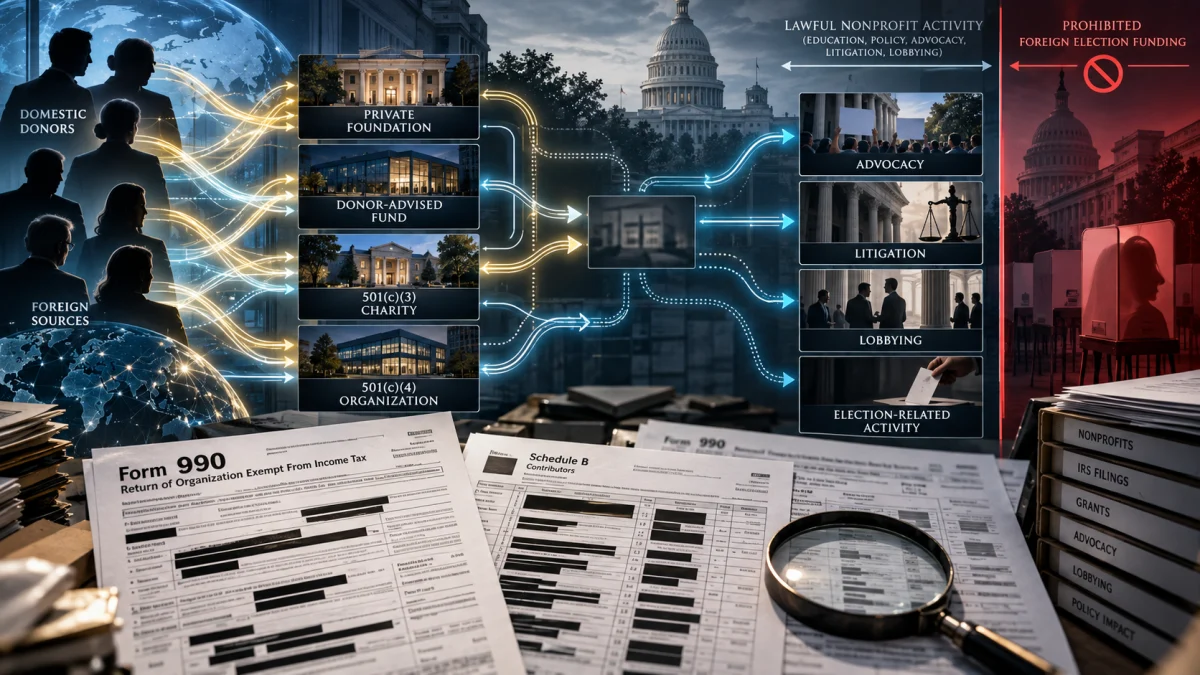
Yes. Foreign nationals generally can donate money to American nonprofit organizations. What they generally cannot do is use that money to finance U.S. elections.
That distinction sounds simple until the money starts moving.
Federal campaign-finance law prohibits a foreign national from directly or indirectly making contributions, donations, expenditures or certain other disbursements connected to federal, state or local elections. Foreign nationals also cannot participate in decisions about another person’s election-related spending. Lawful permanent residents, commonly called green-card holders, are not treated as foreign nationals for this prohibition. Federal Election Commission guidance on foreign nationals
But there is no comparable blanket federal rule saying that a foreign individual, foreign company, foreign foundation or even foreign government can never give money to an American nonprofit. A longstanding State Department explanation of U.S. NGO law states explicitly that, as a general matter, American law does not prohibit U.S. NGOs from receiving foreign funding, subject to other laws such as sanctions, terrorism-financing rules and election restrictions. U.S. State Department explanation of foreign funding of American NGOs
That creates the real question:
If foreign money can legally enter an American nonprofit, but cannot legally finance an American election, how do regulators and the public determine where one ends and the other begins?
The answer is uncomfortable.
Sometimes the trail is clear.
Sometimes the government knows more than the public.
And sometimes even the federal government does not routinely receive the information necessary to reconstruct every original donor.
Foreign Funding of a Nonprofit Is Not the Same Thing as Foreign Election Spending
The first mistake is treating every politically active nonprofit as though it were a political committee.
It is not.
Different nonprofit structures operate under very different rules.
| Organization | Foreign donations generally possible? | Candidate-election activity | Are underlying donor identities normally public? |
|---|---|---|---|
| 501(c)(3) public charity | Yes, subject to other applicable laws | Direct or indirect candidate campaign intervention is prohibited | Generally no |
| 501(c)(4) social-welfare organization | Yes, subject to other applicable laws | Some candidate-related activity is permitted, but it cannot be the organization’s primary activity | Generally no |
| Private foundation | Foreign funding may be possible depending on circumstances | Significant political restrictions apply | Contributor information is substantially more visible through Form 990-PF |
| Section 527 political organization | Foreign-national election funding is prohibited | Political activity is its central function | Much stronger contributor-disclosure requirements apply |
| Super PAC | Foreign-national contributions are prohibited | May make unlimited independent expenditures | Direct donors are publicly disclosed, although an intermediary entity can itself be the disclosed donor |
| Donor-advised fund | A charitable account held by a 501(c)(3) sponsoring organization | Governed by charitable-use rules | Public records may identify the sponsor without identifying the person who originally supplied the money |
The IRS is unequivocal about 501(c)(3) charities: they are prohibited from directly or indirectly participating in political campaigns for or against candidates. IRS rule on 501(c)(3) political campaign intervention
A 501(c)(4) works differently. The IRS says a social-welfare organization may engage in some political campaign activity as long as political activity is not its primary activity. Lobbying can even be a primary activity when it advances the organization’s social-welfare purposes. IRS guidance for 501(c)(4) social-welfare organizations
So the phrase “political nonprofit” can hide several legally different things.
A litigation organization filing lawsuits over immigration policy is not automatically engaging in campaign activity.
A charity publishing research on abortion, climate policy, guns or Israel is not automatically financing an election.
And a nonprofit receiving money from a foreign citizen is not, by that fact alone, violating campaign-finance law.
The difficult issue starts when politically consequential nonprofit activity and election-related money begin crossing organizational boundaries.
What Does a Form 990 Actually Tell the Public?
This is where the transparency problem becomes more obvious.
Most substantial nonprofits file annual Form 990 information returns. Those returns can reveal enormous amounts of information: total contributions, salaries, assets, grants paid, contractors, related entities, program spending and other financial information.
What they frequently do not reveal publicly is the identity of the person who supplied the money.
The IRS says tax-exempt organizations generally do not have to make contributor names and addresses listed on Schedule B available for public inspection. Private foundations and certain Section 527 political organizations are major exceptions. IRS rules for public disclosure of nonprofit contributor identities
For ordinary 501(c)(3) public charities, substantial contributors still must generally be reported to the IRS on Schedule B.
The public copy is different.
Contributor names and addresses are withheld.
That creates an important distinction:
“The donor is not public” does not necessarily mean “nobody knows who the donor is.”
For a 501(c)(3), the organization itself knows its donor, and the IRS generally receives identifying information for contributors that meet Schedule B reporting thresholds.
The ordinary public does not.
In 2020, Another Part of the Trail Disappeared From Routine IRS Reporting
The distinction becomes even more significant with organizations such as 501(c)(4)s.
Before 2020, many tax-exempt organizations outside 501(c)(3) still had to provide the IRS with names and addresses of substantial contributors, even though those identities generally were not public.
Treasury and the IRS changed that.
Under final regulations issued in 2020, tax-exempt organizations other than 501(c)(3) organizations and Section 527 political organizations generally no longer have to routinely report the names and addresses of substantial contributors to the IRS each year.
They must still maintain that information in their own records and provide contribution amounts where required, and the IRS can seek donor information during an examination. IRS 2020 final regulations on contributor reporting
That change is frequently described incorrectly as eliminating public donor disclosure.
Most of those names were not public beforehand.
The meaningful change was different:
The IRS itself stopped routinely receiving names and addresses from most affected non-501(c)(3) organizations.
The organization may know.
Its accountants may know.
The IRS can demand the information in an examination.
But the information is no longer necessarily sitting on an annual Schedule B already in the government’s possession.
That matters if the policy question is not simply tax compliance, but whether investigators can reconstruct the original source of money moving through several organizations.
The Government Can Know More Than You. But Sometimes It Knows Less Than You Think.
A useful way to understand the system is to separate three questions:
| Question | 501(c)(3) public charity | Many non-501(c)(3) organizations |
|---|---|---|
| Does the nonprofit itself know the donor? | Generally yes | Generally yes |
| Does the IRS routinely receive substantial donor identities? | Generally yes through Schedule B | Generally no after the 2020 reporting change |
| Can the public see those identities? | Generally no | Generally no |
The result is a transparency system with several different levels of visibility.
A journalist may see less than the IRS.
The IRS may see less automatically than the nonprofit.
And once money moves through an intermediary, the recipient nonprofit may itself see only the intermediary that issued the grant.
That last step is particularly important.
Donor-Advised Funds Can Break the Public Provenance Trail
A donor-advised fund, or DAF, is an account maintained by a sponsoring 501(c)(3) public charity.
A donor contributes assets to the sponsoring organization and receives the applicable charitable deduction. The sponsoring charity then has legal ownership and control of the money. The original donor generally retains advisory privileges over how assets are invested or which eligible charities should receive grants. IRS explanation of donor-advised funds
That legal-control distinction matters. A DAF should not simply be described as a fake organization or a shell controlled by the donor.
But DAFs can create a very real public provenance break.
Imagine:
Original donor → DAF sponsor → recipient nonprofit
Public records may eventually show that the recipient received a grant from the DAF sponsoring organization.
They may not identify which individual funded the account from which the grant recommendation originated.
Some DAF providers explicitly offer that privacy.
DonorsTrust, for example, describes itself as a donor-advised-fund provider and tells prospective donors that grants may be sent anonymously so the receiving charity sees the grant as coming from an unnamed DonorsTrust adviser. DonorsTrust explanation of donor-advised giving and privacy
The Bradley Impact Fund likewise identifies itself as a donor-advised-fund sponsoring organization whose donors can recommend charitable grants. Bradley Impact Fund donor-advised fund program
None of that proves anything improper about a particular donor.
It shows why tracing a grant to an intermediary is not necessarily the same thing as identifying the original source of the wealth behind it.
America First Legal Shows How Much Can Be Reconstructed — and How Much Cannot
America First Legal Foundation provides a useful real-world example.
The organization is a 501(c)(3) public-interest legal nonprofit. Its current leadership page identifies White House Deputy Chief of Staff Stephen Miller as a co-founder; Gene Hamilton is now its president. America First Legal leadership
Its 2024 Form 990 reported approximately $31.46 million in contributions, accounting for 98.4% of its roughly $31.97 million in total revenue. It finished the year with approximately $29.58 million in net assets. In 2022, it reported approximately $44.4 million in contributions. America First Legal Foundation Form 990 data via ProPublica Nonprofit Explorer
Those totals are public.
The complete underlying donor list is not.
Researchers can nevertheless reconstruct portions of the funding trail by looking backward from grantmaking organizations’ own filings.
A database built from public IRS Form 990 grant records identifies approximately $77.7 million in itemized grants to America First Legal from 64 grantmaking organizations between 2020 and 2025. The largest identified grantmaking sources in that dataset include:
- Bradley Impact Fund: about $27.4 million
- DonorsTrust: about $24.6 million
- Fidelity Investments Charitable Gift Fund: about $11.1 million
- Christian Community Foundation: about $4.8 million
- Rydin Foundation: about $3.4 million
IRS-derived grant records for America First Legal Foundation
Those records are useful, but they need to be interpreted correctly.
They identify grantmaking entities that reported grants to America First Legal.
They do not necessarily identify every donor to America First Legal.
And when a grantmaking entity is itself a donor-advised-fund sponsor, identifying the sponsor still may not identify the individual whose contribution originally financed a particular grant.
That is the transparency gap in practice.
Landmark Legal Foundation Shows the Same Problem on a Smaller Scale
Landmark Legal Foundation provides another useful case.
Mark Levin joined Landmark in 1992, served as its president from 1996 until 2017 and remains active as chairman emeritus, according to Landmark’s own organizational history. Landmark Legal Foundation leadership and history
Landmark’s 2024 Form 990 reported approximately $5.64 million in contributions, representing 91.9% of its $6.14 million in total revenue. Its net assets stood at approximately $17.21 million. Landmark Legal Foundation Form 990 data via ProPublica Nonprofit Explorer
Again, the total contributions are visible.
The full donor identities are not.
Looking backward through other organizations’ filings uncovers part of the network. An IRS-record aggregation identifies about $2.3 million in itemized grants from 47 grantmaking organizations between 2019 and 2025, including roughly $1.1 million from the Sarah Scaife Foundation and $385,000 from Fidelity Investments Charitable Gift Fund. IRS-derived grant records for Landmark Legal Foundation
But the same warning applies:
That is a reconstruction of identifiable grants, not Landmark’s complete donor list.
Nothing in those public records by itself proves that Landmark’s unidentified contributions originated overseas.
Opacity is evidence that the public cannot identify every donor.
It is not evidence that the unknown donor must be foreign.
That distinction is essential.
Foreign-Funded Does Not Automatically Mean “Foreign Agent”
Another common mistake is assuming that any American nonprofit receiving foreign money must register under the Foreign Agents Registration Act.
That is not how FARA works.
The Justice Department describes FARA as applying to certain people or organizations acting at the order, request, direction or control of a foreign principal while engaging in covered activities such as political activity, public relations, political consulting, handling contributions for a foreign principal or representing that principal before the U.S. government. Justice Department FARA guidance
Funding can therefore matter to a FARA analysis.
Funding alone does not automatically answer it.
A genuinely independent American charity receiving a foreign donation is legally different from an organization acting at the direction or control of a foreign government or other foreign principal.
Again, the law turns on the actual relationship and conduct.
The Wyss Case Shows What Happens When the Donor Actually Is Foreign
A stronger case for examining the foreign-money boundary is the dispute involving Swiss billionaire Hansjörg Wyss and several U.S. nonprofits, including the Berger Action Fund, New Venture Fund and Sixteen Thirty Fund.
The case reached the Federal Election Commission as Matter Under Review 7904.
A complaint alleged prohibited foreign-national contributions, conduit contributions and failures by some organizations to register as political committees.
The FEC did not establish a foreign-national violation.
Commissioners deadlocked 3–3 on a motion to find no reason to believe that Wyss and the organizations had made foreign-national contributions or contributions in another person’s name. The Commission ultimately voted unanimously to close the file. Separate political-committee-registration allegations were dismissed. Federal Election Commission record for MUR 7904
That outcome is important precisely because it refuses to provide a simplistic answer.
It did not establish that prohibited foreign election funding occurred.
It also illustrates why the interaction between foreign donors, nonprofit treasuries and subsequent political activity can produce difficult enforcement questions.
The public argument is often framed as:
Did this specific foreign dollar pay for this specific election expenditure?
But money inside an organization’s treasury is fungible.
A foreign donation earmarked for election spending would present a relatively straightforward problem.
The harder scenario is:
A nonprofit receives lawful foreign money for one purpose, freeing domestic money elsewhere in the organization or nonprofit network for political spending.
Whether and when that becomes prohibited foreign-national election activity can depend on the facts, including control, direction, earmarking, decision-making and the path the money takes.
That is the hole Congress is now trying to address.
Congress Is Debating This Exact Problem in 2026
Two bills reported by the House Ways and Means Committee this summer directly target the nonprofit foreign-funding issue.
As of September 28, 2026, both had been reported to the House and placed on the Union Calendar. Neither had become law. September 28, 2026 House Calendar
H.R. 9772: The Foreign Funding Transparency Act
The reported version of H.R. 9772 would require certain 501(c) organizations to report:
- the aggregate amount of contributions received from foreign nationals during the year; and
- separate aggregate amounts associated with foreign nationals from each designated “foreign country of concern.”
The reporting rule would apply to organizations whose preceding-year gross receipts equal or exceed $200,000 or whose assets equal or exceed $500,000. House Report 119-765 on H.R. 9772
The legislation is notable for what it does not do.
It does not simply create a public directory naming every foreign donor.
The reported bill asks for aggregate foreign contribution amounts, with country-specific aggregation for countries of concern.
The committee majority argues that current law leaves regulators without enough information to trace foreign contributions through nonprofit-to-nonprofit transfers.
The committee’s dissenting Democrats argue that the proposal is overly broad and unnecessarily burdens ordinary nonprofits, charities and unions, particularly because 501(c)(3)s already disclose substantial donor identities confidentially to the IRS.
Those are materially different arguments about the same underlying problem:
How much donor information should nonprofits have to collect, and who should be allowed to see it?
H.R. 9771: The Stopping Foreign Influence in Elections Act of 2026
H.R. 9771 takes a different approach.
Its reported version would impose penalties when a covered 501(c) organization makes a contribution to a defined “political entity” after receiving a contribution or gift from a foreign national during a two-year testing period.
The legislation defines political entities to include political committees and 501(c)(4) organizations. Repeated violations would trigger escalating tax consequences and could ultimately result in temporary suspension of tax-exempt status. House Report 119-768 on H.R. 9771
Supporters essentially argue that money is fungible: once a nonprofit accepts foreign money, allowing the same organization to transfer money into political entities creates an avenue through which foreign resources can indirectly expand the organization’s political capacity.
Opponents argue that the rule sweeps much farther than intentionally laundering foreign election money. The dissenting committee report notes that even a nonprofit receiving a small lawful foreign donation could face restrictions on subsequent transfers to a 501(c)(4), including transfers unrelated to campaigns.
The National Council of Nonprofits has made a similar objection, warning that the proposals would impose substantial donor-nationality tracking burdens on ordinary nonprofits. National Council of Nonprofits analysis of H.R. 9771 and H.R. 9772
That policy dispute is legitimate.
But the fact that Congress is fighting over these bills confirms something more basic:
The current system does not provide a simple public mechanism for following every foreign contribution through subsequent nonprofit transfers.
Where the Money Trail Actually Goes Dark
The transparency problem can be reduced to a simple chain:
Original donor → intermediary → recipient nonprofit → another organization → political or policy activity
Every arrow potentially changes what the public can see.
Step 1: Original donor to nonprofit
A 501(c)(3) may report a substantial donor privately to the IRS, while the public cannot see the identity.
Step 2: Original donor to donor-advised fund
The DAF sponsoring organization receives legal control of the donation.
Public records may never identify the underlying donor in connection with a later grant.
Step 3: DAF sponsor to nonprofit
A grant can become publicly traceable back to the sponsoring organization.
That still may not identify the original donor.
Step 4: Nonprofit to another nonprofit
The transfer may appear in public grant records.
But the money now carries the name of the organization making the grant, not necessarily the person whose wealth entered the chain several steps earlier.
Step 5: Political spending
Once money reaches an entity engaging in campaign activity, campaign-finance disclosure rules may reveal the immediate spender or contributor.
They do not automatically reconstruct every upstream source.
This is why saying “the PAC disclosed its donor” and saying “the public knows where the money ultimately originated” are not always the same statement.
sherafy.com previously documented the downstream side of this problem in Mapping the Shadow, examining smaller PACs, 501(c)(4)s, intermediary organizations and other structures capable of separating a political message from the underlying donor network. Mapping the Shadow: How Smaller PACs, Dark Money, and Brand-Laundered Influence Shape U.S. Politics
The earlier Mapping the Money project examined measurable foreign-connected political influence outside the FARA system. Mapping the Money: The Top Non-FARA Foreign-Connected Influencers in U.S. Politics
And our broader investigation into how money runs American politics examines the structural incentives created by campaign funding and organized political spending. How Money Runs American Politics: The Corruption Blocking Real Reform in the U.S.
This article addresses the upstream question those investigations naturally create:
Who supplied the money before it became the name visible on the filing?
So Can Foreign Money Be “Laundered” Through a Nonprofit?
The word laundered needs care.
Criminal money laundering has specific statutory elements. Moving lawful money through several nonprofits does not automatically satisfy them.
But money can unquestionably become harder to attribute publicly as it moves through lawful nonprofit structures.
A foreign donor can legally give to many American nonprofits.
A 501(c)(3) can legally engage in litigation, research, public education and issue advocacy while remaining barred from intervening in candidate campaigns.
A donor-advised fund can legally allow a donor to recommend charitable grants while the sponsoring organization retains legal control.
A 501(c)(4) can legally engage in some electoral activity.
And a Super PAC can legally accept unlimited money from permissible domestic sources while being forbidden from accepting foreign-national funds.
Each individual step can therefore be lawful.
The public-interest problem emerges when several steps are combined and the available records no longer allow an ordinary observer to confidently answer:
Who originally supplied the money?
That is not proof of illegality.
It is proof of an information problem.
What Would Actually Prove Illegal Foreign Election Funding?
A serious investigation needs more than an unidentified donor.
Evidence could include:
- records showing that a foreign national supplied money specifically for election activity;
- communications establishing that a foreign national directed or controlled election-related decisions;
- evidence that an intermediary knowingly transferred foreign money into prohibited election spending;
- false donor attribution or conduit contributions designed to conceal the true contributor;
- financial records showing that an ostensible domestic contributor was acting on behalf of a foreign national; or
- other evidence connecting the foreign source to the election-related expenditure or decision.
Without that connection, responsible reporting should distinguish three different propositions:
Verified: The organization received substantial donations whose original sources are not fully visible to the public.
Possible: Some funding structures could make foreign-origin money difficult for outsiders to trace.
Unproven: The unidentified money funding a particular organization actually came from foreign nationals or illegally financed an election.
Those propositions are not interchangeable.
The Bottom Line
American campaign-finance law draws a bright line around one principle:
Foreign nationals are not supposed to finance American elections.
The nonprofit system draws a very different line:
Foreign nationals generally may support American nonprofit organizations.
Those two rules can coexist because nonprofits perform enormous amounts of lawful activity that has nothing to do with candidate campaigns.
The problem is what happens in between.
A donor can give to a nonprofit whose contributor list is not public.
Money can move through a donor-advised fund that publicly identifies the sponsor rather than the original donor.
One nonprofit can grant money to another.
A later recipient may engage in lobbying, issue advocacy or legally permitted political activity.
And by the time money reaches the public-facing end of the system, identifying its ultimate original source may require reconstructing multiple organizations’ tax filings — and sometimes the public record still ends before the original donor appears.
That does not mean every anonymous donation is foreign.
It does not mean every foreign donation is improper.
And it does not mean every politically consequential nonprofit is secretly violating election law.
It means something simpler:
The United States prohibits foreign election money more clearly than it tracks foreign money moving through the nonprofit system surrounding American politics.
Congress is now debating whether that gap requires new disclosure and anti-funneling rules.
Whatever ultimately happens to those bills, the underlying transparency question will remain:
If the law cares who supplied political money, how far upstream should the public be allowed to follow it?
That is the part of the system Form 990 totals alone cannot answer.
References and Further Reading
Campaign-Finance and Foreign-National Rules
Foreign Nationals — Federal Election Commission
Primary FEC guidance describing the prohibition on foreign-national contributions, donations, expenditures and election-related decision-making.
MUR 7904: Hansjörg Wyss et al. — Federal Election Commission
The enforcement record involving allegations concerning Wyss, the Berger Action Fund, New Venture Fund, Sixteen Thirty Fund and related entities. It documents the Commission’s votes, deadlock and closure of the matter.
IRS Nonprofit and Donor-Disclosure Rules
Public Disclosure of Contributor Identities — Internal Revenue Service
Explains when contributor identities on nonprofit filings are and are not publicly available.
Schedule B Instructions — Internal Revenue Service
Current instructions explaining which organizations must report contributor identities and the effect of the 2020 regulatory change.
Treasury Decision 9898 / 2020 Contributor Reporting Regulations — Internal Revenue Service
The final rule ending routine annual reporting of substantial-contributor names and addresses for many tax-exempt organizations outside 501(c)(3) and 527.
Donor-Advised Funds — Internal Revenue Service
Primary IRS explanation of the ownership, control and donor advisory privileges associated with donor-advised funds.
Restriction of Political Campaign Intervention by 501(c)(3) Organizations — Internal Revenue Service
Establishes the candidate-campaign prohibition applicable to 501(c)(3) organizations.
Social Welfare Organizations — Internal Revenue Service
Explains the different political and lobbying rules applicable to 501(c)(4) organizations.
FARA and Foreign Funding
Foreign Agents Registration Act Frequently Asked Questions — U.S. Department of Justice
Current Justice Department explanation of when a person or organization acting for a foreign principal may have a FARA registration obligation.
Non-Governmental Organizations in the United States — U.S. Department of State Archive
Archived State Department fact sheet explaining the general legal treatment of foreign funding received by U.S. NGOs and distinguishing funding from campaign-finance restrictions.
Current 2026 Legislation
H.R. 9772, Foreign Funding Transparency Act — House Report 119-765
Contains the reported legislative text, current-law background, committee rationale and dissenting views concerning proposed foreign-funding disclosure requirements.
H.R. 9771, Stopping Foreign Influence in Elections Act of 2026 — House Report 119-768
Contains the reported bill, two-year testing-period rules, proposed penalties and competing committee views.
House Calendar for September 28, 2026 — U.S. Government Publishing Office
Current congressional calendar confirming the bills remain pending rather than enacted.
Case-Study Financial Records
America First Legal Foundation — ProPublica Nonprofit Explorer
IRS-derived Form 990 records supporting America First Legal’s revenue, contribution and asset figures.
America First Legal Foundation Grantmakers — philanthropy.org
Compilation of itemized grants reported on public IRS filings by grantmaking organizations; useful for reconstructing portions of the funding network but not equivalent to a complete donor list.
Landmark Legal Foundation — ProPublica Nonprofit Explorer
IRS-derived Form 990 records supporting Landmark’s contribution, revenue and asset figures.
Landmark Legal Foundation Grantmakers — philanthropy.org
IRS-derived grant records showing identifiable institutional grants to Landmark while illustrating why grant records cannot necessarily reconstruct every underlying donor.
Editorial currency note: Campaign-finance rules, nonprofit reporting requirements and the status or text of pending federal legislation can change. The bill-status discussion in this article is current through September 28, 2026.