A viral description of the September 29 Senate vote says Congress voted to let Israel “murder Americans” without investigation. That is not literally what the Senate voted on. Senators did not vote to legalize killing Americans, and they did not cast a final up-or-down vote on whether the FBI or another law-enforcement agency could investigate a homicide.
The primary record is more precise, and still deeply consequential.
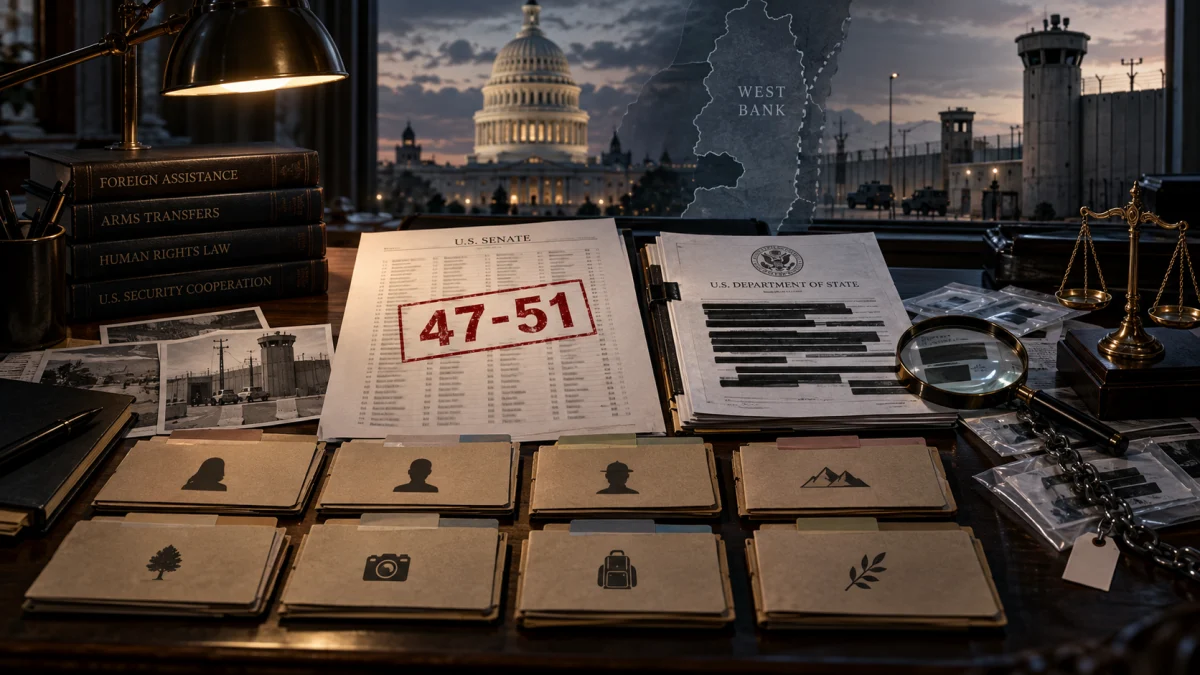
On September 29, 2026, the Senate rejected 47-51 a motion to discharge S.Res. 852 from the Senate Foreign Relations Committee. Two senators did not vote. The resolution would have invoked Section 502B(c) of the Foreign Assistance Act to require an unclassified State Department statement addressing, among other things, nine named American deaths in the West Bank since January 2022. The requested report was unusually specific: it sought the status of U.S. and Israeli investigations, evidence obtained by American officials, information about potential suspects and implicated Israeli security-force units, Israeli accountability measures, U.S. diplomatic communications, possible declassification of prior assessments, and information relevant to U.S. military-assistance restrictions.
Those requirements are in the Congressional Record text of S.Res. 852, not inferred from a speech or social-media video.
That distinction matters. Saying “the Senate voted to allow Israel to murder Americans” assigns a legal meaning and a motive the vote does not establish. But dismissing the episode because that viral formulation is exaggerated would miss the more defensible question:
Why, after nine American deaths, multiple investigations, repeated congressional requests and years of public promises of accountability, was Congress still trying to force the executive branch to disclose basic information about what happened, who may have been responsible and what the United States did about it?
And why did a Senate majority oppose using this particular statutory mechanism to compel those answers?
The evidence does not show that none of the nine cases were investigated. Several were. What the public record does show is a recurring separation between investigation and accountability: inquiries were opened, findings were sometimes announced, cases were sometimes closed, and families repeatedly asked for independent U.S. action, while criminal accountability remained extraordinarily difficult to identify.
That is the stronger story because it survives contact with the documents.
Editorial note: This investigation is current through September 30, 2026. Where an investigation may exist but its status is not public, this article says exactly that. “No public outcome identified” does not mean a secret, sealed or undisclosed proceeding cannot exist.
The short answer: what the Senate vote did and did not mean
| Claim circulating online | What the evidence supports |
|---|---|
| “The Senate voted to let Israel kill Americans.” | Not literally. No legal permission to kill Americans was created. The Senate rejected a procedural motion that would have advanced a resolution compelling a detailed State Department human-rights and accountability report. |
| “The Senate blocked an investigation into nine murdered Americans.” | Imprecise. S.Res. 852 would not itself have opened nine criminal investigations. It would have forced disclosure about existing U.S. and Israeli investigations, evidence, potential suspects, implicated units and U.S. efforts to secure accountability. |
| “The vote was 47-53.” | False. The official Senate roll call is 47-51, with two senators not voting. |
| “None of these deaths were investigated.” | False. Several cases received Israeli inquiries, U.S. fact-finding or both. The more serious documented problem is the lack of visible criminal accountability and the incomplete public status of multiple investigations. |
| “No one has been held accountable for the nine deaths.” | Strongly supported as a public-accountability finding, with an important qualifier. Thirty-one senators said in March 2026 that no one had been held responsible. Case-level public records reviewed by sherafy.com did not identify a criminal conviction for any of the nine deaths through September 30, 2026. That does not prove that no noncriminal discipline, sealed action or still-pending inquiry exists. |
| “The media did not report the vote.” | False as a blanket claim. Reuters, the Guardian, Al Jazeera, The Washington Post and others covered it. The more supportable criticism concerns prominence, framing and incompleteness, not a total blackout. |
The underlying facts are therefore both less sensational and more durable than the viral version.
How this investigation evaluates the evidence
This article uses the same method sherafy.com applies to claims where the surrounding narrative may be louder than the underlying record.
First, separate what is verified from what is alleged. A congressional resolution can establish what senators sought to know and what its sponsors asserted. It cannot, by itself, prove every factual allegation contained in its “whereas” clauses.
Second, distinguish absence of public evidence from evidence of absence. If the FBI has not publicly described the status of a case, the responsible conclusion is that its public status is unknown, not automatically that no investigation exists.
Third, distinguish investigation from accountability. Opening an inquiry, interviewing witnesses, conducting a command review, disciplining officers, filing criminal charges and obtaining a conviction are different events. Collapsing them into one word hides the actual pattern.
Fourth, apply recursive logic. If officials repeatedly say accountability is important, ask what investigations followed. If investigations followed, ask what they concluded. If findings were announced, ask whether anyone was charged. If no public charge appears, ask whether the case was closed, remains pending or disappeared from public view. If Congress is still requesting those answers years later, that itself tells us something about the transparency of the existing process, even if it does not prove why the process failed.
Finally, do not infer motive where the record establishes only outcome. A senator’s “no” vote proves opposition to advancing this resolution through this mechanism. It does not, without additional evidence, prove that the senator approves of an American being killed or opposes every possible investigation.
That distinction between a real evidentiary gap and an invented bridge is essential here.
What the Senate actually voted on
The official Senate roll call records Vote No. 252 at 6:32 p.m. on September 29, 2026.
The question was “On the Motion to Discharge” S.Res. 852. The motion failed:
- 47 yea
- 51 nay
- 2 not voting
This procedural detail is important. The Senate did not reach a final vote adopting or rejecting the text of S.Res. 852 itself. It rejected the motion that would have discharged the resolution from the Foreign Relations Committee and allowed it to advance through that route.
The partisan pattern was sharp but not absolute. Every Republican who cast a vote opposed the motion except Rand Paul of Kentucky, who voted yes. Republican senators Bill Cassidy of Louisiana and Dan Sullivan of Alaska did not vote. Every voting Democrat supported the motion except John Fetterman of Pennsylvania, who voted no. Independents Bernie Sanders and Angus King voted yes.
So another viral formulation also needs correction: 53 senators did not vote against the motion. Fifty-one did; two were absent.
That error has already appeared in some reporting. Al Jazeera’s article described the result as 47-53, while the Senate’s own record says 47-51 with two not voting. When there is a conflict on a congressional vote count, the congressional roll call controls.
S.Res. 852 was much more specific than a generic “human-rights report”
The resolution’s title was bureaucratic: “A resolution requesting information on Israel’s human rights practices pursuant to section 502B(c) of the Foreign Assistance Act of 1961.”
The underlying request was not vague.
According to the full text published by the Government Publishing Office, the State Department would have been asked to provide an unclassified statement within 30 days covering:
| Information S.Res. 852 requested | What that could have clarified |
|---|---|
| All credible State Department information concerning the nine named American deaths | What the U.S. government actually knows beyond public statements |
| Status of any U.S. or Israeli investigations | Which cases are open, closed, stalled or unresolved |
| Credible evidence obtained by State, DOJ or other U.S. officials | Whether American agencies possess evidence never made public |
| Information identifying potential suspects | Whether U.S. officials have names connected to specific deaths |
| Israeli security-force units associated with potential suspects | Whether particular units could trigger U.S. assistance restrictions |
| Steps Israeli authorities took to investigate and impose accountability | Whether announced investigations produced consequences |
| U.S. diplomatic communications requesting accountability | What Washington asked Israel privately, and when |
| Declassification of prior assessments | Whether older government findings could be released publicly |
| Analysis under the Leahy laws | Whether implicated units raise statutory U.S.-assistance questions |
| Information on U.S. citizens held in Israeli prisons | Why they are held, whether they were visited and whether mistreatment was reported |
| Conditions for Palestinian children in Israeli military detention | A broader human-rights inquiry extending beyond the nine deaths |
| Steps the United States took to protect citizens and investigate or seek accountability | A direct test of American government action, not only Israeli action |
This matters for two reasons.
First, it shows why calling S.Res. 852 merely a “report” can understate it. The resolution was designed to force potentially sensitive information about evidence, suspects, military units, diplomatic communications and U.S. conduct into an unclassified congressional statement.
Second, it shows why calling it simply an “investigation bill” overstates it. The resolution requested information and assessments; it did not confer criminal investigative powers on Congress or order prosecutors to file charges.
The accurate description sits between those two poles.
Section 502B gave the request leverage, but its legal mechanics are more complicated than either side’s slogans
S.Res. 852 invoked Section 502B(c) of the Foreign Assistance Act, codified at 22 U.S.C. § 2304.
The statute says that when the Senate, House or the relevant foreign-affairs committee requests the statement contemplated by §502B(c), the Secretary of State “shall” transmit it within 30 days.
The statutory text then provides something more consequential: if the requested statement is not transmitted within 30 days, security assistance shall not be delivered to that country unless Congress specifically authorizes it, until the statement is supplied. After the report is transmitted, Congress may consider a joint resolution terminating, restricting or continuing assistance.
That means opponents were not inventing the fact that S.Res. 852 had an aid-related mechanism behind it.
Sen. Steve Daines, speaking against the resolution, argued that its “sole objective” was not accountability but to cut off security aid to Israel. His September 29 Senate-floor statement also said Ambassador Mike Huckabee had called for investigations and that Daines was confident the administration would obtain answers.
That is the strongest version of the opposition argument, and it deserves to be represented accurately.
But the statutory text also limits how far that argument can be taken. Voting yes on the motion would not itself have terminated aid. The first consequence would have been a mandatory reporting process. Under the statute’s terms, the aid-delivery consequence would arise if the executive branch failed to provide the requested statement within the 30-day period. Compliance would avoid that noncompliance trigger.
There is an additional legal complication. A Congressional Research Service analysis of Section 502B notes a longstanding constitutional objection dating to President George H.W. Bush: because the 30-day cutoff can be triggered by a request from one chamber or even one committee, Bush argued that the mechanism conflicts with the Supreme Court’s bicameralism-and-presentment rule in INS v. Chadha. The statute nevertheless remains on the books and uses mandatory language for noncompliance. This article does not attempt to resolve that constitutional question.
So the careful conclusion is:
Section 502B’s text gives the reporting demand real statutory leverage, while the automatic noncompliance cutoff carries a longstanding constitutional objection that should not be ignored.
For readers trying to understand why this obscure resolution mattered, that is considerably more useful than either “it was only a report” or “the vote was directly to cut off Israel.”
For broader context on how U.S. assistance is structured and how weapons packages intersect with existing aid, see sherafy.com‘s explainers on the $2.8 billion Israel weapons package and Foreign Military Financing and U.S. military aid to Israel and Pentagon contracts.
Who were the nine Americans named in S.Res. 852?
The phrase “nine Americans” should not remain an abstraction. The resolution names nine people, spanning four years and materially different fact patterns.
The table below separates what is reasonably established from what remains disputed or opaque.
| American named in S.Res. 852 | What is established or strongly supported | Investigation/accountability status visible in the public record |
|---|---|---|
| Omar Assad, 78 | In January 2022, Israeli soldiers detained the Palestinian-American grandfather, blindfolded and gagged him, bound his hands and left him on the ground. He was later found dead. Israeli authorities disputed a direct causal link between the soldiers’ conduct and his death; a Palestinian medical assessment and rights groups attributed the fatal heart attack to the stress of the detention. | Israel conducted command and criminal investigations. The U.S. State Department’s 2023 human-rights report says Israeli military prosecutors closed the criminal investigation in June 2023 without charges. |
| Shireen Abu Akleh, 51 | The Palestinian-American Al Jazeera journalist was shot while covering an Israeli operation in Jenin on May 11, 2022. The U.S. Security Coordinator concluded that gunfire from IDF positions was likely responsible. Israel later acknowledged a high possibility she was unintentionally struck by Israeli fire. Whether she was deliberately targeted remains disputed and has not been established by a court. | Israel reviewed the shooting but did not open a criminal investigation based on its conclusion that there was no suspicion of a criminal offense. The FBI reportedly opened a U.S. investigation in 2022; the Committee to Protect Journalists said in May 2026 that no meaningful public progress update had emerged. |
| Tawfic Abdel Jabbar, 17 | The Louisiana teenager was fatally shot in the head in January 2024 while driving near his family’s West Bank village. Early accounts differed over whether an Israeli settler, off-duty officer or soldier fired the fatal shot and over claims involving rock-throwing. | Israeli authorities said they were investigating. U.S. Embassy investigators later visited the family and scene. Associated Press reported in 2025 that no arrest or indictment had followed in this case. |
| Mohammad Khdour, 17 | The Florida teenager was shot in the head while driving near Biddu in February 2024. Witnesses told AP that shots came from an Israeli vehicle; the precise shooter’s identity has not been publicly established. | U.S. investigators visited the family and scene and prepared a report, according to AP. No public criminal accountability was identified in the sources reviewed through September 2026. |
| Ayşenur Ezgi Eygi, 26 | The Seattle-raised American activist was shot during a protest near Beita in September 2024. The IDF’s own initial inquiry found it “highly likely” she was hit indirectly and unintentionally by Israeli fire aimed at someone else. | The IDF announced a Military Police Criminal Investigation Division investigation. One year later, the Guardian reported that the United States had not opened the independent American investigation sought by her family. We found no publicly announced final criminal outcome through September 30, 2026. |
| Amer Mohammad Saada Rabee, 14 | Israeli forces killed the New Jersey teenager near Turmus Ayya in April 2025. The military said the boys involved had thrown rocks and described them as terrorists; family and local accounts disputed that characterization. The resolution says reports suggested Rabee was shot 11 times, but that precise detail should be treated as a reported allegation rather than a judicially established fact. | U.S. lawmakers sought an independent investigation. AP reported in July 2025 that no arrest or indictment had occurred in Rabee’s death. |
| Sayfollah “Saif” Kamel Musallet, 20 | The Florida American was killed during a July 2025 settler attack near Sinjil. His family and witnesses said settlers beat him to death and impeded medical access. Ambassador Mike Huckabee called the killing a “criminal and terrorist act” and demanded accountability. | Israeli police and military police investigated; reporting described initial detentions that did not lead to a publicly identified prosecution. AP reported no arrest or indictment as of its July 2025 review. No later public criminal accountability was identified in this review. |
| Khamis Ayyad, in his 40s | Ayyad died from smoke inhalation in Silwad in late July 2025 after fires were set during settler violence. The Palestinian Health Ministry attributed the arson to settlers; U.S. officials confirmed his American citizenship and condemned “criminal violence by any party.” | The State Department said the United States asked Israel to investigate. We found no publicly announced prosecution arising from his death through September 30, 2026. |
| Nasrallah Abu Siyam, 19 | The Philadelphia-born American was killed in Mukhmas in February 2026. Palestinian officials and eyewitnesses said Israeli settlers shot him during an attack on Palestinian farmers. The Israeli military acknowledged using crowd-dispersal measures in the area but said its soldiers did not fire live ammunition. | Thirty-one senators demanded an independent U.S. investigation and updates on the eight earlier American cases. No publicly announced criminal prosecution was identified through September 30, 2026. |
This table also exposes an important weakness in the viral argument.
The nine cases are not evidentially identical. Some deaths are acknowledged by Israeli authorities as involving Israeli fire. Some involve sharply disputed circumstances. Some involve alleged settler violence rather than soldiers. Omar Assad’s death involved detention followed by a heart attack rather than a gunshot. Khamis Ayyad died from smoke inhalation after arson. Treating all nine as already adjudicated “murders” would erase distinctions that matter in criminal law and responsible reporting.
But the inverse mistake is just as serious: because the nine cases differ, it does not follow that the overall accountability pattern is imaginary.
Omar Assad shows why “there was no investigation” is the wrong criticism
Omar Assad’s case is unusually useful because the documentary trail is clear.
After his January 2022 death, the Israeli military conducted a command investigation. The U.S. State Department said the Israeli inquiry found a “clear lapse of moral judgment” and that disciplinary measures were taken. A military-police criminal investigation followed.
Then, according to the State Department’s 2023 human-rights report, Israeli military prosecutors closed the investigation on June 13, 2023 without charging any Israeli security-force personnel.
The Israeli Advocate General’s Corps said investigators had not established a causal link between the soldiers’ conduct and Assad’s death. Rights groups, relying on a Palestinian Authority medical examination, argued that the stress inflicted during the detention precipitated his heart attack.
That is a real factual dispute about criminal causation.
But it also demonstrates the broader point. The problem in Assad’s case was not that nothing happened institutionally. There was an inquiry, discipline and a criminal investigation. The unresolved accountability question is what standard was applied, why the criminal case ended without charges and whether the result adequately addressed the treatment that Israel’s own command review condemned.
That is a harder question to dismiss than the inaccurate claim that Israel “didn’t investigate.”
Shireen Abu Akleh: strong evidence about who fired, weaker evidence about intent, unresolved U.S. accountability
Shireen Abu Akleh’s death is probably the most internationally recognized of the nine, but it is often described imprecisely in both directions.
The U.S. State Department said in July 2022 that the U.S. Security Coordinator, after reviewing Israeli and Palestinian investigations, concluded that gunfire from IDF positions was likely responsible. The bullet was too damaged for a definitive ballistic match. The U.S. review said it found no reason to believe the killing was intentional.
Israel later acknowledged a high possibility that an Israeli soldier unintentionally struck Abu Akleh but did not open a criminal investigation after the military advocate general concluded there was no suspicion of a criminal offense.
Those findings establish substantially more than “nobody knows what happened,” but less than the viral claim of a judicially proven assassination.
The remaining U.S. question is unusually important. An FBI investigation was reportedly opened in 2022. In May 2026, the Committee to Protect Journalists asked the Justice Department and FBI for a public progress update, describing the case as effectively stagnant in public view.
sherafy.com has separately reconstructed the forensic and accountability record in Who Killed Shireen Abu Akleh? The Evidence Is Clearer Than the Accountability. The key distinction is worth preserving here: the evidence connecting the fatal gunfire to an Israeli position is strong; the separate proposition that the shooter deliberately targeted Abu Akleh as a journalist is not established to the same evidentiary level.
That is exactly the kind of distinction S.Res. 852 could have forced the U.S. government to address more completely by requiring disclosure of investigation status, evidence, potential suspects and prior assessments.
The two 17-year-olds: U.S. investigators did show up, but the public trail still goes cold
The cases of Tawfic Abdel Jabbar and Mohammad Khdour directly contradict the claim that the United States did absolutely nothing.
In 2024, Associated Press reported that U.S. Embassy investigators visited the homes and scenes connected to both teenagers’ deaths. In Khdour’s case, embassy personnel were reportedly preparing a report.
That matters. A serious article cannot erase an American inquiry simply because the outcome is unsatisfying or unknown.
But recursive logic requires the next question: Where is the result?
If U.S. personnel visited the scenes, what evidence did they collect? What did the report conclude? Was a suspect identified? Was the information referred to the Justice Department? Did the United States ask Israel to prosecute anyone? What did Israel report back?
Those are not speculative questions. They closely track the information S.Res. 852 explicitly demanded.
In July 2025, AP’s broader review of the families of Abdel Jabbar, Khdour, Amer Rabee and Sayfollah Musallet reported no arrests or indictments in those four deaths at that time. The existence of investigations therefore does not answer the accountability question; it makes the missing outcome more significant.
Ayşenur Eygi: Israel acknowledged likely Israeli fire and announced a criminal investigation
The Ayşenur Ezgi Eygi case provides another example where the viral version is too absolute.
On September 10, 2024, the IDF announced the results of its initial inquiry. It said it was “highly likely” Eygi was hit indirectly and unintentionally by Israeli fire aimed at what the military called a “key instigator” during a protest. The IDF also said its Military Police Criminal Investigation Division had opened an investigation.
That does not settle whether the IDF account was correct. It does establish that Israel publicly acknowledged likely Israeli fire and announced a criminal probe.
One year later, however, the Guardian reported that the United States had still not opened the independent investigation sought by Eygi’s family. As of this article’s publication, sherafy.com could not identify a publicly announced final criminal outcome from the Israeli military-police investigation.
Again, the evidentiary pattern is not “zero investigation.” It is an investigation whose publicly visible endpoint remains unclear.
Amer Rabee, Saif Musallet, Khamis Ayyad and Nasrallah Abu Siyam push the question beyond the IDF
The later cases also matter because they involve both Israeli security forces and allegations of settler violence.
Fourteen-year-old Amer Rabee was killed by Israeli forces in April 2025. The military said Rabee and two other teenagers had thrown rocks toward a highway and described an exchange of fire; local and family accounts disputed the circumstances. Senators sought an independent U.S. investigation. AP later reported that no arrest or indictment had followed.
Twenty-year-old Sayfollah “Saif” Musallet was killed during a settler attack in July 2025. His family and eyewitnesses alleged that settlers beat him and that medical access was obstructed. Ambassador Mike Huckabee publicly demanded accountability and called the killing a criminal and terrorist act. Israeli police and military police opened a joint investigation. Public reporting described detentions, but sherafy.com found no subsequent prosecution publicly identified through September 30, 2026.
Khamis Ayyad died from smoke inhalation after fires were set during settler violence in Silwad. CBS News reported that U.S. officials confirmed his citizenship and that the State Department condemned criminal violence. The United States asked Israel to investigate. Again, the public record reviewed for this article did not reveal a resulting prosecution.
In February 2026, Nasrallah Abu Siyam, a 19-year-old born in Philadelphia, became the ninth person listed by senators. Associated Press reported that Palestinian officials and eyewitnesses attributed the shooting to Israeli settlers during an attack on Palestinian farmers; the Israeli military said its soldiers had used crowd-dispersal methods but had not fired live ammunition.
His death triggered a March 5 letter from 31 U.S. senators requesting an independent U.S. investigation and status updates on the eight earlier cases. The senators stated that, to date, no one had been held responsible for any of the nine deaths.
That statement comes from lawmakers advocating action, so it should not be treated as neutral proof by itself. But it is consistent with the case-level public record we were able to reconstruct: we identified investigations and disciplinary actions in some cases, but no criminal conviction for any of the nine deaths through September 30, 2026.
The deeper pattern: “investigation” and “accountability” have repeatedly become different things
This is where recursive analysis changes the story.
Start with the strongest correction to the viral claim:
- Some cases were investigated. That is documented.
- Some investigations produced findings. Israel acknowledged likely IDF fire in the Abu Akleh and Eygi cases; the Assad case produced command findings and discipline.
- Some U.S. investigators gathered facts. Embassy personnel visited the Abdel Jabbar and Khdour cases; the FBI reportedly opened an Abu Akleh investigation.
- Yet public criminal accountability remains exceptionally difficult to find across the nine cases. Assad’s criminal investigation was closed without charges. AP found no arrests or indictments in four later cases in its 2025 review. Abu Akleh’s reported FBI case remained publicly opaque in 2026. Several newer cases still lack a publicly identifiable prosecution.
- Congress was still seeking basic status information in 2026. That is not an inference: S.Res. 852 expressly asked for the status of U.S. and Israeli investigations, evidence, potential suspects, implicated units and diplomatic communications.
What follows from that chain?
Not that every investigation was fake. Not that every death was legally murder. Not that every official acted in bad faith.
The reasonable inference is narrower:
Whatever investigative activity occurred, the existing process had not produced a sufficiently transparent public accounting for Congress to know—or at least publicly demonstrate—who was investigated, what evidence the United States possessed, who was considered a suspect, which cases remained active and why criminal accountability had not followed.
That inference is strengthened by chronology. Senators were not asking for these answers days after the first incident. Omar Assad died in early 2022. Shireen Abu Akleh was killed four months later. By March 2026, 31 senators were still asking the executive branch for investigation updates. In September, a larger group turned to a statutory mechanism designed to compel a formal answer.
The move from public requests to a §502B resolution does not prove a cover-up. It does show that ordinary diplomatic assurances had not satisfied a large bloc of senators seeking an auditable record.
Does that amount to “impunity”?
The word impunity can mean different things, and precision matters.
If it means Israel has a formal legal right to kill Americans without consequence, the evidence does not establish that. No Senate vote created such a right, and Israeli and U.S. authorities retain legal mechanisms to investigate criminal conduct.
If it means a repeated practical failure to produce visible criminal accountability after serious allegations, the public record supports a substantial concern.
The State Department’s own 2023 human-rights report cited Israeli nongovernmental organizations reporting that 79% of complaints against Israeli soldiers for alleged harm to Palestinians went uninvestigated and that only 0.87% of investigated complaints led to indictments. Those numbers are NGO findings reproduced by the State Department, not an independent U.S. government statistical finding, and they concern a much broader population than these nine American cases.
S.Res. 852 also cited Israeli human-rights organization Yesh Din’s analysis that more than 93% of 1,685 police investigations into settler violence in the West Bank from 2005 through December 2025 ended without an indictment, while 3% ended in full or partial convictions. Again, those are Yesh Din’s figures incorporated into a Senate resolution; they are not proof of wrongdoing in any individual American case.
But they matter as context because they test an alternative explanation.
If the nine American cases were simply an unlucky cluster inside an otherwise consistently effective accountability system, broader enforcement data should tend to show that. The cited data instead point to a longstanding difficulty converting complaints involving harm to Palestinians into indictments and convictions.
That does not prove why any individual case failed. It does make the repeated lack of a publicly identifiable prosecution less anomalous.
The vote cannot tell us that 51 senators “wanted Americans to be killed”
This is one of the most emotionally satisfying conclusions in the viral monologue and one of the least defensible.
A roll-call vote establishes a senator’s position on the motion before the chamber. It usually does not establish the senator’s complete motive.
There were plausible reasons to oppose S.Res. 852 without opposing all investigations into American deaths. The resolution went beyond the nine cases. It requested information about Palestinian children in military detention, U.S. citizens in Israeli prisons, potential Leahy-law implications and broader Israeli human-rights practices. Section 502B also carries a statutory aid consequence if the executive branch does not comply, subject to the constitutional dispute described above.
Daines explicitly argued that the resolution was really an attempt to threaten security assistance, while saying the administration should investigate the deaths.
A critic can reasonably answer that the administration could have avoided the statutory noncompliance consequence by producing the report and that years of unresolved cases supplied a legitimate reason for Congress to demand documentation. But that is an argument about the mechanism and the adequacy of existing accountability—not proof that a “no” voter affirmatively supports killing Americans.
The evidence-supported criticism is therefore sharper:
Fifty-one senators voted against advancing a measure that would have compelled the executive branch to put far more of the government’s knowledge about these American deaths into an unclassified congressional record. Whatever each senator’s motive, that was the practical result of the vote.
That is serious enough without inventing a different vote.
Was this story “covered up” by the American media?
No evidence reviewed by sherafy.com establishes a coordinated media cover-up.
And there was plainly not a total news blackout.
Reuters published “US Senate blocks measure demanding report on rights violations in West Bank” on the night of the vote, explicitly mentioning American deaths and the 47-51 result. The Guardian framed its report around accountability. Al Jazeera put Americans directly in its headline, although its initial vote tally was inconsistent with the official Senate record. The Washington Post published “Senate blocks measure requiring report on Israeli violence in West Bank.”
So “the media didn’t report this” is too broad to survive basic checking.
The more interesting—and supportable—media question is what different outlets made the story about.
A small headline audit shows materially different framing
| Outlet | Headline / dominant framing | What is foregrounded |
|---|---|---|
| Reuters | “US Senate blocks measure demanding report on rights violations in West Bank” | The Senate action and rights report; American deaths appear immediately in the story |
| The Guardian | “US Senate blocks resolution demanding accountability over Israeli violence in West Bank” | Accountability and violence |
| Al Jazeera | “US Senate blocks resolution seeking report on Americans killed in West Bank” | American deaths directly |
| The Washington Post | “Senate blocks measure requiring report on Israeli violence in West Bank” | The report, but its broader framing emphasizes the Democratic Party’s changing posture toward Israel |
| The New York Times | “Democrats in Congress Embrace a More Punitive Posture Toward Israel” | A partisan/political shift in Democratic policy toward Israel |
The New York Times framing deserves special scrutiny because it illustrates the difference between false reporting and editorial emphasis.
Its indexed headline and summary framed the vote as evidence that Democrats were becoming more willing to pursue punitive measures against Israel. That political interpretation is not invented. There has been a real shift in Senate support for using Section 502B-type mechanisms against Israel, and the 2026 vote was substantially closer than a related 2024 effort.
But it is also not the only obvious way to frame the event.
A reader encountering “Democrats in Congress Embrace a More Punitive Posture Toward Israel” learns first that Democrats are changing their policy toward Israel. A reader encountering “Senate seeks answers on nine Americans killed in West Bank” learns first that American deaths and unresolved investigations are at issue.
Both can be factually defensible. They do not direct attention to the same problem.
The critical point is not that use of terms such as “Palestinian-American” is inherently improper; it is an accurate description of identity and background. Nor does the phrase “Jewish state,” by itself, prove an attempt to smear critics as antisemitic. Those inferences require evidence that a headline alone cannot supply.
The stronger critique is structural:
When a story about a statutory attempt to obtain evidence, suspect information and investigation status for nine American deaths is primarily presented as a story about one party becoming more “punitive” toward an ally, the accountability question becomes secondary even though it is one of the resolution’s central subjects.
That is an observable framing choice. Its motive is not established by the choice itself.
What our search audit can and cannot prove
A targeted search performed September 30 found clear dedicated coverage from multiple national and international outlets. It also found prominent U.S. political coverage that treated the vote mainly as evidence of changing Democratic attitudes toward Israel.
Search results are not a perfect archive of every homepage placement, broadcast segment or story an outlet may have published. The absence of a result from a targeted query is therefore not proof that an outlet published nothing.
That limitation matters because a serious media critique should be falsifiable. The defensible finding today is:
The story was reported, but the search ecosystem remains fragmented. Readers must combine the Senate roll call, the resolution text, Section 502B law, old State Department reports, case-specific reporting and several years of family advocacy to understand what the vote actually meant and what happened in all nine cases.
That is a genuine information gap whether or not one believes individual editors should have given the vote more prominence.
The media-control claims in the viral monologue are not established by this evidence
The original commentary goes substantially further, alleging that major American news organizations “work for Israel,” that billionaire ownership explains coverage choices and that criticism is suppressed through coordinated control.
Nothing in the Senate vote, the nine case files or the headline comparison establishes that theory.
Ownership, lobbying, government influence campaigns and newsroom framing can all be legitimate subjects of investigation when public records support them. sherafy.com has separately examined documented influence mechanisms, including Israeli government-linked efforts to shape AI and online information environments and Israeli public-diplomacy research involving Stagwell.
Those investigations are useful precisely because they distinguish documented contracts, organizations and campaigns from a much broader claim that U.S. newsrooms are secretly controlled by Israel.
This Senate story does not supply the missing bridge for that broader allegation.
The fact that some coverage can reasonably be criticized as politically framed or incomplete is not evidence, by itself, of foreign control. A conclusion that large would require ownership records, communications, contracts, editorial directives, financial trails or comparable direct evidence.
Without that bridge, the responsible conclusion stops at framing.
Campaign contributions may create incentives, but this vote does not prove bribery or control
The viral argument also treats pro-Israel campaign spending as proof that senators were effectively bribed into their votes.
Money in American politics is a legitimate subject of scrutiny. Campaign contributions, independent expenditures, lobbying, donor access and political incentives can affect what issues lawmakers prioritize and how costly particular positions become.
But three propositions must not be collapsed:
- Money was spent to influence politics. This can often be directly documented through campaign-finance and lobbying records.
- The spending created incentives or political pressure. That can sometimes be a reasonable inference when supported by timing, targeting, public strategy and behavior.
- A particular senator cast a particular vote because a donor paid for it. That is a specific causal claim requiring evidence beyond the existence of contributions.
S.Res. 852’s roll call proves the vote. It does not prove the internal motive of every senator on it.
That does not require pretending money is irrelevant. It requires investigating the money trail on its own evidentiary terms rather than using the existence of political spending as a substitute for proof of a specific quid pro quo.
There is a legitimate political-shift story here too
The New York Times and Washington Post emphasis on changing Democratic attitudes did not come from nowhere.
In January 2024, a previous Sanders effort using Section 502B to obtain a report on Israel was stopped much more decisively: the Senate voted 72-11 to table the motion to discharge S.Res. 504, with 17 senators not voting. The procedural posture and resolution were not identical, so the numbers should not be treated as a clean apples-to-apples ideological measure. Still, the difference is striking: by September 2026, 47 senators voted to discharge S.Res. 852.
That is a real political development.
But recognizing it does not require making it the only story.
The same vote can simultaneously reveal:
- a changed congressional willingness to use human-rights conditions in U.S.-Israel policy;
- a partisan divide over how Congress should use Section 502B and security-assistance leverage;
- and an unresolved accountability problem involving nine American citizens.
The first two explain the politics. The third explains why many readers are angry.
What S.Res. 852 would have forced into the record that remains unresolved
Because the motion failed, S.Res. 852 did not trigger the requested 30-day statement.
That leaves several questions the resolution was specifically designed to answer:
What is the current status of every U.S. investigation?
The public record is incomplete. The FBI’s reported Shireen Abu Akleh investigation is the clearest example, but it is not the only one. U.S. personnel gathered information in other cases without a complete public accounting of what followed.
What evidence does the Justice Department or State Department possess?
S.Res. 852 expressly requested “all credible evidence” identified or obtained by U.S. officials. The public does not have an equivalent consolidated record.
Have U.S. officials identified potential suspects?
The resolution requested information about individuals considered potential suspects and the security-force units to which they belonged. Public reporting has not produced a comprehensive answer across all nine cases.
Which Israeli units, if any, raise Leahy-law questions?
The resolution asked whether units connected to responsible individuals could be implicated by U.S. laws restricting assistance to foreign security units credibly implicated in gross human-rights violations.
That is not a rhetorical question. It connects the factual investigation of particular deaths to the administration of U.S. assistance.
What did U.S. officials privately ask Israel to do?
Public statements frequently call for accountability. S.Res. 852 sought the underlying diplomatic communications requesting investigations and accountability. Those records would allow Congress to compare public language with private pressure.
Did the administration provide the April 2026 briefing senators requested?
The March 5 letter from 31 senators requested a briefing by April 5 on Nasrallah Abu Siyam’s death and the status of the earlier cases. The public record reviewed for this article does not provide the same case-by-case information S.Res. 852 later sought in September.
The recurrence of the request is itself relevant. If earlier engagement had produced a complete, satisfactory and publicly available accounting, the later resolution’s demand for the same categories of information would be harder to explain.
That does not prove officials concealed misconduct. It supports the more modest inference that the existing disclosures were insufficient for the senators who introduced and supported the resolution.
What the evidence does not establish
A rigorous investigation should state its limiting conclusions as clearly as its strongest ones.
The evidence reviewed here does not establish that:
- the Senate legalized killing American citizens;
- 51 senators affirmatively wanted Americans to die;
- S.Res. 852 itself would have opened nine criminal prosecutions;
- none of the nine cases was ever investigated;
- every one of the nine deaths has been legally proven to be murder;
- Shireen Abu Akleh was deliberately assassinated as a journalist as an established judicial fact;
- every Israeli investigation was fraudulent;
- every U.S. official who called for accountability acted in bad faith;
- American media collectively suppressed the story under orders from Israel;
- a headline’s use of “Palestinian-American” proves discriminatory intent;
- campaign contributions alone prove a senator was bribed to cast a specific vote.
Those claims require additional evidence.
Rejecting them does not resolve the accountability problem. It clears away claims that are easier to attack so the documented problem is harder to evade.
What the evidence does support
Verified
The Senate officially recorded a 47-51 vote rejecting the motion to discharge S.Res. 852, with two senators not voting.
S.Res. 852 named nine U.S. citizens and sought detailed information about their deaths, investigations, evidence, potential suspects, implicated security units, Israeli accountability measures, U.S. diplomatic communications and possible U.S. assistance restrictions.
Several of the cases were investigated in some form. Omar Assad’s Israeli criminal investigation was closed without charges. U.S. investigators visited the Abdel Jabbar and Khdour cases. Israel announced a military-police investigation after Ayşenur Eygi’s death. An FBI investigation into Shireen Abu Akleh’s death was reportedly opened but still lacked a meaningful public progress account in 2026.
Multiple major news organizations reported the Senate vote. There was no total media blackout.
Strongly supported public-record conclusion
Through September 30, 2026, sherafy.com identified no publicly documented criminal conviction for any of the nine deaths named in S.Res. 852. That finding is consistent with the March statement of 31 senators that no one had been held responsible, although noncriminal discipline and investigations have occurred in some cases.
Reasonable inference
The central problem is not simply failure to start investigations. It is a repeated failure to convert investigations, fact-finding and diplomatic demands into a transparent chain of public accountability that answers who was responsible, what evidence exists, what legal judgment was made and why prosecution did or did not follow.
Congress’s attempt to compel exactly those missing categories of information strengthens that inference.
Not established
The evidence does not establish a legal “license” for Israel to kill Americans, a coordinated newsroom conspiracy, or a single motive shared by all 51 senators who opposed the motion.
Why this matters beyond these nine cases
The most consequential part of S.Res. 852 may be the precedent embedded in the question it asked.
When an American is killed abroad under disputed circumstances, public debate often jumps immediately to whether the foreign government is an ally, whether the victim was also a member of another national or ethnic community, or whether demanding accountability will damage a strategic relationship.
Those may be relevant foreign-policy considerations. They do not answer the evidentiary questions.
Who killed the person?
What does the United States know?
Was a credible investigation performed?
Who was considered a suspect?
Was evidence shared with American authorities?
Was anyone charged?
If not, why not?
Did U.S. officials use the legal and diplomatic tools available to them?
Those questions do not become less legitimate because the American was Palestinian-American, because Israel is a close U.S. partner, or because the answer may have consequences for military assistance.
They become more important when the answers repeatedly remain incomplete.
The broader sherafy.com Israel-Palestine research hub collects related investigations, primary-source explainers and accountability reporting. A separate investigation into why Israel closed cases involving alleged attacks on MSF personnel and facilities examines a different but related question: what “investigation” means when an internal process ends without the accountability outside observers expected.
The most defensible criticism of the September 29 vote is narrower than the viral version—and stronger
The Senate did not vote that Israel is legally entitled to kill Americans.
It did not vote that murder is acceptable.
It did not vote to prohibit the FBI from investigating these deaths.
What happened is more specific.
After four years in which nine Americans named by senators died in West Bank incidents attributed in varying degrees to Israeli soldiers or settlers; after Israeli and American investigations that produced incomplete, disputed or opaque public outcomes; after repeated demands from families and lawmakers; and after no publicly documented criminal conviction emerged in any of those nine cases, senators sought to use an existing human-rights statute to force the executive branch to disclose what it knew.
The requested statement would have addressed evidence, suspects, military units, investigation status, Israeli accountability efforts, U.S. diplomatic communications and the American government’s own response.
The Senate rejected the motion to advance that demand, 47-51.
Opponents had a substantive argument: Section 502B is not a neutral records request. It is linked by statute to security assistance, and the resolution also reached beyond the nine American deaths into broader West Bank human-rights issues. A “no” vote cannot responsibly be translated into “I support killing Americans.”
But the counterpoint is equally factual: the executive branch could have answered the requested report, and the information Congress sought included some of the most basic questions an American family could ask after a relative dies abroad.
Who was responsible? What evidence exists? What did investigators conclude? What did the United States do? And why, years later, are those answers still incomplete?
That is the accountability gap S.Res. 852 put on the Senate floor.
The viral version makes the vote sound like a declaration that American lives do not matter. The documents do not prove that motive.
They show something narrower that Americans can evaluate for themselves: when senators were given an opportunity to advance a statutory demand for a detailed accounting of these deaths and the government’s response, a Senate majority voted not to advance it.
For an issue this serious, the documented fact is powerful enough without turning it into something the roll call cannot prove.
Frequently asked questions
Did the Senate vote to let Israel kill Americans?
No. The September 29 vote did not create any legal permission to kill Americans. The Senate rejected a motion to discharge S.Res. 852, which would have required a detailed State Department statement about Israeli human-rights practices and the deaths of nine Americans in the West Bank.
Did the Senate block an investigation into nine Americans?
Not exactly. S.Res. 852 would not itself have opened criminal investigations. It would have forced the State Department to report on the status of existing U.S. and Israeli investigations, evidence obtained by U.S. officials, potential suspects, implicated security units, accountability efforts and U.S. diplomatic communications.
What was the official S.Res. 852 vote?
The official Senate vote was 47 yes, 51 no, 2 not voting on the motion to discharge S.Res. 852. Claims that the tally was 47-53 are inconsistent with the Senate roll call.
Which Republican voted for S.Res. 852 to advance?
Sen. Rand Paul of Kentucky voted yes. Republican Sens. Bill Cassidy and Dan Sullivan did not vote. Every other Republican who cast a vote voted no.
Which Democrat voted against the motion?
Sen. John Fetterman of Pennsylvania voted no. Every other voting Democrat supported the motion.
Who were the nine Americans named in S.Res. 852?
Omar Assad, Shireen Abu Akleh, Tawfic Abdel Jabbar, Mohammad Khdour, Ayşenur Ezgi Eygi, Amer Rabee, Sayfollah Kamel Musallet, Khamis Ayyad and Nasrallah Abu Siyam.
Were none of the nine cases investigated?
No. That claim is incorrect. Several received Israeli investigations, U.S. fact-finding or both. The stronger documented issue is that public criminal accountability has remained limited or absent and the status of multiple inquiries remains unclear.
Has anyone been convicted for the nine deaths?
sherafy.com‘s review found no publicly documented criminal conviction for any of the nine deaths through September 30, 2026. Some cases produced investigations or disciplinary measures, and some may remain under investigation. “No public conviction identified” is not the same as “nothing was ever done.”
What is Section 502B?
Section 502B(c) of the Foreign Assistance Act allows the Senate, House or relevant foreign-affairs committee to request a State Department human-rights statement concerning a country receiving security assistance. The statute says the statement must be transmitted within 30 days and provides an aid-delivery consequence for noncompliance, although that automatic cutoff mechanism has faced a longstanding constitutional objection.
Was the Senate story ignored by the media?
Not completely. Reuters, the Guardian, Al Jazeera, The Washington Post and other outlets covered it. The more defensible criticism is that coverage was fragmented and often framed around party politics or broader U.S.-Israel relations rather than providing a case-by-case accounting of the nine American deaths and the information S.Res. 852 sought.
References and Further Reading
Primary documents and U.S. government records
-
U.S. Senate Roll Call Vote 252 — Motion to Discharge S.Res. 852 — The authoritative September 29, 2026 vote record: 47 yeas, 51 nays and two not voting.
-
Congressional Record — Full Text of S.Res. 852 — The primary legislative text naming the nine Americans and specifying the evidence, investigation status, suspect information, security-force units, diplomatic communications and other information the Senate resolution sought.
-
22 U.S.C. § 2304 — Human Rights and Security Assistance — Current statutory text for Section 502B, including the 30-day reporting requirement and the security-assistance provisions tied to noncompliance.
-
Congressional Research Service — Democracy and Human Rights in U.S. Foreign Policy — Background on Section 502B and the longstanding constitutional objection to the one-chamber/committee-triggered aid cutoff.
-
Van Hollen, Kaine and Sanders introduce S.Res. 852 — Sponsors’ explanation of what they intended the resolution to accomplish. Useful for legislative intent, but treated as an interested-party source rather than neutral proof of the underlying cases.
-
Thirty-one senators seek investigations and accountability for American deaths in the West Bank — March 2026 congressional letter requesting an independent investigation into Nasrallah Abu Siyam’s death and updates on the eight earlier cases.
-
Sen. Steve Daines’ September 29 opposition statement — Primary source for a leading argument against S.Res. 852, including the claim that its real objective was security-assistance pressure rather than accountability.
Case records and investigation status
-
State Department 2023 Human Rights Report — West Bank and Gaza — Records the closure of the Israeli military criminal investigation into Omar Assad’s death without charges and reproduces broader accountability statistics attributed to Israeli NGOs.
-
State Department statement on the killing of Shireen Abu Akleh — U.S. government’s July 2022 assessment that IDF-position gunfire was likely responsible while stating the U.S. review found no reason to conclude the killing was intentional.
-
Committee to Protect Journalists letter seeking an FBI update in the Abu Akleh case — May 2026 request documenting the absence of a meaningful public progress update on the reported FBI investigation.
-
Associated Press — U.S. investigators visit families of Tawfic Abdel Jabbar and Mohammad Khdour — Establishes that American investigators conducted fact-finding in the two teenage deaths, contradicting claims that no U.S. investigative activity occurred.
-
IDF initial inquiry into the death of Ayşenur Ezgi Eygi — Primary Israeli source acknowledging that Israeli fire likely struck Eygi and announcing a Military Police Criminal Investigation Division investigation.
-
Associated Press — Families of Americans slain in the West Bank lose hope for justice — Case-level reporting on Tawfic Abdel Jabbar, Mohammad Khdour, Amer Rabee and Sayfollah Musallet and the absence of arrests or indictments at the time of publication.
-
CBS News/AP — Khamis Ayyad dies after settler-related fires in Silwad — Confirms U.S. citizenship, smoke-inhalation death and the U.S. government’s public response.
-
Associated Press — Nasrallah Abu Siyam killed in West Bank attack — Contemporary reporting separating eyewitness and Palestinian official allegations from the Israeli military’s account.
Coverage and framing
-
Reuters — U.S. Senate blocks measure demanding report on rights violations in West Bank — Same-day wire coverage documenting that the story was reported and accurately giving the 47-51 vote.
-
The Guardian — U.S. Senate blocks resolution demanding accountability over Israeli violence in West Bank — Coverage foregrounding accountability and the nine American deaths.
-
The Washington Post — Senate blocks measure requiring report on Israeli violence in West Bank — Illustrates the political-shift framing while also reporting the resolution and American deaths.
-
The New York Times — Democrats in Congress Embrace a More Punitive Posture Toward Israel — An example of framing the vote primarily as a change in Democratic policy toward Israel rather than leading on the nine American cases.
Related sherafy.com investigations and explainers
-
Who Killed Shireen Abu Akleh? The Evidence Is Clearer Than the Accountability — sherafy.com‘s case-specific reconstruction of the evidence surrounding Abu Akleh’s killing and the unresolved U.S. accountability process.
-
Why Israel Closed MSF Gaza Cases — A related examination of internal investigation, case closure and accountability standards.
-
Israel’s $2.8 Billion Bomb Package, U.S. Aid and FMF Explained — Explains how particular weapons packages relate to the broader U.S. military-aid structure.
-
Israel, U.S. Military Aid and Pentagon Contracts — Background for understanding why a Section 502B security-assistance mechanism matters materially rather than symbolically.
-
sherafy.com Israel-Palestine Research Hub — Collection of related document-driven investigations and explainers.
Editorial currency note: Investigation status, prosecutions and government disclosures can change. This article reflects public information reviewed through September 30, 2026. If an agency or court later releases findings in any of the nine cases, the accountability table should be updated rather than leaving a stale “no public outcome” statement in place.