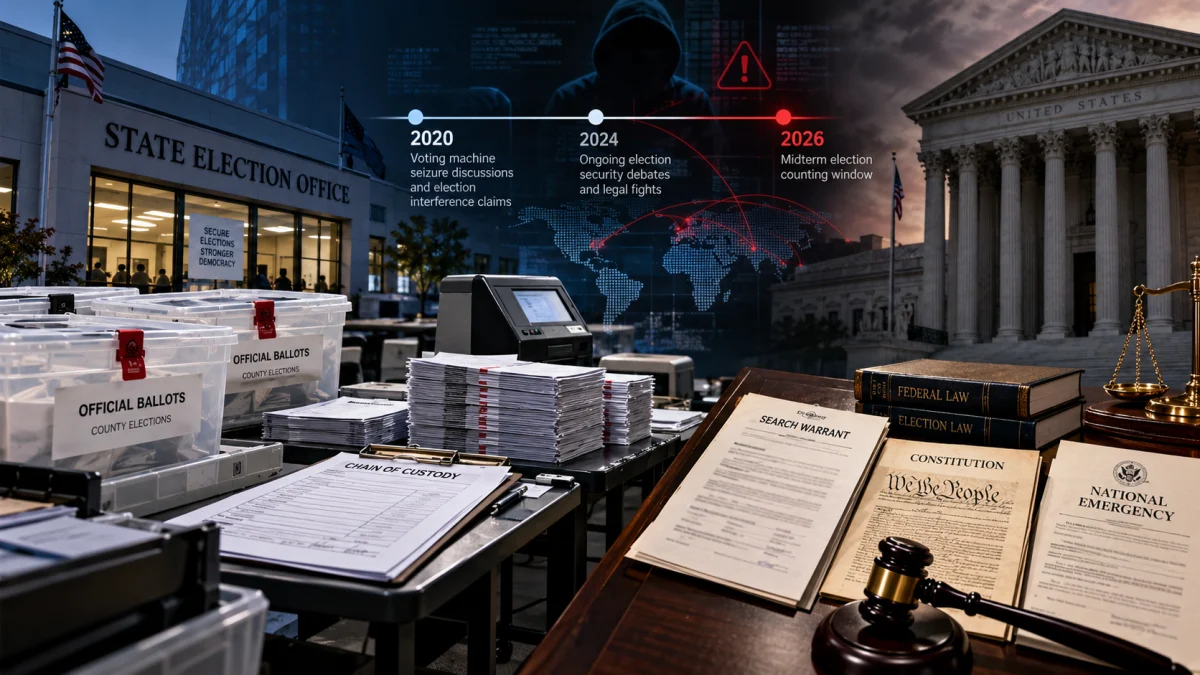
There is no public evidence, as of September 30, 2026, that President Donald Trump has adopted a plan or issued an order to seize live ballots or voting machines during the 2026 midterm count. Current administration officials have specifically denied that such an initiative is underway.
But the scenario election-security experts are warning about is not hypothetical in the sense that nothing remotely similar has ever been considered.
After the 2020 election, Trump personally asked senior Justice Department officials why they would not seize voting machines. Outside allies drafted proposals for federal seizure of election equipment. Some argued that alleged foreign interference and a national emergency declared under Executive Order 13848 supplied authority for extraordinary intervention. Trump’s own Justice Department and Homeland Security officials rejected those proposals because they lacked the evidence and legal authority needed to carry them out.
In 2026, several pieces of that history have reappeared in a new context. Trump has publicly called for Republicans to "nationalize the voting" in at least 15 places. Outside allies have circulated a proposed emergency election order invoking alleged Chinese interference. The administration has elevated foreign threats to election infrastructure as an official national-security concern. And former federal officials are warning that the period between polls closing and final certification could become a pressure point if an allegation of foreign interference is used to justify access to ballots or voting equipment.
That still does not establish that the administration plans to do it.
The legal answer is also more complicated than saying the federal government simply "can" or "cannot" seize election materials. The president does not possess a general power to take over state vote counting because he declares an emergency or alleges foreign interference. But federal law enforcement can seek court-authorized warrants for election records in a criminal investigation. The FBI did exactly that in Fulton County, Georgia, in January 2026. Meanwhile, the California Supreme Court ruled on September 24 that Riverside County’s sheriff had unlawfully removed about 650,000 voted ballots from election officials even though he had obtained search warrants.
Those examples expose the real question for November:
What legal authority is being invoked, who is acting, what evidence supports the action, is a court involved, and would the action preserve an election investigation or interrupt the lawful custody and counting of votes?
That distinction matters because election night is not the legal end of an election. In states such as California, valid ballots continue to be processed after November 3 under rules written long before anyone knows which side benefits from the remaining count.
Quick answers
| Question | Best-supported answer |
|---|---|
| Can Trump personally order states to stop counting and hand over their ballots? | No general presidential power to do that is identified in the Constitution or federal election law. Congressional elections are administered primarily under state law, subject to rules Congress may enact. |
| Can federal agents ever seize election materials? | Yes, in some circumstances through ordinary legal process. The FBI obtained a federal search warrant for Fulton County’s 2020 ballots and other records in January 2026. |
| Does declaring a national emergency automatically give the president control over elections? | No. A national emergency activates specific powers Congress has provided by statute; it is not a free-standing power to disregard election law. |
| Did Trump or his allies consider seizing voting machines after the 2020 election? | Yes. The January 6 committee record and sworn testimony document multiple discussions, including Trump asking DOJ on December 31, 2020, why it would not seize machines. |
| Is there evidence that a foreign government changed 2020 vote totals? | No. The 2021 intelligence assessment and joint DOJ-DHS report found no indication that foreign actors altered voter registration, ballot casting, vote tabulation or reported results. |
| Is foreign election interference a fictional threat? | No. Foreign influence operations, hacking attempts and data collection are real. The critical distinction is between influence or cyber activity and evidence that votes or tabulation were actually altered. |
| Is there evidence of an adopted Trump plan to seize live 2026 ballots? | No public evidence currently establishes one. Current administration officials have denied that such a plan is underway. |
What election experts mean by the 2026 "counting window"
The immediate concern is the period after polls close but before all lawful ballots have been counted, canvassed, audited and certified.
Former National Security Council official Caitlin Durkovich said at a September briefing that she expects claims of foreign interference could be used during this period to justify attempts to seize election equipment or ballots. Her warning was reported by The Guardian on September 27.
That statement needs to be classified correctly.
It is an expert prediction about a possible scenario, not evidence of a leaked order or an already-approved Trump administration operation.
There are, however, concrete reasons experts are looking at this particular window. The 2020 election demonstrated how quickly an incomplete tally can be reframed as suspicious when different categories of legitimate ballots are counted at different times. The current administration has also made foreign election interference a major public theme, while outside Trump allies continue to press for emergency federal action over voting.
The result is a period in which two very different things can be true at once:
- an election can still be proceeding normally under state law; and
- a political or national-security claim can be made before the lawful count is finished.
Understanding that distinction requires understanding what "election night results" actually are.
Election-night results are preliminary, not the legally certified result
The U.S. Election Assistance Commission’s explanation of canvass and certification is straightforward: election-night totals are unofficial. Election officials still have to account for all eligible ballots, reconcile records, resolve qualifying provisional or other outstanding ballots, conduct canvassing and, in most states, complete post-election audits before certification.
This is not a special exception created for 2026.
It is how decentralized American election administration works.
A race can become mathematically clear enough for news organizations to project a winner before certification. That does not mean the government has finished counting, auditing or certifying the election.
Why California can still be counting after November 3
California is a particularly useful example because its deadlines are explicit.
According to the California Secretary of State’s official 2026 calendar:
- November 3, 2026: Election Day. Counties begin reporting results after 8 p.m.
- November 10: deadline for counties to receive qualifying vote-by-mail ballots that were postmarked on or before Election Day.
- November 25: deadline to correct certain ballot-envelope signature issues.
- December 3: deadline for county election officials to certify their results.
- December 11: deadline for the California secretary of state to certify the statewide Statement of Vote.
The state’s official voter guide says results will be updated in the days after the election as counties count remaining ballots.
That does not mean every California contest remains uncertain until December 11. Many will be clear much earlier. It means that continued counting after November 3 is part of the election process itself, not evidence that ballots were created after Election Day.
A changing margin during that process can be politically important. By itself, it is not evidence of fraud.
Is there evidence the Trump administration plans to seize 2026 ballots or voting machines?
Not at this point.
This is where the evidence needs to be separated carefully.
There is verified evidence that Trump has advocated substantially greater federal involvement in elections. In February, he said Republicans should "take over the voting" and "nationalize the voting" in at least 15 unspecified places.
There is also verified evidence that people close to Trump’s political orbit have proposed using emergency powers.
In February, The Washington Post reported on a 17-page draft executive order circulated by pro-Trump activists. The draft invoked alleged Chinese interference in the 2020 election as a rationale for declaring a national emergency and imposing sweeping federal election requirements. One of the proposal’s advocates, Peter Ticktin, acknowledged the ordinary constitutional problem directly: states and their legislatures generally control election administration, not the president.
The proposal was not an issued executive order. Trump subsequently said he was not considering the draft emergency order.
The pressure campaign has nevertheless continued. In September, The Atlantic reported that Ticktin, Wayne Allyn Root and former Colorado clerk Tina Peters were continuing to urge extraordinary federal action.
The same reporting contains an important counterweight: a White House official said those outside advocates have no role in White House election policy, while a Justice Department spokesperson said there were no plans to declare certified voting equipment unreliable or unusable without credible, verified evidence and the legal process required to do so. Senior officials also said there were no plans to forcibly replace state election administrators or deploy federal officials to polling places absent specific threats.
That leaves a genuine but bounded uncertainty:
There is documented outside advocacy for emergency intervention and documented presidential rhetoric favoring greater federal control. There is not currently public evidence establishing an adopted administration plan to seize live ballots or voting machines after November 3.
For separate background on Ticktin’s more expansive proposal involving martial law, sherafy.com has traced that argument and its evidentiary basis in detail.
Why foreign interference is central to the concern
Foreign interference is not an invented category.
Russia, Iran, China and other foreign actors have targeted American political organizations, information systems, public opinion and election-related data in different ways. The problem begins when several very different activities are collapsed into the same phrase.
There are at least three categories that readers should keep separate:
| Category | Example | Does it mean votes were changed? |
|---|---|---|
| Foreign influence | propaganda, covert social-media campaigns, hacked material used to shape opinion | No |
| Cyber intrusion or data collection | stealing or acquiring voter data, scanning government systems, compromising a network | Not by itself |
| Technical election interference | altering voter registration, preventing voting, changing ballots, manipulating tabulation or changing reported results | Potentially, if evidence shows it occurred |
The distinction is not semantic. It determines what the evidence actually proves.
What U.S. intelligence found about 2020
The Office of the Director of National Intelligence’s March 2021 assessment concluded that it had no indication that any foreign actor attempted to alter a technical aspect of the 2020 voting process, including voter registration, ballot casting, vote tabulation or the reporting of results.
The joint Justice Department and Department of Homeland Security report reached the same practical conclusion. Investigators found no evidence that a foreign government-affiliated actor prevented voting, changed votes, disrupted tabulation or manipulated election results. They also investigated public claims that foreign governments controlled voting infrastructure or changed vote counts and concluded those claims were not credible.
That does not mean foreign actors did nothing.
The reports identified influence operations and cyber activity. Russian and Iranian actors targeted networks and public opinion. Chinese actors gathered information. Some state and local government networks were compromised. But the official findings did not establish alteration of the votes themselves.
What changed in the 2026 declassification fight
In July 2026, the Trump White House released and highlighted previously classified material concerning Chinese acquisition of American voter information.
The White House’s July 30 fact sheet says China and its proxies bought, stole or hacked voter-registration data involving as many as 220 million Americans, including some nonpublic data. The documents also describe ways a hostile actor could potentially exploit voter data.
Those disclosures deserve to be taken seriously as a counterintelligence and cybersecurity issue.
They do not, however, establish that China changed the 2020 vote.
Independent reporting on the released documents found that much of the material concerned data collection, commercial datasets and espionage rather than demonstrated manipulation of official voter rolls or ballots. The Washington Post reported that the declassified material did not identify an altered vote or establish that Chinese actors touched the technical counting of the 2020 election. The White House itself, in responding to criticism, stated that Trump’s July address was about vulnerabilities and foreign collection rather than a claim that a past election result had been changed.
That is the line a serious 2026 foreign-interference allegation would still have to cross:
Evidence that a foreign actor collected election-related data is not automatically evidence that the actor altered the election.
The Pentagon’s new election-security directive is not evidence of a seizure order
Another current development can easily be misread.
Defense Secretary Pete Hegseth signed a September 22 memorandum directing U.S. Cyber Command and defense intelligence organizations to prioritize foreign threats to the November election. Associated Press reporting on the directive notes that military and intelligence cyber support for election security predates the current administration and expanded after election infrastructure was designated critical infrastructure in 2017.
The directive focuses on identifying, disrupting and neutralizing foreign cyber threats.
It does not direct troops to seize ballots, occupy counting centers or take voting machines from state officials.
That distinction matters because legitimate federal cybersecurity activity should not be treated as evidence of a domestic election takeover. At the same time, it demonstrates why a later allegation of foreign technical interference would immediately involve national-security agencies as well as state election authorities.
The 2020 record: an expected counting shift became a fraud narrative
The closest historical comparison is not simply that Trump claimed the 2020 election was stolen.
The more important fact is that his own campaign had warned him in advance that the apparent leader could change as different categories of ballots were counted.
The House January 6 committee’s final report, drawing on testimony from Trump campaign officials and senior administration officials, documented the expected "red mirage."
Republican voters in 2020 were more likely to vote in person on Election Day, while Democratic voters were more likely to use mail ballots. In several battleground states, Election Day votes would be reported earlier and mail ballots later. That created a foreseeable possibility that Trump could appear ahead early and then lose ground as valid mail ballots were processed.
Campaign manager Bill Stepien testified that Trump was briefed that large numbers of mail ballots would remain to be counted and that the early returns could look favorable before later ballots changed the totals.
The significance of that record is straightforward:
The movement of a tally after election night was not, by itself, an unexpected event discovered after the fact. Trump’s campaign had discussed that counting pattern before the election was over.
The committee also documented testimony that Trump declared victory while advisers were telling him that the result was still uncertain.
This matters in 2026 because the basic vulnerability is the same even if the details differ: an incomplete count can look like a completed result to anyone who does not understand which ballots remain outstanding.
The 2020 precedent went further: election allegations became arguments for seizure
This is the part of the historical record that makes the current concern materially different from a generic warning about misinformation.
After the 2020 election, allegations about voting machines and foreign involvement were used by some Trump allies as arguments for extraordinary federal action.
A draft executive order dated December 2020 contemplated federal seizure of voting equipment. Sidney Powell, Michael Flynn and others discussed extraordinary steps with Trump during the contentious December 18 White House meeting. White House lawyers opposed the proposals.
Then, on December 31, the issue reached the Justice Department directly.
Former acting deputy attorney general Richard Donoghue testified that Trump asked senior DOJ officials:
"Why don’t you guys seize machines?"
According to the official January 6 committee transcript of Donoghue’s testimony, acting attorney general Jeffrey Rosen responded that DOJ could not simply take voting machines from state authorities. Federal investigators seize evidence through lawful process, including warrants, and DOJ did not have evidence approaching the basis needed for such a warrant.
The January 6 committee’s final report says Trump then called acting DHS deputy secretary Ken Cuccinelli after DOJ rejected the seizure idea. Cuccinelli also said DHS lacked such authority.
That history supports a narrower and more defensible conclusion than the slogan that an accusation must be a confession.
The record does not prove that every allegation Trump made about election interference was secretly a description of what he intended to do. It does prove something more concrete: allegations that voting systems had been compromised became a proposed justification inside Trump’s orbit for federal seizure of election equipment.
That is why a similar foreign-interference allegation made during an unfinished 2026 count would deserve immediate scrutiny of the evidence and the legal authority being claimed.
What Executive Order 13848 actually does
The legal theory raised by Trump allies in both 2020 and 2026 often points back to Executive Order 13848, issued by Trump on September 12, 2018.
The order is real. The emergency is also still active.
The original Executive Order 13848 declared a national emergency concerning foreign interference in U.S. elections. It created a process for the intelligence community to assess foreign interference and for the attorney general and secretary of homeland security to evaluate its effects. It also authorizes economic sanctions and property blocking against qualifying foreign persons involved in election interference.
It does not contain a general provision authorizing the president to seize state voting machines, confiscate ballots or assume control of state vote counting.
On August 31, 2026, Trump continued the national emergency for another year. That makes the order highly relevant to current election-security policy. It does not expand the order into powers it does not contain.
This is where "emergency powers" are often misunderstood.
The Congressional Research Service’s explanation of the National Emergencies Act describes the NEA as a framework for invoking specific emergency authorities Congress has made available by statute. The president must identify the statutory authorities being used.
In other words:
Declaring an emergency does not create a blank legal check. It unlocks powers that already have a legal source.
If an administration claimed that an election-related emergency authorized seizure of ballots or machines, the next legal question would therefore be unavoidable: Which statute or constitutional power authorizes that specific action?
Can a president legally seize ballots or voting machines?
There is no general presidential election-administration power in the Elections Clause.
The Constitution Annotated’s discussion of Article I, Section 4 explains that states establish the "Times, Places and Manner" of congressional elections, while Congress may make or alter those rules. The Supreme Court has interpreted that authority to reach the machinery of election administration, including registration, supervision of voting, prevention of fraud, counting votes, canvassing and election returns.
The president is not assigned a parallel general power to administer those state counts.
That does not mean the federal executive branch has no election-related authority. Congress has enacted criminal laws, civil-rights laws, cybersecurity authorities, records-retention requirements and other statutes that executive agencies enforce. Federal courts can issue orders and warrants in cases within their jurisdiction. Federal agencies can investigate genuine crimes and foreign attacks.
The critical distinction is between:
- executing a specific power Congress has actually authorized, and
- claiming a general presidential power to take control of an election because an emergency has been declared.
The first can be lawful depending on the facts and statute. The second requires a legal authority that neither the Elections Clause nor the National Emergencies Act supplies by itself.
But the FBI really did seize election materials in Fulton County in 2026
Any article that says federal authorities simply "cannot seize ballots" would be incomplete.
On January 28, 2026, FBI agents executed a federal search warrant at the Fulton County Election Hub in Georgia relating to records from the 2020 election.
The warrant’s public attachment authorized seizure of an unusually broad set of materials. The court-filed warrant materials listed:
- all physical 2020 general-election ballots in Fulton County;
- absentee-ballot envelopes;
- provisional, early and Election Day ballots;
- voting-machine tabulator tapes;
- ballot images from the original count and recount;
- and 2020 voter rolls.
That was not a president arriving at a counting center and ordering election officials to stop.
It was a court-authorized law-enforcement search, based on statutes identified in the warrant and approved by a federal magistrate judge.
Whether the factual basis and scope of that investigation withstand every legal challenge is a separate question. For the narrower issue here, the Fulton County seizure demonstrates something important:
Election materials are not categorically immune from federal criminal process.
So if federal agents appear around election materials, the existence and scope of a warrant, the statutes cited, the items authorized for seizure and the status of the election all matter.
California just showed why a warrant is not the end of the legal analysis
California supplied an unusually relevant counterexample only weeks before the 2026 midterms.
Riverside County Sheriff Chad Bianco obtained search warrants in an investigation arising from allegations about the November 2025 special election and removed approximately 650,000 voted ballots from the county registrar.
On September 24, 2026, the California Supreme Court unanimously ruled in Cervantes v. Bianco that the ballot seizure was unlawful.
The court’s opinion held that California Elections Code section 15551 required voted ballots to remain in the physical custody of the responsible election official, even during a criminal investigation. The court ordered the ballots returned.
The ruling does not establish a nationwide rule that every search warrant for election materials is invalid. It interprets California law and the specific legal structure governing those ballots.
But paired with the Fulton County example, it gives readers a much better framework:
| Case | Legal mechanism | What happened |
|---|---|---|
| Fulton County, Georgia, 2026 | Federal search warrant | FBI was authorized to seize specified 2020 election records, including physical ballots and tabulator materials. |
| Riverside County, California, 2026 | County sheriff search warrants | California Supreme Court held removal of voted ballots from the registrar’s custody violated state election law and ordered them returned. |
| Hypothetical live 2026 federal intervention | Depends on claimed authority | Legality would turn on the agency, statute, warrant or order, state custody law, federal preemption and the facts offered to justify the action. |
That is why "can the government seize ballots?" has no useful one-word answer.
What would happen if federal officials tried to seize live 2026 ballots?
No one can responsibly predict the exact legal sequence without knowing the state, the agency and the asserted authority.
But several questions would become immediate.
1. Who is trying to take custody?
An FBI team executing a judicial search warrant presents a different legal posture from a military unit, a Department of Homeland Security component or officials acting only on a presidential directive.
2. What statute authorizes the action?
An emergency declaration is not enough by itself. The government would need to identify the legal authority for the seizure or intervention.
3. Is there a court order or search warrant?
A warrant would mean a federal judge or magistrate had approved a specific search or seizure under a stated legal standard. That would not necessarily resolve every conflict with state election law, as the Riverside case illustrates, but it is fundamentally different from unilateral executive action.
4. Are the ballots part of an active count or an archived election?
Fulton County involved records from the 2020 election more than five years later. Removing live 2026 ballots while canvassing is underway could directly affect state custody, counting and certification functions.
5. What happens to chain of custody?
The legal fight would not only concern who may possess the ballots. Courts and election officials would have to address preservation, access, inventory, handling and whether the normal count could continue.
6. Would state officials sue immediately?
Almost certainly if they believed federal action exceeded lawful authority, although the precise claims would depend on the facts. Election disputes routinely generate emergency litigation because delays can themselves affect statutory deadlines.
The likely legal conflict, then, would not be resolved by a president simply saying "foreign interference." The allegation would have to encounter existing federal statutes, state election law and judicial review.
What the Supreme Court actually blocked on mail ballots
The Supreme Court’s September ruling is relevant to the current context, but it should not be exaggerated.
In United States Postal Service v. California, the administration asked the Supreme Court to stay a lower-court injunction against a new Postal Service rule for federal ballot mail.
The rule required ballot-mail envelopes to carry specified features, including an election-mail logo, high-speed processing compatibility and a voter-specific barcode. States would also have had to submit designs for Postal Service review and upload certain information to a Postal Service portal.
On September 14, the Supreme Court denied the government’s stay request.
The Court’s brief order said the government was unlikely to succeed on the merits of its challenge at that stage and that the equities did not favor emergency relief. Justice Brett Kavanaugh concurred separately. He wrote that the Postal Service might ultimately have statutory authority for the rule, but applying it to the 2026 election would be arbitrary and capricious because state and local officials lacked sufficient time to implement it. Justices Samuel Alito and Clarence Thomas dissented.
So the accurate description is:
The administration failed to get this specific new ballot-mail rule implemented for the 2026 election.
That is not the same as the Supreme Court abolishing every administration policy concerning mail voting. It also does not mean that seizing ballots is the administration’s "only option left." Other election-related litigation, investigations and federal policy initiatives remain active.
Why the 2020 "stolen election" belief still matters in 2026
There is another reason the counting window matters even if no federal seizure ever occurs.
Claims made while results are incomplete can become durable beliefs.
A Pew Research Center survey conducted January 8-12, 2021 asked people who reported voting for Trump who they believed had actually won the 2020 election.
Forty percent said Trump "definitely" won and another 36 percent said he "probably" won.
That is 76 percent of surveyed Trump voters saying, after certification and numerous legal challenges, that Trump definitely or probably was the rightful winner.
The number is important because it demonstrates that the post-election narrative was not confined to court filings or political elites. It became a mass belief among people who had voted for Trump.
This is where the "accusation is a confession" idea needs precision.
The evidence does not allow a responsible article to infer that every accusation of election manipulation is necessarily an admission of an intent to manipulate elections.
What the record does show is more concrete:
- Trump and allies alleged that the 2020 election had been corrupted.
- Trump’s own campaign had briefed him that late-counted lawful ballots could change the apparent election-night lead.
- allegations about voting machines and foreign involvement continued after the election;
- some allies then cited those allegations as justification for extraordinary federal action;
- Trump himself asked DOJ why it would not seize voting machines;
- DOJ and DHS officials rejected the idea for lack of evidence and authority.
That chronology is independently significant. It means a future allegation of foreign interference cannot be evaluated only as rhetoric. The immediate follow-up question has to be whether the allegation is being used to seek a concrete legal or physical intervention in the count.
How would we know if a 2026 foreign-interference allegation were real?
The answer should not depend on which party appears to benefit from the allegation.
A serious claim that a foreign actor compromised an election should generate evidence capable of being independently tested.
Among the most important questions would be:
- What system was allegedly compromised? A campaign email server, a voter-information database and a vote-tabulation system are not the same thing.
- When did the intrusion occur?
- What forensic evidence identifies the foreign actor?
- Was data merely accessed or copied, or was it altered?
- Did the event affect voter registration, ballot casting, tabulation or reporting?
- Do paper records and audits match the electronic tally?
- Which state and local election officials observed the problem?
- What did federal intelligence and cybersecurity agencies independently find?
- Has the evidence been presented to a court if government officials are seeking to seize property or interrupt an election process?
- Can the alleged effect be distinguished from normal changes that occur as outstanding lawful ballots are counted?
Foreign interference is a legitimate national-security problem. Treating every foreign cyber operation as proof that vote totals were manipulated would make the term nearly useless.
The evidence has to show what happened.
The 2018-2026 timeline
The strongest way to understand the current concern is to put the events in chronological order.
| Date | What happened | Why it matters |
|---|---|---|
| Sept. 12, 2018 | Trump signs Executive Order 13848 and declares a national emergency over foreign election interference. | Establishes intelligence-assessment and sanctions mechanisms; does not create a general ballot-seizure power. |
| 2020 election cycle | U.S. agencies track real foreign influence and cyber threats. | Foreign interference is a genuine security category, but influence and technical vote manipulation are different claims. |
| Nov. 3-7, 2020 | Election-night leads shift as states process outstanding ballots. | Trump’s own campaign had warned him that late-counted mail ballots could change the early picture. |
| Dec. 2020 | Outside allies develop proposals involving federal seizure of voting machines. | Election-fraud and foreign-interference claims become proposed rationales for extraordinary intervention. |
| Dec. 18, 2020 | Trump meets with Sidney Powell, Michael Flynn and others at the White House amid discussions of extraordinary election measures. | Machine seizure and special-counsel proposals are debated inside Trump’s orbit. |
| Dec. 31, 2020 | Trump asks DOJ officials why they will not seize voting machines. | DOJ rejects the idea, saying it lacks a legal/evidentiary basis for seizure. |
| March 2021 | ODNI and DOJ-DHS release assessments of 2020 foreign activity. | They identify influence and cyber threats but no evidence foreign actors altered the technical voting process or vote totals. |
| Jan. 28, 2026 | FBI executes a federal warrant for Fulton County’s archived 2020 election materials. | Demonstrates that election records can be seized through judicial criminal process in some circumstances. |
| Feb. 2, 2026 | Trump says Republicans should "nationalize" voting and take over voting in at least 15 places. | Shows current presidential support for greater federal control, although no mechanism was specified. |
| Feb. 2026 | Pro-Trump activists circulate a 17-page draft emergency election order invoking alleged Chinese interference. | Revives an emergency-powers theory around election administration; Trump says he is not considering that draft. |
| July 2026 | White House releases declassified intelligence concerning Chinese acquisition of U.S. voter data. | Reinforces real data-security concerns but does not establish changed 2020 votes. |
| Aug. 31, 2026 | Trump renews the EO 13848 foreign-interference national emergency for another year. | The emergency is currently active, but its existence does not supply unspecified election powers. |
| Sept. 14, 2026 | Supreme Court refuses to let the new Postal Service ballot-mail rule take effect for 2026. | One major administration election initiative is blocked for the midterms. |
| Sept. 22, 2026 | Hegseth directs defense cyber and intelligence resources toward foreign election threats. | Legitimate cyber defense increases the importance of distinguishing foreign threats from domestic election administration. |
| Sept. 24, 2026 | California Supreme Court rules Riverside sheriff’s seizure of about 650,000 voted ballots unlawful. | Shows how election-specific custody law can limit law-enforcement seizure even when warrants were obtained. |
| Sept. 27, 2026 | Former federal officials publicly warn about the post-election counting window and a possible foreign-interference pretext. | The seizure scenario becomes an explicit 2026 election-security concern, but remains a warning rather than proof of a plan. |
| Nov. 3, 2026 | Midterm Election Day. | Initial reported totals will be unofficial. |
| Dec. 3, 2026 | California county certification deadline. | Demonstrates that lawful canvassing can extend well beyond election night. |
| Dec. 11, 2026 | California statewide certification deadline. | Final official results are legally distinct from election-night reporting. |
What is verified, what is inference, and what is not established
The easiest way to lose the thread is to treat every fact in this story as if it proves every other one.
It does not.
| Claim | Evidence status |
|---|---|
| States can lawfully continue processing and counting eligible ballots after election night. | Verified. State statutes and election calendars expressly provide for post-election canvassing and certification. |
| California’s final 2026 count and certification can extend for weeks after November 3. | Verified. Counties certify by December 3; statewide certification is December 11. |
| Former federal officials have warned that foreign-interference allegations could be used to seek seizure of ballots or equipment. | Verified warning. This is a prediction, not proof of an adopted plan. |
| Trump allies considered federal seizure of voting machines after the 2020 election. | Verified. Documented in congressional records, testimony and draft proposals. |
| Trump personally asked DOJ why it would not seize voting machines. | Verified. Richard Donoghue testified to the December 31 exchange; the final committee report records it. |
| Foreign governments conducted influence operations and cyber activity around the 2020 election. | Verified. U.S. intelligence and DOJ-DHS reports document such activity. |
| A foreign government changed 2020 ballots or vote totals. | Not supported by the official investigations reviewed here. ODNI and DOJ-DHS reported no evidence of that technical manipulation. |
| Chinese actors acquired large amounts of U.S. voter-related data. | Supported in the declassified intelligence record, though the provenance, scale and meaning of some datasets remain disputed. |
| The released China material proves the 2020 result was changed. | Not established. The released material does not identify altered votes or tabulation. |
| Trump has called for Republicans to "nationalize" voting. | Verified. He said so publicly in February 2026. |
| Outside Trump allies have proposed using a national emergency to impose federal election controls in 2026. | Verified. A draft order and continuing public advocacy have been reported. |
| DOJ currently has a plan to declare certified machines unusable and seize them. | Not established. DOJ has publicly denied such an initiative is underway. |
| The FBI seized Fulton County’s 2020 ballots and election records in 2026. | Verified. The seizure was conducted under a federal search warrant. |
| A search warrant always overrides state ballot-custody law. | False as a general proposition. California’s Supreme Court held the Riverside seizure violated state law despite search warrants. The result elsewhere would depend on the governing law. |
| A national emergency gives the president unlimited power over elections. | No. The National Emergencies Act provides a framework for invoking specific statutory authorities; it is not an unlimited grant of power. |
| A false foreign-interference claim could be used as a proposed rationale for extraordinary election action. | Plausible and historically grounded, but predictive for 2026. Similar allegations were used to argue for machine seizure in 2020; no public evidence currently establishes that this will happen in November. |
The bottom line
The strongest evidence does not support either extreme version of this story.
It is not accurate to say that Trump has already been shown to have a secret plan to seize live ballots after the 2026 midterms.
It is also not accurate to dismiss the possibility as something with no historical or legal precedent worth examining.
The 2020 record shows that Trump and his allies actually discussed federal seizure of voting machines after alleging election fraud and foreign-linked manipulation. Trump personally asked the Justice Department why it would not seize machines. Senior DOJ and DHS officials refused because the evidence and legal authority were not there.
The 2026 record now adds a new layer: Trump has called for Republicans to nationalize voting; outside allies have circulated emergency-control proposals tied to foreign-interference allegations; the administration has elevated foreign election threats in its cybersecurity posture; and experts are explicitly warning about attempts to act during the interval when lawful counts remain unfinished.
At the same time, current administration officials deny that a ballot- or machine-seizure initiative is underway.
The legal framework provides the cleanest way through the noise.
A slow count is not evidence of a stolen election. A foreign cyber threat is not automatically evidence that votes were changed. A national emergency is not a blank check. And a lawful federal investigation is not the same thing as unilateral federal control of a state election.
If a seizure attempt occurs after November 3, the decisive questions will not be who announced "foreign interference" first. They will be what evidence exists, what legal authority is being invoked, what a court has authorized, and whether the action protects an election investigation or unlawfully interferes with the custody and completion of the vote count itself.
Those are questions that can be answered with evidence.
References and Further Reading
Constitutional and Emergency-Powers Authorities
-
Constitution Annotated: States and the Elections Clause — Library of Congress explanation of state and congressional authority over the mechanics of congressional elections, including counting, canvassing and returns.
-
Congressional Research Service: Emergency Authorities Under the National Emergencies Act — Explains that the National Emergencies Act is a framework for invoking particular statutory emergency authorities rather than an independent grant of unlimited presidential power.
-
Executive Order 13848: Imposing Certain Sanctions in the Event of Foreign Interference in a United States Election — The 2018 order declaring a foreign-election-interference national emergency and establishing intelligence, assessment and sanctions processes.
-
2026 Continuation of the National Emergency With Respect to Foreign Interference in U.S. Elections — President Trump’s August 31, 2026 notice continuing the EO 13848 emergency for another year.
2020 Election, Foreign Interference and Machine-Seizure Record
-
House January 6 Select Committee Final Report — Primary congressional record compiling testimony on the expected "red mirage," post-election fraud claims, White House discussions and Trump’s December 31 request that DOJ consider seizing voting machines.
-
Richard Donoghue Transcribed Interview, January 6 Select Committee — Sworn testimony recounting Trump’s question about why DOJ would not seize voting machines and DOJ’s response that it lacked a warrant-level evidentiary basis.
-
ODNI: Foreign Threats to the 2020 U.S. Federal Elections — Intelligence Community assessment distinguishing foreign influence operations from technical interference with voter registration, ballot casting, tabulation or reported results.
-
DOJ and DHS Joint Report on Foreign Interference in the 2020 Election — Joint federal finding that investigators found no evidence a foreign government-affiliated actor changed votes or manipulated 2020 election results.
-
Pew Research Center: Voters’ Reflections on the 2020 Election — January 2021 survey showing 40% of Trump voters said he definitely won and another 36% said he probably won.
Current 2026 Election Developments
-
The Guardian: Election Experts Warn About the 2026 Post-Election Counting Window — Reporting on Caitlin Durkovich’s warning that a foreign-interference allegation could be used to seek seizure of election equipment or ballots. Her statement is a forecast, not evidence of an existing order.
-
The Atlantic: The Supporters Urging Trump to Declare Martial Law for the Midterms — Reports both the continuing pressure from outside Trump allies and current White House/DOJ statements denying that a federal equipment-takeover initiative is underway.
-
Washington Post: Trump Wants Republicans to "Nationalize the Voting" — Documents Trump’s February 2026 call for Republicans to take over voting in at least 15 places.
-
Washington Post: Pro-Trump Activists’ Draft Emergency Election Order — Reporting on the 17-page proposal invoking alleged Chinese interference as a basis for emergency federal election controls.
-
PBS NewsHour: Trump Says He Is Not Considering the Draft Emergency Election Order — Records Trump’s February response to the proposed order circulating among allies.
-
White House Government Transparency Task Force Fact Sheet on Chinese Voter Data — Administration account of newly declassified intelligence regarding Chinese acquisition of U.S. voter-registration data and election-system vulnerabilities.
-
Washington Post: What the Declassified China Election Records Actually Show — Independent examination of the declassified material, including the distinction between collecting voter data and manipulating election infrastructure or votes.
-
Associated Press: Pentagon Cyber Forces Directed to Guard Against Foreign Election Interference — Explains Hegseth’s September 22 directive and the longer history of military cyber support for election security.
2026 Ballot-Seizure and Mail-Ballot Cases
-
Fulton County Federal Search Warrant Materials — Court-filed warrant attachment listing the 2020 ballots, tabulator tapes, ballot images and voter records federal agents were authorized to seize.
-
California Supreme Court: Cervantes v. Bianco — September 24, 2026 unanimous decision holding that Riverside County’s removal of voted ballots from the registrar’s custody violated California election law despite the sheriff having obtained search warrants.
-
U.S. Supreme Court: United States Postal Service v. California, No. 26A305 — September 14, 2026 order denying the government’s request to lift the injunction against the new Postal Service ballot-mail rule for the 2026 election.
California Counting and Certification
-
California Secretary of State: November 3, 2026 General Election Key Dates and Deadlines — Official deadlines for postmarked mail ballots, county certification and statewide certification.
-
California Secretary of State: 2026 Election Results and Canvass — Explains that election-night reporting continues through the canvass and that certified statewide results are posted later.
-
U.S. Election Assistance Commission: Election Results, Canvass and Certification — Federal reference explaining why election-night totals are unofficial and how canvass, reconciliation, audits and certification produce final results.
Editorial currency note: This article reflects public records, court decisions and reporting available through September 30, 2026. Election litigation and administration policy are changing quickly ahead of November 3; new court orders, agency actions or documentary evidence could materially change parts of this analysis.