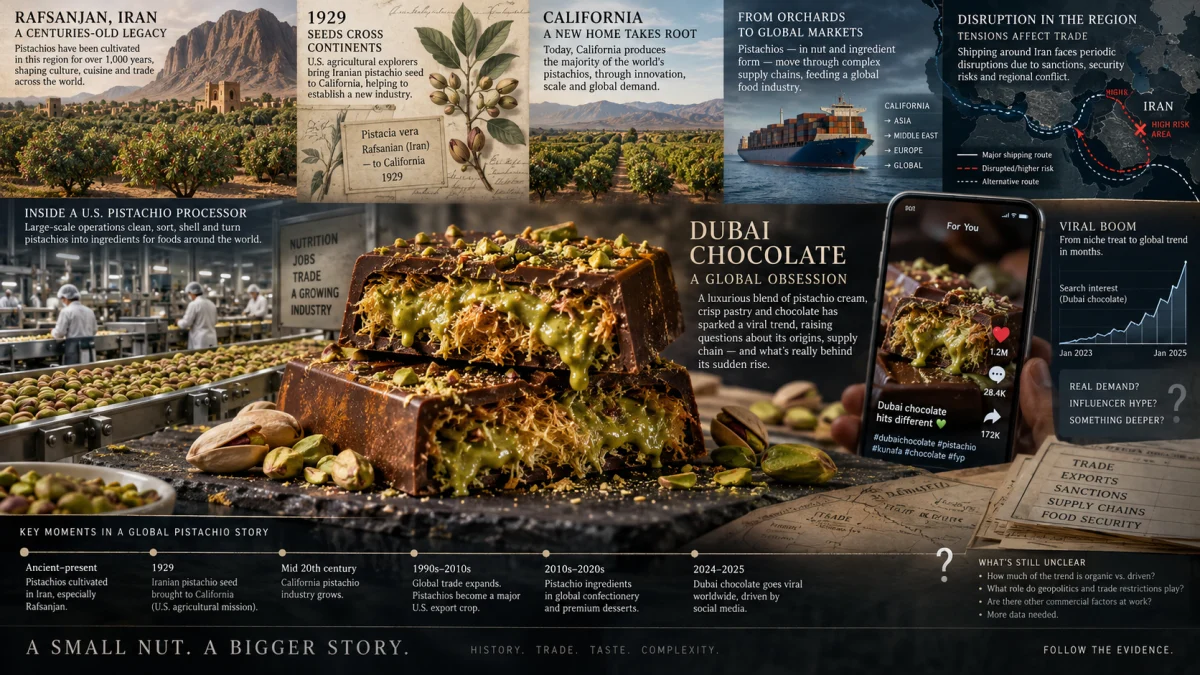
There is no credible evidence that Dubai chocolate was engineered as a geopolitical operation to destroy Iran’s pistachio industry or enrich California’s Wonderful Company. But the viral theory is unusually persuasive because many of the individual facts inside it are real.
Update, September 20, 2026: After readers challenged this article over a separate theory involving the earlier “Dubai Porta Potty” scandal, we investigated that claim and added a new section. The underlying exploitation story and older “Dubai Porta Potty” terminology are well documented, but we have not found comparable pre-2024 evidence that “Dubai chocolate” was an established name for the sexual practice or that the confection was created to bury it. Read the added analysis.
California’s dominant commercial pistachio lineage does trace directly to seed collected in Iran. U.S. trade restrictions helped insulate American growers from Iranian competition. Stewart and Lynda Resnick built Wonderful into an extraordinarily powerful pistachio producer and have made substantial documented donations to Israeli institutions. Wonderful appointed a UAE company as its Middle East processing partner in 2024. Dubai chocolate subsequently became a global phenomenon that pushed up demand for pistachio kernels. And the 2026 war involving the United States, Israel and Iran severely disrupted Iranian pistachio exports.
Those facts deserve scrutiny.
What the evidence does not establish is the connective tissue supplied by the viral story: that the Resnicks engineered the original exclusion of Iranian pistachios, funded a war to protect their market, arranged the Dubai chocolate craze, or caused Iranian pistachio infrastructure to be bombed.
In several places, the documented chronology actually runs in the opposite direction.
The more defensible story is arguably more useful than the conspiracy version. A social-media food craze created a real commodity shock inside a market that had already been shaped by decades of sanctions, agricultural expansion, concentrated corporate power and geopolitical conflict. Virality had geopolitical economic consequences without needing to have been designed as a geopolitical weapon.
That distinction matters.
The viral pistachio story mixes four different kinds of evidence
The easiest way to understand the claim is to separate four questions that social-media retellings tend to collapse into one.
A verified connection means two events or entities genuinely intersect. Wonderful really did establish a UAE processing partnership, for example.
An economic consequence means an actor gained or lost from an event. American pistachio producers can benefit when a major competitor has difficulty exporting.
Political influence means money, access or institutional relationships exist and may affect policy debates. Those relationships can be investigated directly.
Coordination, however, requires evidence that actors deliberately planned or caused the events being connected.
The viral theory often establishes one of the first three and then treats the fourth as proven.
It is not.
Pistachios have deep Persian roots, but Iran was not their only historical home
The viral story begins with a broadly true idea and makes it too absolute.
Iran has an exceptionally deep relationship with the pistachio. Rafsanjan, in Kerman Province, became one of the world’s most famous pistachio-growing regions, and archaeological and genetic research places the crop’s early history across the broader region encompassing Iran and Central Asia.
But saying that pistachios originated specifically in Rafsanjan, or that Iran was literally the world’s sole pistachio exporter for centuries, goes beyond the available evidence.
A modern review of pistachio genetics and cultivation places the species’ native range across parts of Central and western Asia, while archaeological evidence documents very ancient human use in Iran and neighboring regions. Pistachio cultivation also spread west through the Mediterranean long before the modern export industry existed. the scientific review of pistachio origins and genetic diversity
The important historical connection to California, however, is remarkably direct.
California’s most important pistachio really did come from Iran
In 1929, U.S. botanist William E. Whitehouse traveled through Persia collecting plant material for the American pistachio-breeding effort.
The USDA National Agricultural Library archives preserve photographs from Whitehouse’s 1929 Persia expedition. He returned with roughly 20 pounds of pistachio seed.
One seed eventually proved exceptionally well suited to California.
According to the history maintained by American Pistachio Growers, Whitehouse had selected it from drying pistachios belonging to the Agah family near Rafsanjan. The resulting variety was named Kerman, after the nearby Iranian city and province. USDA material likewise describes Kerman as California’s principal commercial variety developed from Persian seed.
So the striking part of the viral story survives scrutiny:
The modern California pistachio industry was built in large part around Iranian genetics.
That does not mean America simply took a mature Iranian commercial industry and duplicated it overnight. California experimentation continued for decades. Large-scale plantings accelerated in the 1960s and 1970s, and USDA material dates California’s first significant commercial crop to 1976. California Department of Food and Agriculture’s pistachio production history
The United States did restrict Iranian pistachios — but the Resnick timeline is important
This is where one of the viral narrative’s most consequential problems appears.
The common version says the Resnicks entered the pistachio business, used their influence to have Iranian pistachios restricted, and then filled the market that Iran was forced to abandon.
The record is substantially more complicated.
On September 26, 1985, a group of California pistachio interests petitioned the U.S. government for antidumping duties against Iranian in-shell pistachios. The petitioners identified in the later U.S. International Trade Commission review of the case included the California Pistachio Commission and several growers and processors.
The documented petitioner list did not include Stewart Resnick, Lynda Resnick or Paramount Farms.
The Commerce Department and ITC completed the investigation in 1986, resulting in an antidumping order against Iranian pistachios in July of that year.
Then comes the crucial date.
The Los Angeles Times reported on August 1, 1986 that a Resnick-controlled company had agreed to buy Mobil’s Apex Orchards for approximately $30 million, acquiring roughly 11,500 acres of almond and pistachio operations. the contemporaneous Los Angeles Times report on the Apex Orchards purchase
In other words, the 1985 trade petition preceded the Resnicks’ documented acquisition of their first major pistachio operation.
That does not prove they never subsequently supported restrictions on Iranian competition. It does substantially undermine the neat viral chronology in which they entered the business and then initiated the original trade action.
The 1987 Iran embargo was broader than pistachios
A second restriction followed for a different stated reason.
On October 29, 1987, President Ronald Reagan issued Executive Order 12613 prohibiting imports of Iranian-origin goods and services.
The order did not present itself as agricultural protectionism. It cited Iran’s policies toward terrorism and what the administration described as aggressive actions against neutral shipping in the Persian Gulf. Pistachios were caught within a much broader economic confrontation.
For American growers, the economic consequence was nevertheless significant.
One of the world’s strongest pistachio competitors faced barriers in the U.S. market while California production expanded rapidly.
That is a legitimate economic relationship to investigate. It is not evidence that pistachio companies caused the broader Iran embargo.
Those are different propositions.
California eventually overtook Iran
What happened next was extraordinary.
California pistachio acreage expanded dramatically, yields increased, processing became more sophisticated and U.S. producers developed an enormous export business.
By the 2025 crop year, the USDA Economic Research Service reported a record U.S. harvest of roughly 1.58 billion pounds. USDA’s February 2026 international outlook forecast U.S. production around 713,000 metric tons, compared with roughly 200,000 metric tons for Iran and 120,000 for Turkey. USDA’s February 2026 tree-nut outlook
The United States had gone from an experimental pistachio producer to the dominant producer in the world.
Iran remained a formidable competitor, particularly in export markets, but the balance of power had decisively changed.
How Wonderful became the giant of American pistachios
The Resnicks did not create California’s pistachio industry, but they became its most important corporate players.
Through acquisitions, land expansion, processing capacity and unusually effective consumer marketing, the company that ultimately became The Wonderful Company turned pistachios from a relatively anonymous agricultural commodity into a branded snack business.
A 2025 profile published by the Western Growers trade association described Wonderful as controlling approximately 60% of the U.S. pistachio market and 40% of the global market. Because Wonderful is privately held, those figures should be treated as an industry estimate rather than audited public market-share data. Western Growers’ 2025 profile of Stewart Resnick
Forty percent of a global agricultural market would be enormous.
It is also not a majority.
The viral claim that the Resnicks now control “the majority of the global pistachio trade” is therefore not supported by the best figure we found.
Did the Resnicks fund organizations connected to Israel? Yes
This part of the story deserves precision rather than euphemism or exaggeration.
The Resnicks have a long, well-documented philanthropic relationship with institutions in Israel and organizations supporting Israelis.
Their own foundation’s IRS filings provide unusually concrete evidence.
The Resnick Foundation’s 2018 Form 990-PF records a $128,000 grant to Friends of the Israel Defense Forces, along with $350,000 to American Friends of IDC — the U.S. support organization for what is now Reichman University — and $150,000 to American Friends of Tel Aviv University. the Resnick Foundation’s 2018 IRS filing
More recent IRS-derived records compiled from the foundation’s filings show another $356,000 in grants to Friends of the Israel Defense Forces from 2019 through 2021. the Resnick Foundation grant database derived from IRS filings
The couple has also made major gifts to Israeli universities. Reichman University identifies Stewart Resnick as a board member of its American friends organization and describes the couple as long-term supporters. Reichman University’s donor profile for Stewart and Lynda Resnick
Those are facts.
Using the word “Zionist” as a substitute for this evidence adds less information than simply documenting where the money went.
But “tens of millions into AIPAC candidates to back an Iran war” is not established
The viral version makes a much more specific allegation: that the Resnicks poured tens of millions of dollars into AIPAC-backed candidates for the purpose of pushing the United States toward war with Iran.
Our research did not substantiate that claim.
There is older investigative and advocacy reporting connecting the Resnicks to the Washington Institute for Near East Policy, including accounts that they served as trustees and that their foundation made a smaller grant to the organization. The filmmakers behind the 2025 documentary Pistachio Wars have argued that these relationships form part of a political network favoring harder-line Iran policy.
That argument should be distinguished from the much larger claim circulating online.
We found documented charitable support for Israeli institutions and FIDF. We found evidence that the Resnicks have been politically active donors over many years. We found reporting tying them to institutions that have advocated hawkish positions toward Iran.
We did not find credible documentation showing that they spent “tens of millions” financing AIPAC candidates specifically to cause a war with Iran.
Nor would pro-Israel donations by themselves establish a pistachio motive for any foreign-policy position.
The conflict of interest worth examining is therefore narrower but real: a politically connected family whose company benefits from reduced Iranian competition has supported institutions involved in Israel and Middle East policy.
That creates a legitimate question about incentives.
It does not answer the question of causation.
The Dubai chocolate craze began before Wonderful’s UAE processing deal
The chronology becomes even more important when the story reaches Dubai.
The chocolate bar now copied around the world originated with Dubai-based FIX Dessert Chocolatier. Founder Sarah Hamouda developed the product with pastry chef Nouel Catis Omamalin, combining chocolate with a filling inspired by knafeh: pistachio cream, tahini and crisp shredded pastry.
It did not immediately become a global phenomenon.
FIX sent products to social-media creators, and in December 2023, food influencer Maria Vehera posted a TikTok video eating the chocolate. The clip eventually accumulated more than 100 million views and helped trigger the international craze. The Guardian’s reconstruction of how Dubai chocolate went viral
That provides a documented mechanism for the virality: influencer seeding followed by an unusually successful TikTok post.
Then, on February 16, 2024, Wonderful Pistachios announced that UAE-based Al Douri Group would become its official processing partner for the Middle East. The companies said the agreement would improve regional processing, freshness and availability. Al Douri Group’s announcement of the Wonderful Pistachios partnership
The order of events matters:
The TikTok trigger came first. The Wonderful processing partnership came later.
That does not make the partnership irrelevant. Wonderful clearly had a commercial reason to improve its Middle Eastern supply chain, and the company was well positioned to benefit from subsequent demand.
But the public timeline does not support the claim that Wonderful’s Dubai processing deal launched the trend.
Dubai’s monarchy embraced the chocolate — after it was already famous
There is also truth behind the claim that Dubai’s rulers publicly associated themselves with the product.
In September 2024, Dubai Crown Prince Sheikh Hamdan bin Mohammed collaborated with FIX on an Emirati halwa-inspired chocolate flavor. Gulf News’ report on the Sheikh Hamdan–FIX collaboration
But once again, chronology changes the inference.
The collaboration came roughly nine months after the December 2023 viral video.
It demonstrates that Dubai’s leadership recognized and promoted a successful local consumer phenomenon.
It does not demonstrate that the monarchy secretly created the phenomenon.
For a city and emirate that deliberately markets itself as a global destination for luxury retail, food, tourism and social-media spectacle, embracing a product already generating international attention requires no covert explanation.
Was “Dubai chocolate” created to bury the “Dubai Porta Potty” scandal?
A separate theory circulating online claims that the Dubai chocolate phenomenon was promoted to overwrite an older sexual meaning of the phrase “Dubai chocolate” and bury embarrassing search results about wealthy men in Dubai paying women for degrading sexual acts.
There is a real story underneath that claim, but the available chronology does not currently establish the alleged rebranding operation.
The phrase “Dubai Porta Potty” was circulating years before the pistachio-chocolate craze. It became especially prominent online in 2022 in connection with allegations that influencers and models were being paid to participate in degrading sexual acts in Dubai. A later BBC Africa Eye investigation found a real prostitution and exploitation network involving vulnerable women in Dubai, while also finding that some viral accusations surrounding the #DubaiPortaPotty phenomenon were speculative or falsely directed at particular women.
What we have not found is comparable pre-2024 evidence that “Dubai chocolate” itself was an established name for this practice.
That distinction is important.
The strongest contemporaneous records from the earlier scandal use “Dubai Porta Potty.” Meanwhile, evidence preserved in a 2025 decision by the Cologne Higher Regional Court traces the food term in Europe to the later chocolate phenomenon. The court records evidence that German food creator Kiki Aweimer encountered the Dubai confection in April 2024 and later explained how she came to call it “Dubai Schokolade.” The original FIX product itself was sold under the name “Can’t Get Knafeh of It,” not “Dubai Chocolate.”
None of this proves that nobody, anywhere on the internet, ever used the phrase “Dubai chocolate” sexually before 2024. Deleted posts, private conversations and poorly indexed slang can be difficult to reconstruct.
But that is different from demonstrating that “Dubai chocolate” was a recognized term important enough to require an organized search-engine reputation campaign.
There is also a narrower claim that deserves more consideration. Once the chocolate became globally successful, Dubai’s government and ruling family clearly recognized its positive branding value and publicly embraced it. That kind of promotion can push unrelated or unfavorable material farther down search results as an incidental consequence.
But benefiting from a cleaner or more attractive association with the word “Dubai” is not evidence that the chocolate phenomenon was originally created for that purpose.
For the stronger theory to become substantially more credible, one piece of evidence would be especially important: a verifiable, dated example from before the chocolate craze showing that the exact phrase “Dubai chocolate” was already commonly used for the sexual practice.
We have not found that evidence.
Readers who have a verifiable pre-2024 post, archived webpage, video caption, forum discussion or other contemporaneous source using “Dubai chocolate” in that earlier sexual sense are encouraged to submit it through the challenge process. If better evidence changes the chronology, this article should change with it.
Dubai chocolate really did tighten the pistachio market
This is one of the strongest factual parts of the story.
Dubai chocolate requires substantial quantities of pistachio kernels, particularly for its creamy filling. As thousands of confectioners, supermarkets and major food companies launched copies, demand for that particular segment of the pistachio market surged.
Financial Times reporting in 2025 described kernel prices rising from approximately $7.65 per pound to $10.30 per pound over about a year. Financial Times reporting on the Dubai-chocolate pistachio squeeze
But even here, “Dubai chocolate caused the pistachio shortage” is too simple.
The market was already constrained by crop conditions and the type of nuts available. A weaker U.S. harvest had produced fewer kernels suitable for confectionery, while the viral trend created an unexpected additional demand shock.
Dubai chocolate was therefore an important accelerator, not the sole cause.
No, global pistachio demand did not suddenly rise 40%
One number has been particularly mangled as it moved through social media.
Articles discussing the shortage reported that Iranian pistachio exports to the United Arab Emirates rose roughly 40% over a specified period as Dubai-chocolate production expanded. FoodNavigator’s reporting on the pistachio supply squeeze
That is not the same as saying:
Global pistachio demand rose 40%.
And the difference matters.
In fact, Iran initially benefited from the Dubai chocolate boom. Iranian growers could sell more product into the UAE just as readily as American growers could benefit from increased worldwide demand.
That fact alone complicates the idea that the fad was designed as an anti-Iranian economic weapon.
Then the 2026 war changed the equation
By early 2026, the commodity story collided with something much larger.
The war involving the United States, Israel and Iran badly disrupted Iranian commerce. Shipping constraints, fighting, sanctions and disruption around the Strait of Hormuz created serious problems for exporters.
The Financial Times reported in April 2026 that the conflict was worsening an already constrained pistachio market and putting additional pressure on supplies and prices. Importantly, the reporting described the war as amplifying existing constraints rather than creating the shortage from nothing. Financial Times reporting on the Iran war and pistachio trade
For American pistachio producers, including Wonderful, problems facing a major Iranian competitor can plainly have an economic upside.
That is an economic consequence.
It is not, on its own, evidence explaining why the war occurred.
Iran was not “wiped out of the pistachio market”
The viral story’s most dramatic economic claim is plainly contradicted by current data.
According to the Iran Pistachio Association’s latest 2025/26 season report, Iran exported approximately 137,000 metric tons of pistachios on an in-shell-equivalent basis from September 2025 through August 22, 2026.
That was down roughly 30% year over year, a serious decline consistent with major wartime disruption.
It was not zero.
The association also estimated remaining inventory around 81,000 metric tons and projected a 2026 crop of roughly 118,000 metric tons. Because the association represents the Iranian industry, its estimates should be treated as industry data rather than an independent audit, but they decisively contradict the idea that Iran simply vanished from the world pistachio business.
Iran was hurt.
Iran was not eliminated.
Were pistachio warehouses near Rafsanjan actually bombed?
This is currently the least settled part of the story.
Satellite images circulated online in 2026 showing destroyed buildings near Rafsanjan Airport. Open-source accounts identified some of those buildings as pistachio warehouses and attributed their destruction to U.S. or Israeli strikes.
The imagery is worth investigating.
The interpretation requires more caution.
We have not found a public U.S. or Israeli target record establishing that those structures were selected because they contained pistachios. Nor have we found sufficiently strong independent evidence demonstrating that damaging Iran’s pistachio export industry was a stated or inferred military objective.
Iranian nut-industry representatives subsequently told Al Jazeera that farms and processing infrastructure in the country’s major growing regions had largely avoided direct attack, although logistics and exports were heavily disrupted. That is an interested-party account, but it cuts against the sweeping claim that the pistachio-producing region was systematically destroyed.
Even if every building identified online proves to have been a pistachio warehouse, the evidence would establish damage to pistachio infrastructure.
It would still not establish why the structures were struck.
That missing step is the difference between documenting an attack and documenting a pistachio war.
The conspiracy theory predates Dubai chocolate
Another useful piece of context is that Dubai chocolate did not create the broader pistachio-geopolitics theory.
Journalist Yasha Levine and filmmaker Rowan Wernham had been investigating the Resnicks, California water and Iran for years before the chocolate became a global trend. Their documentary Pistachio Wars, released in 2025, argues that the history of American pistachios cannot be separated from sanctions, corporate power, California water politics and U.S. policy toward Iran. the distributor’s description of Pistachio Wars
Some of the strongest versions of the 2026 “pistachio war” claim come from the filmmakers themselves or outlets promoting their work.
That does not make their underlying evidence false.
It does mean their interpretation should be treated as an argument to test rather than a neutral source establishing the conclusion.
When independently checked, several of their documented connections survive: U.S. restrictions did help California’s industry; the Resnicks became exceptionally powerful; they have supported Israeli organizations; and they have substantial interests in California’s water system.
The causal claim that their pistachio interests materially drove U.S. policy toward Iran remains much harder to demonstrate.
The Kern Water Bank story is real — and badly distorted online
The water claim attached to the pistachio story follows the same pattern.
There is a genuine and controversial history underneath an exaggerated viral summary.
The Kern Water Bank is a massive groundwater-storage project on roughly 20,000 acres in California’s southern San Joaquin Valley. It can recharge and recover large quantities of water underground and is operated by the Kern Water Bank Authority, a joint-powers authority composed of participating water entities. the Kern Water Bank Authority’s description of the project
The State of California had acquired the land and invested roughly $74 million in development before the controversial 1990s Monterey Agreement restructuring transferred the project into the new arrangement. In exchange, state water contractors relinquished a substantial portion of contractual water entitlement.
Wonderful-linked interests ultimately became extraordinarily influential within the bank.
Contemporary reporting commonly describes Resnick-linked entities as controlling approximately 57% of its participation when associated interests are counted. PolitiFact’s examination of claims about the Resnicks and California water
That is a legitimate public-policy controversy involving private agricultural power and infrastructure developed partly with public resources.
But the statement that the Resnicks simply “bought California’s largest public freshwater reservoir and sell taxpayer-funded water back to residents” is misleading.
The Kern Water Bank is primarily an underground groundwater banking system, not California’s largest surface reservoir. It is governed through a public joint-powers structure, its participating entities have defined shares and contractual rights, and water can be stored, exchanged and transferred under a web of state, district and contractual rules.
The real history is complicated enough that exaggeration does not help it.
Who benefited from the Dubai chocolate boom?
This is where the evidence permits a stronger inference.
A sudden worldwide demand shock for pistachios benefits producers capable of supplying additional nuts or charging higher prices. Wonderful is one of the largest such producers in the world. Iran was another major supplier and, before wartime disruption intensified, its exports to the UAE were reportedly climbing sharply.
Wonderful therefore had a plausible and probably substantial economic benefit from the trend.
So did other U.S. growers.
So did Iranian exporters.
So did Turkish producers.
So did processors, chocolate manufacturers, retailers and thousands of businesses selling imitation Dubai chocolate.
Once Iran’s export logistics were disrupted by war, competitors outside Iran gained an additional structural advantage.
None of that is trivial.
But benefiting from an event is not evidence of causing it.
That sounds obvious when stated directly, yet it is the logical step on which most versions of the pistachio-psyop story depend.
Could an apparently organic TikTok trend still have geopolitical effects?
Absolutely.
This may be the most useful lesson in the entire story.
Modern virality can alter real commodity markets extraordinarily quickly. An influencer does not need to understand agricultural supply chains for 100 million views to change what factories order. Retailers then copy the product. Large food companies scale it. Importers adjust inventories. Commodity prices respond. Producers plant more acreage. Governments notice successful cultural exports and promote them.
The effects can propagate far beyond the intentions of the people who started the trend.
That is not a “psyop.”
It is a network effect.
And when that network effect enters a market already structured by sanctions, concentrated ownership and geopolitical rivalry, its winners and losers will not be distributed randomly.
Dubai chocolate is therefore an excellent example of virality becoming economically geopolitical without evidence that the virality itself was geopolitically engineered.
That is a subtler claim, but it is also the one the evidence supports.
So was Dubai chocolate a pistachio psyop?
Based on the evidence currently available, no.
There is no demonstrated operational chain connecting Wonderful, the Resnicks, Dubai’s government, TikTok creators and U.S. or Israeli war planners into a coordinated project to increase American pistachio dominance.
Some parts of the viral account are wrong outright.
Iran is not the sole ancient homeland of the pistachio. The Resnicks did not initiate the 1985 antidumping petition after entering the pistachio business; the petition predates their documented major pistachio acquisition. Wonderful’s UAE processing partnership came after the December 2023 TikTok video that triggered the craze. The often-repeated 40% statistic concerns Iranian exports to the UAE, not global pistachio demand. Wonderful is estimated to control roughly 40%, not a majority, of the global market. And Iran has not been wiped out as a pistachio exporter.
Other elements are genuinely striking.
California’s principal commercial pistachio really does descend from Iranian seed collected near Rafsanjan. Restrictions on Iranian trade helped create favorable conditions for California growers. The Resnicks became enormously powerful within that industry and have documented political and philanthropic relationships touching Israel. Their company expanded Middle Eastern processing capacity just as pistachio demand was about to explode. Dubai’s leadership later embraced the chocolate phenomenon. The craze materially tightened pistachio supplies. And a war with Iran then impaired one of America’s principal agricultural competitors.
Those facts justify investigation.
They do not justify inserting a hidden coordinating hand wherever the documentary record goes silent.
The strongest conclusion is therefore neither “nothing to see here” nor “Dubai chocolate was a weapon.”
It is that a seemingly frivolous TikTok food trend landed inside a commodity market shaped by a century of agricultural science, forty years of U.S.–Iran conflict, enormous corporate concentration, political money, water politics and sanctions. Then a real war magnified the effects.
No secret chocolate operation is required for that story to be consequential.
If better evidence emerges showing coordination, funding or targeting that is not currently public, the conclusion should change with it.
For now, the pistachio psyop remains an elegant narrative assembled from an extraordinary collection of real facts — with several crucial causal links still missing.
References and Further Reading
Primary Government, Trade and Agricultural Records
USDA National Agricultural Library — William E. Whitehouse and the 1929 Persia expedition The USDA archive confirms Whitehouse’s plant-collection work in Persia and provides primary institutional evidence for the Iranian ancestry of California’s commercial pistachio program.
USDA — Pistachios: Economic Assessment and California Production History USDA background on Kerman’s Iranian origin, early California introductions and the development of commercial production.
U.S. International Trade Commission — Review of the Iranian Pistachio Antidumping Order The most important record for reconstructing the 1985 petition, named petitioners and chronology of the U.S. trade case.
President Ronald Reagan — Executive Order 12613 on Iranian Imports The underlying 1987 order establishing the broader U.S. import prohibition and its stated geopolitical rationale.
USDA Foreign Agricultural Service — Tree Nuts: World Markets and Trade, February 2026 Current comparative production and export estimates for the United States, Iran, Turkey and the global pistachio market.
USDA Economic Research Service — 2026 U.S. Pistachio Market Update Documents the record 2025 U.S. crop, long-term acreage growth and America’s current export position.
Corporate, Nonprofit and Industry Records
Resnick Foundation — IRS Form 990-PF for 2018 Primary tax filing documenting grants to Friends of the Israel Defense Forces, American Friends of IDC and American Friends of Tel Aviv University.
ProPublica Nonprofit Explorer — Resnick Foundation IRS Filings Searchable archive of the foundation’s public federal tax records.
Al Douri Group — Wonderful Pistachios Middle East Processing Partnership The February 2024 announcement establishing the timing and stated purpose of Wonderful’s UAE processing arrangement.
Iran Pistachio Association — 2025/26 Export and Inventory Data Industry figures through August 22, 2026 showing substantial wartime export losses but continued Iranian production and exports.
Kern Water Bank Authority — Project and Governance Information Primary description of the groundwater bank, participating entities, recharge system and governance structure.
Historical and Scientific Background
American Pistachio Growers — History of the Kerman Pistachio Industry history detailing Whitehouse’s collection of the Iranian seed near Rafsanjan that became California’s Kerman cultivar.
Scientific Review — Pistachio Origin, Domestication and Genetic Diversity Useful for distinguishing pistachio’s broader Central and western Asian origins from the narrower claim that Rafsanjan was its sole original homeland.
Independent Reporting and Additional Context
Los Angeles Times — 1986 Report on the Resnick Company’s Purchase of Apex Orchards Contemporaneous evidence establishing when the Resnick business acquired a major pistachio operation, critical to testing the trade-restriction chronology.
Financial Times — Dubai Chocolate and the Global Pistachio Squeeze Reporting on kernel prices, the viral demand shock, crop constraints and increased Iranian exports to the UAE.
The Guardian — How Dubai Chocolate Became a Global Phenomenon Reconstructs FIX’s creation of the product, influencer seeding and Maria Vehera’s December 2023 viral TikTok.
Financial Times — Iran War Disrupts Global Pistachio Trade Current 2026 reporting on export disruption, prices and the interaction between war and an already tight pistachio market.
Gulf News — Sheikh Hamdan and FIX’s Emirati Halwa Collaboration Documents the Dubai Crown Prince’s September 2024 involvement and establishes that royal promotion occurred after the chocolate was already viral.
Western Growers — 2025 Stewart Resnick Profile Trade-industry source for the widely cited estimates that Wonderful controls roughly 60% of the U.S. and 40% of the global pistachio market. Those figures are best treated as industry estimates because Wonderful is privately held.
Los Angeles Times — History of the Kern Water Bank Transfer Detailed background on the state’s investment in the project, the Monterey Agreement and the transfer into the joint-powers structure.
Cologne Higher Regional Court — Decision 6 U 53/25 on “Dubai Chocolate,” June 27, 2025 — The official German appellate-court record reconstructs important parts of the confection’s naming and media history. It identifies Sarah Hamouda and FIX Dessert Chocolatier as the origin of the product, discusses the roles of Maria Vehera and German food creator Kiki Aweimer in its international spread, and preserves evidence that Aweimer described arriving at the name “Dubai Schokolade” in April 2024. The record also notes that the original FIX product had been sold as “Can’t Get Knafeh of It.”
BBC News Africa — Death in Dubai: #DubaiPortaPotty, BBC Africa Eye Documentary — BBC Africa Eye’s investigation examines the real exploitation and prostitution networks behind part of the “Dubai Porta Potty” mythology while also distinguishing documented abuse from unsupported accusations and viral speculation surrounding individual women.
Daily Hive — Dubai Porta Potty: Influencers Are Apparently Being Pooped on for Cash, May 20, 2022 — Contemporaneous 2022 coverage documenting that the viral scandal was circulating under the name “Dubai Porta Potty” well before the global Dubai-chocolate craze.
Know Your Meme — Dubai Porta Potty — Internet-culture archive documenting the terminology and spread of the “Dubai Porta Potty” meme in spring 2022. Useful for establishing online provenance and chronology, although it should be treated as an archival secondary source rather than proof that every allegation associated with the meme was true.
Claims and Evidence Requiring Additional Caution
Pistachio Wars — Documentary Overview The 2025 documentary connects the Resnicks’ pistachio business, California water and U.S.–Iran policy. It is useful for understanding the origin of the broader argument, but its causal thesis should be independently tested rather than treated as established fact.
Open-Source Satellite Reporting on Damage Near Rafsanjan Airport Collects satellite imagery and online claims identifying damaged buildings as pistachio warehouses. The imagery establishes physical destruction more securely than it establishes the buildings’ exact function or the motive for targeting them.
Editorial currency note: Pistachio production, exports, prices, sanctions and wartime shipping conditions are changing rapidly. Market and conflict information in this article is current to September 16, 2026; the latest Iranian Pistachio Association season figures cited here run through August 22, 2026.