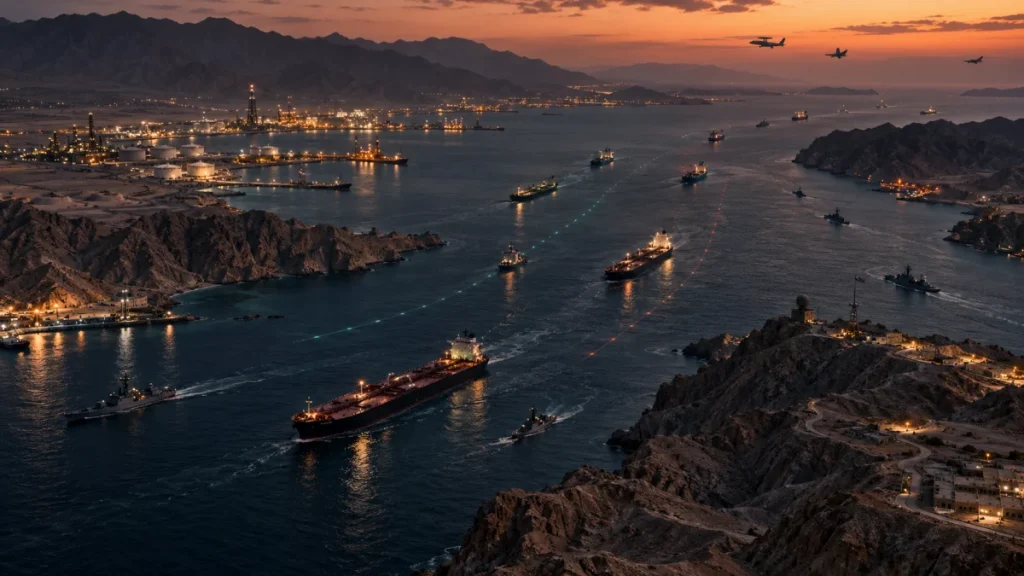
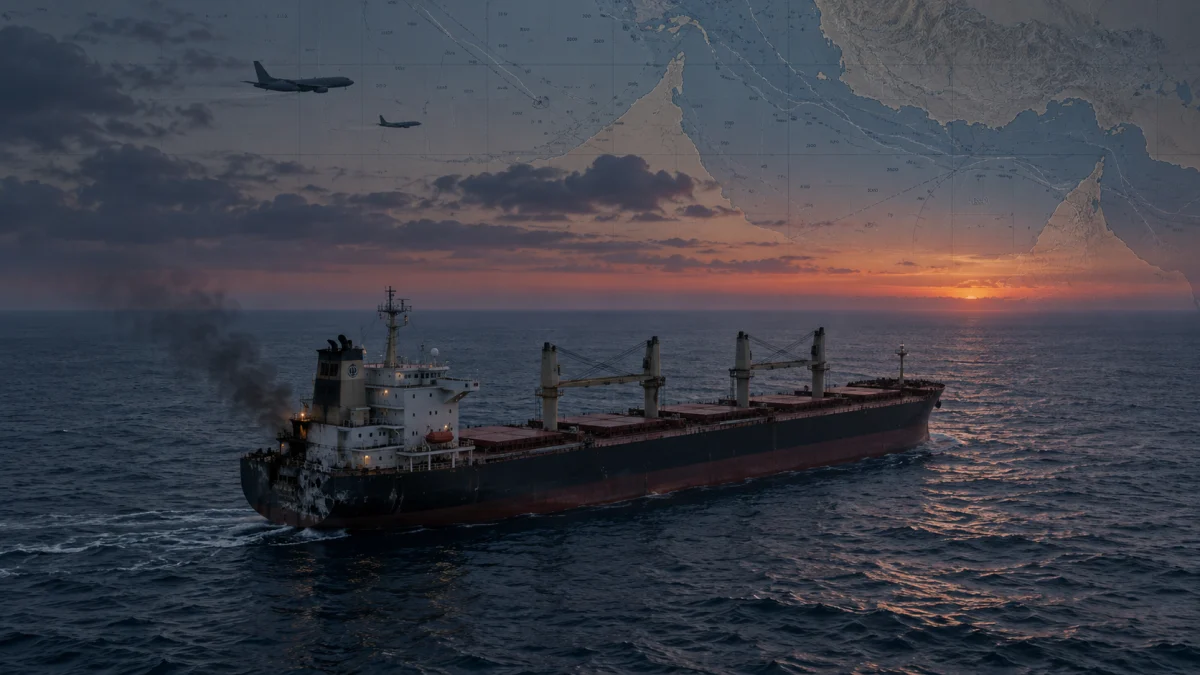
On October 10, 2026, a U.S. fighter jet struck the stern of the Ocean Molica, a Panama-flagged commercial bulk carrier in the Gulf of Oman. U.S. Central Command (CENTCOM) says the vessel ignored repeated warnings after departing an Iranian port and was attempting to violate Washington’s naval blockade. The military says the strike disabled the ship’s propulsion without injuring its crew.
The strike is documented. The full justification for it is not yet independently established.
The difference matters. A commercial vessel’s neutral flag does not make it immune from wartime interception. But under widely cited rules of naval warfare, suspected blockade violations can justify capture under certain conditions; attacking a neutral merchant ship requires additional grounds. The exact warnings, the crew’s responses, the voyage’s verified origin and the circumstances of the strike are therefore central—not incidental—to assessing what happened.
This investigation compares CENTCOM’s October 10 statement, reproduced in full by Forth, the U.S. Navy’s July 14 blockade warning published through UK Maritime Trade Operations, ship-identification and AIS records, and the San Remo Manual’s rules for neutral merchant vessels.
What happened to the Ocean Molica on October 10?
CENTCOM’s statement says its forces attacked the vessel after the crew ignored repeated warnings during enforcement of the blockade against ships entering or departing Iranian ports. The command identified the ship as the Panama-flagged M/V Ocean Molica, described it as also known as the Arika Sun, and said a U.S. fighter jet struck the stern with a precision munition.
The military’s account includes four consequential assertions:
- The ship had previously departed an Iranian port.
- Its crew received and ignored repeated warnings.
- The strike fully disabled its propulsion.
- No crew members were harmed.
Those assertions are not all supported to the same degree by independent evidence.
Reuters reported the CENTCOM statement on October 10 and said it had not immediately reached the vessel’s operator for comment. A separate Reuters verification note accompanying a still from the U.S.-released video says its team checked the video’s October 10 date against ship-tracking data. Reuters expressly noted that the exact location of the strike was not verified.
Video showing an explosion at the ship’s stern is meaningful corroboration of an attack. It does not reveal the complete sequence of warnings, prove the ship’s previous port of call, establish what its crew understood or independently confirm its members’ physical condition afterward.
In the same release, CENTCOM reported that, during the roughly three months since the blockade resumed, U.S. forces had disabled four commercial vessels, turned around 135 ships and destroyed ten tankers it described as connected to the Islamic Revolutionary Guard Corps. Those are CENTCOM’s cumulative figures, not independently audited totals and not counts specific to the Ocean Molica.
What kind of ship was the Ocean Molica?
Despite occasional descriptions of the incident as a tanker strike, the identified vessel is a bulk carrier, a ship designed to transport unpackaged dry cargo such as grain, ore, coal or other commodities. Nothing verified in the public record reviewed here establishes that it was carrying oil—or identifies its cargo on October 10.
The ship’s relatively stable identifier is IMO 9139270. IMO numbers are intended to remain attached to a vessel even when its name, owner or flag changes.
| Vessel detail | Publicly documented information |
|---|---|
| Vessel involved | Ocean Molica |
| IMO number | 9139270 |
| Maritime Mobile Service Identity (MMSI) | 374348000 |
| Flag | Panama |
| Type | Bulk carrier / dry-bulk vessel |
| Year built | 1996 |
| Length | Approximately 225 meters |
| Deadweight capacity | Approximately 70,296 metric tons |
| Another name in vessel databases | Akira Sun |
| Another name in CENTCOM’s statement | Arika Sun |
The characteristics above are consistent across VesselFinder, Maritime Optima and Rynda’s vessel record, although the services do not always display the same current name or voyage data.
Why do Arika Sun and Akira Sun appear as different names?
CENTCOM uses Arika Sun. Multiple shipping databases associate IMO 9139270 with Akira Sun, with the letters i and r reversed compared with the military’s version. AIS-oriented sites also display Ocean Molica for the same identifier.
A vessel can legitimately acquire new names throughout its service life, and commercial tracking platforms may lag behind official registry changes. Here, however, the specific Arika/Akira spelling difference has not been resolved by an independently obtained registry certificate. It should not be treated as evidence of a fraudulent identity, sanctions evasion or an intentional deception.
For identifying this ship, IMO 9139270 is more reliable than choosing one of the conflicting names.
Where was the Ocean Molica going? Did it leave Iran?
This is the most important factual question that the initial military account leaves open.
CENTCOM says the vessel had previously departed an Iranian port but does not publicly name that port, specify the departure date or publish the port-clearance documents on which the conclusion rests.
Meanwhile, MarineRadar’s public AIS display reports an October 8 departure from Fujairah Anchorage and a declared destination of Jakarta, Indonesia. It lists a reported position near 25.2069° N, 56.8586° E, received on October 10 at 15:23 UTC. Rynda shows a broadly nearby AIS position at 15:13 UTC but different broadcast voyage details and vessel status. Reuters’ image-verification note independently reports a nearby last-known location, approximately 25.2136° N, 56.8515° E.
Those are reported tracking observations, not verified strike coordinates. They also should not be confused with a definitive record of every port visited.
There are several reasons the displayed destination does not settle the question:
- A ship could have departed an Iranian port before arriving at an intermediate anchorage elsewhere.
- An AIS destination may be a manually entered declaration that is stale, incomplete or subsequently changed.
- Public ship-tracking sites may differ because of receiver coverage, update timing and how they reconstruct voyages.
- A destination outside Iran does not itself exclude a past departure from an Iranian port during an applicable blockade.
The reverse is just as important: an allegation of a past Iranian port departure is not proof, by itself, that every legal condition for attacking the vessel was met.
To reconstruct this voyage conclusively, investigators would need time-stamped port-call or clearance records, a continuous track where available, the vessel’s log, and the relevant boarding or interception communications. Its October cargo manifest and bill of lading would also help establish what commercial voyage was underway, although cargo type alone would not determine whether a blockade was breached.
What did the U.S. blockade of Iran prohibit?
The October strike occurred under a formally announced U.S. naval blockade, not simply an ordinary economic-sanctions program.
On July 13, 2026, CENTCOM announced that it would resume blockading ships entering or exiting Iranian ports the following day at 4 p.m. Eastern time, equivalent to 20:00 UTC. The command said the earlier blockade had operated between April 13 and June 18.
The detailed Joint Maritime Information Center Advisory 015-26, dated July 14 and carrying a U.S. Naval Forces Central Command naval-cooperation notice, makes several distinctions that are easy to lose in a general description of the war:
- The blockade covers Iranian ports and coastal areas and is stated to apply to traffic regardless of flag.
- Vessels suspected of entering or departing the blockaded area without authorization may face interception, diversion or capture.
- The notice expressly says neutral traffic through the Strait of Hormuz to or from non-Iranian destinations is not itself barred, although vessels can be inspected to evaluate suspected contraband or blockade violations.
- Humanitarian shipments essential to civilians are subject to a specified inspection and approval process.
- It warns that failures to comply with blockading forces can rapidly escalate to disabling or destructive fire.
These are the U.S. command’s stated enforcement rules and warnings. Publishing a warning is relevant to whether ships were put on notice. It does not automatically settle the separate question of whether a particular attack complied with international law or whether a particular crew received an adequate incident-specific warning.
A naval blockade also differs from sanctions. Sanctions restrict defined financial transactions, commerce or dealings under applicable domestic or international rules. A wartime blockade is a physical maritime enforcement measure whose use of force engages the law of armed conflict, neutrality and the UN Charter.
For the wider war chronology, including why transit through the Strait of Hormuz became contested, see sherafy.com‘s explanation of the Strait of Hormuz crisis and the U.S.-Israel war with Iran.
Can the U.S. legally attack a Panama-flagged merchant ship?
A neutral flag offers significant protections, but it is not an absolute shield against wartime capture or attack. What matters is the applicable legal framework and the ship’s conduct.
The widely cited San Remo Manual on International Law Applicable to Armed Conflicts at Sea is a nonbinding expert restatement of naval-warfare rules. It is not a treaty automatically binding every state in all its particulars, although many of its provisions reflect widely accepted customary-law principles.
Two of its provisions are especially important here.
Rule 1: Suspected blockade breach can justify capture
Under San Remo paragraph 98, a merchant vessel reasonably believed to be breaching a blockade may be captured. Paragraph 146 likewise addresses grounds for capturing neutral merchant vessels outside neutral waters, including an attempted blockade breach.
That makes the Ocean Molica‘s actual route important. If U.S. forces possessed reasonable grounds to believe it was breaking an applicable blockade, a basis for stopping or capturing it might exist under the naval-warfare framework even though it flew Panama’s flag.
But authorization to capture is not identical to authorization to attack.
Rule 2: Attacking a neutral merchant vessel has additional conditions
San Remo paragraph 67(a) addresses neutral merchant vessels reasonably believed to be carrying contraband or breaching a blockade. It permits attack in that setting when, after prior warning, the vessel intentionally and clearly refuses to stop or intentionally and clearly resists visit, search or capture.
Paragraph 98 also states that a merchant vessel which clearly resists capture after prior warning may be attacked. Other provisions address different conduct—for example, a neutral vessel engaging in belligerent acts—but no such alternative allegation has been substantiated publicly for this case.
The 2025 second edition of the Newport Manual on the Law of Naval Warfare, published in the U.S. Naval War College’s International Law Studies, likewise treats resistance to visit, search or capture and refusal to stop as circumstances that can make a neutral merchant vessel liable to attack. That is an expert manual, not a ruling on this specific incident.
These rules make the distinction between a warning being issued and a warning being received, understood and intentionally defied highly consequential. An intentional refusal to stop can be relevant even without firing weapons at a warship. Conversely, a vessel’s mere presence in a dangerous area, its nationality or a destination entry in AIS is not enough by itself to establish the required conduct.
Even where a vessel becomes liable to attack, the broader rules governing military objectives, feasible precautions and civilian protection continue to matter. The fact that a precision weapon was used or no casualties were reported does not, on its own, answer every applicable legal question.
What does the evidence show about this particular strike?
The strongest answer currently available is conditional: CENTCOM describes facts relevant to the naval-warfare rules, but the publicly reviewed material does not independently establish the complete sequence needed to evaluate those rules against the crew’s actual conduct.
Ocean Molica evidence and legality matrix
| Material question | What the record establishes | What remains unresolved |
|---|---|---|
| Was a commercial vessel struck? | CENTCOM acknowledges the attack; its footage and Reuters’ verification support an October 10 strike. | Full independent damage assessment and the vessel’s later condition. |
| Was it Panama-flagged? | CENTCOM and multiple vessel databases identify Panama as the flag. | Current underlying registry certificate has not been obtained for this report. |
| Was it an oil tanker? | Consistent ship particulars identify IMO 9139270 as a bulk carrier, not an oil tanker. | The actual cargo aboard on October 10. |
| Was there a published blockade? | The July 13 announcement and July 14 maritime advisory establish the declared U.S. blockade and its scope. | Whether all legal requirements for the blockade were satisfied and how the UN Charter applies. |
| Had the ship departed an Iranian port? | CENTCOM makes this claim. | The port, departure date and independent port-clearance evidence. |
| Did the crew receive warnings? | CENTCOM says warnings were repeated. | Audio, exact wording, languages used, timing and confirmation of receipt. |
| Did it intentionally refuse to stop or resist visit, search or capture? | CENTCOM alleges noncompliance and an attempted blockade breach. | The ship’s orders, responses, maneuvers and any effort to comply. |
| Where precisely did the attack occur? | Public tracking provides nearby last-reported AIS positions; Reuters verified the video’s date. | Reuters could not confirm the exact strike location or its territorial-waters context. |
| Was the crew unharmed? | CENTCOM says there were no injuries. | Independent crew or operator confirmation. |
This matrix is not a court finding. It identifies which propositions are supported by records, which are military assertions and which still lack the evidence needed for a responsible conclusion.
There is a useful comparison in the U.S. military’s own earlier reporting. After it disabled the Iranian-flagged M/V Touska in April, CENTCOM’s detailed account published by the Defense Visual Information Distribution Service described a six-hour warning period, an instruction to evacuate the engine room and a later Marine boarding operation. Those circumstances are not proof that the October incident was similar, and the ships’ different flags matter. They demonstrate, however, the level of incident-specific detail the military has previously made public.
For the Ocean Molica, the available October 10 statement does not provide a comparable warning chronology.
Does international law permit the blockade itself?
There are two different legal questions, and an analysis that answers only one is incomplete.
The first is the law governing conduct during an armed conflict: assuming a naval blockade is being enforced, what conditions govern interception, capture and attack? The San Remo and Newport provisions above address that question.
The second is the law governing when states may use force at all. Article 2(4) of the UN Charter generally prohibits the threat or use of force in international relations, subject to the Charter’s exceptions and legal framework, including self-defense and Security Council action. An operation’s conformity with naval-warfare rules does not necessarily resolve its legality under the Charter.
The distinction is not a technicality invented for this incident. In a June 2026 analysis for Just Security, legal scholars Brian Finucane and Rebecca Ingber argued that using force against neutral-flagged vessels to enforce the U.S. blockade raises an additional UN Charter problem, even where older naval-warfare rules might authorize capture or attack. They expressly challenged the broader legal basis of the U.S. campaign. That is a reasoned legal argument, not a court judgment settling the matter.
Separately, maritime-law researcher Frederik Rogiers argued in Opinio Juris that the U.S. arrangement’s protection of transit to non-Iranian ports matters significantly when assessing its compliance with customary blockade rules. His analysis addressed the blockade’s conduct-related requirements without deciding whether the underlying resort to force was lawful.
Nor does saying that a ship is Panama-flagged, by itself, prove that Panama has become a belligerent or that the incident constitutes a legally established armed attack on Panama. Flag-state rights are important: Article 92 of the UN Convention on the Law of the Sea sets out the general high-seas principle of flag-state jurisdiction, while wartime naval law claims particular exceptions and enforcement powers. Determining the legal consequences here requires attention to the strike location, Panama’s position and the governing law.
An attack may raise questions under both frameworks. Neither framework can responsibly be reduced to the claim that neutral vessels can never be struck—or that a blockade announcement automatically authorizes every strike.
Why the missing records matter
It would take relatively little new evidence to make several unresolved points much clearer.
A complete record of the radio warnings could establish what the U.S. forces instructed, when they did so and whether the ship replied. Bridge audio and logs could clarify whether the crew understood and refused the orders, was unable to comply or attempted to alter course. A verified port-call history would test the alleged Iranian departure. The exact engagement coordinates and time would clarify the geography and jurisdictional questions. A statement from the ship operator, master or Panamanian maritime authority could independently address the crew, damage, route and aftermath.
None of those records should be presumed to say something they have not yet said. Their importance is precisely that they could support, qualify or contradict the present account.
The distinction is especially consequential because the July 14 U.S. maritime notice warned ships to comply immediately and said noncompliance could escalate rapidly to disabling fire. That makes it important to know what happened between the first communication with the Ocean Molica and the moment a fighter jet attacked its stern.
What happens next?
The next meaningful developments are likely to be practical and evidentiary rather than rhetorical: the vessel’s propulsion and seaworthiness, any required towing or salvage, the crew’s welfare, the flag state’s response, the operator’s account, and possible release of military communications or additional tracking records.
The broader context remains a contested Strait of Hormuz and an unresolved U.S.-Iran conflict. For readers following the diplomatic effort to end the blockade, sherafy.com has separately examined Iran’s publicly stated negotiating conditions and its demands concerning the Strait of Hormuz. For the economic consequences of the war’s shipping disruptions, see our analysis of China’s role in absorbing the global oil shock.
For now, the clearest conclusion is not a categorical legal verdict. It is a distinction between what is known and what has merely been asserted.
A U.S. jet struck a Panama-flagged bulk carrier. The U.S. says the ship breached an Iran blockade and disregarded warnings. The blockade notice and naval-warfare rules explain why those allegations matter. But the public record does not yet independently establish the actual warnings, the ship’s complete voyage or its conduct immediately before the attack.
Those are the facts that determine whether this was lawful blockade enforcement—not simply the fact that a strike took place.
Frequently Asked Questions
Why did the United States strike the Ocean Molica?
CENTCOM says the bulk carrier had departed an Iranian port, ignored repeated warnings and attempted to violate the U.S. naval blockade. Its fighter jet struck the ship’s stern on October 10, 2026. The warning sequence and voyage have not yet been independently reconstructed in full.
Was the Ocean Molica an oil tanker?
No. Shipping databases identify IMO 9139270 as a bulk carrier. Its actual October 10 cargo has not been independently verified in the documents reviewed here.
Are Ocean Molica, Akira Sun and Arika Sun the same ship?
They are names associated with the same reported incident or IMO identity, but the spelling needs care. CENTCOM describes Ocean Molica as also known as Arika Sun, while multiple ship databases list Akira Sun for IMO 9139270. The precise status of those names has not been resolved by an original registry certificate.
Does Panama’s flag make an attack automatically illegal?
No. Neutral merchant vessels are protected, but under the law of naval warfare they may be subject to capture for suspected blockade breaches and, in narrower circumstances, attack after specified forms of warning and noncompliance. Separate UN Charter questions about using force against neutral-flagged shipping may remain.
Does an ignored warning automatically justify firing on a ship?
Not on its own. The applicable rules require attention to what the ship was reasonably suspected of doing and to the circumstances of the warning and response. A public advisory does not independently prove that a specific crew received and intentionally defied an adequate warning.
Did the Ocean Molica really leave an Iranian port?
CENTCOM says it did. Public AIS platforms display other voyage declarations, including Fujairah Anchorage and Jakarta, but those fields do not provide a complete historical itinerary. The named Iranian port, dates and supporting clearance records have not been independently verified for this article.
Were any crew members injured?
CENTCOM reported no injuries. An independent confirmation from the crew, operator or maritime authority was not established in the public materials reviewed through October 11.
Did the attack take place in international waters?
CENTCOM places it in the Gulf of Oman, and public AIS data shows the vessel’s last reported position in the broader area. Reuters could not independently verify the exact strike location. That means a specific territorial-waters conclusion should not be inferred from the broad geographic description alone.
References and Further Reading
Military announcements and maritime notices
- CENTCOM, "U.S. Forces Disable Cargo Vessel Attempting to Violate Blockade" (October 10, 2026; full statement reproduced by Forth). The U.S. military’s account of the strike, asserted warnings, Iranian departure, propulsion damage and reported crew safety. A military statement is direct evidence of what CENTCOM claims, not independent proof of every assertion.
- CENTCOM, "U.S. Forces to Resume Naval Blockade Against Iran" (July 13, 2026). Formal announcement of the July 14 resumption, including the previously declared blockade period and intended scope.
- Joint Maritime Information Center / USNAVCENT-NCAGS, Advisory 015-26: "Blockade of Iranian Ports" (July 14, 2026; PDF). Original notice describing neutral transit, interdiction, humanitarian procedures and U.S. warnings about the possible use of force.
- CENTCOM Public Affairs, "U.S. Forces Disable Vessel Attempting to Enter Iranian Port, Violate Blockade" (April 19, 2026; DVIDS). Prior case involving the Iranian-flagged Touska, useful for contrasting the specificity of publicly disclosed warning and boarding details; it is not evidence of what occurred aboard the Ocean Molica.
Vessel identity, tracking and independent verification
- VesselFinder, Ocean Molica / IMO 9139270 vessel particulars. Ship type, flag, dimensions, identifier and associated historical naming data; live data fields can change.
- Rynda, Akira Sun / IMO 9139270. Corroborating identification and a separately presented October 10 AIS observation.
- MarineRadar, Ocean Molica / MMSI 374348000. Public AIS-derived position, declared destination and voyage display; not a verified complete port-call log.
- Reuters, "U.S. military says it disabled cargo vessel trying to run Iran blockade" (October 10, 2026; republished by Investing.com). Independent reporting of CENTCOM’s allegations and unsuccessful initial effort to obtain the operator’s comment.
- Reuters Connect, October 10 Ocean Molica video-still verification notes. Explains Reuters’ check of the footage date and its explicit inability to confirm the precise strike location. Image rights are separate from the ability to cite the verification record.
Law of naval warfare and the UN Charter
- ICRC, San Remo Manual, paragraphs 67–71: Neutral Merchant Vessels. Circumstances under which a neutral merchant vessel may become liable to attack.
- ICRC, San Remo Manual, paragraphs 93–108: Blockade. Declaration, notification, effectiveness, impartiality, humanitarian limits and the distinction between capture and attack.
- ICRC, San Remo Manual, paragraphs 146–152: Capture of Neutral Merchant Vessels. Circumstances in which vessels may be captured beyond neutral waters.
- Newport Manual Expert Group, Newport Manual on the Law of Naval Warfare, Second Edition (2025). Contemporary scholarly restatement of the law governing merchant ships, blockade, capture and targeting.
- United Nations, Charter of the United Nations. Primary text for the distinct international-law rules on the threat or use of force by states.
- United Nations, Convention on the Law of the Sea, Part VII. Article 92’s baseline high-seas principle of flag-state jurisdiction, subject to applicable exceptions.
Competing legal interpretations
- Brian Finucane and Rebecca Ingber, "Blockade and Article 2(4) of the UN Charter" (Just Security, June 12, 2026). Argues that the U.S. blockade’s enforcement against ships registered to third states raises serious Charter issues distinct from compliance with naval-warfare rules.
- Frederik Rogiers, "A Blockade by the Book: Why CENTCOM’s Carve-Out for Non-Iranian Ports Matters" (Opinio Juris, June 11, 2026). Examines the design of the U.S. blockade under naval-warfare rules while separating that assessment from the lawfulness of the underlying resort to force.
Editorial currency note: This article reflects publicly accessible information reviewed through October 11, 2026. The vessel’s exact October cargo, independently verified Iranian departure, complete warning record, precise strike coordinates, crew condition and operator or flag-state response may change as new records emerge. Any subsequent release of primary evidence should be assessed before updating the factual or legal conclusions.