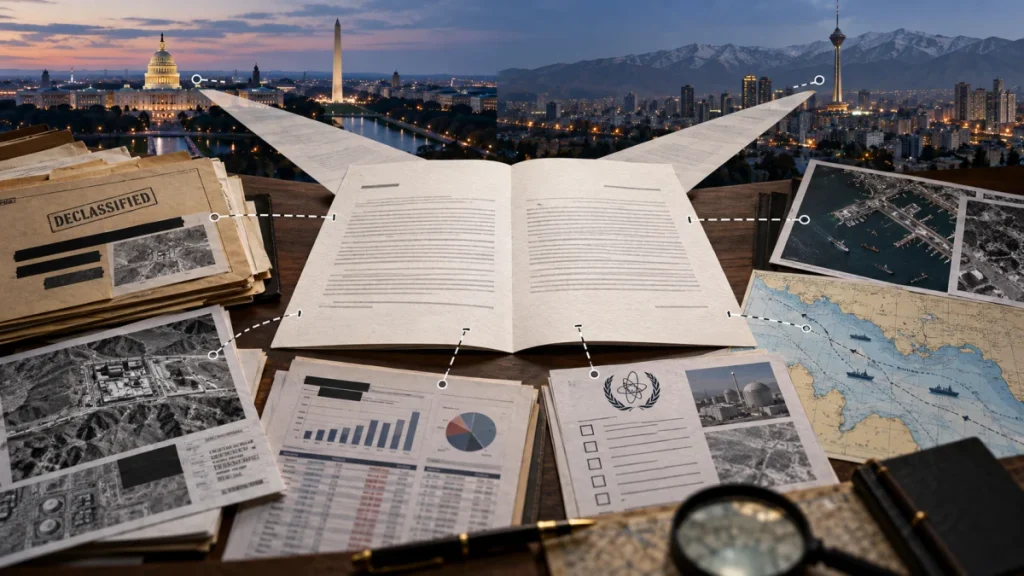
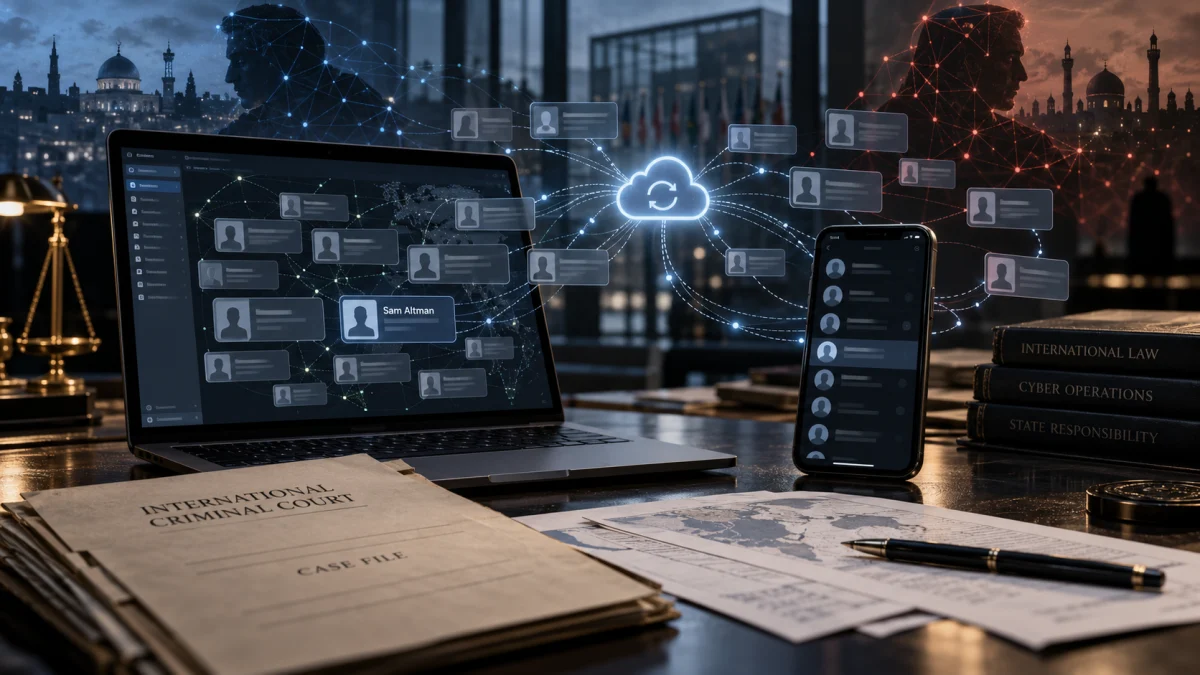
There is currently no public forensic evidence proving that Mossad hacked Juan Branco’s computer or phone. Branco, a French lawyer whose name appears on victim submissions in the International Criminal Court’s Palestine proceedings, did publicly circulate an extraordinary allegation: thousands of unexpected contacts had appeared on his systems, including entries identified as Elon Musk, Sam Altman, and senior Israeli political, judicial, and intelligence figures.
The viral version went much further. It became: Mossad tried to steal Branco’s data, accidentally reversed the operation, uploaded its own secret directory, and exposed thousands of Israeli intelligence contacts in the process.
That version is not established by the public evidence.
There is no published forensic report attributing the incident to Mossad. There is no publicly documented exploit chain. There is no malware sample, command-and-control infrastructure, contact-database analysis, or independent technical examination showing that an Israeli intelligence service "injected" its own records instead of extracting Branco’s.
There is, however, an overlooked clue that makes the story more interesting rather than less.
Months before Branco’s August 2026 allegation, an Iran-linked hack-and-leak operation released a massive contact list associated with former Israeli prime minister Naftali Bennett. Bennett later acknowledged unauthorized access to his Telegram account and said genuine contacts, photos, and chats had been obtained and circulated alongside fabricated material. The Wall Street Journal reported that the release included a 141-page contact list. A contemporaneous Turkish report specifically named Sam Altman and Elon Musk among the contacts circulating from the Bennett leak.
That does not prove Branco’s contacts came from the Bennett material. It means there was already a large, compromised Israeli political contact dataset in circulation containing at least some of the same headline names.
The real question is therefore not simply, "Did Mossad screw up?"
It is:
What actually appeared on Juan Branco’s systems, where did that data come from, and what evidence would be necessary to identify who put it there?
That distinction matters because this story involves a lawyer participating in an active international criminal proceeding, a documented history of intelligence pressure against the ICC, an Iran-linked hack-and-leak campaign, and a viral narrative that has repeatedly converted allegations into facts.
This article separates them.
Privacy note: sherafy.com does not reproduce leaked private phone numbers or use them as a public matching key. The issue here is the provenance and significance of the dataset, not the redistribution of personal information.
What did Juan Branco actually claim?
On August 7, 2026, a post from Juan Branco’s X account circulated with video showing a large number of unexpected contacts. The original X post later became unavailable, but contemporary mirrors and reposts preserve the central allegation.
A widely circulated version quoted Branco as saying that when "the Mossad plays around with your phone," it had, "by mistake," injected rather than extracted thousands of contacts. Viral posts highlighted names identified as Musk, Altman, and many Israeli political, judicial, and intelligence figures.
A contemporaneous Thread Reader mirror of the viral thread and a Substack copy published on August 7 preserve how the allegation spread.
But there is an important evidentiary distinction:
We can verify that the allegation circulated from material attributed to Branco. We cannot verify from the public record that Mossad was responsible for the underlying event.
Those are different propositions.
The distinction largely disappeared as the story moved through social media.
| What the available material supports | What the viral version turned it into |
|---|---|
| Branco publicly attributed an anomalous contact event to Mossad | Mossad was forensically identified as the attacker |
| Thousands of unexpected contacts were shown or described | Mossad accidentally uploaded its internal directory |
| Entries identified as Altman, Musk, and Israeli officials appeared | Altman was exposed as a Mossad contact |
| Branco associated the event with an intrusion | The exact attack mechanism was established |
| Some reposts say the contacts came through a computer sync | GrapheneOS itself was hacked |
That inflation is the central problem with the current coverage.
Juan Branco really is involved in the ICC’s Palestine proceedings
The professional connection at the center of the story is not invented.
The International Criminal Court’s own docket contains a filing titled "Amended Victims’ Observations regarding the jurisdiction of the ICC towards Israeli Citizens in the situation of Palestine – Juan Branco." It was filed in August 2024 and later corrected on the docket.
That is stronger evidence than social-media descriptions of Branco as an "ICC lawyer." More precisely, the official record shows him filing observations on behalf of victims in the ICC’s Situation in the State of Palestine.
What the ICC record does not establish is every additional biographical claim circulating online. For example, sherafy.com has not independently verified the viral assertion that Branco is "one of only 12" such lawyers worldwide, and that number is unnecessary to understand the story.
The important fact is simpler: Branco has a documented role representing victim interests in the ICC Palestine proceedings.
That also explains why a genuine compromise of his systems would be serious. Lawyers involved in sensitive international criminal proceedings may possess confidential communications, victim information, legal strategy, or evidentiary material.
But seriousness is not proof.
There is presently no public evidence that Palestinian victims’ records were actually obtained in this incident, and it would be irresponsible to state that they were.
What evidence proves Branco was hacked?
At the moment, not enough has been published to answer that question conclusively.
A video of an unexpected contact list can establish that unusual data appeared on a device. It cannot, by itself, establish:
- who placed the data there;
- whether an attacker placed it there at all;
- whether the source was the phone, a computer, a cloud account, or a synchronized address book;
- whether information was also extracted;
- whether malware was involved;
- whether the contact database was new, recycled, or assembled from several sources;
- or whether Mossad, another intelligence service, a hack-and-leak group, or an unrelated technical event was responsible.
For a cyber-espionage attribution this serious, the public would normally want at least some combination of host forensics, synchronization logs, contact-source metadata, account-access records, malware artifacts, network indicators, infrastructure analysis, or an independent technical report.
None of that has been published.
That does not prove Branco fabricated the incident.
It means the available evidence does not support the certainty with which the internet is describing it.
The ICC itself offers a useful comparison. After an unprecedented cyberattack against the Court in 2023, the institution said it had conducted forensic analysis but still could not publicly confirm who was responsible. Cyber attribution is difficult even when the victim is an international court with professional security personnel and investigators.
A screenshot or contact-list video is not a shortcut around that problem.
Was GrapheneOS hacked?
There is no public evidence establishing a compromise of GrapheneOS itself.
This matters because many reposts focused on the operating system as though Branco’s video demonstrated that a hardened Android platform had been remotely defeated.
It does not.
Several contemporaneous Reddit discussions preserved screenshots that participants said came from Branco’s follow-up posts. Those reposts say the apparent infection or anomaly originated on his computer and was then synchronized with his contacts. The original follow-up is no longer readily available, so sherafy.com treats that detail as secondary evidence, not an independently authenticated statement.
Even if the sync account is accurate, several very different technical scenarios remain possible:
- Computer compromise: an attacker alters a contact database on a desktop or laptop, which later synchronizes normally to the phone.
- Cloud or account compromise: an attacker gains access to a Google, CardDAV, Exchange, or other synchronized account and modifies contacts remotely.
- Imported contact file: a large vCard or address-book dataset is added through a legitimate synchronization mechanism.
- Phone compromise: malicious code directly modifies contact data on the handset.
- Non-malicious synchronization error: an existing address book or data source is unintentionally merged.
Only one of those scenarios requires defeating the phone’s operating system.
So the careful answer to "Did Mossad hack GrapheneOS?" is not "yes" or "no."
It is: nothing currently published demonstrates that GrapheneOS was the point of compromise.
The overlooked clue: another huge Israeli contact list had already leaked
This is where the chronology becomes important.
On December 17, 2025, the Handala hacking persona announced what it called "Operation Octopus" and claimed to have compromised former Israeli prime minister Naftali Bennett’s iPhone.
Bennett initially denied that his phone had been hacked. Later that day, however, his office acknowledged a narrower compromise.
According to The Times of Israel’s report on Bennett’s statement, Bennett said his phone itself had not been breached but that attackers had obtained unauthorized access to his Telegram account "through various means."
More importantly for the Branco story, Bennett acknowledged that material from his contact list, along with images and chats, had been unlawfully obtained and circulated. He said some of the released material was authentic and some was fabricated.
That admission establishes two things:
- a real unauthorized compromise occurred; and
- a large contact dataset associated with Bennett was circulating publicly afterward.
The Wall Street Journal reported that the release included a 141-page contact list containing several world leaders.
Israeli technology publication CTech independently examined the Bennett material and found reason to question Handala’s claim that it had fully compromised the physical phone. Its analysis noted that some supposedly extracted chat material looked more like messaging-platform contact cards than proof of complete device access.
That distinction is directly relevant here.
A large contact dataset can be real even when the attacker’s story about how it obtained the data is exaggerated or wrong.
Sam Altman and Elon Musk were reportedly in the Bennett material months earlier
The most intriguing overlap is also the one that requires the most careful wording.
A December 18, 2025 report from the Turkish newspaper Sözcü, preserved by Ankara24, specifically identified OpenAI CEO Sam Altman, Elon Musk, and International Atomic Energy Agency Director General Rafael Grossi among notable names in the Bennett contact list circulating online.
The report also said alleged Mossad and Shin Bet personnel appeared in the list.
That latter assertion should not be treated as independently verified. Bennett himself warned that the leak mixed authentic and fabricated material, and sherafy.com has not authenticated the raw contact database.
But the Altman-Musk overlap matters for a narrower reason.
Those names were publicly associated with a leaked Israeli political contact list about eight months before Branco’s August 2026 video.
Branco’s later material also highlighted Altman and Musk.
That creates an obvious provenance question:
Were some or all of the unexpected contacts on Branco’s systems drawn from an already circulating leak?
The answer is currently unknown.
And two overlapping celebrity names are nowhere near enough to establish that the datasets are the same.
A meaningful comparison would require substantially more.
Does this mean Branco received the Bennett contact list?
No. Not on the evidence currently available.
This is where a responsible investigation has to resist replacing one unsupported certainty with another.
The existence of an earlier dataset gives us a plausible alternative source for at least some of the names. It does not establish a chain of custody from Bennett’s compromised account to Branco’s computer.
To test that hypothesis properly, investigators would want to compare non-sensitive structural features such as:
- the same unusual contact names or aliases;
- identical misspellings;
- organization labels;
- duplicate entries;
- record order;
- vCard identifiers;
- contact creation and modification timestamps;
- synchronization-source metadata;
- account identifiers;
- or other database artifacts.
A high number of exact, unusual matches would strengthen the hypothesis.
Major differences would weaken it.
Phone numbers themselves could also be evidentiary in a controlled forensic setting, but publishing or redistributing private numbers would create unnecessary privacy and security harms. sherafy.com will not do that.
Until that comparison exists, the most accurate formulation is:
The Bennett leak is an overlooked possible provenance source, not a proven explanation for Branco’s contact anomaly.
Why was Sam Altman’s name there?
The internet has attached an enormous amount of meaning to a single contact entry.
It should not.
Even if the contact labeled Sam Altman is authentic, a person’s presence in a politician’s address book is not evidence that the person works with an intelligence service.
There is also an ordinary documented reason senior Israeli political figures might possess Altman’s contact information.
During a June 2023 visit to Israel, Altman met Israeli President Isaac Herzog and spoke publicly about Israel’s technology sector. Israeli Prime Minister Benjamin Netanyahu’s office also said Netanyahu spoke with Altman by phone about artificial intelligence, its opportunities and risks, and possible cooperation.
That does not prove how Altman’s information entered Bennett’s contacts, and sherafy.com has not independently authenticated the alleged number shown in leaked datasets.
But it does demolish one of the weakest viral implications:
"Sam Altman appeared in an Israeli political contact list" does not logically become "Sam Altman was exposed as a Mossad contact."
There is currently no evidence for that conclusion.
Why Mossad is not an absurd hypothesis, even though it is unproven here
Saying that Mossad attribution is unproven does not require pretending Israeli intelligence has no documented interest in the ICC.
Quite the opposite.
A major May 2024 joint investigation by The Guardian, +972 Magazine, and Local Call reported that Israeli intelligence agencies had conducted a years-long campaign of surveillance and interference directed at the International Criminal Court and Palestinian organizations cooperating with it.
The investigation, based on interviews with current and former Israeli intelligence and government officials, ICC figures, diplomats, lawyers, and others, reported interception of communications involving ICC personnel and alleged attempts to pressure or compromise former chief prosecutor Fatou Bensouda.
A related Guardian investigation reported that then-Mossad director Yossi Cohen personally pressured Bensouda over the Palestine investigation.
Israel disputed the reporting. The Israeli prime minister’s office said the questions presented to it contained "false and unfounded allegations," while the Israel Defense Forces denied conducting surveillance or intelligence operations against the ICC.
The ICC, meanwhile, told the reporters that it was aware of proactive intelligence-gathering activity by national agencies hostile to the Court.
This history matters.
It makes the proposition that an Israeli intelligence service could have an interest in an ICC-linked lawyer plausible in a general sense.
But this is exactly where probability and proof must remain separate.
Prior allegations of Israeli surveillance against the ICC do not identify the actor responsible for Branco’s 2026 contact anomaly.
In Bayesian terms, history can change the prior probability. It cannot supply the missing forensic evidence.
Who is Handala, and why does it matter?
The earlier Bennett leak also cannot be dismissed as an anonymous internet prank.
On March 19, 2026, the U.S. Justice Department announced the seizure of four domains that it said were used by Iran’s Ministry of Intelligence and Security in cyber-enabled psychological operations and transnational repression.
Two of those domains used the Handala name.
According to the Justice Department, the infrastructure was used to claim credit for hacking activity, publish sensitive data stolen during hacks, and conduct psychological operations against perceived adversaries.
That does not mean every Handala claim is true. In fact, hack-and-leak operations frequently mix genuine stolen material with exaggeration, selective presentation, or false material precisely because the objective is psychological as well as informational.
Bennett’s own response illustrates the problem: he admitted unauthorized Telegram access and genuine leaked material while saying some content had been fabricated.
So Handala’s relevance to the Branco story is specific:
By the time Branco’s contacts appeared, a large Israeli political contact dataset connected to an Iran-linked hack-and-leak ecosystem had already been released into the wild.
That fact expands the list of plausible provenance pathways.
It does not identify the actor who affected Branco.
The evidence, claim by claim
The easiest way to understand this story is to stop treating it as one giant yes-or-no proposition.
| Claim | Current assessment | Why |
|---|---|---|
| Juan Branco has represented victim interests in the ICC Palestine proceedings | Verified | The ICC docket contains victims’ observations filed under his name |
| Branco publicly attributed an anomalous contact event to Mossad | Verified as an allegation | Contemporary mirrors preserve the allegation after the original X post became unavailable |
| Thousands of unexpected contacts appeared on his systems | Supported by Branco’s displayed material, not independently forensically verified | Public evidence is primarily Branco’s video/screenshots and reposts |
| Mossad caused the event | Unproven | No public forensic attribution has been produced |
| GrapheneOS itself was compromised | No public evidence | The material does not identify the phone OS as the attack vector |
| Mossad accidentally uploaded its internal directory | Unproven | This is a viral interpretation, not a demonstrated forensic finding |
| The contact labeled Sam Altman was genuinely Altman’s direct number | Unverified | sherafy.com has not authenticated the number |
| Altman’s appearance establishes a Mossad relationship | Unsupported | A contact-book entry does not establish intelligence affiliation |
| Bennett suffered unauthorized account access in December 2025 | Verified | Bennett acknowledged unauthorized Telegram access |
| A large Bennett-associated contact list was leaked | Verified | Bennett acknowledged contact material was obtained; major outlets documented the release |
| Altman and Musk were reported in the Bennett material | Reported, not independently authenticated by sherafy.com | A contemporaneous Sözcü report named both |
| Branco’s contacts came from the Bennett leak | Plausible hypothesis, unproven | Some headline-name overlap exists, but no record-by-record or metadata comparison has been published |
| Israeli intelligence has previously targeted or surveilled ICC-related activity | Strongly reported and disputed by Israel | Multi-outlet investigative reporting cites numerous sources; Israeli officials denied the allegations |
| Palestinian victims’ confidential information was stolen from Branco | No public evidence | The potential risk is real, but successful access to victim files has not been demonstrated |
This table is the core of the story.
The viral version collapses the entire matrix into a single sentence. The evidence does not.
A short chronology explains why the provenance question matters
May 2024: Israeli intelligence operations against the ICC are reported
The Guardian, +972 Magazine, and Local Call publish a major investigation alleging years of Israeli surveillance and interference directed at ICC officials and Palestinian organizations.
August 2024: Branco appears in the ICC Palestine docket
The ICC publishes victim observations filed under Juan Branco’s name in the Situation in the State of Palestine.
December 17-18, 2025: Handala releases Bennett-associated material
Handala claims to have hacked Naftali Bennett’s phone. Bennett says his phone was not breached but acknowledges unauthorized access to Telegram and the release of contact material, chats, and images.
The Wall Street Journal reports a 141-page contact list.
A contemporaneous Turkish report specifically names Sam Altman and Elon Musk among contacts in the leaked material.
March 19, 2026: U.S. authorities publicly connect Handala infrastructure to Iranian intelligence
The Justice Department announces domain seizures and says Handala-branded domains were being used by Iran’s Ministry of Intelligence and Security for hacking-related leaks and psychological operations.
August 7, 2026: Branco publishes the anomalous contacts
Branco publicly attributes the event to Mossad and displays or describes thousands of contacts, with viral accounts emphasizing Musk, Altman, and Israeli officials.
After August 7: the allegation becomes a conclusion
Posts and videos increasingly describe the event as a confirmed Mossad operation in which an extraction tool malfunctioned and uploaded an intelligence directory.
No corresponding public forensic report appears.
That is how an unresolved technical event became an accepted narrative.
What evidence would actually settle this?
There are several ways the story could move from allegation to attribution.
1. Forensic imaging of the affected computer and phone
A qualified examiner could determine what changed, when it changed, what processes made the changes, and whether known malicious artifacts were present.
2. Contact-database metadata
Contact stores often preserve identifiers, source-account information, modification times, group membership, sync metadata, or other structural clues. Those details could reveal whether thousands of records arrived in one import, through a cloud service, or incrementally.
3. Account and synchronization logs
If the contacts arrived through Google, CardDAV, Exchange, iCloud, or another synchronization provider, login and synchronization history could identify the account, device, IP address, or session involved.
4. Malware or persistence artifacts
If a computer or phone was compromised, investigators would look for executables, scripts, persistence mechanisms, exploit traces, process logs, or indicators of compromise.
5. Network evidence
Command-and-control infrastructure, DNS activity, TLS certificates, hosting patterns, or known infrastructure reuse can help attribute operations when combined with other evidence.
6. Dataset comparison
A forensic comparison between Branco’s anomalous contacts and the Bennett leak could test the older-dataset hypothesis without publishing private numbers. Rare names, misspellings, internal labels, record IDs, ordering, and metadata would be particularly valuable.
7. Independent review
Because the allegation involves state intelligence services and an active international legal matter, the strongest evidence would come from an independent technical examination whose methodology can be scrutinized.
Until evidence of that quality appears, certainty is premature.
What about the claim that Branco later admitted "Mossad" was figurative?
A contemporaneous Reddit discussion linked to a second post from Branco’s X account and claimed that he later said he lacked evidence of Mossad responsibility and had used the term more figuratively.
That would be highly relevant if authenticated.
At present, however, the linked X post is unavailable and sherafy.com has not located a reliable archival copy containing the full original text.
We therefore do not treat that characterization as established.
The absence of a recoverable post does not prove the Reddit description was false. It simply means it cannot carry evidentiary weight in our conclusion.
If an authentic archive or statement from Branco becomes available, this article should be updated.
So what most likely happened?
The public evidence is not strong enough to select one scenario with high confidence.
Several remain consistent with what we know.
Scenario 1: Branco was genuinely compromised by an unidentified actor
An attacker could have gained access to a computer, account, or synchronized service and caused a large contact dataset to appear.
This would explain the anomaly without establishing who the attacker was.
Scenario 2: a previously leaked contact dataset was imported during a compromise
An attacker could have intentionally or accidentally imported an existing Israeli political contact list, potentially including material from the Bennett leak or another dataset.
The timing and overlapping headline names make this worth investigating, but the hypothesis remains unproven.
Scenario 3: a sync or account event imported an unrelated existing address book
The contacts could have arrived through a compromised account, misconfigured synchronization source, restored backup, or imported file without requiring the exotic "Mossad reversed its extraction tool" mechanism.
This possibility is technically mundane, but mundane explanations cannot be ruled out merely because the surrounding political context is extraordinary.
Scenario 4: Mossad or another Israeli service was responsible
The documented history of alleged Israeli intelligence interest in ICC activity means this is not inherently implausible.
But no public forensic evidence currently identifies Mossad as the actor.
Scenario 5: another intelligence or influence actor was responsible
The existence of an Iran-linked hack-and-leak ecosystem possessing Israeli political contact data makes alternative state-linked scenarios possible as well.
Again, possibility is not evidence.
The strongest conclusion is therefore narrower:
The anomaly may be real. The viral explanation has not been demonstrated.
The bottom line
Juan Branco’s connection to the ICC’s Palestine proceedings is real.
His allegation that Mossad was involved in an anomalous contact event genuinely circulated from material attributed to his account.
What has not been established is the part the internet now repeats most confidently: that Mossad hacked his phone, accidentally reversed a data-extraction operation, and uploaded its own directory of agents and high-level contacts.
There is no public forensic report demonstrating that.
There is no public evidence that GrapheneOS itself was compromised.
There is no sound basis for claiming that Sam Altman’s appearance in a contact list establishes an intelligence relationship.
And there is no evidence currently showing that attackers obtained confidential files belonging to Palestinian victims.
At the same time, dismissing the story out of hand would also ignore important evidence.
Branco is genuinely involved in sensitive ICC proceedings. Serious investigative reporting has previously described Israeli intelligence surveillance and interference targeting the Court, allegations Israel has denied. And a large Israeli political contact list connected to Naftali Bennett had already been leaked months before Branco’s incident, with contemporaneous reporting identifying Altman and Musk among its contents.
That earlier leak does not solve the mystery.
It tells us what the mystery actually is.
The central unresolved question is data provenance.
Until someone can show where Branco’s unexpected contacts came from, how they entered his systems, and what forensic evidence identifies the responsible actor, "Mossad accidentally uploaded its phone book" should be treated as a viral claim, not an established fact.
That is less satisfying than the version circulating online.
It is also what the evidence supports.
References and Further Reading
Primary Records and Official Sources
-
International Criminal Court — Amended Victims’ Observations in the Situation in the State of Palestine, Juan Branco — The ICC docket record directly establishing Branco’s participation in victim submissions related to the Palestine situation.
-
International Criminal Court — Measures taken following the unprecedented cyber-attack on the ICC — The Court’s 2023 statement describing its forensic response to a major cyberattack and its inability at that stage to publicly identify the attacker; useful context for how difficult cyber attribution can be.
-
U.S. Department of Justice — Justice Department Disrupts Iranian Cyber Enabled Psychological Operations — The March 2026 domain-seizure announcement connecting Handala-branded infrastructure with Iranian Ministry of Intelligence and Security operations.
Bennett / Handala Leak
-
The Times of Israel — Bennett admits Iranian hackers accessed his Telegram account, says phone not breached — Reports Bennett’s acknowledgment of unauthorized Telegram access and his statement that genuine contacts, images, and chats were circulated alongside fabricated material.
-
The Wall Street Journal — New Iran-Linked Cyberattack Targets Former Israeli Prime Minister — Reports that the Bennett release included hundreds of messages and a 141-page contact list containing several world leaders.
-
CTech — Inside the alleged hack of Naftali Bennett: Telegram breach or phone compromise? — Technical reporting examining the released material and questioning whether Handala’s evidence demonstrated the full device compromise it claimed.
-
Ankara24 archive of Sözcü report — Bennett contact leak and notable names — Preserves a contemporaneous Turkish report specifically identifying Sam Altman, Elon Musk, and Rafael Grossi among notable names said to appear in the leaked Bennett contacts. This is secondary evidence and should not be mistaken for independent authentication of the raw dataset.
Israeli Intelligence and the ICC
-
The Guardian — Spying, hacking and intimidation: Israel’s nine-year ‘war’ on the ICC exposed — Major joint investigation with +972 Magazine and Local Call into alleged Israeli surveillance and interference targeting ICC officials and Palestinian organizations. The article also records Israeli denials.
-
+972 Magazine — Surveillance and interference: Israel’s covert war on the ICC exposed — The Israeli-Palestinian publication’s version of the joint investigation, with additional detail about the alleged multi-agency surveillance effort.
-
The Guardian — Israeli spy chief ‘threatened’ ICC prosecutor over war crimes inquiry — Reports allegations that former Mossad director Yossi Cohen personally pressured former ICC prosecutor Fatou Bensouda. Cohen did not respond to the Guardian; Israel’s prime minister’s office rejected the allegations put to it.
Sam Altman and Israeli Officials
-
The Times of Israel — Israel will have ‘huge role’ to play in AI revolution, OpenAI’s Sam Altman says — Documents Altman’s June 2023 Israel visit, including his meeting with President Isaac Herzog and discussions with Israeli technology leaders.
-
The Times of Israel — Netanyahu speaks to visiting OpenAI CEO Sam Altman, discusses cooperation — Reports the Prime Minister’s Office statement that Netanyahu and Altman spoke by phone about AI and possible cooperation.
The Branco Claim and Its Viral Spread
-
Thread Reader — contemporary mirror of the August 2026 viral thread — Preserves a contemporaneous social-media rendering of Branco’s allegation after the original X material became difficult to access. Useful for provenance of the viral claim, not as independent technical verification.
-
GenXGirl — August 7, 2026 copy of the viral allegation and ICC timeline — Another contemporaneous preservation of how the allegation was framed and spread online. It should be read as a record of the claim, not evidence establishing the hack’s attribution.
Editorial currency note: This is an active cyber-attribution question. If Branco, a forensic laboratory, the ICC, a security researcher, or another competent investigator releases authenticated technical evidence identifying the source of the contacts or the actor responsible, the evidentiary assessment in this article should be updated.